This three-part blog series is a modified version of what I presented to the Evangelical Philosophical Society meeting in November 2010.
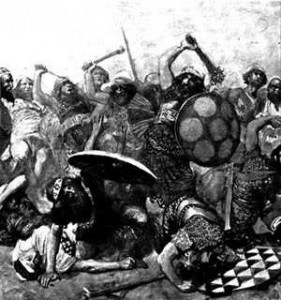
In a recent Conference at Notre Dame Alvin Plantinga suggested that the commands to wipe out the Canaanites, recorded in the book of Deuteronomy, might be hyperbolic; they should be understood more like how we understand a person who states, in the context of a boxing match, “knock his block off, hand him his head”, or in a football game where a person states that the team should “kill the opposition” or boasts that “we totally slaughtered them.”[1] Understood this way, the commands in Deuteronomy meant “something like attack them, defeat them, drive them out; not literally kill every man, woman, child donkey and the like”.[2]
In two previous posts I have explored and defended Nicholas Wolterstorff’s argument for this conclusion. In God and the Genocide of the Canaanites Part I: Wolterstorff’s Argument for the Hagiographic Hyperbolic Interpretation, I elaborated on, appropriated and expanded Nicholas Wolterstorff’s case for understanding Joshua as a hagiographic, stylised and highly hyperbolic account of Israel’s early skirmishes. In Part II: Ancient Near Eastern Conquest Accounts, I argued that studies into Ancient Near Eastern historiography give considerable support to his conclusion. Joshua appears to follow the same rhetoric, literary conventions and motifs of other ancient Near East conquest accounts and one feature of such accounts is to narrate victories hyperbolically in terms of killing all people, leaving no survivors and so forth. This suggests the description of Joshua putting every inhabitant to the sword, totally destroying all and leaving no survivors, is not to be taken literally. In this last post in this series I want to look at some implications of accepting this.
I think two implications can be drawn from this conclusion. First,
On the assumption that Deuteronomy and Joshua are parts of the same sequence of books, this interpretation of Joshua forces a back-interpretation of Deuteronomy. If “struck down all the inhabitants with the edge of the sword” is a literary convention when used to describe Joshua’s exploits, then it is likewise a literary convention when similar words are used by Moses in his instructions to Israel in general and to Joshua in particular.[3]
I think Wolterstorff is correct here, this interpretation of Joshua does force a back-interpretation of Deuteronomy. Deuteronomy 7:2 states “when Yahweh your God has given them up before you and you have struck them, you shall utterly destroy them”. Similarly, Deuteronomy 20:16-17 states “anything that breathes you shall not keep alive, but you shall utterly destroy them”. In Joshua 10 one sees the formulaic language of “and Yahweh gave [the city]” and they “struck it by the mouth of the sword, and its king he hath destroyed” until there were “no survivors”. The chapter is summarised with the phrase “So Joshua struck all the land, … He destroyed all that breathed”. The similar phraseology is evident.[4]
Moreover, the book of Joshua clearly, explicitly and repeatedly identifies what Joshua did in these chapters with the command that Moses had given regarding the Canaanites in Deuteronomy.[5] If the language of “striking all the people by the sword”, “leaving no survivors”, “totally destroying”, “striking all the inhabitants with the edge of the sword”, and so on, is hyperbolic (as the evidence suggests it is) then the command cannot have been intended to be taken literally.
This understanding of the commands in Deuteronomy also solves some other interpretative problems. Here I will mention briefly three.
First, what God commanded regarding the Canaanites differs in various canonical books (more…)