Tag: Kenneth Kitchen

  • God and the Genocide of the Canaanites Part II: Ancient Near Eastern Conquest Accounts

    This three-part blog series is a modified version of what I presented to the Evangelical Philosophical Society meeting in November 2010.

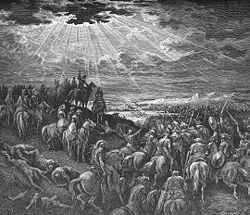
    Joshua stops the sun

    In my previous post, God and the Genocide of the Canaanites Part I: Wolterstorff’s Argument for the Hagiographic Hyperbolic Interpretation, I expounded and adapted Nicholas Wolterstorff’s argument for a hagiographic hyperbolic reading of the book of Joshua. Wolterstorff’s argument has, I think, considerable force. Judges and Joshua cannot both be taken literally as their accounts are at odds; given the internal evidence Wolterstorff cites it is reasonable to contend that Joshua is the one that is non-literal. Wolterstorff, however, limits his case to what I call internal evidence, evidence from within the text itself. I think there is some interesting external evidence, evidence of how particular terms and language were used in other Ancient Near Eastern histories of conquests and battles, which could be added to Wolterstorff’s argument to make it significantly more plausible. Here I will cite three lines of such evidence.

    The first is that comparisons between the book of Joshua and other Ancient Near Eastern conquest accounts from the same period demonstrate some important stylistic parallels. Various studies have documented these similarities. Commenting on the structure of the campaigns mentioned in Joshua 9-12, Kitchen notes;

    This kind of report profile is familiar to readers of ancient Near Eastern military reports, not least in the second millennium. Most striking is the example of the campaign annals of Tuthmosis III of Egypt in his years 22-42 (ca. 1458-1438). … [T]he pharaoh there gives a very full account of his initial victory at Megiddo, by contrast with the far more summary and stylized reports of the ensuing sixteen subsequent campaigns. Just like Joshua against up to seven kings in south Canaan and four-plus up north.[1] [Emphasis added]

    Kitchen adds,

    The Ten Year Annals of the Hittite king Mursil II (later fourteenth century) are also instructive. Exactly like the “prefaces” in the two Joshua war reports (10:1-4; 11:1-5), detailing hostility by a number of foreign rulers against Joshua and Israel as the reason for the wars, so in his annals Mursil II gives us a long “preface” on the hostility of neighbouring rulers and people groups that lead to his campaigns.[2] [Emphasis added]

    Kitchen adds other examples. He observes that the same formulaic style found in Joshua is also used in the Amarna letters EA 185 and EA 186.[3]Similarly, before his major campaigns (more…)

  • God and the Genocide of the Canaanites Part I: Wolterstorff’s Argument for the Hagiographic Hyperbolic Interpretation

    Around this time last year I wrote two posts Joshua and the Genocide of the Canaanites I and Joshua and the Genocide of the Canaanites II. These posts attracted a fair amount of attention and debate. I got offers to publish my ideas in several upcoming books and present them before both the Evangelical Philosophical Society (EPS) and the Society for Biblical Literature in November 2010. Since the original posts I have corresponded with various people and I have modified and refined some of the ideas. This three-part blog series is a modified version of what I presented to the EPS last month. These posts supersede and update what I wrote in a year ago.

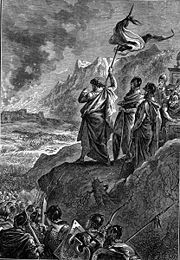
    Joshua at AiOne of the most perplexing issues facing Christian believers is a series of jarring texts in the Old Testament. After liberating Israel from slavery in Egypt, the Israelites arrived on the edge of the Promised Land. The book of Deuteronomy records that God then commanded Israel to “destroy totally” the people occupying these regions (the Canaanites); the Israelites were to “leave alive nothing that breathes”. The book of Joshua records the carrying out of this command. In the sixth chapter it states “they devoted the city to the LORD and destroyed with the sword every living thing in it—men and women, young and old, cattle, sheep and donkeys”. In the tenth and eleventh chapters it states that Joshua “left no survivors. He totally destroyed all who breathed, just as the LORD, the God of Israel, had commanded.” The text mentions city after city where Joshua, at God’s command, puts every inhabitant “to the sword”  “totally destroyed the inhabitants” and “left no survivors.”

    If one takes these passages literally they record the divinely-authorised commission of genocide. But genocide surely is morally wrong. In the light of this, critics of Christian theism often ask a rhetorical question; how could a good and loving God command the extermination of the Canaanites?

    One response which goes back to the patristic era is to suggest that the strict, literal reading on which this rhetorical question is based is mistaken. Recently, several, protestant scholars have suggested a hyperbolic reading of the relevant passages.[1] Perhaps the most detailed is that proposed by Nicholas Wolterstorff. Wolterstorff suggests,

    “[T]hat the Book of Joshua has to be read as a theologically-oriented narration, stylized and hyperbolic at important points, of Israel’s early skirmishes in the Promised Land, with the story of these battles being framed by descriptions of two great ritualized events.  The story as a whole celebrates Joshua as the great leader of his people, faithful to Yahweh, worthy successor of Moses.  If we strip the word “hagiography” of its negative connotations, we can call it a hagiographic account of Joshua’s exploits.”[2]

    In this series I will defend Wolterstorff’s position. In this post I will sketch, adapt and defend Wolterstorff’s argument. In Part II, I will argue that external evidence from comparative studies in Ancient Near Eastern conquest accounts gives considerable support to Wolterstorff’s position. Finally in Part III I will look at two implications of this position.

    Wolterstorff’s Argument
    Wolterstorff’s contention is that “a careful reading of the text in its literary context makes it implausible to interpret it as claiming that Yahweh ordered extermination”. It is important to note what he means by context. Here, it is clear that Wolterstorff is advocating a canonical approach. He notes that,

    “Joshua as we have it today was intended as a component in the larger sequence consisting of Deuteronomy, Joshua, Judges, I and II Samuel, and I and II Kings…  I propose that we interpret the Book of Joshua as a component within this larger sequence – in particular, that we interpret it as preceded by Deuteronomy and succeeded by Judges.”[3]

    Joshua comes after Deuteronomy and before Judges. Wolterstorff points out that these books should be read as a single narrative. When one does this, however, several issues are apparent. (more…)

  • Contra Mundum: Did God Command Genocide in the Old Testament?

    Perhaps the most perplexing issue facing Christan believers is a series of jarring texts in the Old Testament. After liberating Israel from slavery in Egypt, the Israelites arrived on the edge of the promised land. The book of Deuteronomy records that God then commanded Israel to “destroy totally” the people occupying these regions (the Canaanites); the Israelites were to “leave alive nothing that breathes.” The book of Joshua records the carrying out of this command. In the sixth chapter it states “they devoted the city to the LORD and destroyed with the sword every living thing in it—men and women, young and old, cattle, sheep and donkeys.” In the tenth and eleventh chapters the text states that Joshua “left no survivors. He totally destroyed all who breathed, just as the LORD, the God of Israel, had commanded.” The text mentions city after city where Joshua, at God’s command, puts every inhabitant “to the sword” and “left no survivors.” If these passages are taken in a strict, literal fashion then it is correct to conclude that they do record the divinely authorised commission of genocide. In light of this critics of Christianity often ask how a good and loving God could command the extermination of the Canaanites?

    In response, I want to suggest that this strict, literal reading is mistaken. Reading these texts in isolation from the narrative in which they occur risks a distortion of the authors intended meaning. Consider the book of Joshua, critics are quick to point out that in chapters ten and eleven the text states that Joshua “totally destroyed all who breathed”, left “no survivors” in “the entire land”, went through the land “exterminating them without mercy”.

    The problem is that chapters fifteen to seventeen record that the Canaanites were, in fact, not literally wiped out. Over and over the text affirms that the land was still occupied by the Canaanites, who remain heavily armed and deeply entrenched in the cities. Astute readers will note that these are the same regions and the same cities that Joshua was said to have “destroyed all who breathed”, left “no survivors” in just a few chapters earlier.

    This continues through into the next book in the Old Testament. The first two chapters of the book of Judges record that the Canaanites lived in the very same regions and cities that Joshua was said to have put every inhabitant “to the sword” in and “left no survivors” in. Moreover, again we see that they occupied these cities and regions in such numbers and strength that they had to again be driven out by force, which chapter one of Judges declared was very difficult.

    Read in context then, it is difficult to see how the language of total genocide in chapters ten and eleven of the book of Joshua could have been intended to be taken literally by the authors.

    This phenomena is not limited to the books of Joshua and Judges. The book of Deuteronomy in chapters seven and twenty contain commands to the Israelites to “destroy them [the Canaanites] totally” and “not leave alive anything that breathes.” The books of Deuteronomy and Exodus, in numerous places, state that the Canaanites are to be slowly driven out and expelled from the land, which is not the same thing as killing them. In fact, legislation is cited in the texts which clearly assumes that the Canaanites will survive Joshua’s the invasion. Immediately after stating that the Israelites should “destroy them totally” the text reads, “make no treaty with them, and show them no mercy. Do not intermarry with them. Do not give your daughters to their sons or take their daughters for your sons.” If they were all supposed to be dead then why bother issuing instructions regarding treaties and intermarriage?

    When read in context, it is unlikely that the author of these texts intended the language “destroy totally”, “do not leave alive anything that breathes”, destroy “men and women, young and old”, and so on, to be taken literally. How then should these passages be understood? At a recent conference at the University of Notre Dame, Philosopher Alvin Plantinga suggested a possible solution is to take this language hyperbolically. He suggested phrases such as, “destroy with the sword … men and women … cattle, sheep and donkeys” are phrases to be understood more like we understand a person who, in the context of watching David Tua in a boxing match, yells, “Knock his block off! Hand him his head! Take him out!” or hopes that the All Blacks will “annihilate the Springboks” or “totally slaughter the Wallabies.” Now, the sports fan does not actually want David Tua to decapitate his opponent or for the All Blacks to become mass murderers. Plantinga suggests that the same could be true here; understood in a non-literal sense the phrases probably mean “something like, attack them, defeat them, drive them out; not literally kill every man, woman, child donkey and the like.” If this is correct then the differences between the different texts is easily explained and more significantly, the texts do not teach that God commanded genocide or that Joshua carried it out.

    Interestingly, research into Ancient Near-Eastern history writings bear Plantinga’s idea out. In a comprehensive comparative study of Ancient Near-Eastern conquest accounts, Old Testament scholar, K. Lawson Younger documents stylistic and literary similarities between Joshua and reports of wars written by the some of these surrounding cultures. He concludes that the Old Testament uses the same literary conventions. He notes, “the composition and rhetoric of the Joshua narratives in chapters 9-12 are compared to the the conventions of writing about conquests in Egyptian, Hittite, Akkadian, Moabite, and Aramaic texts, they are revealed to be very similar.” He substantiates with numerous examples in his book.

    In addition, when one examines the literary conventions of such accounts it is evident that the rhetoric of total conquest, complete annihilation and destruction of the enemy, killing everyone, leaving no survivors, etc, is a common hyperbolic way of describing a victory in the manner Plantinga suggests. Renowned Egyptologist Kenneth Kitchen notes,

    [T]he type of rhetoric in question was a regular feature of military reports in the second and first millennia, as others have made very clear. … In the later fifteenth century Tuthmosis III could boast “the numerous army of Mitanni, was overthrown within the hour, annihilated totally, like those (now) non-existent” –- whereas, in fact, the forces of Mitanni lived to fight many another day, in the fifteenth and fourteenth centuries. Some centuries later, about 840/830, Mesha king of Moab could boast that “Israel has utterly perished for always” – a rather premature judgment at that date, by over a century! And so on, ad libitum. It is in this frame of reference that the Joshua rhetoric must also be understood.

    Some examples will illustrate this. The Merneptah Stele states “Yanoam was made nonexistent; Israel is laid waste, its seed is not.” here the Egyptian Pharoh Merneptah describes a skirmish with Israel in which his armies prevailed, hyperbolically, in terms of the total annihilation of Israel. The Assyrian king Sennacherib uses similar hyperbole, “The soldiers of Hirimme, dangerous enemies, I cut down with the sword; and not one escaped.” Mursili II records making “Mt. Asharpaya empty (of humanity)” and the “mountains of Tarikarimu empty (of humanity).” Similarly, The Bulletin of Ramses II, an historical narrative of Egyptian military campaigns into Syria, narrates Egypt’s considerably less than decisive victory at the battle of Kadesh with the rhetoric, “His majesty slew the entire force of the wretched foe from Hatti, together with his great chiefs and all his brothers, as well as all the chiefs of all the countries that had come with him” [Emphasis added]. The examples could be multiplied but the point is that such language was hyperbolic and not intended to be taken literally.

    Consequently, if one does not read the texts in isolation and is sensitive to the genre of Ancient Near-Eastern writings then a literal reading is far from obvious. As Egyptologist James K. Hoffmeier notes, such a reading commits “the fallacy of misplaced literalism … the misconstruction of a statement-in-evidence so that it carries a literal meaning when a symbolic or hyperbolic or figurative meaning was intended.” This underscores an obvious but often neglected point, the bible is not written in accord with the conventions of 21st century English. It was written in ancient foreign languages and in the conventions that governed historical, legal, epic, etc writings of that time. To understand what it teaches accurately one needs to ask what it teaches given these factors. When one does this, it seems probable that the Old Testament does not teach that God commanded or that Israel carried out the genocide or extermination of the Canaanites.

    I write a monthly column for Investigate Magazine entitled Contra Mundum. This blog post was published in the Aug 10 issue and is reproduced here with permission. Contra Mundum is Latin for ‘against the world;’ the phrase is usually attributed to Athanasius who was exiled for defending Christian orthodoxy.

    Letters to the editor should be sent to:
    editorial@investigatemagazine.DELETE.com

    RELATED POSTS:
    Contra Mundum: Fairies, Leprechauns, Golden Tea Cups & Spaghetti Monsters
    Contra Mundum: Secularism and Public Life
    Contra Mundum: Richard Dawkins and Open Mindedness
    Contra Mundum: Slavery and the Old Testament

    Contra Mundum: Secular Smoke Screens and Plato’s Euthyphro

    Contra Mundum: What’s Wrong with Imposing your Beliefs onto Others?
    Contra Mundum: God, Proof and Faith
    Contra Mundum: “Bigoted Fundamentalist” as Orwellian Double-Speak
    Contra Mundum: The Flat-Earth Myth
    Contra Mundum: Confessions of an Anti-Choice Fanatic
    Contra Mundum: The Judgmental Jesus

  • Sunday Study: Joshua and the Genocide of the Canaanites Part II

    In my previous post, Joshua and the Genocide of the Canaanites Part I, I mentioned the position suggested by Alvin Plantinga and endorsed by Nicholas Wolterstorff that the passages in Joshua that appear to record the carrying out of genocide at God’s command, such as, “putting all the people to the sword”, “leaving no survivors”, “totally destroying”, “striking all the inhabitants with the edge of the sword” are not intended to be taken literally but rather as hyperbole.

    Plantinga suggests that such phrases should “be understood more like a person who in the context of a boxing match states, “knock his block off, hand him his head” or in a football or baseball game where it is stated that the team should “kill the opposition” or that “we totally slaughtered them.”[1] In reading Joshua, Wolterstorff defends the thesis that the relevant passages are hyperbolic. He argues essentially that:

    (a) the picture of total conquest and annihilation of populations is incompatible with what is said elsewhere in Joshua and Judges;
    (b) this is obvious to anyone who reads the narrative straight through without artificially dividing the text into chapter divisions and verses;
    (c) the redactors or authors would not have been so mindless as to accidentally put obviously contradictory accounts into one narrative;
    (d) the annihilation language appears stereotyped and formulaic whereas the other passages read like more down-to-earth history.[2]

    On the basis of these points Wolterstorff argues that texts are hyperboles, similar to a football player who says “we slaughtered the opposition just like Coach told us to”[3]

    In my previous post I addressed (a); I argued, in some detail, that the picture of Joshua conquering all southern and northern Canaan, killing every inhabitant of the relevant cities and regions and leaving no survivors, if taken literally, contradicts what is affirmed in the rest of the book of Joshua and what is affirmed in Judges. I also agree with Wolterstorff about (b); to any person who reads the text straight through, not breaking it artificially into chapters and verses, and who then reads the book of Judges, these contradictions are fairly obvious. These two points alongside (c) make it improbable that the text should be read in a literal fashion.

    I think Wolterstorff understates (c). If, as Wolterstorff believes, the primary author of scripture is God then obviously the author of the text is an intelligent person who is unlikely to have deliberately (or accidentally) authored an obviously contradictory narrative.

    Now it may be contended that an appeal to divine authorship in this way begs the question, however, I think this is mistaken. As I understand the objection, the sceptic who claims that God commanded genocide is offering a reductio ad absurdium; he or she starts by assuming that whatever God commands is right and that scripture is the word of God and then derives from these assumptions the absurd conclusion that genocide is not wrong. The question then is whether, granting these assumptions, such a conclusion does, in fact, follow.

    Taken together, (a),(b),(c) and (d) do make a hyperbolic reading probable. If the text cannot sensibly be taken literally, and if there is some evidence of formulaic, ritualistic language in the text, then that would suggest some kind of non-literal reading and a hyperbolic one certainly makes sense of the data.

    Wolterstorff’s case has some merit, however, I think it can be considerably strengthened. Wolterstorff limits his case to what I call internal evidence, evidence from within the text itself. I think, however, there is some interesting external evidence, evidence from how particular terms and language is used in other ancient near eastern histories of conquests and battles, which could be added to Wolterstorff’s argument to make it significantly more plausible. Here I will cite three lines of such evidence.

    The first is that rhetoric of total conquest, complete annihilation and destruction of the enemy, killing everyone, leaving no survivors, etc, is a common hyperbolic way of describing a victory in ancient near eastern histories of the same period. Kenneth Kitchen notes,

    [T]he type of rhetoric in question was a regular feature of military reports in the second and first millennia, as others have made very clear. … In the later fifteenth century Tuthmosis III could boast “the numerous army of Mitanni, was overthrown within the hour, annihilated totally, like those (now) non-existent” –- whereas, in fact, the forces of Mitanni lived to fight many another day, in the fifteenth and fourteenth centuries. Some centuries later, about 840/830, Mesha king of Moab could boast that “Israel has utterly perished for always” – a rather premature judgment at that date, by over a century! And so on, ad libitum. It is in this frame of reference that the Joshua rhetoric must also be understood.[4]

    In a comprehensive comparative study of ancient near eastern conquest accounts K Lawson Younger documents stylistic and literary similarities between Joshua and reports of wars written by the Hittites, Egyptians and Assyrians including this kind of hyperbole. Merenptah’s Stele describes a skirmish with Israel as follows, “Yanoam is nonexistent; Israel is wasted, his seed is not.”[5] Here a skirmish in which Egypt prevailed is described hyperbolically in terms of the total annihilation of Israel. Sennacherib uses similar hyperbole, “The soldiers of Hirimme, dangerous enemies, I cut down with the sword; and not one escaped.”[6] Mursilli II records making “Mt. Asharpaya empty (of humanity)” and the “mountains of Tarikarimu empty (of humanity).”[7] Mesha (whom Kitchen cited as stating “Israel has utterly perished for always”) describes victories in terms of him fighting against a town, taking it and then killing all the inhabitants of the town.[8] Similarly, The Bulletin of Ramses II, an historical narrative of Egyptian military campaigns into Syria, narrates Egypt’s considerably less than decisive victory at the battle of Kadesh with the following rhetoric,

    His majesty slew the entire force of the wretched foe from Hatti, together with his great chiefs and all his brothers, as well as all the chiefs of all the countries that had come with him, their infantry and their chariotry falling on their faces one upon the other. His majesty slaughtered and slew them in their places; … He took no note of the millions of foreigners; he regarded them as chaff.[9] [Emphasis original]

    The hyperbolic use of language similar to that in Joshua is strikingly evident.

    Second, comparisons between the book of Joshua, and other ancient near eastern conquest accounts from the same period, demonstrate some important stylistic parallels. Commenting on the structure of the campaigns mentioned in Joshua 9-12, Kitchen notes;

    This kind of report profile is familiar to readers of ancient Near Eastern military reports, not least in the second millennium. Most striking is the example of the campaign annals of Tuthmosis III of Egypt in his years 22-42 (ca. 1458-1438). … the pharaoh there gives a very full account of his initial victory at Megiddo, by contrast with the far more summary and stylized reports of the ensuing sixteen subsequent campaigns. Just like Joshua against up to seven kings in south Canaan and four-plus up north.[10] [Emphasis added]

    Kitchen adds,

    The Ten Year Annals of the Hittite king Mursil II (later fourteenth century) are also instructive. Exactly like the “prefaces” in the two Joshua war reports (10:1-4; 11:1-5), detailing hostility by a number of foreign rulers against Joshua and Israel as the reason for the wars, so in his annals Mursil II gives us a long “preface” on the hostility of neighbouring rulers and people groups that lead to his campaigns.[11] [Emphasis added]

    Kitchen adds other examples. He observes that the same formulaic style found in Joshua is also used in the Amarna letters EA 185 and EA 186.[12] Similarly, before his major campaigns, “Joshua is commissioned by YHWH not to fear (cf. 5:13-15; 10:8; 11:6). So also by Ptah and Amun were Merenptah in Egypt, and Tuthmosis IV long before him: and likewise Mursil II of the Hittites by his gods (10T-Year Annals, etc.), all in the second millennium besides such kings as Assurbanipal of Assyria down to the seventh century.”[13]

    Younger notes similarities in the preface, structure and even the way the treaty with the Gibeonites is recorded between Joshua and various ancient near eastern accounts.[14] Like Joshua, The 10 Year Annals of Mursilli and Sargon’s Letter to the God record a divine intervention where the God sends hailstones on the enemy.[15] Tuthmosis III has a similar story regarding a meteor.[16] Joshua follows ancient near eastern convention in describing numerous battles occurring in a single day or within a single campaign.[17] Ancient near eastern accounts also, like Joshua, repeatedly make reference to the enemy “melting with fear.”[18] Even the way post-battle pursuits are set out and described shows similarities with similar pursuits in ancient near eastern literature.[19] I could mention more examples; the point is that “when the composition and rhetoric of the Joshua narratives in chapters 9-12 are compared to the the conventions of writing about conquests in Egyptian, Hittite, Akkadian, Moabite, and Aramaic texts, they are revealed to be very similar”.[20]

    Finally, both Kitchen and Younger note that such hyperbolic language is used in several places within the book of Joshua itself. In Joshua 10:20, for example, we are told that Joshua and the sons of Israel had “finished destroying” and “completely destroyed” their enemies. Immediately, however, the text, affirms that the “survivors went to fortified cities.” In this context, the language of total destruction is clearly hyperbolic.

    When these lines of external evidence are conjoined with the internal evidence that Wolterstorff proposes (and that which I elaborated on in my previous post) seven things are evident:

    (a) the picture of total conquest and annihilation of populations is incompatible with what is said elsewhere in Joshua and Judges;
    (b) this is obvious to anyone who reads the narrative straight through without artificially dividing the text into chapter divisions and verses;
    (c) the redactors or authors would not have been so mindless as to accidentally put obviously contradictory accounts into one narrative;
    (d) the annihilation language appears stereotyped and formulaic whereas the other passages read like more down-to-earth history;
    (e) the kind of formulaic language used in Joshua is a common form of rhetorical hyperbole for describing a victory in ancient near eastern accounts;
    (f) Joshua is written in accord with the literary and rhetorical conventions typical of such ancient near eastern accounts;
    (e) the rhetorical use of “finished destroying” and “completely destroyed” is attested to elsewhere in the book of Joshua.

    In light of these seven lines of evidence, I am inclined to think that the case for the reading that Wolterstorff defends is compelling.

    While space prevents me exploring all the implications of this conclusion, it is worthwhile commenting on one. Wolterstorff argues,

    On the assumption that Deuteronomy and Joshua are part of the same sequence of books then I submit that this interpretation of Joshua forces a back interpretation of Deuteronomy. If ‘struck down all the inhabitants with the edge of the sword is a literary convention when used to describe Joshua’s exploits then it must, likewise, be a literary convention when used by Moses in his instructions to Israel in general and to Joshua in particular. Remember this is one sequence edited just before the end of captivity.[21]

    I think Wolterstorff is correct here. The same point can be seen from the text of Joshua itself,

    So Joshua subdued the whole region, including the hill country, the Negev, the western foothills and the mountain slopes, together with all their kings. He left no survivors. He totally destroyed all who breathed, just as the LORD, the God of Israel, had commanded. (Joshua 10:40 NIV) [Emphasis added]

    Similarly we see,

    Everyone in it they put to the sword. They totally destroyed them, not sparing anything that breathed, and he burned up Hazor itself. Joshua took all these royal cities and their kings and put them to the sword. He totally destroyed them, as Moses the servant of the LORD had commanded.” (Joshua 11:11-12 NIV) [Emphasis added]

    Also,

    So that he might destroy them totally, exterminating them without mercy, as the LORD had commanded Moses (Joshua 11:20b NIV) [Emphasis added]

    As the LORD commanded his servant Moses, so Moses commanded Joshua, and Joshua did it; he left nothing undone of all that the LORD commanded Moses. (Joshua 11:15 NIV) [Emphasis added]

    The text of Joshua clearly and explicitly states that what Joshua did fulfilled the command that Moses had given regarding the Canaanites in Deuteronomy. If the language of “putting all the people to the sword”, “leaving no survivors”, “totally destroying”, “striking all the inhabitants with the edge of the sword”, and so on, is hyperbolic (as the evidence suggests it is) then the command cannot have been intended to be taken literally.


    [1] Alvin Plantinga “Comments on Evan Fales’ Satanic Versus: Moral Chaos in Holy Writ” a paper presented to My Ways Are Not Your Ways: The Character of the God of the Hebrew Bible Conference at the centre for Philosophy of Religion, University of Notre Dame, Friday 11 September 2009.
    [2] Nicholas Wolterstorff “Reading Joshua” a paper presented to My Ways Are Not Your Ways: The Character of the God of the Hebrew Bible Conference at the centre for Philosophy of Religion, University of Notre Dame, Saturday 12 September 2009.
    [3] Ibid.
    [4]
    Kenneth Kitchen On the Reliability of the Old Testament (Grand Rapids MI: Erdmans Publishing Co, 2003) 174.
    [5] K Lawson Younger Jr Ancient Conquest Accounts: A Study in Ancient Near Eastern and Biblical History Writing (Sheffield: Sheffield Academic Press, 1990) 227.
    [6]
    Ibid 228.
    [7] Ibid.
    [8]
    Ibid, 227.
    [9]
    Ibid, 245.
    [10]
    Kitchen, note 4, 170.
    [11] Ibid, 170.
    [12]
    Ibid, 172.
    [13] Ibid, 174-175.
    [14]
    Younger, note 5, 200-204.
    [15] Ibid, 208-211.
    [16] Ibid, 217.
    [17] Ibid, 216.
    [18] Ibid, 258-260.
    [19] Ibid, 220-225.
    [20] Ziony Zevit The Religions of Ancient Israel: A Synthesis of Parallactic Approaches (London and New York: Continuum, 2001) 114.
    [21]
    Wolterstorff, note 2.

    RELATED POSTS:
    Sunday Study: Joshua and the Genocide of the Canaanites Part I
    William Lane Craig, Raymond Bradley and the Problem of Hell Part One
    William Lane Craig, Raymond Bradley and the Problem of Hell Part Two

  • Sunday Study: Joshua and the Genocide of the Canaanites Part I

    Critics of Christianity often claim that the book of Joshua teaches that God commanded genocide. Raymond Bradley for example states,

    In chapters 7 through 12, [the book of Joshua] treats us to a chilling chronicle of the 31 kingdoms, and all the cities therein, that fell victim to Joshua’s, and God’s, genocidal policies. Time and again we read the phrases “he utterly destroyed every person who was in it,” “he left no survivor,” and “there was no one left who breathed.”[1]

    Similarly, Walter Sinnott-Armstrong cites passages in Joshua with the same point in mind.[2]

    The objection that Bradley and Armstrong raise in highlighting these passages is that Christians are committed to an inconsistent set of propositions.

    [1] Any act that God commands is morally permissible.
    [2] The scriptures are an authoritative revelation of God’s commands.
    [3] It is morally impermissible for anyone to commit genocide.
    [4] According to the book of Joshua, God commanded Israel to commit genocide.

    If we are to rationally affirm both [1] and [2] then we must give up either [3] or [4]. So which one should we reject?

    Philip Quinn has developed a way of addressing clashes such as this. He suggests that we can draw on a principle whereby “whenever two conflicting claims differ in epistemic status, the claim with the lower epistemic status is to be rejected.”

    [3]Given this approach, if a particular interpretation of any passage conflicts with one of our moral intuitions then we should ask whether or not the case for that interpretation is as convincing as the principle that it clashes with. Now, the principle that genocide is wrong is, I think, a highly plausible one. Therefore, if one is to prefer [3] to [4] then the case for a literal reading must at least be this plausible, and preferably even more plausible. In this series of posts I will argue, perhaps surprisingly to some, that [4] is doubtful. While it is true that taken in isolation and interpreted in a strict literal fashion the book of Joshua does appear to state that God commanded Genocide, I contend that when the text is read in its literary and textual context this conclusion is far from evident and is, in fact, rather questionable.

    In the tenth chapter of the book of Joshua we read,

    They [Joshua and his troops] took the city, its king and its villages, and put them to the sword. Everyone in it they totally destroyed. They left no survivors. They did to Debir and its king as they had done to Libnah and its king and to Hebron. So Joshua subdued the whole region, including the hill country, the Negev, the western foothills and the mountain slopes, together with all their kings. He left no survivors. He totally destroyed all who breathed, just as the LORD, the God of Israel, had commanded. Joshua subdued them from Kadesh Barnea to Gaza and from the whole region of Goshen to Gibeon. (Joshua 10:39-41)

    This text summarises Joshua’s campaign in southern Canaan. The northern campaign is summarised in a similar fashion in the following chapter,

    So Joshua took this entire land: the hill country, all the Negev, the whole region of Goshen, the western foothills, the Arabah and the mountains of Israel with their foothills, from Mount Halak, which rises toward Seir, to Baal Gad in the Valley of Lebanon below Mount Hermon. He captured all their kings and struck them down, putting them to death. Joshua waged war against all these kings for a long time. Except for the Hivites living in Gibeon, not one city made a treaty of peace with the Israelites, who took them all in battle. For it was the LORD himself who hardened their hearts to wage war against Israel, so that he might destroy them totally, exterminating them without mercy, as the LORD had commanded Moses. At that time Joshua came and wiped out the Anakim from the hill country, from Hebron, from Debir, from Anab, and from all the hill country of Judah, and from all the hill country of Israel; Joshua utterly destroyed them with their towns. No Anakites were left in Israelite territory; only in Gaza, Gath and Ashdod did any survive. So Joshua took the entire land, just as the LORD had directed Moses, and he gave it as an inheritance to Israel according to their tribal divisions. Then the land had rest from war. (Joshua 11:16-23)

    If these passages are taken in a strict literal fashion and read in isolation from the proceeding narrative they record the divinely authorised commission of genocide. Taken literally these passages state three things.

    Firstly, that Joshua conquered and subdued the entire regions of southern and northern Canaan. Verse 11:23 states that “Joshua took the entire land” and then “gave it as an inheritance to Israel according to their tribal divisions.” This suggests that the region in question is the same land that is later divided between the Israelite tribes, which was the entire land of Canaan.

    Secondly, the passage repeatedly emphasises that Joshua exterminated all the Canaanites in this region. Verse 11:21 states “Joshua came and wiped out the Anakim from the hill country, from Hebron, from Debir, from Anab, and from all the hill country of Judah.” Verse 11:22 states that no Anakites were left living in Israeli territory after this campaign.  Repeatedly it states that Joshua left “no survivors” and “destroyed everything that breathed” in “the entire land.” Alongside these general claims the text goes to identifies several specific places and cities where Joshua exterminated everyone and left no survivors and killed all who breathed. These include Hebron, Debir, the hill country and the Negev.

    Thirdly, the text states that God commanded these actions. Verse 23 identifies the commands with those laid down in the Law of Moses, which refers back to passages like Deut 20:16-19 and Deut 7.1-5.

    The first thing I want to note is that the text should not be read in isolation from the narrative in which this occurs. This hermeneutical point may seem rather obvious but when it is taken seriously immediate and obvious problems occur with a strictly literal reading of the ‘genocide passages’ I mention above. The most glaringly obvious issue relates to the opening of the book of Judges. In the first chapter of Judges we read of events that occurred after the death of Joshua (and, hence, after the campaigns mentioned in Josh 10 and 11). Here it is explicitly stated that Canaanites are living in the land which had been allotted to various Israeli tribes, the land that Joshua is said to have conquered and “left no survivors” in. Note that this was not a small remnant. They existed in such numbers that each of the tribes of Israel needed to fight in order to dislodge them from the land. Several of the tribes were unable to do so and so Israel failed to dislodge them.

    Of particular interest, however, are the several cities and regions mentioned. In the first chapter we are told that the Canaanites lived Gaza (Judg 1:18), the Negev (1:9), in the hill country  (Judg 1:9) in Debir (Judg 1:11), in Hebron (Judg 1:10) and in the the western foothills (Judg 1:9). Moreover, they did so in such numbers and strength that they had to be driven out by force. These are the same cities that Joshua 10 tells us Joshua had annihilated and left no survivors in.  Moreover, the text explicitly states that Anakites are in Hebron, yet Joshua 11:22 tells us that “No Anakites were left in Israelite territory.” This seems rather odd if Joshua had exterminated everyone there and left no survivors. It is also odd given that Joshua is said, in the genocide passages, to have conquered and subdued the entire region.

    Moreover, the account of what God commanded also differs in Judges 2:1. Here no mention of genocide or annihilation is made, instead we hear of how God had promised to drive them out and has commanded the Israelites to not to make treaties with them and to destroy their shrines. Taken in a straight-forward literal manner then, Joshua’s actions are at odds with the first two chapters of Judges.

    It is not just Judges that this problem occurs in. There are numerous places within the book of Joshua itself where the same picture is presented. As noted, Joshua 11 ends by stating that “the entire land, just as the LORD had directed Moses” was given “as an inheritance to Israel according to their tribal divisions.” When the text turns to giving an account of these tribal divisions it is evident that the Israelites do not actually occupy it, but living, breathing, Canaanites do.

    The allotments begin with God telling Joshua, “You are very old, and there are still very large areas of land to be taken over” (Josh 13:1). Moreover, when one examines the allotment given to Judah we see Caleb asking permission to drive the  Anakites (Josh14: 11) from the hill countries and we also hear how Caleb has to defeat Anakites living in Hebron and, after this, marches against the people “living in Debir” (Josh 15:13-19). Similarly it is evident with several of the other allotments that the people have yet to drive Canaanites entrenched in the area and that Israelites were not always successful in doing so.

    We read, for example, that Ephraimites and Manassites “did not dislodge the Canaanites living in Gezer; to this day the Canaanites live among the people of Ephraim” (Josh 16:10). Similarly, in Chapter 17 it states “Yet the Manassites were not able to occupy these towns, for the Canaanites were determined to live in that region. However, when the Israelites grew stronger, they subjected the Canaanites to forced labor but did not drive them out completely” (Joshua 17:12-13). We hear that “Danites had difficulty taking possession of their territory, so they went up and attacked Leshem, took it, put it to the sword and occupied it. They settled in Leshem and named it Dan after their forefather” (Joshua 19:47). Here, we see the same land said to be subdued and conquered by Joshua in battles where he exterminated and left alive nothing that breathed. This land is yet to be occupied by the tribes of Israel and is occupied by Canaanites, often heavily armed and deeply entrenched (17:17-18).

    Brevard Childs notes the apparent contradiction,

    Critical scholars have long since pointed out the tension – usually it is called a contradiction – in the portrayal of the conquest of the land. On the one hand, the conquest is pictured in the main source of Josh. 1-12 as a unified assault against the inhabitants of the land under the leadership of Joshua which succeeded in conquering the entire land. On the other hand, there is a conflicting view of the conquest represented by Judges 1 and its parallels in Joshua which appears to picture the conquest as undertaken by individual tribes, extending over a long period beyond the age of Joshua, and unsuccessful in driving out the Canaanites from much of the land.[4]

    More recently Kenneth Kitchen has taken issue with Childs’ picture of Joshua 1-12. He notes that, apart from the passages cited at the beginning of this post, a careful reading of Joshua 1-12 makes it clear that Israel did not actually occupy or conquer the areas mentioned at all. Kitchen notes that after crossing the Jordan the Israelites set up camp in Gilgal “on the east border of Jericho” (Joshua 4:19). He notes that after every battle in the next six chapters the text explicitly states that they returned to Gilgal,

    The conflict with Canaanite city-state rulers in the southern part of Canaan is worth close examination. After the battle for Gibeon, we see the Hebrews advancing upon six towns in order, attacking and capturing them, killing their local kings and such inhabitants that had not gotten clear, and moving on, not holding on to those places. Twice over (10:15, 43), it is clearly stated that their strike force returned to base camp at Gilgal.  So there was no sweeping take over and occupation of this region at this point. And no total destruction of the towns attacked.[5]

    Kitchen goes on to note,

    What happened in the south was repeated up north. Hazor was both leader and famed center for the north Canaanite kinglets. Thus as in the south the Hebrew strike force defeated the opposition; captured their towns, killed rulers and less mobile inhabitants, symbolically burned Hazor and Hazor only[6] to emphasis its end to its local supremacy. Again Israel did not attempt to immediately hold on to Galilee: they remained based at Gilgal (14:6).[7]

    Kitchen notes that the first “real indication of a move in occupation beyond Gilgal comes in 18:4.” This is after the first allotment of “lands to be occupied are made” and as we saw above the Israelites did not find occupying these allotments easy. He concludes, “these campaigns were essentially disabling raids: they were not territorial conquests with instant Hebrew occupation. The text is very clear about this.”[8]

    So a straight-forward, literal, reading of the passages cited at the beginning of this post does not cohere with the rest of the narrative. The best account I have come across for explaining this apparent contradiction between a literal reading of the “genocide passages” and the rest of Joshua and Judges is one recently defended by Nicholas Wolterstorff.[9] Wolterstorff suggests that the phrases such as, “Everyone in it they totally destroyed,” “They left no survivors,” etc are not intended to be read literally but function as hyperboles. The analogy he gives is of a high school student who, after a baseball game states, “we totally slaughtered the opposition, we annihilated them just as coach told us to.”[10]

    Plantinga suggests a similar line as a possibility. That phrases such as, “put to death men women infants and cattle” are to be understood more like a person who in the context of a boxing match states, “knock his block off, hand him his head” or  in a football or baseball game where it is stated that the team should “kill the opposition” or that “we totally slaughtered them.”[11] Understood in a non-literal sense the phrases probably meant “something like, attack them, defeat them, drive them out; not literally kill every man, woman, child donkey and the like.”[12] Wolterstorff elaborates,

    When a high-school basket ball player says his team slaughtered the other team last night he’s not asserting, literally now, that they slaughter the other team. What is he asserting? Not easy to tell. That they scored a decisive victory? Maybe, but suppose they barely eked out a win? Was he lying? Maybe not. Maybe he was speaking with a wink of the eye hyperbole. High school kids do.[13]

    In the same way,

    To say Joshua struck down all the inhabitants with the edge of the sword is a way of saying something like Israel scored a decisive victory and once you recognise the presence of hyperbole it is not even clear how decisive the victories were. Joshua did not conquer all the cities in the land nor did he slaughter all the inhabitants in the cities he did conquer. The book of Joshua does not say that he did.[14]

    In my next Sunday Study, Sunday Study: Joshua and the Genocide of the Canaanites Part II,  I will attempt to defend Wolterstorff’s position.


    [1] Raymond Bradley “A moral Argument for Atheism” Presented at the University of Western Washington, May 27, 1999, and–in a revised form–at the University of Auckland, September 29, 1999.
    [2] Walter Sinnott-Armstrong “Why Traditional Theism Cannot Provide an Adequate Foundation for Morality” in Is Goodness without God Good Enough: A Debate on Faith, Secularism and Ethics eds Robert K Garcia and Nathan L King (Lanham: Rowman & Littlefield Publishers, 2008) 110.
    [3]
    Philip Quinn “Religion and Politics” in ed William Mann The Blackwell Guide to Philosophy of Religion (Malden MA: Blackwell Publishing, 2005) 316.
    [4]
    Brevard Childs An Introduction to the Old Testament as Scripture (Fortress Press Philadelphia: 1979) 247.
    [5]
    Kenneth Kitchen On the Reliability of the Old Testament (Grand Rapids and Cambridge: William B. Eerdmans Publishing Company, 2003) 162.
    [6]
    See Joshua 11:13 “But Israel burned none of the towns that stood on mounds except Hazor, which Joshua did burn.”
    [7] Kitchen, above n 5.
    [8]
    Ibid.
    [9] Nicholas Wolterstorff “Reading Joshua” a paper presented to “My Ways Are Not Your Ways: The Character of the God of the Hebrew Bible” Conference at the centre for Philosophy of Religion, University of Notre Dame, Saturday 12 September 2009
    [10] Ibid.
    [11]
    Alvin Plantinga “Comments on Evan Fales’ Satanic Versus: Moral Chaos in Holy Writ” a paper presented to “My Ways Are Not Your Ways: The Character of the God of the Hebrew Bible” Conference at the centre for Philosophy of Religion, University of Notre Dame, Friday 11 September 2009.
    [12]
    Ibid – stated by Plantinga in the Q&A session.
    [13] Nicholas Wolterstorff “Response to Louise Anthony” a paper presented to “My Ways Are Not Your Ways: The Character of the God of the Hebrew Bible” Conference at the centre for Philosophy of Religion, University of Notre Dame. Saturday 12 September 2009.
    [14]
    Wolterstorff, above n 9.


    More recently Kenneth Kitchen has taken issue with Childs’ picture of Joshua 1-12. He notes that, apart from the passages cited at the beginning of this post, a careful reading of  Joshua 1-12 makes it clear that Israel did not actually occupy or conquer the areas mentioned at all. Kitchen notes that after crossing the Jordan the Israelites set up camp in Gilgal “on the east border of Jericho” (Joshua 4:19). He notes that after every battle in the next six chapters the text explicitly states that they returned to Gilgal,

    RELATED POSTS:
    Sunday Study: Joshua and the Genocide of the Canaanites Part II

  • Sunday Study: Abraham and Isaac – Did God Command the Killing of an Innocent?

    Perhaps the most infamous passage in the Hebrew scriptures occurs in Genesis 22:2,

    Then God said, “Take your son, your only son, Isaac, whom you love, and go to the region of Moriah. Sacrifice him there as a burnt offering on one of the mountains I will tell you about.”

    Of course, as anyone who has read the story knows, God intervened before Abraham carried out the command and prevented him from killing Isaac. It is also true that in the Mosaic laws that follow this passage, the Prophets, the Psalms and the historical books, human sacrifice is condemned. Nevertheless, God still, in this instance, commanded Abraham to kill Isaac. For this reason this story looms large in the criticisms of theological morality. The problem can be expounded succinctly; it seems plausible that Christians are committed to an inconsistent triad;

    [1] If God commands an action A then A is morally required;
    [2] It is wrong to kill innocent human beings;
    [3] God commanded Abraham to attempt to kill an innocent human being.

    It is worth noting here that the problem in [3] arises only if one takes the patriarchal narrative in Genesis as literally true, if one assumes that these narratives accurately and reliably convey the actual historical events. Some commentators evade the dilemma by denying this; according to one line of interpretation, the story of Gen 22 is a sort of parable instructing Israel, in an age where infant sacrifice was common, that God did not require such sacrifices and instead required that such piety be expressed through the sacrifice of goats.

    If this interpretation is correct the problem evaporates. However, I will not pursue this line here because, while I think there are some interesting questions around whether the proto-history of Gen 1-11 should be understood as literal history, I am not convinced that this applies to the patriarchal narratives. Kenneth Kitchen makes a reasonable case that these narratives are historically reliable. Moreover, even if he is mistaken, it seems clear that anyone who raises this objection must assume this (at least for the sake of argument). If not then there would be no basis for asserting [3] and the dilemma would again evaporate. So, in this post I will assume it as a given that the patriarchal narratives are literally true, that what they describe actually occurred.

    As I understand the objection, the objector is offering a reductio ad absurdum. He or she starts by assuming, that the patriarchal narratives are literally true and then derives a contradiction from this assumption. The question then is whether, granting this assumption, such a contradiction actually does arise.

    Proceeding on this basis, the obvious problem is that [1], [2] and [3] cannot all be true. Kant and Robert Adams have contended Christians should abandon [3] in favour of [2]. While others such as Quinn and Evans have offered defences of the claim that it in certain situations a person (or at least a person in Abraham’s epistemic situation) could rationally deny [2]. While the philosophical questions here are interesting, in this post I will endeavour to solve the dilemma exegetically. I will argue that while [1] is true, a careful examination of the text shows that the events occur in a certain context. I will then argue that when the context is taken into account, [2] is not correct. In essence, while it is true under normal circumstances that killing the innocent is wrong, in certain unusual circumstances it is not wrong. A contextual interpretation of The Torah suggests it affirms that in the case of Abraham unusual circumstances were in play.

    The Command in its Context
    In Gen 12:1-2 God reveals;

    The LORD had said to Abram, “Leave your country, your people and your father’s household and go to the land I will show you. “I will make you into a great nation and I will bless you; I will make your name great, and you will be a blessing.

    Here Abram is told by a God that he will be the father of an entire nation, one that will have its own country. An obvious implication of this is that Abram will have descendants; he will have a son who will live at least as long enough to have children of his own. The text then implicitly teaches that Abram knew on the basis of a reliable source that his son would live to adulthood.

    This point is reiterated in several other encounters between God and Abram. In Gen 15 “the word of the LORD” comes to Abram “in a vision.” Abram’s response is, “You have given me no children; so a servant in my household will be my heir.” God’s answer was emphatic, “This man will not be your heir, but a son coming from your own body will be your heir.” Abram is told, and hence knows, that his heir will be a son from his own body, a biological descendant.” The text continues; “He took him outside and said, ‘Look up at the heavens and count the stars—if indeed you can count them.’ Then he said to him, ‘So shall your offspring be.’”

    In the New Testament Paul utilises this incident as a paradigm example of salvation by faith. Paul notes that Abram, at this stage a Gentile, is considered righteous because of his response in faith to God’s revelation. What’s important in this context is that again Abram knows that he will, both, have a biological son and that this son will live at least long enough to have children. Obviously, if his son dies early in life, before he is able to have children, then Abram will not have biological descendants yet it is clear that Abram knew that he would. Moreover, the passage continues with God promising, as part of a covenant, that these things will be so; again Abram knows that his son will live into adulthood.

    After this incident, Abram makes the mistake of sleeping with Hagar, which results in her giving birth to Ishmael. This leads to various domestic problems including rivalry between Hagar, Ishmael and Abram’s wife Sarah. However, Abram has another encounter with God; in Gen 17:2-14 we read,

    I will confirm my covenant between me and you and will greatly increase your numbers.”

    Abram fell facedown, and God said to him, “As for me, this is my covenant with you: You will be the father of many nations. No longer will you be called Abram; your name will be Abraham, for I have made you a father of many nations. I will make you very fruitful; I will make nations of you, and kings will come from you. I will establish my covenant as an everlasting covenant between me and you and your descendants after you for the generations to come, to be your God and the God of your descendants after you. The whole land of Canaan, where you are now an alien, I will give as an everlasting possession to you and your descendants after you; and I will be their God.”

    Then God said to Abraham, “As for you, you must keep my covenant, you and your descendants after you for the generations to come. This is my covenant with you and your descendants after you, the covenant you are to keep: Every male among you shall be circumcised. You are to undergo circumcision, and it will be the sign of the covenant between me and you. For the generations to come every male among you who is eight days old must be circumcised, including those born in your household or bought with money from a foreigner—those who are not your offspring. Whether born in your household or bought with your money, they must be circumcised. My covenant in your flesh is to be an everlasting covenant. Any uncircumcised male, who has not been circumcised in the flesh, will be cut off from his people; he has broken my covenant.”

    God promises that Abram’s descendants will be numerous, again implying, very clearly, that Abram’s son will live to adulthood. This promise was signified by a covenant marked by circumcision; it was reiterated by God changing his name from Abram (exalted father) to Abraham (father of many).

    The text goes on however to provide us more specifics in verses 15-19,

    God also said to Abraham, “As for Sarai your wife, you are no longer to call her Sarai; her name will be Sarah. I will bless her and will surely give you a son by her. I will bless her so that she will be the mother of nations; kings of peoples will come from her.”

    Abraham fell facedown; he laughed and said to himself, “Will a son be born to a man a hundred years old? Will Sarah bear a child at the age of ninety?” And Abraham said to God, “If only Ishmael might live under your blessing!”

    Then God said, “Yes, but your wife Sarah will bear you a son, and you will call him Isaac. I will establish my covenant with him as an everlasting covenant for his descendants after him.”

    Here it is made crystal clear; the promise will come through the line of a child called Isaac who will be born through his wife. This seems impossible to Abram due to the fact that his wife is barren. God, however, is emphatic, changing his wife’s name from Sarai (my princess) to Sarah (mother of nations). Abram is again reassured that Isaac will be born and will live at least long enough to have children of his own and will enter into a covenant with God himself. This promise is promised to be confirmed by a seemingly impossible event, a barren woman will bear a child.

    In chapter 18 the promise is again reiterated. Abraham is visited by three men who appear to represent God himself. The text records in verse 10, “Then the LORD said, ‘I will surely return to you about this time next year, and Sarah your wife will have a son.’” Again the point is made in a crystal clear fashion; Sarah will have a child. Again the strong impression from the surrounding text is that this child will live on to adulthood to have children of his own. Abraham is again reassured that Isaac will survive to adulthood.

    If the point has not yet been belaboured enough by the narrative, in Gen 21, when Isaac is born, God again makes it clear to Abraham on the day Isaac is weaned. Abraham is told in verse 12, “Listen to whatever Sarah tells you, because it is through Isaac that your offspring will be reckoned.” Again Abraham is reassured that Isaac will live for at least long enough to have children of his own.

    This then, is the backdrop to the events described in Gen 22. It is worth remembering that this is all one narrative, the division into chapters and verses that occurs in our modern English version were added centuries later. In the original narrative and in the canonically authoritative forms, the division does not occur. Hence by the time we get to Gen 22 both Abraham and the astute reader know that Isaac is not going to die; both the reader and Abraham know that Isaac will live beyond this day to rear children of his own. This is actually pointed out in the text; just before Abraham goes up the mountain to sacrifice Isaac, Abraham states to his servants in verse 5, “Stay here with the donkey while I and the boy go over there. We will worship and then we will come back to you.” Abraham expected Isaac to return alive.

    Just to clinch this point, let me note a final line of evidence; the New Testament teaches that this is the correct way to understand the passage. In Hebrews 11:17-19 it states,

    By faith Abraham, when God tested him, offered Isaac as a sacrifice. He who had received the promises was about to sacrifice his one and only son, even though God had said to him, “It is through Isaac that your offspring will be reckoned.” Abraham reasoned that God could raise the dead, and figuratively speaking, he did receive Isaac back from death.

    Earlier in the same chapter, verses 11-12, the reader is reminded of the promise that Isaac would live to have many descendants. This is significant because Christians do not accept any and all interpretations of the Old Testament, Christians accept as authoritative, the Old Testament as interpreted by the New Testament. One can think whatever they like about Christianity, but this is how Christians are supposed to accept and interpret the story. If one attacks a different interpretation of the passage, one is attacking an interpretation Christians (should) reject, and hence, are not attacking anything Christians (should) believe or are committed to believing. In light of this, I think we can establish the following point, that premise [3] is true provided that a certain context or qualification is understood to apply; namely, God commanded Abraham to attempt to kill his son in a context where Abraham knew that his son would not die but live on after the incident.

    At this stage, no doubt, some will scoff; they will contend that they do not believe these stories could be literally true. They do not think God appeared to Abraham and told him any of this or that he did know these things. However, this complaint is beside the point, whether a person believes the story or not, this is what the story says. If a person is to argue that the text, taken literally, is immoral or portrays God a certain way then he or she needs to accurately portray what the text says. Not believing what a text says is one thing, however, misrepresenting what it says and using that distortion as the basis of an argument to a conclusion is another.

    In the context of this discussion we are asking, if one takes the text to be literally true then what does it teach? Does it teach that God commanded Abraham to kill his son? The answer here, is that God commanded Abraham to kill his son, in a context where Abraham knew his son would not die but live on after the incident. Commanding killing, in this context needs to be shown as immoral for the objection to gain traction.

    Is This Immoral?
    I have argued that [3] is true only if a certain context is assumed. I will now ask if [2] is correct, the claim that “It is wrong to kill innocent human beings.” Here again, I think the answer is yes provided a certain context is assumed. Many people will find this answer a little shocking; I think some reflection, however, will show that it is not.

    Many of the ethical prohibitions that hold in the actual world do so because of certain facts about the world. Hitting someone in the head, for example, is wrong because, in the world we actually live in, doing so causes pain and harms people. However, if the physical structure of the world was different, if hitting someone in the head actually advanced their health and improved their quality of life, then it would be permissible and possibly even commendable, to hit someone in the head. Of course, none of this shows us that in the actual world hitting people in this way is not wrong, this is because in the actual world hitting people in the head usually cause harm. However, it does show that the prohibition relies on certain background assumptions about the effects of hitting. If these assumptions were not true then the prohibition would not hold.

    In a critique of deductivist natural law theory, John Hare develops this point showing that slight alterations in the way God set the world up could lead to quite different moral rules applying than in fact do. One example Hare notes, is particularly interesting, “Perhaps (to get more bizarre) God could have willed that we kill each other at the age of 18, at which point God would bring us immediately back to life.” Hare asks us to imagine a world, in which, when people of a certain age are killed they immediately come back to life. He opines, quite plausibly, that if this were to be the case then killing people at this age would not be wrong or at least, not seriously wrong. One of the reasons that killing people is wrong in the world we live in is because people stay dead. If they were only unconscious for a split second and came back to life in full health then arguably killing a person would not be the serious wrong we believe it is.

    Once this is realised, I think it is evident that [1], [2] and [3] are consistent. If one assumes, for the sake of argument, that the Patriarchal Narratives are literally true then it follows that [3] is true only if a certain context is assumed. God commanded Abraham to kill his son in the highly unusual context where Abraham knew that his son would not stay dead but would come down the mountain afterwards and live on to adulthood to father children of his own. Proposition [2] is defensible only in a context where people do not know these sorts of things; the rule to not kill the innocent applies to a world where people do not come back to life after they have been killed. Hence, the story of Abraham and Isaac, if taken literally, does not entail that God commanded something immoral or contradictory.

    1. See for example, Louise Anthony “Atheism as Perfect Piety” in Is Goodness without God Good Enough: A Debate on Faith, Secularism and Ethics Eds Robert K Garcia and Nathan L King (Lanham: Rowan & Littlefield Publishers, 2008), 77-79.
    2. Kenneth Kitchen On the Reliability of the Old Testament (Grand Rapids MI: Eerdmans Publishing Company, 2003) 313-372.
    3. Immanuel Kant The Conflict of the Faculties (Ak. VI1, 63) 115; similar statements can be found in Kant’s
    Religion within the Boundaries of Mere Reason (Ak, VI,87, 186f).
    4. Robert Adams Finite and Infinite Goods (New York: Oxford University Press, 1999) Chapter 12.
    5. Philip Quinn Divine Commands and Moral Requirements (Oxford: Oxford University Press, 1978); also “Obligation, Divine Commands and Abraham’s Dilemma” Philosophy and Phenomenological Research 64(2) 459-466.
    6. C Stephen Evans Kierkegaard’s Ethic of Love: Divine Commands and Moral Obligations (New York: Oxford University Press, 2004).
    7. Ibid.
    8. John E Hare God’s Call: Moral Realism, God’s Commands and Human Autonomy (Grand Rapids MI: Eerdmans Publishing Co, 2001) 68-69.