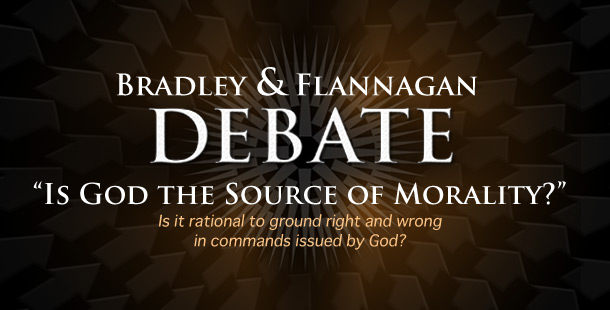
On Monday 2 August at the University of Auckland Emeritus Professor of Philosophy Dr Raymond Bradley and Dr Matthew Flannagan (of this blog) debated the topic “Is God the Source of Morality? Is it rational to ground right and wrong in commands issued by God?” For the benefit of those who could not be there, who are awaiting the editing and uploading of the video of the debate, we will be running a blog series where we bring you some of the debate in written form.
PROFESSOR ROBERT NOLA’S INTRODUCTION
Published here with permission
It gives me great pleasure to introduce Ray Bradley to you.
Ray was a student of philosophy at this university in the early 1950s. He also attended the Auckland Teachers’ Training College and become a school teacher. But then he won scholarship to the ANU to do advanced research in Philosophy where he wrote a PhD thesis entitled ‘Free Will and Logic’. One of his papers that emerges from this research is on fatalism ‘Must the Future be what it is going to be?”. This paper has been anthologised and it is a pretty good read about what is wrong with fatalism.
After the ANU Ray spent a year at Oxford and then returned to teach philosophy in Australia. He was appointed to the Chair of Philosophy at This University in 1964 at the very young age of 33 – he is most likely the youngest professorial appointment at this university. It was at this time that I first met Ray as a student in the Dept. He was an energetic shaker of a number matters from the organisation of the dept and its courses to protesting against the Viet Nam war. And also debating about religion; he took on the professors of Botany and Classics in a series of about 20 debates.
Unfortunately he left Auckland at the end of 1969 for a professorship at Simon Fraser University. There he produced many papers and two books: the co-authored ‘Possible Worlds’ and ‘The Nature of all Being’. When Ray retired from Simon Fraser he returned to NZ to live in Northland by the sea.
Living in Canada gave Ray his chance to realise one of his great passions – skiing. He has won over 60 medals in National and International events, including three World Championships in the speed event known as Super G. You can read about this in the recent Sunday Times article on Ray: they devoted more space to Ray as a skier than Ray as a philosopher.
One of Ray’s other abiding passions has been to combat religion. In his youth he was a believer but he gave this up in his teens. As a professional philosopher he entered into debates with a range of people from local advocates of religion in Auckland and those elsewhere such as William Lane Craig and Anthony Flew who had a late life conversion from atheism to religion. There are many of Ray’s papers on religion around, – you can find some of them on the web. One of the finest is Ray’s exposition of the claim by David Hume that the rivalry between religions discredit them all, that is, their rivalry shows that each is highly improbable. – see Ray’s paper ‘The rivalry of religions’.
Tonight Ray is on one of his favourite themes – the connection, more strictly the lack of a connection, between God and morality.
As I have indicated, Ray has debated issues about God at this University for over 50 years – tonight is yet another stage in Ray’s long engagement with the atheism and his presentation of it.
Welcome to Ray Bradley.
PROFESSOR RAYMOND BRADLEY’S OPENING STATEMENT
Published here with permission
I come not to praise God but to bury him along with the dead gods of now forgotten religions. Not to praise him as the source of all that’s good in the world, and hence the ultimate guide to human morals, but to indict him as the self-confessed source of all that’s wrong with it. When the Christian God says in his Holy Scriptures, that he is the creator of evil, I am prepared to take him at his word.
I will assume the role of prosecutor in providing grounds for agreeing with God’s self-indictment. And having conducted God’s trial in accord with the principles of morality and logic, I will hope to see him put, first, into a straightjacket, and then forever in his grave, no longer to command the belief of men.
Matt will act on God’s behalf as counsel for God’s defence, what theologians call an “apologist”.
THE DEITY IN THE DOCK
I’m going to indict God on four categories of charges. Each category has scores, if not hundreds or thousands of instances. If God is guilty of even one of these instances, that alone would be grounds for his conviction. Drawing upon evidence provided by God himself in his so-called Holy Scriptures, I hold that he’s guilty of them all.
A. Crimes against Humanity
The pagan religions typically invoked various gods as supernatural causes of natural phenomena: earthquakes, volcanic eruptions, floods, lightning, plagues, famines, and so on. The biblical god takes over the same sort of role, only he claims to be responsible for the lot. He boasts of repeatedly using natural events such as these to injure, maim, starve, drown, and in other ways kill off millions upon millions of people. Disease and disaster are God’s weapons of mass destruction.
B. War Crimes
This god is guilty of the crime of genocide. According to the story of Noah and the flood he wipes out “every living thing on the face of the earth”. In his role as Commander-in-Chief of his chosen people, God is guilty of ethnic cleansing. He orders the slaughter, without compassion, of hundreds of thousands of women, children, and suckling babes. He condones the taking of orphaned virgins for use as sex slaves by his conquering soldiers. He threatens, too, to have unborn children ripped out of their mothers’ wombs; and seems to relish the prospect.
C. Licensing Moral Mayhem and Murder
This God prescribes the death penalty for at least 15 alleged offences. These include being a stubborn and rebellious son (Deuteronomy 21:18-21), hitting or cursing one’s father and mother (Exodus 21:17, Leviticus 20:8), desecrating the Sabbath (Exodus 31:14), being a woman who cannot prove she was a virgin prior to marriage (Deuteronomy 22:20-21), being a woman who did not protest loudly enough when she was being raped (Deuteronomy 22:23-24), being a blasphemer (Leviticus 24:16), being an adulterer (Leviticus 20:10-12), worshipping some other gods (Deuteronomy 13:6-9), and being a homosexual (Leviticus 20:13). God’s recommended penalty? Stoning, usually.
God tells us unambiguously that he’s committed all these crimes and countless more. And he never says sorry for any of them or even shows a trace of regret.
But all of these crimes pale into insignificance compared with that for which I’m now about to indict him. For all of these are finite in duration, whereas the next is supposed to go on and on for all eternity.
D. Crimes of Torture
This god, in the person of his son, Jesus, commits the vilest of all crimes: torture of infinite duration in the fires of hell. For whom and why? The majority of the human race for the simple alleged offence of not having the right religious beliefs.
There are at least thirteen passages in Matthew alone in which Jesus talks about the fate of those who will go to hell—a fate that he describes as “eternal”, as “fiery”, as a place of “unquenchable fire”, as a place where there will be “weeping and gnashing of teeth”. The apostle Paul (2 Thessalonians 1:8-9) looks forward to the time when, in his words, “the Lord Jesus Christ shall be revealed from heaven with his mighty angels, in flaming fire taking vengeance on them that know not God.” And the author of Revelation paints a picture of hell in all its voyeuristic obscenity when he reports that all whose names were not written in the book of life would be “cast into the lake of fire” (Revelation 20:15), a place where all non-believers will, in his words, “be tormented with burning sulphur in the presence of the holy angels and of the Lamb, and the smoke of their torment ascendeth for ever and ever” (Revelation 14:10-11). The expression “the Lamb”, scholars and theologians agree, refers to Jesus. Nice to know that Jesus will watch the eternal tortures of the damned, i.e., of many like me, and hosts of unbelievers like some of you.
Is it any wonder that Christians who take God at his word have tortured themselves with fear about their own eternal prospects, have burned heretics at the stake so as to save their souls from eternal perdition, or have dashed infants’ brains out on the stones so they wouldn’t have a chance of becoming non-believers? Yet God, by virtue of his omniscience, knew all this.
Is it any wonder that televangelists are able to use the fear of hellfire to bring money into their coffers?
Who today, you may ask, would take this sort of moral primitivism seriously? Well, many Muslim fundamentalists certainly do: the Taliban, for instance. Arguably, the moral laws they and other Islamic fundamentalists seek to enforce are little more than the Islamic versions of the Old Testament, which Mohammed drew upon freely.
Ditto with many Christian fundamentalists—the Christian Reconstructionists, for instance. Comprising a sizable and increasingly influential proportion of the Southern Baptist Convention—itself the most potent force for evangelical Christianity—the extreme Christian Right, like their Muslim brethren, demand their country become a theocracy and unflinchingly acknowledge that implementing God’s commands would inevitably result in the death of tens of millions of their fellow citizens: over 45 million, on one estimate. Welcome to a replica of Sharia Law.
It’s not just the ultra-fundamentalists of theistic religions that take God’s precepts seriously. Even the relatively liberal branch of the Christian church–as represented by the Church of England and its Episcopalian offshoot–are troubled enough by God’s word to agonise over some of them, what he has to say about homosexuals in particular: that they are an “abomination” who should be killed in this world and spend the next in hell. Hence the prospect of another great schism in Christianity, and the pathetic excuse by gay bishop, Bishop Gene Robinson that the church is “still trying to figure out God’s will” on the subject. Robinson and Archbishop Rowan Williams (who’s on the other side of the debate), should read the Bible. It reported God’s will long ago.
Has God changed his mind about any of his moral dictates? If so, he has kept it to himself. Yet acclaimed Christian philosopher and apologist, William Alston, claims God still communicates with sincere Christians. Could it be that all those sincere Christians who–for about two thousand years–have gone on crusades with God’s word on their lips, are listening to themselves, not God.
Why don’t any ever report having heard God say clearly “Stop! You’ve got me wrong.”
The biblical god is not what Saint Anselm thought he was: that than which no greater, no more morally perfect, can be conceived. Out of his own mouth God condemns himself as that than which no viler, no more evil, can be conceived.
“God is love” is a sick joke. The pleasantry, “Do unto others as you would have others do unto you”, is little more than propaganda to cover up God’s true nature. The Golden Rule we might applaud, as a rough rule of thumb. But it’s a bit rich, don’t you think, coming from the mouth of someone, Jesus, who would send most of us to hell? No moral reciprocity there!
How do God’s depictions of his own behaviour square with the belief that he’s perfectly good? Or that he’s the source of what some call “The Moral Law”? They don’t.
Putting God and his Defenders in a Logical Straight-Jacket
The fact that God himself chronicles all his crimes–often in graphic and gruesome detail–falsifies the belief that he is omnipotent, omniscient, and perfectly good. His self-revelation places both God and his followers, such as Matt, in a logical straightjacket. For there is no way of escaping from the following set of five mutually inconsistent propositions:
1. What God proposes for our belief–including beliefs about what we ought to do–is what we ought to believe or do.
2. In his holy scripture God proposes for our belief that he has caused, committed, condoned, or laid down commands for us to obey, every one of the four types of crimes of types A, B, C, and D.
3. It is morally wrong to cause, commit, condone, or command any of the crimes of types A, B, C, D.
4. God is omnipotent, omniscient, and morally perfect.
5. A morally perfect being would not do anything that is morally wrong.
Theists believe in all five. The trouble is that these five statements form an inconsistent set such that from any four one can validly infer the falsity of the remaining one. Thus, one can coherently assert (1), (2), (3) and (4) only at the cost of giving up (5); coherently assert (2), (3), (4), and (5) only at the cost of giving up (1); and so on.
The problem is to decide which of these five statements to give up in order to avoid contradiction.
To deny (1) would be to deny that we ought to do what he says we should believe as to matters of morals, or matters of fact. It would be to deny, for instance, that we ought to obey God’s commandments, such as those instanced in category C. It would be to deny that God is the ultimate authority on what is true or false, right or wrong.
To deny (2) would be to deny the authority of scripture. It would be to say either (a) that God didn’t know how to say what he meant or (b) that he really meant what he so clearly said. But the first alternative would entail denying his linguistic competence and hence his omniscience. On the other hand, the second alternative would entail that we have to rely on human interpreters to tell us what he really did mean. That’s where the art of apologetics comes in. But in that case, the so-called Word of God becomes the word of man subject to rival, subjective, interpretations. All pretence of objective moral truth is then abandoned. We would then place ourselves in the same sort of position as primitives who wait on witch doctors to tell them what the chicken entrails really mean.
To deny (3) would be to assert that it is morally permissible to cause, commit, condone, or command some of the vilest crimes imaginable. It would be to ally oneself with moral monsters like Ghenghis Khan, Hitler, Stalin, and Pol Pot.
To deny (4) would be to deny that the god we are talking about has the properties that theologians regard as the defining, and distinguishing, properties of the Christian God. In short it would be to deny the core belief of theism.
Finally, to deny (5) would be to deny a virtual truism. To deny it would to license the use of the word “good” so as to mean the equivalent of “evil”. It would be to play word games, like Humpty Dumpty who thought he could make words mean whatever he wanted them to mean–including their opposites.
Which, I wonder, will Matt deny so as to avoid contradiction?
Let’s wait and see.
I’ll also challenge him to discuss the false scientific presuppositions of the story of God’s genocide by means of Noah’s Flood, and the dubious historical presuppositions to the stories about Jesus condemning unbelievers to eternal torment in Hell.
Please note that this series is not a transcript of the debate. Each post in this series is effectively a very close approximation of what was said on the night and has been put together from the papers and notes each speaker prepared and spoke from plus any additions each recalled making.
RELATED POSTS:
Video: Bradley v Flannagan “Is God the Source of Morality?
The Podcast: Bradley v Flannagan
Joint Communique: Bradley v Flannagan Debate
Matthew Flannagan’s Opening Statement: Bradley v Flannagan Debate
Bradley’s Reply to Matt: Bradley v Flannagan Debate
Flannagan’s Reply to Ray: Bradley v Flannagan Debate
Glenn Peoples’ Review: Bradley v Flannagan Debate