Tag: Peter Cresswell

  • Auckland Bloggers Drinks Tonight – Note New Venue

    The first Thursday of the month means Bloggers Drinks! The event for bloggers, blog trolls, blog groupies (bloupies) and blog readers. So come along tonight and see if you can talk as much nonsense as Peter Cresswell and Cameron Slater can.

    Past blogging celebrities in attendance include bloggers and blog readers from Annie Fox, Barnsley Bill, Beretta, Bowalley Road, The Fairfacts Media Show, Stephen Franks, Fundy Post, Hard News, Island Life, Garfield Herrington, Bernard Hickey, Cactus Kate, Kiwiblog, MandM, No Minister, No Right Turn, Not PC, Roar Prawn, Lolly Scramble, SOLO, The Standard, Born on State Highway One, Whale Oil and WHOAR! … though several didn’t stay around too long.

    The Horse and TrapWe’ve decided to experiment with central venues – so take note of the venue! The Horse and Trap is just down the road from Galbraiths and has Thirsty Thursday specials!

    What: Auckland Bloggers Drinks 
    When: Thursday 2 December, from 6.30pm 
    Where: Horse and Trap, 3 Enfield St, Mt Eden, Auckland
    Who for: Bloggers, blog readers, blog trolls
    What for: The talking of nonsense and telling of lies

    There is a rumour that Blondie from WhaleOil will turn up with an entire home made chocolate caramel slice in her handbag… RSVP on Facebook, invite your friends or just turn up on your own.

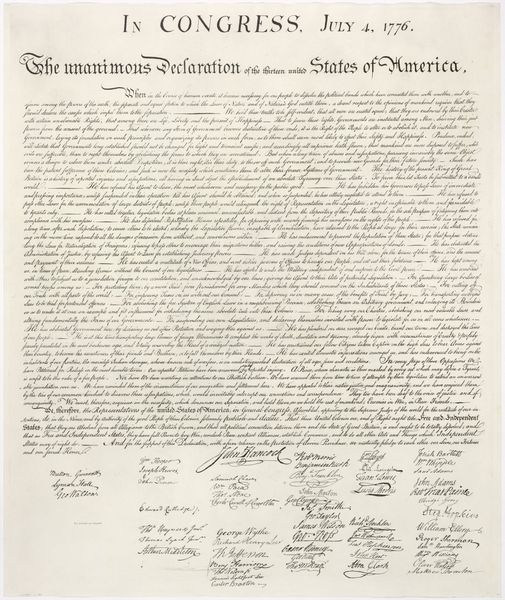
  • The Theology of the Declaration of Independence

    As I write this it is just beginning to be the 4th of July in the United States now, though its been 4th July for some time here in New Zealand.

    The 4th of July is, of course, Independence Day. Typically in New Zealand, those members of the secular blogosphere, who consider themselves to be classical liberals, have an annual rant on the 4th of July about the Declaration of Independence, praising the philosophy expounded in this document.

    Declaration of IndependenceNot PC’s Peter Cresswell, for example, states in Happy July 4th! that “with the exception of just a few words, the words could hardly be bettered today;” the declaration is, “A wonderful, wonderful anthem to freedom that rings down through the years.”  He bemoans, “if only the real meaning of those words could be heard and understood.”

    A few years ago Kiwiblog’s David Farrar made similar claims, he stated he would often “marvel at those marvelous words, written in the heat of oppression…Marvelous, absolutely marvelous.”

    I agree. I would simply point out to my secular, liberal, country-men what the words in this document actually say, and some of the philosophical ideas they expound.

    First, the declaration refers to God; it does so four times. Maverick Philosopher has an excellent analysis of the theological content;

    In the initial paragraph, we find the phrase “…Laws of Nature and of Nature’s God….” This phrase rules out pantheism: God is distinct from Nature. In the second paragraph, there is the phrase, “…endowed by their Creator with certain unalienable rights….” Putting these two references together, we may infer that the God being referred to is not merely a deistic initiator of the temporally first segment of the physical universe, but a being involved in the creation of the human race. For if God endowed human beings with rights, this endowment had to occur at the time of the creation of human beings, which of course occurred later than the beginning of the physical universe. In traditional jargon, God is a creator continuans rather than a mere creator originans. He is not a mere cosmic starter-upper, but a being who is continuously involved in maintaining the universe in existence.

    …

    The other two references are in the final paragraph. There we find the phrase, “…Supreme Judge of the World for the Rectitude of our Intentions….” near the beginning of the paragraph, and near the end, “…a firm Reliance on the Protection of divine Providence….” Now if God is the Supreme Judge, then he is more than a mere metaphysical cause responsible for the universe’s beginning to exist; he is also the supreme moral arbiter. And since he endows human beings with rights, as opposed to being merely a judge of rights antecedently possessed, then it seems we may infer that God is the source of moral distinctions (as opposed to a mere judge of them).

    The reference to divine providence is further evidence that the conception of God in the Declaration is non-deistic. For if God provides and protects, then God has an ongoing involvement with the world and its inhabitants such as would be ruled out by a deistic view. It should also be obvious that talk of providence (from the Latin, pro-videre) implies divine foreknowledge which implies intelligence and perhaps omniscience on the part of the deity. The God of the Declaration is not a blind metaphysical cause posited to explain why the universe began to exist, but a being with such attributes as moral goodness and intelligence…. So if by ‘deism’ is meant the doctrine that God is a mere metaphysical cause of the universe’s beginning to exist who is thereafter uninvolved in its continuing to exist, then the God of the Declaration is non-deistic.

    Second, the declaration claims that belief in a creator is self-evident; that is, it is a properly basic belief, which is rationally acceptable to hold in the absence of any proof.

    We hold these truths to be self-evident, that all men are created equal, that they are endowed by their Creator with certain unalienable Rights, that among these are Life, Liberty, and the pursuit of Happiness.

    Third, the declaration makes political pronouncements about public policy on the basis of these theological claims and expects these pronouncements to be taken seriously.

    Fourth, the declaration says that various rights, such as the right to life and liberty, are unalienable. That is, a person cannot alienate one’s life or freedom as they can legally alienate a piece of property. You can’t take my property if I do not consent to you having it but if I do consent, you can take it; property is alienable, life and liberty are not. The argument of the declaration reflects John Locke’s argument in the Second Treatise of Civil Government;

    To understand political power right, and derive it from its original, we must consider, what state all men are naturally in, and that is, a state of perfect freedom to order their actions, and dispose of their possessions and persons, as they think fit, within the bounds of the law of nature, without asking leave, or depending upon the will of any other man.[1]

    …

    But though this be a state of liberty, yet it is not a state of licence: though man in that state have an uncontroulable liberty to dispose of his person or possessions, yet he has not liberty to destroy himself, or so much as any creature in his possession, but where some nobler use than its bare preservation calls for it. The state of nature has a law of nature to govern it, which obliges every one: and reason, which is that law, teaches all mankind, who will but consult it, that being all equal and independent, no one ought to harm another in his life, health, liberty, or possessions: for men being all the workmanship of one omnipotent, and infinitely wise maker; all the servants of one sovereign master, sent into the world by his order, and about his business; they are his property, whose workmanship they are, made to last during his, not one another’s pleasure[2]

    …

    This freedom from absolute, arbitrary power, is so necessary to, and closely joined with a man’s preservation, that he cannot part with it, but by what forfeits his preservation and life together: for a man, not having the power of his own life, cannot, by compact, or his own consent, enslave himself to any one, nor put himself under the absolute, arbitrary power of another, to take away his life, when he pleases. No body can give more power than he has himself; and he that cannot take away his own life, cannot give another power over it.[3]

    The point here is that because your right to life and liberty are from God, no one can legitimately enslave or kill you, even if you consent to it. This was not a mere incidental addendum idea, it was central to Lockean political philosophy, which maintained (as the declaration does) that the government derives its powers from the consent of the governed. If a person can consent to be killed or enslaved then they can consent to the government enslaving them also to having the arbitrary power to kill them and hence tyranny can be legitimate. The reason tyranny is illegitimate is because, “No body can give more power than he has himself; and he that cannot take away his own life, cannot give another power over it.”

    The declaration then makes a metaphysical claim: God exists. It makes an epistemological claim about faith and reason: that belief in God is rational independent of proof. It makes an implicit claim of political philosophy: religion is not a private thing that should not influence public life but rather, theological claims should influence public life. Finally it makes a moral claim; that consenting adults do not have a right to do whatever they like with their own bodies, rather there are “Laws of Nature and of Nature’s God” that bind all human beings, that they are compelled to follow even if all parties consent otherwise. Governments are legitimate to the extent in which they respect these laws.

    I agree with PC, it is hard to improve on this philosophy; I have defended it in several places on this blog.

    Ironically, however, the militant secular liberals in NZ who parrot the declaration seem committed to attacking these ideas and rejecting them on every point. They argue that belief in God is irrational because it cannot be empirically proven, they claim that the public square should be secular, that religion should be private and not influence public policy and they argue that liberty means consenting adults can do whatever they like with their own bodies and lives. Far from being unalienable, a person’s life and freedom is his property to alienate as that person sees fit.

    It is also hard to disagree with PC’s sentiments that the declaration is “A wonderful, wonderful anthem to freedom that rings down through the years. If only the real meaning of those words could be heard and understood.” “Indeed, if only.”

    [1] John Locke Second Treatise of Civil Government Section II 4.
    [2] Ibid II6.
    [3] Ibid IV 23.

  • Freedom, Science and Christianity: A Response to James Valliant Part II

    Recently Peter Cresswell published a guest post by James Valliant, which originally appeared on SOLO. In Freedom, Science and Christianity: A Response to James Valliant Part I, I addressed Valliant’s claims that science and freedom of religion were unanimously opposed by Christians and the success of science and freedom of religion in Europe was solely due to the influence of pagan ideas which the church sought to suppress. Then in The Theological Foundations of the Enlightenment Philosophers, I further documented how Enlightenment defences of freedom of religion were grounded in earlier theological writings. Here I will continue my critique of Valliant’s article.

    3. Valliant contends that it is absurd to suggest that “the US declaration of independence is based on Judeo-Christian ideas.” His reasons, however, are once again based on ignorance of Christian intellectual history.

    First he ridicules the idea of Christian influence, “We are asked to believe that it took a mere 1,776 years of reading that darned Bible before any of those great and learned Christian scholars figured out its true political implications!” Valliant seems blissfully unaware that many ideas expressed in the declaration were expressed by Christian writers sometimes hundreds of years prior to 1776.

    The claim that there is a creator and that this is self-evident, are ideas that go back centuries in Christian theology. Moreover, the contention that people are created equal is found in the book of Job and would not have been contested by many medieval or patristic theologians.  Mark Murphy has noted that the idea of ‘consent of the governed’ was also accepted in political thought of the Middle Ages.[1] In fact, a form of ‘consent of the governed’ was actually a key feature of feudalism; under this system the monarch was elected or chosen by the land owners and could be deposed by the land owners.[2] Nicholas Wolterstorff has documented that the notion of natural rights had its origins in medieval canon law and theological reflections of the middle ages.[3] Many of the ideas expressed in the declaration were defended centuries earlier by Calvinist tracts such as Lex Rex and Vindicae Contra Tyrannos. In fact, medieval theologians criticised absolute monarchy, debated the question of just revolutions and so on resulting in the birth of the Magna Carta.

    The declaration simply repeats the argument for liberty, put forward by John Locke in his Two Treatise of Civil Government. Locke’s argument occurred in the context of an exegetical debate with Robert Filmer about whether or not the bible supported absolute monarchy. Locke’s main argument was that because human beings are created by God, they have an inalienable right to life and liberty and so could not licitly sell themselves or give another person arbitrary or total power over them. In making this argument, Locke actually appropriated an ancient rabbinical argument against slavery which was alluded to by the Apostle Paul (1 Cor 7:23) and is implicit in the Torah (Lev 25: 42). Paul’s appropriation of this argument was the basis for the Christian abolition of slavery in the early Middle Ages. Valliant’s ignorance about what Christians did not support or write about prior to 1776 does not mean that these texts do not exist.

    Valliant continues with the claim that Paul told Christians “to just ‘obey’ the governmental ‘authorities’ placed over us, because God has appointed them, by St. Paul himself, who likely wrote during the reign of the monster Nero.” This again is a caricature, as I have pointed out elsewhere, the context (which Valliant ignores) qualifies Paul’s command. Moreover, the passage Valliant cites was written during the early part of Nero’s reign when Nero was strongly influenced by Seneca the Younger and Barrus and his rule was widely considered to be competent and relatively enlightened. When Nero later degenerated into a monster the scripture, rather scathingly, describes Nero as a satanic beast whom Christians are required to resist – not obey!

    Valliant also seems blithely unaware of the fact that Paul wrote as a prisoner of Rome and was himself executed by Nero for refusing to pay homage to Nero (as were many other Christians). His picture then of Paul as a proponent of advocating unqualified obedience to Nero is simply inaccurate.

    4. Valliant similarly quotes Paul’s admonition to slaves to obey their masters in contrast to the US Framers who “thought slavery was evil, too, and it was this belief that provided the basis (e.g., see the Gettysburg Address) for later abolishing it” as evidence that abolitionist ideas originate from ancient Greek/Aristotelian thought and not Christian theology. Apart from the fact that Jefferson was himself a slave owner, Valliant’s understanding is extremely selective.

    First, opposition to slavery in various forms has a long history in Christian thought and practice. It predates the American Founding by hundreds, maybe, thousands of years. Early Christians advocated emancipating slaves, a practice exhorted by several leading theologians and early church councils.  W.E.H. Lecky contends that early Christian saints such as Melania, Ovidius, Chromatius, and Hermes, between them liberated almost 20,000 slaves.[4] Later, in 315, Constantine made it a capital offence to steal a child and bring it up as a slave. Justinian, in the 6th century, abolished earlier roman laws prohibiting the freeing of slaves. Similarly St Bathilde, a runaway slave who became the wife of King Clovis II in the 9th century, campaigned against the slave trade as did other notables, St Patrick in the 5th century, St Anskar in the 9th century and St Wulfstan, St Anselm in the 11th century. Rodney Stark notes that Christian opposition to slavery in the lead to its effective abolition within in Europe during the Middle Ages. Stark goes on to document that Pope Eugene IV (1431-1447), Pope Pius II (1458-1464), Pope Sixtus IV (1471-1484), Pope Paul III (1534-1549), Pope Urban VIII (1623-1644) issued papal bulls against slavery. In addition, the Roman Inquisition condemned slavery on 20 March 1686.

    All of the above occurred hundreds of years prior to the US Founding Fathers.[5] In fact, evangelical Christians, such as William Wilberforce, had brought about the abolition of slavery peacefully in the British several decades before the US fought a civil war over it. Moreover, Stark’s analysis shows that the earliest abolitionist tracts within the US were whttp://www.mandm.org.nz/wp-admin/post-new.phpritten by Puritans – actually by one of the judges at the Salem witch trials. The abolitionist movements in the US were overwhelmingly religious in orientation.[6] The suggestion then that opposition to slavery was without Christian precedent and was a novel idea proposed by the revival of pre-Christian ideas in the Enlightenment is implausible. The issue of slavery is a particularly bad example to substantiate Valliant’s thesis given that in the pre-Christian pagan world slavery was widely practiced and accepted. In fact Aristotle, Valliant’s pre-Christian Greek hero, famously defended slavery (in three chapters no less) contending the enslavement of other races was natural.[7]

    Valliant’s reading of scripture is also questionable. While it is true that Paul exhorted slaves to obey their masters, this by itself does not entail support for slavery anymore than my paying my taxes constitutes my agreement with taxation laws. Moreover, Valliant ignores the numerous other things both the scriptures and Paul stated about slavery, which contradict and condemn the practice of slavery that existed in America. In fact, the enlightenment philosopher who most influenced the US, John Locke, appealed to these very texts both explicitly and implicitly, to condemn slavery. Once again, Valliant ignores crucial facts of Christian intellectual history to come to his stereotypical conclusions.


    [1] Mark Murphy “Natural Law, Consent, and Political Obligation” Social Philosophy & Policy 18 (2001) 70-92.
    [2]
    Regine Pernoud,  Those Terrible Middle Ages : Debunking the Myths (San Francisco: Ignatius Press,  2000) 128-129.
    [3] Nicolas Wolterstorff  Justice Rights and Wrongs (Princeton, NJ: Princeton University Press, 2008).
    [4] W.E.H. Lecky History of European Morals: From Augustus to Charlemagne (New York: D. Appleton, 1921) 2:69.
    [5]
    Rodney Stark For the Glory of God: How Monotheism led to Reformations, Science, Witch-hunts and the end of Slavery (Princeton: Princeton University Press, 2003).
    [6] Ibid.
    [7] Aristotle The Politics Bk I iii, iv, v.

    RELATED POSTS:
    Freedom, Science and Christianity: A Response to James Valliant Part I
    The Theological Foundations of the Enlightenment Philosophers
    The Theology of the Declaration of Independence
    The “Dark Ages” and Other Propaganda
    Guest Post: James Hannam on Dan Brown’s History of Science
    Slavery, John Locke and the Bible
    666 The Number of the Beast
    R 13: Romans, Revelations and the Role of the State

  • Freedom, Science and Christianity: A Response to James Valliant Part I

    Recently Peter Cresswell published a guest post by James Valliant, which originally appeared on SOLO. The following series is a critique of this piece.

    Valliant’s basic thesis is that,

    Both science and freedom came about among European Christians despite the best efforts of pious Christians to prevent their development, and only on a foundation of pagan, pre-Christian ideas, and with conservative Christians fighting each and every step of the way.

    Like other Randian’s he erroneously thinks of Aristotle’s philosophy as a paradigm of the pagan ideas in question. Valliant’s post contains numerous errors. His uncritical acceptance of literal reading of Genocide passages, his claim that the Bible teaches sex is bad, his assertion that it teaches people will be tortured forever for not believing in Christ and numerous other things means there are far to many errors for me to address in a short post and this one is long enough as it is! Here I will focus on those errors most relevant to his main thesis. [I have inserted hyperlinks on the less relevant errors where I have previously blogged on the issue – also see the related posts at the end.]

    1. Valliant appears to accept the now discredited conflict thesis. He states that the Church “imprisoned scientists” for challenging its authority and that that “Western science only got going again following the rediscovery of pre-Christian Greek ideas, starting with Aristotle’s.” Valliant cites Copernicus as an example, claiming that he “got his ideas about the earth and the sun from an ancient, pagan source, one that he suppressed upon publication.” This is all questionable at best, as James Hannam’s recent study shows, “During the Middle Ages, the Catholic Church actively supported a great deal of science.” Hannam goes on to document that, contrary to popular belief, the Church, “never supported the idea that the earth was flat, never banned human dissection, never banned zero and certainly never burnt anyone at the stake for scientific ideas.” The one exception to this, he notes, is the case of Galileo in the 17th century, who was placed under house arrest for teaching Copernican cosmology as true (as opposed to a hypothesis).[1] The Catholic Church’s opposition to Copernicus, of course, is the sole case Valliant alludes to but a single case does not substantiate a trend.

    Valliant’s allusion to the views of Copernicus is similarly questionable. Copernicus’ heliocentric cosmology constituted a rejection of the standard Aristotelian cosmology accepted by the ancient Greeks. Stillman Drake notes that Galileo’s strongest opponents were supporters of Aristotle and it was more his calling into question Aristotle and the pressure by Aristotelians to silence him, that lead to his condemnation from the church than merely interpreting a psalm figuratively.[2] Nor is it correct to suggest that Copernicus got his “ideas about the earth” from suppressed Greek scientists. In fact, the thesis that the earth moves had already been suggested by 14th century theologians   Jean Buridan and Nicole d’Oresme and had been openly discussed in medieval universities for centuries prior to Copernicus. Edward Grant notes the positions of Buridan and d’Oresme were based in part on Theological condemnations of Aristotelian Philosophy that had occurred in the 13 century.[3] The Copernican position then was already being debated openly in theological circles before Copernicus and was a repudiation of Greek cosmology motivated, in part, by theological concerns about God’s sovereignty.

    2. Valliant makes the historical claim that “The burning of thousands and thousands at the stake for no reason other than their heretical faith, the torturing of thousands and thousands more in order to get them to confess to any deviation from the Bible … is all a matter of historical record.” He asks,

    If Christians, in the name of their faith, did horrible things in the more remote past, had they simply misunderstood the Bible that they were poring over in such detail and with such devotion? Did they finally get clear on the meaning of their true doctrine only after the better part of two millennia?. No, it was the horrible institution of Christian persecution, century after century, which inspired sensitive minds to first consider the idea of freedom of conscience, and, again, only with a good deal of philosophical help from those ancient, pagan sources, from Aristotle to Cicero.” [Emphasis added]

    Valliant appears to think that religious persecution as existed in the Inquisition was due to Christian theology and that the notion of freedom of conscience was the result of pagan ideas.  The facts, however, are not so simple. Valliant’s argument contains several false assumptions.

    First, Valliant is mistaken that Christians for the better part of two millennia both engaged in and supported the activities he refers too. In fact, for the first four hundred years of Christian history, the Church fathers supported and defended a right to freedom of conscience; it was only in the 5th century, due to the influence of Augustine, that suppression of heresy was supported. Even in this instance there was not unanimity. Many theologians such as Ambrose and Pope Siricius protested heresy executions in the late Roman Empire.  Forced baptisms did occur under Charlemagne in the 8th century but were criticised by leading theologians of the time such as Alcurin.  From Charlemagne till the 12th century, some 400 years, there were no inquisitions.[4] The Inquisition arose in Western Europe in the 12th century in response to a particular political crisis.

    Interestingly both Canon Law and Medieval Theology developed a notion of freedom of conscience in the Middle Ages, drawing from earlier patristic sources and exegesis of Paul’s comments on freedom of conscience in Romans 14.[5] In fact, the defences of religious tolerance, proposed by enlightenment thinkers such as John Locke, Pierre Bayle and James Madison are often simply repetitions of the arguments of early Christian theologians such as Lactantius and Tertullian, which had been known to Christian theologians for over a thousand years.  These facts also show that is mistaken to suggest defences of freedom of conscience were only developed after hundreds of years of Christian persecution.

    Second, Valliant’s attempt to equate religious tolerance with pagan antiquity is equally dubious. The pre-Christian Athenian democracy Valliant champions executed Socrates for heresy, around 400 years before Christ. Plato and Aristotle also experienced periods of exile from Athens – Aristotle fled precisely to avoid sharing Socrates fate. Greek Philosophers, including Plato, defended censorship of religious books and execution of those who denied the existence of the gods. For 300 years prior to the Christianisation of Europe the roman state persecuted and executed Christian believers. Eusebius records that thousands of men, women and children – sometimes whole towns – were martyred by Rome for their beliefs.[6] David Lindberg sums the evidence up,

    Intolerance is and was (and is) a widely cultivated trait, shared about equally by pagans and Christians. Moreover, each party was capable of employing coercive measures when it gained the political power to do so; Christians, in fact appear to have done so less often than Pagans.[7]

    Valliant’s contention that “freedom” was based on “pre-Christian” Aristotelian ideas “with conservative Christians fighting each and every step of the way” also ignores the obvious fact that the Inquisition came into Europe around the same time as the rise of Aristotelianism and was in fact defended and carried out by the Dominican order – the very same order that promoted and defended Aristotle in European universities. The facts, therefore, do not fit the generalised picture Valliant paints.

    Third, Valliant’s comments appear to assume that the torture and execution of heretics was justified solely by an appeal to the Bible. However, nowhere does the Bible mention executing or torturing heretics nor was it typically taken to teach this. Christopher Eberle and Terence Cuneo note that suppression of heresy was frequently punished, not on religious grounds per se, but on broader secular grounds,

    Religious believers have employed coercive power to violate the right to religious freedom, they themselves rarely have done so in a way that violates the [Doctrine of Religious Restraint] … when such rights have been violated, the justifications offered, even by religious believers, appeal to alleged requirements for social order, such as the need for uniformity of belief on basic normative issues. One theological apologist for religious repression, for example, writes this: ‘The king punishes heretics as enemies, as extremely wicked rebels, who endanger the peace of the kingdom, which cannot be maintained without the unity of the faith. That is why they are burnt in Spain’. [8]

    Régine Pernoud points out that reason heretics were burnt or tortured is because the 12th century saw the revival of Roman law which allowed torture to gain a confession and punish treason with burning.[9] Hence contrary to Valliant, the torture and burning of heretics had as much to do with ancient pagan roman legal customs as it did with biblical exegesis.  In fact, the evidence suggests that unlike secular courts, the Inquisition used torture sparingly, more moderately and rarely executed those who came before it, suggesting that it in fact moderated and softened the harshness of roman practice.[10]

    In my next post in this series, Freedom, Science and Christianity: A Response to James Valliant Part II, I address Valliant’s claims that the writers of the Declaration of Independence were not influenced by Christianity and his claims around freedom and slavery.

    In the meantime see this update: The Theological Foundations of the Enlightenment Philosophers


    [1] James Hannam God’s Philosophers: How the Medieval World Laid the Foundations of Modern Science (London: Icon books, 2009) 2-3.
    [2] Stillman Drake Galileo (Oxford: Oxford University Press, 1996).
    [3] Edward Grant “Science and Theology in the Middle Ages” in David C Linberg and Ronald L Numbers eds God and Nature: Historical Essays on the Encounter between Religion and Science (Berkley: University of California Press, 1986) 49-75.
    [4]
    Regine Pernoud Those Terrible Middle Ages: Debunking the Myths (San Francisco: Ignatius Press,  2000) 120.
    [5]
    See Joseph Lecler Toleration and the Reformation trans. by TL Weslow (New York: Association Press, 1960).
    [6] Eusebius Ecclesiastical History.
    [7] David Lindberg “Science and the Early Church” in David C Linberg and Ronald L Numbers eds God and Nature: Historical Essays on the Encounter between Religion and Science (Berkley: University of California Press, 1986) 22.
    [8]
    Christopher Eberle and Terence Cuneo “Religion and Political Theory” (2008) Stanford Encyclopedia of Philosophy.
    [9]
    Pernoud, above n 4, 128-129.
    [10] See, for example, Edward Peters Inquisition (London: Collier Macmillan, 1981); also Henry Kamen The Spanish Inquisition: A Revisionist History (New Haven Conn: Yale University Press, 1998).

    RELATED POSTS:
    Freedom, Science and Christianity: A Response to James Valliant Part II
    The Theological Foundations of the Enlightenment Philosophers
    The “Dark Ages” and Other Propaganda
    Sunday Study: Joshua and the Genocide of the Canaanites Part I
    Sunday Study: Joshua and the Genocide of the Canaanites Part II
    William Lane Craig, Raymond Bradley and the Problem of Hell. Part Two
    Guest Post: James Hannam on Dan Brown’s History of Science

  • This one’s for Anna Woolf

    Peter Cresswell has an update on blogger Anna Woolf‘s battle with cancer which is very near the end. We met Anna on my and her birthday in April this year at bloggers drinks and have enjoyed her company and shared laughs and swapped pain meds at each bloggers drinks since.

    We have not known her that long but we have come to know an incredibly warm, funny, brave and courageous person with a heart of gold and it with deep sadness that we share this news. Our love and prayers go out to Anna, her sister Maria and her family and friends.

    You can leave a comment at the link to NotPC which will be read to Anna. This week’s bloggers drinks have now been moved to The Cavalier, which is over the road from the hospice Anna is in, with the hope that those who wish to can pop over the road and say goodbye.

  • Auckland Bloggers Drinks Feat. Pamela Anderson and John Key – This Thursday!

    Following on from the success of last week’s packed out impromptu Auckland Bloggers drinks featuring blogging celebrity David Farrar, Peter Cresswell and I have decided that we should feature celebrity guests more often.

    Anna WoolfThis week Pamela Anderson is in Auckland for Fashion Week and John Key is back from New York, fresh from his success as New Zealand’s newest comedian to appear on Letterman, so we invited them both to the Auckland Bloggers Bar Bash.

    They refused to take our calls are yet to confirm but in the unlikely event that neither will make it, and as Pamela is more woman than most, both Anna Woolf and myself will be appearing in her place and Peter Cresswell will be standing in for John Key.

    Madeleine Flannagan standing in for Pamela AndersonOpen to anyone who happens to be in Auckland. Regular blogger attendees include those from Annie Fox, Not PC, Interest.co.nz, Lolly Scramble, State Highway One and MandM. Others have been known to stop by, such as David Farrar, Whaleoil, No Minister, Roar Prawn and Fran O’Sullivan so don’t be shy.

    What: Auckland Bloggers Drinks – a social gathering of bloggers and bloupies (those who read, comment on and hang out with bloggers)
    When:
    Thursday 1 October from 6.30pm
    Where:
    Galbraiths, 2 Mt Eden Road, Mt Eden, Auckland

    Peter Cresswell standing in for John Key

  • Is Abortion Liberal? Part 2

    In my previous post, Is Abortion Liberal? Part 1, I argued that liberals who support the non-initiation of force principle can support abortion only on two grounds;

    (a) the fetus is a person but its existence inside the mother without her consent constitutes a form aggression, and hence, the mother’s action of killing it is defensive; or,
    (b) a fetus is not a person.

    I will now address each of these in turn.

    Is the Fetus an Aggressor?
    Consider first (a), the contention that a fetus can be considered an aggressor because it is intruding upon a woman’s body without her consent; an intrusion grave enough to justify the use of lethal force. In this respect then, being subject to an unplanned pregnancy would be on par with being the recipient of a serious assault such as being raped or severely beaten.

    Frank Beckwith and Steve Thomas in Consent, Sex and the Pre-Natal Rapist, have demonstrated several problems with this claim. It leads to the conclusion that, in certain circumstances abortion is justified without the consent of the woman.

    Consider the following scenario. A young woman is involved in a car accident and is rendered unconscious by her injuries. She is brought to a hospital where, still comatose, she is examined by a doctor. While performing some tests, the doctor determines that the woman has been pregnant for several weeks. Furthermore, suppose that evidence comes to light to suggest that the woman is unaware of her pregnancy, perhaps her close friends know nothing of the pregnancy, her diary shows no knowledge of being pregnant, and so on.

    Adopting McDonagh’s understanding of pregnancy as morally equivalent to rape or assault, what is the doctor’s obligation to this unconscious patient? It would seem that, under these conditions, the doctor is morally required to perform an abortion to rid his patient of the ‘massive intrusion’ being imposed upon her by her unborn offspring. After regaining consciousness, the woman would have to be told that she’s undergone an abortion for a pregnancy of which she was not aware, for there was good evidence that no consent had been given and that she was under assault.[i]

    Beckwith’s point is that if the fetus is morally or legally on par with an aggressor who intrudes upon a woman’s body without her consent, such as a assailant or rapist then it would follow that in the case sketched above the doctor would be justified (and arguably would have an obligation) to abort despite the fact that no consent from the women had been obtained.

    Consider, that if one saw a person having sex with an unconscious woman and one knew the woman had not consented, it would be absurd to wait for the woman to wake up to see if she wanted to consent to sex. One would be obligated to intervene. “[T]he doctor in the midst of the situation, aware of the pregnancy in the absence of consent, must see it as the rape-in-progress of his unconscious patient. How could he do anything else but end the assault?”[ii]

    Now I assume that liberals would oppose the idea that any woman who both does not know she is pregnant and is unconscious should be subjected to an abortion without her consent. If this is the case then it is clear that they do not think that an unconsented to pregnancy constitutes an act of serious aggression.

    If the fetus is an unjust aggressor then liberals are committed to coercive abortions. If coercive abortions are not liberal then the fetus is not an unjust aggressor.

    Is the Fetus a Person?
    If the fetus is not an unjust aggressor then a liberal defense of abortion must be based upon (b), the idea that a fetus is not a person, a being that possesses the rights to life, liberty and property that liberals believe the state exists to protect.

    Now a fetus is clearly a human organism. After 14 days at least, it is an individual living being that is a member of the species homo sapiens. To justify abortion via (b), the liberal needs to tell us what property a human being possesses that grounds the right to not be subjected to the initiation of force, to not be killed. Further a liberal must also be able to plausibly maintain that a human organism does not acquire this property until after the fetal stage.

    Peter Cresswell takes the view,

    [T]he foetus is not yet a human being, but a part of a human being – the mother – who has rights over it. To be an actual, rather than merely potential, human being is, among other things, to be physically separate, which a foetus is not.

    This claim is erroneous. First the “parts of” relationship is transitive; if a brick is part of a wall and the wall part of a house then the brick is part of the house. If a fetus is part of a woman’s body it follows then that any organ that is part of the fetus will be part of the mother. A woman pregnant at eight weeks then possesses four arms, four legs and two brains. If the fetus is male, she will have both a vagina and a penis and be both male and female. Conclusions that are even more bizarre follow if the woman is pregnant with twins. She could have three faces, three brains, six arms, two penises and a vagina, three hearts, six kidneys and so on.[iv]

    Moreover, PC’s contention that “to be an actual human” one must be “physically separate” entails that conjoined twins are not human. Consider conjoined twins Bob and Scott. If Bob is a human being then since Scott cannot live independently of Bob, Scott must not be a human person (the converse is equally true).

    Yet it is difficult to see what property Bob has that Scott lacks which would justify considering one of them human and the other not simply because neither is dependant of the other. It appears then, that one would be forced to conclude that they both are and are not, human. Perhaps PC is simply giving a poorly worded defence of the viability criteria, which I have previously critiqued here.

    However, the usual liberal response is to ground the right to not be subjected to the initiation of force, to not be killed, in certain psychological capacities that human beings typically display; such things as sentience, rationality, self-awareness, autonomy, etc.

    Despite the pervasive appeal of this approach, it faces serious problems. Boonin notes that those who attempt to ground humanity in the amount of brain development an organism has face a dilemma. “Any appeal to what a brain can do at various stages of development would seem to have to appeal to what the brain can already do. Or to what the brain has the potential to do in the future.”[v]

    Either option leads to problems for a defender of the permissibility of abortion who does not also want to endorse infanticide. This is because “by any plausible measure dogs, and cats, cows and pigs, chickens and ducks or more intellectually developed than a new born infant.”[vi] Suppose, then, one takes the first horn and appeals to what the brain can already do. However, unless one wishes to affirm that cats, dogs and chickens are human beings, “appeals to what the brain can already do” will “be unable to account for the presumed wrongness of killing toddlers or infants.”[vii] Suppose, then, one takes up the second horn of the dilemma and appeals to “what the brain has the potential to do in the future;”[viii] Boonin notes that this will entail that feticide is homicide. “If [such an account] allows appeals to what the brain has the potential to do in the future, then it will have to include fetuses as soon as their brains begin to emerge, during the first few weeks of gestation.”[ix]

    A couple of examples will illustrate this. Suppose the liberal appeals to sentience, the capacity for consciousness and the ability to perceive pleasure and pain. This criterion will mean abortion is permissible up to 24 weeks.[x] The problem is that this criterion also catches cats, dogs, cows, and chickens as well all. All of which are as sentient if not more sentient than new born infants and post-24 week fetuses.

    If the liberal draws the line at sentience, he/she will have to hold that farming, butchers shops, McDonald’s restaurants, Kentucky fried Chicken restaurants all engage in unjustified aggression against people because they kill sentient beings without their consent. Further, to remain consistent, the liberal will have to maintain a policy of outlawing all these industries and prosecuting those who engage in them for murder and cannibalism.

    Suppose the liberal appeals to more advanced psychological states such as self-awareness, rationality or autonomy. Such accounts of the grounding of rights will exclude the animals mentioned above and will exclude human fetuses. The problem is, according to this account, newborn infants are not persons either.

    In a definitive study of infanticide, Michael Tooley compiles an impressive array of neurological and physiological data that demonstrates that infants are not persons in this sense until some time after birth.[xi] The price of this line of inference is the reduction of newborn infants to the ethical level of cows. A newborn cow, and certainly a mature cow, is more person-like than an infant is. It is difficult to understand by this view why killing and eating infants is any more problematic than consuming a Big Mac.

    Of course the liberal can avoid this by claiming that it is the potential to acquire properties such as rationality, self-awareness, autonomy, not their actuality that matters. This will enable one to claim infants are protected by the non-initiation of force principle and will exclude animals. But the problem of course is that foetuses will also be protected by the non-initiation of force principle because fetuses also have the potential to possess these properties.

    In summation, liberal proponents of the non-initiation of force principle can only support abortion if they are willing to be inconsistent and arbitrary in their application of the principle or if they are willing to endorse not just infanticide but the eating of newborn infants or state mandated vegetarianism or coercive abortions. These policies are an anathema to most liberals; as such, abortion is not liberal.

    UPDATE: In response to comments below see Sentience Part 1 and Sentience Part 2.

    [i] Francis J. Beckwith & Stephen Thomas, “Consent, Sex, and the Prenatal Rapist; A Brief Reply to McDonagh’s Suggested Revision of Roe v Wade,” Journal of Libertarian Studies 17: 3 (2003): 4.
    [ii] Ibid, 6.
    [iii] Peter Creswell, “Not PC: Cue Card Libertarianism – Abortion”.
    [iv] Here I am influenced by Peter Kreeft, The Unaborted Socrates (Downers Grove, IL: InterVarsity Press, 1983), 45-47 and Francis J Beckwith, Politically Correct Death, 124.
    [v] David Boonin, A Defense of Abortion (Cambridge: Cambridge University Press, 2003) 125.
    [vi] Ibid, 121.
    [vii] Ibid.
    [viii] Ibid.
    [ix] Ibid.
    [x] It is generally accepted that sentience occurs around 24 week’s gestation. There is some dispute over this and some scientists date sentience in the first 10 weeks of gestation.
    [xi] Michael Tooley, Abortion and Infanticide (New York: Oxford University Press, 1983) Ch. 11.5.