I teach NCEA Religious Studies, at level three, one standard is to “Analyse the response of a religious tradition to a contemporary ethical issue”. Officially students have to describe the response a religious tradition has made to a moral issue. Our school like a lot of schools looks at Christian responses to abortion. Because I did my PhD thesis on this very subject in the last year I have been going through my dissertation and simplifying, summarising and rewriting it into short sections I can use with my classes. Because there is some interest in this, I have decided to post some of these on MandM. I welcome any feedback or comments.
In our last post we looked at how Christian theologians who wrote during the Patristic period, the period from 90AD to 475 AD, addressed the question of abortion. Our survey suggested they adopted essentially the same position we saw earlier in Alexandrian Judaism and which is found in the Septuagint. In this next section, we will look at the medieval period. Historians date the medieval period from 500 AD -1500. AD, during this period Christian Theologians adopted pretty much the same stance they did during the Patristic period.
I. Canon Law
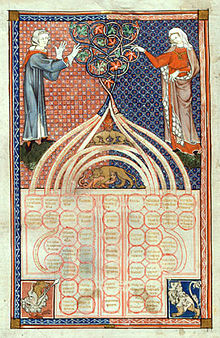 The period from 500-1000 AD is known as the early middle ages. During this time the church in Europe developed what is called Canon law. Canon law is a set of laws developed by church authorities to govern the church and its members. One thing that Canon law had to deal with was penance; suppose someone commits a seriously immoral action, how should the church respond, what penalties practices of confession and repentance, should be in place to deal with this such practices are known in Catholicism as penance.
During the early middle ages, manuals about how penance should be applied were developed. Many of these manuals addressed abortion. Here are some examples:
- Manual Canones Hibernenses (675 A.D.) refers to abortion as a sin but draws a distinction between an unformed embryo and a formed, fetus. While both incur a penalty, The latter is punished more severely.[1]
- The Bigotian Penitential (8th Century AD) draws a distinction between an embryo in liquid form and a fetus with flesh and spirit. Both abortions are punished, but the latter is punished more severely. [2]
- The Anglo-Saxon Penitentials (668-690 A.D.) associated with the then the Archbishop of Canterbury Theodore drew a distinction between an abortion before and after 40 days. Penances are imposed for both periods; however, the penance after 40 days is stricter.[3]
- The Penitentiale Discupulus Umbrensium, states that if abortion takes place before an embryo has a soul the penance will be a year or three forty-day periods [4]
In 1000 AD Pope Leo began reforming canon law and attempted and get a consistent practice. A Bishop called Ivo de Chartres collected together various manuals which became the standard rules for the church. Ivo dealt with abortion under the heading of “Homicide” he cited various Patristic writers we mentioned in our last lesson such as Jerome and Augustine and argued that a formed embryo or fetus is a human being and hence killing is a form of homicide[5] Ivo’s position became the standard position in Medieval Canon law. Ivo’s position was adopted by Gratian (1160) and Gratian’s work on Concordia became the dominant text of Canon law until the nineteenth century.
-
II. Medieval Theology
Alongside Canon law, we can also examine what Theologians or Philosophers who taught at Universities wrote.
1.Peter Lombard
One of the most important Theologians of the middle ages was Peter Lombard. Lombard lived from 1095-1160 A.D. He is important because he wrote The Sentences which was the most widely used textbook in Medieval universities. When discussing feticide, Lombard repeated the texts cited by Gratian and Patristic writers such as Augustine, Jerome and also quote from the Septuagint.[6]
Because Lombard’s book was such a widely used , other scholars of the period wrote commentaries on it.
- In his commentaries, Albert the Great (1206-1280) accepted Lombard’s position that killing a formed conceptus was homicide.[7]
- In his commentary Bonaventure (1221-1274) also accepted Lombard’s position that killing a fetus was homicide.[8]
2.Thomas Aquinas
The most famous Theologian and philosopher of the middle ages was Thomas Aquinas (1225-1275). In his commentary the Sentences he accepted Lombard’s basic position.80 Later, in the Summa Theologiae, Aquinas quotes Exodus 21:22-25:
He that strikes a woman with child does something unlawful: wherefore if there results the death either of the woman or of the animated fetus, he will not be excused from homicide, especially seeing that death is the natural result of such a blow.[9]
3.John of Naples
A final theologian to note is fifteenth-century theologian John of Naples. John wrote a book called Quodlibeta; in which he addressed the question “is it acceptable to give medical treatment to a pregnant woman if doing so will cause an abortion?” John’s answer. If the drugs are provided for the purpose of destroying the embryo or fetus, then this is forbidden. On the other hand, if the drugs are provided to save the woman’s life from a fatal illness, then one can provide this treatment to her provided the fetus is not formed at the time.
John was the first Theologian since Tertullian to explicitly address the question of whether abortion was acceptable to save a woman’s life. His position was taken up by later theologians and lead to a debate about under what circumstances abortion was acceptable if it saved a pregnant woman’s life.
III. Medieval Law
We will close our examination of the medieval period by looking at the law.
1. Roman Law
During the medieval period, Europeans followed Roman law. Roman law regarding abortion had developed as follows:
- Roman dictator Sulla (81 BC) passed the Lex Cornelia a general law against selling and distributing poison.
- Roman legal scholar Iulius Paulus applied the Lex Cornelia to cover drugs that cause an abortion:
If anyone gives another a love potion or an abortion potion, even without an evil intention, since it is a source of bad example, he will be condemned to work in the mines if he belongs to the lower classes. If he belongs to the upper classes, he will be exiled and part of his property confiscated. But if the man dies, he will be punished with a capital sentence.[10]
This became known as the Qui Abortionis law. The phrase “but if a man dies” probably referred to the death of the mother. However, during the medieval period, European lawyers began interpreting Roman law in accord with both the Septuagint and canon law. As a result, the reference to killing a man in the Qui Abortion was understood to include the killing of a fetus, 40 days after conception.
2.English Common Law
Canon law and medieval European law had an influence on English common law: English common law is that part of English law which is based on custom.
- Henry Bracton, (1210 – 1268 AD ) recorded English common law as stating: “If there is anyone who strikes a pregnant woman or gives her a poison which produces an abortion if the foetus be already formed or animated, and especially if it be animated, he commits homicide.” [11]
- In 1290 an anonymous royal official wrote a book called Fleta according to this book:
One is rightly a homicide who has pressed on a pregnant woman or has given her a poison or struck her to produce an abortion … if the foetus was already formed and ensouled… A woman also commits homicide if, by a potion or the like, she destroy the ensouled child in her womb. 89
Bracton and Fleta tell us that killing a fetus was considered homicide in English common law.
3.The Quickening rule
The courts had difficulty applying these laws in practice. In English law, a person cannot be prosecuted for murder unless it is proven beyond a reasonable doubt that they deliberately killed a human being. I was hard to do this in medieval times. Miscarriage sometimes happens naturally, and it is difficult to determine how long a woman has been pregnant and whether or not the child in her womb had died of natural causes. Two prominent legal cases in the middle ages resulted in an acquittal because of an inability to prove
These difficulties lead to the development of what is called the “quickening rule”. Quickening refers to the time when a woman first feels the fetus move inside her. English law treated any action which caused the death of a fetus after quickening a serious criminal offence. But refused to treat it as murder unless the fetus was born alive and died from wounds which were obviously caused while the woman was pregnant. This way of applying the law was followed by the famous English judge Edward Coke (1552 –1634) and is recorded as the law of England by the judge William Blackstone 1723 – 1780) This remained the English law till the mid-19th century.
[1] Canones Hibernenses,1 Canons 6-8.
[2] Penitentiale Bigotianum, 4.2, 2-4.
[3] Penitentiale, 14, 24 also 27.
[4] Penitentiale, 14, 24 also 27.
[5] Ivo of Chartres, Decretum, 10 55-58.
[6] Peter Lombard, Libri Sententiarium, Lib 4 d.31.
[7] Albert, Commentarium, in L IV d. 31 a18.
[8] Bonaventure, Commentarium in Librum IV Sententiarium, d 31 dub 4. 80 Thomas Aquinas, Commentarium in Librum IV Sententiarium, d 31.
[9] Thomas Aquinas, Summa Theologiae II II Q64 Article 8. 82 Connery, Abortion:, 112.
[10] Justinian, Digest 48. 19. 38. 5.
[11] Henry Bracton, On the Laws and Customs of England, 2: 341.