Tag: TV One

  • Jesus: The Cold Case a Guest Post by Glenn Peoples

    Glenn Peoples shares his thoughts on TV One’s recent episode Jesus: The Cold Case.

    Jesus: The Cold Case

    Like a number of others tonight I have just watched Jesus: The Cold Case on TV One, presented by Bryan Bruce. Here are my thoughts on what I have seen. First off, who is Bryan Bruce?

    Bryan Bruce

    Bryan Bruce is an award winning producer, writer & director who lives in Wellington, New Zealand. He has a MA in Sociology, Psychology & philosophy from Canterbury University. A former musician and schoolteacher, he began his television career in 1984 as front person and writer for a TVNZ arts show. Since then has won awards for Best Director and Best Factual Writer and his work has made the finals of several international festivals, including the New York Television Festival and the prestigious Banff Awards.

    The overarching message that Bryan Bruce is gravitating towards in this documentary is that the biblical and subsequent Christian message on who killed Jesus, namely, “the Jews” in some broad sense, is false, and what’s more it is responsible for centuries of great evil.

    Something that strikes the viewer quite early on is that Bruce quite simply doesn’t believe that the Gospels accounts are true in general terms. “Many,” he says, “now believe that the Gospels contain more fiction than fact.” Throughout the documentary we hear from a number of academics who lend their credibility to the various claims Bruce makes.

    One of the immediate worries about the presentation is that although we’re led to believe that the presenter is applying rigorous criminal investigation methods to the case, to those familiar with the world of biblical scholarship, his list of authorities suggests otherwise:

    • Emeritus Prof. Geza Vermes (Oxford)
    • Emeritus Prof John Dominic Crossan ( St Pauls)
    • Prof. Elaine Paigels (Princeton)
    • Bishop John Shelby Spong (USA)
    • Prof. Lloyd Geering (New Zealand)
    • Dr Helen Bond ( Edinburgh)
    • Prof . Israel Hershkovitz (Tel Aviv)
    • Dr Shimon Gibson (London)

    Does this read like the list a careful investigator consults if he wants a decent shot at getting to the unvarnished truth, rather than a somewhat partisan perspective?

    According to Vermes, Jesus was resurrected in the hearts of his followers, but not literally from the dead.

    Crossan claims that Jesus’ followers had a kind of spiritual visionary experience
    Paigels writes that early Christians didn’t believe in physical resurrection at all, seeking instead a state of spiritual knowledge and enlightenment Spong says that Jesus’ resurrection had nothing to do with him coming back to life, but with the subjective – but real – experiences in the hearts of his followers.

    Lloyd Geering, who himself does not believe in any such being as God, claims that the body of Jesus remained buried and that the story of his resurrection was a later story concocted on the basis of a re-reading of the Old Testament.

    Now of course this isn’t a documentary on the resurrection, but the pattern is somewhat striking. It looks fairly clearly as though the presenter has intentionally stacked the witness stand with those hostile to the Christian story. It will hardly come as a surprise that, given such a uniform and narrow sample, the testimony will (rather gleefully!) point away from the traditional version of events surrounding the death of Christ. We might just as easily consult the faculty of Dallas Theological Seminary and claim that using rigorous scrutiny, we have reached the conclusion that the biblical portrait of Jesus’ death is, well, inerrant! Given that those consulted would be placed at one extreme of the spectrum on whether or not we can generally trust the Gospel accounts or the teaching of the early Christian movement, the interests of balance would surely call for less radical voices, the likes of Craig Evans, James Dunn, Luke Timothy Johnson or N. T Wright. One example – Lloyd Geering is quoted as assuring viewers – completely unchallenged – that the details of the crucifixion was no more than what people “imagined” had probably taken place. When it comes to the story of the resurrection, Geering is explicit – Jesus was probably buried by the Romans and that was that. No tomb, no stone rolled away, and no angels. Geering laughs, “the very fact that you’ve got angels [in the story] shows that we’re dealing with myth, not history.” There was not a single challenge raised. Not even an innuendo that Geering’s view isn’t the scholarly consensus. This was said just minutes after the narrator told us that the Gospel was more fiction than fact.

    This type of concern rears its head among a more sceptical audience when the evangelical likes of Lee Strobel seeks to do just what Bryan Bruce is doing: Apply critical scrutiny to the facts concerning the life of Christ. And yet we frequently hear the complaint that Strobel consults only committed and usually conservative Christians, people who are unlikely to disagree strongly with each other – or with Strobel. I would hope, then, that this same type of sceptical, professedly critical audience will likewise regard Bruce’s offering as a biased, selective survey of a very thin slice of the scholarly community. For example (more…)
  • Guest Post: Tim Wikiriwhi Reviews The Great Waitangi Debate (Uncut)

    On Waitangi Day, Saturday 6 Feb, TV One aired “The Great Waitangi Debate” on their Marae Program in which Matt and I were audience members. Panelist Tim Wikiriwhi (who won the MandM award for being the most inflammatory speaker of the day) has submitted his review as a guest post. Other blogs have published bits of it, we are the first to publish it in its entirety. Neither Matt or I concur completely with Tim’s assessment of Matthew Hooten’s criticisms of Stephen Franks’ position (which Stephen documents here) nevertheless we back his call for racial equality and he alludes to some fascinating historical arguments around land confiscations which we both intend to read more on. Tim Wikiriwhi was the Maori Spokesperson for the Libertarianz Party for 10 years and is himself Maori. Tim writes:

    It was with great pleasure that I accepted TVNZs invitation to participate in this debate, and agree with Steve Franks who said it was truly a great thing for tvnz to open up this discussion in the public arena as a lack of serious debate plays a large part in perpetuating the troubles surrounding race relations and the treaty.

    I completely agreed with his argument that the real treaty was not holding us back but that the bogus treaty separatist interpretations and sexed up versions were the trouble. I did not agree with his position that it was ok for the state to treat different peoples differently or that some of the favoritism was pragmatic common sense. This was in fact picked up by Matthew Hooten when he slammed Franks for claiming the favoritism that worked was not treatyism but that the rest was!

    Hana Oreagan was nice enough in person, but the politics she espoused can only be described as flakey and hypocritical. For example she could not see that when she slammed the NZ government for being discriminatory against Maori in the 1920s ( Lower pensions for Maori was one example she used) that she her self was advocating the same type of discrimination be imposed today …favoring Maori…this completely escaped her just as she did not recognize that some of the favoritism in the 1920s was actually in favour of Maori such as exemption from rates.

    Off air I did my best to show her this error and that what was needed was one equal law for all. Her claim the treaty can mean whatever we want it to mean just shows how flakey her ideas really are.

    When the time came for me to present my arguments, I attempted to give as broad a range of the troubles as I could in two minutes, hoping to fill in the details later when interviewed. Yet Shane decided it was better to attack my views on taxation instead! This worked in my favour as it gave me opportunity to slam socialist rapaciousness.

    I do want to add in here a couple of historic references to support my speech which I was unable to include in the debate. The first is Governor Grays declaration to the Waikato Chiefs about respecting the sovereignty of the queen and keeping the peace dated 11 July 1863 (as can be found in Richard Stowers book The Forest Rangers pg6) Governor Grey asked them to stop the evil acts against peaceable settlers…Grey asked for the free passage of Europeans in the Waikato district, in particular movement on the Waikato river. He also stated:

    Those who remain peaceably at their own villages in the Waikato , or move into such districts as may be pointed out by the government, will be protected in their persons, property and land.

    Those who wage war against her majesty, or remain in arms, threatening the lives of her peaceable subjects, must take the consequences of their acts and they must understand that they forfeit the right of possession of their lands guaranteed them by the treaty of Waitangi; which lands will be occupied by a population capable of protecting for the future the quiet and un-offending from violence with which they are now so constantly threatened.

    A second reference is to Sir Apirana Ngata who stated in his ‘The Treaty of Waitangi, An Explanation’ that…

    Some have said that these confiscations were wrong and they contravened the articles of the treaty of Waitangi, but the chiefs placed in the hands of the Queen of England, the Sovereignty and authority to make Laws. Some sections of the Maori people violated that authority, war arose and blood was spilled. The Law came into operation and land was taken in payment. This in itself is Maori Custom-revenge-plunder to avenge a wrong. It was their chiefs who ceded that right to the Queen. The Confiscations can not therefore be objected to in the light of the treaty…

    Finally I am happy I got a plug in against the anti freedom Nannyism and anti colonialism of Minto regarding Crime and health statistics that are used as vindication for socialist favoritism and ongoing regulation.

    “Why are we trying to manipulate fat people I said?”

    “That is not a duty of government but a matter of self responsibility!”

    (Socialists believe its their right/duty to force you to be the politically correct weight)

    I liked Matt Hootens smug grin…very amusing, but he said little worthy of note except that people will continue to use the current system to gain filthy lucre which more supported us and not them!

    I think even Hana O Regan thought she had been paired up with a wally.

    Valuable contributions from the audience came from:

    • Martin Doutre, New Zealand’s foremost expert on the history of the treaty documents when he verified Steve Franks assertion that the modern treaty used by the separatists and current government is a fraud.
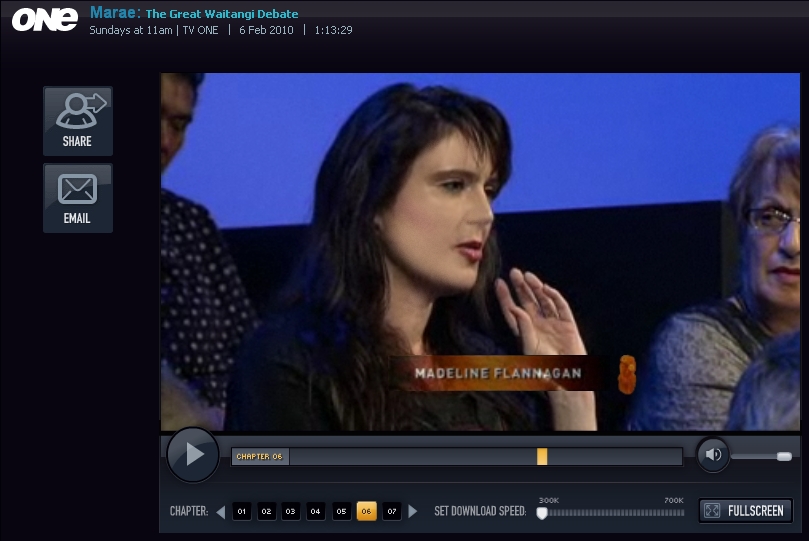
    • Matt and Madeleine Flannagan both questioned the interpretations of the separatists … “How did they get their idea that the treaty obliged the state to teach and propagate Te Reo?” … “Why do they think a legal document like the treaty can be interpreted without applying the usual rules of law?”
    • Prof David Round criticised the ongoing and deepening riff caused by the separatist treaty industry.

    Most of the rest from the likes of Minto, Dalamere and co were the usual socialist rubbish that denies any responsibility of the Maori people to stand on their own two feet lumping the taxpayer with the burden of carrying them like babies.

    It was difficult to follow much of the commentary as it was so muddled up with some truth and a hell of a lot of false assumptions/propaganda.

    I was even dis-owned by my tribe for supporting equality before the Law! (Oh well, I shall continue to walk on alone if I must)

    I was happy that in the last segment I got to slam our racially divided electoral system and parliament adding that what made the election of Barack Obama great is that he was elected in a proper non-racist election competing with white men and woman, unlike our current shameful apartheid system in NZ.

    In closing I want to state for the record that…Just as the state education system is a propaganda machine of the theory of evolution…so too it propagates the lies of treaty separatism.

    This exposes the travesty of having a democracy with state control of our schools and the urgent need to divest the state of its evil encroachments and control over our children’s minds. Privatize education!

    The battle goes on…

    RELATED POSTS:
    View “Marae: The Great Waitangi Debate” Here

    Sovereignty and The Treaty of Waitangi
    Maori and Pakeha are Not Partners to the Treaty of Waitangi
    (Our Review of the Debate)

  • View “Marae: The Great Waitangi Debate” Here

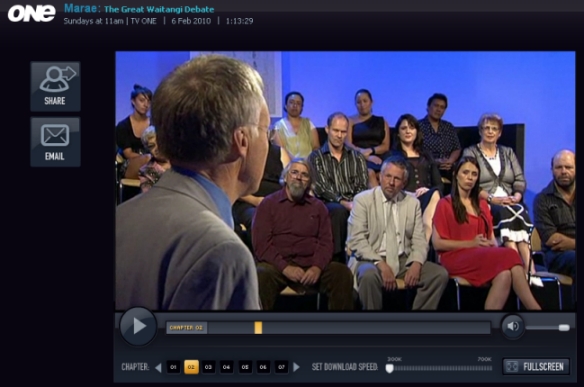
    For those of you who slept in, got the time wrong or who just don’t get TV One because you don’t live in New Zealand, click on the link to watch “Marae: The Great Waitangi Debate,” as screened on national television this morning.

    The debate featured panelists Stephen Franks, Tim Wikiriwhi, Matthew Hooten and Hana O’Regan and an active studio audience, including Matt and I, who were expected to comment and ask questions from the floor (which we did).

    Our thoughts from inside the program are here.

  • Tune in to Marae Tomorrow

    Yesterday Matt and I participated in filming a debate on the Treaty of Waitangi. The moot was “That the Treaty of Waitangi is holding NZ back.” There were four panelists, Stephen Franks, Tim Wikiriwhi, Matthew Hooten and Hana O’Regan and an active audience, of which Matt and I were asked to be members of to represent blogging New Zealand (apparently they considered David Farrar but decided we’d be more interesting on the basis of Matt’s blog post, Maori and Pakeha are Not Partners to the Treaty of Waitangi).

    The audience, who comprised a range of commentators, Members of Parliament and even activist John Minto, were expected to comment and ask questions, which we dutifully did. Who knows if we’ll make the editing room cut, or how what we said will play on screen (it always feels different in the moment to how it looks on air I find)  – one way to find out I guess!

    The debate will screen on Marae tomorrow morning, Saturday, 6 Feb, from 8:00am – 9:30am on TV One.

    Here is a brief rundown of our thoughts:

    • Speaker of the Day goes to Stephen Franks for presenting the best case and for managing to use terms like “fake treaty”, “bogus” and “spurious” whilst still managing to come across calm, pleasant and reasonable.
    • The Most Inflammatory award goes to Tim Wikiriwhi – you can read his transcript at Not PC. The award was for his  student-politician-styled-delivery coupled with claims later on in the debate that there had not been a single past injustice towards Maori, which earned him shocked and awed hissing. (That aside his message was good and his historical claims were fascinating.)
    • Best Impersonation of Peter Dunne award goes to Matthew Hooten for trying to take the middle ground and please everyone whilst effectively saying nothing but sounding profound.
    • The Loonie Leftie Why–Didn’t–Her–Over-Sized–Tiki–Explode? award goes to Hana O’Regan for (and it was hard to pick a winner from the many incoherent and internally inconsistent examples she had on offer) arguing for the confiscation of property  (tax dollars) to support the promotion of Maori language “because it is beautiful” [so too is the NZ countryside] citing the Treaty as justification for said confiscation of property (I kid you not!). We both called her on this in the Q&A.
    • Funniest Moment was when the producer decided that our paper voting forms didn’t look so good on camera so had the audience pretend to push invisible electronic voting buttons and to vote multiple times so that the camera could grab a range of shots. Shane Taurima, the host, completely lost it with laughter when he delivered the instructions to the audience to push the green button for the affirmative and the red button for the negative “on the small electronic device you see before you” and he had to re-shoot it. (Then they decided to have us vote with the paper ballots).

    I must note that at the beginning of the debate the audience was asked for a show of hands as to who was for the motion and who was against it. At the outset less than 5 people were for the motion. This is an important consideration to factor into the voting results announced at the end of the debate. As Stephen said to me afterwards, I think the for’s won it as they gained votes and the againsts lost them.

    RELATED POSTS:
    Maori and Pakeha are Not Partners to the Treaty of Waitangi