Tag: War Ethics

  • Contra Mundum: Pacifism and Just Wars

    Comedian Bill Maher recently berated Christians for being hypocrites for supporting military action against terrorists in his “New Rules” segment on the U.S. TV show Real Time (transcript here). Jesus, Maher contended, was a pacifist; “Jesus lays on that hippie stuff pretty thick. He has lines like, “do not repay evil with evil,” and “do not take revenge on someone who wrongs you.” Here Maher was citing from Romans 12, where Paul formulated Christ’s teaching about loving one’s enemies. In this passage Paul commanded people to “bless those who persecute them,” they are forbidden to “repay evil for evil” and are commanded to “not take revenge” but to “leave room for God’s wrath. For it is written, ‘Vengeance belongs to me. I will pay them back’.”

    Maher scathingly contended that this support contradicted Christ’s clear teaching; he said, “nonviolence was kind of Jesus’ trademark. Kind of his big thing. To not follow that part of it is like joining Greenpeace and hating whales.”

    After saying this Maher quipped, “the next line isn’t ‘and if that doesn’t work, send a titanium fanged dog to rip his nuts off.’” The irony is that it Maher clearly had not bothered to actually read the next line; Romans 13 states that the “governing authorities” are “established by God”; one is morally bound to submit to rulers because “rulers do not bear the sword for no reason. They are God’s servants, agents of wrath to execute vengeance upon evil doers”.

    The Greek words for evil, wrath, and vengeance are the same in both Romans 12 and 13. Paul is stating that the very things Christians are forbidden to do with regard to not repaying evil for evil, are precisely what the State has been given the legitimate authority and right to do.

    Paul here elaborates the basic premise that moral theologians appeal to to reject pacifism and to support the claim that war can be just under certain circumstances. The premise is that a government has the right and duty to use force to uphold within the geographical area over which it has jurisdiction. A just war is simply an extension of a government’s power to pass laws and create police powers.

    If a criminal attempts to rape or kill people within the geographical realm over which a government has authority then the government can justifiably use force to prevent this. And it can also use force to try and punish anyone who does these things; hence, the existence of a legislature, police force, courts and prisons. Just War theorists simply note that there seems no reason why this would not extend to when the person committing the offence is a soldier from another country as opposed to a domestic criminal.

    These theorists argue that for a war to be just it must (more…)

  • Lawful Authority and Just Wars

    A reader pointed me to this interesting post on Pacifism and Just War Theory from Baylor University Philosophy Professor, Alexander Pruss.

    Just WarInterestingly Pruss offers an argument similar to the one I presented at a panel discussion on the ethics of war recently. In this discussion I suggested that traditional Christian Just War Theory follows from the contention that a government has the right and duty to use force to uphold justice within the geographical area over which it has jurisdiction. A just war is simply an extension of the government’s police powers. If a criminal attempted to rape or kill people within the geographical realm over which a government has authority then the government could justifiably use force to prevent this. It could also use force to try and punish anyone who did do these things; this is why we have a police force, court system and prisons. Just war theorists cannot see why this should cease to be the case when the person committing the offence is a soldier from another country as opposed to a domestic criminal.

    Pruss gives a similar argument; he starts by defining problematic violence as “lethal violence, i.e. violence that, if successful, has a high probability of resulting in the opponent’s death, counts as problematic, even when the death is not intended.” He then argues,

    “If it is permissible to use problematic violence to stop a citizen wife from murdering her citizen husband, it should also be permissible to use problematic violence to stop a non-citizen woman who sneaked into one’s country to murder her citizen husband. Moreover, this should be permissible even if the woman was commissioned by another state to kill her husband. But if we allow that it is permissible to use problematic violence against criminals acting on behalf of foreign states, then there seems to be no way to deny that it is permissible to use problematic violence to stop invaders.”

    He makes this illustration,

    “When the invading army marches in, burning crops and murdering citizens, they are breaking the victim country’s laws. If problematic violence is permitted to enforce the laws of one’s territory, it should be permissible to use problematic violence to stop them. But this seems to be a case of war.”

    This argument is common in the Reformed or Presbyterian traditions. John Murray, in his book Principles of Conduct, notes the Pauline teaching that the  “governing authorities” are “established by God.” One is morally bound to submit to rulers because “rulers do not bear the sword for no reason. They are God’s servants, agents of wrath to bring punishment on the wrongdoer.” He then asks, “by what kind of logic can it be maintained that the magistrate, who is invested with the power of the sword, may and must execute vengeance upon evil doers within his own domain must sheath the sword of resistance when evil doers from without invade his domain.”

    The Westminster confession makes a similar argument. It argues that because a Government has the authority to use force to maintain justice and peace within the realm over which it governs it can fight wars to maintain justice and peace within this realm.

    I think this is one of the most important lines of argument in defence of Just War Theory. In my talk, I argued that the standard six criteria of a just war: just cause, lawful authority, last resort, the use of proportionate and discriminate force and so on simply unpack the general circumstances in which governments are permitted to us force and apply it to warfare. Here I simply want to explore one implication of this line of argument that Pruss raises. (more…)

  • Pacifism, the Bible and the Sin of Selfishness

    ‘If someone wants something from us and we do not want to give it to them that is the sin of selfishness and the Bible condemns selfishness.’ This was one of the three points a Christian pacifist speaker made in defending his stance at the panel discussion on War Ethics that Matt mentioned in Pacifism and The Golden Rule.

    Whilst there were a lot of issues raised that night that I wanted to respond to (being a member of the audience, I was only able to ask a question on one) it was this point that I woke up with in my head the next morning; I awoke with the question/statement I wished I’d have asked/said on the night fresh in my mind. Here it is:

    Mr Pacifist, you said that if someone wants something from us and we do not want to give it to them that is the sin of selfishness; if someone wants to take from us we should let them without resistance because that is what Jesus did when he let himself be crucified. Is that about right?

    Gun=Better Protection than any Pacifist Male

    So if I go out to the parking lot and a man pins me to the ground and starts raping me and my hand find a rock in the darkness next to me, is what you are saying that I should let him take what he wants, that I should not use the rock to smash him in the head but rather I should lie back and think of Jesus?

    I think the point you are missing is that Jesus let his life be taken to save humankind. If I let myself be taken I am saving no one; if I smashed the rapist in the head with a rock I could at least save the next victim. I could mount the argument that by responding with my choice to be pacifist I was selfishly not thinking of the next victim?

    And what if it was my daughter? What if I heard a noise in the night and found some man pinning my 10 year old down raping her? Should I tell her to lie back and think of Jesus too? Not call the police who might force him away in handcuffs to face a justice system that will deprive him on his liberty? Not smash him over the head with a frying pan or attack him with a kitchen knife? Because I’ll tell you what, anyone who I found doing that to my daughter would leave my house in a body bag or I would give my life trying.

    Pacifism might sound trendy but it misses the point that while Jesus might have lived a fairly pacifist looking life when he was on earth, Jesus is part of a Trinity and there are other parts of the Trinity that judge, that wage war, that strike down and destroy. Yet another part of the Trinity inspired the writing of  the whole Bible. All three elements of the Trinity’s example must be read together to understand the contexts they fall in and I believe  (more…)

  • Pacifism and The Golden Rule

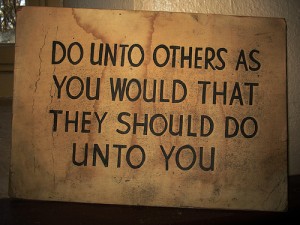
    The Golden RuleLast night I was part of a discussion panel looking at the Ethics of War; I defended classical just war theory. Speaking in defence of pacifism was one of the Waihope three who offered the argument that you cannot use force against an oppressor because of the Golden Rule, typically stated as: ‘do to others as you would have them do to you.’ His idea seemed to be that if you were an oppressor you would not want force used against you so therefore no one should use force against oppressors – this is what the Golden Rule teaches.

    This struck me as odd. One problem with this line of argument is that it interprets the Golden Rule as stating we should do to others what we want them to do to us. This interpretation is obviously problematic. I want a million dollars, does it follow that therefore I should give a million dollars to everyone? I want a nice car does it follow that I should give nice cars to everyone? What the Golden Rule says is that there should be consistency between what we think that people are morally required to do for us and to us and what we are morally required to do for and to others; if I object to someone stealing from me in certain circumstances and condemn that person’s action in doing so as wrong then I am committed to not stealing from that person.

    Once this is understood, I do not think my fellow panellist’s argument works. I am quite happy to accept that if I was trying to kill or seriously maim another human being that others (including the state) would be morally permitted to use force to stop me; I may not want them to but that is not the issue. The issue is whether I think they are are required not to and the answer I think is obviously no.

    In fact, anyone who recognises the government as legitimate must accept that the state can use force against them if they violate certain rules. I would have thought that the laws against assault and homicide would be paradigm examples of this.

  • EPS Apologetics Conference: God and the Genocide of the Canaanites

    Matt has been invited to speak at the annual Evangelical Philosophical Society (EPS) Apologetics Conference in Atlanta, Georgia, USA which runs 18-20 November 2010. He will be speaking alongside some big names in contemporary Christian philosophy including Alvin Plantinga and William Lane Craig.

    Evangelical Philosophical Society Apologetics Conference

    Experience seasoned teaching by Alvin Plantinga, William Lane Craig, Gary Habermas, Greg Koukl, Randy Newman, Frank Beckwith, Craig Evans, Craig Blomberg, Mike Licona and over twenty other influencers in Christian apologetics as they equip you about the issues facing contemporary Christian witness.

    The full line up of speakers is here.

    You can register here.

    Matt’s talk is entitled “God and the Genocide of the Canaanites,”

    How could a just and loving God command Joshua to genocide the Canaanites as is apparently taught in the Old Testament? Is God really a moral monster as Christianity’s critics use these passages to claim? Matthew will re-examine these passages in light of the context they were written in showing that the skeptics’ case against God relies on a questionable reading of the Old Testament.

    This talk will be based on Matt’s blog series, Joshua and the Genocide of the Canaanites Part I and Part II, his Contra Mundum column, “Did God Command Genocide in the Old Testament?” (forthcoming August 2010) and his chapter, co-authored with Paul Copan, “Ethics of ‘Holy War’ for Christian Morality and Theology” in Old Testament ‘Holy War’ and Christian Morality: Perspectives and Prospects (forthcoming 2011).

    If you would like to donate to help Matt get to America to speak at the EPS Apologetics Conference please visit our support page.

  • Guest Post: Israel – Definitely One Subject Where One “Size-R” Does Not Fit All!

    This guest post, part of open mic week(s), is a long, uncharacteristically straight-forward and very interesting submission from Jonny King on Israel.

    Israel – Definitely One Subject Where One “Size-R”
    Does Not Fit All!

    Warning! Reading this could induce uncontrollable urges to spontaneously desire sleep!  Recommended for Insomniacs and other freaks!

    Now I thought that heading was rather cheeky, but also rather good… go on, call me a cheeseburger… what say you?

    If you are still miffed and are desperately looking again to see what could possibly have caused such a flummoxed expression redounding right back at you, what can I say but, “read on, all will be revealed, blog to the future… after all, you did have a flummoxed capacitor.”

    If you know the subject heading to your question, then dim your lights, there will no doubt be traffic coming in the opposite direction… and this could be get rather sporting!

    A Jewish proverb says, “Two Jews, three opinions.”  Sadly and with a little concern, on the subject that relates to the nation of Israel, be it either theological or Geo-political, it seems to be becoming more and more “Two Gentiles, One Opinion,” with this opinion being neither nuanced, consistent, and credible, when the facts on the ground are fairly and comprehensively examined, contrasted and assimilated into ones worldview, which means that at the crossroads of justice, Israel is seemingly always getting a red light for its actions, with those that action upon it, receiving no such sufferance.

    We live in such a cultural time that when the weapons of thought war are drawn, when one affirms that they biblically and theologically support the nation of Israel, such are viewed at best as theological lightweights, and at worst, Christians blindingly committing injustice with their “Left Behind” special edition bibles in tow,  as some pseudo-come-psycho-authorial basis.

    We will get to a discussion of some of these themes at a later date (marriage is out of the question), but I do want to make some opening statements, call them clarifications, which reflect on this support.

    The nation of Israel is like every other nation under the Sun, inhabited by people who are not only mortal, but mortally fallen.  Therefore, as a practical outworking of this theory, they will do things that reflect this standing, as I occasionally do, okay, add that to the list of the many… liar.

    You know what, there have been times and will be times when total depravity will party with utter depravity, with the result being that circumstances of sin will stain their record and others reality.

    An example of where the nation of Israel misses Mark. and while you’re at it add in Mary and Martha,  relates to a historical reality I personally know about (Jacob Damkani would be another example).  I believe it is not presumptuous to call Dr. Arnold Fruchtenbaum a friend. I have had the pleasure of touring Israel (on two occasions) and Jordan (on one of those occasions) over a five to six week period in 2000 and 2004.

    I have been on the border with Gaza and I have been in the West Bank.  I have heard the sounds of battle and I have been locked in Rachel’s tomb as stones were being thrown on the roof, with some teenage Soldiers discussing how to approach such a reality.  I have been to Bethlehem Bible College, had lunch and listened to someone from Musalaha speak about reconciliation (I believe it was Salim J. Munayer).

    In fact, “the Frucht” has authored a chapter titled, “The Biblical Teaching on Peace,” in a book titled Seeking and Pursuing Peace: The Process, The Pain, and the Product, which is published by this ministry.  In a small precis about Arnold in this work, which by the way, is not produced by an organisation that shares Arnie’s perspectives on Israel, it does say, however, He has graciously led several Musalaha conferences and is best known for his biblical teachings.

    However, this survivor of the Holocaust, whose account and travel to safety is really one of “boys own” fame does not have the freedom to make “aliyah” and live in the national homeland that has once again been introduced into the drama of statehood for the express purpose of Jews diaspora-wide.

    The obvious question from the interactive reader is why this is the case?

    There was a time when Arnold did live in Israel and would do so, for at least a portion of the year (at the time I asked him so years ago).  He has committed no crime (that we know about anyway… joking), but the reason he cannot is that many years ago, upon his return to the land of his ancestors, Arnold and his wife decided to set up a small Bible study type school for believers and those God-ordained to be.  Hush your perverse lips!… He did what?  Surely not, who would consider such a concept this side of Matthew 28: 19-20!

    When the more ultra-orthodox found out about this, there was a full-page spread on the fourth page of one of the newspapers, which did not make him especially popular, with Arnold sent on his own personal diaspora, and like little old me, a goy boy, he gets the standard three-month exemption card when entering the country, with his future stops there, always having to return to go, as he can not stay.

    For all intense and purposes, the reason is because of his belief that Jesus is the Messiah, the Anointed One not only for Gentiles, but even for Jews, without distinction, which all mankind must accept, without prejudice… such an intolerant message.

    This is also why, if my memory serves me correctly, he is on what is termed a Grey list, not, however, what is termed a Black list, which would mean he would not be able to get in at all, but a Grey list… which means that he is allowed in, after all, he does bring the student, not the tourist dollar (most, if not all reading this will not have been on his tours and one of the first things you are made to understand is that you are students, not tourists.  If you doubt this, just wait until you start), but those in the know will know who he is!

    1) Why am I telling you this, and 2) What is my response to such realities?

    I am telling you this to affirm that while I like wearing glasses, rose-tinted glasses are so passe.  My theoretical statements about Israel failing is not mere rhetoric, but is allowed out of the dark into the sunlit world of reality.

    I am also telling you this to show that Israel is imperfect and is not above reproach, and where they fail, they should be called out.  However, this calling out should be consistent and reflective of our interactive discourse with the activities of other nations of this world.

    Sadly, it is my perception that too many people occupy one or the other extreme, with presently, there being no room at the Inn of Israel hostility.  Therefore, now that I have offered such a reflection,  in today’s climate, there are those who will use this as another knife to fix into this nations back without so much as a moments Christ-like reflection.

    Yes, we should speak the truth, but as Messiah affirmed in the sermon of Mountainous proportions, it is not only what we do, but why we do it!  Can I suggest that we imitate this high calling and do so with the love of Christ in Paul (Romans 9:1-3) radiating within to without our puny frames, after all, the power does not emanate from our building… it is the Gospel that enters the building (Romans 1:16-17)!

    Now that I might possibly have made some more street cred before I get to some more heated matters, let me also say that I am a Chovevei Tzion, and I believe her best times are ahead of her when a generation of Jews will say, Baruch Haba B’Shem Adonai.

    Here is where we take the corner and transition… lean, the J, I mean G-forces are about to hit!

    Statement of Intent: I find the present and the presently growing attitude towards Israel and Jews worldwide to be very concerning, with the recent conflict in Gaza an example of wisdom gone wild.

    While the time will come when there will be reflections on a certain written Christian witness as it pertains to Israel, this will have to wait for a future time, as what was going to be my introduction has binged!

    I know, I am being so I am Jonny King… writing too much to so few… spread the word wouldya!

    The present cultural climate can be exemplified by the response to the recent confrontation, war, or whatever you want to call it… blatant Israeli aggression the kool-aid drinker interjects.

    As an example of such a position, Amnesty International has placed the sole blame on Israel for the breakdown in the cease-fire between Israel and Hamas that led to Operation Cast Lead, as affirmed here… which it seems is another way of framing the perspective that one way or another, Israel is guilty – period!

    Forget the historical fact that Israel, lock, stock and multiple smoking barrels aimed at its own, pulled out of Gaza in 2005, with the vivid scenes of Israeli armed forces removing those Jews who were intending to stay, leaving all behind them (this included what I believe is millions of dollars worth of donated technology [glasshouses]), with one donation, some $500,000, being donated by the head of the World Bank.  Sadly, this was subsequently destroyed by those who were claiming a victory.

    Forget the consistent terrorising of Israeli life with some 8,000 rockets fired to Lord knows where these would hit, as a possible reason for the escalation!

    Scrap that statement, please consider this…

    Seriously reflect on the implications and practical applications as to how a nation-state should respond when, for example, in the first six months of 2008 alone, Israel was on the receiving end of over 2000 rockets and mortars that were launched into the nation proper from Gaza.

    That means on average of about a dozen times each and every day, Israeli’s must to be ready to re-act, should they get the call, which means for certain areas, not straying too far from a bunker… Oh, the possibility of death plays some small part in this fear factor too (yes, purposely understated)!

    Do you think accepting such a reality is a reasonable position to maintain? If not, from our theoretical (safe) ivory towers, how would you stop such a reality, when withdrawal, sanctions, and talking obviously did not?

    Maybe if Israel pulled out – period!… that “cessational” idea might work, but it is so of the 1940’s… who would possibly suggest such a thing?!

    While you are contemplating, here is one possible answer from one individual… See what you think!

    I don’t think any country would find it acceptable to have missiles raining down on the heads of their citizens.

    The first job of any nation state is to protect its citizens.  And so I can assure you that if – I don’t care if I was a politician.  If somebody was sending rockets into my house where my two daughters sleep at night, I’m going to do everything in my power to stop that.  And I would expect Israelis to do the same thing.

    In terms of negotiations with Hamas, it is very hard to negotiate with a group that is not representative of a nation state, does not recognize your right to exist, has consistently used terror as a weapon, and is deeply influenced by other countries.  I think that Hamas leadership will have to make a decision at some point as to whether it is a serious political party seeking to represent the aspirations of the Palestinian people.  And, as a consequence, willing to recognize Israel’s right to exist and renounce violence as a tool to achieve its aims.  Or whether it wants to continue to operate as a terrorist organization.  Until that point, it’s hard for Israel, I think, to negotiate with a country that – or with a group that doesn’t recognize Israel’s right to exist as a country.

    Did you really read all that?… Sound reasonable?… Guess who said that?

    The-then Candidate Barack Obama at Sderot, Israel, prior to becoming Mr President.

    Obviously, when he said that he would do anything for the safety of his daughters, he did not mean such things as water-boarding!

    Intriguing!

    As the cease-fire that was spoken about (I refer to that concept loosely, somewhere near the trajectory of the meaning of this concept) was nearing its conclusion, Hamas once again affirmed that it would step up to the rocket fire plate and play “ball” again.

    It is also an important historical point to affirm that the long-distance attack, viz-a-viz rocket attack, would have to become the weapon of choice as Israel decided that suicide bombers were not the visitors-come-tourism that one should seek or encourage.  Weddings, Nightclubs and gathering of Jewish humanity were the vortex where the brutality of shrapnel-infected weaponry (is such a war crime) would inflict, killing and maiming citizens not directly involved in this bloody interchange (civilians).

    Therefore, can such a decision be justified? (more…)
  • Bush’s Legacy

    I am always slightly disturbed when I encounter Bush-haters amongst my friends. Disturbed not because it surprises me that Bush-hater exist but because my friends are otherwise smart, informed, thinking people who have a healthy degree of scepticism towards the left-wing, anti-conservative values of the media and hollywood; I just don’t get how they can navigate other issues well but then buy into all the conspiracy, anti-Bush hysteria.

    They in turn, of learning that I think Bush is one of greatest US Presidents of my life time and that I firmly believe he will be remembered up there with Reagan, Lincoln, Roosevelt and Washington as one of the best, think I am insane and are invariably shocked. They start throwing all the conspiracy theories at me, they talk about his motives, his war-mongering and the rest. Typically each demonstrates a superficial understanding of the issues and even when they have read up on some of these issues they still fall into the error of failing to understand the nature of politics and the necessity of spin demonstrating that despite their protests they have and do buy into the media and hollywood’s portrayal of Bush.

    In New Zealand, even among a Christian or politically conservative constituency, I am very aware that in making these statements I am amongst a minority and that many regular readers will be baffled to discover that I think Bush rocks. If you are such a person but you otherwise generally like what I have to say, please read the following article that appears in today’s Herald as it summs up pretty much everything I would like to say.

    This article, unlike today’s Herald editorial claiming the opposite, was written by a political historian, educated at Cambridge.

    Legacy the Bush-Haters Will Loathe
    NZ Herald 16 Jan 09

    The American lady who called to see if I would appear on her radio programme was specific. “We’re setting up a debate,” she said sweetly, “and we want to know from your perspective as a historian whether George W Bush was the worst president of the 20th century, or might he be the worst president in American history?” “I think he’s a good president,” I told her, which seemed to dumbfound her, and wreck my chances of appearing on her show.

    In the avalanche of abuse and ridicule that we are witnessing in the media assessments of President Bush’s legacy, there are factors that need to be borne in mind if we are to come to a judgment that is not warped by the kind of partisan hysteria that has characterised this issue on both sides of the Atlantic.

    The first is that history, by looking at the key facts rather than being distracted by the loud ambient noise of the 24-hour news cycle, will probably hand down a far more positive judgment on Mr Bush’s presidency than the immediate, knee-jerk loathing of the American and European elites.

    At the time of 9/11, which will forever rightly be regarded as the defining moment of the presidency, history will look in vain for anyone predicting that the Americans murdered that day would be the very last ones to die at the hands of Islamic fundamentalist terrorists in the US from that day to this.

    The decisions taken by Mr Bush in the immediate aftermath of that ghastly moment will be pored over by historians for the rest of our lifetimes. One thing they will doubtless conclude is that the measures he took to lock down America’s borders, scrutinise travellers to and from the United States, eavesdrop upon terrorist suspects, work closely with international intelligence agencies and take the war to the enemy has foiled dozens, perhaps scores of would-be murderous attacks on America. There are Americans alive today who would not be if it had not been for the passing of the Patriot Act. There are 3,000 people who would have died in the August 2005 airline conspiracy if it had not been for the superb inter-agency co-operation demanded by Bush after 9/11.

    The next factor that will be seen in its proper historical context in years to come will be the true reasons for invading Afghanistan in October 2001 and Iraq in April 2003. The conspiracy theories believed by many (generally, but not always) stupid people – that it was “all about oil”, or the securing of contracts for the US-based Halliburton corporation, etc – will slip into the obscurity from which they should never have emerged had it not been for comedian-filmmakers such as Michael Moore.

    Instead, the obvious fact that there was a good case for invading Iraq based on 14 spurned UN resolutions, massive human rights abuses and unfinished business following the interrupted invasion of 1991 will be recalled.

    Similarly, the cold light of history will absolve Bush of the worst conspiracy-theory accusation: that he knew there were no WMDs in Iraq. History will show that, in common with the rest of his administration, the British Government, Saddam’s own generals, the French, Chinese, Israeli and Russian intelligence agencies, and of course SIS and the CIA, everyone assumed that a murderous dictator does not voluntarily destroy the WMD arsenal he has used against his own people. And if he does, he does not then expel the UN weapons inspectorate looking for proof of it, as he did in 1998 and again in 2001.

    Mr Bush assumed that the Coalition forces would find mass graves, torture chambers, evidence for the gross abuse of the UN’s food-for-oil programme, but also WMDs. He was right about each but the last, and history will place him in the mainstream of Western, Eastern and Arab thinking on the matter.

    History will probably, assuming it is researched and written objectively, congratulate Mr Bush on the fact that whereas in 2000 Libya was an active and vicious member of what he was accurately to describe as an “axis of evil” of rogue states willing to employ terrorism to gain its ends, four years later Colonel Gaddafi’s WMD programme was sitting behind glass in a museum in Oakridge, Tennessee.

    With his characteristic openness and at times almost self-defeating honesty, Mr Bush has been the first to acknowledge his mistakes – for example, tardiness over Hurricane Katrina – but there are some he made not because he was a ranting Right-winger, but because he was too keen to win bipartisan support. The invasion of Iraq should probably have taken place months earlier, but was held up by the attempt to find support from UN security council members, such as Jacques Chirac’s France, that had ties to Iraq and hostility towards the Anglo-Americans. History will also take Mr Bush’s verbal fumbling into account, reminding us that Ronald Reagan also mis-spoke regularly, but was still a fine president. The first MBA president, who had a higher grade-point average at Yale than John Kerry, Mr Bush’s supposed lack of intellect will be seen to be a myth once the papers in his Presidential Library in the Southern Methodist University in Dallas are available.

    Films such as Oliver North’s W, which portray him as a spitting, oafish frat boy who eats with his mouth open and is rude to servants, will be revealed by the diaries and correspondence of those around him to be absurd travesties, of this charming, interesting, beautifully mannered history buff who, were he not the most powerful man in the world, would be a fine person to have as a pal.

    Instead of Al Franken, history will listen to Bob Geldof praising Mr Bush’s efforts over Aids and malaria in Africa; or to Manmohan Singh, the prime minister of India, who told him last week: “The people of India deeply love you.” And certainly to the women of Afghanistan thanking him for saving them from Taliban abuse, degradation and tyranny.

    When Abu Ghraib is mentioned, history will remind us that it was the Bush Administration that imprisoned those responsible for the horrors. When water-boarding is brought up, we will see that it was only used on three suspects, one of whom was Khalid Sheikh Mohammed, al-Qaeda’s chief of operational planning, who divulged vast amounts of information that saved hundreds of innocent lives. When extraordinary renditions are queried, historians will ask how else the world’s most dangerous terrorists should have been transported. On scheduled flights?

    The credit crunch, brought on by the Democrats in Congress insisting upon home ownership for credit-unworthy people, will initially be blamed on Bush, but the perspective of time will show that the problems at Fannie Mae and Freddie Mac started with the deregulation of the Clinton era. Instead Bush’s very un-ideological but vast rescue package of $700 billion (£480 billion) might well be seen as lessening the impact of the squeeze, and putting America in position to be the first country out of recession, helped along by his huge tax-cut packages since 2000. Sneered at for being “simplistic” in his reaction to 9/11, Bush’s visceral responses to the attacks of a fascistic, totalitarian death cult will be seen as having been substantially the right ones. Mistakes are made in every war, but when virtually the entire military, diplomatic and political establishment in the West opposed it, Bush insisted on the surge in Iraq that has been seen to have brought the war around, and set Iraq on the right path. Today its GDP is 30 per cent higher than under Saddam, and it is free of a brutal dictator and his rapist sons.

    The number of American troops killed during the eight years of the War against Terror has been fewer than those slain capturing two islands in the Second World War, and in Britain we have lost fewer soldiers than on a normal weekend on the Western Front. As for civilians, there have been fewer Iraqis killed since the invasion than in 20 conflicts since the Second World War. Iraq has been a victory for the US-led coalition, a fact that the Bush-haters will have to deal with when perspective finally – perhaps years from now – lends objectivity to this fine man’s record.

    Andrew Roberts is the author of Masters and Commanders: How Roosevelt, Churchill, Marshall and Alanbrooke Won the War in the West
    RELATED POST: