
Below is part one of a sermon I presented at Crossroads Presbyterian Church in Pokeno.
“Do not judge, or you
too will be judged. 2 For in the same way you judge others, you will be judged, and with the measure you use, it will be measured to you. 3 “Why do you look at the speck of sawdust in your brother’s eye and pay no attention to the plank in your own eye? 4 How can you say to your brother, ‘Let me take the speck out of your eye,’ when all the time there is a plank in your own eye? 5 You hypocrite, first take the plank out of your own eye, and then you will see clearly to remove the speck from your brother’s eye.6 “Do not give dogs what is sacred; do not throw your pearls to pigs. If you do, they may trample them under their feet, and turn and tear you to pieces.”

There is an apocryphal story going around that goes as follows: A generation ago, the most well-known New Testament passage was John 3:16—“For God so loved the world that he gave his one and only Son, that whoever believes in him shall not perish but have eternal life.” However, now, in this current generation, the most well-known passage is Matthew 7:1—“Do not judge, or you too will be judged.”
I don’t know if this is an accurate claim. However, it is an apocryphal story because it illustrates a widely held understanding of Jesus’ teaching. Today I want to offer a corrective. I will do three things. First, I will sketch what I take to be a common understanding of this passage. Second, I will give several reasons why I think this interpretation is mistaken—indefensible, in fact. Third, I will offer a different way of reading the passage, which I think is more accurate.
1.A Common Interpretation.
Let’s look first at how this passage is commonly understood. Several years ago, I gave a talk on moral relativism for Thinking Matters Tauranga. During that talk, I noted that relativism entails that one cannot apply the moral principles you (or your culture) accept to the practices of other people (or cultures). I was critical of this position, arguing that it suffers from all sorts of problems. Predictably, someone in the audience asked me a question about Jesus’ comments in the Sermon on the Mount:
“Do not judge, or you too will be judged. For in the same way you judge others, you will be judged.” (Matt. 7:1–2)
Notice the highlighted word “or” in this passage. It suggests a disjunction: there are only two options—either you refrain from judgement, or you fall under judgement.
It is common to hear people interpret this passage as a commandment to not “judge other people.” The basic idea is this: judging other people is wrong; if you judge other people, God will judge you.
In fact, it is common for people to use this statement as a kind of rhetorical club to silence Christian theological and moral critique of various cultural practices. When a particular practice is subjected to such critique, those who engage in the practice will complain they are being “judged,” that Christians are being “judgemental,” and that this is contrary to what Christ taught.
I believe this is a misinterpretation of the passage. In fact, if one wants an example of the claim that it is wrong to make moral judgements about other cultures in Scripture, the most explicit example actually comes from the men of Sodom in the story of Lot. When the men seek to sodomise Lot’s visitors, Lot condemns what they desire to do as a “wicked thing.” Their response is recorded as follows:
“Get out of our way,” they replied. And they said, “This fellow came here as an alien, and now he wants to play the judge! We’ll treat you worse than them.” They kept bringing pressure on Lot and moved forward to break down the door.
Here, the men of Sodom objected that Lot is from a different culture, and yet he dared “play the judge.” In my view, Jesus was not defending the men of Lot’s behaviour in Matt. 7:1–2. I think we need to look closer at this passage that is so often cited.
2. What Is Wrong with the Common Interpretation?
Why do I think this common interpretation is mistaken? Several reasons.
First, the claim that it is wrong to judge other people has absurd implications. Just think about it for a minute. If it is wrong to judge other people, then—since Hitler was another person—it is wrong to say that what he did was wrong. To say that his actions were wrong is to make a judgement about them and, hence, to judge him. Similarly, Martin Luther King Jr. was wrong to criticise racism, and William Wilberforce was wrong to make moral judgements about the slave trade. Taken consistently, the claim that it is wrong to judge entails that we should have no legal system, no laws, and no courts, as all these things involve judging certain conduct as wrong and condemning and punishing those who engage in it.
Second, not only would these historical and contemporary cases of judging be wrong, but if it were sinful to judge others, then much of the Hebrew Scriptures—parts that purport to describe people faithfully following God’s will—are, in fact, exercises in wrongdoing. The prophets offer, in some instances, scathing moral critiques of (and hence make moral judgements about) the actions of Israel, Judah, and also surrounding nations such as Assyria and Babylon. Isaiah, Jeremiah, Ezekiel, Amos, etc., in uttering such judgements, were engaging in sin. It is not just the Hebrew Scriptures that are implicated in wrongdoing. The opening chapters of the book of Romans contain a moral critique of both the Gentile and Hebrew cultures of Paul’s day. Here is an excerpt:
Furthermore, just as they did not think it worthwhile to retain the knowledge of God, so God gave them over to a depraved mind, so that they do what ought not to be done. 29 They have become filled with every kind of wickedness, evil, greed and depravity. They are full of envy, murder, strife, deceit and malice. They are gossips, 30 slanderers, God-haters, insolent, arrogant and boastful; they invent ways of doing evil; they disobey their parents; 31 they have no understanding, no fidelity, no love, no mercy. 32 Although they know God’s righteous decree that those who do such things deserve death, they not only continue to do these very things but also approve of those who practice them.
Paul made harsh moral judgements about other people.
In fact, if one seriously believes that judging is wrong and contrary to the will of God, then Jesus was a sinner. Jesus, after all, made some very harsh judgements about the Pharisees and Sadducees throughout the Synoptic Gospels. In Matthew’s Gospel, on seven occasions he says, “Woe to you, teachers of the law and Pharisees, you hypocrites!” He proceeds to offer scathing criticisms of their religious and moral practices.
On at least one occasion, Jesus criticises the Pharisees for not judging people in the correct way. In John 7:21–24, Jesus states:
Yet, because Moses gave you circumcision (though actually it did not come from Moses, but from the patriarchs), you circumcise a boy on the Sabbath. 23 Now if a boy can be circumcised on the Sabbath so that the law of Moses may not be broken, why are you angry with me for healing a man’s whole body on the Sabbath? 24 Stop judging by mere appearances, but instead judge correctly.
The problems with this interpretation of Matthew 7:1–2 do not stop there. A little reflection will demonstrate that the claim that it is wrong to judge other people is itself incoherent. It is what philosophers call a performative self-contradiction. To claim it is wrong to judge others is to make a moral judgement—it is to judge that a particular action is wrong. Moreover, when a person announces this to other people, he or she is implicitly making a judgement about other people’s actions. To utter “it is wrong to judge others,” therefore, is to engage in judging others.
Tags: Judging · Sermon on the Mount · SermonsNo Comments

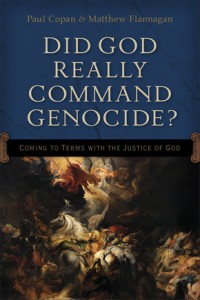 A common objection to belief in the God of the Bible is that a good, kind, and loving deity would never command the wholesale slaughter of nations. In the tradition of his popular Is God a Moral Monster?, Paul Copan teams up with Matthew Flannagan to tackle some of the most confusing and uncomfortable passages of Scripture. Together they help the Christian and nonbeliever alike understand the biblical, theological, philosophical, and ethical implications of Old Testament warfare passages.

0 responses so far ↓
Comments on this entry are closed.