Author: Madeleine

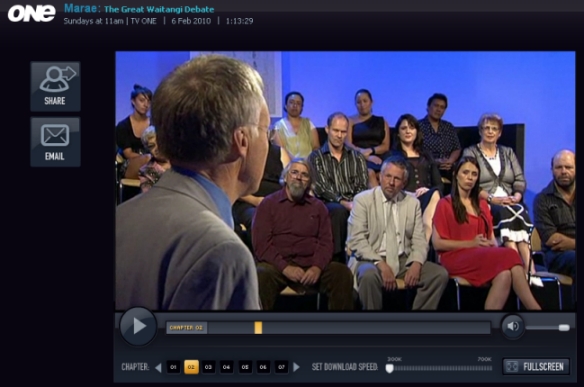
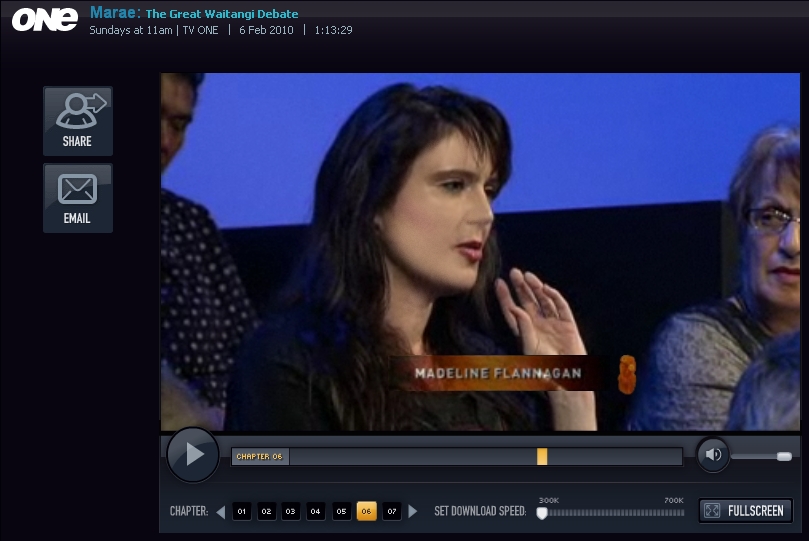
  • View “Marae: The Great Waitangi Debate” Here

    For those of you who slept in, got the time wrong or who just don’t get TV One because you don’t live in New Zealand, click on the link to watch “Marae: The Great Waitangi Debate,” as screened on national television this morning.

    The debate featured panelists Stephen Franks, Tim Wikiriwhi, Matthew Hooten and Hana O’Regan and an active studio audience, including Matt and I, who were expected to comment and ask questions from the floor (which we did).

    Our thoughts from inside the program are here.

  • Tune in to Marae Tomorrow

    Yesterday Matt and I participated in filming a debate on the Treaty of Waitangi. The moot was “That the Treaty of Waitangi is holding NZ back.” There were four panelists, Stephen Franks, Tim Wikiriwhi, Matthew Hooten and Hana O’Regan and an active audience, of which Matt and I were asked to be members of to represent blogging New Zealand (apparently they considered David Farrar but decided we’d be more interesting on the basis of Matt’s blog post, Maori and Pakeha are Not Partners to the Treaty of Waitangi).

    The audience, who comprised a range of commentators, Members of Parliament and even activist John Minto, were expected to comment and ask questions, which we dutifully did. Who knows if we’ll make the editing room cut, or how what we said will play on screen (it always feels different in the moment to how it looks on air I find)  – one way to find out I guess!

    The debate will screen on Marae tomorrow morning, Saturday, 6 Feb, from 8:00am – 9:30am on TV One.

    Here is a brief rundown of our thoughts:

    • Speaker of the Day goes to Stephen Franks for presenting the best case and for managing to use terms like “fake treaty”, “bogus” and “spurious” whilst still managing to come across calm, pleasant and reasonable.
    • The Most Inflammatory award goes to Tim Wikiriwhi – you can read his transcript at Not PC. The award was for his  student-politician-styled-delivery coupled with claims later on in the debate that there had not been a single past injustice towards Maori, which earned him shocked and awed hissing. (That aside his message was good and his historical claims were fascinating.)
    • Best Impersonation of Peter Dunne award goes to Matthew Hooten for trying to take the middle ground and please everyone whilst effectively saying nothing but sounding profound.
    • The Loonie Leftie Why–Didn’t–Her–Over-Sized–Tiki–Explode? award goes to Hana O’Regan for (and it was hard to pick a winner from the many incoherent and internally inconsistent examples she had on offer) arguing for the confiscation of property  (tax dollars) to support the promotion of Maori language “because it is beautiful” [so too is the NZ countryside] citing the Treaty as justification for said confiscation of property (I kid you not!). We both called her on this in the Q&A.
    • Funniest Moment was when the producer decided that our paper voting forms didn’t look so good on camera so had the audience pretend to push invisible electronic voting buttons and to vote multiple times so that the camera could grab a range of shots. Shane Taurima, the host, completely lost it with laughter when he delivered the instructions to the audience to push the green button for the affirmative and the red button for the negative “on the small electronic device you see before you” and he had to re-shoot it. (Then they decided to have us vote with the paper ballots).

    I must note that at the beginning of the debate the audience was asked for a show of hands as to who was for the motion and who was against it. At the outset less than 5 people were for the motion. This is an important consideration to factor into the voting results announced at the end of the debate. As Stephen said to me afterwards, I think the for’s won it as they gained votes and the againsts lost them.

    RELATED POSTS:
    Maori and Pakeha are Not Partners to the Treaty of Waitangi

  • Auckland Bloggers Drinks – This Thursday

    On the first Thursday of every month, Auckland bloggers gather for the B3 (Bloggers Bar Bash).

    What: Auckland Bloggers Drinks
    When:
    Thursday 3 February from 6.30pm
    Where:
    Galbraiths, 2 Mt Eden Road, Mt Eden, Auckland

    The B3, as it coined by regulars, is open to anyone who happens to be in Auckland. Past blogging celebrities in attendance include bloggers and bloupies (blog groupies – those who read blogs) from Annie Fox, Beretta, Cactus Kate, Interest.co.nz, Kiwiblog, Lolly Scramble, MandM, No Minister, Not PC, Roar Prawn, SOLO, State Highway One, The Fairfacts Media Show, Whaleoil and WHOAR.

    RSVP on Facebook or just turn up…

    Matt and I will be there fresh from spending the day filming “Marae: the Great Waitangi Debate” at TVNZ. We’ve been invited to represent the blogging community from the studio the audience and are expected to comment from the floor at some point, which I’m sure will be taxing, so we’ll definitely be in need of a beverage.

  • John Loftus’ The Christian Delusion: Why Faith Fails

    John Loftus will soon release his new book The Christian Delusion: Why Faith Fails. As many readers will be aware John Loftus and the authors of this blog are not strangers to one another so it may not be much of a surprise to discover that the blurbs page of Loftus’ new book features very short reviews from a range of international scholars including Matt:

    Dr. Matthew Flannagan, Christian philosopher and Adjunct Lecturer in Philosophy for Laidlaw College and Bethlehem Tertiary Institute.

    The Christian Delusion is a comprehensive and representative presentation of contemporary skeptical thought. Anyone who wants to understand the position of contemporary free thinkers could not do much better than to read this book.

    Matt intends to write a more thorough review which we will submit for publication both nationally and internationally.

  • Distractions

    I have a summer school assignment due in on Friday (US readers, I am not repeating anything I’m just getting ahead) and we have family stuff happening which is rather distracting to say the least, so sorry for the absence of posts, it shouldn’t last too much longer.

    Matt has written a lengthy followup post which will probably be two follow up posts on inerrancy as soon as I can get them edited and tomorrow the Christian Blog Carnival will be up at some point as we are the hosts for this round.

  • Christian Blog Carnival CCCXI

    The Christian Carnival CCCXI is out now at Fish and Cans.

    There is a good range in this edition so check it out – it is a good way to discover new blogs.

    Matt’s post, Inerrancy and Biblical Authority, was featured.

    We here at MandM are hosting the next Christian Carnival, which will be out on Wed 27 January. If you wish to submit a recent blog post to it please take note of the guidelines here and submit your post using the Christian Carnival Submission Form by Tuesday 26 January.

  • Can State Appropriation of Minerals in Privately Held Land be Justified? Resources Needed

    I am currently undertaking my second-to-last paper in pursuit of my Bachelor of Law (LLB).  Due to a complicated bunch of factors involving the potential staleness of my papers, if I do not apply to the New Zealand Council of Legal Education for a completion certificate with an LLB and a Professional Legal Studies certificate in hand prior to 31 Dec 2010, combined with limitations of my ability to do much more than one paper at the time due to my neck injury and chronic pain issues and due to the fact that with only two papers to go I need to submit three opinion papers (only one of which can be substituted with voluntary community legal service), I had little choice but to choose a summer school paper that had the option of an opinion credit. This set of circumstances has seen me engaged in the project for which I now hope some of our readers can help me with.

    My paper is Mining and Natural Resource Law (there is not much choice at Summer School). As an opinion topic we were allowed to take our budding legal specialty and apply it to any of the topics on the course outline. I like to take a philosophical rights and freedoms approach to most of what I research and write within the field of law so I have submitted and had approved a topic with a bit of a jurisprudential twist. I intend to analyse the justifications given for the state appropriation of minerals in the sub-soil of privately owned property.

    Most articles I have found on state appropriation so far seem to tacitly assume that if the state has legislated that it owns the minerals in the sub-soil of privately owned land then the state’s action is justified or the author simply does not question this, even if he or she acknowledges that a few private property owners had an issue with this at the time, which is not helpful as I intend to question the justification.

    New Zealand philosophical writings from the perspective of classical liberal/pro-property rights/limited state angles are fairly difficult to find. Further international writings on this subject are not commonly cited in New Zealand so they too are hard to find. If any of our readers can point me to any good sources that might help me in the project or even if you can just leave your thoughts in the comments section (if I use your ideas in the work I promise to attribute them back to you) that would be most helpful.

    The following is the gist of the direction I hope to take.

    Since at least the 16th century, the maxim cujus est solum, ejus est usque ad coelum et ad inferos (Latin for for whoever owns the soil, it is theirs up to heaven and down to hell) meant that at common law, minerals in the sub-soil of land belonged to land owner. Such minerals were assumed to be conveyed along with the land on its change of ownership unless wording in the conveyance instrument specified otherwise. Until fairly recently, the last century or so, the only minerals not subject to this rule were gold and silver. The Case of Mines found “that by the law all mines of gold and silver within the realm, whether they be in the lands of the Queen, or of subjects, belong to the Queen by prerogative”. According to Dr Robyn Anderson,[1]

    The Court of Exchequer found in Case of Mines, that base metals – tin, lead, iron, copper, and non-precious minerals – belonged to the owner of the soil, but that the right to gold, silver, and their ores and admixtures, lay with the Crown. That right was not an incident of ownership of the soil, but rather, an attribute of the monarchy. The Elizabethan assertion of the prerogative reflected the pragmatic needs of the developing English state to control the coinage, and finance an army … [1]

    The argument that back in the 16th century the Monarch needed to be able to protect the realm by using coinage to raise an army (there was no standing army) and weapons to arm it, seems, prima facie, a reasonable justification for the state appropriation of gold and silver. However, in the last century or so many of the base metals and minerals deemed non-precious in the Case of Mines are now included in statutory reservations to the crown. This has reached the point in 2010 where, with few exceptions, the state currently owns almost all minerals in territorial New Zealand and has exclusive right to alienate (or grant a licence to alienate) most of those minerals from even those lands held in private ownership. Further, in many circumstances, land owners cannot even refuse consent for prospective, exploration and mining to occur on their land.

    The New Zealand government owns all naturally occurring petroleum (including both oil and gas), radioactive minerals, and gold and silver in New Zealand. Any individual or company wanting to prospect, explore or mine these substances must obtain a permit under the Crown Minerals Act 1991 and pay the specified fees and royalties [to the state]. The same rules apply to coal and all other metallic and non-metallic minerals and aggregates on Crown-owned land.

    Mining of minerals and aggregates other than petroleum, radioactive minerals and gold and silver on privately owned land requires the consent of the landowner together with resource consents from local authorities granted under provisions of the Resource Management Act. [Emphasis added] [2]

    The current state of mineral rights in New Zealand seems to me, prima facie, to be a violation of ad coelum et ad inferos (the right of land ownership “down to hell” or in sub-soil), so the question I want to ask in my opinion is: what is the basis for the state’s appropriation of sub-soil minerals from the lands of private property owners and is it justified? The New Zealand army is not armed with gold and silver these days, further,  I cannot see any legitimate argument for why the state needs to own petroleum and “Nuclear Free New Zealand” does not have a nuclear weapons program (and are,  just a guess here,  highly unlikely to in the future) so what is with the state ownership of radioactive resources?

    Obviously 3,000 words will not give me a lot of space to develop this topic so I will try to keep the topic to more of a general overview but I need resources and fast both directly on this topic and on property rights generally so if you have any thoughts…


    [1] Robyn Anderson Goldmining: Policy, Legislation, and Administration (Rangahaua Whanui Report, Waitangi Tribunal, Dec 1996) RANGAHAUA Whanui NATIONAL Theme N: GOLDMINING: Policy, Legislation, and Administration (Robyn Anderson ed., 1996) 1.
    [2] Simon Nathan “Mining and underground resources – Mining regulation and education” Te Ara – the Encyclopedia of New Zealand, updated 2-Mar-09.