Author: Matt

  • Matt’s Sermons at Takanini Community Church

    Those who read MandM may be aware that I work as a teaching elder part time at Takanini Community Church. This involves me preparing and giving a lesson for the Takanini Community Church congregation every two weeks.

    In case you’re interested, my sermons at Takanini can be found online here.  I have done a series on the book of Judges, Genesis, The book of Corinthians, The Psalms, and the book of Jonah, currently I am going through the gospel of Luke.

  • Video: The Smith-Flannagan Debate “Morality Does Not Need God”

    On Wednesday 21st May at the University of Waikato retired Philosophy and Political science lecturer Dr Ron Smith and Dr Matthew Flannagan (of this blog) debated the resolution “Morality Does not need God”. Here is the video of that debate.


  • Matt on “Divine Commands and the Canaanite Massacre” at Windsor Park Baptist Church

    Matt’s talk “Divine Commands and the Canaanite Massacre” at Windsor Park Baptist, is  now available online. Matt’s talk was part of a series of talks hosted by “Reasons for Faith” an apologetics group based at Windsor Park Baptist Church.

  • An Interesting Comparison

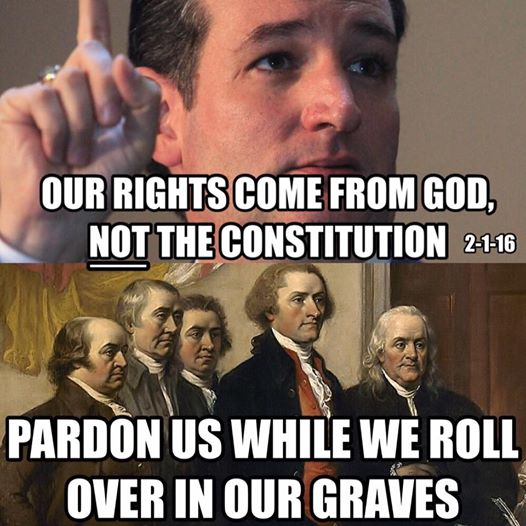
    This from Occupy Democrats:

    12647129_1058653647561022_4746717199189857381_n

    This from the Unites States Founding Fathers:

    When in the Course of human events, it becomes necessary for one people to dissolve the political bands which have connected them with another, and to assume among the powers of the earth, the separate and equal station to which the Laws of Nature and of Nature’s God entitle them, a decent respect to the opinions of mankind requires that they should declare the causes which impel them to the separation.

    We hold these truths to be self-evident, that all men are created equal, that they are endowed by their Creator with certain unalienable Rights, that among these are Life, Liberty and the pursuit of Happiness.–That to secure these rights, Governments are instituted among Men, deriving their just powers from the consent of the governed, –That whenever any Form of Government becomes destructive of these ends, it is the Right of the People to alter or to abolish it, and to institute new Government, laying its foundation on such principles and organizing its powers in such form, as to them shall seem most likely to effect their Safety and Happiness. Prudence, indeed, will dictate that Governments long established should not be changed for light and transient causes; and accordingly all experience hath shewn, that mankind are more disposed to suffer, while evils are sufferable, than to right themselves by abolishing the forms to which they are accustomed. But when a long train of abuses and usurpations, pursuing invariably the same Object evinces a design to reduce them under absolute Despotism, it is their right, it is their duty, to throw off such Government, and to provide new Guards for their future security…

    We, therefore, the Representatives of the united States of America, in General Congress, Assembled, appealing to the Supreme Judge of the world for the rectitude of our intentions, do, in the Name, and by Authority of the good People of these Colonies, solemnly publish and declare, That these United Colonies are, and of Right ought to be Free and Independent States; that they are Absolved from all Allegiance to the British Crown, and that all political connection between them and the State of Great Britain, is and ought to be totally dissolved; and that as Free and Independent States, they have full Power to levy War, conclude Peace, contract Alliances, establish Commerce, and to do all other Acts and Things which Independent States may of right do. And for the support of this Declaration, with a firm reliance on the protection of divine Providence, we mutually pledge to each other our Lives, our Fortunes and our sacred Honor. (emphasis mine)

    Oceania is at war with Eastasia. Oceania has always been at war with Eastasia.

  • Hear Matt’s Three Talks on “Questions People ask”

    Recently Matt spoke at  Orewa Community Church, as part of their series on “Questions People ask”. His three talks: “How can there be just one religion?”, “How does God allow suffering?”, and “Hasn’t Science disproved Christianity?” are all available to listen online to here.

    Real Questions People Ask

  • Richard Carrier and the “Infantile” objection to God’s command’s

    In his article, “Why Traditional Theism Cannot Provide an Adequate Foundation for Morality”, Walter Sinnott-Armstrong argued that a “Divine command theory makes morality childish.”[1]

    In my response to Armstrong, “Is Ethical Naturalism more Plausible than Supernaturalism?”[2] I made two points. First, I addressed a tangential point: that Armstrong’s argument caricatures divine command theory (“DCT”) by tacitly assuming that divine command theorists believe actions are wrong because God will punish us for doing them. Second, I called into question the analogy Armstrong draws between a child following one’s parents and humans following God.Carrier

    Richard Carrier, in his reply to my article, “On the Facts as we Know them, Ethical Naturalism is all there is”,[3] objects to both these responses.

    The motivation of punishment
    Carrier dismisses my first point as “disingenuous” stating,

    (a) that he is “not aware of any DCT advocate who is actually a universalist”; and

    (b) “Every time a DCT advocate has ever threatened or warned anyone of hell (or even just the loss of heaven) in reference to their behaviour, they expose what they really think the ground of Morality is: the fear of consequences.”[4]

    Neither argument is cogent. Let us look at (a) first. The philosopher most responsible for developing and defending DCT in the last fifty years, Robert Merrithew Adams, is a universalist. Given that Adams’ discussion is definitive, and most of the literature in the last thirty years discusses his arguments, Carrier’s claim that he is “not aware of any DCT advocate who is actually a universalist” speaks only to his lack of reading and knowledge of the subject.

    Premise (b) expresses a non-sequitur. Even if, as is true, many divine command theorists are not universalists and even if some have warned people about divine punishment, then it does not follow that those people believe that fear of punishment is the ground of morality. At most it shows that those people believe in divine judgement and they see it as one reason to avoid wrongdoing.

    An analogy might illustrate the mistaken logic here. All people I know believe that prisons exist and I have known some of them warn others that if they commit a crime they will go to jail. It does not follow from this that that these people believe that jail is the only reason one should not commit crimes.

    Straw manning Armstrong and missing the real target
    Carrier’s response to my second point fares little better. He makes two objections:

    (i): “[Armstrong’s] point about infantilization is not the point Flannagan is responding to. Flannagan thinks he means something to do with children obeying parents (and therefore we can build a comparable analogy to adults obeying God that does not infantilize).”

    (ii) that Armstrong’s real point, that “Adult moral reasoning is based on actually caring about the people affected by our actions and thus wanting to do good, as opposed to actually not wanting to do good but begrudgingly doing it anyway to avoid punishment” remains untouched.[5]

    Once again, both objections fail. In respect of (i), contrary to Carrier’s protestation, Armstrong does speak of children obeying parents and does draw an analogy between adults obeying God and children obeying their parents. Here is what Armstrong says:

    “A second objection is that the divine command theory makes morality childish Compare a small boy who thinks that what makes it Morally wrong for him to hit his little sister is only that his parents told him not to hit her and will punish him if he does. As a result, this little boy thinks that if his parents leave home or die then there is nothing wrong with hitting his little sister. Perhaps some little boys think this way but surely we adults do not think that Morality is anything like this.”[6]

    This section of Armstrong’s work was directly quoted in my article.

    This brings us to (ii), even if Armstrong was making the point Carrier attributed to him in this section of his paper, it is mistaken to conclude that I never addressed this (more…)