Author: Matt

  • Plantinga & Ruse on Methodological Naturalism & Science Definitions

    Michael Ruse (and many others) contend that science is constrained by methodological naturalism, which is the thesis that that neither the data, for a scientific investigation, nor a scientific theory nor the background beliefs, against which a theory is assessed, can properly refer to or contain supernatural beings or propositions based on revelation. In Darwinism Defended Michael Ruse seems to think science, by the very definition of science, is constrained by methodological naturalism.  He writes,

    Furthermore, even if Scientific Creationism were totally successful in making its case as science, it would not yield a scientific explanation of origins. Rather, at most, it could prove that science shows that there can be no scientific explanation of origins. The Creationists believe that the world started miraculously. But miracles lie outside of science, which by definition deals only with the natural, the repeatable, that which is governed by law.[1]

    Ruse’s specific target here are creationists who typically contend that the world was created around 6-10 thousand years ago, in 6×24 hour days and that the fossil record is the result of a world-wide flood. However, the definition he offers excludes far more than this specific position. Ruse’s definition entails that any reference to God’s activity is unacceptable in scientific theorising. Any claims such as that the universe was created (in some way or another), that God created the universe ex nihlo, that God sustains the universe, upholds laws of nature God or even theological interpretations of the big bang and the advocacy of theistic evolution would be ruled out as non scientific.

    Moreover, this ruling out is a prori. It is not that scientists have examined whether God exists, that they have gathered evidence showing he does not exist and this has become a settled, peer-reviewed, consensus; science has, in fact, done no such thing. Further, Ruse is clear that his definition would hold even if God does exist and even if there is compelling evidence for his existence. Science would not consider such facts in its theorising; the very rules governing scientific inquiry would rule it out of consideration from the outset. This is because, according to Ruse, science by definition deals only with what is:

    (i) natural;
    (ii) repeatable;
    (iii) law-governed.

    Elsewhere in the same article Ruse defines in more detail what he means by (iii). He states,

    [A]n approach to the empirical world that demands understanding in terms of unbroken law. That is to say, understanding in terms of regularities, which in some way or an other we feel are more than mere contingencies, but rather part of the necessary succession of the empirical world.[Emphasis added][2]

    Ruse contends that science only postulates and presupposes objects and properties that are natural, repeatable and governed by laws of nature. He understands these as regularities grounded in some form of necessary succession.

    Plantinga’s critique
    Alvin Plantinga argues that Ruse’s definition of science is mistaken,

    What about the Big Bang: if it turns out to be unrepeatable, must we conclude that it can’t be studied scientifically? And consider the claim that science, by definition, deals only with that which is governed by law—natural law, one supposes. Some empiricists (in particular, Bas van Fraassen) argue that there aren’t any natural laws (but only regularities): if they are right, would it follow that there is nothing at all for science to study?[3]

    Plantinga here suggests that Ruse’s conditions (ii) and (iii) are subject to straightforward counter-examples and that, as such, his definition is mistaken. In Methodological Naturalism Under Fire Ruse responds to both these criticisms. Below I will examine Ruse’s response and argue that it is unsuccessful.

    The Repeatability Requirement
    Turning to (ii), Plantinga notes that on at least one possible cosmological model the big bang is unrepeatable. Despite this studies into the first instant of the big bang are clearly parts of science and would continue to be so even if this model is true and the big bang is unrepeatable. It follows from this that science can study unrepeatable events which renders (ii) false.

    Ruse’s response is two-fold; first Ruse suggests that Plantinga is repeating a common line of argument,

    As a matter of fact, Plantinga here is raising an objection which has often been raised by critics of the claim that scientific understanding involves reference to law. His point, as was theirs, is that there are many unique events that science must surely try to cover and under stand, but that given the uniqueness of these events, in some sense this precludes lawful understanding.[4]

    Ruse then goes on to address this common line of argument,

    But, as many critics of the critics have countered, there surely has to be some thing wrong with this argument. Take for in stance the demise of the dinosaurs at the end of the Cretaceous. This was in it self a unique phenomenon and un repeat able; but, uniqueness not with standing, the demise was made up of many factors which can individually be brought beneath lawful under standing. To day, it seems most probable that an asteroid or a comet or some such thing hit the earth. This was no unique phenomenon, nor was the hit ting of the earth by the asteroid or comet such that the normal laws of nature – that is to say Galileo’s laws of motion – could not be applied.[5]

    Ruse’s response misses its target. Ruse construes Plantinga’s objection to be aimed at (iii), “the claim that scientific understanding involves reference to law.” This, however, is false. The appeal to the big bang was actually proposed as a counter example to (ii), Ruse’s contention that science deals only with repeatable events. The common line of argument Ruse responds to is not the line of argument Plantinga actually offers.

    Moreover, Ruse’s response fails to address Plantinga’s counter example completely. Plantinga’s counter example was based on big bang cosmology. Instead of showing that his definition can accommodate the big bang, Ruse instead notes that other people (not Plantinga) have offered a different counter-example, the extinction of the dinosaurs, and that this different counter example is unsuccessful. Ruse may well be correct; the extinction of the dinosaurs is not a valid counter-example to (iii) however, Plantinga never said it was. What he said was that the possibility that the big bang is unrepeatable is a counter-example to (ii) and to this line of argument Ruse says nothing.

    Requirement of Being Law-Governed
    Of course Plantinga does offer a response to (iii), the idea that science, by definition, deals only with what is governed by law but his argument against this is very different to an appeal to the extinction of the dinosaurs. Plantinga turns to the issue of being law-governed in the next paragraph and raises quite a different objection to this,

    Consider next the property of being governed by law. The first point, here, would be that the very existence of natural law is controversial; Bas van Fraassen, for example, has given an extended and formidable argument for the conclusion that there are no natural laws. There are regularities, of course, but a regularity is not yet a law; a law is what is supposed to explain and ground a regularity. Furthermore, a law is supposed to hold with some kind of necessity, typically thought to be less stringent than broadly logical necessity, but necessity nonetheless. … So suppose van Fraassen is right and there are no natural laws: would it follow by definition that there isn’t any science? That seems a bit strong.[6]

    Plantinga’s point is that some empiricists (in particular, Bas van Fraassen) argue that there are not any natural laws, there are only regularities. Regardless of whether one agrees with van Frassen or not, even if he is correct it clearly would not follow that science does not exist. This entails that the existence of science does not depend on the existence of laws of nature; hence it is a mistake to define the former in terms of the latter.

    Ruse’s response is as follows,

    Now, whilst I am the last per son to belittle the formidable philosophical powers of Bas van Fraassen – as eminent in the field of the philosophy of quantum mechanics as Plantinga is in the field of the philosophy of religion – what is being extrapolated here is far stronger than van Fraassen or any one else would want (should want) to claim. Certainly there are questions about how one might interpret the necessity of laws: I myself have al lowed that already. But neither van Fraassen, nor any one else is going to deny that there are certain sorts of regularities of some kind and that these are pre -supposed in the activity of science.[7]

    Here Ruse states the existence of science does not presuppose the existence of natural laws, it merely presupposes regularities in nature and this is compatible with the empiricist critiques of laws of nature. The problem is that this explicitly contradicts Ruse’s definition. Ruse states that science deals only with the natural, the repeatable and that which is governed by law. In elucidating this Ruse states that science is “an approach to the empirical world that demands understanding in terms of unbroken law. That is to say, understanding in terms of regularities, which in some way or another we feel are more than mere contingencies, but rather part of the necessary succession of the empirical world.” As Ruse defines science then it presupposes more than mere regularities. This position requires that these be necessary in some sense and it is precisely this understanding of laws of nature that empiricists, such as van Fraassen, do criticise.

    Ruse appears to be in a dilemma; if he accepts natural laws as necessary in some sense then his argument is subject to the objection Plantinga raises. Some empiricists reject the existence of laws so understood but even if they are correct it would be erroneous to claim that science did not exist. If Ruse contends that science need only presuppose regularities then his definition is false because his definition states science demands an understanding in terms of a necessity over and above mere regularity. It seems then that Ruse’s definition of science is problematic; if this is the case, attempts to argue for methodological naturalism on the basis of such a definition are unsound.


    [1] Michael Ruse Darwinism Defended (Reading, MA: Addison -Wesley, 1982) 322.
    [2]
    Ibid.
    [3]
    Alvin Plantinga “Religion and Science” Stanford Encyclopedia of Philosophy accessed 8 December 2009.
    [4]
    Michael Ruse “Methodological Naturalism Under Fire” South African Journal of Philosophy 24 (1) 2005 47.
    [5]
    Ibid.
    [6] Alvin Plantinga “Methodological Naturalism” Perspectives on Science and the Christian Faith 49 (September 1997).
    [7]
    Ruse, above n4, 48.
  • Philosophers’ Carnival – Call for Submissions

    The current edition of the Philosophers’ Carnival is here; the next Philosophers’ Carnival is heading down under and will be hosted by this blog.

    So... you've got a couple of weeks to submit an entry.

    The lowdown on the carnival and the criteria for submissions is explained in full here. The short version is that you should  use the BlogCarnival submissions form to submit your link to the blog post you'd like to have featured.  It doesn't have to be something new, feel free to use something you might have written a while back but that perhaps deserves more exposure. Also keep in mind that Philosophers' Carnival founder Richard Chappell points out that "your post doesn't need to be anything earth-shattering - it just needs to be something that other philosophically-minded people might enjoy reading."

    It would be great to see some more kiwi contributions amongst the international ones especially now that Richard is an honorary yank - I'm not sure we can claim him anymore 😉

  • NIWA, Climategate and Evasive Fallacious Answers

    Climategate has been all the rage on the blogosphere of late and judging by the emails we’ve received in the past few days from our international readers, New Zealand’s own climategate has gone global. The fuel providing the heat is a recent criticism of New Zealand’s National Institute of Water and Atmospheric Research (NIWA) by the New Zealand Climate Science Coalition (NZCSC).

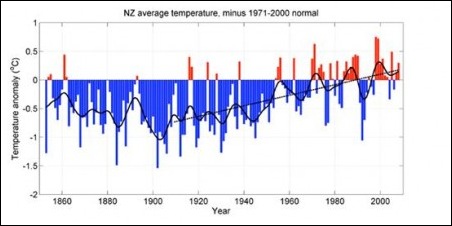
    The coalition released an 8-page report that compares the figures on NIWA’s website with the official graph NIWA has constructed that purports to show that New Zealand’s temperatures have steadily risen since 1909.

    Official New Zealand Average Temperature According to NIWA

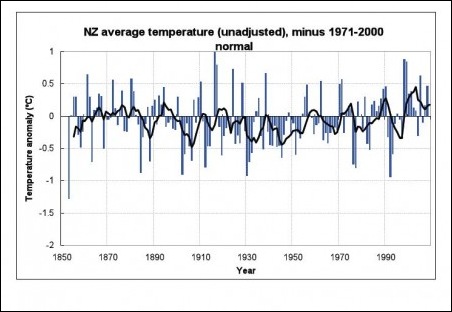
    The problem is that the two sets of figures do not match. When one graphs NIWA’s own websites figures the graph shows a constant steady rate of temperature.

    Unadjusted New Zealand Average Temperature According to NIWA

    The climb in temperature in the official graph is due to the fact that NIWA adjusted the raw data, in almost all cases, upwards. It is these adjustments, and not the raw data itself, which leads to the incline on the official graph. NZCSC have cried foul, Ian Wishart, author of best seller Air Con: The Seriously Inconvenient Truth About Global Warming, got hold of it, the blogosphere followed suit.

    In response NIWA have argued that they had good reasons for adjusting the raw data in this fashion. They maintain that over a hundred years the sites where measurements have been taken have changed and so they have needed to adjust their figures upwards to correct for the distortions these changes would have made.

    I am aware that not being a climatologist or someone that familiar with the relevant data to any great extent makes it difficult to arrive at an informed position in this debate. However, it seems to this lay person that two things are evident.

    From what I have seen from NIWA’s response, the raw data does not support their conclusions and the method of collecting the raw data was flawed and inaccurate to begin with.

    The issue then is whether one is justified in adjusting the data to fit what one thinks it would have been if these inaccuracies did not exist, and, if we are, how confident we can be of the results based on counter-factual speculations of this sort. I myself have no idea of the answer but certainly I think that it is fair for people to ask questions of this sort. Especially with the backdrop of the international climategate emails and memos and when serious political policies such as the Emissions Trading Scheme (ETS), which restricts people’s life, liberty and property, are being passed on the basis of the legitimacy of climate change science.

    Scientific debates aside, it seems that as a point of justice the burden of proof must fall on those who wish to impose severe restrictions on other people’s lives, liberty and property; those advocating restrictive policies, like the ETS and those under discussion at Copenhagen, must be able to show that their polices are defensible. This is simply an implication of the idea that people have a prima facie right to liberty and property. A prima facie right is one that holds as a default position in the absence of sufficient reason to the contrary. It seems to me fairly self-evident that if one is going to restrict people’s freedom or property one needs good reasons for doing so. A principle that suggests we could enslave, coerce and confiscate people’s property for no reason, trivial reasons or simply when we unsure there were any reasons would clearly be wrong – much more so when the question hangs over the reason as to whether or not the justification has been faked.

    One thing that did interest me in this whole debate, however, is how some scientists have defended NIWA against its critics. What I have observed does not inspire confidence.  A good example occurs over at MacDoctor. MacDoctor had raised questions about NIWA’s data, the response from Gareth Renowden, author of Hot Topic.

    I think you are giving far too much weight to the CRU email hack. Here’s a few reasons why:

    1: The emails were stolen. Those released amount to under 2% (pers comm) of the total stolen, and have clearly been selected to support the storylines being run by the “right wing blogs” you mention. The editorial selection has been made by a bunch of crooks.

    2: Many of the mails being talked about have perfectly innocent explanations (see RealClimate). They are the private conversations of a bunch of working scientists, not the science itself. We see that they can be rude about each other and their rivals — that only proves that scientists are human. However, the climate sceptic network is making all sorts of outrageous claims about what they say. Sadly you seem to have bought those interpretations, rather than the somewhat more mundane truth.

    3: Our body of scientific knowledge is found in the peer-reviewed literature, not in a careful selection of emails. Not one peer-reviewed paper is called into question by these emails.

    4: Timing is everything. These emails were “released” a couple of weeks before the Copenhagen conference, and while a major emissions reduction bill is before the US legislature. They were immediately trumpeted from the rooftops by the usual suspects – those campaigning against action on climate change. Coincidence, or part of a campaign?

    If I was a climatologist, I would be very angry at this point, not because I have to go back and redo any work, but because those seeking to delay or prevent action on climate change are resorting to vicious personal attacks against my colleagues. After all, if you can only make a case by stealing and lying, what sort of case have you got?

    There are some things about this response that deserve comment. Consider the points raised in 1: here Gareth’s response is to attack the character of those who took the emails. He notes that they are crooks, that the data has been used to support a particular line of interpretation put forward by “right wing blogs.” Similarly, in 4: he suggests that the timing of the information was politically motivated.

    These arguments commit the ad hominem fallacy; whether or not the material put forward by climate change sceptics is true or false depends on the empirical evidence for it and not on the motives of those who put it forward. One can see the point better by simply reversing it, suppose a body of scientific data is appropriated by left-wing bloggers and is released just before an important political meeting. Does it follow that the studies themselves are worthless? Gareth seems to be suggesting that because the people had particular political leanings or particular political motivations that one should reject their research without actually examining the evidence. Far from showing that the sceptics claims are unfounded, this very line of argument suggests that the scientists are letting political commitments dictate the lines of inquiry they will consider from the outset.

    Gareth’s points 2: and 3: have more merit. He suggests correctly that the nasty rude character of individual scientists does not mean their research is flawed. This is correct; it makes the valid point that whether an individual scientist has a good character is in fact a different question as to whether his arguments are sound. Of course this observation actually rebuts most of what he has said in 1: and 4:.

    Moreover, Gareth suggests that what matters is what the peer reviewed studies show and these are not called into question by anything in the leaked (stolen) emails and memos at the centre of climategate and goes on to suggest that there are innocent explanations of the conversations in question. These latter claims, if correct, do provide a valid response to the questions people raised.

    MacDoctor responds to this as follows:

    Those released amount to under 2% (pers comm) of the total stolen

    No. You can access all the emails. The ones being discussed in blogs and the media amount to about 2%.

    Many of the mails being talked about have perfectly innocent explanations

    I’m sure you are right. However, many of the e-mails have meanings that cannot be interpreted in any way except that they reveal severe selection bias. Even Monbiot thinks that they show more politics than science.

    Our body of scientific knowledge is found in the peer-reviewed literature

    Apparently not, according to the emails. There appears to have been a concerted effort made to keep certain articles out of the peer reviewed literature. The smothering of dissenting views makes for a flawed, truncated science that is all but worthless.

    Timing is everything

    Indeed. CRU timed plenty of scary statistics to be brought forth just before the Copenhagen conference – now all suspect. The timing works both ways.

    Here MacDoctor addresses both the valid and invalid arguments. In response to the issue of peer review, MacDoctor notes that the climategate emails and memos provide evidence that the process of peer review has been corrupted. He also notes that not all of the emails and memos can be plausibly explained away in the fashion Gareth suggests.

    At this point I was interested in seeing if Gareth had an adequate response to these points. I was disappointed. Gareth’s response is as follows,

    Selection bias! In the cherry-picking of stuff to feed into right wing attack lines, yes.

    The “concerted effort” was to deal with crap – papers that should never have got through peer review. Note that the perversion of peer review was actually being conducted by sceptics – notably Chris de Freitas, who as an editor at Climate Research was responsible for passing several papers from his sceptic mates for publication without proper peer review. Six editors resigned in protest. Full story here from one of the editors who resigned.

    CRU “timed” no scary statistics for release, and none of their normal products are now suspect.

    I must say I’m astonished that someone who (presumably) relies on evidence-based should be so partial when it comes to work in another field. Your choice. Your loss.

    What we see here is not a valid response to MacDoctor’s concerns but rather a series of tu quoques. He responds by noting that right wingers have selection bias. That may or may not be true but that was not the question. The question was whether the scientists at the heart of climategate had selection bias. You do not show that one person is not biased by pointing out that someone else is or might be. In the same way, pointing out, as Gareth does, that some sceptics of anthropogenic global warming (AGW) have tried to manipulate peer review does not actually tell us anything about whether defenders of AGW have also manipulated peer review.

    If anything, Gareth’s remaining comments tend to suggest that they did try to do this but were justified because the work of sceptics is “crap.” This shows us that, at the crucial point, his defence degenerates to denigration and name-calling. The rest of the response is to insinuate that those who do not disagree with these obviously fallacious arguments do not follow “evidence based research.” Strange, I though evidence based research involves actually providing evidence for your claims, not raising red herrings and making evasions.

    After reading the exchange I am left wondering; here scientists are defending their position by using clear-cut obvious examples of fallacious reasoning but surely scientists of all people know not to do this don’t they?

    For those like myself who are lay people the questions remain. Governments advocate using the force of law, with policies such as the ETS, to restrict peoples freedom, confiscate their property and raise the price of food, petrol and power. We are told this is because a “consensus” of scientists thinks certain facts about climate change and AGW are the case and that these facts justify certain action. Apart from the obvious is ought fallacy employed in such reasoning (empirical research by itself cannot answer moral questions about what we ought to do) and putting aside the question of whether scientific consensus are always reliable guides to truth, it is disconcerting, in such a politically charged context as we find ourselves in amidst climategate, that when people discover that data has been adjusted on the basis not of what it actually showed but what they think it should have shown under non-existent ideal conditions and they ask questions about this that at least some defenders of science respond with evasions. People who are trained in scientific thinking must know that such responses are fallacious and inadequate. When  I witness this, especially when some of it seems premised on the idea that views can be dismissed out of hand if the conclusions are “right wing,” it makes one, at the very least, a bit suspicious that we are dealing with politics and agendas as much as science.

  • Contra Mundum: The Flat-Earth Myth

    A while back I made a passing comment on my blog criticising an advertisement which claimed that, prior to Columbus, the Church taught that the world was flat. In response I received the following email from a high-school student in the US,

    I’ve been studying Christopher Columbus in my history class and my history books say that prior to Columbus everyone did think the world was flat……..I don’t know if it was a mistake in the history book or your mistake…..but anyway….I guess I have some things to learn! God bless ~ Katie

    We have all heard the story behind this. Prior to Columbus, the Church and its theological scholars taught that the world was flat. For this reason they opposed Columbus’ proposed voyage in 1492 as they believed he would sail off the edge of the earth (or that he would prove them wrong and they would lose standing in society). Despite this Columbus sailed anyway and his rejection of the Church’s position was vindicated, he scored a victory for science and reason.

    My correspondent is correct. They do teach this in high school text books. I was taught it at both primary and high-school. In fact, not too long ago Prentice Hall published claims to this effect in their middle school textbook Prentice Hall Earth Science.

    At a philosophy conference at Otago University, shortly after I graduated, I recall one speaker using the example of “medieval flat-earthers” in his paper as an example of an irrational belief. Almost everyone in attendance nodded their heads in agreement; no one contested the historical assumptions implicit in the example. More recently Victoria University ran a slick television campaign stating that in the 14th century most people believed the world was flat. The ad showed a picture of a boat sailing across the sea only to fall over the side of the earth and concluded “It makes you think.”

    You might have gathered from obvious clues like the title and from the way I have set this article up that I dispute the veracity of much of these historical claims. If I state this publicly there are very few settings where this admission does not at least earn me an incredulous stare (as if I were, in fact, asserting that the earth was flat). Invariably some comment follows, “come on Matt, everyone knows this story is true, didn’t you learn this at school? Haven’t you read any history textbooks?”

    It is true that I did learn this story at school and that I have read it in more than one history textbook but because I took the time to research the history of theology when I was at university I know that this story is fiction. It is a slanderous fabrication invented by opponents of Christianity in the 19th century and has been thoroughly debunked by contemporary historians of science.

    The definitive study is undoubtedly that of Jeffrey Burton Russell in Inventing the Flat Earth: Columbus and Modern Historians. Russell summarised his findings, in a paper presented to the 1997 American Scientific Affiliation Conference, as follows,

    [W]ith extraordinary few exceptions no educated person in the history of Western Civilization from the third century B.C. onward believed that the earth was flat. A round earth appears at least as early as the sixth century BC with Pythagoras, who was followed by Aristotle, Euclid, and Aristarchus, among others in observing that the earth was a sphere. Although there were a few dissenters—Leukippos and Demokritos for example–by the time of Eratosthenes (3 c. BC), followed by Crates(2 c. BC), Strabo (3 c. BC), and Ptolemy (first c. AD), the sphericity of the earth was accepted by all educated Greeks and Romans.

    Nor did this situation change with the advent of Christianity. A few—at least two and at most five—early Christian fathers denied the spherically of earth by mistakenly taking passages such as Ps. 104:2-3 as geographical rather than metaphorical statements. On the other side tens of thousands of Christian theologians, poets, artists, and scientists took the spherical view throughout the early, medieval, and modern church. The point is that no educated person believed otherwise.

    Russell traced the story about Columbus and medieval flat-earthers back to the 19th century; it originated in a fictional novel by Washington Irving The Life and Voyages of Christopher Columbus I (1829). Later it was picked up by two influential books, John Draper’s History of the Conflict between Religion and Science (1874) and Andrew Dickson White’s book A History of The Warfare Between Science and Theology in Christendom. These books famously used the Columbus story plus many others to defend the thesis that the Church, for centuries, suppressed science and worked to prevent its flourishing; this is known as the conflict thesis.

    These books and the conflict thesis they spawned, are highly influential in popular science and media coverage of theological and scientific issues today despite most historians rejecting them as propaganda. In The Encyclopedia of the History of Science and Religion, Collin Russell notes,

    Draper takes such liberty with history, perpetuating legends as fact that he is rightly avoided today in serious historical study. The same is nearly as true of White, though his prominent apparatus of prolific footnotes may create a misleading impression of meticulous scholarship.

    Steven Shapin wrote in the same vein in The Scientific Revolution,

    In the late Victorian period it was common to write about the “warfare between science and religion” and to presume that the two bodies of culture must always have been in conflict. However, it is a very long time since these attitudes have been held by historians of science.

    Numerous other specialists in the field of the history of science and religion concur that the existence of medieval flat-earthers is a myth. Numbers and Lindberg noted in a journal article, “there was scarcely a Christian scholar of the Middle Ages who did not acknowledge [Earth’s] sphericity and even know its approximate circumference.” In his study of medieval cosmology, God and Reason in the Middle Ages, distinguished historian Edward Grant noted that,

    All medieval students who attended a university knew this. In fact any educated person in the Middle Ages knew the earth was spherical, or of a round shape. Medieval commentators on Aristotle’s “On the Heavens” or in the commentaries on a popular thirteenth century work titled “Treatise on the Sphere” by John of Sacrobosco, usually included a question in which they enquired “whether the whole earth is spherical”. Scholastics answered this question unanimously: The earth is spherical or round. No university trained author ever thought it was flat.

    Draper’s and White’s books remain widely cited despite being debunked as historically inaccurate. In fact, the kinds of textbooks Katie mentioned have been subject to scathing criticism precisely for making the aforementioned claims. Lawrence S. Lerner, a professor in the Department of Physics and Astronomy at California State University who is a member of the panel that wrote the 1990 framework for science education in California’s public schools criticised Pretence Halls history text denouncing it as “ignorant fakery.” In an article entitled “Fake ‘History’ That Is Flatly Wrong,” Lerner described the flat-earth claims as a “popular piece of pseudo historical folklore” he added that it “remains popular today among people who have had little education. These evidently include the people who produce ‘science’ books for Prentice Hall.”

    The historical facts are difficult to dispute. During the, so called, “dark ages” Boethius (480-525) cited a well known and accepted ancient Greek cosmological model that affirmed the sphericity of the earth in the Consolidation of Philosophy. Isidore of Serville (560-636) affirmed a round earth in the Etymologies. Bede (672-735) in The Reckoning of Time taught the earth was round; as did Rabanus Marcus in the ninth century.

    The late middle-ages are no different. Hemannus Contractus (1013-155) measured the circumference of the world. Hildegard of Bingen (1098-1179) taught the world was round as did John of Sacrbosco (1200-1256) and Peire d’Ailly (1350-1420). Dante’s Divine Comedy portrays the earth as a sphere. In the Summa Theologicae Thomas Aquinas wrote,

    The physicist proves the earth to be round by one means, the astronomer by another: for the latter proves this by means of mathematics, e.g. by the shapes of eclipses, or something of the sort; while the former proves it by means of physics, e.g. by the movement of heavy bodies towards the center, and so forth.

    Even medieval textbooks taught the world was round. Both the Elucidarium of Honorius Augustodunensis, a twelfth century manual for educating clergy, and On the Sphere of the World, the standard cosmological textbook of medieval universities in the 13th century, taught that the world was round.

    As I have delved into religious history further I have found that this had not been the first or only instance where I was fed false propaganda about Christianity. I could document several other false versions of history; the flat-earth story will suffice for now. As New Zealand blogger Contra Celsum wrote, “the flat earthers are those who think they existed.”

    I write a monthly column for Investigate Magazine entitled Contra Mundum. This blog post was published in the December 09 issue and is reproduced here with permission. Contra Mundum is Latin for ‘against the world;’ the phrase is usually attributed to Athanasius who was exiled for defending Christian orthodoxy.

    Letters to the editor should be sent to: editorial@investigatemagazine.DELETE.com

    RELATED POSTS:
    The “Dark Ages” and Other Propaganda
    More on the “Dark Ages” and Other Propaganda
    Things They Don’t Teach you in Public Schools…
    The Flat Earth Myth
    Guest Post: Dan Brown’s History of Science

  • During, Sherwin & Hutchison on Backstreet Abortion

    Recently Madeleine was on a TV panel discussion regarding the issue of abortion and parental notification/consent which will go to air in the next week. During the ensuing dialogue Dr Paul Hutchinson, National Party Member of Parliament for Hunua, specialist in Obstetrics and Gynaecology and former member of the Abortion Supervisory Committee, raised the famous backstreet abortion argument for abortion rights. In many respects this is hardly surprising. In almost any media discussion of the issue of abortion the back-street abortion argument comes out. In Abortion: A Feminist Perspective, Susan Sherwin states, “Feminists recognise that women have abortions for a wide variety of compelling reasons.”[1] One reason she immediately cites is,

    No one denies that if abortion is not made legal, safe, and accessible in our society, women will seek out illegal and life-threatening abortions to terminate pregnancies they cannot accept. Antiabortion activists appear willing to accept this cost, although liberals definitely are not; feminists, who explicitly value women, judge the inevitable loss of women’s lives that results from restrictive abortion laws to be of fundamental concern.[2]

    In similar vein Dr Zoe During, former President of the Abortion Law Reform Association of New Zealand (ALRANZ), in a debate with the me, gave a paper entitled “Is Abortion Justifiable: An Examination of the Evidence”, in which she argued,

    But the majority of women, poor women, have had to go to backstreet practitioners or swallow dubious potions or use knitting needles on themselves. Attempting illegal abortion by such means has always been dreadful and dangerous and greatly increased maternal mortality.

    The World Health Organisation estimates that worldwide there are 20 million abortions each year, half or more being illegal, these causing up to 78,000 maternal deaths and hundreds of thousands of disabilities. A New York statistic is illuminating. For the three years before abortion became legal in that state, the maternal death ratio averaged 51 per 100,000 live births. For each of the three years immediately following legalisation it dropped to a mere 38, and there was the additional bonus of a 5% reduction in the neo-natal mortality rate. Thus not having access to legal abortion unjustifiably kills mothers and babies, while legalising abortion saves lives.[3]

    During’s argument rests upon three contentions:

    (a) That prohibiting feticide results in the death of women.
    (b) That (a) entails that prohibiting feticide kills women.
    (c) That killing of thousands of women in these circumstances is unjustifiable.

    Firstly, this is an argument not to the conclusion that feticide is permissible but rather that it should not be a criminal action. The fact (if it is a fact) that there are reasons why an act should not be a criminal offence does not entail that the act is morally permissible. Strictly speaking, this argument is compatible with the position that feticide is morally wrong. However, even as an argument for decriminalisation it is unsound.

    Many debates swirl around (a). As the citation shows During bases her conclusion on statistics from the World Health Organisation (WHO) and an un-referenced study about mortality in New York. These statistical claims are vigorously debated in the literature,[4] however, for our purposes this debate can be set aside. More interesting, I think, are the normative premises encapsulated in (b) and (c). If these are mistaken, the argument as a whole is unjust regardless of any merits of (a).

    Regarding premise (b) During appears to think that if passing a law results in the death of large numbers of women then to pass such a law is to kill these women. This is false. It is an empirical fact that building motorways results in innocent people dying, yet it does not follow that a person who builds a road kills innocent people. It is also a fact that by allowing people to swim at beaches some people will drown yet in permitting people to swim at beaches the government cannot be said to have drowned these people. Even if it could be demonstrated that restricting feticide results in women dying it does not follow that such restrictions kill women.

    During fails to distinguish between an action that foreseeably results in a person’s death and an action that causes that person’s death. Suppose that Parliament were to criminalise feticide and this led to a chain of events one of which was the death of a woman due to septic abortion. Somewhere in this chain, between the act of the legislature and the death of the woman, are the free actions of various people who choose to ignore or breach these laws. Parliament does not perform these actions; in fact they are done in defiance of Parliament’s will and hence without Parliament’s consent. Such actions include the choice of a woman to violate the law and procure an abortion and the choice of an abortionist to perform an abortion and to violate hygiene and safety standards. The death and injury that occurs is caused by these actions. It is the abortionist’s decision, acting as an agent of the woman, to perform unsafe surgery that causes the injury to occur. These facts make it evident that Parliament does not cause such deaths. The actions of the woman and abortionist are un-coerced. They are free, voluntary actions and as such not caused by someone else. It follows immediately that they were not caused by the state. If they were not caused by the state, then the effects that follow from them were not caused by the state either. The suggestion that one causes the free (and hence uncaused) reactions of others to decisions one makes is far fetched.

    The failure to distinguish caused and foreseen effects is illustrated well by Augustine. In contending with the consequentialists of his day, Augustine proposed the following example. Suppose a man approaches a woman and tells her that he will kill himself if she refuses to have sex with him. Does that mean that she is a murderer if she refuses?[5]

    One response to this kind of rejoinder is to claim that a woman’s choice is not free; rather it is made out of desperation and anguish. She feels compelled to abort given the psychological and economic pressures she faces. Three responses can be given to this argument.

    Firstly, even if it is granted, the same cannot be said to be true of the abortionist and given that it is the abortionist’s actions that kill the woman, the fact that these are uncaused entails that Parliament cannot have caused them either.

    Secondly, even if the woman’s actions were not free but caused in some way it does not follow that Parliament caused them. In some circumstances other people, such as the man’s decision to have intercourse and then to not support her or the family’s refusal to help, caused this desperation. Given that these actions are free, then Parliament cannot be held to have caused these either.

    Thirdly, making the claim that a woman was not free to refuse an abortion makes this argument less plausible. Abortion is often trumpeted as a woman’s free choice. If this claim is correct then how can women be coerced into such an operation against their consent? Further, it seems odd to claim that we should legalise forced abortions.

    Turning to (c), this claim is plausible only if it is true that feticide is not homicide. If feticide is homicide then to permit feticide is to permit homicide. Not only will the failure to permit feticide result in human beings dying, permitting it will also result in human beings being killed. If, as During contends, endorsing a rule that results in deaths is wrong then it will also be wrong to permit feticide.

    It is worthwhile noting that the numbers of fetuses killed by legal abortion is significantly higher than the number of women killed by illegal ones. At its highest, the number of women who died from illegal abortion in New Zealand in any one year was 37.[6] The number of fetuses destroyed by legal abortion in New Zealand annually is approximately 18,000.[7] Moreover, according to the stats During cited from WHO, there are around 10 million legal abortions per year and 78,000 deaths resulting from illegal ones.[8] If we follow the argument During offers, then we are permitting the killing of 10,000,000 human beings per year to avoid killing 78,000 human beings.

    During’s argument in favour of feticide is sound only if feticide is not homicide. However, if feticide is homicide she is arguing that in order to prevent thousands of people from harming themselves we should kill millions of people; a claim that on the face of it is absurd.

    This absurdity is not unique to During; the same thing can be said about the arguments offered by Sherwin and Hutchinson.


    [1] Susan Sherwin “Abortion a Feminist Perspective” in Ethical Issues in Modern Medicine ed Bonnie Steinbock & John D. Arras (Mountain View CA: Mayfield Publishing Co, 1999) 361.
    [2]
    Ibid.
    [3]
    Zoe During “Is Abortion Justifiable?” New Zealand Rationalist Humanist Spring (1999) 10-11.
    [4]
    The debates on this issue are documented in Francis Beckwith Politically Correct Death: Answering the Arguments for Abortion Rights (Grand Rapids MI: Baker Books, 1993) 54-59.
    [5] Augustine On Lying 9.
    [6]
    Wayne Facer Criminal Abortion in New Zealand: Public Health Consequences; this study was distributed by the Abortion Law Reform Association of New Zealand in the 1970’s. Facer was an outspoken proponent of decriminalising abortion.
    [7]
    New Zealand Abortion Supervisory Committee Report 2008.
    [8]
    These figures are not current.

    RELATED POSTS:
    Is Abortion Liberal? Part 1
    Is Abortion Liberal? Part 2
    Sentience Part 1
    Sentience Part 2
    Viability
    Abortion and Child Abuse
    Abortion and Brain Death: A Response to Farrar
    Abortion and Capital Punishment: No Contradiction
    Imposing Your Beliefs onto Others: A Defence
    Boonin’s Defense of the Sentience Criterion: A Critique Part I
    Boonin’s Defense of the Sentience Criterion: A Critique Part II

  • Guest Post: The Common Good – An Emergent Phenomenon

    This guest post comes from Nyokodo of And All These Things…. Catholic social teaching stresses that civil government should seek the common good. This post contains some critical commentary as to how to understand and apply the common good.

    The documents of the Church and the writings of most socially minded scholars are replete with exhortations for public figures to work towards the common good in all secular affairs. In response grand public works are begun, optimistic programmes launched, and a great many resources are shifted from one sector to another to achieve this lofty goal. However, it soon becomes clear that these programmes introduce further imbalances, insecurities and evils. Entire strata of society become addicted to welfare, economic protectionism make prices soar, unjust monopolies are established, and regulations are always too little too late. Some of these problems can be explained by ordinary political corruption and the general imperfection of man, however there is an even larger problem with all these methods: it’s literally impossible for them to work.

    The problem is information:

    • how to collect it;
    • how to interpret it once you have it;
    • and the time frame in which all this is done.

    Governments simply cannot aggregate enough information in a timely enough fashion, and even if they could social and economic data are largely subjective and impossible to interpret correctly when distanced from the specific situation and the particular people involved.

    Readers will be familiar with government economic data only coming out after the fact, often sometime after. This is because it takes time for sectors of the economy to report how they’re doing, there is always a delay requisite with the time it takes for individuals and businesses to aggregate their own data and to government requirements. Even then the data is often manipulated to make government policies look better so the reliability of the data is questionable.

    The data are also very much subjective as the needs, wants, aspirations and acceptable outcomes of economic and social activities differs per person, business, city and region. The sheer immensity of this subjective information is too vast for any government to sufficiently aggregate and essentially impossible to even attempt to collect.

    Governments who attempt this central planning of our social and economic lives are simply driving blind because they cannot have the information they would need to direct us effectively. This is why government programmes always encourage the wrong behaviour, leave certain groups and issues behind, grow stale and unresponsive, and generally spring leaks from every orifice.

    The only way for the Common Good to be achieved is to unleash the power of individuals, families and groups to work towards their own benefit. The Common Good emerges out of this chaos with the most efficient use of resources, the most timely actions taken and no interpretation being necessary. The only people who have the necessary information to achieve their good, and in chorus the common good, are the individuals directly involved. Governments need to get out of the way and enable this process to occur instead of their futile attempts to conjure the common good from the top down.

  • “My Ways are Not Your Ways” Notre Dame Conference

    In September this year, the centre for Philosophy of Religion at the University of Notre Dame hosted a conference entitled “My Ways Are Not Your Ways”; the proceedings of the conference can be seen at the previous link and is a good resource.

    The theme of the conference, as outlined on Notre Dame’s webpage,  is as follows;

    Adherents of the Abrahamic religious traditions contend that human beings are made in the image of God and that modeling the character of God in one’s life represents the pinnacle of human flourishing and moral perfection. Defenders of this tradition commonly point to passages in the canonical texts of the Jewish and Christian faiths that portray God as loving, merciful, patient, etc. in support of such a position. Since the seventeenth century, however, numerous critics of these Abrahamic traditions have argued that God, especially in the Hebrew Bible, is often portrayed as anything but a moral role model.

    On the one hand, historical narratives in these texts describe God apparently committing, ordering, or commending genocide, slavery, and rape among other moral atrocities. On the other hand, a number of commands purportedly issued by God seem to commend bigotry, misogyny, and homophobia. In recent days, similar criticisms of the Abrahamic traditions have been raised by philosophers (Daniel Dennett), scientists (Richard Dawkins and Sam Harris), social commentators (Christopher Hitchens), and others.

    Are these apparent commendations and commands of the Hebrew Bible consistent with the claim that the Abrahamic God is perfectly good and loving? Those defending this tradition have two avenues of response open to them. The first response would be to argue that the aforementioned troubling narratives or commands should simply be rejected. Those taking this approach would have to explain how they think such passages could be rejected without placing in peril the Abrahamic religions, which have traditionally claimed that the Hebrew Bible is, represents, or contains the inspired word of God. The second response would offer explanations aiming to show that the apparently untoward consequences can be avoided without rejecting the narratives or commands. Those taking this approach must explain either why the untoward consequences do not follow, or why they are not, in the end untoward.

    However, while defenders of this tradition have both routes available to them, few of these defenders seem to have taken the challenge to heart. Despite these recent, forthright criticisms, only a handful of theologians or philosophers in these traditions have sought to respond to the criticisms.

    The present conference aims to remedy this deficiency, taking as its focus the charge that the Abrahamic tradition should be rejected because of its foundation in the Hebrew Bible, which portrays God as immoral and vicious.  The presenters and commentators include philosophers—both theistic and nontheistic—as well as Biblical scholars.

    For those who are interested, Michael Rea from Notre Dame has put the entire conference online (including the Q & A).

    Enjoy 🙂