Author: Matt

  • Sunday Study: The Bible and Rape – A Response to Michael Martin

    A little while ago I wrote a post criticising Michael Martin’s contention that the Bible commands a rape victim to marry her rapist, Does the Bible Teach that a Rape Victim has to Marry her Rapist? To summarise briefly, Martin cited Deuteronomy 22:28-29 and interpreted it as,

    Here the victim of rape is as treated the property of the father. Since the rapist has despoiled the father’s property he must pay a bridal fee. The woman apparently has no say in the matter and is forced to marry the person who raped her. Notice also if they are not discovered, no negative judgment is forthcoming. The implicit message seems to be that if you rape an unbetrothed virgin, be sure not to get caught.[1]

    In the post I noted that the word translated rape is tapas which simply means “to grab” or “hold;” the term itself is neutral as to whether this involves force. It can be used in a context where it is clear that force is involved but it also can be used in a context where no force is involved. All the text states then is that a virgin is grabbed by a man. I went on to argue that the context provided reasons for thinking that what was envisaged was actually a seduction.

    In discussing this I noted that a few verses prior to this one the text does envisage a rape. In the immediately preceding passage in Deuteronomy 22:23-27, the word chazak is used instead of tapas in reference to a bethrothed woman who screamed for help when a man attempted to have sex with her; chazak suggests a violent seizure.

    In regards to this text, Martin contends that “when rape is condemned in the Old Testament the woman’s rights and her psychological welfare are ignored.”[2] Martin argues

    In the case of the rape of a betrothed virgin in a city, the Bible says that both the rapist and victim should be stoned to death: the rapist because he violated his neighbor’s wife and the victim because she did not cry for help (Deut. 22: 23-25). Again the assumption is that the rapist despoiled the property of another man and so must pay with his life. Concern for the welfare of the victim does not seem to matter. Moreover, it is assumed that in all cases that a rape victim could cry for help and if she did, she would be heard and rescued. Both of these assumptions are very dubious and sensitive to the contextual aspects of rape.

    On the other hand, according to the Bible, the situation is completely different if the rape occurs in “open country.” Here the rapist should be killed, not the victim. The reason given is that if a woman cried for help in open country, she would not be heard. Consequently, she could not be blamed for allowing the rape to occur. No mention is made about the psychological harm to victim. No condemnation is made of a rapist in open country, let alone in a city, who does not get caught.[3]

    There are several points packed in here. First Martin contends that these passages teach that rape is an offence against a man’s property and do not condemn it out of concern for the woman’s welfare. Second, Martin suggests that the text does not condemn rapists who do not get caught. Third and perhaps most significantly, Martin suggests that the passage makes “dubious” assumptions about rape; it assumes, for example, “that in all cases that a rape victim could cry for help and if she did, she would be heard and rescued.” [Emphasis added] Martin states that this is something that fails to be sensitive to contextual factors of rape.

    This last point in particular is often emphasised by sceptics. To take a common example, suppose a rapist puts a knife to a woman’s throat and commands her not to scream. If this happens in the city she will not cry out and the passage, so the sceptics allege, will hold the woman unjustly responsible for her own rape.

    I think each of these points are mistaken.

    Turning to the first point, Martin contends that the passage teaches that rape is merely a property offence against the husband and is not concerned with the welfare of the woman. To asses the claim it is worth looking at the passage he refers to,

    If a man happens to meet in a town a virgin pledged to be married and he sleeps with her,24  you shall take both of them to the gate of that town and stone them to death–the girl because she was in a town and did not scream for help, and the man because he violated another man’s wife. You must purge the evil from among you.25  But if out in the country a man happens to meet a girl pledged to be married and rapes her, only the man who has done this shall die.26  Do nothing to the girl; she has committed no sin deserving death. This case is like that of someone who attacks and murders his neighbour, for the man found the girl out in the country, and though the betrothed girl screamed, there was no one to rescue her. (Deuteronomy 22:24-27 NIV)

    Two points need to be noted here. First, the text states that people who rape should be executed (I have argued that capital sanctions like this were not always intended to be taken literally in Capital Punishment in the Old Testament). Martin suggests that the fact that adultery is a capital crime means that this is merely a property offence. He states the “assumption is that the rapist despoiled the property of another man and so must pay with this life.” Actually the converse is true; Christopher Wright notes this point,

    The fact that the legal penalty for the wife who commits adultery is execution weighs strongly against the idea that wives in OT Israel are legally no more than the property of their husbands. If adultery is merely an offence against another man’s “property” why destroy the property as well as punishing the guilty man? Furthermore, it would be quite exceptional, in as much as no other property offence in the OT is punishable by death.[4]

    The second point to note is that Martin’s contention seems to be explicitly contradicted by the text in v 26. In this passage it states that rape is, “This case is like that of someone who attacks and murders his neighbour.” The text compares rape to a violent assault, a murder, not theft.

    Martin’s second point fares no better. Martin seems to argue that the text ignores the “woman’s rights and her psychological welfare” because “no condemnation is made of a rapist in open country, let alone in a city, who does not get caught.” It is hard, however, to see the force of this; all legal codes will only punish people who commit crimes once they are caught. Current New Zealand law on rape, for example, does not punish or condemn people who are not caught, tried and proven guilty of rape. No one thinks that this practice of observing due process is contrary to the rights of rape victims and correctly so, the fact that a woman is the victim of a heinous crime does not automatically cancel out the due process rights of anyone accused of a crime. The same is true here, the law punishes only those caught; if a person has not been caught committing a crime then the state does not know who committed the crime. To call the failure to punish the perpetrator of an unsolved crime a violation of a woman’s rights is hard to take seriously.

    Moreover even if one were to take this line of argument seriously, it proves too much. In Deuteronomy, for example, The Torah refers to a situation where a man has been murdered and the authorities, after careful investigation, cannot determine who committed the crime. The result is that the unknown perpetrator is not punished. Are we to infer from this that The Torah victimises men and treats them as property and expresses a sexist anti-male sentiment?

    This brings us to the final and perhaps most significant point. Martin notes that the law assumes “that in all cases that a rape victim could cry for help and if she did, she would be heard and rescued. Both of these assumptions are very dubious and sensitive to the contextual aspects of rape.” A rhetorical question will more vividly express this point; what if a women could not cry out, what if the rapist in a city put a knife to a woman’s throat and ordered her not to scream, what if a woman was set upon suddenly and was unable to scream? In these situations the rape occurs in a city and the woman does not scream for help. The above law then seems to teach that she is should be treated as guilty of a serious crime. If this is the case then surely this is insensitive to the rape victim? To have a law that condemns a woman in this situation is to have a law that ignores the specifics of the situation; it, in Martin’s words, ignores the “contextual aspects of rape.”

    I am inclined to agree that if the law condemned a woman in these kinds of contexts it would indeed be unjust. The question needs to be asked, however, is does it? Is it plausible to assume that the law is intended to be applied in such a rigid, a-contextual, fashion?  I think the answer is no.

    Deuteronomy is an Ancient Near Eastern Legal text; it therefore is part of a literary genre from that period of time. We are aware of other texts from the same genre such as the ancient Hittite Laws, Middle Assyrian Laws and Code of Hammurabi, and its important to note that legal codes written in this Genre differ significantly from modern legal codes.  Hiller notes,

    [T]here is no evidence that any collection of Near Eastern laws functioned as a written code that was applied by a strict method of exegesis to individual cases. As far as we can tell, these bodies of laws served educational purposes and gave expression to what was regarded as just in typical cases, but they left considerable latitude to local courts for determining the right in individual suits. They aided local courts without controlling them.[5]

    The same point is made by Raymond Westbrook in his comparative study of Ancient Near Eastern Legal Codes. He notes that such laws “reflect the scribal compilers’ concern for perfect symmetry and delicious irony rather than the pragmatic experience of the law courts.”[6] The method used in legal texts was “to set out principles by the use of often extreme examples.” Christopher Wright calls this “paradigmatic law,” which he explains as “the detailing of specific circumstances with the view to giving judges basic principles and precedents on which to evaluate the great variety of individual cases that may come before them.”[7]

    Once the genre is understood it is not hard to see the flaw in Martin’s argument. Martin assumes that the law is a rigidly literal rule that inflexibly applies to all cases. In fact, the law probably did not function this way nor was it intended to. Instead it functioned as kind of paradigm illustrating a principle. The principle was this; women who have sex with a man are not to be considered adulterers or immoral if they do not consent. If it cannot be established whether a woman consented to a sexual act then she should be presumed innocent. Rape is not adultery, it is rather a serious assault or an attempted murder. At a more general level the case law vividly illustrates the principle that culpability entails consent.


    [1] Michael Martin “Atheism, Christian Theism, and Rape” accessed 27 September 2009.
    [2]
    Ibid.
    [3]
    Ibid.
    [4]
    Christopher Wright International Biblical Commentary: Deuteronomy, (Massachusetts: Hendrickson Publishers, 1996 ) 254.
    [5]
    Delbert R Hillers Covenant: the History of a Biblical Idea (Baltimore: The John Hopkins Press, 1969).
    [6]
    Raymond Westbrook “The Character of Ancient Near Eastern Law” in The History of Ancient Near Eastern Law Vol 1 ed Raymond Westbrook (Boston: Brill Academic Publishers, 2003) 74.
    [7]
    Christopher Wright Deuteronomy 244.
  • VSM Bill off to Select Committee

    The VSM Bill has passed its first reading and is off to Select Committee. Predictably the student associations have freaked out and David Farrar has an interesting fisk of the various press releases they’ve issued in response here.

    Given that Madeleine and I were involved in the move to make student associations voluntary in the late 90’s we will follow this debate with interest.

    UPDATE:
    The Hansards debate on the VSM Bill is now online here. It makes for interesting reading, you can really see the left/right ideologies coming through. The left MP’s rubbish the concept of freedom of association and conscience as right wing inventions and talk about collective rights, rights to free education and so on.

    We also noted Labour MP Chris Hipkins revealing objection to the Bill:

    “the real driver behind this bill—which, of course, we heard already from Roger Douglas and Anne Tolley—is that it is designed to silence critics of the Government.” [Emphasis added]

    Note the assumption that all tertiary students oppose National, ACT, United Future and Maori Party [Government] policies.

    Funny, I recall some CM Research being done when I was a student at Waikato University that showed that in fact 60% of tertiary students vote right of centre, a study that NZUSA commissioned, paid for with money taken from all students, and then refused to release the study when the results didn’t come out showing all students being lefties.

  • Walter Sinnott-Armstrong and Infantile Religious Morality

    In “Why Traditional Theism Cannot Provide an Adequate Foundation for Morality” Walter Sinnott Armstrong criticises William Lane Craig’s contention that theism, if true, provides an adequate foundation for morality. Armstrong contends that Craig’s position is “incredible”[1] and subject to a “cavalcade of devastating objections.”[2] He goes on to conclude that his criticisms do not just call into question Craig’s argument for a theistic based system of ethics, he contends that his arguments are conclusive against any theistic account of ethics that is compatible with Christianity. He states, “Other theists might try to give better arguments for a religious view of morality, I don’t see how they could avoid all the problems in Craig’s account without leaving traditional Christianity far behind.”[3]

    In several posts (see the related posts below) I have criticised some of the arguments Armstrong makes in this article. In this post I want to turn to another. The claim that “divine command theory makes morality childish;” Armstrong states,

    A second objection is that the divine command theory makes morality childish. Compare a small boy who thinks that what makes it morally wrong for him to hit his little sister is only that his parents  told him not to hit her and will punish him if he hits her. As a result, this little boy thinks that, if his parents leave home or die, then there is nothing wrong with hitting his little sister. Maybe some little boys think this way, but surely we adults do not think that morality is anything like this.[4]

    Its worth noting that Armstrong’s sketch is something of a caricature; the picture is of a little boy who thinks hitting is wrong because his parents will punish him if he engages in hitting. This tacitly implies that divine command theorists believe that actions are wrong because God will issue punishments to us if we do them. No divine command theorist to my knowledge holds this view. What we typically hold is that an action is wrong for a person to perform if a perfectly good, omniscient being (identified as God) commands that person to refrain from the action in question. The fear of punishment does not come into it.

    This point, however, is largely tangential because the heart of Armstrong’s position appears to be based on three ideas.

    [1] That some children see morality as dependent on the commands of their parents.
    [2] That it is inappropriate, childish or infantile for adults to view morality as being dependent on the commands of a parent.
    [3] That the conception of morality proposed by a divine command theorist is analogous to basing morality on the commands of a parent.

    Hence, divine command morality is infantile or childish.

    In responding to this line of argument, it is worth noting Armstrong’s argument is not new. In fact, it simply summarises an early argument made by Patrick Nowell-Smith in his widely-anthologised essay Morality: Religious and Secular. In this article all three of Armstrong’s premises are defended in more detail than Armstrong provides in the short paragraph above. I think that by critically examining Smith’s argument one can see the problems with Armstrong’s.

    Like Armstrong, Nowell-Smith argued, “religious morality is infantile.”[5] Similarly, like Armstrong, it is clear that Nowell-Smith’s target was a divine command theory.[6] Nowell-Smith’s thesis is that a divine command theorist possesses an ethical consciousness that is frozen or arrested at the pre-critical stage of a child. A mature adult whose cognitive faculties are functioning properly would have outgrown it.

    In arguing for this thesis, Nowell-Smith draws upon the theories of moral development proposed by Piaget.[7] According to Piaget, children start out with a view of morality that Nowell-Smith labels deontological, heteronomous and realist. Children view morality as obedience to certain rules (deontology) which hold because an authority figure, usually the parent, has promulgated them (heteronomous) and wrongdoing is perceived as any external action that violates these rules (realism). This view of ethics is appropriate for small children; however, as they mature and become more rational their consciousness changes. They begin to see the point of certain rules and understand the reasons behind them and the function of such rules. This is the stage where ethics become in Nowell-Smith’s words “autonomous.” Instead of just accepting a parent’s word for it the child learns to figure these things out for him/herself.[8]

    Nowell-Smith goes on to argue that these same features of heteronomy, realism and deontology are present in “religious morality” or more specifically, divine command theory. Consequently, divine command theory reflects a childish way of viewing ethics, one not worthy of a grown-up, educated adult.[9]

    Nowell-Smith’s analogy between divine command theory and childish morality ignores a fundamental disanalogy between the case Piaget describes and that of the divine/human relationship. As Richard Mouw has pointed out, Piaget views the transition from heteronomy to autonomy as corresponding to the time when a child begins to be on an increasingly-equal footing with his or her parents. The infantile stage of morality is appropriate while the child is in infancy because of its limited rationality and knowledge. In this state the child is unable to make decisions as competently as the adult, hence it relies on and defers to the judgement of adults. However, as the child grows equal to the parent in these respects he or she ceases to rely on parental judgement. He or she is now just as competent to answer these questions as his or her parent is and so his or her thinking becomes autonomous.[10]

    Consequently, Piaget’s model of development applies to situations where the subordinate is temporarily in a stage of inferiority to the authority but is undergoing a process of growth towards equality. It is when this equality is reached that the authority relationship is no longer appropriate. However, the relationship between adult humans and God is fundamentally different. Adults are not growing into divinity so that when mature they will equal God in rationality and knowledge. Rather, they are permanently in a state where they are inferior to God in these respects. In this context the failure to reach a moral consciousness that is equal to God’s is not a sign of arrested development and the infantile charge loses its sting. It is inappropriate for adults to behave like children but not inappropriate for them to fail to think like God.[11]

    Nowell-Smith’s argument, therefore, is unsound. I think the same response can be attributed to Armstrong’s argument. Returning to Armstrong’s three premises,

    [1] That some children see morality as dependent on the commands of their parents.
    [2] That it is inappropriate, childish or infantile for adults to view morality as being dependent on the commands of a parent.
    [3] That the conception of morality proposed by a divine command theorist is analogous to basing morality on the commands of a parent.

    There is a subtle equivocation in this argument; turning to premise [2] that it is inappropriate, childish or infantile for adults to view morality as being dependent on the commands of a parent, as we saw, this is because an adult child has grown to a position where he or she is on par in terms of maturity, rationality, insight, knowledge, and so on, to the parent. The problem is once this is clarified [3] is false. The conception of morality proposed by the divine command theorist is not analogous to basing morality on par with the commands of a parent who is an equal as no divine command theorist thinks of adult human beings as being on par with God in terms of maturity, rationality, insight, knowledge, and so on.

    Of course there are other respects whereby the conception of morality proposed by divine command theorists is analogous to a conception that sees morality as dependent on the commands of a parent, so in this sense [3] is true. The problem is that these respects do not include the features of the relationship between an adult child and their parent that makes the conception inappropriate and so if correct then [2] would no longer be true. Either way the argument fails.


    [1] Walter Sinnott-Armstrong “Why Traditional Theism Cannot Provide an Adequate Foundation for Morality” in Is Goodness without God Good Enough: A Debate on Faith, Secularism and Ethics, eds. Robert K Garcia and Nathan L King (Lanham: Rowman & Littlefield Publishers, 2008) 106.
    [2]
    Ibid. 108.
    [3]
    Ibid. 114.
    [4]
    Ibid. 109.
    [5]
    Patrick H. Nowell-Smith “Morality: Religious and Secular,” in Christian Ethics and Contemporary Philosophy ed. Ian T. Ramsey (London: SCM Press, 1966) 95.
    [6]
    Ibid. 96. Nowell-Smith characterises the view he critiques as follows, “They have simply assumed that just as the legal propriety of an action is established by showing it to emanates from an authoritative source, so also the moral propriety of an action must be established in the same way; the legal rightness has the same form as moral rightness, and may therefore be used to shed light on it. … Morality, on this view, is an affair of being commanded to behave in certain ways by some person who has a right to issue such commands; and once this premise is granted, it is said with some reason that only God has such a right.”
    [7]
    Ibid. 100.
    [8]
    Ibid. 100-103.
    [9]
    Ibid. 103-108.
    [10]
    Richard Mouw The God Who Commands: A Study in Divine Command Ethics (Notre Dame, IN: University of Notre Dame Press, 1990) 12.
    [11]
    Ibid. 12-14.

    RELATED POSTS:
    On a Common Equivocation
    Walter Sinnott-Armstrong on God, Morality and Arbitrariness
    Walter Sinnott-Armstrong, William Lane Craig and the Argument from Harm Part I
    Walter Sinnott-Armstrong, William Lane Craig and the Argument from Harm Part II
    Tooley, The Euthyphro Objection and Divine Commands: Part I
    Tooley, The Euthyphro Objection and Divine Commands: Part II

  • The 2009 Forum on the Family: A Review

    On Friday Madeleine and I attended the Forum on the Family and the following is our long awaited (and long) review of it.

    The Forum kicked off with an impassioned talk from Bev Adair. Bev gave a harrowing account of her own story of childhood physical and sexual abuse and subsequent encounter with God that transformed her life and character and enabled her to break the cycle in her own life, heal and bring her own experience into her work with the Family and Child Trust. She stressed that the solution to child abuse was that people stopped blaming others or their social context for what happens to them; that they must cease demanding solutions from the state and being reliant on welfare; she called for individuals and communities to take responsibility for their own actions and for an end to the silence; abuse is not invisible, people who see it must act. Bev stated that voluntary organisations that were not funded by the state were doing some of the most effective work in the community and the consensus from them was that poverty does not make people hurt their children, she pointed out that countries with real poverty don’t brutalise their children or have stats like New Zealand’s.

    What was interesting was that later in the program the children’s commissioner, Dr John Angus, gave a much drier facts and figures type talk that reinforced what Bev stated. Relying on data compiled by CYFS, Angus noted that abuse tended to be more correlated to drug and alcohol abuse than poverty and that while reports of child abuse are on the increase, the actual cases are not. Like Bev he also suggested that the solutions were at the family, individual and community levels as opposed to government. Angus noted that one of the biggest problems was that when people were worried about a friend or family member’s conduct they rang CYFS rather than actually confronting or addressing it at a family level. Angus argued that real progress is made when families and communities own the problem and openly confront the issues family members face and offer constructive help instead of just looking to the state. It was at this family/community level, that real change can be made.

    In contrast to this, Labour Leader Phil Goff gave a speech about how poverty and economic hardship were the key issues in child abuse. Goff spoke of the need for a society where no children missed out on health care, education or basic necessities due to economic deprivation. He noted the historic Christian motivation behind the original welfare policies of Labour and suggested a need for all parties to work towards helping families in need. While I am not generally a fan of Labour, it is hard to dispute Goff’s claim that we should work towards having a society where no child misses out on basic necessities due to poverty and God clearly would want Christians should to be committed to achieving such a society, that said, none of this speaks to the question as to how this should be done and what the just and appropriate means of bringing it about are (I have discussed the issue of sustenance rights in a previous post). In the Q&A when I questioned Goff further on this he made it clear that he specifically saw this support as primarily coming from the state and not from the voluntary sector on the grounds that “the state has the money.” (Ironically Goff also justified high taxes on the grounds that it was needed for the state to play this role making his position somewhat circular.) These criticisms aside, Goff is to be commended for being the first Labour leader to front up and address the Forum on the Family and for attempting to build bridges with conservative Christians instead of trying to “marginalise them out of existence.”

    One unfortunate feature of Goff’s talk was the focus in the Q&A on the smacking issue. Goff suggested this was a side issue, not as important as child abuse and that people should focus their energy and passions on more important issues. That is, of course, correct and the fixation by members of the audience on this issue did seem disproportionate. However, at the same time, as members of the audience noted, a large number of the audience were from voluntary organisations that were dealing with domestic violence and child abuse at the coal face; hence, the suggestion they were not addressing this or were not as committed to these issues is inaccurate. Moreover, opponents of the current s59 of the Crimes Act had repeatedly told Labour that laws about smacking had nothing to do with child abuse in the past. Proponents had justified the decriminalisation of reasonable force for the purposes of parental correction on the grounds that it would help to stop child abuse and some had, in fact, equated smacking with child abuse. The previous Labour government’s support of this line of argument was the reason that there was now a Bill before the house, John Boscawen’s Crimes (Reasonable Parental Control and Correction) Amendment Private Member’s Bill. So for Phil Goff to now claim now that concern around s59 was a side issue and the question of child abuse was a different, more important issue that Labour was deeply committed to was more than a tad disingenuous, which is what evoked the scathing (and justified) attack from Christine Rankin that David Farrar referred to on his Facebook page.

    Moreover, with a Bill before the house, Labour really do need to take a stance; it is fine to say s59 is not their main focus but when the bill is actually put before them they will need a position. Their opinion on the now, apparently separate and unrelated to light smacking, issue of child abuse, while commendable, is not what they will be asked to vote on. When Madeleine pressed Goff on this he stated that Labour will be voting against Boscawen’s Bill.

    Not all the speakers spoke on child abuse and s59, Greg Fleming, CEO of the Maxim Institute, gave a good talk entitled “Right Wing, Left Wing. What Does it Mean? Does it Matter?” Fleming made essentially three points; first, he noted that the terms ‘right wing’ or ‘left wing’ often function as labels that are used to pigeon hole or brand a person so as to summarily dismiss their position without actually addressing it or considering its merits. Fleming’s contention that such dismissals often reflect a kind of unjustifiable intellectual laziness is undoubtedly correct and occurs far too often.

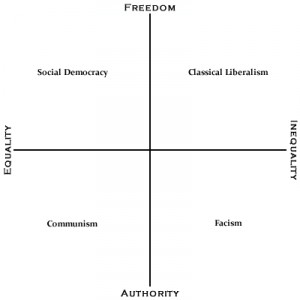
    Political SpectrumFleming’s second point was to suggest that the labels ‘left’ and ‘right,’ when understood correctly, do have a useful descriptive function in highlighting where a person sits on a particular spectrum. For Fleming, this spectrum constituted a horizontal axis whereby equality was at one end, the left and inequality at the other, the right. In addition to the horizontal left-right spectrum is a vertical spectrum with freedom at the top and authority on the bottom. These axes lead to communism being on the bottom left, totalitarian authority to maximise equality; fascism on the bottom right, totalitarian authority to maintain inequality; social democracy on the top left, limited government focused on achieving equality; finally, classical liberalism on the right, limited government for the sake of maximising individual freedom.

    One criticism I have of this is that (more…)

  • Rest in Peace William Alston

    Philosopher William Alston died peacefully in his home in Jamestown New York on 13 September 2009 aged 87; he had been diagnosed with  pancreatic cancer just a week earlier.

    Many of my readers will not know but Alston was one of the leading contemporary Christian Philosophers of the last fifty years. I discovered his writings while studying philosophy at the University of Waikato and have always found his discussions to be perceptive and insightful.  Alongside others such as Plantinga and Wolterstorff, Alston was one of my early Philosophical heroes and continues to be so.

    He wrote several excellent works in the area of epistemology and later turned his talents to contributing to the emergence of the Reformed Epistemology movement, which argues that belief in God can, in certain contexts, be properly basic: justified in the absence of any inference or argument for theism’s truth. Alston developed these insights in his ground breaking work Percieving God where he defended the rational status of mystic and religious experience, arguably one of the most significant discussions of the epistemology of religious experience since William James.

    Alston published several important essays on religious language;  critiques of the problem of evil, an excellent defence of the concept of divine action in the world, an interesting discussion on divine command theories of ethics and an inspiring spiritual auto-biography on his conversion to Christianity is published in God and the Philosophers: The Reconciliation of Faith and Reason.

    Alston’s work has influenced the current generation of Philosophers of Religion including, William Row, Alvin Plantinga, Robert Audi, George Mavrodes, William Wainwright, Daniel Howard-Snyder (who has on-line both a biography of Prof. Alston and a bibliography of his writings) and a number of others.

    Alston will be sorely missed. May he rest in peace. May the grace and peace of God be with his family and friends.

    Hat tip: Christian Theist


  • Sunday Study: Interpreting the Sixth Commandment Part II

    In a previous post, Sunday Study: Interpreting the Sixth Commandment Part I, I discussed some translations of the sixth commandment of the Decalogue. I began with the King James Version (KJV), “thou shall not kill.”[1] I looked at problems with this translation most famously raised by Augustine. The New International Version (NIV) and New Revised Standard Version (NRSV) translate the word rasah as “murder” in an attempt to avoid these problems. However, as I noted in my previous post, this translation fails to capture accurately the use of rasah in Hebrew and turns the command into an empty tautology.

    Augustine’s Interpretation
    I want to suggest that an adequate understanding or account of the sixth commandment was suggested by Augustine or at least can be constructed from his writings. In Book One of The City of God, Augustine addressed the question of whether suicide is lawful and concluded that it is not. What is interesting is how Augustine interpreted and applied the sixth commandment in doing this.

    Augustine’s argument against suicide consists of three observations. Firstly, Augustine takes the commandment fairly literally as forbidding homicide. He states, “The commandment is ‘Thou shall not kill man.’”[2] We saw in the last post that there is a sensible basis for this. The term literally means to slay and is predicated only of human beings; further, while in most instances it is used of unjustified killing, it can be used of a lawful execution. The slaying of humans is a common meaning to the different nuances that its use takes in the text.

    The obvious problem for such a reading is that elsewhere the scriptures seem to allow, even command, killing in certain instances. This does not perplex Augustine,

    However, there are some exceptions made by the divine authority to its own law, that men may not be put to death. These exceptions are of two kinds, being justified either by a general law, or by a special commission granted for a time to some individual. And in this latter case, he to whom authority is delegated, and who is but the sword in the hand of him who uses it, is not himself responsible for the death he deals. And, accordingly, they who have waged war in obedience to the divine command, or in conformity with His laws, have represented in their persons the public justice or the wisdom of government, and in this capacity have put to death wicked men; such persons have by no means violated the commandment, “Thou shalt not kill.”[3]

    Augustine’s answer is straightforward. The universal prohibition is the general rule while the specific commands are the exceptions to this rule. The law prohibits homicide; however, the law must be read in its context and not in isolation and, when this is done, one realises that other commands and prohibitions offer qualifications or exceptions to this general rule.

    There are several reasons for accepting this way of interpreting the sixth commandment. Firstly, it is in other areas a matter of common-sense; as Bahnsen notes,

    Human communication by means of language would come to a grinding halt if it were illegitimate ever to express yourself by way of generalizations which do not explicitly acknowledge qualifications and exceptions. Lawyers may specialize in the fine print of complicated legal contracts, but even they do not speak that way in ordinary discourse. A father who asserts that his son is a fine basketball player is not guilty of falsehood or deception simply because he does not add that, of course, his son has some bad games.

    Generalizations which state an accurate summary or the prevailing principle are not, as generalizations, faulty or inaccurate.[4]

    In fact, not only is this a matter of common-sense, it is a method followed elsewhere in scripture. For example in Exodus 21:12,

    Anyone who strikes a man and kills him shall surely be put to death. However, if he does not do it intentionally, but God lets it happen, he is to flee to a place I will designate. But if a man schemes and kills another man deliberately…

    Here we see a universal principle “Any one who strikes a man and kills him shall be put to death” and then immediately this principle is qualified in the proceeding verses. Moreover, contrary to Bahnsen, this type of writing is common even in legal circles. Even contemporary, legal codes often have a general, universal principle laid down regarding homicide or assault and then add specific exceptions which one can appeal to as a defence to committing actions which fall within the broad definition of the general rule.[5]

    As Madeleine has pointed out to me, the legal maxim ‘lex specialis derogat legi generali’ (specific rules override general rules) is still used in legal interpretation today. She said,

    If my lecturer said to the class, I want you to go straight to the library and get started on your assignments but then he said, Madeleine and Matt I want to see you two before you leave he would not be saying that he did not want everyone to go straight to the library and start their assignments just because he gave a specific, contradictory instruction to Matt and I and he wouldn’t be saying that we did not have to go to the library to start our assignments after he had finished speaking to us (once the exception no longer applies) because his specific instructions to us do not override the general instruction to all.[6]

    Secondly, the hermeneutical principle of the analogy of scripture supports this kind of interpretation. We have a general command prohibiting homicide; then we have more specific rules commanding or permitting homicide in certain situations. To interpret the command as absolute and unqualified would be to render the text internally incoherent.

    This leaves two other options; either one understands the general prohibition as the exception to the more specific ones or the specific ones as exceptions to the general rule. The former option is problematic. If a command permitting killing in a certain context is subject to an exception that you can never kill at all then the specific command is redundant and pointless. On the other hand, a general rule that states “do not kill,” except in certain specified circumstances is not redundant. This then seems the more sensible approach.

    A third reason for Augustine’s interpretation follows from a voluntarist understanding of the moral law. In several previous posts I have defended a voluntarist (divine command theory) account of the moral law; one that states that actions are right or wrong in virtue of their being commanded by God. On this account, what is fundamentally wrong about homicide is that it violates the law of God. Now, just as homicide is wrong because it violates the law of God, when God commands or permits homicide in a certain context the very property that makes killing wrong ceases to be present and hence the law is not being broken in that instance. It follows then that the killing in question is not wrong in this instance. This voluntarist understanding of Augustine’s position has a long history and is suggested by Bernard of Clairvaux[7] and Aquinas,[8] as well as those 14th century voluntarists such as Andreas de Novo.[9] Contemporary defenders of this position are Philip Quinn[10] and William Lane Craig.[11]

    Augustine’s position then is to interpret the command as a prohibition on homicide, understanding that in its context it is subject to qualification and exceptions provided elsewhere in the other commands of the law. His basic insight is that the law lays down the general principle “thou shall not kill man;” given that this is the general norm, one is to assume that any given act of homicide is prohibited unless the law elsewhere qualifies this rule or lays down an exception.

    This means that in practice the commandment forbids killing a human being without justification, where justification is construed as an excuse or permission granted by God’s law. In the absence of any other command or permission to the contrary, one should refrain from homicide. In this respect homicide differs from an action that is permissible. One does not need a reason or justification for engaging in a permissible action as one can do it for any reason at all or even no reason. However, because God condemns homicide one needs a reason drawn from the law of God itself before one can engage in it licitly.

    This interpretation clarifies Augustine’s argument that suicide is unlawful. Augustine justifies his conclusion by defending two points. Firstly, “he who kills himself still kills nothing else than man.”[12] Secondly, “It is not without significance, that in no passage of the holy canonical books can there be found either divine precept or permission to take away our own life.”[13] He adds, “in the commandment, ‘Thou shalt not kill,’ there is no limitation added nor any exception made in favor of any one, and least of all in favor of him on whom the command is laid!”[14]

    In other words suicide is homicide and the law does not qualify or grant exclusions to suicide, so suicide is unlawful. It is clear that this inference presupposes the interpretation of the commandment I have defended above. Homicide is unlawful unless the law of God provides grounds or exceptions to the general rule.

    In summation, the sixth commandment offers a general prohibition on homicide. This prohibition is binding unless a specific exception or qualification is found elsewhere in the law of God showing that a particular instance of homicide is licit. The procedure in applying the law is then as follows; first, ascertain whether the action in question is homicide and then ask whether it falls under any lawful exception. If an act is homicide then prima facie it is unlawful and a positive argument from some other command is needed to justify the action if it is to be defensible.


    [1] Exodus 20:13 KJV.
    [2]
    Ibid, 1:20.
    [3]
    Ibid, 1:21.
    [4]
    Greg L Bahnsen “Cross Examination: In Defense of Theonomy” The Counsel of Chalcedon XIV:5-6 (1992).
    [5]
    I am thankful to David Simpkin for bringing this point to my attention.
    [6]
    I am grateful to my wife, Madeleine Flannagan, for sharing this example she developed from Paul Rishworth.
    [7]
    Bernard of Clairvaux On Precept and Dispensation III.6.
    [8]
    Aquinas Summa Theologicae I-II q 800, a. 8, ad 3.
    [9]
    Andrea de Novo Castro Primium Scripturum Sententiarium d 48, q 2, a 2 Concl. 2. I.
    [10]
    Phillip Quinn “The Recent Revival of Divine Command Ethics” Research Philosophy-and Phenomenological Research (Fall 1990) 345-365.
    [11]
    William Lane Craig & Edwin Curley “Does the Christian God Exist?” A debate held at the University of Michigan (5 February 1998).
    [12]
    Augustine City of God 1:21.
    [13]
    Ibid.
    [14]
    Ibid.

    RELATED POSTS:
    Sunday Study: Interpreting the Sixth Commandment Part I

  • Darwinian Evolution, God and Ockham’s Razor

    In a previous post, Darwinian Evolution, Chance and Design, I argued that the contention that Darwinian evolution occurs by chance does not entail that it shows the world was not designed. Once one sees how the concept of chance is defined in evolutionary theory one can see that it does not rule out design.

    It is possible at this stage to argue that evolutionary theory rules out design by appeal to Ockham’s razor. Suppose one grants that chance is used in a limited sense to refer to the fact that, following Sober, “there is no physical mechanism (either inside organisms or outside of them) that detects which mutations would be beneficial and causes those mutations to occur.”[1] Or following Mayr, it means, “that there is no correlation between the production of new genotypes and the adaptation needs of an organism in a given environment.”[2] Suppose that evolution occurring by chance in this sense is well supported by the evidence. One could go on to interpret this theory in at least two ways; one might argue that evolution was in some sense guided by God or that it occurred by chance in a stronger sense that precludes design. Both arguments would be compatible with the empirical evidence. However, the sceptic could argue that the latter is preferable in virtue of the principle of Ockham’s razor, “entities should not be multiplied unnecessarily.”

    The idea is that that the hypothesis of unguided evolution is simpler, more in accord with Ockham’s razor, than the hypothesis that God guided evolution. The former theory explains everything in terms of natural causes without appeal to a supernatural being such as God; hence, to claim God did it is to add an extra entity and is superfluous. Something like this argument is sometimes given by scientists writing in the field. George Gaylord Simpson writes,

    Although many details remain to be worked out, it is already evident that all the objective phenomena of the history of life can be explained by purely naturalistic or, in a proper sense of the sometimes abused word, materialistic factors.[3]

    Similarly, Douglas Futuyma states,

    By coupling undirected, purposeless variation to the blind, uncaring process of natural selection Darwin made theological or spiritual explanations of the life processes superfluous.[4]

    In this post I will respond to this appeal to Ockham’s razor and identify two problems with this line of argument. The first is that Ockham’s razor is only one criteria used to adjudicate rival hypotheses; the fact that one hypothesis is preferable on grounds of simplicity does not entail that it is preferable all things considered. There are at least couple of other considerations to take into account.[5]

    One other consideration to bear in mind is which hypothesis is more probable? To answer this question one would need to assess whether the probability that the history of life coming to be by a process of guided evolution is significantly higher than the probability of life coming to be by an evolution of blind chance and it seems to me, on the face of it at least, quite plausible to suggest that the chances of life evolving by chance is significantly lower than its coming about by divine guidance. If this is correct, then while atheistic evolution gives a simpler or more economical explanation of the origin of species it is considerably less probable.

    A further consideration is that Ockham’s razor tells us that if two theories can explain the phenomena equally well then the one that postulates the least entities is the preferred one. For naturalistic evolution to be preferable to theistic evolution it would need to be argued that it explains all the data equally as well.[6] The person who proposes the above line of argument, however, does not do this; all he or she does is show that both theories equally explain the history of life on earth. However, the history of life is only one feature of the world that scientists seek to explain. Showing that your theory explains one feature as well as a rival theory is a long way from showing that it explains all features as well.

    This is important because one of the arguments theists offer is that God can explain numerous features of the world better, better than theism’s rivals. It has been argued that theism explains the origin of the universe, the continued existence of the contingent universe, the existence of laws of nature, the existence of cosmic fine-tuning, the existence and nature of objective moral duties  and so on. To show that unguided evolution is a better theory then, one would need to show that unguided evolution provides a better explanation of all these phenomena together than theistic evolution does. If it does not then theism explains the history of life equally as well as atheistic naturalism but it also provides a better explanation of various other features of the world, thus it is a better overall theory.

    So even if we grant that unguided evolution conforms to Ockham’s razor better than theistic evolution, it is not at all clear or obvious that this means it is a better theory, all things considered. Theistic evolution may be a significantly more probable theory and have significantly greater explanatory scope and comprehensiveness.

    A second problem with the appeal to Ockham’s razor is that what constitutes a simpler hypothesis in a given context depends on the background information one has about what exists. Plantinga makes this point,

    The theistic noetic structure already, of course, includes the existence of God.  Relative to that noetic structure, therefore, there is no additional Ockhamistic cost in the hypothesis of guided evolution.  As an analogy: suppose we land a space ship on a planet we know is inhabited by intelligent creatures.  We find something that looks exactly like a stone arrowhead, complete with grooves and indentations made in the process of shaping and sharpening it.  Two possibilities suggest themselves: one, that it acquired these characteristics by way of erosion, let’s say, and the other, that it was intentionally designed and fashioned by the inhabitants.  Someone with a couple of courses in philosophy might suggest that the former hypothesis is to be preferred because it posits fewer entities than the latter.  He’d be wrong, of course; since we already know that the planet contains intelligent creatures, there is no Ockhamistic cost involved in thinking those structures designed. The same would go for evolution; theists already accept divine design, and do not incur additional Ockhamistic cost by way of thinking of evolution as guided.[7]

    Plantinga’s insight is correct. He goes on to note that if we did not know the planet was inhabited by intelligent beings and the erosion hypothesis was not significantly less probable then an appeal to Ockham’s razor in favour of the erosion hypothesis would have “teeth.”  If this argument works at all, it only works if one begins with an agnostic perspective and then postulates “the existence of a divine designer in order to explain the course of evolution.” If, however, one already knows that God exists and rationally believes God and has created the world on other grounds then we do not violate Ockham’s razor by appealing to the existence of God to explain the evolutionary process.

    Evolutionary theory then might mean that an agnostic has reason for accepting atheistic evolution over theistic evolution as an explanation of the origin of species (I say “might” because the problem of relative probabilities and explanatory comprehensiveness still would need addressing). However, it does not show that those who believe in God, are irrational in doing so, nor does it provide a theist with any rational reason to reject his or her belief.

    Again then, it seems that evolution by itself does not make belief in God untenable. Before it could the objector would first need to show there were no other grounds for believing in God other than the evolution of life on earth. Then he or she would need to show that one could construct a theory that has as much explanatory power as theism and on which the evolution of life by blind chance was not significantly less probable than its occurrence by divine guidance. Only after both these things were done could evolution be used to defeat theism. It is evident, however, that evolutionary theory by itself establishes none of these claims. Whether they are defensible is a substantive philosophical question over and above anything established in contemporary evolutionary theory.

    This post draws from parts of my paper “Does Evolution Make Belief in God Untenable?” given at the recent TANSA conference, Faithful Science? – Just How Well Do Science and Faith Get Along?


    [1] Eliot Sober “Evolution Without Metaphysics” (unpublished).
    [2]
    Ernest Mayr Toward a New Philosophy of Biology; Observations of an Evolutionist (Cambridge: Harvard University Press, 1998) 98.
    [3] George Gaylord Simpson The Meaning of Evolution (Yale University Press, rev ed., 1967) 344-345.
    [4]
    Douglas Futuyma Evolutionary Biology (Sunderland, MA: Sinauer Associates Inc, 1986) 2.
    [5]
    Alvin Plantinga
    “Science and Religion: Where Does  the Conflict Really Lie?” (unpublished).
    [7]
    Ibid.

    RELATED POSTS:
    Darwinian Evolution, Chance and Design
    God, Darwinian Evolution and The Teleological Argument
    TANSA Faith and Science Conference
    Faith and Science Conference Write-Up