Author: Matt

  • Living Philosophers of Religion

    Over at Common Sense Atheism, Lukeprog has compiled an impressively comprehensive list of 100+ Living Philosophers of Religion and Their Best Work. Lukeprog identifies his list of philosophers of religion as those who have “published at least one influential work in the field” offering “analytic arguments over the truth of theism vs. atheism.”

    What I find interesting about this list are the following features.

    The ratio of theists to atheists is significantly stacked in favour of theism. Now the numbers of people who believe something do not determine the truth or falsity of the thing but what it suggests is that those who specialise in the actual subject that studies whether or not belief in God is rational, defensible, etc. the majority believe that it is. This of course is extremely hard to reconcile with the common popular level atheist claims that the case for theism is so obviously ridiculous that no sane, thinking person would believe in it. It also tends to call into question the claim that there is absolutely no evidence whatsoever of any merit at all for the existence of God.

    Equally interesting is who did not make the list. Noticeably absent are the popularly cited “authorities in the field,” Sam Harris, John Loftus, Richard Dawkins, Christopher Hitchens. Also absent is Daniel Dennett who, despite being a very good philosopher of mind, is not a philosopher of religion.

  • Sunday Study: Christ on The Prohibition on Homicide Part I

    This morning I preached a sermon at Riverhead Presbyterian Church on Christ’s exposition of the 6th Commandment, the prohibition on homicide, contained in the Sermon on the Mount. This Sunday Study series is essentially a transcript of today’s sermon.

    Christ states,

    You have heard that it was said to the people long ago, ‘Do not murder, and anyone who murders will be subject to judgment.’ But I tell you that anyone who is angry with his brother will be subject to judgment. Again, anyone who says to his brother, ‘Raca, ‘ is answerable to the Sanhedrin. But anyone who says, ‘You fool!’ will be in danger of the fire of hell. “Therefore, if you are offering your gift at the altar and there remember that your brother has something against you, leave your gift there in front of the altar. First go and be reconciled to your brother; then come and offer your gift. “Settle matters quickly with your adversary who is taking you to court. Do it while you are still with him on the way, or he may hand you over to the judge, and the judge may hand you over to the officer, and you may be thrown into prison. I tell you the truth, you will not get out until you have paid the last penny. (Matthew 5: 21-26)

    This passage is the first of a series where Jesus contrasts what his listeners “have heard that it was said to the people long ago” with his own teachings. In v27 he contrasts, “You have heard that it was said, ‘Do not commit adultery’” with his own teaching to not look at another person’s spouse lustfully. In v31 he contrasts, “It has been said, ‘Anyone who divorces his wife must give her a certificate of divorce,’” with his own teaching that divorce is unacceptable except for adultery. In v34 he contrasts, “you have heard that it was said to the people long ago, ‘Do not break your oath,’” with his own teaching about keeping one’s word. The rest of chapter five continues in this manner.

    One way these contrasts are commonly understood is to see Christ as repudiating and rejecting the teaching of the Old Testament and replacing it with his own teaching. The problem is that this goes against the context and genre of the text.

    In the verses immediately prior to these, Christ tells his readers not to interpret his comments as a rejection of Old Testament commands; in v17 he states emphatically “Do not think that I have come to abolish the Law or the Prophets; I have not come to abolish them.” In v19 he states, “Anyone who breaks one of the least of these commandments and teaches others to do the same will be called least in the kingdom of heaven, but whoever practices and teaches these commands will be called great in the kingdom of heaven.” The contrast Christ draws in v 20 is not between The Torah and his own teaching but between faithful obedience and the obedience of the scribes and Pharisees. This suggests that Christ is contradicting, not The Torah per se but a particular interpretation of it; he is correcting the interpretation.

    Daube provides confirmation of this. Daube notes the contrast in this pericope between “you have heard it said” and “I say to you”. This, Daube points out, was a common way of setting out rabbinic teaching. The rabbi would contrast an excessively formalistic interpretation of the torah that people had “heard” with a fuller correct one that the rabbi himself expounded. This observation fits precisely other parts of the Sermon on the Mount where the same formula is used.[1] The relevant pericope then can be usefully analysed in three parts. First, “You have heard that it was said,” the excessively formalistic interpretation. Second, “I say to you,” which is Christ’s authoritative interpretation. Finally, Christ draws two applications of the interpretation he has expounded. I will turn to each of these features in turn over a two-part series.

    You Have Heard That it was Said
    What Jesus’ hearers “heard said to the people long ago” was, “’Do not murder, and anyone who murders will be subject to judgment.” The word “judgment” (greek krisis) used here refers to legal proceedings.[2] Jesus was succinctly summarising some of The Torah’s explicit teachings regarding homicide. An overview of these teachings follows.

    Then God blessed Noah and his sons, saying to them, “Be fruitful and increase in number and fill the earth. The fear and dread of you will fall upon all the beasts of the earth and all the birds of the air, upon every creature that moves along the ground, and upon all the fish of the sea; they are given into your hands. Everything that lives and moves will be food for you. Just as I gave you the green plants, I now give you everything. “But you must not eat meat that has its lifeblood still in it. And for your lifeblood I will surely demand an accounting. I will demand an accounting from every animal. And from each man, too, I will demand an accounting for the life of his fellow man. “Whoever sheds the blood of man, by man shall his blood be shed; for in the image of God has God made man. As for you, be fruitful and increase in number; multiply on the earth and increase upon it.” (Genesis 9: 1-7)

    This passage occurs at the end of the flood story in the proto-history of Genesis 1-11. It outlines a covenant God made with Noah “and his descendants” and with “every living creature … the birds, the livestock and all the wild animals.” Two things are relevant for our discussion here, murder is implicitly condemned and human beings are commanded to ensure that those who are murdered are brought to justice.

    The same teachings are expounded upon in the law of Moses. The 6th commandment of the Decalogue, which occurs in Exodus 20 and also Deuteronomy 5, states, “you shall not man-slay;” this passage teaches that the killing of one human being by another is prima facie condemned.

    Other sections of The Torah outline duties that the community of Israel have towards people who engage in homicide;

    Anyone who strikes a man and kills him shall surely be put to death. However, if he does not do it intentionally, but God lets it happen, he is to flee to a place I will designate. But if a man schemes and kills another man deliberately, take him away from my altar and put him to death. (Exodus 21:12-14)

    The cultural back-drop to this was the ancient near-eastern custom of blood vengeance; the cultural mores of the time dictated that the kin of anyone killed by another were honour-bound to avenge the death of their kinsman by killing the killer. In such a culture anyone who killed another would flee to an altar for sanctuary.

    In this context, the universal pre-Sinai law of Genesis 9 was given a specific application in ancient Israel. If a person killed another then the community had three responsibilities. First they were to determine whether the person’s actions were premeditated and deliberate or whether they were an accident. Second, if they were accidental, the community was to provide institutions that would protect them (the reference to “an altar” and a “place they can flee” to refer to ancient practices of sanctuary). Third, if the killing was pre-meditated they were to execute the offender, that is, bringing the offender to justice.

    After the settlement of Canaan this law was expounded on in Deuteronomy 19 and Numbers 35; the Israelites were commanded to establish a series of cities of refuge, defined as, “places of refuge from the avenger, so that a person accused of murder may not die before he stands trial before the assembly.”

    While an exposition of all the aspects of these institutions are beyond the scope of this post, behind them are the same three requirements I mentioned above. First, if a killing occurred the community was required to determine whether the killer acted with pre-meditation or whether there was some mitigation or accident. This is seen in the laws relating to trials, corroboration by witnesses, perjury, etc that are laid down in The Torah. Second, if the person was not guilty of pre-meditated homicide, the community was to provide the person with protection; this is the very basis of the cities of refuge. Third, if the person was guilty of pre-meditated homicide, they were to execute him. In fact, Numbers 35 goes so far as to state, “‘Do not accept a ransom for the life of a murderer, who deserves to die. He must surely be put to death.’”

    In common with other ancient near-eastern laws, several crimes in The Torah ostensibly called for the death penalty. JJ Finkelstein notes that the capital sanctions that occur in ancient near-eastern legal texts, “Were not meant to be complied with literally even when they were first drawn up, [But rather they] serve an admonitory function”[3] Raymond Westbrook notes that such sanctions typically, “reflect the scribal compilers’ concern for perfect symmetry and delicious irony rather than the pragmatic experience of the law courts.”[4] As I argued in my series, Capital Punishment in the Old Testament, in practice such punishments were substituted for monetary compensation. Numbers 35 tells us that pre-mediated homicide constitutes an exception, in this situation the law must be applied literally.

    Interestingly, Deuteronomy suggests that failure by the leaders of the community to establish institutions that protect the innocent from being violently attacked or a failure to execute those guilty of murder, makes those communities (or at least their leaders) complicit in the crime. The reason they are to build cities of refuge is, “so that innocent blood will not be shed in your land, which the LORD your God is giving you as your inheritance, and so that you will not be guilty of bloodshed.” (Deuteronomy 19:10) Further, the murderer must be brought to justice to “purge from Israel the guilt of shedding innocent blood, so that it may go well with you.” (Deuteronomy 19: 13)

    Jesus’ summary, then, of, “Do not murder, and anyone who murders will be subject to judgment,” is an accurate rendition of what The Torah taught. Murder was condemned and a community that failed to respond justly to murder by protecting the innocent from it and condemning those guilty of it violated the command.

    The problem is that this is not all the Old Testament said. In the book of Leviticus it is affirmed that,

    ‘You shall not go about as a slanderer among your people, and you are not to act against the life of your neighbor; I am the LORD. ‘You shall not hate your fellow countryman in your heart; you may surely reprove your neighbor, but shall not incur sin because of him. ‘You shall not take vengeance, nor bear any grudge against the sons of your people, but you shall love your neighbor as yourself; I am the LORD. (Leviticus 19:16-20)

    Here there is a command to “not act against the life of your neighbour;” literally, to stand by the blood of your neighbour, that is to not refuse to protect or assist a person from danger when one is reasonably able to. Not that alongside it is a condemnation of “hating your neighbour in your heart,” bearing a grudge and lashing out with slander. In other words, The Torah requires not just that one refrain from killing and protect others from being killed, it required an absence of malice and these kinds of expression of it. In my next Sunday Study, Sunday Study: Christ on The Prohibition on Homicide Part II, I will conclude this series by looking at Christ’s authoritative interpretation, “but I say to you,” and the application of the interpretation he expounded.

    [1] David Daube The New Testament and Rabbinic Judaism (London: Athlone Press, 1956) 256.
    [2] Don Carson “Matthew” in The Expositors Bible Commentary Volume 8, ed Frank E Gaebelein ( Grand Rapids MI: Zondervan, 1984) 148.
    [3] J. J. Finkelstein The Ox that Gored (Philadelphia: American Philosophical Society, 1981) 34-35.
    [4] Raymond Westbrook, “The Character of Ancient Near Eastern Law,” in A History of Ancient Near Eastern Law, Vol. 1, ed. Raymond Westbrook (Boston: Brill Academic Publishers, 2003) 74.

    RELATED POSTS:
    Sunday Study: Christ on The Prohibition on Homicide Part II
    John Loftus on Calvin, Matthew Flannagan and Psalm 14
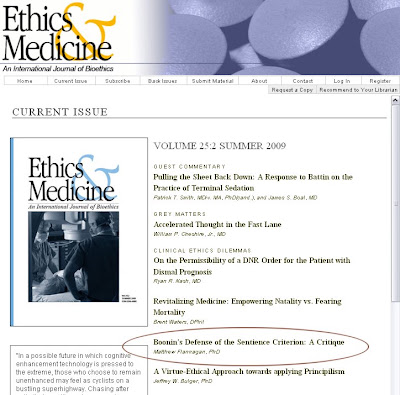
  • Published: Boonin’s Defense of the Sentience Criteria – A Critique

    We just discovered that if you go to Ethics and Medicine – An International Journal of Bioethics and click on “current issue” (VOLUME 25:2 SUMMER 2009) you will see that my article “Boonin’s Defense of the Sentience Criteria – A Critique” is now in print. It is always nice to finally see a publication in print as it can take along time from submission to acceptance til publication.

    Journal of Ethics and Medicine

    I have written to the editor and asked if I can put a copy of the article on this blog. Until I hear back I will leave you with the abstract and encourage you buy a copy of the journal or locate it at your library.

    Defenders of the permissibility of feticide commonly argue that killing an organism is not homicide unless the organism’s brain has developed enough for it to acquire sentience: the capacity for consciousness and the ability to perceive pleasure and pain. In this paper I will critique one of the more sophisticated versions of this argument that proposed by David Boonin in A Defense of Abortion. In I I will sketch some prima facie problems faced by any appeal to sentience. In section II I will examine Boonin’s attempt to defend an appeal to sentience against these problems by contructing a modified future like ours (FLO) account of the wrongness of killing. I will argue that Boonin’s modified future like ours (FLO) defence of sentience fails. Both his argument for the modified FLO account and his application of this account to feticide rest on ad hoc arbitrary manoeuvres, manoeuvres which mean that the modified FLO account is a plausible criteria for the right to life only if one already grants that feticide is not homicide.

    RELATED POSTS:
    Some Thoughts on Human Embryonic Stem-cell Research
    Is Abortion Liberal? Part 1
    Is Abortion Liberal? Part 2
    Sentience Part 1
    Sentience Part 2
    Viability
    Abortion and Brain Death: A Response to Farrar
    Abortion and Capital Punishment: No Contradiction
    Imposing You Beliefs Onto Others: A Defence

  • Fisking Ian Hassall: The Arbitrary Ethical Reasoning on the Smacking Referendum

    Recently Dr Ian Hassall gave a presentation, on the upcoming referendum on section 59 of the Crimes Act 1961, entitled: How did we come to have a law that supported hitting children? This presentation defends the thesis that mild physical punishment (smacking) is wrong and should remain illegal in New Zealand. In this post I will critically evaluate Hassall’s arguments and demonstrate why they fail.

    Much of Hassall’s article discusses the evolutionary, legal and religious origins of corporal punishment and while I disagree with much of his analysis, and I am sure Paul Moon would have a few things to say about his historical claims regarding early Maori not engaging in violence against children, for the sake of space, I will forgo addressing this. I will also put to one side Hassall’s caricatured picture of ‘evangelical views’ on the doctrine of original sin which does not include a teaching on the necessity of inflicting pain repeatedly on children (I intend to do a Sunday Study on the biblical teachings surrounding this issue in the near future). Strictly speaking, the origins of the practice is irrelevant; the real issue is: now that it is here, is it wrong, is corporal punishment morally permissible and should it be illegal? These are questions of morality and ethics. My critique will focus on these aspects.

    Evidence Shows Smacking Does Not Harm
    Hassall begins his discussion of the ethical questions by conceding, contrary to the standard assertions from opponents of corporal punishment, that “a considerable body of research” shows “no detectable harm to children who have been mildly physically punished when compared with children who have had no such punishment.” This concession raises an immediate question; if mild corporal punishment is no more harmful than other forms of discipline, which are legal and considered morally unproblematic, why then is corporal punishment singled out for censure and prohibition? Hassall puts up several arguments, I will address the most significant ones.

    Equality before the Law
    Hassall argues against mild forms of corporal punishment by noting that the same acts would undoubtedly constitute a crime if done to an adult;

    The main argument against legally sanctioned assaults on children has never been a question of whether or not it does harm, as can be seen by applying the same argument to assaults on adults.

    The law that makes it a criminal offence to assault an adult does not rely for its justification on whether or not it does harm. If evidence was lacking for any ill effects from a certain level of assault by a man on his wife, for example, it would still not be acceptable. … The central issue is not whether or not harm is done but whether or not one person is entitled to assault another.

    The implicit assumption behind these appeals is that, if it is a crime to do something to an adult then it must also be a crime to do the same thing to a child. This kind of reasoning seems pervasive in the arguments of those who criticise corporal punishment. The problem is that the assumption is false.


    It is a criminal offence (theft) for a man to confiscate his wife’s property without her consent; similarly, it would be a criminal offence (false imprisonment) for a man to prevent his wife from leaving her room or her house. Yet no sensible person thinks that it ought to be a crime for parents to ground their child or confiscate property when their child is acting out.

    Corporal punishment does not seem different from other forms of parental discipline in this respect. Both corporal punishment, like smacking and non-corporal punishments, like groundings and confiscations, are such that if one adult did them to another they would be illegal.

    The Right to Physical Integrity
    A second argument Hassall raises is that children have a right to physical integrity, “the right of children to physical integrity is recognised by the UN Convention on the Rights of the Child. Twenty-three countries have recognised this right in their law.” Now the argument that we should adopt a policy on something just because twenty-three other countries have done so is not compelling in and of itself.

    Now, I accept that children have a right to physical integrity. The obvious problem, however, is that not all forms of corporal punishment damage a person’s physical integrity. Some forms, like those that inflict injuries upon their victims, clearly do but the fact that some forms of corporal punishment violate a right does not entail that all do – anymore so than the fact that some forms of non-corporal punishment, such as locking a child up in a cage without food or water, mean that all forms of non-corporal punishment are unjust. Again there appears no reason for concluding that corporal punishment is wrong or unjust by this argument.

    Feeling Guilty
    Hassall notes that parents sometimes feel guilty when they engage in corporal punishment. “It feels wrong and when we reflect, we know in our hearts it is wrong. What ordinary parent can recall without remorse the look of fear on the child’s face when they raised their arm to strike?” The problem again is that this is not unique to corporal punishment. What parent does not feel upset, for example, when they see their child crying hysterically as a result of being sent to their room or not being allowed to watch a TV show or missing out on an event they were looking forward to due to their misbehaviour? Once again this argument gives us no reason for singling out mild corporal punishment as wrong but not other forms of non-corporal punishment. The argument applies equally to all forms of punishment that make parents feel bad when administering them.

    Normalisation of Hitting
    Hassall pulls out another common argument against corporal punishment, that it sends the message that “hitting people is normal.” He notes, “if as parents we have become inured to the fear and pain we cause by hitting our children, what have we become? And if our children over the years become used to us hitting them and regard it as normal, what have they become?”

    It is evident from this comment that Hassall’s conclusion is decided aprori and read into the evidence instead of being inferred from it. In the previous paragraph I noted his claim that if parents feel bad about corporal punishment then this shows it is bad, here he suggests if they do not feel this way then this also shows it is bad. In other words, no matter what the facts are, he draws the same conclusion. But more importantly, if Hassall’s argument is sound then an analogous argument shows that non-corporal punishments are unjustifiable.

    If smacking children teaches them that hitting others is normal then wouldn’t grounding them teach that restricting others liberty is normal? Wouldn’t confiscating their property teach that taking others property without their consent is normal? All punishment by its nature involves subjecting someone to something unpleasant, usually without their consent, which in normal circumstances it would be wrong to do; consider incarceration or periodic detention. Given that one of the functions of punishment is deterrence, all forms of punishment involves some degree of threatening others and scaring them away from wrongdoing. Not only is this an argument against smacking, it is also an argument against our justice system.

    Degradation and Indirect Harm
    Hassall offers two final arguments against the legality of mild corporal punishment. The first is that mild corporal punishment causes indirect harm to children and the second is that it is degrading.

    Turning to first of these arguments, Hassall notes,

    The old law propped up a sense of entitlement to strike children. This sense of entitlement, in an angry person with limited self control, can be the beginning of a beating. Surveys of adults found guilty of abuse of children have revealed that usually the episode of abuse began with the intention to punish and escalated.

    This is a very bad argument. Essentially Hassall is arguing that mild corporal punishment is wrong because if people with limited self-control engage in it then it will escalate into a beating. He also notes that often beatings come about as a result of such escalation. The problem here is that these facts are true of many legal and perfectly permissible activities. Spousal abuse often results following escalation of a marital argument. If a person with limited self-control argues with his or her spouse he or she may lose control and commit assault. However, it does not follow that it is wrong to argue with one’s spouse nor does it follow that such arguments should be illegal. Likewise, if people with limited self-control drink alcohol they may drink excessively, get in a car and kill someone. Many criminal offences result from an escalation of drinking; does it follow that any consumption of alcohol should be illegal?


    Hassall’s main and most important argument, however, is the claim that mild corporal punishment is “dehumanising” he notes that,

    Women, servants and soldiers, once subject to legally sanctioned corporal punishment are deemed in modern times to have the right to be free from assault and the threat of assault and from the oppression and dehumanisation that accompanies the entitlement of others to inflict pain upon them.

    Here Hassall singles out a feature that he contends mild corporal punishment possesses that other punishments do not. In modern times, adults can be subject to legally sanctioned punishments, like fines and incarceration but they cannot be subject to corporal punishment and this is because the latter (not the former) is “dehumanising” in a way that the others are not. This, he thinks, is the reason smacking should remain illegal.


    The problem with this argument is the central claim behind it, that mild corporal punishment is demeaning in a way that other forms are not. David Benatar makes the point well;

    Here it is noteworthy that there are other forms of punishment that lower people’s standing even more than corporal punishment, and yet are not subject to similar condemnation. Consider, for example, various indignities attendant upon imprisonment, including severe invasions of privacy (such as strip-searches and ablution facilities that require relieving oneself in full view of others) as well as imposed subservience to prison wardens, guards, and even to more powerful fellow inmates. My intuitions suggest that this lowering of people’s standing surpasses that implicit in corporal punishment per se, even though it is obviously the case that corporal punishment could be meted out in a manner in which it were aggravated…Therefore, if we think that current practices in prison life are not wrong on grounds of degradation, then we cannot consistently say that all corporal punishment is wrong on these grounds.

    Benatar’s point is that one cannot claim that corporal punishment is less dehumanising than current legal punishments which “in modern times” are legally sanctioned against adults. Once this is realised, the central premise behind Hassall’s objection collapses; he has not singled out a property that is unique to corporal punishment that does not equally apply to any other form of punishment.


    I began this post noting that Hassall concedes that mild corporal punishment causes no more harm than many punishments which are both permissible and legal. I conclude, by noting that mild corporal punishment does not differ in any of the other features Hassall mentions either. All punishments done to children would be crimes if done by one private adult to another. If any punishment sends the message that one can mistreat another then all do. There are numerous perfectly acceptable practices which, when engaged in by people who lack self control, escalate into crime. Having to inflict any punishment is something loving parents find unpleasant and corporal punishment is no more dehumanising than many other punishments.

    Far, from showing that mild corporal punishment, such as smacking, should be singled out for prohibition, Hassall’s argument suggests that it is no more problematic than many other forms of discipline, which good parents can and do permissibly utilise. Hassall’s moral case against mild corporal punishment then is arbitrary and appears to have little rational basis.

    David Benatar “Corporal Punishment” Social Theory & Practice, Summer 1998, Vol 24, Issue 2, accessed July 3 2009.

    RELATED POSTS:
    Fisking Margaret Mayman: The Flawed Moral Theology on the Smacking Referendum
    We’re Confused about the Anti-Smacking Referendum Question
    No Defences Permitted for the Accused

    (This post was authored by Matt and was accidentally posted under Madeleine’s account.)


  • Fisking Margaret Mayman: The Flawed Moral Theology on the Smacking Referendum

    In “A Christian Perspective on the Child Discipline Referendum,” Rev Dr Margaret Mayman presents a theological justification for retaining the amended section 59 of the Crimes Act 1961, which has criminalised force used against a child for the purposes of parental correction.

    Mayman began by offering three standard arguments for repealing the old section 59, the defence of reasonable force for the purposes of parental correction. The first is that, “Prior to the law change, there had been terrible cases of child abuse that had not resulted in an assault conviction because of the use of this defence.” The second is that, “New Zealand has appalling rates of lethal and non-lethal child abuse and there is strong evidence that abuse often occurs as an escalation of physical punishment.” The third is that, “The law needed to be changed to ensure that the children received equal protection.” Despite their popularity and repetition in the media, these arguments are seriously flawed.

    Some Accuseds Get Off
    Turning to the first, it may be true that the existence of the defence of reasonable force meant that some child abusers escaped conviction. What Mayman fails to note is that this is true of any defence in Criminal Law. Section 48 of the Crimes Act allows a person to use reasonable force in defence of oneself or another from assault. Undoubtedly some serious assaults have not resulted in criminal prosecution as a result of the existence of this defence. Similarly, the law allows those accused of rape to mount a defence that the victim consented; this defence undoubtedly has lead to serious rapes not resulting in conviction. In fact, the very existence of a requirement for the prosecution to prove an assault has occurred, beyond reasonable doubt, has resulted in untold number of serious criminal actions not resulting in criminal convictions. Hence, if the mere fact that the former s59 occasionally resulted in criminals not being convicted entails that it should remain abolished then all defences should be abolished; clearly this is an absurd conclusion.

    Criminalisation Because of Escalation
    The second argument fares no better. Mayman asserts that, “abuse often occurs as an escalation of physical punishment.” This may be true. It is also true that spousal abuse often occurs as an escalation from a verbal argument between spouses. Does it follow that we should criminalise verbal arguments with one’s spouse.

    Equal Protection
    Mayman’s third argument, that children must receive “equal protection” under the law, is also problematic. It is true that the law does not allow a parent to smack an adult. However, it is also true that the law does not allow an adult to prevent another adult from leaving the house; to do this would be to commit false imprisonment. The law also does not allow an adult to confiscate the property of another adult; this is the crime commonly known as theft. Nor does the law allow an adult to subject another adult to medical treatment without their consent; this would be both a form of assault and a violation of the Bill of Rights’ protection of life and security of the person.

    If we were to truly give children equal protection under the law then it should be illegal for parents to send their children to their room, to ground them, to confiscate their property or keep their immunisations up to date. Clearly no sensible person advocates this because no sensible person really believes that children should receive equal protection under the law.

    After presenting these ill-thought out arguments, Mayman offers a theological case for her position. Mayman cited Jesus, “Let the little children come to me, and do not stop them; for it is to such as these that the kingdom of heaven belongs. And he laid his hands upon them and went on his way” (Matthew 19: 13-15). She also cited, “Take care that you do not despise one of these little ones; for, I tell you, in heaven their angels continually see the face of my Father in heaven. … So it is not the will of your Father in heaven that one of these little ones should be lost.” (Matthew 18:10, 14). Mayman then drew two conclusions from these passages. First, these passages call us to a “radical respect for the personhood, and therefore the bodily integrity of children.” Second, that Mayman finds, “no justification for physical punishment, let alone any directive for it.”

    Personhood and Bodily Integrity
    Turning to the first, I agree that we should respect the personhood and bodily integrity of children. I also think (as I am sure Mayman does) that we should also respect the personhood of adults. Mayman assumes, without argument, that the use of force for correction is always incompatible with respecting someone’s personhood or their bodily integrity. This claim is clearly false. Certain forms of physical punishment that cause injury or harm can damage a person’s personhood or bodily integrity but not all forms do. Moreover, if correction by force always contradicts our duty to respect personhood or bodily integrity then Mayman would have to conclude that criminal punishment of child abusers themselves is unjustified. Such criminals often do not voluntarily go to jail; they have to be forced to. The fact that Mayman supports laws against child abuse shows that she does not believe her own argument; she accepts that sometimes physical force for correction is justified (for adults anyway).

    No Directive for Physical Punishment
    Her second argument is equally problematic. Mayman states she finds, “no justification for physical punishment, let alone any directive for it.” Here she is correct; nothing in the passages she cited provides any justification for physical punishment or any directive for it. Nor, for that matter, do these particular passages provide any justification for refraining from rape, kidnapping, adultery or theft. That is because these particular passages do not address these issues; they have nothing to say about them at all. Whether such things are justified or not depends on other passages or arguments that are actually about those things. Hence, appealing to them in this context is irrelevant.

    Interestingly, immediately after citing these passages, Mayman notes that another passage in scripture does seem to imply the permissibility of corporal punishment. She provides four responses to this, none of which hold any weight.

    First she notes that people have historically appealed to the book of Proverbs, “Those who spare the rod hate their children, but those who love them are diligent to discipline them”, to justify “physical violence and assaults.” This may be true but only in the same way that historically people have appealed to notions of equality to murder millions of people in Gulags. Does it follow that all appeals to equality are wrong (and should be criminalised)? Incorrect use or application of an idea tells us nothing about whether the idea itself is true.

    Second Mayman states this passage needs to interpreted in light of the “knowledge about child development and of the damage caused by physical punishment” that we have acquired since “the scriptures were written.” I agree that one should take into account relevant empirical facts when interpreting scripture. The problem is that Mayman simply assumes that it is an empirical fact that “physical punishment” causes damage; the problem is that this is far from obvious. In “Corporal Punishment,” Professor David Benatar surveys several studies and notes,

    Although there is evidence that excessive corporal punishment can significantly increase the chances of such psychological harm, most of the psychological data are woefully inadequate to the task of demonstrating that mild and infrequent corporal punishment has such consequences.

    Moreover, he goes on to note that, “even the data suggesting that very rare instances of mild corporal punishment do have some negative effects also suggest that the effects are not substantial.” In fact, the empirical data is nowhere near as conclusive as Mayman suggests; several studies found little or no adverse effects of physical correction once the difference between severe and abusive types of physical punishment was distinguished from other, milder forms. Theologians should take into account empirical data; they should not, however, uncritically accept unsubstantiated empirical claims about what science allegedly shows.

    Literal Interpretation
    Mayman also attacks the idea that one should take the Bible literally. She backs this up by citing Deuteronomy 21: 18-21. Mayman claims that this verse teaches that parents are required, “to put to death the persistently disobedient youth.” In fact, Mayman’s interpretation of this verse is flawed. As Christopher Wright notes, in the Ancient Near East it was common for fathers to have rights of life and death over their adult children. Deuteronomy 21, in this context, actually subverts this by taking these decisions out of the hands of fathers. The passage probably refers to adult sons, not children as it describes the sons and gluttonous drunks. Moreover, many scholars have provided evidence that penal sanctions, like those recorded in this passage, serve a rhetorical function of denouncing the action and are not intended to be taken literally.

    Even if one ignores these problems, Mayman’s position remains erroneous. Mayman assumes that if one should not take Deuteronomy 21 literally it follows that one should not take any other part of Scripture literally. This is mistaken. Such a conclusion would follow, only if, one assumed that either every statement in Scripture is to be taken literally or none is. Almost any piece of writing will contain a mixture of metaphor, figures of speech, hyperbole and so on, alongside literal comments. In any event, Mayman seems to want it both ways, in several places in her article she takes the teachings of Jesus literally in an attempt to substantiate her view on corporal punishment!

    Similar contradictions inflict the rest of Mayman’s exegesis. She dismisses the Epistle to the Hebrews on the grounds that “Nowhere does the author invoke the teaching of Jesus to confirm his beliefs.” She then immediately cites Paul’s commands to “provoke your children, or they may lose heart,” despite the fact that Paul does not, in this verse, “invoke the teaching of Jesus” to confirm this instruction. Even if Mayman’s exegesis were coherent (which it is not) the claim to not provoke one’s children is not the same as the claim to never physically correct them.

    Slavery
    Mayman finally asserts “that Paul accepted the institution of slavery” but that “Nineteenth century Christians realised that to take seriously the teaching of Jesus about the dignity of all people, required that slavery be ended.” Even if Mayman’s exegesis of Paul and her historical claims about abolitionists were correct (which scholar’s dispute) it again proves nothing at all. Even if Paul was mistaken on one issue, it does not mean he was mistaken on all issues nor does it mean he is mistaken on this issue (Mayman authoritatively quotes Paul elsewhere herself). To show Paul is mistaken on this matter requires an actual argument.

    Slogans About Violence
    After the above dubious moral theology Mayman turns to a series of slogans. She suggests that physical punishment constitutes violence, she insinuates that violence is always wrong and that violence begets violence. In fact, none of these claims are true.

    The Oxford Shorter Dictionary defines violence as “the use of physical force so as to inflict injury on others or cause damage to property.” However, not all force inflicts injury or damages property. Further, violence does not always beget violence; sometimes violence stops violence. The existence of the police force, army, armed offenders squad, courts and prisons show that even civilised societies recognise that violence and force can be justly used against others and are necessary to stop and deter further violence. Therefore, while it is correct to suggest that force and violence are often unjustified, sometimes they are not, and a sensible and just social policy will recognise the difference.

    David Benatar “Corporal Punishment” in Social Theory & Practice (Summer 1998) Vol 24, Issue 2, 237.

    RELATED POSTS:
    Fisking Ian Hassall: The Arbitrary Ethical Reasoning on the Smacking Referendum
    We’re Confused about the Anti-Smacking Referendum Question
    No Defences Permitted for the Accused

  • Sunday Study: Does the Bible Teach that a Rape Victim has to Marry her Rapist?

    In our recent discussion on the Bible’s teachings on slavery John Loftus asked Madeleine, “if you were raped you should marry your rapist? Get real. … Would you want to be treated the way the Bible says women and slaves should be treated?” Loftus then dedicated a post on Debunking Christianity to Madeleine’s “stupidity” for her answer where he elaborated on his interpretation of various verses on the treatment of women in the comments section. 

    Loftus is not alone in contending that the Bible teaches that rape victims had to marry their rapists. Michael Martin states that,

    when rape is condemned in the Old Testament the woman’s rights and her psychological welfare are ignored.[15] For example: “If a man meets a virgin who is not betrothed, and seizes her and lies with her, and they are found, then the man who lay with her shall give to the father fifty skelels of silver, and she shall be his wife, and he may not put her away all of his days (Deut:22; 28-29).” Here the victim of rape is as treated the property of the father. Since the rapist has despoiled the father’s property he must pay a bridal fee. The women apparently has no say in the matter and is forced to marry the person who raped her. Notice also if they are not discovered, no negative judgment is forthcoming. The implicit message seems to be that if you rape an unbetrothed virgin, be sure not to get caught.[1] [sic]

    Martin is not alone is making this claim, I often hear this claim brought up in dialogues and discussions with those skeptical of the Christian faith. Not long ago a correspondent cited that most medieval commentators taught, on the basis of Deut 22:28-29, that a woman who had been raped was commanded by God to marry her rapist. In particular he referred me to Maimonides who wrote, “by this prohibition a man is forbidden to divorce a woman whom he has raped.”[2] 

    In this post I want to address this line of argument. My response is two-fold, first I will argue that Martin’s translation of Deuteronomy is mistaken, second, I will suggest that the medieval commentators my correspondent referred to actually utilised a different definition of rape to that used today. My conclusion will be that this law does not command a woman to marry her rapist; it rather commands men who have sex with women to follow their sexual advances up with marital commitment, and teaches that failure to do so is forbidden by God.

    Martin’s Translation of Deuteronomy 22:28-29
    Martin cites Deut 22:28-29 as dealing with a situation where “a man meets a virgin who is not betrothed, and seizes her and lies with her.” He immediately states, without argument, that this refers to acts of rape. Although he does not say, it appears this conclusion is based on the verb “seizes” in the English version he cites. Martin imports into this word the connotation of violent, coercive, abduction so that the sexual intercourse that follows is a rape. There are several problems with this claim.

    First, and most obvious, the English word “seizes” is not in The Torah. The word in The Torah is tabas; in Hebrew, tabas “does not in itself indicate anything about the use of force.”[3] While the word can refer to the capture of a city,[4] it is also used for “handling” the harp and flute,[5] the sword,[6] a sickle,[7] a shield,[8] oars or a bow,[9] “taking” God’s name[10] or dealing with the law of God.[11] The word simply means to “lay hold of,” “to take hold of something” or to “grasp it in hand.” The more formal King James translation interprets the passage as, “If a man find a damsel that is a virgin, which is not betrothed, and lay hold on her and lie with her.”

    Second, there are good reasons in this context for interpreting the word in a manner where it does not have a connotation of force or violence. Here I will mention three.

    The first reason is that the context strongly suggests it. Had the author intended to refer to rape then he would have used the word chazak which does carry the connotations Martin plays on. This is reinforced by the fact that three verses earlier the author does refer to a rape. The law immediately preceding this one begins, “But if a man finds a betrothed young woman in the countryside, and the man forces her and lies with her …” here the word used is chazak, which suggests a violent seizure is used. Bahsen notes, “Just three verses later (Deut. 25:28), the verb is changed to simply ‘take hold of’ her – indicating an action less intense and violent than the action dealt with in verse 25:25 (viz., rape).”[12]

    The second reason is that Deut 22:28-29 actually repeats a law which has already been laid down in the book of Exodus. When one examines this law it is clear it does not refer to rape. The word “Deuteronomy” in Greek means “second law;” throughout the book of Deuteronomy, Moses repeats laws already laid down in the book of Exodus, sometimes expanding on them. The Decalogue, for example, which was delivered on Sinai in Exodus 20, is repeated again in Deuteronomy 5. The laws about releasing an ebed (or indentured servant) in Exodus 21:1 are repeated and expanded on in Deuteronomy 15:12-18. The same occurs with the law under discussion. Gordon Wenham points out that that Deut 22:28-29 is a repetition of a law spelled out in Exodus 22:15, which states “If a man seduces a virgin who is not pledged to be married and sleeps with her, he must pay the bride-price, and she shall be his wife.”[13] Here, the penalty for sleeping with an unbethrothed virgin is that the man must marry the woman which is why the man must pay the mohar or “bride-price” to the bride’s father. A mohar was security money (50 shekels) that the groom paid to the bride’s father. It was held in trust for the woman in case the man later abandoned her or divorced her without just cause.[14] Such money protected women from the poverty that could occur if they were abandoned with children. What is important, however, is that we are left in no doubt that in Exodus 22:15 the case deals, not with rape, but with what was traditionally called seduction.

    The third reason is that, to interpret the law in Deut 21:28-29 as a rape is to make God the commander of a morally heinous command. Martin is correct, given what we know about the psychological harm that rape inflicts upon its victims to command that a woman marry her rapist is cruel and hence clashes with strong moral intuitions. Elsewhere I have defended the claim that if one interpretation of divine commands coheres better with our moral intuitions than another then that fact constitutes evidence for the former interpretation. All else being equal, an interpretation that coheres with our pre-theoretical moral intuitions is always preferable. This hermeneutical principle applies here.

    The passage then does not refer to a rape. The Hebrew word does not, by itself, indicate rape and interpreting it this way both ignores the context where the word chazak is used to designate a rape. It also makes the second law inconsistent with the exposition of the same law in Exodus 22:15 and also with our prior moral discernment about what is right and wrong. Seduction, however, is consistent with the meaning of tabas, the context it is used in, the original law it was derived from and it coheres with our moral intuitions. These factors, to me, provide decisive reasons for rejecting Martin’s interpretation.

    It is worth noting that the fact that this passage refers to a seduction and not rape is really not news. Bahnsen notes that, “one will find that many competent authorities in Biblical interpretation understand Deuteronomy 22:28-29 to apply to cases of seduction, not forcible rape;”[15] he lists several,

    Meredith Kline: “The seducer of an unbetrothed virgin was obliged to take her as wife, paying the customary bride price and forfeiting the right of divorce” (Treaty of the Great King: The Covenant Structure of Deuteronomy, p. 111).

    Matthew Henry: “. . . if he and the damsel did consent, he should be bound to marry her, and never to divorce her, how much soever she was below him and how unpleasing soever she might afterwards be to him” (Commentary on the Whole Bible, ad loc.).

    J. A. Thompson: “Seduction of a young girl. Where the girl was not betrothed and no legal obligations had been entered into, the man was forced to pay the normal bride-price and marry the girl. He was not allowed, subsequently, to send her away (Deuteronomy: Introduction and Commentary, Tyndale Series, p. 237).
    In Israel’s Laws and legal Precedents (1907), Charles Foster Kent (professor of Biblical Literature at Yale University) clearly distinguished between the law pertaining to rape in Dt. 22:25-27 and the law pertaining to seduction in Dt. 22:28-29 (pp. 117-118).

    Keil and Delitzsch classify Deuteronomy 22:28-29 under the category of “Seduction of a virgin,” comment that the crime involved was ‘their deed” – implying consent of the part of both parties – and liken this law to that found in Exodus 22:16-17 (Biblical Commentary on the Old Testament, vol. 3, p. 412).

    John Calvin: “The remedy is, that he who has corrupted the girl should be compelled to marry her, and also to give her a dowry from his own property, lest, if he should afterwards cast her off, she should go away from her bed penniless” (Commentaries on the Four Last Books of Moses Arranged in the Form of a Harmony, vol. 3, pp. 83-84.

    J. C. Connell: “Although she consented, it was still his responsibility to protect her from lifelong shame resulting from the sin of the moment by marrying her, not without payment of the regular dowry” (“Exodus,” New bible Commentary, ed. F. Davidson, p. 122).

    Adam Clarke: “This was an exceedingly wise and humane law, and must have operated powerfully against seduction and fornication; because the person who might feel inclined to take advantage of a young woman knew that he must marry her, and give her a dowry, if her parents consented” (The Holy Bible . . . with a Commentary and Critical Notes, vol. 1, p. 414).

    Alan Cole: “If a man seduces a virgin: . . . he must acknowledge her as his wife, unless her father refuses” (Exodus: An Introduction and Commentary, Tyndale Series, p. 173).

    James Jordan: “the punishment for the seducer is that he must marry the girl, unless her father objects, and that he may never divorce her (according to Dt. 22:29)” (The Law of the Covenant, p. 148).

    Walter C. Kaiser, Jr.: “Exodus 22:16-17 takes up the problem of the seduction of a maiden who was not engaged . . .. Here the seducer must pay the ‘bride-price’ and agree to marry her” (Toward Old Testament Ethics, p. 107).[16]

    Hence a skeptic who was interested in what the passage actually says could easily have discovered what I have noted by consulting a commentary. 

    Medieval Commentators
    If many post enlightenment and modern commentators realise that this passage is about a seduction and not a rape how does one explain the fact, alluded to above, that many medieval commentators apparently interpreted the passage to refer to rape? Here one needs to be attentive to the fact that words change their meaning over time. Medieval writers utilised a wider definition of rape than modern people do. In the middle ages the word ‘rape’ could include not only what we call rape today but also what was called “seduction,” where a man seduces a virgin he is not married to with her consent.

    Isidore De Seville, for example, stated “seduction [stuprum], or rape, properly speaking, is unlawful intercourse, and takes its name from its causing corruption: wherefore he that is guilty of rape is a seducer.”[17] Similarly, Thomas Aquinas wrote,

    They [rape and seduction] coincide when a man employs force in order unlawfully to violate a virgin. This force is employed sometimes both towards the virgin and towards her father; and sometimes towards the father and not to the virgin, for instance if she allows herself to be taken away by force from her father’s house. Again, the force employed in rape differs in another way, because sometimes a maid is taken away by force from her parents’ house, and is forcibly violated: while sometimes, though taken away by force, she is not forcibly violated, but of her own consent, whether by act of fornication or by the act of marriage: for the conditions of rape remain no matter how force is employed.[18]

    Hence it is not entirely accurate to read the word “rape” in Medieval commentaries as we understand it today.


    In conclusion then, it is very doubtful that Deut 22:28-29 commands women who have been raped to marry their rapists.

    [1] Michael Martin “Theism, Atheism and Rape.”
    [2] Moses Maimonides The Negative Commandments 358 translated by Charles B Chavel 324.
    [3] Greg Bahnsen “Pre-Marital Sexual Relations: What is the Moral Obligation When Repeated Incidents are Confessed?”
    [4] Deut 20:19.
    [5] Gen 4:21.
    [6] Ezek 21:11; 30:21.
    [7] Jer 50:16.
    [8] Jer 46:9.
    [9] Amos 2:15.
    [10] Prov 30:9.
    [11] Jer 2:8.
    [12] Bahnsen “Pre-Marital Sexual Relations.”
    [13] Gordon Wenham “Bethulah: A Girl of Marriageable Age” Vetus Testamentum 22 (1972) 326-348.
    [14] See the discussion in David Instone Brewer Divorce and Remarriage in the Bible: The Social and Literary Context (Grand Rapids: Eerdmans, 2002).
    [15] Bahnsen “Pre-Marital Sexual Relations.”
    [16] Ibid.
    [17] Quoted in Summa Theologica II-II Question 15, Article 7, Objection 1.
    [18] Summa Theologica II-II Question 15, Article 7, Objection 4.

  • John Loftus on Madeleine Flannagan and Women and Other Red Herrings

    A few days ago I posted, Sunday Study: Slavery, John Locke and the Bible; in this post I defended an argument proposed by John Locke that the Bible does not support slavery. In that article I quoted from John Loftus’ book “Why I Became an Atheist” as an example of what is typically meant by slavery when sceptics claim the Bible supports slavery. John Loftus runs the blog Debunking Christianity, is a former preacher and student of William Lane Craig, turned new-atheist. On page 231 of his book, Loftus cites an eyewitness description of a malicious, brutal and bloodthirsty whipping of a female slave that took place in the antebellum south. Immediately after this he asks, “Why didn’t the Christian God ever explicitly and clearly condemn slavery?”

    Now by juxtaposing this question next to the description of the beating, Loftus insinuates, that the scriptures explicitly or implicitly condone these sorts of practices. In his book, Loftus reinforces this by noting that,

    the Bible was still used by Christians to justify the brutal slavery in the American South. Distinguished Princeton professor Charles Hodge defended American slavery in a 40 page essay written in 1860, just prior to the Civil War.

    Here Loftus suggests that Hodge supported the “brutal slavery in the American south” which he had just described, on the same page only a few lines earlier, with his graphic account of a female slave being beaten. In the same paragraph Loftus also refers to the book Slavery Sabbath and War, which summarises various pro-slavery theological arguments to the same effect and then he states, “The Catholic Church didn’t condemn slavery until the year 1888, after the Civil War and after ever other Christian nation had abolished it.” This again suggests that the writers in Slavery Sabbath and War, along with the Catholic Church, all condoned and failed to condemn the practices he refers to.

    Now in my post I pointed out that Loftus’ claim that the Bible does not explicitly condemn the kind of practices he describes is mistaken. In the comments thread I also noted his suggestion that Hodge did is also mistaken. Hodge did defend the existence of slavery an as institution, but on page 831 of Cotton is King, the book Loftus himself referred me to, Hodge states that if the bible is used to argue that “slavery as it occurs among us [in the US south]” is sinful, then “he has no objection.” Hodge only objects to the idea that all forms of slavery, including the ebed in scripture, are unjust. On the same page, he states that laws allowing people to beat, harm, kill and starve their slaves are condemned by scripture. A point, Loftus conveniently missed. On the next page, page 832, Hodge again states that it is very plain that the institution which existed in the US was condemned by scripture.

    The same is true if one looks at Slavery Sabbath and War. Many of the pro-slavery theologians Loftus referred to, in fact, criticised the abuses that were occurring in their day and suggested these should be condemned.

    It is also worth noting, at this juncture, that Loftus’ claim about the Catholic Church has been shown to be false by Rodney Stark. Stark notes that “[the Catholic Church repeatedly condemned slavery] … beginning in 1435 and culminating in three major pronouncements against slavery by Pope Paul III in 1537.” He notes that Pope Eugene IV (1431-1447), Pope Pius II (1458-1464), Pope Sixtus IV (1471-1484), Pope Paul III (1534-1549), Pope Urban VIII (1623-1644) issued bulls against slavery; in addition, the Roman Inquisition condemned slavery on 20 March 1686. These condemnations were largely motivated by concerns about new world slavery.

    In addition to weighing into the comments, Loftus responded with a post on his own site, Nitpickers Have Started to Attack; this response led with aspersions about my education and intelligence concluding that my comments were “nitpicking” and did not address the real issue. This lead to a response by Glenn Peoples, Skeptics and the annoyance of the little things…. like facts. Glenn noted.

    Apparently it’s just in poor taste and really just skirts around the edges to point out that contrary to the claims that some skeptics love to make, the Old Testament does not endorse what we call slavery. But I daresay that annoyance has clouded John’s vision, for what has been shown is that in fact God did condemn kidnapping and/or mistreating people, the very things that Loftus is concerned about and which he is calling “slavery.” it may be irritating to have the rug ripped out from under your argument, but getting annoyed and demanding that people deal with the “main” argument by pretending that the rug is still there (for the sake of your argument and nothing else) is a bit of an ask, don’t you think? Why not just graciously thank the other person for their helpful explanation and remove the argument from your repertoire?

    Glenn wasn’t the only person to ask Loftus to respond to the main argument and address the factual claims I had called him on. Loftus’s response to this pressure was to single out the only woman who’d criticised him along the same grounds, Madeleine. He dedicated a post to her, Madeleine Flannagan is Happy to be Treated as Women Were in the Bible!, publicly ridiculing her as “backward thinking,” “incredibly ignorant” quoted her out of context and finished with an aspersion on our marriage:

    Here’s exhibit “A” of the backward thinking of some Christians. This is incredibly ignorant:

    “So yes, I…am happy to be treated the same way women were in the Bible.” Link

    How much more ignorant can someone be? Although, her husband probably likes it! 😉

    Of course in the actual comment Madeleine qualified her statement (as the “So yes” will tell any observant reader) and of course Loftus pasted it without this qualification into his own contextual understanding which assumes that his take on the Bible and on its teachings on gender is correct and is what Madeleine meant.

    I write this post to demonstrate how some people who pass themselves off as free-thinkers or rationalists are often dogmatic proponents of a secular party-line who will happily ridicule and attack other people personally who question the orthodoxy that they expound even if the facts get in the way.

    Madeleine asks that even though Loftus hefted a stone at our marriage that commenters refrain from doing the same in turn.