Category: Bloggers

  • Auckland Bloggers Drinks – This Thursday

    On the first Thursday of every month, Auckland bloggers gather for the B3 (Bloggers Bar Bash).

    What: Auckland Bloggers Drinks
    When:
    Thursday 7 January from 6.30pm
    Where:
    Galbraiths, 2 Mt Eden Road, Mt Eden, Auckland

    The B3, as it coined by regulars, is open to anyone who happens to be in Auckland. Past blogging celebrities in attendance include bloggers and bloupies (blog groupies – those who read blogs) from Annie Fox, Beretta, Cactus Kate, Interest.co.nz, Kiwiblog, Lolly Scramble, MandM, No Minister, Not PC, Roar Prawn, SOLO, State Highway One, The Fairfacts Media Show, Whaleoil and WHOAR.

    Rumours of MacDoctor and Bryan Spondre one day making an appearance regularly abound.

  • A Response to The Dunedin School’s “Thinking in Tatters: Moral Relativism and Hidden Objectivist Assumptions”

    A while ago I did a series of semi-popular posts on moral relativism beginning with Cultural Confusion and Ethical Relativism I. These posts grew out of a talk I gave in Tauranga in 2008. Later I presented essentially the same talk at Laidlaw College for Thinking Matters Auckland which was posted on You Tube and is available for viewing here. This video drew a response from Dean of The Dunedin School (TDS) blog (a full copy is pasted below as it has disappeared offline then reappeared more than once). In this post I will address Deane’s critique of my discussion of some arguments for moral relativism. In the next I will respond to his criticism of my arguments against relativism.

    Deane’s critique appears to consist of three lines of argument. The first is a string of assertions about my alleged motives combined with pejorative terms to describe my conclusions. Deane insinuates that I am a “frustrated atavistic reactionists who want to take away rights from women, homosexuals, and other minorities and restore power to the patriarchy” and smugly contends that my arguments are “a mish-mash of illogical nonsense and rhetorical scaremongering.”

    Unfortunately one does not refute a person’s arguments by simply asserting that their arguments are illogical. Even if Deane’s assertions about my motives were correct, and he offers no evidence to suggest that that they are, this would show only that I have terrible motives in making the arguments in question, not that the arguments themselves were problematic. Hence, this first line of argument can be dismissed as mere rhetoric.

    The second line of argument is only marginally more substantial. Deane suggests that I spent more than half my talk “presenting obviously unsound arguments for relativism and then (marvelously!) disproving them to [my] captive evangelical audience”. Deane describes this as a “sleight of hand” on my part. Now exactly what this objection amounts to is unclear. Deane clearly dislikes the idea that my audience were evangelicals (which not all were) but the fact that my audience may hold to a particular religion does not show the arguments I presented to this audience were mistaken; in fact, Deane in conceding that the arguments I criticised were “obviously unsound” seems to agree with my conclusions about the merits of these arguments. Given this, it is hard to know what the problem is. Of course Deane describes my criticisms in a sarcastic tone but simply describing something sarcastically does not constitute an argument against it nor does deeming it “sleight of hand” show that it is mistaken.

    What I think Deane is driving at is something more substantial. Some of what he says suggests he is accusing me of attacking a straw-man; he seems to be suggesting that I chose some really bad arguments, which anyone familiar with the discussions on relativism will know are not actually made by proponents of relativism and I criticised these arguments. I got away with it only because my audience are evangelicals, and hence, unaware that a straw-man has been presented.

    Now apart from the suggestion that all evangelicals are ignorant, gullible people with no background in ethics and the assumption that the audience was made up of evangelicals (I suspect that the atheists present probably would not describe themselves as “evangelical”) the obvious problem with this claim is that it is false. The arguments I put forward come from the literature on relativism (as anyone familiar with the discussions on relativism can attest to).

    In the talk I cite two arguments, an argument from tolerance and an argument from diversity. These arguments are often cited in secular ethics text books. Alan Bloom in The Closing of the American Mind, for example, notes that the appeal to tolerance is one of the most common reasons proposed for relativism. The arguments I mentioned are also cited by Harry Gensler in his book Ethics: A Contemporary Introduction,  Louis Pojman notes these arguments in Ethics Discovering Right and Wrong and James Rachels raises them in The Elements of Moral Philosophy. Hence, far from being a straw-man that only an ignoramus would cite in the context of relativism, these are arguments for relativism cited in leading mainstream ethics textbooks.

    The third of Deane’s arguments is more substantive. He suggests that one point I make in my talk is circular. Now the first thing to note is that this claim is, to some extent, fairly irrelevant. In the section in question I noted two arguments commonly put forward in favor of relativism and offered several lines of criticism against them, one of them Deane claims is circular. Now even if Deane were correct, pointing out that one line of criticism is fallacious does nothing to address the overall case I made. If one of several arguments are mistaken it does not follow that the rest are.

    That said, Deane’s attribution of circularity to me is mistaken. In my talk I noted that one argument for relativism implicitly appeals to the following premise:

    [2] All people have a duty to not be intolerant

    At one point I made the following comment about this premise, “And notice too that the second premise is making a what? An objective moral statement. It is saying that all people have a duty to be tolerant. But according to relativism there are no objective moral statements”

    It is here Deane thinks I have argued in a circle. He states,

    Now, indulging Matt for a while, let’s ask this question: if a moral relativist did happen to hold to this premise, what would be the nature of the ‘duty’? Too obvious, you say? Well yes, the answer would seem to be too obvious. The  ’duty’ would clearly be relative for a moral relativist… Matt falsely attributes moral objectivism to a moral relativist, because he just cannot grasp the concept of moral relativism. However, in moral relativism, a duty, even if applicable to everybody in a particular society, would by definition be morally relative. A prevalent problem with moral objectivists such as Matt is that they haven’t ever grasped what a purely subjective morality looks like, how it operates. They keep trying to sneak back in assumptions of moral objectivity – the very thing that moral relativists deny. And so their attempt to raise an argument against it – by assuming the objectivity of morality – is revealed as a piece of illogical and circular nonsense.

    Several things can be said about this. First, even if I did (as Deane contends) assume the objectivity of morality in my criticism here, this would not make my argument circular. A circular argument is one where the conclusion is assumed in the premises. To be circular then I would have to be making an argument for the conclusion that moral relativism is correct. But I was not. At this point in the talk I was criticising one argument for moral relativism. But criticising one argument for moral relativism is not the same thing as offering an argument for objectivism. Hence, even if one grants Deane’s substantive point, my argument is not circular.

    Second, and more importantly, Deane is wrong to claim that I was, at this point, assuming the objectivity of morality and sneaking this assumption into my interpretation of [2]. If Deane had bothered to listen to the passage he cited in its context he would see that I immediately went on to argue that [2] should be interpreted as affirming an objective principle. What I said was:

    if relativism were true [2] would actually be wrong. You would only have a duty to be tolerant if you yourself believed in tolerance. If you were a bigot you’d be perfectly entitled to be intolerant. And if your society was a bigoted society it would be perfectly appropriate for you to be intolerant. So the person who makes this claim actually shows that they believe in objective morality, they believe there is an objective value of tolerance.

    Hence it is simply not the case that I assumed moral objectivism and sneaked this assumption into my reading of [2]. What I did was offer an argument that [2] had to be interpreted this way because unless one interpreted [2] in an objectivist manner, [2] would be false.

    Now if Deane thinks that [2] can be interpreted in a relativist manner then the burden is on him to show that my argument is mistaken. To ignore the argument and simply state that I assumed the position I argued for and then assert that the position is wrong establishes nothing at all (well, it establishes nothing about my argument).

    Ironically, if we accept Deane’s contention that [2] should be interpreted as asserting a relative duty and not an objective duty then, in fact, it is the relativist that is engaging in circular reasoning. Remember, at this point in the talk I was criticising an argument for relativism, [2] was a premise of this particular argument for relativism. If [2], therefore, expresses or presupposes that moral claims are to be interpreted in a relativist fashion then the relativist is presupposing the truth of relativism in the premises of one argument for relativism, and this clearly would be circular.

    For the relativist to offer a non-question begging argument for his position he must appeal to premises that non-relativists are likely to accept and hence the premises of his argument cannot be interpreted in a relativist fashion.

    There is a final point to make here, Deane makes heavy weather out of the contention that I cannot conceive of what a relativist morality would look like. He states,

    Matt’s criticism reveals that he has failed to appreciate what a thoroughgoing moral relativism would look like. He just doesn’t get it. He cannot conceive of moral duties that are not objective. I suspect that this is an all-too-frequent barrier for moral objectivists. Their commitment to moral objectivism is such that they fail to properly conceive of a world in which every moral duty is simply the result of cultural norms.

    It is evident that an unjustified leap is being made here. Suppose, contrary to fact, I did err in one criticism I made of one argument for relativism. It hardly follows from this that I cannot conceive of what a thorough-going relativism would look like. All it would show is that on one point I made a mistake. But more importantly, even if it did establish what Deane claims, that I failed to appreciate what a thoroughgoing moral relativism would look like, it is not clear how this would constitute a criticism of my position. After all there are many things which I cannot conceive of that are perfectly rational for me to reject. I cannot conceive of what a square triangle would look like, it does not follow from this that I cannot defensibly claim that anyone who affirms that square triangles exist is mistaken and is uttering a nonsense. So once again Deane’s criticism amounts to nothing at all.

    Of course Deane makes his points in a rhetorical, sarcastic, snarky manner and I am sure that for those who dislike evangelical Christianity, such writing is highly entertaining. Entertaining rhetoric, however, is never a substitute for substantive content; notwithstanding the entertaining rhetoric in this instance, the arguments Deane offers fail.

    RELATED POSTS:
    A Response to The Dunedin School’s “Thinking in Tatters: Moral Relativism and So-Called ‘Counter-Examples’”
    Video of Matthew Flannagan Speaking on Moral Relativism
    Cultural Confusion and Ethical Relativism I
    Cultural Confusion and Ethical Relativism II
    Cultural Confusion and Ethical Relativism III

    The original blog post, “Thinking in Tatters: Moral Relativism and Hidden Objectivist Assumptions”, by Deane Galbraith of The Dunedin School is below (more…)

  • Name Suppression and the Balancing of Rights and Freedoms

    God, via the consent of the governed, gives authority to the state to administer justice against those who violate the rights and freedoms of others. Given this, it is important that the citizens can see that justice is being done. My fellow blogger WhaleOil’s very public battle with New Zealand’s name suppression laws and the wide support he’s received (if not for his actions at least for the sentiment behind them) highlights a concern that name suppression law, as practiced in New Zealand – especially with regard to celebrities – offends this notion.

    Suppression orders offend important liberal concepts; the principle of openness, transparent and public trials, is grounded in the right to a fair trial and the right to freedom of expression, for each citizen to be able to seek, receive and impart information, are both contained the New Zealand Bill of Rights Act 1990. Suppression orders meant that we, the public, are unable to receive information about matters of justice and thus we cannot fully witness justice being done; the balance of power becomes too weighted in favour of the state.

    This is not to say there is no place for suppression orders, I believe there clearly is, but in granting one the interests of justice must be properly weighed against the right to expression “and only where the Court’s capacity to ensure justice is significantly imperilled will the right of citizens and the media to seek, receive and impart information be curtailed.” (Thomas J in Police v O’Connor [1992] 1 NZLR 87, 99) The court must take into consideration the effect of doing so on freedom of expression, alongside its affronts to the principle of openness, and engage in the weighing and balancing that Thomas J referred to.

    Now given the presumption of innocence, innocent until proven guilty in a court of law, one wonders why someone simply being accused of something causes the court to tip the balance in favour of the right to privacy, a right not typically contained in Bills of Rights or listed by jurists when considering the key elements of a just and liberal society? If the reason is that once accused everyone thinks you did it then why doesn’t everyone get name suppression? Do non-celebrities not also have very real risks to their careers and relationships when they are tainted by accusations?

  • Rangiora New Life College, Religion and Discrimination

    On Wednesday I flew to Christchurch for an interview regarding a religious education (RE) teaching position in a Catholic School. On having the interview and receiving the subsequent rejection email, it was clear what the reason I did not get the position was: I am a protestant, the school has a particular Catholic ethos that it was trying to instill in the students; this ethos involved such things as Marian devotions, praying the rosary, prayers for the dead and regular involvement in the Eucharist. As a leader in the school I would be expected to, by my teaching and life, encourage and model this ethos. Given I am an evangelical protestant I could not do this. I could, of course, explain to students what the Catholic teaching was on these issues and respect the special character of the school but due to my religious convictions, I could not truly fit with the ethos of the school because I could not model it, as fact, in my own example.

    Now in no way do I think I was treated unfairly, it was afterall a Catholic School and this was something that was  obvious both from the name on the advertisement in the education gazette and from the website linked to from the same ad. The function of this school was not simply to impart information; it was to imbibe a particular religious way of life, some of it involving what Nicholas Wolterstorff calls “educating for responsible action,”

    The ultimate goal of all education, as Christians see it, is that those who are taught shall live in such a way as to carry out their responsibilities to God and find joy and delight in so doing. … But if responsible action is to ensue, more is necessary than for the students to have knowledge of the relevant matters and the ability to perform the relevant actions. Knowledge and ability are not yet performance. It is also necessary that the students’ tendencies, ranging all the way from their unreflective habits to highly self-conscious commitments, be those of acting in accord with the normative laws for right action. Education, accordingly, must have among its goals to secure–always in morally defensible ways–the formation of right tendencies.[1] [Emphasis original]

    Wolterstorff argues that modelling plays an important role in cultivating tendencies. He notes that a series of studies show that students who view other people resisting the temptation to act in an immoral or inappropriate way fortify their own resistance to temptation.[2] Wolterstorff states, “The evidence seems to be that not only do a model’s low standards influence the student to lower the standards which otherwise he or she would adopt, but also a model’s high standards influence the child to raise his or hers.”[3] [Emphasis original]. An important caveat of this is that studies show “the self-denial induced by a stringent model gives way rather readily when the subject is confronted by another model with lower standards.”[4] Because the school was seeking to train students to internalise a Catholic ethos, and an important part of the pedagogy of internalising such an ethos is modelling, it follows that leaders within communities committed to this goal must themselves follow and be committed to the basic moral teachings of the community. I was not. I am a protestant and so would buck (internally) against many of the tendencies the RE department were trying to teach.

    This does not seem terribly controversial to me. Schools dedicated to inculculating a religious way of life into their students have the right to demand that the leaders in their schools be committed to and reflect this way of life. It is perfectly reasonable for Jewish schools to expect people in positions of leadership to be faithful followers of the Torah. It is perfectly reasonable for Muslim schools to expect leaders in their community to be faithful Muslims; for atheist schools devoted to promoting atheism to expect their leaders to be atheists.

    I reflect on this because of the recent outcry in response to a Campbell Live story that a Christian school in Rangiora, Rangiora New Life School, expelled a student for getting pregnant and subsequently revoked the deputy head-boy status given to her fiancé, the father of her child. Now, in light of what the media has reported, I will say I am not in agreement with everything the school did (I should qualify this by stating that I have very little faith that the media to report events like this terribly accurately – so take that concession with a grain of salt).

    For example, Ollie Sterrit the deputy head-boy and his fiancé Sara Etherington stated that “if we decided not to keep her [abort their daughter] they didn’t support it, and they still didn’t support us if we did keep it. So we were stuck in the middle and couldn’t do anything to please them.” The media reports that the teen couple “are engaged and determined to stay together.” Now, I am inclined to think that if a teenage couple respond to getting pregnant unmarried by taking their responsibilities seriously by refusing to kill their child, getting engaged, making a commitment to stay together and to continue their education they should be supported and commended for doing the right thing. They are of course not yet “legally married” but given their age, in this country, that is impossible; hence it is not clear cut to me that this couple’s choice should not be supported. In fact, I think that a scriptural case could be made that people in this situation can, in certain circumstances, be viewed as being in a constituted kind of common law marriage and that, in fact, it is the duty of the father to marry the woman he has impregnated and to take his responsibilities to her and the child seriously (which is what appears to be happening in this situation).  However, Sara’s parents tell a different story (see the second comment on the Campbell Live link) “We have consistently tried to encourage Ollie and Sara to see the bigger picture (others affected by there decisions) all along, their choice of course. Sara has had every love and support from RNLS  [the school] and her family.“

    Whatever the truth is on the matter of the school supporting the couple, stripping someone of a position of leadership is not the same thing as not supporting them –  though not permitting Sara to finish her education (she was apparently asked to leave the school) might be. Also giving someone a position of leadership, knowing about the pregnancy and then removing it from them, perhaps demonstrated a lack of wisdom in the first place on the part of the school or some dud processes (or bad media reporting).

    However, these issues are not the focus of my concern in this blog post. First, Dave Crampton at Big News seems to suggest that the school had no policy on sex outside of marriage and as such they could not claim that this was part of the ethos they were trying to impart, meaning the school had no right to suddenly make an issue of the sexual conduct of its students, “The schools handbook has no mention of policies on sex, although swearing and alcohol are forbidden in school grounds, as are piercings for males.” If you visit Rangiora New Life’s website a very different picture emerges. First of all, the name of the school  “New Life” immediately suggests it is evangelical or pentecostal. On the front page the school mission states “Providing quality Christian education that equips and inspires all students to reach their life’s potential in order to serve God’s purposes.” There is a clear indication by the use of words such as “their life’s potential” and “serve God’s purpose” that the type of education they are seeking to inculculate is holistic, they hope that it will impact all aspects of the students’ lives. Click through to their Mission, Vision and Values page and you’ll find under the heading “Vision,”

    GODLINESS – Building character in the students that will enable them to lead by example.

    LIFE SKILLS – Equipping students with skills in relationships, home-life and vocation.

    EVANGELISM – Taking every opportunity to share the life changing message of the gospel.

    SERVICE – Impacting our region and beyond through sacrificial service and giving. [Emphasis added]

    Here we see concern with character, leading by example, reference to relationship skills, home-life and vocation tell us they mean more than relationships with their school peers and teachers. Evangelism and reference impacting the region and beyond show, again, the broader ethos of the school. The “guiding values” on this page continue these motifs and among these we find “Ensuring school relationships, procedures and policies reflect Biblical principles and the highest Christian conduct” and “Promoting personal responsibility in learning and conduct, and community responsibility by way of service and leadership skill.” Does anyone really think, on reading these, that banging your fellow teenage school peer and knocking her up is compatible with Rangiora New Life’s understanding of these terms and is the sort of example in leadership or high biblical standard that the school is seeking to promote by example and that this sort of conduct is what the other parents with kids in the school want modelled to their kids?

    Now, as Madeleine points out, when contracts are formed (I’m getting at here Dave Crampton’s contractual suggestion) all aspects of the communication between the parties, the information freely offered about the parties states of mind, intent, etc as well as the surrounding documentation speak to how the minutae of the handbooks and policies should be read and interpreted. The school is clearly a conservative, pentecostal/evangelical bible believing Christian school. Did anyone miss the memo that people with such beliefs tend to frown on pre-marital sex and that such people have high expectations of the example of their leaders – that’s why church leaders being hypocrites is such a big deal.

    Second, what is my concern is the widespread belief of some commentators that a religious school cannot demand that leaders in their community abide by the moral teachings of the religious ethos the school seeks to inculculate. Idiot/Savant of No Right Turn’s comments are typical,

    This is clearly unlawful discrimination on the basis of marital status and family status, in violation of sections 21(1)(b) and s21(1)(l) of the Human Rights Act 1993. It may also constitute discrimination on the basis of religious belief in violation of s21(1)(c). Rangiora New Life School is a religious school, so it has an exemption for the latter – but not for the former. It can not legally exclude or punish students who have children or are in de facto relationships, any more than it can exclude or punish them for being divorced (or the children of people who are divorced).

    Regardless of the merits (or lack thereof as Madeleine insists) of Idiot/Savant’s legal analysis here there is a moral point here worth addressing. Idiot/Savant seems to think that religious schools can discriminate on the grounds of religious belief but not on grounds of sexual behaviour. It is hard to see the sense in this because in many circumstances, and certainly in this case, a person’s religious beliefs include a set of beliefs about sexual morality. If we are to take this line of argument seriously a religious school can discriminate against people who believe that sex outside of marriage is wrong but they cannot discriminate against people who refuse to practice this belief. It is hard to see how such a view could be taken seriously; surely the whole point of these teachings is that they be followed.

    Idiot/Savant continues,

    But there’s another aspect to this: Rangiora New Life School is a state integrated school, and therefore effectively part of the state education system. The New Zealand Bill of Rights Act therefore clearly applies. By discriminating against its students and denying them any involvement in the decisions about them, the school has violated the right to be free from discrimination and the right to justice. And that is something we should not be tolerating from any part of our government. Rangiora New Life School’s board must be told to obey the law, cease its discrimination, and reinstate the student it has excluded. And if they do not, they should be replaced.

    Idiot/Savant here makes heavy weather over the fact that Rangiora New Life is an integrated school. While this is true, it is also a religious school which aims to inculculate a particular religious way of life. Integrated religious schools, with special characters allowing them to promote a particular religion, are extremely common. If Idiot/Savant’s, position is correct none of these schools should be allowed to require leaders in the school or students who attend the schools to uphold a certain religious ethos. This would of course make a mockery out of their mission to promote such a way of life.

    Lurking behind this complaint is, I think, a mindset that schools that promote a particular religious ethos (or at least take the ethos seriously) should not get public funds; only secular schools should get such funds. In practice this means that a school that promotes a secular perspective antithetical to a particular religion will get state funds whereas a school that inculculates certain religious beliefs will not. It’s odd that people like Idiot/Savant who maintain the right to be free from discrimination on the part of the state would support such a policy that clearly discriminates against tax paying parents with religious views.

    Wolterstorff notes a deeper problem,

    there are parents within society for whom it is a matter of religious conviction that their children receive a religiously integrated education. … If those parents are forbidden by law to establish and patronize schools that teach in accord with their religious convictions, then the discrimination is embodied in law. If they not legally forbidden to establish and patronize such schools then the discrimination is embodied in economics. Were those parents to establish and patronize schools that teach in accord with their convictions, they would have to pay for those schools out of their own pockets, while still contributing to the general tax fund for the other schools, obviously there free exercise of religion is thereby infringed upon in a way in which that of others is not. They do not enjoy equal freedom to live their lives as they see fit.[5]

    To insist that schools either forgo public funds or compromise the religious ethos they seek to inculculate is itself discrimination. Wolterstorff notes the only escape from this dilemma apart from privatising education entirely is to “fund equitably all schools that meet minimum educational requirements” and this means allowing schools to take public funding that will require strict standards of sexual morality from student leaders. Of course one could always admit that one does not actually support the right of all to be free from religious discrimination…


    [1] Nicholas Wolterstorff Educating for Responsible Action (Grand Rapids MI: Eerdmans Publishing Co) 14-15.
    [2]
    Ibid 51-55.
    [3]
    Ibid 55.
    [4] Ibid.
    [5]
    Nicholas Wolterstorff “The Role of Religion in Political Issues” Religion in the Public Square

    RECOMMENDED READING:
    Religious Restraint and Public Policy

    While it is not central to my point I cannot ignore the fact that in two places now (see the second comment on the Campbell Live link for one) I have seen the parents express anger at Campbell Live’s intrusion into their home without their consent. They had apparently categorically told the producers that they did not give permission for their property to be used for the interview but Campbell Live ignored their wishes and waited til they were not home to film the piece. Appalling.

  • Hadouken Punch

    Online Sid had some fun with my Pacific Viewpoint TV screen-shot. Apparently my question to MP Paul Hutchison on Pacific Viewpoint was so powerful you could see the hadouken punch I hurled at him (or chi blast as my kids tell me the correct term is) when you freeze-framed the video.

    Classic!

    Hat Tip: Online Sid

  • Goodbye Anna

    Peter Cresswell posted this afternoon that blogger Anna Woolf who blogged at Annie Fox lost her battle with Non-Hodgkins Lymphoma today.

    We first met Anna at bloggers drinks back in April this year and then we began to read her blog. Over the few short months I knew her I saw someone who bravely looked death in the face, who managed to laugh and enjoy life despite the pain she lived with and the short time she had left. Her courage was and strength amazed me.

    Goodbye Anna – bloggers drinks and blogosphere will not be the same without you.

  • NIWA, Climategate and Evasive Fallacious Answers

    Climategate has been all the rage on the blogosphere of late and judging by the emails we’ve received in the past few days from our international readers, New Zealand’s own climategate has gone global. The fuel providing the heat is a recent criticism of New Zealand’s National Institute of Water and Atmospheric Research (NIWA) by the New Zealand Climate Science Coalition (NZCSC).

    The coalition released an 8-page report that compares the figures on NIWA’s website with the official graph NIWA has constructed that purports to show that New Zealand’s temperatures have steadily risen since 1909.
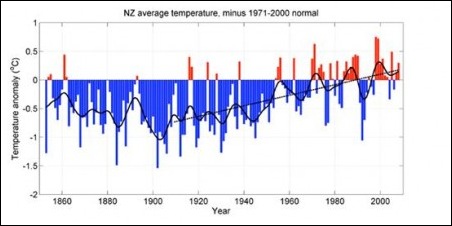
    Official New Zealand Average Temperature According to NIWA

    The problem is that the two sets of figures do not match. When one graphs NIWA’s own websites figures the graph shows a constant steady rate of temperature.
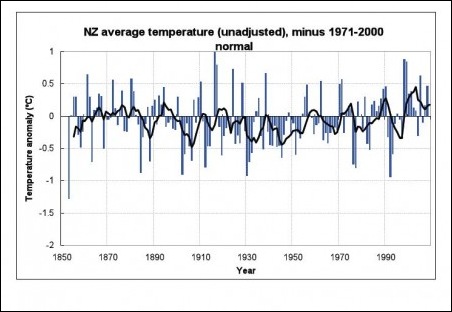
    Unadjusted New Zealand Average Temperature According to NIWA

    The climb in temperature in the official graph is due to the fact that NIWA adjusted the raw data, in almost all cases, upwards. It is these adjustments, and not the raw data itself, which leads to the incline on the official graph. NZCSC have cried foul, Ian Wishart, author of best seller Air Con: The Seriously Inconvenient Truth About Global Warming, got hold of it, the blogosphere followed suit.

    In response NIWA have argued that they had good reasons for adjusting the raw data in this fashion. They maintain that over a hundred years the sites where measurements have been taken have changed and so they have needed to adjust their figures upwards to correct for the distortions these changes would have made.

    I am aware that not being a climatologist or someone that familiar with the relevant data to any great extent makes it difficult to arrive at an informed position in this debate. However, it seems to this lay person that two things are evident.

    From what I have seen from NIWA’s response, the raw data does not support their conclusions and the method of collecting the raw data was flawed and inaccurate to begin with.

    The issue then is whether one is justified in adjusting the data to fit what one thinks it would have been if these inaccuracies did not exist, and, if we are, how confident we can be of the results based on counter-factual speculations of this sort. I myself have no idea of the answer but certainly I think that it is fair for people to ask questions of this sort. Especially with the backdrop of the international climategate emails and memos and when serious political policies such as the Emissions Trading Scheme (ETS), which restricts people’s life, liberty and property, are being passed on the basis of the legitimacy of climate change science.

    Scientific debates aside, it seems that as a point of justice the burden of proof must fall on those who wish to impose severe restrictions on other people’s lives, liberty and property; those advocating restrictive policies, like the ETS and those under discussion at Copenhagen, must be able to show that their polices are defensible. This is simply an implication of the idea that people have a prima facie right to liberty and property. A prima facie right is one that holds as a default position in the absence of sufficient reason to the contrary. It seems to me fairly self-evident that if one is going to restrict people’s freedom or property one needs good reasons for doing so. A principle that suggests we could enslave, coerce and confiscate people’s property for no reason, trivial reasons or simply when we unsure there were any reasons would clearly be wrong – much more so when the question hangs over the reason as to whether or not the justification has been faked.

    One thing that did interest me in this whole debate, however, is how some scientists have defended NIWA against its critics. What I have observed does not inspire confidence.  A good example occurs over at MacDoctor. MacDoctor had raised questions about NIWA’s data, the response from Gareth Renowden, author of Hot Topic.

    I think you are giving far too much weight to the CRU email hack. Here’s a few reasons why:

    1: The emails were stolen. Those released amount to under 2% (pers comm) of the total stolen, and have clearly been selected to support the storylines being run by the “right wing blogs” you mention. The editorial selection has been made by a bunch of crooks.

    2: Many of the mails being talked about have perfectly innocent explanations (see RealClimate). They are the private conversations of a bunch of working scientists, not the science itself. We see that they can be rude about each other and their rivals — that only proves that scientists are human. However, the climate sceptic network is making all sorts of outrageous claims about what they say. Sadly you seem to have bought those interpretations, rather than the somewhat more mundane truth.

    3: Our body of scientific knowledge is found in the peer-reviewed literature, not in a careful selection of emails. Not one peer-reviewed paper is called into question by these emails.

    4: Timing is everything. These emails were “released” a couple of weeks before the Copenhagen conference, and while a major emissions reduction bill is before the US legislature. They were immediately trumpeted from the rooftops by the usual suspects – those campaigning against action on climate change. Coincidence, or part of a campaign?

    If I was a climatologist, I would be very angry at this point, not because I have to go back and redo any work, but because those seeking to delay or prevent action on climate change are resorting to vicious personal attacks against my colleagues. After all, if you can only make a case by stealing and lying, what sort of case have you got?

    There are some things about this response that deserve comment. Consider the points raised in 1: here Gareth’s response is to attack the character of those who took the emails. He notes that they are crooks, that the data has been used to support a particular line of interpretation put forward by “right wing blogs.” Similarly, in 4: he suggests that the timing of the information was politically motivated.

    These arguments commit the ad hominem fallacy; whether or not the material put forward by climate change sceptics is true or false depends on the empirical evidence for it and not on the motives of those who put it forward. One can see the point better by simply reversing it, suppose a body of scientific data is appropriated by left-wing bloggers and is released just before an important political meeting. Does it follow that the studies themselves are worthless? Gareth seems to be suggesting that because the people had particular political leanings or particular political motivations that one should reject their research without actually examining the evidence. Far from showing that the sceptics claims are unfounded, this very line of argument suggests that the scientists are letting political commitments dictate the lines of inquiry they will consider from the outset.

    Gareth’s points 2: and 3: have more merit. He suggests correctly that the nasty rude character of individual scientists does not mean their research is flawed. This is correct; it makes the valid point that whether an individual scientist has a good character is in fact a different question as to whether his arguments are sound. Of course this observation actually rebuts most of what he has said in 1: and 4:.

    Moreover, Gareth suggests that what matters is what the peer reviewed studies show and these are not called into question by anything in the leaked (stolen) emails and memos at the centre of climategate and goes on to suggest that there are innocent explanations of the conversations in question. These latter claims, if correct, do provide a valid response to the questions people raised.

    MacDoctor responds to this as follows:

    Those released amount to under 2% (pers comm) of the total stolen

    No. You can access all the emails. The ones being discussed in blogs and the media amount to about 2%.

    Many of the mails being talked about have perfectly innocent explanations

    I’m sure you are right. However, many of the e-mails have meanings that cannot be interpreted in any way except that they reveal severe selection bias. Even Monbiot thinks that they show more politics than science.

    Our body of scientific knowledge is found in the peer-reviewed literature

    Apparently not, according to the emails. There appears to have been a concerted effort made to keep certain articles out of the peer reviewed literature. The smothering of dissenting views makes for a flawed, truncated science that is all but worthless.

    Timing is everything

    Indeed. CRU timed plenty of scary statistics to be brought forth just before the Copenhagen conference – now all suspect. The timing works both ways.

    Here MacDoctor addresses both the valid and invalid arguments. In response to the issue of peer review, MacDoctor notes that the climategate emails and memos provide evidence that the process of peer review has been corrupted. He also notes that not all of the emails and memos can be plausibly explained away in the fashion Gareth suggests.

    At this point I was interested in seeing if Gareth had an adequate response to these points. I was disappointed. Gareth’s response is as follows,

    Selection bias! In the cherry-picking of stuff to feed into right wing attack lines, yes.

    The “concerted effort” was to deal with crap – papers that should never have got through peer review. Note that the perversion of peer review was actually being conducted by sceptics – notably Chris de Freitas, who as an editor at Climate Research was responsible for passing several papers from his sceptic mates for publication without proper peer review. Six editors resigned in protest. Full story here from one of the editors who resigned.

    CRU “timed” no scary statistics for release, and none of their normal products are now suspect.

    I must say I’m astonished that someone who (presumably) relies on evidence-based should be so partial when it comes to work in another field. Your choice. Your loss.

    What we see here is not a valid response to MacDoctor’s concerns but rather a series of tu quoques. He responds by noting that right wingers have selection bias. That may or may not be true but that was not the question. The question was whether the scientists at the heart of climategate had selection bias. You do not show that one person is not biased by pointing out that someone else is or might be. In the same way, pointing out, as Gareth does, that some sceptics of anthropogenic global warming (AGW) have tried to manipulate peer review does not actually tell us anything about whether defenders of AGW have also manipulated peer review.

    If anything, Gareth’s remaining comments tend to suggest that they did try to do this but were justified because the work of sceptics is “crap.” This shows us that, at the crucial point, his defence degenerates to denigration and name-calling. The rest of the response is to insinuate that those who do not disagree with these obviously fallacious arguments do not follow “evidence based research.” Strange, I though evidence based research involves actually providing evidence for your claims, not raising red herrings and making evasions.

    After reading the exchange I am left wondering; here scientists are defending their position by using clear-cut obvious examples of fallacious reasoning but surely scientists of all people know not to do this don’t they?

    For those like myself who are lay people the questions remain. Governments advocate using the force of law, with policies such as the ETS, to restrict peoples freedom, confiscate their property and raise the price of food, petrol and power. We are told this is because a “consensus” of scientists thinks certain facts about climate change and AGW are the case and that these facts justify certain action. Apart from the obvious is ought fallacy employed in such reasoning (empirical research by itself cannot answer moral questions about what we ought to do) and putting aside the question of whether scientific consensus are always reliable guides to truth, it is disconcerting, in such a politically charged context as we find ourselves in amidst climategate, that when people discover that data has been adjusted on the basis not of what it actually showed but what they think it should have shown under non-existent ideal conditions and they ask questions about this that at least some defenders of science respond with evasions. People who are trained in scientific thinking must know that such responses are fallacious and inadequate. When  I witness this, especially when some of it seems premised on the idea that views can be dismissed out of hand if the conclusions are “right wing,” it makes one, at the very least, a bit suspicious that we are dealing with politics and agendas as much as science.