Category: War Ethics

  • More on Iraq and the Just War Theory

    A little while ago I posted up some thoughts I had about the war in Iraq. These thoughts did not come in a vacuum. At the time of the invasion I read several books on the morality of war. At the time of compiling this article had just read James Turner Johnson’s works on the issue and was reading the medieval ethicist Vitoria’s De Indus . This morning I discovered a discussion about my article at the Manawatu Christian Apologetics Society website . One correspondent Murray asks several questions about my post. These are good questions so I will clarify here.

    Just War Theory is all very well, and sounds good. However, I would ask the following in respect to the 6 requirements needed to call a war “Just” by this theory:
    1. Who decides what a “just cause” is? When religion is involved [especially] the word “just” is completely dependant upon your world view.

    The question of what constitutes a just cause, is simply an extension of the more general question when is a person justified in using violence .In the Christian tradition, two answers are forthcoming, to defend innocent people from attack and to punish those guilty of crimes. Hence, in the writings of Theologians the two cases have generally been either to defend people from an attack upon their rights or to punish a person for an offence committed. My understanding is that Jewish and Islamic traditions do not differ greatly on these conclusions, and international law about war in fact is largely based on just war theorizing.

    Murray seems to espouse a kind of relativism, whereby what’s right and wrong depends on what a person thinks. The problem is he does not seem to apply this consistently because he condemns the US invasion for violating principles he and the peace movement think is correct. If no one has a right to decide these questions then the peace movement doesn’t either.

    2. When does any nation have a lawful authority to wage war, and whose law do we judge this right by?

    OK here the answer is relatively straightforward. The right of a government to go to war is simply an extension of governments police powers. If a criminal attempts to rape or kill people within the geographical realm over which a government has authority then the government can use force to prevent this and also can use force to try and punish anyone who does hence the existence of a police force, courts and prisons. Just war theorists simply note that there seems no reason why this authority ceases to exist when the person committing the offence is a soldier from another country as opposed to a domestic criminal.

    I have never heard anyone give an answer as to why this should make a difference. If the NZ government cannot use force against foreign soldiers who invade us why are they required to protect Greenpeace demonstrators on a peaceful march from violence? Or why are they allowed to protect children from violent parents and yet not allowed to protect those same children from bullets from a foreign army?

    3. There is usually no such thing as a “last resort”, simply preferred resorts. If invading Iraq was a last resort what is a nuclear bomb? The resort after the last resort?

    It’s hard to get exactly what Murray’s point is here. First, use of Nuclear weapons are almost always ruled out by a just war theory on the basis of principles of discrimination (only combatants can be targeted) and proportionality ( the force used must be the proportionate to the threat being repelled).

    As to Murray’s other point, again the idea of a last resort is simply an extension of principles governing a resort to violence in other contexts. The basic idea is that if a conflict can be reasonably and realistically resolved without violence, then to use it is unnecessary and hence unjust.

    In the case I wrote about. The the US wanted regime change. They wanted the Baathists out of power. Given the horrendous record of this government in violating the rights of its citizens and other citizens that was a perfectly reasonable request. One that Saddam could have granted, and was morally obligated to grant. (Did Saddam have a right to torture kill and massacre people?) He did not grant this request. Hence Iraq did not fight as a last resort.

    On the other hand if Saddam had made reasonable concessions, if he had agreed to write a new constitution granting basic rights to Iraqi citizens, had set a date for free and open elections with international observers etc and organized a transition. Then the US should not have invaded or at least delayed the invasion until the sincerity of these concessions was apparent.

    .4. Who is the judge of the “possibility of waging war with a reasonable chance of success”? What is success and who determines it, by what guidelines is success measured? Success is dependant upon the original aim. (in Iraq this was removal of WMD, then when that was found lacking it was changed to “regime change to bring democracy”. No,luck there, sow whats next, control of oil flow? well, I guess that has been almost achieved…). If we don’t know the aim of waging a war (i.e. we were told it was WMD in Iraq, but obviously was not as they are still there and no WMD found) then how can we possibly judge the likeliness of a successful war?

    With any moral question the person who needs to answer the question is the person engaging in the action The role of being a moral agent is to ask oneself is what I am about to do the right thing? So in this case the government has the duty to ask, before it goes to war whether it’s likely the end for which they are fighting is one they are likely to achieve. This is determined by examining the factual information and making the best assessment one can *at the time of the decision*. (not on the basis of what was known after the event) Like all factual decisions it’s fallible. If this counts against making it then one should not make any factual decisions which involve life and death.

    Murray’s response to some extent proves the point of my original post, because after dismissing the idea of doing so he inconsistently criticizes the US for not making this assessment adequately. However, as I noted its not just the US who have a duty to act justly so does Iraq, and it seems blatantly obvious that Saddam had good reasons for thinking that he could not successfully fight of a US invasion, hindsight confirms this to a far greater extent than it does with regards to the US belief that they could defeat Saddam. Yet Murray ignores this and applies the standard only to the US despite suggesting that the standard is meaningless.

    It is precisely this kind of garbage that lead me to not support the peace movement.

    5. To prevent evil we must agree on what evil is. One mans terrorist is another mans freedom fighter.

    Well this slogan is simply false. A terrorist is a person who targets non combatants for the purpose of striking terror into the population so as to achieve political ends. A freedom fighter is a person who engages in war for the purpose of liberating a people from oppression. It’s simply false to conflate these categories. A person can use terrorism to enslave people and a person can fight for freedom without using terrorism.

    However again, Murray is also very inconsistent here, if what constitutes an unjust attack on another’s rights is simply relative. If what counts as an unjust act of war (terrorism) and what is justified (freedom fighting) is simply arbitrary and relative. Then on what basis does he condemn the US invasion. Its funny how, when dictators act unjustly we can’t condemn it because morality is relative, when the US uses force suddenly the standards the peace movement believe are correct apply to the US government even when it disagrees with them.

    If one cannot make judgements that certain actions are evil, then one cannot judge George Bush’s actions as evil.

    6. How is it possible to wage a war in a civilian area (e.g. a city) and at the same time use only “proportionate and discriminate” force? Any attempt at this would result in a quagmire within hours, which any invading army knows full well. Which is why Baghdad was bombed from the air. In that particular case “Just War” is surely an oxymoron.

    I find this response surprising because just war theorists have frequently and repeatedly discussed this very issue.

    The problem Murray points to is this. According to traditional just war theory a state can (in certain circumstances) use proportionate violence against enemy combatants but not against non-combatants. However, this requires the ability to distinguish between the two and to be able to attack one without attacking not the other. For this reason in addition to refraining from targeting combatants, there is also a duty to not use combatants as human shields (hence the traditional European method of meeting at a battlefield in Uniform).However, if enemy combatants dress like civilians, look like civilians, hide amongst civilians and attack from within civilians centres it becomes extremely difficult to repel them without hitting civilians in the cross fire.

    There are really only two responses to this problem: The more sensible response is the one suggested by several just war theorists such as Donagan, Walzer Ramsey etc that in such cases, soldiers should take reasonable care to avoid hitting civilians, but if they cannot defend themselves from attack without killing some civilians then the responsibility for the deaths is not theirs, its rather the fault of the enemy who choose to attack from amongst them. This suggests that the duty to not kill non-combatants does not apply to human shields if there is no reasonable way of hitting the assailant without hitting them.

    (This I think is a general point about self defence a F 16 would have been justified in shooting down one of the United Airliners heading for the world trade centre for the same reason and similarly a policeman could shoot a suicide bomber threatening to blow up a mall who was also carrying a baby )

    Murray however takes a different option which I consider mistaken. He suggests that when the enemy fights from within a civilian area it is wrong to defend oneself against their attacks. This seems to lead to a conclusion that as long as I hide behind civilians and use them as human shields I gain protection from the morality, however if I don’t do this and refuse to use human shields I do not. This seems problematic if not outright perverse.

    In a sense however Murray answers his own question he notes attacking a city would result in mass civilian causalities, he therefore notes that because of this an alternative method was used precisely to minimise these causalities. Exactly, that’s what a just belligerent tries to do in such cases, minimise civilian causalities. Would Saddam have made an effort to do this, I doubt it.

    RELATED POSTS:
    Iraq and the Just War Theory: Why I Choose not to Support the Anti-War Movement
  • 9/11

    Today in New Zealand the date is the 11th of September, this date marks the anniversary of a terrible crime, an event where planes were used to incinerate and kill thousands of innocent civilians in order to strike terror into the heart of the local population.

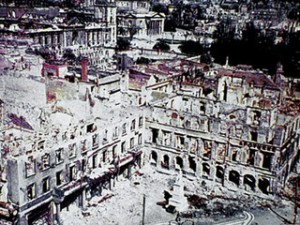
    Darmstadt, after the bombing on 9/11Those reading this will suspect that I am talking of the attack on the world trade towers in 2001. I am not. The event I refer to occurred in September 11th 1944 the bombing of Darmstadt. This was one of several bombing raids performed by the allies against German occupied Europe. What’s less well known was that Churchill under pressure from his ally Stalin, perhaps the greatest mass murderer in history, authorized the deliberate area bombing of civilian cities. Defenders of these actions argued it was necessary to destroy the morale of the German people. The raid on Darmstadt created a fire storm 1 mile high. The roaring firestorm so terrified the population that most people stayed in their bomb shelters leading to them dying of suffocation. In his fascinating monograph Humanity Jonathan Glover notes that over 12000 people died in this raid. Carolin Schaffer a survivor of the raid tells how she and her children were forced to flee through piles of corpses. She covered her children’s eyes for fear that the images would traumatize them for life.

    Darmstard was only one of many area bombings performed by the allies. A year earlier between 24 July and 3 of August the city of Hamburg was repeatedly attacked. On the night of the 27th the bombings created a firestorm with temperatures up to 800 degrees. Roads melted and fleeing civilians found their feet stuck in molten tar and asphalt while they were burnt alive. Glover’s account contains disturbing accounts from eyewitnesses, stories of charred women and children, with brains tumbling onto the ground. The firestorm of the 27th killed 40,000 people. Similar things can be said about the fire bombing of Dresden in 1945 which killed 30,000.

    Many in the west forget do not know about these events. I talk to well meaning sincere students all the time who know all about the atrocities of Hitler and have no idea that Churchill supported terrorism moreover often when this is pointed out they do not care. After all he was fighting Hitler.

    I highlight these events not to engage in the specious reasoning of anti war activists. The invalid tu quoque which states that because the west has engaged in terrorism of this sort in the past that some how means they are mistaken to condemn it now. Such arguments seem to suggest that because we did not do the right thing in the past we should not do it now. Nor do I wish to engage in the facile “Bush is a hypocrite” argument; such reasoning displays a shallow understanding of ethical argument, one that mistakes attacking against a persons character with actually offering an argument against the proposition asserted by the person. Any first year critical thinking or logic class would clear these issues up; the fact that educated University students seriously put them forward is a shame to our education system.

    I highlight to say simply this terrorism in all its forms should be condemned. The Christian Just war theory condemns deliberately targeting and killing non combatants in war. It bases this on the sixth commandment “you shall not kill” but notes, following Augustine, that when this commandment is read in it’s context it admits of two specified exceptions; killing an aggressor to defend of the innocent from his attack, and killing a person justly sentenced for a capital crime. The commandment is issued to all human beings. It does not say it’s wrong for the US to do this but Sunni Muslims who do it against America are freedom fighters. It does not say that we should condemn Israel when (and if) they deliberately attack civilians but then agree to listen and hear the complaints of Palestinians when they blow up Israeli women and children and encourage their teenagers to do so. It does not say that we should revile the CIA for dubious actions they have engaged in and yet praise terrorist organizations like Nelson Mandela’s ANC. All forms of terrorism should be condemned. All people, including all governments, are required to obey Gods law.

    The leftwing forces of “peace” and “tolerance” in our country reject Gods law and find the idea that Governments are under God as absurd. In popular discourse they replace Gods law with the most bizarre unprincipled stance on violence. They say the state should never kill when a person has been found guilty of serial murder. But they slaughter by the thousands innocent children for social, economic reasons in state hospitals at taxpayer funds. They tell us the US should not intervene in Iraq to bring down a brutal dictator and stop his slaughter of thousands of innocent people. Yet they support military intervention in the Solomon Islands to stop riots. It’s wrong to correct disobedient children with force, but they then exhort thousands of dollars of tax payer money out of adults, by threatening force and violence for any social cause they deem worthy of support. This leads to the absurd situation where Journalists on TV tell us that Bush and other American conservatives are the equivalent of Bin Laden and the Taliban. As though a country that executes serial murderers is the same as one that executes women for not wearing a Burka. As though condemning pornographic filth is the same as banning TVs and kites. Their real ethic is clear; violence is good when used by us for causes we like by regimes who oppose those we hate. It should not be used against murderers only innocent tax payers, it should not be used against dictators only against those dictators which the UN ( which is composed of dictators) like. A plane that attacks a military target illegally located within a civilian area and which inevitably but unintentionally hits a civilians ( after ringing the civilians and telling them to leave) is a terrorist because the person who did it is a Jew and supported by the US. However a terrorist who fights apartheid is a hero and Muslim Jihadists they are simply venting understandable frustration at western colonialism.

    This is one of the reasons people do not know about Darmstadt, because the Nazis were evil racists, they are the figure the left use to label any person they don’t like, so no one cares about the Germans. People confidently forget or excuse the atrocities committed upon german civilians by the allies. They also minimize the even worse social polices and massacres of Stalin our ally in the war. What is needed is not the pragmatic utilitarianism of the left. But a consistent stance grounded in the law of God. Violence is wrong when intentionally wielded against innocent people. However, to protect the innocent, governments must wield it against criminals and those who engage in aggression against the innocent. This applies domestically and internationally. I say hunt Bin Laden down kill him. Destroy terrorists everywhere and anywhere when they threaten us. Refuse to give in to them or negotiate with them until they denounce terrorism. Execute the evil people who rape and kill children here at home. Arm the police with tasers and when a criminal is threatening the innocent use them. However let those of us who are innocent, whether civilians in other countries or non criminals at home, use our life liberty and property as we please. Stop restricting our liberty appropriating our property and threatening us with incarceration us as means to achieve your social ends. Stop killing unborn children by the thousands to further the women’s revolution while selectively condemning “non violence” and prattling about peace when those who threaten the innocent us are challenged by governments doing the job God instituted them to do. Show us you actually have some moral discernment and can tell the difference between guilt and innocence, aggression and non aggression.

    Black is not white and your continual claiming it is does not make it so.

  • Iraq and the Just War Theory: Why I choose not to support the anti-war movement.

    I found this last night, I wrote it at the beginning of the US invasion in 2003 at that time I was opposed to the invasion of Iraq and was considering joining the anti-war movement in Dunedin. I posted it up on a newsgroup to get some answers from peace activists. I have edited it slightly and incorporated some of the responses I made to objections in the ensuing discussion into the main text.My views on permissibility the invasion have since changed. However I stand by what I said here:

    I was sitting down last night watching the News and pondering whether the doctrine of a Just War ruled out a military intervention by the US in Iraq. While I was doing this an idea came to me. I was struck by the fact that no one has asked whether the Doctrine would justify Iraq defending themselves against the US invasion. It seems odd that no one has asked this. There is after all two sides to a conflict and both sides are required to act according to Gods law. Why were people predominately concerned with the actions of only one of the belligerents? It is almost as if we people think that democratic nations have a duty to refrain from unjust belligerency, dictatorships do not. I submit that this is absurd.

    Upon reflection I came to the conclusion that the just war doctrine would not permit Iraq to engage in a defensive war against the US. Just war doctrine states that a war to be lawfully prosecuted must meet 6 requirements 1) it must be fought for a just cause with just aims 2) it must be prosecuted by someone with the lawful authority to do so 3), It must be a last resort 4) one must have a reasonable chance of success in prosecuting these aims 5) The cost one incurs by going to war must not be greater than the evil one is trying to prevent and 6) only force must be used proportionate and discriminate ( aimed only at non combatants) force should be utilized in prosecuting the war.

    I will examine each of these criteria in turn.

    1) The cause and aim is to prevent a brutal dictator, Saddam Hussein, being removed from power this is hardly a just cause.

    Some deny this, they suggest that Iraq is defending it’s oil reserves from foreign annexation. I demur for three reasons

    First, “the no blood for oil” argument is a bad one. The aim of the US is to topple the regime, of course Oil could be the motive (just as it could be the motive of Frances decision to veto). But even if it was all it shows is that the US has bad motives. It does not show their actions are unjust. Consider a person can give to charity because he wants others to be impressed by his piety, this would be a bad motive but it does not follow that giving to charity is wrong, or that he should not give to charity. It simply tells us about his character the no blood for oil argument expresses a logical fallacy, attacking a person’s character not their reasons.

    Second, Saddam’s aim is not to prevent the US getting Oil. To see this simply ask whether Saddam would settle for a situation where his regime fell, his people liberated but Iraq kept the Oil. Would he stop fighting and surrender on such terms NO. Which shows his aim is self preservation not protecting people from getting oil?

    Third even if protection of Oil reserves was Saddam’s aim (which it is not) the question could still be raised over whether this is a just cause. Is maintaining possession of Oil and money is a just cause for war, normally one does not have aright to kill to defend money. If America is not permitted to shed blood for oil why is Iraq?

    2) Holds only if one grants that a dictator who ceased power by force and stays in power largely by rigged votes is the legitimate ruler of Iraq. notice the words “if” here I was cautious because I am tempted to think that a de facto regime can be legitimate even if dictatorial, that does not mean that everything the regime did is legitimate. We recognize China’s government for example and various others.

    The standard response I get to this is that Bush rigged the election in Florida and so does not have lawful authority either. This is not an adequate response. My suggestion is that Saddam lacks lawful authority to wage war. Saying that Bush has no such authority does not address this, in fact it tends to confirm it. If Bush can’t wage war because he was not really elected then neither can Saddam why is it acceptable for dictators to engage in wars and yet not unelected leaders of free countries?

    3) Clearly does not hold, Saddam could have taken numerous reasonable non violent actions to prevent invasion. He could have stopped oppressing his people. He could have gone into exile. Saddam could have stepped down; he could have allowed his people to have free democratic elections and reformed the regime so that it upheld justice and human rights. These are all perfectly reasonable things that he had a duty to do any way and they would have averted war. Why is the US is being condemned for not exhausting all non violent solutions when Saddam did not either. You can’t have it both ways, a rule that says dictators don’t need to find peaceful alternatives but free countries do.

    4) Does not hold, it is not likely that Saddam can defeat the coalition in a war, he could not beat Iran, was beaten soundly by the US last time and has a weaker army this time.

    [note: one response I got to this point was that I was completely brainless if I thought this. I was told that Saddam’s forces would drive the US advance back, another respondent said the Arab world would unite and defeat the US as a response to the invasion. I have not put my responses to this here. I don’t think I need to…]

    5) Does not hold the “evil” being prevent is the toppling of a brutal dictatorship and so is not an evil at all. Consequently the costs incurred by the Iraqi people by fighting the coalition are not outweighed by a positive good.

    The response I get to this claim is that Saddam is no more of a dictator than George W Bush who signed Bush has signed over 200 death warrants [ Bush is the former governor of a death penalty state see here ]. Again this is beside the point I have not argued that the US or Bush are fighting a just war, I merely said Iraq is fighting an unjust one. Even if one grants that Bush’s actions are problematic it does not mean that Saddam’s are not. Taken at face value this argument confirms my claim. I take it that people who make this argument consider these actions by Bush to be wrong if so then Saddam doing the same thing is wrong and I assure you he has executed more than 200 people.

    I am surprised anyone takes this argument seriously. There is a world of difference between executing people found guilty by due process of committing first degree murder which is what happens in the US. and executing women and children without trial, often for trivial reasons, or for actions which are not crimes ( such as criticizing the government or being a Kurd).There is also a difference between a lethal injection and being tortured to death in an Iraqi torture chamber. I am at a loss to understand why some who oppose the war cannot draw such basic and obvious distinctions. Is as though any killing by the US, no matter what the circumstances, is murder but when the same action is done by Iraq it’s excusable.

    6) Saddam is does not have a track record of using force discriminately. He has a history of massacring civilians. His defenders tend also to disrespect non combatant immunity by a) housing military targets in close proximity to civilian centers and hence effectively using civilians as shields b) executing POW’s and disrespecting their rights, c) disguising troops as civilians.

    [One peace activist responded to this point by saying that my claim Saddam did these things was simply my biased opinion and hence worthless. He appeared to maintain that Saddam was a democratically elected popular leader. I kid you not]

    So Iraq fails on nearly every criterion, except perhaps 2). In fact I am inclined to think that even if the US invasion is unjust it meets more of the criteria for a just war than Iraq’s defense does, making the American invasion less morally problematic than the Iraqi’s defense . This means in fact that Saddam had a to not defend himself against the attack. If he had done this the US would not have used force and nearly every adverse effect associated with the war that people are concerned about would not have happened. Saddam therefore is as much responsible (perhaps more so) for whatever happens as the US is. His derelection of the duty to not engage in an unjust wars has lead to these things coming about

    These observations lead me to question the tactics and strategy of the Peace movement. This movement is advocating that the U.S withdraw because they are fighting an unjust war. It states that because the US are prosecuting such a war there should be demonstrations against the US. The question needs to be asked are governments allowed to prosecute unjust wars, if the answer is yes then the peace movement has no case , because Bush is not doing anything wrong, if the answer is No then it follows that Iraq also has a duty to refrain from fighting this war and that Iraq has a duty to cease fighting and withdraw its defenses from Bagdad. The peace movement should be picketing Iraq’s decision to fight, burning Iraqi flags demanding that Saddam step down, storming Iraqs embassies etc. We should see hundreds of thousands of people marching denouncing Iraq. But we do not.

    Consider it this way. The war can be stopped in two ways either by the US ceasing to invade or by Iraq ceasing to defend, It seems to me that putting pressure on Iraq to stop fighting is in fact preferable to demanding a US withdraw. For three reasons first because even if one grants the unjust nature of both wars I suspect that the US will conform to the model of a just war better than Iraq does. Second, because Iraq withdrawing and the US liberating Iraqi people from tyranny without violence is surely a better outcome than the US withdrawing and liberated people being crushed with violence, reprisals etc And Third because if it did this it would also gain support of those who support the US invasion and hence represent a broader base of people and gain more popular support.

    Why then is the peace movement most of its efforts on denouncing the coalition? If the peace movement wants to credibly pass itself of as concerned with justice for the people of Iraq rather than a simply a movement that is committed to anti Americanism while turning a blind eye to dictatorships It should focus most of its efforts protesting the actions of the Iraqi leadership. It should call for the Iraqi leadership to put down its weapons and cease fighting an unjust war. Until it does many people even those who have doubts about the justice of Americas actions will remain skeptical of its goals. If not morally appalled at its selective blindness and lack of concern for the Iraq people.

    RELATED POSTS:
    More on Iraq and the Just War Theory

  • The Question of Islam

    An interesting discussion of Islam has been occurring at Kiwiblog. Up until now I have merely chipped in to correct inaccurate claims about Christian beliefs and practices. However, for what its worth I’ll add my two cents worth here.

    Here is what I think the issues are.

    We are familiar with Christian teachings on the morality of violence. The just war theory of Augustine, Aquinas, Gratian, Vitoria, Calvin, Luther and Grotius have been pretty much codified into international law and things like the Geneva accords. They are now at least held up as the correct rules ( even if they are not always followed in practice) by liberal democratic societies. We are also familiar with various other ideas which come from Christianity the idea that individuals have inalienable rights which the state cannot transgress. Those non believers should be tolerated. That Government should be limited. That Church and state are separate institutions with degrees of autonomy from each other. That the state should be concerned with the temporal welfare of its citizens and not their welfare in the life to come. While it’s fashionable for people to attribute to these things to the enlightenment, in reality, much of this in is found in Medieval Theology and even in earlier writers like the Church fathers. The basic premises of course come from the scriptures.

    Now when we confront Islam we confront (a) a religion we know less about (b) a religion which historically has threatened parts of Europe with invasion and hence has been feared and (c) whose high profile practitioners seem to have very different understandings of these things. Some of them appear to believe direct killing of non combatants is permissible and they seem to not respect the Geneva accords. They appear to have more absolute governments. Have clerics exercising vetoing legislation and they seem to threaten people with death if they don’t convert etc.

    I guess the question is this: does this historically feared tradition have the same moral teachings about these things Christianity does? And if it does not what does that mean for religious tolerance? How far can a religion disagree with our current consensus on these types of questions before tolerance is no longer acceptable? And finally, if we tolerate it and large numbers of the population embrace this religion how will that change the cultural values and assumptions which our liberal institutions are based on?

    I do not know the answers to these questions. but I think they need to be asked and debated. Not dismissed as Islamiphobia. I also think that the debate should be informed not a banding about of stereotypes and caricatures about either religion.

    This latter point requires emphasis. If we see the discussion as it occurs today one side dregs up stereotypes of Muslims and attempts to quote the Koran out of context without examining the tradition, critical commentaries that responsible study of this document requires. Another side dregs up stereotypes of Christians and argues they are the *real* problem and predictably do the same thing. They argue that the scriptures support rape, torturing heretics we are told. Any debate on the question of religious tolerance which relies on slander, ignorance and prejudice towards religious minorities scares me. The alternative to tolerance is supression; which involves violence. If it comes to that then lets make sure we have been informed enough to make the right decision.

    I would also add that these questions are not new. Medieval Theologians like Aquinas supported religious tolerance for Jews and Muslims but and not for Heretics. This is because he perceived heretics to threaten the institutions of society whereas other monotheistic minorities did not. Latter, John Locke suggested that religious dissenters (what Aquinas would have called Christian heretics) should be tolerated provided they did not challenge the moral values essential to a free and just society. Locke advocated suppressing Christian groups that taught contracts could not be kept with heretics because that would undermine the co-operation needed to maintain a free and just society. He also supported the suppression of atheists because he felt belief in a moral law giver was a necessary foundation for such a society. Some contemporary Gay rights advocates seem to believe we should not tolerate evangelical Christianity because opposing homosexual conduct inevitably incites violence. Or is opposed to certain understandings of equality which they think justice requires. Libertarians draw the line at aggression, because they believe freedom needs to be based on everyone refraining from the initiation of force.

    The irony of this, of course, is that many of defenders of one position view the others as being opposed to tolerance. As though tolerance did not come in degrees. Everyone is for tolerance of some religions and no one to my knowledge tolerates all religions. Because we have conducted the debate in this manner few people have been able to ask the real question : How far should tolerance extend?

    Aquinas’s question is still with us. When does error in Theology become serious enough for the state to step in?

  • Sanctions and Siege Warfare

    Helen Clark has announced that the New Zealand government will not be sending troops to Fiji. We will, however, impose economic sanctions, including a reduction of aid.

    I agree with Clark about militarily intervention. I believe that a state has the right to wage war only to defend those living with in its boarders from attack. A state’s authority to use coercion to uphold justice is limited to its borders.

    Just as a state has no right to prosecute a person for committing a crime committed outside NZ or to make laws regulating peoples behaviour beyond its shores, it has no duty to defend people in other countries.

    However, it seems to me that replacing military action with sanctions is questionable. First, sanctions are in fact a type of warfare, a form of siege warfare. Where a person instead of fighting the enemy directly attempts to force a surrender by cutting off supplies and starving the populace into submission. (Not suggesting that Helen intends to see the people of Fiji starve – making a general point about what siege warfare entails.)

    Secondly, siege warfare of this type is unjust. In a just war one targets enemy combatants – a military intervention would do this. The NZ army would go in and kill the military who are carrying out the coup and would not deliberately target innocent civilians. Sanctions do not do this. The entire population is deprived of aid and support including women, children, the poor, etc. Sanctions work in the same way terrorism does, one attempts to force a government to change by causing innocent civilians to suffer and essentially blackmailing them into submission.

    Also sanctions infringe the rights of New Zealand citizens to freely dispose of their own lawfully acquired property. New Zealanders will be told that they cannot sell to another person because of his race (in this case Fijian race) and because some other person of the same race has behaved unjustly. This is the mentality of the KKK.

    Moreover, for a government to tell private sports clubs who they can and cannot play cricket and rugby with is stepping well outside the bounds of its lawful authority.

    If one wants to harm and hurt people then hurt those who are guilty, send in the troops. If one cannot justify this then one cannot justify harming innocent third parties by depriving them of aid and support and preventing others freely giving it to them.

  • Democracy and Legitimacy

    The founding statement of liberal political theory, John Locke’s Two Treaties of Civil Government, opens with the following statement:

    Reader, thou hast here the beginning and end of a discourse concerning government; what fate has otherwise disposed of the papers that should have filled up the middle, and were more than all the rest, it is not worth while to tell thee. These, which remain, I hope are sufficient to establish the throne of our great restorer, our present King William; to make good his title, in the consent of the people, which being the only one of all lawful governments, he has more fully and clearly, than any prince in Christendom; and to justify to the world the people of England, whose love of their just and natural rights, with their resolution to preserve them, saved the nation when it was on the very brink of slavery and ruin.

    Locke states his purpose in writing is to defend a military coup. Locke goes on to argue that a government derives its powers from the consent of the government for the purpose of protecting the rights of its citizens. Specifically a citizen’s right to life, liberty and property. He argues that if a government turns against these rights the people can justly overthrow it.

    The US declaration of independence reiterates this claim.

    We hold these truths to be self-evident, that all men are created equal, that they are endowed by their Creator with certain unalienable rights, that among these are life, liberty and the pursuit of happiness. That to secure these rights, governments are instituted among men, deriving their just powers from
    the consent of the governed. That whenever any form of government becomes destructive to these ends, it is the right of the people to alter or to abolish it, and to institute new government, laying its foundation on such principles and organizing its powers in such form, as to them shall seem most likely to effect their safety and happiness.

    Two of the founding documents for liberal democracy maintain that a government can be legitimately overthrown if it uses its powers to infringe, as opposed to protect, the rights of its citizens. In some instances, the military have a duty to do this; often the military have sworn duty to defend the rights of its citizens with force. If the government begins to threaten these rights then this duty means the military have a duty to resist the government with force. This is not some crackpot, novel idea, it is part of our liberal heritage, it is also incidentally part of our Christian heritage. Aquinas argued in a similar vein, as did numerous Puritan writers such as Mornay, Rutherford, Milton, Buchanan.

    I say this because at 7:30 PM tonight on Campbell live a military coup was announced in Fiji. The immediate reaction from every commentator I saw was one of disgust because a democratically elected government had been overthrown. Now I am not saying I agree with the coup, I am quite willing to concede that the Military are acting unjustly. However, the mere fact that the government of Fiji was democratically elected does not mean its wrong to over throw them with a coup. If the government uses its power to punish the guilty with proportionate and humane punishments and they defend the rights of the innocent against aggression then I agree it is unjust to over throw them. But if the government of Fiji has used its power to deprive innocent people of there rights and to acquit those guilty of crimes then in certain circumstances the military are within their rights in staging a coup. The fact that the government was lawfully elected is irrelevant.

    When commentators in the media claim that a coup is wrong because the government is elected. They are in essence promoting the tyranny of the majority. They are suggesting that we have a duty of unqualified obedience to any leader which 51% of our peers support on election day, regardless of what this government does or orders us to do. They are deifying the majority and placing a democratic government in the place of God.

    A state’s legitimacy depends on what it does, not on how many people support it or how popular it is the year of an election. If upholds the law of God and the rights this law confers upon us it is worthy of support. If it turns against these, it is not. God and God alone is the only person worthy of unqualified obedience.