Category: War Ethics

  • Pacifism and The Golden Rule

    The Golden RuleLast night I was part of a discussion panel looking at the Ethics of War; I defended classical just war theory. Speaking in defence of pacifism was one of the Waihope three who offered the argument that you cannot use force against an oppressor because of the Golden Rule, typically stated as: ‘do to others as you would have them do to you.’ His idea seemed to be that if you were an oppressor you would not want force used against you so therefore no one should use force against oppressors – this is what the Golden Rule teaches.

    This struck me as odd. One problem with this line of argument is that it interprets the Golden Rule as stating we should do to others what we want them to do to us. This interpretation is obviously problematic. I want a million dollars, does it follow that therefore I should give a million dollars to everyone? I want a nice car does it follow that I should give nice cars to everyone? What the Golden Rule says is that there should be consistency between what we think that people are morally required to do for us and to us and what we are morally required to do for and to others; if I object to someone stealing from me in certain circumstances and condemn that person’s action in doing so as wrong then I am committed to not stealing from that person.

    Once this is understood, I do not think my fellow panellist’s argument works. I am quite happy to accept that if I was trying to kill or seriously maim another human being that others (including the state) would be morally permitted to use force to stop me; I may not want them to but that is not the issue. The issue is whether I think they are are required not to and the answer I think is obviously no.

    In fact, anyone who recognises the government as legitimate must accept that the state can use force against them if they violate certain rules. I would have thought that the laws against assault and homicide would be paradigm examples of this.

  • Internationalism is Dead: Boneparte’s Descendants

    OK, so we thought that you would want to hear it here first. Internationalism–the idea that nation states are subject to a higher “sovereignty”– is dead. The corpse is rotting. The Libyan “adventure”, called for by the UN, is growing madder than a March Hare. All the problems and faults of internationalism are now clearly displayed. We hear Joan Baez in the background, intoning “when will they ever learn?” Not in a hurry would be our bet.

    Muammar Muhammad al-Gaddafi

    Though internationalism may be dead, the foolishness that is bound up in the heart of unconverted man is likely to keep flogging that particular equine corpse for decades to come.

    Consider the mess that the internationalists are now in. The UN has passed a resolution directing that a no-fly zone be established in Libya. The internationalist community has spoken. Man, the universal overlord of the globe, has determined that what was happening in Libya ought not to be; some kind of nebulous higher ethic was appealed to which mean that “humanity” or “the international community” had to step up and into Libya to sort things out.

    The echoes in the UN Security Council chamber had not died away before they were drowned by arguments between those who voted over what the meaning and application of the resolution. This from Al Jazeera:

    International criticism of the coalition enforcing the no-fly zone has continued to grow, with India joining China in publicly calling for an end to the airstrikes. Jiang Yu, a spokeswoman for China’s foreign ministry, said on Tuesday that the government opposed “the wanton use of armed force leading to more civilian casualties and more humanitarian disasters”. China had already called for a ceasefire.

    S M Krishna, the Indian foreign minister, called for a “cessation of armed conflict”. His office had previously issued a statement on Monday expressing “regret” for the military intervention. Pranab Mukherjee, the country’s foreign minister, said in a speech to parliament that “no external powers” should interfere in Libya. “Nobody, not a couple of countries, can take that decision to change a particular regime,” he said

    The Sydney Morning Herald reports that the Brits cannot even agree amongst themselves as to what the resolution means: can they take Gaddafi out or not? Some say yes; others nay-say. Neither can the French agree amongst themselves. Does the resolution mean that Gaddafi can legitimately stay in power. Yes. No. Maybe. All of the above. Meanwhile, Turkey a member of NATO has announced that it will not allow its airspace to be used in enforcing the no-fly zone, if it goes beyond the UN resolution–whatever it might mean, and no-one knows.

    The announcement came after Turkey, a member of the NATO, warned on Tuesday that it could not agree to the military alliance taking over the enforcement of the no-fly zone if their mission went “outside the framework” of the UN decision.

    Meanwhile in the US, President Obama, a committed internationalist, appeared deeply reluctant to (more…)

  • God and the Genocide of the Canaanites Part III: Two Implications of the Hagiographic Hyperbolic Account

    This three-part blog series is a modified version of what I presented to the Evangelical Philosophical Society meeting in November 2010.

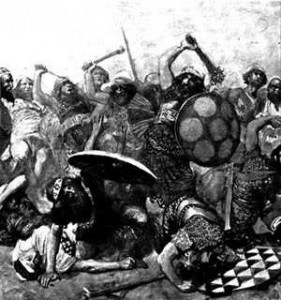
    Joshua Slaughters the Canaanites

    In a recent Conference at Notre Dame Alvin Plantinga suggested that the commands to wipe out the Canaanites, recorded in the book of Deuteronomy, might be hyperbolic; they should be understood more like how we understand a person who states, in the context of a boxing match, “knock his block off, hand him his head”, or in a football game where a person states that the team should “kill the opposition” or boasts that “we totally slaughtered them.”[1] Understood this way, the commands in Deuteronomy meant “something like attack them, defeat them, drive them out; not literally kill every man, woman, child donkey and the like”.[2]

    In two previous posts I have explored and defended Nicholas Wolterstorff’s argument for this conclusion. In God and the Genocide of the Canaanites Part I: Wolterstorff’s Argument for the Hagiographic Hyperbolic Interpretation, I elaborated on, appropriated and expanded Nicholas Wolterstorff’s case for understanding Joshua as a hagiographic, stylised and highly hyperbolic account of Israel’s early skirmishes. In Part II: Ancient Near Eastern Conquest Accounts, I argued that studies into Ancient Near Eastern historiography give considerable support to his conclusion. Joshua appears to follow the same rhetoric, literary conventions and motifs of other ancient Near East conquest accounts and one feature of such accounts is to narrate victories hyperbolically in terms of killing all people, leaving no survivors and so forth. This suggests the description of Joshua putting every inhabitant to the sword, totally destroying all and leaving no survivors, is not to be taken literally. In this last post in this series I want to look at some implications of accepting this.

    I think two implications can be drawn from this conclusion. First,

    On the assumption that Deuteronomy and Joshua are parts of the same sequence of books, this interpretation of Joshua forces a back-interpretation of Deuteronomy. If “struck down all the inhabitants with the edge of the sword” is a literary convention when used to describe Joshua’s exploits, then it is likewise a literary convention when similar words are used by Moses in his instructions to Israel in general and to Joshua in particular.[3]

    I think Wolterstorff is correct here, this interpretation of Joshua does force a back-interpretation of Deuteronomy. Deuteronomy 7:2 states “when Yahweh your God has given them up before you and you have struck them, you shall utterly destroy them”. Similarly, Deuteronomy 20:16-17 states “anything that breathes you shall not keep alive, but you shall utterly destroy them”. In Joshua 10 one sees the formulaic language of “and Yahweh gave [the city]” and they “struck it by the mouth of the sword, and its king he hath destroyed” until there were “no survivors”. The chapter is summarised with the phrase “So Joshua struck all the land, … He destroyed all that breathed”. The similar phraseology is evident.[4]

    Moreover, the book of Joshua clearly, explicitly and repeatedly identifies what Joshua did in these chapters with the command that Moses had given regarding the Canaanites in Deuteronomy.[5] If the language of “striking all the people by the sword”, “leaving no survivors”, “totally destroying”, “striking all the inhabitants with the edge of the sword”, and so on, is hyperbolic (as the evidence suggests it is) then the command cannot have been intended to be taken literally.

    This understanding of the commands in Deuteronomy also solves some other interpretative problems. Here I will mention briefly three.

    First, what God commanded regarding the Canaanites differs in various canonical books (more…)

  • God and the Genocide of the Canaanites Part I: Wolterstorff’s Argument for the Hagiographic Hyperbolic Interpretation

    Around this time last year I wrote two posts Joshua and the Genocide of the Canaanites I and Joshua and the Genocide of the Canaanites II. These posts attracted a fair amount of attention and debate. I got offers to publish my ideas in several upcoming books and present them before both the Evangelical Philosophical Society (EPS) and the Society for Biblical Literature in November 2010. Since the original posts I have corresponded with various people and I have modified and refined some of the ideas. This three-part blog series is a modified version of what I presented to the EPS last month. These posts supersede and update what I wrote in a year ago.

    Joshua at AiOne of the most perplexing issues facing Christian believers is a series of jarring texts in the Old Testament. After liberating Israel from slavery in Egypt, the Israelites arrived on the edge of the Promised Land. The book of Deuteronomy records that God then commanded Israel to “destroy totally” the people occupying these regions (the Canaanites); the Israelites were to “leave alive nothing that breathes”. The book of Joshua records the carrying out of this command. In the sixth chapter it states “they devoted the city to the LORD and destroyed with the sword every living thing in it—men and women, young and old, cattle, sheep and donkeys”. In the tenth and eleventh chapters it states that Joshua “left no survivors. He totally destroyed all who breathed, just as the LORD, the God of Israel, had commanded.” The text mentions city after city where Joshua, at God’s command, puts every inhabitant “to the sword”  “totally destroyed the inhabitants” and “left no survivors.”

    If one takes these passages literally they record the divinely-authorised commission of genocide. But genocide surely is morally wrong. In the light of this, critics of Christian theism often ask a rhetorical question; how could a good and loving God command the extermination of the Canaanites?

    One response which goes back to the patristic era is to suggest that the strict, literal reading on which this rhetorical question is based is mistaken. Recently, several, protestant scholars have suggested a hyperbolic reading of the relevant passages.[1] Perhaps the most detailed is that proposed by Nicholas Wolterstorff. Wolterstorff suggests,

    “[T]hat the Book of Joshua has to be read as a theologically-oriented narration, stylized and hyperbolic at important points, of Israel’s early skirmishes in the Promised Land, with the story of these battles being framed by descriptions of two great ritualized events.  The story as a whole celebrates Joshua as the great leader of his people, faithful to Yahweh, worthy successor of Moses.  If we strip the word “hagiography” of its negative connotations, we can call it a hagiographic account of Joshua’s exploits.”[2]

    In this series I will defend Wolterstorff’s position. In this post I will sketch, adapt and defend Wolterstorff’s argument. In Part II, I will argue that external evidence from comparative studies in Ancient Near Eastern conquest accounts gives considerable support to Wolterstorff’s position. Finally in Part III I will look at two implications of this position.

    Wolterstorff’s Argument
    Wolterstorff’s contention is that “a careful reading of the text in its literary context makes it implausible to interpret it as claiming that Yahweh ordered extermination”. It is important to note what he means by context. Here, it is clear that Wolterstorff is advocating a canonical approach. He notes that,

    “Joshua as we have it today was intended as a component in the larger sequence consisting of Deuteronomy, Joshua, Judges, I and II Samuel, and I and II Kings…  I propose that we interpret the Book of Joshua as a component within this larger sequence – in particular, that we interpret it as preceded by Deuteronomy and succeeded by Judges.”[3]

    Joshua comes after Deuteronomy and before Judges. Wolterstorff points out that these books should be read as a single narrative. When one does this, however, several issues are apparent. (more…)

  • Commonsense Atheism and the Canaanite Massacre

    Luke Muehlauser at Commonsense Atheism has written a review of my argument on the genocide of the Canaanites (Joshua and the Genocide of the Canaanites Part I and Part II). Luke’s comments are largely positive (and I appreciate that a critic of Theism and Christianity sees merit in my position) he does, however, raise a few issues I would like to respond to.

    First, Luke summarises my conclusion as:

    Perhaps instead the most genocidal phrases in Joshua were meant as hyperbole. Imagine a basketball team speaking of how they “totally slaughtered” their opponents like their coach told them to. In the same way, maybe the Israelites wrote in hyperbolic language about how they defeated their enemies. Indeed, this kind of exaggeration and hagiography on a nation’s own behalf is common in ancient literature.

    This is not quite right; I did not state “perhaps” the passages are hyperbolic. I argued a hyperbolic reading best fits the context, as it explains why the author uses stylised phrases in some passages which, if taken literally, contradict what he affirms elsewhere in the text did literally happen. Furthermore, I did not suggest that such exaggeration and hagiography is common in ancient literature. I suggested it was common in literature of the same general time and place, which used the same literary conventions and rhetorical techniques as the Bible does in the Book of Joshua – namely Ancient Near-Eastern war and conquest accounts.   

    Second, Luke states that my position “agrees with the Biblical minimalism already espoused by most atheists, for it says that these events found in the Bible never happened.” This comment is intriguing because much of my research drew from the writings of biblical maximalists who were criticising minimalism. My repeated citation of Kenneth Kitchen is an obvious example. Minimalists point out that the archaeological record does not fit the picture of total conquest and genocide and hence conclude the Bible is inaccurate. Maximalists, such as Kenneth Kitchen and James Hoffmeier, respond by arguing that the text is not inaccurate because, having examined the literary conventions of Ancient Near-Eastern historiography, one finds it does not actually teach total conquest and genocide as it is written according to the hyperbolic and to some extent hagiographic rhetoric of Ancient Near-Eastern historiography. So I am inclined to think my position is a development of a rejoinder to minimalist challenges.  

    This is of course another area where my perspective has merit. It resolves not only some of the moral questions people have with the narrative; it also resolves the apparent contradictions within the text cited by critical scholars, answers the challenge of archaeology and fits what we know about the conventions of such literature. If we know that Joshua is written according to certain literary conventions and we know that these conventions frequently are hagiographic and hyperbolic, then to insist on a literal reading is implausible. This is particularly so when it makes the text contradictory, contrary to archaeological record and seemingly immoral.   Luke goes on to ask,

    If Matt did think these events happened literally as described in the Bible, would he then conclude that God was an evil monster to command them? Or would he, in the end, agree with Bill Craig that genocide is okay as long as God feels like it?

    I will make two points in answering Luke’s questions.

    One, it seems to me one could only conclude that Joshua actually carried out a divinely authorised Genocide if, in addition to taking Joshua literally one also accepts that the Bible is inerrant. But Joshua is not the only text in the canon, the Bible also in various other places teaches that God is good, just, and so on. So it’s hard to see how a person could coherently draw the conclusion Luke mentions. A person who concluded that God is evil, would have to conclude that much of what the Bible teaches about God is mistaken, but if this is the case then one has reason for doubting that it is accurate in its description of Genocide in the first place.

    Two, Luke asks if I “agree with Bill Craig that genocide is okay as long as God feels like it?” It is important to note is that this is not Craig’s position. Craig claims that killing non combatants in war is permissible if a loving and just God commands it. He also contends that God in fact did not command this in the biblical narratives hence his view is about a hypothetical conditional.1 Once this is realised the issues are not as simple as Luke appears to think.   Either it is possible for a just and loving omniscient person to command genocide or is not. If it is, then genocide would only be commanded in situations where a just and loving person aware of all the relevant facts could endorse it, and under these circumstances its hard to see how genocide could be evil.

    On the other hand if it is impossible for a perfectly good omniscient being to ever command genocide, then the situation Luke mentions is one with an impossible antecedent. On the standard accounts of counter factual logic, conditionals with impossible antecedents are true. Of course this is a disputed point of modal logic, the debate however is technical and complex and certainly not one with an obvious answer. As I have argued elsewhere every ethical theory is such that under impossible circumstances it entails that genocide is permissible.

    Finally, Luke argues that atheists are not “‘attacking a straw man’ or ‘taking things out of context’ as Matt sometimes says” but rather, “they are responding to the way that millions of Christian fundamentalists interpret these verses.” He states,  

    Atheists are not, as Matt claims, reading the Bible as fundamentalists. Atheists don’t believe the genocide ever took place! What we atheists are saying is this: If you think these events were literally commanded by God and carried out by the Israelites, then how can you call God “perfectly good”?

    But here Luke is quoting me out of context.  The argument I responded to was developed by Ray Bradley. Ray’s conclusion was not that fundamentalist Christianity is false but that theism is false, and that all forms of theistic ethics are false. This only follows if you assume either,

    (a) that fundamentalist readings are the only defensible ones or,
    (b) all theists as a matter of fact do make such readings.

    To affirm (a) is to adopt a fundamentalist hermeneutic as correct interpretation.

    To affirm (b) is to attack a straw man.

    Of course someone might adopt a more qualified argument along the manner he suggests. But if he does, then it is not an argument against theism, nor is it an argument against Christianity, it is not even an argument against a form of Christianity committed to a strong view of inerrancy. It is an argument against anyone who accepts these things and also accepts an interpretation of Scripture which reads these passages as a literal description of what actually happened, as opposed to hagiographic or hyperbolic description. Now showing this combination of positions to be indefensible might be  interesting and useful, but it is extremely limited in its conclusion. Anyone appraised of such an argument can respond simply by moving to a less literalistic hermeneutic and retaining every thing else. I suspect this is much less than atheists typically want and certainly less than they typically maintain this argument shows.

    1. In Divine Command Morality and Voluntarism William Lane Craig writes “I’ve come to appreciate that the object of God’s command to the Israelis was not the slaughter of the Canaanites, as is often imagined.” The command rather was primarily to drive them out of the land.” He goes on to state “But I’m assuming a “worst case” scenario for the sake of argument.”

    RELATED POSTS:
    Joshua and the Genocide of the Canaanites Part I
    Joshua and the Genocide of the Canaanites Part II
    Contra Mundum: Did God Command Genocide in the Old Testament? 

  • Contra Mundum: Did God Command Genocide in the Old Testament?

    Perhaps the most perplexing issue facing Christan believers is a series of jarring texts in the Old Testament. After liberating Israel from slavery in Egypt, the Israelites arrived on the edge of the promised land. The book of Deuteronomy records that God then commanded Israel to “destroy totally” the people occupying these regions (the Canaanites); the Israelites were to “leave alive nothing that breathes.” The book of Joshua records the carrying out of this command. In the sixth chapter it states “they devoted the city to the LORD and destroyed with the sword every living thing in it—men and women, young and old, cattle, sheep and donkeys.” In the tenth and eleventh chapters the text states that Joshua “left no survivors. He totally destroyed all who breathed, just as the LORD, the God of Israel, had commanded.” The text mentions city after city where Joshua, at God’s command, puts every inhabitant “to the sword” and “left no survivors.” If these passages are taken in a strict, literal fashion then it is correct to conclude that they do record the divinely authorised commission of genocide. In light of this critics of Christianity often ask how a good and loving God could command the extermination of the Canaanites?

    In response, I want to suggest that this strict, literal reading is mistaken. Reading these texts in isolation from the narrative in which they occur risks a distortion of the authors intended meaning. Consider the book of Joshua, critics are quick to point out that in chapters ten and eleven the text states that Joshua “totally destroyed all who breathed”, left “no survivors” in “the entire land”, went through the land “exterminating them without mercy”.

    The problem is that chapters fifteen to seventeen record that the Canaanites were, in fact, not literally wiped out. Over and over the text affirms that the land was still occupied by the Canaanites, who remain heavily armed and deeply entrenched in the cities. Astute readers will note that these are the same regions and the same cities that Joshua was said to have “destroyed all who breathed”, left “no survivors” in just a few chapters earlier.

    This continues through into the next book in the Old Testament. The first two chapters of the book of Judges record that the Canaanites lived in the very same regions and cities that Joshua was said to have put every inhabitant “to the sword” in and “left no survivors” in. Moreover, again we see that they occupied these cities and regions in such numbers and strength that they had to again be driven out by force, which chapter one of Judges declared was very difficult.

    Read in context then, it is difficult to see how the language of total genocide in chapters ten and eleven of the book of Joshua could have been intended to be taken literally by the authors.

    This phenomena is not limited to the books of Joshua and Judges. The book of Deuteronomy in chapters seven and twenty contain commands to the Israelites to “destroy them [the Canaanites] totally” and “not leave alive anything that breathes.” The books of Deuteronomy and Exodus, in numerous places, state that the Canaanites are to be slowly driven out and expelled from the land, which is not the same thing as killing them. In fact, legislation is cited in the texts which clearly assumes that the Canaanites will survive Joshua’s the invasion. Immediately after stating that the Israelites should “destroy them totally” the text reads, “make no treaty with them, and show them no mercy. Do not intermarry with them. Do not give your daughters to their sons or take their daughters for your sons.” If they were all supposed to be dead then why bother issuing instructions regarding treaties and intermarriage?

    When read in context, it is unlikely that the author of these texts intended the language “destroy totally”, “do not leave alive anything that breathes”, destroy “men and women, young and old”, and so on, to be taken literally. How then should these passages be understood? At a recent conference at the University of Notre Dame, Philosopher Alvin Plantinga suggested a possible solution is to take this language hyperbolically. He suggested phrases such as, “destroy with the sword … men and women … cattle, sheep and donkeys” are phrases to be understood more like we understand a person who, in the context of watching David Tua in a boxing match, yells, “Knock his block off! Hand him his head! Take him out!” or hopes that the All Blacks will “annihilate the Springboks” or “totally slaughter the Wallabies.” Now, the sports fan does not actually want David Tua to decapitate his opponent or for the All Blacks to become mass murderers. Plantinga suggests that the same could be true here; understood in a non-literal sense the phrases probably mean “something like, attack them, defeat them, drive them out; not literally kill every man, woman, child donkey and the like.” If this is correct then the differences between the different texts is easily explained and more significantly, the texts do not teach that God commanded genocide or that Joshua carried it out.

    Interestingly, research into Ancient Near-Eastern history writings bear Plantinga’s idea out. In a comprehensive comparative study of Ancient Near-Eastern conquest accounts, Old Testament scholar, K. Lawson Younger documents stylistic and literary similarities between Joshua and reports of wars written by the some of these surrounding cultures. He concludes that the Old Testament uses the same literary conventions. He notes, “the composition and rhetoric of the Joshua narratives in chapters 9-12 are compared to the the conventions of writing about conquests in Egyptian, Hittite, Akkadian, Moabite, and Aramaic texts, they are revealed to be very similar.” He substantiates with numerous examples in his book.

    In addition, when one examines the literary conventions of such accounts it is evident that the rhetoric of total conquest, complete annihilation and destruction of the enemy, killing everyone, leaving no survivors, etc, is a common hyperbolic way of describing a victory in the manner Plantinga suggests. Renowned Egyptologist Kenneth Kitchen notes,

    [T]he type of rhetoric in question was a regular feature of military reports in the second and first millennia, as others have made very clear. … In the later fifteenth century Tuthmosis III could boast “the numerous army of Mitanni, was overthrown within the hour, annihilated totally, like those (now) non-existent” –- whereas, in fact, the forces of Mitanni lived to fight many another day, in the fifteenth and fourteenth centuries. Some centuries later, about 840/830, Mesha king of Moab could boast that “Israel has utterly perished for always” – a rather premature judgment at that date, by over a century! And so on, ad libitum. It is in this frame of reference that the Joshua rhetoric must also be understood.

    Some examples will illustrate this. The Merneptah Stele states “Yanoam was made nonexistent; Israel is laid waste, its seed is not.” here the Egyptian Pharoh Merneptah describes a skirmish with Israel in which his armies prevailed, hyperbolically, in terms of the total annihilation of Israel. The Assyrian king Sennacherib uses similar hyperbole, “The soldiers of Hirimme, dangerous enemies, I cut down with the sword; and not one escaped.” Mursili II records making “Mt. Asharpaya empty (of humanity)” and the “mountains of Tarikarimu empty (of humanity).” Similarly, The Bulletin of Ramses II, an historical narrative of Egyptian military campaigns into Syria, narrates Egypt’s considerably less than decisive victory at the battle of Kadesh with the rhetoric, “His majesty slew the entire force of the wretched foe from Hatti, together with his great chiefs and all his brothers, as well as all the chiefs of all the countries that had come with him” [Emphasis added]. The examples could be multiplied but the point is that such language was hyperbolic and not intended to be taken literally.

    Consequently, if one does not read the texts in isolation and is sensitive to the genre of Ancient Near-Eastern writings then a literal reading is far from obvious. As Egyptologist James K. Hoffmeier notes, such a reading commits “the fallacy of misplaced literalism … the misconstruction of a statement-in-evidence so that it carries a literal meaning when a symbolic or hyperbolic or figurative meaning was intended.” This underscores an obvious but often neglected point, the bible is not written in accord with the conventions of 21st century English. It was written in ancient foreign languages and in the conventions that governed historical, legal, epic, etc writings of that time. To understand what it teaches accurately one needs to ask what it teaches given these factors. When one does this, it seems probable that the Old Testament does not teach that God commanded or that Israel carried out the genocide or extermination of the Canaanites.

    I write a monthly column for Investigate Magazine entitled Contra Mundum. This blog post was published in the Aug 10 issue and is reproduced here with permission. Contra Mundum is Latin for ‘against the world;’ the phrase is usually attributed to Athanasius who was exiled for defending Christian orthodoxy.

    Letters to the editor should be sent to:
    editorial@investigatemagazine.DELETE.com

    RELATED POSTS:
    Contra Mundum: Fairies, Leprechauns, Golden Tea Cups & Spaghetti Monsters
    Contra Mundum: Secularism and Public Life
    Contra Mundum: Richard Dawkins and Open Mindedness
    Contra Mundum: Slavery and the Old Testament

    Contra Mundum: Secular Smoke Screens and Plato’s Euthyphro

    Contra Mundum: What’s Wrong with Imposing your Beliefs onto Others?
    Contra Mundum: God, Proof and Faith
    Contra Mundum: “Bigoted Fundamentalist” as Orwellian Double-Speak
    Contra Mundum: The Flat-Earth Myth
    Contra Mundum: Confessions of an Anti-Choice Fanatic
    Contra Mundum: The Judgmental Jesus

  • Inter-Continental Developments: Matt to Speak in the US

    When Matt wrote his blog series Joshua and the Genocide of the Canaanites Part I and Part II he had no idea just how far clicking the ‘publish’ button would end up taking him. It turns out that it will be taking him quite far;  half-way around the world from Auckland, New Zealand to Atlanta, Georgia in the United States to be precise.

    What’s in Georgia? Well it is this years location for the annual conferences and meetings of the  Evangelical Theological Society (ETS), the Evangelical Philosophical Society (EPS) and the Society of Biblical Literature (SBL). Each organisation’s events dove-tail the others so that they all run between 17-23 November 2010 in pretty much the same location.

    Anyway, in addition to the  Canaanite blog series being the catalyst to Matt’s receiving invitations to co-author chapters in edited books with Philosophers of Religion and Old Testament Ethicists  working at the top of the international field on the subject of Old Testament Ethics (see the upcoming publication list on Matt’s profile page) Matt will also be speaking on this topic in Atlanta.

    At the EPS Apologetics Conference, Matt will speak on “God and the Genocide of the Canaanites” (full details here). The following day he will join Palm Beach Atlantic University Professor of Philosophy  and Ethics and EPS President Paul Copan, Denver Seminary Professor of Old Testament and Semitic Languages Richard Hess and Taylor University Associate Professor of Historical Theology Randal Rauser at the SBL Annual Meeting for a panel discussion entitled “Navigating Old Testament Ethics” (full details here). He’ll also be attending bits of the ETS conference too.

    This is an incredible opportunity for Matt. Not only does he get to go somewhere where most of the Philosophers and Theologians at the top of his field will all be gathered in one place and meet them all but he gets to present his work to them and speak alongside them. The potential for Matt to obtain more research and speaking opportunities coupled with the fact that attending the EPS is seen in the evangelical academic world as one of the best ways to obtain employment makes this an opportunity that we are determined for Matt to take up.

    The problem is cost. Almost every other speaker in attendance has institutional backing. Financially this translates to their respective academic departments funding most of their attendance. Matt does not have institutional backing. EPS President Paul Copan, who personally invited Matt to take up these speaking opportunities, is aware of this and has generously offered to help Matt out with accommodation and to and fro conference travel. This brings the total cost down considerably but we are still chasing a total of $2,481.55 NZD ($1746.52USD) to get Matt there.

    From simply talking to friends about this opportunity we are aware that people who are able to would like to help Matt get to these conferences so we have decided to take a step of faith by accepting the speaking offers and purchasing the tickets. Given our employment woes and battle with ACC over my injury compensation being wrongfully discontinued, this has made things rather tight but we have faith we will get through.

    If you would like to help, our support page has various donation options. We would also greatly appreciate the word being spread, so if you are a blogger or you have website, please consider linking to this page.