Tag: Gordon Wenham

  • Contra Mundum: Stoning Adulterers

    Back in 2005 there was a minor furore when Labour MP Ashraf Choudhary stated he agreed with the Koran’s teaching that people who engaged in homosexual conduct or who committed adultery should be stoned to death. In the media spiral that followed, some commentators pointed out that it was not just Islam that held this view; Christians are committed to the same conclusion. Consider Deuteronomy 22:22 “If a man is found sleeping with another man’s wife, both the man who slept with her and the woman must die. You must purge the evil from Israel” or Leviticus 20:10 “If a man commits adultery with another man’s wife—with the wife of his neighbour—both the adulterer and the adulteress are to be put to death. Often passages like this motivate a rhetorical question “why don’t Christians today stone to death women who commit adultery? After all, this is what the Bible commands isn’t it?”

    Ten Commandments

    I’ll make two points in response to this. First, those who press this line of argument assume that these commands are addressed to contemporary Christians. This is a dubious assumption; the laws occur as part of a covenant or vassal treaty between the tribes of Israel and God. While some of the laws expounded in this treaty reflect rules of justice and equity applicable to all people, Gentiles were not parties to this treaty nor were gentile Christians required to be – something the New Testament spends a lot of time elaborating on.

    Second, and this will be my main focus, this line of argument assumes that these apparent laws function like modern statute law; the assumption is that they are literal and binding commands to kill people who had committed certain crimes. It is also assumed that the author of these laws expected them to be carried out. Interestingly, it is precisely this assumption which many scholars of these laws have questioned. Here I will spell out some reasons why they do so.

    Comparisons between Leviticus and Deuteronomy and other ancient Near Eastern (“ANE”) law codes suggest they are the same genre. One feature of such codes is seemingly harsh penalties. In old Babylonian law, the hand that assaults was severed; a man who kissed another’s wife was to have his lips cut off; a person who stole bees was to be stung by bees; a man who raped another’s wife would be sentenced to having his own wife or daughter raped; a negligent builder whose house collapsed and killed another’s son would be sentenced to having his own son killed, and so on.

    ANE expert Raymond Westbrook notes that these prescribed punishments are both inconsistent with the actual legal practice known to have occurred in these cultures and are often inconsistent with themselves. He notes, “some law codes impose physical punishments and others payments for the same offenses, while some codes have a mixture of the two.” The contradiction is only apparent because, “in highlighting one or the other alternative, the codes are making a statement as to their view of the gravity of the offence.” He argues that the laws “reflect the scribal compilers’ concern for perfect symmetry and delicious irony rather than the pragmatic experience of the law courts.” Westbrook concludes that the method used in ANE legal texts was “to set out principles by the use of often extreme examples.”

    A similar point is made by Old Testament scholar John Goldingay who suggests that many of these laws “were not intended to be enforced” but rather were “promulgated to indicate the moral and social priorities of the law giver.” They functioned to express certain ideals of behaviour, to denounce actions like adultery as really bad and intolerable rather than to define precise penalties for these actions.

    Westbrook points to the practice of (more…)

  • God and the Genocide of the Canaanites Part III: Two Implications of the Hagiographic Hyperbolic Account

    This three-part blog series is a modified version of what I presented to the Evangelical Philosophical Society meeting in November 2010.

    Joshua Slaughters the Canaanites

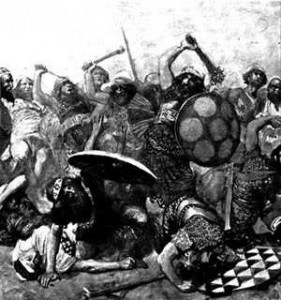
    In a recent Conference at Notre Dame Alvin Plantinga suggested that the commands to wipe out the Canaanites, recorded in the book of Deuteronomy, might be hyperbolic; they should be understood more like how we understand a person who states, in the context of a boxing match, “knock his block off, hand him his head”, or in a football game where a person states that the team should “kill the opposition” or boasts that “we totally slaughtered them.”[1] Understood this way, the commands in Deuteronomy meant “something like attack them, defeat them, drive them out; not literally kill every man, woman, child donkey and the like”.[2]

    In two previous posts I have explored and defended Nicholas Wolterstorff’s argument for this conclusion. In God and the Genocide of the Canaanites Part I: Wolterstorff’s Argument for the Hagiographic Hyperbolic Interpretation, I elaborated on, appropriated and expanded Nicholas Wolterstorff’s case for understanding Joshua as a hagiographic, stylised and highly hyperbolic account of Israel’s early skirmishes. In Part II: Ancient Near Eastern Conquest Accounts, I argued that studies into Ancient Near Eastern historiography give considerable support to his conclusion. Joshua appears to follow the same rhetoric, literary conventions and motifs of other ancient Near East conquest accounts and one feature of such accounts is to narrate victories hyperbolically in terms of killing all people, leaving no survivors and so forth. This suggests the description of Joshua putting every inhabitant to the sword, totally destroying all and leaving no survivors, is not to be taken literally. In this last post in this series I want to look at some implications of accepting this.

    I think two implications can be drawn from this conclusion. First,

    On the assumption that Deuteronomy and Joshua are parts of the same sequence of books, this interpretation of Joshua forces a back-interpretation of Deuteronomy. If “struck down all the inhabitants with the edge of the sword” is a literary convention when used to describe Joshua’s exploits, then it is likewise a literary convention when similar words are used by Moses in his instructions to Israel in general and to Joshua in particular.[3]

    I think Wolterstorff is correct here, this interpretation of Joshua does force a back-interpretation of Deuteronomy. Deuteronomy 7:2 states “when Yahweh your God has given them up before you and you have struck them, you shall utterly destroy them”. Similarly, Deuteronomy 20:16-17 states “anything that breathes you shall not keep alive, but you shall utterly destroy them”. In Joshua 10 one sees the formulaic language of “and Yahweh gave [the city]” and they “struck it by the mouth of the sword, and its king he hath destroyed” until there were “no survivors”. The chapter is summarised with the phrase “So Joshua struck all the land, … He destroyed all that breathed”. The similar phraseology is evident.[4]

    Moreover, the book of Joshua clearly, explicitly and repeatedly identifies what Joshua did in these chapters with the command that Moses had given regarding the Canaanites in Deuteronomy.[5] If the language of “striking all the people by the sword”, “leaving no survivors”, “totally destroying”, “striking all the inhabitants with the edge of the sword”, and so on, is hyperbolic (as the evidence suggests it is) then the command cannot have been intended to be taken literally.

    This understanding of the commands in Deuteronomy also solves some other interpretative problems. Here I will mention briefly three.

    First, what God commanded regarding the Canaanites differs in various canonical books (more…)

  • Myth, Truth and Genesis 1-11

    In Naturalism Defeated, Evan Fales attacks the biblical teaching that man is made in the image of God. One reason he gives is, “How seriously, then, should one take the testimony of Genesis 1:26-27? … There is the generally mythical character of Genesis; many of the themes in the first 11 chapters are borrowed from, or influenced by, the myths of other ancient Near Eastern cultures.”[1]

    Fales’ reasoning here is not uncommon. He argues that what Genesis teaches is false because Genesis 1-11 is a myth. The latter claim he substantiates by comparing the early chapters of Genesis to various Ancient Near Eastern texts which we know to be myths. Fales contends that a comparison of the texts in question leads to the conclusion Genesis is a myth and hence what it teaches lacks authority.

    In this post I want to address one aspect of this argument. The key premise I want to contest is that if Genesis is a myth and of the same genre as Ancient Near-Eastern myths then what it teaches lacks authority. Note this is a conditional claim: I am arguing that if Genesis 1-11 is mythic in genre then this would not necessarily entail that the text lacks authority. I am not, in this post, committing myself to any claim that Genesis is mythic; I am simply asking what follows if it is.

    As a way of entering this question let me start by summarising a debate between two evangelical scholars, both of whom affirm biblical inerrancy. In Inspiration and Incarnation, Peter Enns compares the story of creation, fall, flood and Babel in Genesis 1-11 to various Ancient Near-Eastern texts such as Enuma Elish, The Gilgamesh Epic, Atrahasis Epic, the Sumerian Flood Story and the Sumerian King Lists. Enns argues that:

    (a) these writings appear to be earlier than Genesis; and,
    (b) the latter four in particular contain obvious parallels to Genesis that cannot be mere coincidence; and,
    (c) these texts are myths.

    In light of this, Enns argues that Genesis must be understood as a myth.

    When Enns says Genesis is a myth it is important to not misunderstand his meaning here. In contemporary English the word myth is often a colloquial term for a falsehood, so that calling something a myth means it is false. In Enns’ use of the term the word ‘myth’ refers to a particular kind of genre, “myth is an ancient, pre-modern, pre-scientific way of addressing ultimate meaning and origins in the form of stories: Who are we ? Where do we come from ?”[2] Hence, by saying Genesis is a myth Enns is not committing himself to the claim that the text is false.

    However, later in the same book Enns goes on to state that “the biblical account, along with its ancient Near Eastern counterparts assumes the factual nature of what it reports. They did not think, “We know this is all ‘myth’ but we will have to wait until science is invented to give us better answers.”[3] He suggests that while the text is myth, its original hearers would probably not have distinguished myth from what we would call an historical narrative.

    It is worth noting that Enns is not alone in this kind of assessment. Drawing on the same literary parallels, Gordon Wenham has argued that the author of Genesis 1-11 was retelling stories that were well known in Babylonian culture. However, the author was transforming them to make a radically different theological point. These  points, in fact, repudiate and at times ridicule, the very teachings the Babylonian myths  were trying to teach.

    Like Enns, Wenham notes several important parallels between Gen 1-11 and Ancient Near-Eastern myths and legends to substantiate this point. Wenham suggests that in retelling the Babylonian myths to make theological counter points the authors assumed or took for granted, the historicity of the folk stories in question. In The Erosion of Inerrancy in Evangelicalism, Greg Beale responds to Enns’ suggestion, “But Enns is saying more than this: the biblical writers thought they were recording history but were really recording myth … Thus one ends up with a completely inspired bible  in which the narrators recorded what they thought was history, but we know they are wrong. This is tantamount to saying the biblical writers made mistakes.”[4]

    Beale goes on to state that Enns sees Genesis as “a genre of divine accommodation,  whereby God knew better but the Israelite writers did not. They thought they were writing true history, but God knew they were not. In this respect has Enns formulated a new version of sensus plenor?”[5]

    I think Beale is correct; Enns’ position does commit him to the claim that the biblical authors made mistakes. However, I think the conclusion he tries to draw, that this claim compromises the authority of scripture is too quick. It is worth noting that Enns claimed that the biblical writers assumed the factual nature of what they reported. He explicitly states also that the genre of myth uses stories to teach answers to certain theological and existential questions.  For example, questions regarding ultimate meaning and origins, such things as, who are we? where do we come from? and so on. Hence while Enns position accords errors to what biblical writers assumed, it does not necessarily entail that what the text teaches is erroneous. This may sound like a minor technical point but I am inclined to think it is important.

    An example might help to illustrate this point. Let’s take as an example the well known story of  the boy who cried wolf. This story, on the face of it, is simply a description of a shepherd boy who was killed after giving false alarms about wolves. Taken in a straight-forward, literal fashion it appears to relay an historical event. Now most people recognise that this story is not designed to teach us an historical event, those who retell this story do so to make a moral point about the dangers and pitfalls of repeatedly lying. The story is a powerful and graphic way of teaching this point and gives the point a vividness and power that the mere claim “don’t lie” does not have.  It is also clear, I think, that no one would consider what this story teaches to be false if it was discovered the events the story described never happened (which they probably did not). This is because once the genre of the text is realised, it is evident that the text does not teach that the events happened and if it does not teach that they happened then the fact that they did not cannot render what it teaches as false.

    Now, let me provide a hypothetical situation. Suppose I was researching the origins of the story of the boy who cried wolf and I discovered that at some point in the past a person heard this story and believed it to be literally true, the person believed that the events actually happened. Suppose this person was also struck by the fact that these events provided a powerful illustration of the dangers of lying and issuing false reports so much so that this person began using this story to teach about the dangers of lying. Suppose that this person’s pedagogy caught on and the story entered into cultural consciousness and that those people who heard and retold the story also believed it actually happened. Would this discovery lead us to conclude that what the story teaches is false? Again it seems clear to me that it would not. This is because whatever the original teller believed about the story, what the story teaches remains true. The original teller may have all sorts of beliefs about what was authored but unless the story was actually used to teach each of these beliefs the story is not discredited by any finding to the effect that these beliefs are false. The story of the boy who cries wolf teaches us about lying it does not teach (nor does it purport to teach us) an historical event. As such, it is shown to be false only if someone can show us that what it says about lying is false.

    It is important to see the limitations of this illustration. I am not arguing that Genesis 1-11 should be construed as a fable in the vein of the story of the boy who cried wolf – I think Genesis  is clearly not a fable – the point I am making is that there is a distinction between what a person assumes about a story when they tell it and what the story actually teaches. Even if a person falsely assumes the factual accuracy of the events in a story or narrative as true then that does not entail that what the text teaches is untrue. The example of the boy who cries wolf shows that with some genres the truth of what is taught stands whether or not the story used to teach this truth is historically accurate. Even if we grant that Genesis is myth or folklore, it does not follow that what it teaches is false.


    [1] Evan Fales “Darwin’s Doubt, Calvin’s Calvary” in James Beilby Naturalism Defeated? Essays on Plantinga’s Evolutionary Argument Against Naturalism (Ithaca: Cornell University Press, 2000) 55.
    [2] Peter Enns  Inspiration and Incarnation: Evangelicals and the Problem of the Old Testament (Grand Rapids MI : Baker Books, 2005) 50.
    [3] Ibid 55.
    [4] Greg Beale The Erosion of Inerrancy in Evangelicalism: Responding to New Challenges to Biblical Authority (Wheaton Ill: Crossway Books, 2008) 69.
    [5] Ibid.

  • Capital Punishment in the Old Testament: 2

    In Capital Punishment in the Old Testament: 1 I suggested that the capital sanctions found in The Torah in most cases were not intended to be carried out, that instead there operated an implicit assumption that a person who committed a serious crime had forfeited their life and hence was to pay a ransom as decided by the courts as a substitute. One area where this claim seems to make particular sense is in the laws governing adultery that occur in the book of Deuteronomy.

    In the article I cited in the previous post, David Brink, addresses Deuteronomy 22: 13-21. Brink claims this teaches “that the community can and should stone to death any women whose husband finds she was not a virgin on her wedding night.”

    I’ll start with two minor points. First, Brink assumes that this is addressed to “the community,” by which I assume he means contemporary communities. This is false; it is addressed to ancient Israel’s community as any reading of the opening chapters of Deuteronomy clearly show. How The Mosaic Law relates to contemporary Christians is a detailed and vexed topic of biblical hermenutics yet Brink ignores the issues and simply assumes that it addresses us directly.

    Second, this text deals with adultery and not pre-marital sex. As Gordon Wenham notes pre-marital sex is addressed a few lines later in Deuteronomy 22: 28-29.[1] Wenham notes that the case Brink cites (Dt 22:13-21) deals with adultery.[2] In ANE law, betrothal was considered a binding marriage; women were betrothed young and often some time before they consummated the marriage. This case deals with betrothed women who after betrothal and prior to consummation has sex with a third party. As I note in footnote 15, this is a minor point. I am sure Brink is not allayed by the fact that she is to be executed for adultery as opposed to pre-marital sex, his problem is clearly execution related; that said, it is important that one not exaggerate what the text says.

    Third, as I argued in Part I, when The Torah prescribes that a person be executed, the implict assumption is that this will not be carried out but some lesser financial penalty will be inflicted as a ransom. This seems to be borne out by an examination of this law.

    Brink refers to Deuteronomy 22:13-21, in particular “if … the charge is true and no proof of the girl’s virginity can be found … the men of her town shall stone her to death.” What Brink does not focus on is the sentence if the charges prove to be false; if the husband is simply slandering his bride. In this instance the husband suffers three penalties, first he is subjected to some unspecified punishment which would be at the discretion of the court. It is clear that this is not execution because the text assumes that he will continue to be married to the women in the future. Second the husband shall pay “100 shekels of silver” to the father and lose his right to divorce. Wenham explains the rationale for this price:

    The husband claims that by giving him a dud wife (for his 50 shekels) his father in law had in effect stolen the sum from him. Two legal principles are therefore applicable those dealing with theft and false witness. The penalty for theft of deposited property is double restitution according to Ex xii7. But according to Deut xix19 and other ancient near eastern laws false witnesses were punished with the punishment the accused would have suffered if substantiated”[3]

    This explains the 100 shekels; the problem is that it raises an issue which Wenham is aware of. “[A]ccording to Deut xix19 false witnesses were punished with the punishment the accused would have suffered if substantiated.” If this law meant that substantiation of the husband’s accusation would actually result in the execution of his wife then the failure to substantiate his claim would mean that the husband would be executed, but he is not. Apart from the fine to the father, his other punishment is an unspecified punishment (which is not execution) and loss of his right to divorce. It appears then that the actual execution of the woman was not envisaged. Wenham suggests then a substitute must have been envisaged in this text if it was to be read as coherent and consistent with the other laws in Deuteronomy.

    This conclusion seems to be strengthened by several other passages that deal with the same topic. Two chapters later, Deuteronomy 24:1-5, The Torah deals with a case where a man divorces his wife, “who becomes displeasing to him because he finds something indecent about her.” This same passage is cited by Jesus in the synoptic gospels. David Instone-Brewer has argued, convincingly, that the reference to “something indecent” is interpreted by Christ as referring to adultery.[4] This passage then deals with the same situation as Deuteronomy 24; the text tells us she is divorced and by implication loses her mohar money but is silent on any other punishment. However, the woman is clearly not executed as she marries another man in v 2. This makes sense if the capital sanctions for adultery function as admonitory devices and in practice, a ransom was made as a substitute (possibly alongside a lesser sentence) but it does not make sense if a women who was discovered to have committed adultery by her husband was required to be executed.

    A similar picture emerges in a second passage Wenham cites. In the book of proverbs the author warns his son about adultery and refers to the judicial consequences that will ensue if he does not heed this warning.[5] It is clear that a ransom substitute is envisaged, moreover, it suggests that if the husband refuses to accept a ransom payment the adulterer will suffer blows and disgrace, note that execution is not envisaged. In fact, the discussions in Proverbs suggest the consequences will be financial loss and social ostracism. This all makes sense on the hypothesis mentioned in Part 1 but does not make sense if adultery was in fact punished by death. Wenham notes this point and draws the conclusion that in Deuteronomy 22:13-21 the law envisaged a substitute.

    In conclusion, sceptics like David Brink often cite passages like Deuteronomy 22:13-21 in horror to discredit Christianity. However, they erroneously assume superficial literalistic renditions of the passages in question. In this instance, the genre of the passage, in light of the common ANE legal practices and customs suggests that capital sanctions function as a kind of hyperbole and in practice a ransom was paid and the punishment mitigated.

    This practice is implicitly assumed in many of the Old Testament laws about homicide. Further, reading it this way renders the laws in Deuteronomy consistent with each other and with the reference to adultery in the book of Proverbs. I will add finally, that it also coheres better with our moral intuitions in the way a literalistic reading does not.

    [1] In “Bethulah: A Girl of Marriageable Age,” Vetus Testamentum 22 (1972) 326-348, Gordon Wenham points out that the same law is also spelled out in Exodus 22:15 and it is treated as a relatively minor offense; the penalty is simply that the man must pay the “mohar” to the bride’s father. A mohar was security money (50 shekels) that the groom paid to the bride’s father. It was held in trust for the woman in case the man later abandoned her or divorced her without just cause. See the discussion in David Instone Brewer Divorce and Remarriage in the Bible: The Social and Literary Context (Grand Rapids: Eerdmans, 2002).
    [2] Wenham “Bethulah: A Girl of Marriageable Age.”
    [3] Ibid 332.
    [4] Brewer
    Divorce and Remarriage in the Bible.
    [5] Proverbs 6.


    RELATED POSTS:
    Capital Punishment in the Old Testament: 1