Tag: Theology

  • Randal Rauser’s Mistake: A Defense of Calvin’s Doctrine of Election

    John CalvinThanks go to Matthew Flannagan for pointing me in the direction of this response to the problem.

    A while back Professor Randal Rauser issued a blog entitled “Calvinism and the Arbitrary Camp Director” in which he criticised the Calvinist understanding of election.

    For those of you who are unaware of the Calvinistic understanding of election, very roughly, it’s the idea is that God elected some for salvation and did not elect others for salvation. Now obviously there’s FAR more to Calvin’s doctrine of election than merely the claim that some are elected and others are not. But that at least, is the centre point of Rauser’s criticism, and more particularly, it’s that element of Calvin’s doctrine that I seek to defend in this article.

    Before we begin, it’s interesting to note that barely three months ago I was a staunch Arminian when it came to soteriology. I reacted against Calvin’s doctrine with the greatest of revulsion. How could it possibly be, I thought, that God could be “good” and yet actively choose some for salvation while leaving others to die?! It made no sense to me! In-fact, I remember going to scripture one Sunday morning actively seeking to find that knock down scriptural blow against the Reformed understanding of election. Interestingly, the first scripture I read was the parable of the wheat and the tares Matthew 13:24-29/13:36-43. While I read it, it struck me that this challenged my Arminian understanding of Salvation. But I didn’t want to believe it, so I left it for a week hoping that there would be some other explanation. But none was forthcoming. Very quickly I found myself speaking in terms that a week earlier I would never have been revolted to hear myself say. I was not yet a practicing Calvinist. I was what you might call “soteriologically agnostic”.

    Now the reason I say this is not because I hope to establish myself as any authority on the matter. To the contrary, Rauser, being a Professor of Historical Theology at Taylor Seminary is far more of an authority on the matter than I can hope to be at this stage of my life. So it’s with much fear and trepidation that I dare post this article contradicting Rauser’s arguments. So why do I give my testimony of how I came to Calvinism? Well I myself am a little unsure. Nevertheless, I suspect that the main reason I give such testimony is that I find it and irony worth sharing that I am writing an article that barely three months ago I would never have even dreamed of writing. If I was going to write anything, it would have been about how Calvinism completely destroys any sensible understanding of God’s justice and love.

    But now let’s get down to business. Precisely what is Rauser’s objection? More than anything else, it appears to be a moral objection. The problem, Rauser urges, is that it makes God’s choice about who save entirely arbitrary. Why, he asks (referring to one of his dialectic opponents apparently named Tom) should God bring glory to him (Tom) and not another say Saddam Hussein? This picture, Rauser asserts, completely undermines the idea that God is loving. In order help us to see this point. Rauser entreats us to consider the following illustrative analogy:

    Randal Rauser“Imagine that there is a camp for troubled youth. The camp director has a rather unorthodox method of dealing with the campers. Some of them are beaten severely with whips in a wholly punitive or retributive (i.e. not restorative) manner while others are chosen by the director to receive care, love and nurture in a way that restores them.

    You are contemplating sending your child to the camp but you want your child to be lovingly restored, not viciously beaten, even if the beatings are just. So you enquire: what is it that makes the director decide to beat the children rather than nurture them? Is it the nature of their crimes? Their race? Gender? What?

    The answer comes back. There is (more…)

  • Tim McGrew’s Library of Historical Apologetics: Rediscovering Forgotten Defenders of the Faith

    Last year Timothy McGrew, Professor of Philosophy at Western Michigan University (and reader of and occasional commenter on this blog) was kind enough to ship us a hard-drive from the US filled with thousands of old theological works on the historical argument for the truth of Christianity. It is truly a gold-mine of information, which Matt gets himself routinely lost in and for which visitors to our home have been known to arrive carrying their own portable hard drives so as take away a copy.

    Library of Historical Apologetics

    At the time Tim told us he was aiming to get this material online so that everyone could access it. Along with his advisory board of William Lane Craig, Gary Habermas, Craig Hazen, Robert Stewart, it seems he has made some progress as the Library of Historical Apologetics is now live and open for browsing and is really worth checking out.

    Paraphrasing and splicing bits together from the Collection page:

    The collection contains both one of the world’s largest catalogs of works in historical apologetics, the branch of apologetics dealing with the authenticity and credibility of the scriptures and particularly of the New Testament. The authors come from various denominational and educational backgrounds and would not agree with each other on all points of theology. Some are profound works of research and scholarship; others are brief works addressed to a non-specialist audience. But each makes a distinctive contribution to the literature of historical apologetics.

    In addition to the library, the site features:

    • Annotated Bibliography: Short descriptions of selected works.
    • Spotlight Articles: Published monthly, these two page articles describe an author, book or apologetic theme [Very cool!]
    • Quotation of the Week: Significant and pithy excerpts that make a poignant point and illustrate the subject matter of a particular author.

    All works available at the library are in English and are part of the public domain.

    HT Tim McGrew

  • Contra Mundum: Slavery and the Old Testament

    “Why didn’t the Christian God ever explicitly and clearly condemn slavery?” This was John Loftus’ question in his book, Why I Became an Atheist: A Former Preacher Rejects Christianity. He posed it after sharing the following chilling account of slavery as practiced in the antebellum American south,

    He took her into the kitchen, and stripped her from neck to waist. He made her get upon the stool, and he tied her hands to a hook in the joist. After rolling up his sleeves, he commenced to lay on the heavy cow skin, and soon the warm, red blood came dripping to the floor … No words, no tears, no prayers, from his gory victim, seemed to move his iron heart from its bloody purpose. The louder she screamed, the harder he whipped; and where the blood ran fastest, there he whipped longest. He would whip her to make her scream, and whip her to make her hush; and not until overcome by fatigue, would he cease to swing the blood clotted cowskin.

    Loftus is not alone, it is often affirmed as an incontestable and obvious truth that the Bible supports slavery. Atheist philosopher Walter Armstrong substantiated this accusation with a citation from the book of Leviticus, “as for your male and female slaves whom you may have: you may buy male and female slaves from among the nations around you” (Lev 25:44 ESV).

    The ESV here uses the English word ‘slave’ to translate the Hebrew word ebed. The problem is that it is not at all clear that these two terms are analogous. In 1690 philosopher John Locke argued that an examination of the Old Testament’s references to an ebed shows that it is not the equivalent what we think of when we hear the term ‘slave.’ Locke is only one of many scholars who have come to the same conclusion.

    The Oxford Dictionary defines a slave as a “person who is the legal property of another or others and is bound to absolute obedience, human chattel.” Rodney Stark utilises a similar definition, “A slave is a human being who, in the eyes of the law and custom, is the possession, or chattel, of another human being or of a small group of human beings. Ownership of slaves entails absolute control, including the right to punish (often including the right to kill), to direct behavior, and to transfer ownership.” Timothy Keller astutely observes that the English term ‘slave’ carries connotations of new-world slavery as it was practiced in the British Empire and made infamous in the antebellum southern states of the US.

    In the British Empire and in many US states, slavery was governed under the Code of Barbados. This code was explicitly racist and described Africans as “heathenish, brutish, and an uncertaine, dangerous kinde of people.” It allowed owners to use, “unlimited force to compel labor without penalty even if this resulted in maiming or death.” It denied slaves due process rights and permitted owners to, in effect, kill their slave for any cause. It forbade slaves from marrying. It effectively prevented owners from setting their slaves free. Keller writes that, “The African slave trade was begun and resourced through kidnapping.” Stark notes that “20 to 40 percent of slaves died while being transported to the coast, another 3-10 percent died while waiting on the coast, and about 12 to 16 percent boarded on ships died during the voyage.”

    However, what the Old Testament refers to differs from slavery, so understood, in several important respects.

    First, an ebed was not acquired by kidnapping. Kidnapping a human being and selling that person as a slave was a capital offence in the Old Testament (Ex 21:16). Moreover, slave trading is implicitly condemned in the book of Revelation (Rev 18:13) and explicitly condemned by Paul as contrary to the law and sound doctrine (1 Tim 1:9-10).

    In the Old Testament an ebed was usually person who offered to work for another, free of charge, in exchange for a debt being cancelled. It resembled a form of indentured servitude.

    Second, the institution was not based on notions that ebed were of an inferior race. In fact, the opposite is affirmed. In the book of Job we read,

    If I have rejected the cause of my male or female slaves [Hebrew: ebed amah] when they brought a complaint against me; what then shall I do when God rises up? When he makes inquiry, what shall I answer him? Did not he who made me in the womb make them? And did not one fashion us in the womb? (Job 31:13-15)

    Here Job refers to an ebed as having a right to go to court and sue his or her “owner” in pursuit of his or her rights. Job bases this on the idea that both he and his ebed are equal, both are created by God.

    Third, as Locke noted, an ebed was not the property of another and could not be disposed of. To deliberately kill an ebed was a capital offence (Ex 21:20-21). Similarly, it was illegal to strike an ebed (Ex 21:26-27).

    However, some dispute this latter point on the basis of Exodus 21:20-21,

    If a man beats his male or female slave with a rod and the slave dies as a direct result, he must be punished, but he is not to be punished if the slave gets up after a day or two, since the slave is his property.

    Some interpret this passage to mean that because a “slave” is the property of another they can severely beat the slave and providing the beating is not fatal, there is no legal punishment. However, this fails to deal adequately with the context and the Hebrew text, the word translated as ‘property’ here is actually ‘silver’ (a reference to money) and the word translated ‘punishment’ here is not the usual word for punishment.

    Old Testament scholar Christopher Wright notes that the word implies “the shedding of the blood of the master of the slave” and so refers to capital punishment. It is used in direct contrast with the same word in the previous verse where it is stated that deliberately killing an ebed is to be avenged. Therefore, it does not say the person will not be punished for beating a slave, it says he will not be executed for it unless he kills the slave. For further evidence that the passage is not a license to beat, a couple of verses later even causing a minor injury on an ebed, such as a bruise, is explicitly condemned. The same contrast occurs in the passage immediately preceding where a free man who struck and killed another was to be “held responsible” but not if the person survived. It is clear, however, that the person was in fact to be legally punished as v 19 states he had to compensate his victim for the injury. Hence, in context the ‘held responsible’ is referring only to being held responsible for murder and is not speaking to the lesser charges of assault. What Ex 21:20-21 says then, is that if a person deliberately kills his or her ebed then that person is to be held responsible for murder and executed. If the slave “gets up after a day or two,” then the person is not to be held responsible for murder because the ebed is his or her “silver.”

    This makes sense as a few verses later, in Ex 21:26-27, striking a slave is explicitly prohibited and the legal punishment is for the ebed to go free. In The Old Testament, the penalty for assault was for the assailant to provide monetary compensation to the victim. This would create a quandary in this case as an ebed is in a position of servitude because he or she is in debt to the person he or she works for. In such a case the assailant would owe money to a person who owes him or her money. The Old Testament resolves the issue by declaring that even a trivial strike, such as causing a bruise (v21:25) should result in an immediate cancelation of the ebed’s entire debt, which would often result in a financial loss to the assailant. The New Testament similarly concurs, prohibiting “masters’ from even threatening their “slaves” (Eph 6:9) and to treat their “slaves” the way the “slave” is required to treat them.

    Further, unlike new-world slavery which was life long and where, under the Barbados Code, emancipation was effectively prohibited, an ebed could not be held in service for more than six years (Ex 21:2). Upon release, their employer was morally required to give them sufficient resources for them to be set up on their own feet (Deut 15:12-18) and the community left resources for them to live on for a year (Ex 23:10-11, Lev 25:2-7).

    These passages are often thought to refer only to Hebrew and hence Jewish slaves. Wright, however, argues that that in its original context the key word ibri designated a social class, not an ethnic group. This was the class of people who did not own land and in an agrarian economy survived by hiring themselves out to land owners.

    In fact, in the passage immediately before the verse Armstrong cites the Old Testament forbids any Israelite taking another Israelite as a ebed on the grounds that they are a “ebed of God” whom God has redeemed. Paul applies the same teaching to Christians prohibiting Christians from being sold as ‘slaves’ (1 Cor 7:23). Similarly, the Old Testament commanded people to prevent family members from becoming an ebed by paying their debts for them (Lev 25:48). Further, Paul, after writing to the Corinthians and encouraging them to “retain the place in life that the Lord assigned,” encourages slaves to purchase their freedom and to not remain in this position if it was possible to do so (1 Cor 7:21-22).

    Finally, if an ebed fled from an oppressive employer it was illegal to return him or her to “his master.” Instead, he or she was to live “wherever he likes and in whatever town he chooses” (Deut 23:15-16). It was forbidden to send an ebed back to his or her owner; contrast this with the practice in the antebellum south, the Fugitive Slave Act 1850 required the return of run-away slaves at penalty of law.

    Contrary to what some contend, the Old Testament does not permit slavery. It is more accurate to say it tolerates indentured servitude under certain situations; the paradigm being where the servitude is voluntary, temporary, is done in exchange for payment of a debt where the alternative is starvation and destitution and only in situations where the servant is given the same basic legal rights as everyone else and is protected from abusive treatment. To suggest this picture fits with the opening quote above is a stretch to say the least.

    I write a monthly column for Investigate Magazine entitled Contra Mundum. This blog post was published in the April 10 issue and is reproduced here with permission. Contra Mundum is Latin for ‘against the world;’ the phrase is usually attributed to Athanasius who was exiled for defending Christian orthodoxy.

    Letters to the editor should be sent to: editorial@investigatemagazine.DELETE.com

    RELATED POSTS:
    Contra Mundum: Secular Smoke Screens and Plato’s Euthyphro

    Contra Mundum: What’s Wrong with Imposing your Beliefs onto Others?
    Contra Mundum: God, Proof and Faith
    Contra Mundum: “Bigoted Fundamentalist” as Orwellian Double-Speak
    Contra Mundum: The Flat-Earth Myth
    Contra Mundum: Confessions of an Anti-Choice Fanatic
    Contra Mundum: The Judgmental Jesus

  • Sunday Study: Joshua and the Genocide of the Canaanites Part I

    Critics of Christianity often claim that the book of Joshua teaches that God commanded genocide. Raymond Bradley for example states,

    In chapters 7 through 12, [the book of Joshua] treats us to a chilling chronicle of the 31 kingdoms, and all the cities therein, that fell victim to Joshua’s, and God’s, genocidal policies. Time and again we read the phrases “he utterly destroyed every person who was in it,” “he left no survivor,” and “there was no one left who breathed.”[1]

    Similarly, Walter Sinnott-Armstrong cites passages in Joshua with the same point in mind.[2]

    The objection that Bradley and Armstrong raise in highlighting these passages is that Christians are committed to an inconsistent set of propositions.

    [1] Any act that God commands is morally permissible.
    [2] The scriptures are an authoritative revelation of God’s commands.
    [3] It is morally impermissible for anyone to commit genocide.
    [4] According to the book of Joshua, God commanded Israel to commit genocide.

    If we are to rationally affirm both [1] and [2] then we must give up either [3] or [4]. So which one should we reject?

    Philip Quinn has developed a way of addressing clashes such as this. He suggests that we can draw on a principle whereby “whenever two conflicting claims differ in epistemic status, the claim with the lower epistemic status is to be rejected.”

    [3]Given this approach, if a particular interpretation of any passage conflicts with one of our moral intuitions then we should ask whether or not the case for that interpretation is as convincing as the principle that it clashes with. Now, the principle that genocide is wrong is, I think, a highly plausible one. Therefore, if one is to prefer [3] to [4] then the case for a literal reading must at least be this plausible, and preferably even more plausible. In this series of posts I will argue, perhaps surprisingly to some, that [4] is doubtful. While it is true that taken in isolation and interpreted in a strict literal fashion the book of Joshua does appear to state that God commanded Genocide, I contend that when the text is read in its literary and textual context this conclusion is far from evident and is, in fact, rather questionable.

    In the tenth chapter of the book of Joshua we read,

    They [Joshua and his troops] took the city, its king and its villages, and put them to the sword. Everyone in it they totally destroyed. They left no survivors. They did to Debir and its king as they had done to Libnah and its king and to Hebron. So Joshua subdued the whole region, including the hill country, the Negev, the western foothills and the mountain slopes, together with all their kings. He left no survivors. He totally destroyed all who breathed, just as the LORD, the God of Israel, had commanded. Joshua subdued them from Kadesh Barnea to Gaza and from the whole region of Goshen to Gibeon. (Joshua 10:39-41)

    This text summarises Joshua’s campaign in southern Canaan. The northern campaign is summarised in a similar fashion in the following chapter,

    So Joshua took this entire land: the hill country, all the Negev, the whole region of Goshen, the western foothills, the Arabah and the mountains of Israel with their foothills, from Mount Halak, which rises toward Seir, to Baal Gad in the Valley of Lebanon below Mount Hermon. He captured all their kings and struck them down, putting them to death. Joshua waged war against all these kings for a long time. Except for the Hivites living in Gibeon, not one city made a treaty of peace with the Israelites, who took them all in battle. For it was the LORD himself who hardened their hearts to wage war against Israel, so that he might destroy them totally, exterminating them without mercy, as the LORD had commanded Moses. At that time Joshua came and wiped out the Anakim from the hill country, from Hebron, from Debir, from Anab, and from all the hill country of Judah, and from all the hill country of Israel; Joshua utterly destroyed them with their towns. No Anakites were left in Israelite territory; only in Gaza, Gath and Ashdod did any survive. So Joshua took the entire land, just as the LORD had directed Moses, and he gave it as an inheritance to Israel according to their tribal divisions. Then the land had rest from war. (Joshua 11:16-23)

    If these passages are taken in a strict literal fashion and read in isolation from the proceeding narrative they record the divinely authorised commission of genocide. Taken literally these passages state three things.

    Firstly, that Joshua conquered and subdued the entire regions of southern and northern Canaan. Verse 11:23 states that “Joshua took the entire land” and then “gave it as an inheritance to Israel according to their tribal divisions.” This suggests that the region in question is the same land that is later divided between the Israelite tribes, which was the entire land of Canaan.

    Secondly, the passage repeatedly emphasises that Joshua exterminated all the Canaanites in this region. Verse 11:21 states “Joshua came and wiped out the Anakim from the hill country, from Hebron, from Debir, from Anab, and from all the hill country of Judah.” Verse 11:22 states that no Anakites were left living in Israeli territory after this campaign.  Repeatedly it states that Joshua left “no survivors” and “destroyed everything that breathed” in “the entire land.” Alongside these general claims the text goes to identifies several specific places and cities where Joshua exterminated everyone and left no survivors and killed all who breathed. These include Hebron, Debir, the hill country and the Negev.

    Thirdly, the text states that God commanded these actions. Verse 23 identifies the commands with those laid down in the Law of Moses, which refers back to passages like Deut 20:16-19 and Deut 7.1-5.

    The first thing I want to note is that the text should not be read in isolation from the narrative in which this occurs. This hermeneutical point may seem rather obvious but when it is taken seriously immediate and obvious problems occur with a strictly literal reading of the ‘genocide passages’ I mention above. The most glaringly obvious issue relates to the opening of the book of Judges. In the first chapter of Judges we read of events that occurred after the death of Joshua (and, hence, after the campaigns mentioned in Josh 10 and 11). Here it is explicitly stated that Canaanites are living in the land which had been allotted to various Israeli tribes, the land that Joshua is said to have conquered and “left no survivors” in. Note that this was not a small remnant. They existed in such numbers that each of the tribes of Israel needed to fight in order to dislodge them from the land. Several of the tribes were unable to do so and so Israel failed to dislodge them.

    Of particular interest, however, are the several cities and regions mentioned. In the first chapter we are told that the Canaanites lived Gaza (Judg 1:18), the Negev (1:9), in the hill country  (Judg 1:9) in Debir (Judg 1:11), in Hebron (Judg 1:10) and in the the western foothills (Judg 1:9). Moreover, they did so in such numbers and strength that they had to be driven out by force. These are the same cities that Joshua 10 tells us Joshua had annihilated and left no survivors in.  Moreover, the text explicitly states that Anakites are in Hebron, yet Joshua 11:22 tells us that “No Anakites were left in Israelite territory.” This seems rather odd if Joshua had exterminated everyone there and left no survivors. It is also odd given that Joshua is said, in the genocide passages, to have conquered and subdued the entire region.

    Moreover, the account of what God commanded also differs in Judges 2:1. Here no mention of genocide or annihilation is made, instead we hear of how God had promised to drive them out and has commanded the Israelites to not to make treaties with them and to destroy their shrines. Taken in a straight-forward literal manner then, Joshua’s actions are at odds with the first two chapters of Judges.

    It is not just Judges that this problem occurs in. There are numerous places within the book of Joshua itself where the same picture is presented. As noted, Joshua 11 ends by stating that “the entire land, just as the LORD had directed Moses” was given “as an inheritance to Israel according to their tribal divisions.” When the text turns to giving an account of these tribal divisions it is evident that the Israelites do not actually occupy it, but living, breathing, Canaanites do.

    The allotments begin with God telling Joshua, “You are very old, and there are still very large areas of land to be taken over” (Josh 13:1). Moreover, when one examines the allotment given to Judah we see Caleb asking permission to drive the  Anakites (Josh14: 11) from the hill countries and we also hear how Caleb has to defeat Anakites living in Hebron and, after this, marches against the people “living in Debir” (Josh 15:13-19). Similarly it is evident with several of the other allotments that the people have yet to drive Canaanites entrenched in the area and that Israelites were not always successful in doing so.

    We read, for example, that Ephraimites and Manassites “did not dislodge the Canaanites living in Gezer; to this day the Canaanites live among the people of Ephraim” (Josh 16:10). Similarly, in Chapter 17 it states “Yet the Manassites were not able to occupy these towns, for the Canaanites were determined to live in that region. However, when the Israelites grew stronger, they subjected the Canaanites to forced labor but did not drive them out completely” (Joshua 17:12-13). We hear that “Danites had difficulty taking possession of their territory, so they went up and attacked Leshem, took it, put it to the sword and occupied it. They settled in Leshem and named it Dan after their forefather” (Joshua 19:47). Here, we see the same land said to be subdued and conquered by Joshua in battles where he exterminated and left alive nothing that breathed. This land is yet to be occupied by the tribes of Israel and is occupied by Canaanites, often heavily armed and deeply entrenched (17:17-18).

    Brevard Childs notes the apparent contradiction,

    Critical scholars have long since pointed out the tension – usually it is called a contradiction – in the portrayal of the conquest of the land. On the one hand, the conquest is pictured in the main source of Josh. 1-12 as a unified assault against the inhabitants of the land under the leadership of Joshua which succeeded in conquering the entire land. On the other hand, there is a conflicting view of the conquest represented by Judges 1 and its parallels in Joshua which appears to picture the conquest as undertaken by individual tribes, extending over a long period beyond the age of Joshua, and unsuccessful in driving out the Canaanites from much of the land.[4]

    More recently Kenneth Kitchen has taken issue with Childs’ picture of Joshua 1-12. He notes that, apart from the passages cited at the beginning of this post, a careful reading of Joshua 1-12 makes it clear that Israel did not actually occupy or conquer the areas mentioned at all. Kitchen notes that after crossing the Jordan the Israelites set up camp in Gilgal “on the east border of Jericho” (Joshua 4:19). He notes that after every battle in the next six chapters the text explicitly states that they returned to Gilgal,

    The conflict with Canaanite city-state rulers in the southern part of Canaan is worth close examination. After the battle for Gibeon, we see the Hebrews advancing upon six towns in order, attacking and capturing them, killing their local kings and such inhabitants that had not gotten clear, and moving on, not holding on to those places. Twice over (10:15, 43), it is clearly stated that their strike force returned to base camp at Gilgal.  So there was no sweeping take over and occupation of this region at this point. And no total destruction of the towns attacked.[5]

    Kitchen goes on to note,

    What happened in the south was repeated up north. Hazor was both leader and famed center for the north Canaanite kinglets. Thus as in the south the Hebrew strike force defeated the opposition; captured their towns, killed rulers and less mobile inhabitants, symbolically burned Hazor and Hazor only[6] to emphasis its end to its local supremacy. Again Israel did not attempt to immediately hold on to Galilee: they remained based at Gilgal (14:6).[7]

    Kitchen notes that the first “real indication of a move in occupation beyond Gilgal comes in 18:4.” This is after the first allotment of “lands to be occupied are made” and as we saw above the Israelites did not find occupying these allotments easy. He concludes, “these campaigns were essentially disabling raids: they were not territorial conquests with instant Hebrew occupation. The text is very clear about this.”[8]

    So a straight-forward, literal, reading of the passages cited at the beginning of this post does not cohere with the rest of the narrative. The best account I have come across for explaining this apparent contradiction between a literal reading of the “genocide passages” and the rest of Joshua and Judges is one recently defended by Nicholas Wolterstorff.[9] Wolterstorff suggests that the phrases such as, “Everyone in it they totally destroyed,” “They left no survivors,” etc are not intended to be read literally but function as hyperboles. The analogy he gives is of a high school student who, after a baseball game states, “we totally slaughtered the opposition, we annihilated them just as coach told us to.”[10]

    Plantinga suggests a similar line as a possibility. That phrases such as, “put to death men women infants and cattle” are to be understood more like a person who in the context of a boxing match states, “knock his block off, hand him his head” or  in a football or baseball game where it is stated that the team should “kill the opposition” or that “we totally slaughtered them.”[11] Understood in a non-literal sense the phrases probably meant “something like, attack them, defeat them, drive them out; not literally kill every man, woman, child donkey and the like.”[12] Wolterstorff elaborates,

    When a high-school basket ball player says his team slaughtered the other team last night he’s not asserting, literally now, that they slaughter the other team. What is he asserting? Not easy to tell. That they scored a decisive victory? Maybe, but suppose they barely eked out a win? Was he lying? Maybe not. Maybe he was speaking with a wink of the eye hyperbole. High school kids do.[13]

    In the same way,

    To say Joshua struck down all the inhabitants with the edge of the sword is a way of saying something like Israel scored a decisive victory and once you recognise the presence of hyperbole it is not even clear how decisive the victories were. Joshua did not conquer all the cities in the land nor did he slaughter all the inhabitants in the cities he did conquer. The book of Joshua does not say that he did.[14]

    In my next Sunday Study, Sunday Study: Joshua and the Genocide of the Canaanites Part II,  I will attempt to defend Wolterstorff’s position.


    [1] Raymond Bradley “A moral Argument for Atheism” Presented at the University of Western Washington, May 27, 1999, and–in a revised form–at the University of Auckland, September 29, 1999.
    [2] Walter Sinnott-Armstrong “Why Traditional Theism Cannot Provide an Adequate Foundation for Morality” in Is Goodness without God Good Enough: A Debate on Faith, Secularism and Ethics eds Robert K Garcia and Nathan L King (Lanham: Rowman & Littlefield Publishers, 2008) 110.
    [3]
    Philip Quinn “Religion and Politics” in ed William Mann The Blackwell Guide to Philosophy of Religion (Malden MA: Blackwell Publishing, 2005) 316.
    [4]
    Brevard Childs An Introduction to the Old Testament as Scripture (Fortress Press Philadelphia: 1979) 247.
    [5]
    Kenneth Kitchen On the Reliability of the Old Testament (Grand Rapids and Cambridge: William B. Eerdmans Publishing Company, 2003) 162.
    [6]
    See Joshua 11:13 “But Israel burned none of the towns that stood on mounds except Hazor, which Joshua did burn.”
    [7] Kitchen, above n 5.
    [8]
    Ibid.
    [9] Nicholas Wolterstorff “Reading Joshua” a paper presented to “My Ways Are Not Your Ways: The Character of the God of the Hebrew Bible” Conference at the centre for Philosophy of Religion, University of Notre Dame, Saturday 12 September 2009
    [10] Ibid.
    [11]
    Alvin Plantinga “Comments on Evan Fales’ Satanic Versus: Moral Chaos in Holy Writ” a paper presented to “My Ways Are Not Your Ways: The Character of the God of the Hebrew Bible” Conference at the centre for Philosophy of Religion, University of Notre Dame, Friday 11 September 2009.
    [12]
    Ibid – stated by Plantinga in the Q&A session.
    [13] Nicholas Wolterstorff “Response to Louise Anthony” a paper presented to “My Ways Are Not Your Ways: The Character of the God of the Hebrew Bible” Conference at the centre for Philosophy of Religion, University of Notre Dame. Saturday 12 September 2009.
    [14]
    Wolterstorff, above n 9.


    More recently Kenneth Kitchen has taken issue with Childs’ picture of Joshua 1-12. He notes that, apart from the passages cited at the beginning of this post, a careful reading of  Joshua 1-12 makes it clear that Israel did not actually occupy or conquer the areas mentioned at all. Kitchen notes that after crossing the Jordan the Israelites set up camp in Gilgal “on the east border of Jericho” (Joshua 4:19). He notes that after every battle in the next six chapters the text explicitly states that they returned to Gilgal,

    RELATED POSTS:
    Sunday Study: Joshua and the Genocide of the Canaanites Part II
  • St Matthews in the City: Progressive Irrationality

    It was a typical chilly Dunedin morning. I was standing in line at the Otago University Post Shop, about to send an important document overseas, when the student in front of me, oblivious to his audience, announced to the girl beside him “I’ve got a doll of Jesus in my car, I have tied a noose around its neck and hanged it. It’s hilarious. It really pisses those Christians off.” Laughter ensued. Now I was outwardly restrained but in my mind I contemplated a come back; it went like this, as soon as the guy had spoken I would call him an “asshole” in front of everyone in the line. When he looked bewildered and offended that a complete stranger had insulted him for no reason at all, I would respond, “What’s your problem, you just said that it was funny to insult people for no reason at all other than the fact that you find it funny to piss them off.”

    Now I did not do this, and for good reason. It is generally not a good look for a doctoral student to go around insulting other students simply because they said things about my religion that I disagreed with – people would justifiably be outraged at me and denounce me as bigoted. But, isn’t this the point?

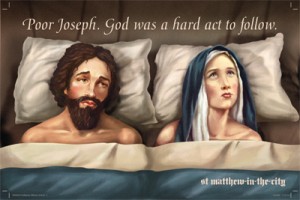
    I recalled this event this morning as I heard that the controversial Christmas billboard, put up by St Matthews in the City, has been taken down. For those outside of Auckland, St Matthews in the City is an Anglican congregation that propounds, what they like to call, “progressive Christianity.” They recently put up a billboard showing Mary and Joseph in bed, not looking too happy, with the line “poor Joseph, God was a tough act to follow.” The billboard implies quite clearly that God not only literally had sex with Mary, was a fantastic orgasmic lover but it also, by implication, entails that God committed adultery, and so did Mary.

    Mary and JosephI am glad the billboard is down (though I will not endorse the  reported method) for the obvious reason that it is insulting to other people and, prima facie, it is wrong to insult other people. Of course, there can be situations, such as where a person does something wrong, that the appropriate response is to insult them but absent such situations, charity dictates that we refrain from doing so. Millions of people world-wide worship God and millions of Roman Catholic venerate Mary, this billboard affirmed that persons they love and adore are adulterers.

    Of course some are saying that this is just a joke and we Christians should get a sense of humour. I always find this response disingenuous. Suppose I, for a joke, put a picture of the vicar of St Matthews, Glyn Cardy and his wife, outside my Church, made both of them look not so happy, and added the phrase “Glyn Cardy is as soft and floppy as his theology,” right there, in public – outside my church let’s not forget – for all to see. Would the response, ‘oh come on it’s only a joke, get a sense of humour,’ wash with anyone? I doubt it. If I were a gambler I would bet we would hear another of Cardy’s little sermons about how this is proof of the narrow-minded intolerance that non-progressive Christians like me expound. But then wouldn’t it be evident that neither Cardy nor anyone else believes that humor justifies making insulting personal comments of this nature?

    Of course in many ways this whole event shows up the intellectual shallowness that so called “progressive Christians” show towards others. Take Cardy’s justification for the billboard according to Stuff, Cardy states,

    St Matthew’s church says the aim is to provoke conversation about spiritual matters by lampooning the literal Christian conception story and inviting people to think again about what a miracle is … He said the idea behind the billboard was to move a debate that was inside the church to outside it ”and certainly people in all sorts of places are talking about it”. He didn’t doubt that some people had been offended by the billboard, but ”the literalness of a male God impregnating Mary needs to be laughed at”.

    Note two things here, first Cardy clearly caricatures the “literal conception story” yet mainstream Christendom, who believes this story, do not hold that God is literally a man and that he had sex with Mary. God in traditional theology is immaterial, he has no sex organs and the story of a virginal conception is just that, a virginal conception. Cardy, of course, being theologically trained, knows this. Second, Cardy on calling for “debate” means that people who hold orthodox Christian views “needs to be laughed at.” So Cardy’s understanding of theological debate apparently involves deliberately distorting and caricaturing the views of other people and then responding, not with reasoned argument, but ridicule.

    I might be a bit too conservative and old fashioned but in my book theological argument involves trying to understand another’s position by trying to grasp the best representative examples of it so one can articulate it accurately and then offer sound arguments or reasons for rejecting it or for showing where and why it is flawed. It also involves treating ones interlocutors with respect. Of course I do not always live up to this ideal but it is one that I think Theologians should aspire to.

    The fact that Cardy and St Matthews thinks otherwise tells us a bit about them and their “progressive Christianity.” People who think it is ok to ridicule and insult people simply because they hold a different religious perspective to them, who will dishonestly distort other’s views and responds to being challenged on this, not by reason, but by self-confident ridicule is not “progressive” and no amount of relabeling it will change this fact.

  • Auckland STAANZ Conference: Eschatology and Pneumatology UPDATED

    The Systematic Theology Association in Aotearoa New Zealand (STAANZ ) are this week holding a conference in Auckland focusing on eschatology and pneumatology.

    What: STAANZ Conference on Eschatology and Pneumatology
    When: Thursday 19 November – Friday 20 November 9:00am-5:30 pm
    Where: Ponsonby Baptist Church, 43 Jervois Rd, Auckland
    Cost: $15

    Pre-conference prayer will be held at 8:00am at All Saints in Ponsonby, 284 Ponsonby Rd, Auckland.
    Dinner at a local restaurant will be organised for the Thursday night.

    Speakers are as follows: [UPDATED]

    Thursday
    “Holy Spirit in the theology of Walter Kasper” – Hugh Bowron
    “Backgrounding Walter Kasper’s Early Thought”- John Dunn
    “Wandering between two worlds: 19th Century Reflections on Hope and Hell” – Carolyn Kelly
    “Conscious Awareness of the Spirit in Symeon the New Theologian” – Jim McInnes
    “Searching for Embers” – Susan Adams & John Salmon

    Friday
    “Abortion, Harm and Eschatology” – Matthew Flannagan
    “Infant Salvation: Is God’s Mercy Enough?” – Myk Habets
    “Participatory Glory : The Eschatological Direction of Karl Barth’s Theology of the Cross”— Rosalene Bradbury
    “The Spirit and Longing” – Judith Brown
    “Filioque, Personhood and Ecclesiology” – Scott Kirkland

    The abstract for Matt’s topic “Abortion, Harm and Eschatology” is as follows:

    In No Harm No Foul: Abortion and the Implications of Fetal Innocence Kenneth Einar Himma offers what I shall call ‘the eschatological argument for abortion rights.’ Himma argues that because a fetus lacks the mental capacity to be culpable for any sin, a plausible Christian eschatology entails that a person who kills a fetus does not actually harm the fetus. Instead feticide benefits the fetus by sending the person killed straight to the afterlife, thus avoiding the possibility of any risk of future sin and consequent damnation. Given abortion does not harm the fetus, and as one should only legally proscribe harmful actions, it follows that abortion should be considered a woman’s right. In this paper I will criticise the eschatological argument for abortion, arguing it has absurd implications that entail infanticide and killing the disabled. Further, that even if one grants the eschatological assumptions implicit in Himma’s critique, abortion does, in fact, harm the fetus.

    Whilst Matt’s paper will find its way onto this blog, it is always nicer to hear it delivered in person so if you are free Friday morning he will be delivering it from 9:00-10:00 am.

  • “My Ways are Not Your Ways” Notre Dame Conference

    In September this year, the centre for Philosophy of Religion at the University of Notre Dame hosted a conference entitled “My Ways Are Not Your Ways”; the proceedings of the conference can be seen at the previous link and is a good resource.

    The theme of the conference, as outlined on Notre Dame’s webpage,  is as follows;

    Adherents of the Abrahamic religious traditions contend that human beings are made in the image of God and that modeling the character of God in one’s life represents the pinnacle of human flourishing and moral perfection. Defenders of this tradition commonly point to passages in the canonical texts of the Jewish and Christian faiths that portray God as loving, merciful, patient, etc. in support of such a position. Since the seventeenth century, however, numerous critics of these Abrahamic traditions have argued that God, especially in the Hebrew Bible, is often portrayed as anything but a moral role model.

    On the one hand, historical narratives in these texts describe God apparently committing, ordering, or commending genocide, slavery, and rape among other moral atrocities. On the other hand, a number of commands purportedly issued by God seem to commend bigotry, misogyny, and homophobia. In recent days, similar criticisms of the Abrahamic traditions have been raised by philosophers (Daniel Dennett), scientists (Richard Dawkins and Sam Harris), social commentators (Christopher Hitchens), and others.

    Are these apparent commendations and commands of the Hebrew Bible consistent with the claim that the Abrahamic God is perfectly good and loving? Those defending this tradition have two avenues of response open to them. The first response would be to argue that the aforementioned troubling narratives or commands should simply be rejected. Those taking this approach would have to explain how they think such passages could be rejected without placing in peril the Abrahamic religions, which have traditionally claimed that the Hebrew Bible is, represents, or contains the inspired word of God. The second response would offer explanations aiming to show that the apparently untoward consequences can be avoided without rejecting the narratives or commands. Those taking this approach must explain either why the untoward consequences do not follow, or why they are not, in the end untoward.

    However, while defenders of this tradition have both routes available to them, few of these defenders seem to have taken the challenge to heart. Despite these recent, forthright criticisms, only a handful of theologians or philosophers in these traditions have sought to respond to the criticisms.

    The present conference aims to remedy this deficiency, taking as its focus the charge that the Abrahamic tradition should be rejected because of its foundation in the Hebrew Bible, which portrays God as immoral and vicious.  The presenters and commentators include philosophers—both theistic and nontheistic—as well as Biblical scholars.

    For those who are interested, Michael Rea from Notre Dame has put the entire conference online (including the Q & A).

    Enjoy 🙂