Recently, I gave a talk at New Hope Community Church in East Auckland. This talk was on the topic “Is Jesus the only way? I attach it here.
Tag: Faith and Reason
-
I’m so Objective about how You’re so Subjective
One general objection to theistic arguments for God is that no such argument could be based on the subjective experience of one’s own cognitive processes, and that therefore it suggests delusions of grandeur to think that one can get from such a basis to God necessarily existing.
 But to deny that a sound argument could be based on one’s subjective experience of one’s own cognitive processes is self-exempting if it is -itself- claimed to arbitrate the status of that experience in relation to such an argument. This is the same old self-referential inconsistency that itself claims to be above that which it is itself an instance of by sheer force of the domain of its subject term.
The delusion of grandeur is in thinking that one has the logical standing to predicate the -denial- of such an inferential move with any authority beyond one’s -own- cognitive subjectivity by exempting oneself from that alleged limitation in order to make that trans-subjective claim and thus pass judgment on the entire scope and limits of that very subjectivity itself for all thinking subjects.
Moreover, how could one’s own subjectivity be capable of such a universal claim about what one can or cannot know or infer, if subjectivity itself is as self-limited as that claim itself asserts? Especially when no argument or criteria is ever even mentioned.
In fact, how does this differ from a religious-like admonition: “Believe in my arbitrarily subjective self-stultifying claims about the possibility of knowledge and thou shalt be saved”?
In other words, how does an unargued self-contradictory prohibition on everyone’s thinking differ from the religious proof-texting of an arbitrarily-protected claim that restricts all other claims except itself?
Such self-exemption is never mentioned for a reason, although not a logical one.
-
Undesigned Coincidences in the Gospels – Tim McGrew
 If we have a question on the historicity of the resurrection, Timothy McGrew is our first port of call; there is no one we would turn to before him on the subject. Tim is also highly regarded for his work on probability theory and on miracles – he is the author of “Miracles” for the Stanford Encyclopedia of Philosophy. We have previously linked to his Library of Historical Apologetics.
I mention all this because Tim recently gave an excellent talk, which is available free as an MP3 and is entitled “Undesigned Coincidences in the Gospels.” Tim’s wife, Lydia McGrew, who first alerted us to this talk, writes:
Undesigned coincidences in the Gospels … is an argument that was well-known in the nineteenth century but has, for no really clear reason, simply been forgotten as time has gone on. It is a cumulative case argument that the Gospels reflect, to an important extent, independent knowledge of actual events. Please note that this argument is quite independent of one’s preferred answer to the synoptic question. That is to say, even if, e.g., Mark was the first Gospel and others had access to Mark and show signs of literary dependence on Mark, the argument from undesigned coincidences provides evidence for independent knowledge of real events among the Gospel writers. There are many more of such coincidences beyond those given in the talk.
Two of Tim’s other talks, which overlap the material in this talk but also extend it, “Beyond Minimal Facts, Part I: External Evidences” and “Beyond Minimal Facts, Part II: Internal Evidences” can be ordered for a small fee – details here. Matt and I have both of these and can highly recommend them.
-
The Importance of Critical Engagement
“’Love the Lord your God with all your heart and with all your soul and with all your mind.’” (Matthew 22:37)
“‘You must love the LORD your God with all your heart, all your soul, all your strength, and all your mind.’” (Luke 10:27)
“Test everything, hold on to the good.” (1 Thess 5:21)
“See to it that no one takes you captive through philosophy and empty deception, according to the tradition of men, according to the elementary principles of the world, rather than according to Christ.” (Colossians 2:8)
“Always be prepared to give an answer to everyone who asks you to give the reason for the hope that you have.” (1 Peter 3:15)

A couple of years ago Matt made it to the position of one of two final candidates for a position with a Christian school who wanted to hire a theologian to re-write their curriculum and work with their teachers so as to better bring God into each subject area. The final interview went badly. Matt was asked for how he would approach science and creation issues and he gave an answer not unlike this comment which he left in the comments thread of my post “The NZARH and the Privileging of Secularism“:
The Atheist Missionary asked: “If a student approaches their science teacher and asks whether the world is only 6000 years old, what should the science teacher tell them?”
Matt answered: “If it is a public school with a significant “fundamentalist constituency” the teacher should tell the student that according to the best current scientific theories the world is several millions of years old and explain why they think this. The teacher could then state that some religious groups believe that the world is 6000 years old and this is because they think the bible is God’s word and that Genesis 1-11 should be read literally. The teacher could note that if these assumptions are correct then God teaches that current science is wrong and there would be good reasons for thinking science is mistaken. The teacher could add that there are other Christians who think Genesis 1-11 should not be interpreted literally but he should note that whether the assumptions and interpretation in question are correct or not is a theological dispute which he as a science teacher cannot really comment on. He could refer the student to some books which discuss these issues from various angles and perhaps even refer him to the Religious Education teacher who might be able to explain the theological positions better.
If the student asks what do you think? The teacher could answer, “I accept that science is the only reliable way of coming to these questions, and I don’t accept the assumption that the Bible is God’s word; however, these are philosophical and theological positions, not strictly scientific ones.” Alternatively he might state, “while I accept the Bible is God’s word I think Genesis 1-11 is not supposed to be interpreted literally, I think when you examine the kind of writing it is there are good reasons for thinking something else is going on there and so there is no reason for thinking science has made a mistake here.” Again, the teacher should encourage the student to come to an understanding of the issues for himself and should recommend a range of people or resources from different perspectives for him to consult. What he should not do is say: ‘no it is millions of years old and anyone who thinks otherwise is an ignorant fool worthy of ridicule.’
The former approach that I advocate encourages understanding of the issues and it encourages the student to think wholistically about all the questions- scientific, philosophical and theological – as well as how to distinguish the different issues and assumptions involved and so on. The latter position, which appears to be the attitude of many, does not do this. It essentially fosters ignorance about why others think the way they do and encourages intolerance based on this ignorance.”
In the final interview Matt said he thought that at a senior level differing approaches to how Genesis relates to evolutionary theory should be presented; the arguments for different positions should be examined and tested with a view to the students grappling with the theories and coming to an informed conclusion. Some on the interview panel reacted strongly against this, suggesting Matt was claiming “God was wrong” and one even insinuated Matt might be an atheist. They claimed he had denied scriptural authority and even suggested that his whole theology should be in question. Matt was advised the next day that the school were not sure if they were going to hire the other candidate but they definitely were not going to hire him. (Ouch!)
In addition to the frustration of missing an opportunity to serve God with his giftings we were frustrated at the school’s apparent refusal to be willing to permit room for the engagement of the common reasons for doubt that many young people growing into independence have.
It would be nice if this experience was a once-off and was unique to that school but we have not found that to be the case in New Zealand (more…)
-
God and Other Unquestioned Authorities
 The ultimacy and decisiveness of reason is itself just as vulnerable as the existence of God. That one ought to “justify” one’s thought is to me just another religious-like commandment. If someone does not buy into the god-level authority of reason, especially pertaining to universal and ultimate domains of predication themselves, there is no possible logically prior inferential warrant.
Only assuming logic and reason makes logical priority possible and necessary, so there is nothing possibly logically prior, in the sense of more inferentially basic, if logic itself is questioned. One can end up *appealing* to some kind of intellectual pragmatics, but that cannot be a *logical* appeal without simply begging the same question all over again: namely, whether logic or general reason have any god-like authority over one’s thinking.
And this is just as questionable in any other proposed authority. Hardly limited to the God belief. Sorry to dash a certain hope.
But these points and any other possible points that I might be making in this writing are themselves subject to the same problems, since they too depend on a wholesale acceptance of some core of a logical/rational ideal, nonlocal obligation relations between rational standards and each mind, the preferential value of inquiry, the decisive criterial status of reason, and so on.
But at that level what can be argued against them?
And what need is there to justify them?
-
Apologetics 315 Interviews Matthew Flannagan on his Contribution to Apologetics
Apologetics 315, which brings together a variety of apologetics resources including audio, debates, podcasts, book reviews and articles profiling the works of the best apologists in the world, has interviewed Matt as part of their Apologist Interviews series.
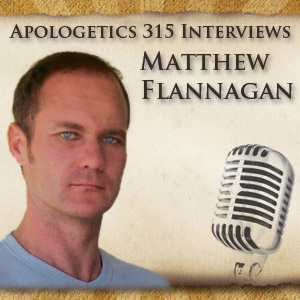
Matt is the first kiwi apologist to be featured in this series and stands alongside
such contemporary greats as William Lane Craig, Michael Licona, Gary Habermas, Paul Copan, Greg Koukl, Doug Groothius, Doug Geivett, Craig Hazen, Peter Williams, Kenneth Samples, Chris Shannon to name a few.
The interview is in the form of a half-hour podcast entitled Apologist Interview: Matthew Flannagan. It covers how Matt got into philosophy of religion, the international attention some of his work has received, his upcoming research projects, his upcoming US speaking engagements, his recent debate with Raymond Bradley, his thoughts on the benefit of public debate, the need for reasoned faith and more.
We’d like to thank our generous supporters who donated the necessary equipment for us to be able to do interviews via Skype.
-
Gary Gutting on Richard Dawkins’ Atheism
The New York Times has an accessible and excellent critique of Richard Dawkins’ argument for the non- existence of God, written by University of Notre Dame Philosopher Gary Gutting entitled, “On Dawkins’s Atheism: A Response.”
Enjoy.
RELATED POSTS:
Fairies Leprechauns, Golden Tea Cups and Spaghetti Monsters
Richard Dawkins and Open Mindedness