Tag: Faith and Reason

  • CANCELLED Is belief in God rational when you can’t prove God exists? @ Unitec

    THIS EVENT HAS NOW BEEN CANCELLED – sorry all! We are working with the organisers to reschedule it (apparently something went wrong with the on campus promotion).

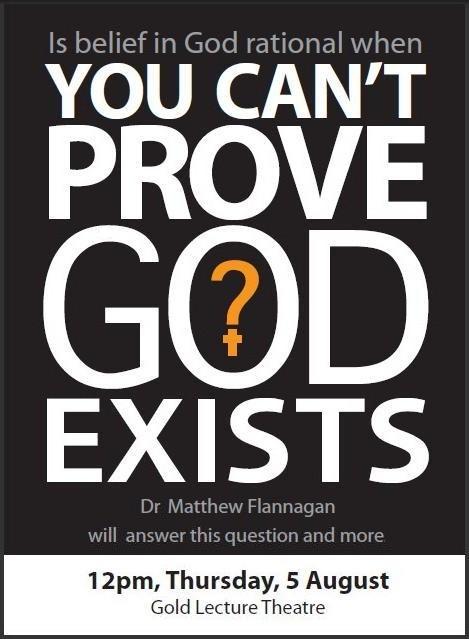
    Matt is speaking on the topic “Is belief in God rational when you can’t prove that God exists?” at 12pm, Thursday 5 August in the Gold Lecture Theatre on the Auckland Unitec campus on Carrington Rd. The talk will be based on the Showing Christianity is True essay Matt had published as part of Apologetics 315’s essay series, “Why is Christianity True?”

    Is belief in God rational when YOU CAN'T PROVE GOD EXISTS?

    The format is a talk delivered followed by Q&A. The event is open to the public and entry is free.

  • Epistemology 101: Clash of Authorities Part III

    This three-part blog series is essentially the talk I gave at the recent Clearing the Air Forum, which was entitled “Discovering Truth in the Synthesis of Science and Faith.” The audience was comprised of scientists, church leaders, journalists and other interested parties so this is a fairly lay introduction to epistemology.

    In my first post, Epistemology 101: Science, Faith and Authority Part I, I set out some basics about epistemology. In Part II I looked at testimony and authority. Now I will turn to my final point, what about the clash of traditions or authorities, what should we believe then?

    Here is a fairly obvious example, suppose I am not a biologist but I hear it on authority that the scientific consensus is that evolutionary theory is the correct account of human origins. In the absence of any defeaters for this, such as the absence of compelling reasons for thinking that the biological sciences are unreliable in this area or some compelling disproof of evolution, I should accept this claim. One the other hand, I read the Bible and it looks like it states that the world was created by God in six 24-hour days and that humans and animals were created on separate days. I examine the subsequent genealogies and I discover that when added up these entail that the world is only a few thousand years old. If I accept the Bible as authoritative and as the word of God, then I have a reason for thinking that evolution is false. What should I do?

    I am using this case as a vivid example because it is such an obvious one in an evangelical setting, particularly one like this full of scientists who will have experienced the tension first hand. I want to look at two approaches that I think are mistaken. The first is exemplified by a well meaning school board member I encountered a few years ago. I was applying for a job as a curriculum developer at a Christian school. I was asked if I would teach that Genesis was true. I responded by saying that at the senior level, students should learn about the debate over how Genesis should be interpreted. They should be encouraged to ask whether it literally teaches that the world was created in six 24-hour days or whether, as some scholars believe, the days are a kind of literary device drawing out the relationship between human and divine work. The board member responded in horror,  he said “are you saying God might be wrong?” I did not get the job.

    There was some wisdom in the board member’s response. If God teaches something then it is true and what God says trumps all human opinion, including scientific opinion. The problem is that I was not questioning what God said, I was questioning an interpretation of Genesis which was the basis of the board member’s conclusions about what God said. God does not make mistakes but human interpreters do.

    Throughout history brilliant Christian theologians have disagreed as to how to interpret scripture and also which theological perspectives are correct. The fact that they disagree means that they cannot all be correct. Our theologising then is fallible and it is not given that we are always correct. It is mistaken then to assume that when the scientific consensus clashes with our theology it is always wrong and our theology is always correct.

    In a room full of scientists this is probably uncontroversial but I want to also reject an equally erroneous view. This is the view that whenever scientific consensus clashes with a theological position, the theological position is always incorrect. Often this view is based on mistaken views on history. In the 19th century an interpretation of Church history known as the conflict thesis emerged. This position taught that religion and science had been locked in conflict throughout their history and that science had flourished only by fighting off the shackles of the church, which had consistently suppressed its ideas. The picture was of a Church constantly losing ground to science. This view of the history of science has been rejected by most historians today but its legacy lingers on.

    In fact the history of science and religion is quite different. There were few conflicts of the sort this thesis puts forward and when they did occur issues were not as simple as science being right and theology wrong. In fact, in some cases the opposite was been true. The fact is that scientific consensus can be and has been, in the past, mistaken. Only a few decades ago the steady state theory of cosmology was widely accepted and it was believed the universe had no beginning, a thesis in direct contradiction to the Christian doctrine of creation ex nihilo. Today, theology now appears to have been correct. In the 12th century a similar clash occurred between aristotlean science and that of the Church. The church was proven correct. There are other examples, such as denials that people groups such as the Hittites ever existed and claims people could not write at the time of Moses.

    Further, scientific consensuses changes over time. Alvin Plantinga notes,

    According to Bryan Appleyard, “At Harvard University in the 1880’s John Trowbridge, head of the physics department, was telling his students that it was not worthwhile to major in physics, since all the very important discoveries in the subject had now been made. All that remained was a routine tidying up of loose ends, hardly a heroic task worthy of a Harvard graduate.”4 Twenty years later the same opinion seemed dominant: for example, in 1902 Albert Michelson, of Michelson-Morley fame declared that “the most important fundamental laws and facts of physical science have all been discovered and these are now so firmly established that the possibility of their ever being supplanted on consequences of new discoveries is remote.”5 And of course we all know of the scientific theories that once enjoyed consensus but are now discarded: caloric theories of heat, effluvial theories of electricity and magnetism, theories involving the existence of phlogiston, vital forces in physiology, theories of spontaneous generation of life, the luminiferous ether, and so on.[1]

    Scientific consensuses then can and have been mistaken. In addition to this there is an important insight in the comment of the school board member who cost me employment. Given the fallibility of humans, even as a group, if God says something and the scientific community says something else then we have good reasons for thinking the scientific community is wrong and hence we do have a viable defeater for the testimony we have heard. God, understood as a all knowing, all powerful, perfectly good being, certainly is not mistaken and it is not as if he needs some scientists to enlighten him or correct his teaching.

    I think the correct response is to allow science and theology to mutually correct each other. Take the case of evolution and the Bible. One needs to ask just how likely is it, given the evidence, that evolution occurred? One also needs to ask just how likely is it that the interpretation of Genesis underlying creationism is correct? If it is more likely that a literal interpretation of Genesis is true than it is that evolution is true then we should reject evolution despite the consensus in favour of it. On the other hand, if there are reasons for thinking our interpretation of Genesis is mistaken and that the evidence for evolution is overwhelming then we should conclude that God is not teaching us that the world is only a few thousand years old.

    My own view is that there are good reasons for rejecting a literal interpretation drawn from what we have learned about ancient near-eastern texts from the same period. Evidence suggests that ancient genealogies did not function the way the literalist picture suggests and that much of early Genesis is a polemic against ancient near-eastern mythology rather than sober history. But my views are beside the point main point.

    My point is that I think as Christians we need to say that both science and theology are valid ways of knowing and that human theorising in both fields are fallible.

    There is a view in our culture which denies this, this is a view called scientism which claims, following Bertrand Russell, that whatever is knowable is knowable by the methods of science and what science does not tell us is not knowable. This is, however, a philosophical and theological view that rejects the existence of revelation. If we accept that God has spoken to humanity then we should not assume that God has not said something that is the basis for a legitimate critique of scientific claims or culture and if he has then we should not cower from offering such a critique despite the fact that the scientific community thinks otherwise. At the same time we should not embrace the kind of naiive theologising that reads the bible in English, ignores the fact that God’s word was mediated through human texts in different languages which essentially boils down to “God said it, that settles it” type thinking. Both approaches should be repudiated.

    Let me make a final comment in this area. If we are to gain an accurate picture of the world then we need to take into account all information we know that is relevant to the question. If we bracket some information which is relevant then the picture we will only be probable on “part of the evidence” and may not be probable when everything else is factored in. If one accepts that science is the only way of knowing this does not matter much. Nor does it matter much if we think that all that is at issue is what we find in the scriptures. But if we accept, as I think we should, that both are valid sources of information then theologians and scientists needs to take others insights into account. There might be areas of reality in which both make claims. If scientists proceed ignoring information from theology that is relevant to what they study and theologians ignore what scientists are saying when it is relevant to the issue both will end up with a distorted view.

    I think this picture applies to the issue of climate change. We have scientific claims about anthropogenic global warming being affirmed and contradicted in the media, in the pulpit, on talk-back radio, in the blogosphere and so on. Those of us who are not climatologists rely on testimony and we need to start being critical about whether much of what we hear is subject to defeaters. Similarly, the issue has moved beyond science into areas of ethics, public policy, laws and even pictures of eschatology. In these areas scientists are not experts and questions of theology and ethics, among other things, come into play and we need to have a method for negotiating this.

    [1] Alvin Plantinga “Creation and Evolution: A Modest Proposal” in Robert Pennock Ed Intelligent Design Creationism and Its Critics: Philosophical, Theological and Scientific Perspectives (Cambridge, The MIT Press – Bradford Books, 2001) 785.

    RELATED POSTS:
    Epistemology 101: Science, Faith and Authority Part I
    Epistemology 101: Science, Faith and Authority Part II

  • Epistemology 101: Science, Faith and Authority Part II

    This three-part blog series is essentially the talk I gave at the recent Clearing the Air Forum, which was entitled “Discovering Truth in the Synthesis of Science and Faith.” The audience was comprised of scientists, church leaders, journalists and other interested parties so this is a fairly lay introduction to epistemology.

    In my first post, Epistemology 101: Science, Faith and Authority Part I, I set out some basics about epistemology, I now want to turn to one particular way we know things: testimony. Nicholas Wolterstorff defines paradigmatic cases of testimony as: believing X on the say so of someone else Y. There is a highly influential tradition of epistemology which is sceptical or critical of beliefs based on testimony.

    Testimony
    In his Essay on Human Understanding John Locke argued that one had a duty to not believe any proposition merely on the authority of another person. One should trust the testimony of another only if one has:

    (a) good reasons for thinking that the testifier is reliable; or,
    (b) good reasons for believing the truth of the proposition itself.

    Taking another persons word for something in the absence of independent evidence is irrational. Locke hinted that such gullibility was socially dangerous, tied up with intolerance, authoritarianism and oppression.

    Something like this lurks in contemporary culture and is often encapsulated in quotes such as “think for yourself.” The problem is that a little reflection shows that this view of testimony is mistaken.

    CAJ Coady summarises the problem, if one is going to have evidence for the reliability of a testifier then this evidence will either include some other testimony or it will be based upon sources apart from testimony. The first option is obviously a non-starter, any evidence based on testimony will have to, by Locke’s position, be shown to be reliable by further testimony and so on, ad infinitum, until we reach some non-testimonial source. However, if we embrace the second option and we exclude what we know by way of testimony from our evidence base then we will have so little to go on that such grounds will be almost impossible to come by.

    To demonstrate this consider an example from Greg Dawes in a paper he wrote on faith,

    Very many of our beliefs are held on the basis of testimony. (In this context I shall sometimes refer to these as beliefs held on the basis of authority.) Does e=mc2 represent the rate at which matter can be transformed into energy? I believe so, although I would not have the faintest idea how to demonstrate its truth I have it on good authority that it is true…Of course, there is a sense in which I do believe this on the basis of evidence. I have reasons to believe in the trustworthiness of the sources from which I gained the information.[1]

    Like Locke, Dawes suggests that a non-physicist such as himself can rationally believe e=mc2 because he has reasons to believe that his sources are trustworthy. I believe this last comment is incorrect. Consider, for example, what reasons he could offer for believing that the source of his information was reliable? Presumably, it would be because the author of the book where he read it or the person who told him the information was a physicist. Nevertheless, how does Dawes know this? He could have read the person’s qualifications off a faculty list, off the dust-jacket of the book or have been told them by the person in person but in each case he is relying on testimony and so, in the absence of further reasons, he cannot believe these sources. Suppose, however, Dawes was to investigate thoroughly and locate the address of the university where the degree in physics was claimed to be awarded in order to travel there and personally check the original records. Yet again, he will be relying on testimony in the form of an address list and records. He also would have to have trusted the testimony of maps and road signs in getting to the institution in question.

    Consider then what Dawes would have left to go on if he did not use testimony. He could not rely on any information that he himself did not observe first-hand. This would exclude any information about events prior to his own lifetime, any events in his own lifetime that he did not remember witnessing first-hand and any event that happened in a place other than where he was at the time. Nothing read in journals, books, heard in lectures, taught to him by his parents or teachers could be used. Nothing heard on the news, read on the computer, told over the phone or reported on in the media could be included. Almost everything he had learnt through his entire education would be excluded because nearly all of it is based on testimony. It seems, then, that if Dawes were really to comply with the epistemic standards that he laid down, he could not rationally believe in e=mc2. It appears he is mistaken in thinking that one needs to have reasons for thinking a given authority is reliable in order to be warranted in believing in testimony.

    I think this example shows that this is not isolated. What we know, by way of being told by others, accounts for a huge and pervasive amount of what we believe. Everything I know about other places, other times, everything learned at school, university, from my parents, friends, books, newspapers, television, etc is based on testimony. If I were to try to verify any of these beliefs without first relying on some other piece of testimony, I would be unable to. The kind of critical attitude where one deplores believing things on faith or on the say so of others is un-viable. As social beings with a limited perspective in time and space, and with limited areas of speciality, we need to trust the testimony of others for most of what we know.

    Testimony Beliefs as Basic Beliefs
    For this reason the idea that one cannot accept something on the say so of testimony until it is verified is problematic. Instead I am inclined to accept a different picture of the role that testimony and faith in authorities should play in our knowledge. The picture that testimony beliefs are properly basic beliefs.

    To see what I mean by this consider the following point by Roy Clouser,

    If everything needs to be proven then the premises of every proof would need to be proven. But if you need a proof for every proof, you need a proof for your proof, and a proof for your proof of a proof and so on-forever. Thus it makes no sense to demand that everything be proven because an infinite regress of proofs is impossible.[2]

    Clouser notes that the appeal to evidence, in the form of premises from which one infers a conclusion, have to terminate somewhere if we are to avoid being sceptical about everything.

    The terminus is a set of ultimate premises called basic beliefs, which are those beliefs that form the foundation of our knowledge. We are justified in believing them independently of any argument or proof for them.

    If this seems counter-intuitive consider that there are plenty of things we believe that are not based on arguments. Our belief in the existence of the past or our belief that it is wrong to rape women or our belief that other people exist or that basic axioms of logic are true are not based on inferences to the best explanation so that they are rationally believed because they explain some phenomena better than all alternatives. It is rather that these beliefs are part of the background data that we use to assess proposed explanations against.

    Usually basic beliefs are grounded in some form of experience. We recognise these as true because we experience or see them to be true. For example, I see that the basic axioms of logic are self-evident, I remember the existence of a past event, I intuitively see that rape is wrong and think anyone who does not see this is simply morally blind. I see the chair in front of me, I hear the car outside and so on. These beliefs function as fundamental premises that we argue to other theories from.

    It is important to note that while we are justified in believing basic beliefs in the absence of evidence for them, their justified status can be defeated if we gain good reasons for rejecting these beliefs. For example, on a Tuesday evening I have a vivid experience of my brother entering my room, I form the basic belief that “my brother is in my room.” The next morning I hear that my brother was out all evening. I also discover that the medication I took the night before has hallucinatory side effects. The basic belief, grounded in my perceptual experience of observing my brother entering the room on Tuesday night is defeated. There are two ways basic beliefs can be defeated, undercutting defeaters involve a reason a person acquires which, when added to their stock of beliefs, gives them reasons for thinking that the source of the basic belief is unreliable – my discovery of the hallucinatory side effects is an example of this. Rebutting defeaters, on the other hand, are reasons one acquires for thinking the belief itself is false. My discovery that my brother was not home is a rebutting defeater, if he was not home then he was not in my room.

    The picture I want to suggest is that in many circumstances beliefs held on the basis of testimony function as basic beliefs. When a person, whom we take to be a competent authority, affirms a proposition P then in the absence of defeaters we are rational in accepting P. We do not need to prove that what the person says is true before we can accept it and nor do we have to prove that they are a reliable authority before we have to accept it. We do, however, have to take seriously any purported defeaters we are confronted with. We have to take seriously evidence we have that the authorities in question are not actually a reliable guide in the area in which they are speaking and we have to take seriously arguments given against what we accept.

    Translating this into a current context, contrary to what is often thought, most of our knowledge of scientific facts is, in fact, on the basis of testimony. As a child I ask questions, why does this happen? what caused this? and so on, my parents tell me answers and I believe them. I go to school and I am taught science and later physics and chemistry, I go to university and attend lectures, I read text books, I might do some experimental work myself but it is in the context of what I have already learned from testimonial sources. I read about studies scientists have done in journals and I believe what is written in these journals. Despite the bravado of self-professed free thinkers, our  acquisition of scientific knowledge is pervasively shot through with faith – faith in authorities, faith that others are being honest to us and are trustworthy and so on. It can be no other way. Hence, to believe some fact about the world merely because another has told you it is true is not irrational but in fact a sensible thing to do.

    Consider an example, I am in my car listening to the radio and Keisha Castle-Hughes is on air talking about climate change. The media are praising her for her brave efforts to educate the public. How should I respond? In this instance I am inclined to think that I face some defeaters. I know Castle-Hughes is an actor and has no real expertise in the area in which she is talking. I also know that actors are good at being very convincing at playing a role, which is not real. I know Castle-Hughes is quite young and is unlikely to have had a very substantial science education, much less time to specialise in climatology. I know the media are notoriously unreliable, journalists tend to be very political, their deadline give them limited time to research and they are not experts in science at all. In this instance, I think that I have real reasons to be sceptical of what Castle-Hughes is saying. Even if what she is saying, in fact, is true, I should not believe it just because she says so.

    Here is another example. I read a book by Richard Dawkins. He claims that the evidence quite conclusively suggests there is no God. Now in some places Dawkins offers arguments and I can assess these using my ability to reason deductively but in other places he simply tells his readers things. He puts forward various arguments for God’s existence, which he says these are representative of the case for theism, he attributes these to Thomas Aquinas, talks of first-cause arguments and the like. This is a bona fide, scientist with a professorship at Oxford. His specialty is zoology.

    However, accurately representing Aquinas’ arguments for God requires knowledge not in zoology but in medieval philosophy. A knowledge of what arguments have been put forward for theism, which are the most representative, which are the best, requires knowledge of a discipline called philosophy of religion. Dawkins’ position as a zoologist means his knowledge is in a very different field. Hence, his being a scientist gives me no reason to accept his work on Aquinas.

    This underscores an important point. If a person has some bone fide authority in a field it means he has authority in that field, it does not mean he or she has any authority in another field. Scientists qua scientists are experts in science, not morality, public policy, law, ethics, theology and what have you. Similarly, pastors are trained in biblical exegesis and theology, their knowledge, therefore, is in those fields and not science. One of the problems with the rise of the Internet is that people can get information on any subject any where from any source. In this context it is important to examine carefully whether we have good reasons for questioning whether the source is authoritative.

    It is not a bad idea to make our starting place be that we will accept what we are told by authorities but we should not always end there.

    In my final post in this series, Part III, I will look at what we should do when authorities clash.

    [1] Greg Dawes, “Faith and Reason”, a paper presented to the University of Otago Theology and Religious Studies Faculty. This is contained in Dawes, Philosophy of Religion (so far unpublished) 34.
    [2] Roy Clouser  Knowing With the Heart (IVP: Downers Grove, 1999) 69.

    RELATED POSTS:
    Epistemology 101: Science, Faith and Authority Part I
    Epistemology 101: Science, Faith and Authority Part III
  • Epistemology 101: Science, Faith and Authority Part I

    This three-part blog series is essentially the talk I gave at the recent Clearing the Air Forum, which was entitled “Discovering Truth in the Synthesis of Science and Faith.” The audience was comprised of scientists, church leaders, journalists and other interested parties so this is a fairly lay introduction to epistemology.

    I was asked to address the epistemological issues around the climate change debate from a Christian perspective. In some ways I feel significantly under qualified to address this issue, I have no degrees in or knowledge of climatology, I am a theologian with an interest in Philosophy of Religion. Despite this, my research into religious epistemology has led me to some conclusions as to how faith and science should relate and how those of us who are Christians should respond to scientific challenges or purported scientific challenges to our theological beliefs. I’ve also gained some understanding on the role of testimony and the way believing things on the basis of authority figures in our knowledge. So, given this, I would like to share a few of my conclusions with you.

    What is Epistemology?
    Epistemology is one of those technical terms that often makes peoples eyes glaze over but it is important to grasp what it is. You may know it as “ways of knowing” or “the theory of knowledge.” Human beings are knowers, we like to gain accurate information about the world, about morality, about God and a whole host of other subjects.

    Sometimes we do this task well and sometimes we do it poorly. A person, for example, who believed the moon was made of green cheese on the basis that he had resolved to believe this if a coin-toss came up heads (and it had in fact come up heads) has believed poorly. The way he believes is irrational, it does not count as knowledge, his belief is unjustified and so on. Epistemology involves asking questions such as, what is it to have knowledge, what is it to be justified? The idea is to help gain clarity as to what knowledge is, how we ought to believe and so on.

    The subject and literature is vast and I cannot really do it justice here, so I will just give some basics.

    Since the time of Plato it has been widely acknowledged that knowledge involves at least two things: belief and truth. I have found that scientists often get irritated when they are told that their knowledge is a form of belief. This, however, is based on a verbal confusion. In epistemology to believe something is to simply think that it is the case, it is to assent to a proposition. I believe that the sky is blue if I think that the sky is blue; if I do not think this, if, in fact, I think that the sky is over-cast and grey then I do not believe that the sky is blue.

    What is meant by truth is defined best by Aristotle, “To say of what is that it is not, or of what is not that it is, is false, while to say of what is that it is, and of what is not that it is not, is true.” A belief is true if what you think is the case actually is the case. My belief that the sky is blue is true if the sky is blue and it is false if it is not blue but some other colour such as green. Truth is determined by facts about the world, the way things are; the point of being a knower is that one tries to match what one believes with reality. Knowledge involves achieving this match.

    My knowing P then involves at least two things:

    [1] I believe P
    [2] P

    The problem is that while these two conditions are necessary for knowledge they are not sufficient. Suppose I decide to choose beliefs about a particular subject matter on the basis of a coin-toss. Every time I throw a heads I will affirm the proposition and every time I throw a tails I will deny it. If such a method were employed I would, at least sometimes, form true beliefs but I would not have knowledge as my grasp of the truth would be the result of a lucky guess. Some third condition (or conditions) are needed.

    One of the biggest issues in epistemology today involves working out what this third condition is. The normal starting point in the discussion is the idea that knowledge is a justified true belief, I know when I believe P, that P is the case and that I am justified in believing P.

    [1] I believe P
    [2] P
    [3] I am justified in believing P

    At the same time it is also widely acknowledged that this position is incomplete. In a short but very important paper Edmund Gettier put forward a series of counter examples to the idea that knowledge is justified true belief. Consider the following. You are watching the All Blacks beat the Spring Boks on Sky TV and so you justifiably believe “the All Blacks beat the Spring Boks.” As it turns out, Sky has mucked its coverage up and the game you are watching is a repeat of a previous Tri-Nations win. Coincidentally, however, the All Blacks are playing the Spring Boks this very night and they win the game. Your belief is true and justified, yet it is not knowledge. Something more is needed to turn justified true belief into knowledge.

    Much of the debate in the contemporary epistemology is about how best to fix this problem and arrive at an answer as to what is needed to be added to true belief to make it into knowledge. Broadly speaking, accounts of knowledge fall into two schools, internalist and externalist.

    The internalist school emphasises properties that are internal to the consciousness of the knower, conditions the knower could be aware of on reflection – such things as appearing to be true, not having any reasons to think something false or reasons for thinking something false that are not outweighed by other reasons. It involves being coherent, believing responsibly and not carelessly and so on. These are all things that the knower can be aware of in an important sense.

    Externalist positions, on the other hand, emphasise conditions that the knower may not be aware of and may be unable to become aware of. Such things as basing one’s beliefs on what is, in fact, a reliable method or cognitive process, having properly functioning cognitive faculties, the belief being caused by the truth in question or tracking the truth in the right way. Frequently one cannot demonstrate the truth of these conditions for the obvious reason that we need to use our mind and belief sources to conduct such a demonstration in the first place. What is important on this view is that these sources are actually reliable, that they work properly, hook up to truth in the correct way and so on.

    The basic point is that despite slogans such as “you are entitled to believe whatever you like” not all beliefs are equal. We should aim to believe what is true, there are good and bad ways of believing, being rational involves trying to avoid the latter and seek the former.

    In Part II I look at testimony and authority and in Part III, I look at what to do when authorities clash.

    RELATED POSTS:
    Epistemology 101: Science, Faith and Authority Part II

    Epistemology 101: Science, Faith and Authority Part III

  • Contra Mundum: Fairies, Leprechauns, Golden Tea Cups & Spaghetti Monsters

    That belief in God is on par with belief in fairy tales is a fairly common charge levelled at Christianity. Highly regarded atheist Philosopher Michael Tooley argues,

    If there is no evidence in support of the existence of God, then it is reasonable to believe that God does not exist. The essential line of thought which I would hope to develop later on is that if you consider other things like fairies, leprechauns, golden teacups orbiting around Venus, and so on, I would suggest that we have no evidence against the existence of those sorts of things, but if I asked you whether you were agnostic I think the answer would be “no.” You would believe there are no fairies, no leprechauns, no golden teacups orbiting around Venus. That illustrates the general principle in regard to God’s existence that the burden of proof must fall upon the person who is arguing in support of God’s existence. If there’s no positive support for it, then the other side wins by default.

    Something like Tooley’s argument regularly features in popular discussions of religion where fairies, leprechauns and golden tea-cups are substituted for flying spaghetti monsters. The basic idea remains the same, to believe in God without providing compelling arguments or evidence for his existence is on par with believing in fairy tales and this is something no sensible, educated, intelligent person can take seriously.

    To address this argument it is first necessary to unpack it. Three separate claims are being made; first, it is assumed that the rational stance to take towards the existence of fairies, leprechauns, orbiting golden tea-cups and spaghetti monsters is not a stance of agnosticism but one of certain denial. Second, it is contended that the reason why this stance is correct is not because we have reasons for believing such things do not exist, but rather that we lack any positive evidence for the existence of these things. Third, the objector assumes that a person who advocates or defends belief in God, in the absence of compelling evidence for God’s existence, has no principled way of distinguishing the case for God from the case for the existence of fairies, leprechauns, et al. Now I grant the first of these claims, it is obviously silly and irrational to believe in things like fairies, leprechauns, orbiting golden tea-cups and spaghetti monsters. The real issue is whether the second and third claims are correct; I will argue that they are not.

    Turning to the second claim that the reason it is irrational to believe in fairies, leprechauns, et al is solely because we lack evidence for their existence and not because we have reasons for thinking that they do not exist. I am inclined to think this claim is false. Consider another claim for which we also lack evidence for thinking is true, that intelligent extra-terrestrial life (ET’s) exists somewhere in the universe. We lack compelling reasons for thinking this claim is true yet it seems mistaken to infer from this that such beings absolutely do not exist, at best all that we can say is that we do not know. Moreover, even in face of agnosticism, many scientists take the existence of ET’s quite seriously; for example, the SETI research site in California spends millions of dollars sending messages into outer space and searching the universe for signs of intelligent life. I note that they do not do the same in pursuit of the search for signs of fairies, leprechauns, orbiting tea-cups or spaghetti monsters and I cannot find any evidence of an agency anywhere in the world that does.

    This example suggests that the reason it is rational to deny the existence of the stuff of fairy tales cannot be simply the lack of positive evidence for these things, if it was we would take the same stance towards ET’s yet we do not. This is because there are important differences between ET’s and fairies, leprechauns, et al over and above the mere lack of evidence we have for their existence. ET’s are the sort of things that could exist even if we lack evidence that they do. ET’s fit with the picture of the world we hold, we know that intelligent life can evolve on planets. This is not the case with fairies, leprechauns, orbiting tea-cups, spaghetti monsters and so on.

    Leprechaun’s first appeared in fairy tales and folklore; in such tales they store their wealth in pots of gold at the end of rainbows. We know that the genre of fairy tales is fantasy. We know rainbows do not have ends in the way this picture envisages. Similarly tea-cups we know are artefacts made by human beings, seeing humans have not been to Venus it is unlikely that such things orbit Venus – even if they are made of gold. It is not just that we lack evidence for the existence of such things but that we have evidence against their existence. What we do know about the world provides us with reasons for doubting they can exist. With ET’s, on the other hand, we have no such reasons for doubting they can exist. Hence, in the latter case agnosticism is justified whereas denial is required in the former case.

    The insinuation that belief in God is on par with belief in fairies, leprechauns, et al is equally questionable. In the case of these things we have no evidence for their existence. With God, however, the situation is different. It is not that no evidence exists; on the contrary, sophisticated and rigorous arguments for God’s existence have been offered and are still being offered in the literature today, it is that experts in the field are divided on the cogency of these arguments. The best that sceptics can suggest is that the evidence is inconclusive. However, even if we grant this, those who defend belief in God can and have offered principled distinctions between God and things like flying spaghetti monsters.

    Two examples will suffice. The first stems from a tradition going back to William James and Blaise Pascal is that when one cannot avoid making a choice, one can act in hope or faith that a belief is true, even if there is no evidence for it, if the expected benefits of the thing hoped for outweigh the benefits of the alternatives. James Jordan provides an example,

    A castaway builds a bonfire hoping to catch the attention of any ship or plane that might be passing nearby. Even with no evidence that a plane or ship is nearby, he still gathers driftwood and lights a fire, enhancing the possibility of rescue. The castaway’s reasoning is pragmatic. The benefit associated with fire building exceeds that of not building, and, clearly, no one questions the wisdom of the action.

    Pascal argued that if one acts on the assumption that God exists and that assumption turns out to be incorrect then one has lost little but if one acts on the assumption that God does not exist and that assumption turns out to be incorrect the one has lost everything. Modified versions of this line of argument are still defended by philosophers today.

    A second reason is that even if one has insufficient evidence for the truth of some proposition, one can be rational in believing it if it is grounded directly in one’s experience. There are plenty of things we believe which are not based on evidence, our belief in the existence in the past or our belief that it is wrong to rape women, our belief that other people exist or that basic axioms of logic are true are not based on arguments or proofs. These things are true because we experience or see them to be true, for example, I remember the existence of a past event, I intuitively conclude that rape is wrong, I observe that other people exist, I see that basic axioms of logic are self-evident. Philosophers such as Alvin Plantinga argue that belief in God is like these beliefs; it is something a person directly sees as true via direct experience or intuition of some sort as opposed to the conclusion of an evidentiary proof.

    I am not in a short article like this going to be able to develop and defend these lines of argument further. I mention them only to show that according to two standard ways of defending belief in God in the face of inconclusive evidence a principled distinction between belief in God and the stuff of fairy tales can be made. People tend to not directly experience or perceive the existence of these things nor does one risk losing everything by acting on the assumption they do not exist. Moreover, if belief in fairies, leprechauns, orbiting tea-cups and spaghetti monsters did possess these features then it is no longer obvious that belief in such beings is irrational. Suppose that instead of there being no evidence for the existence of leprechauns there was in fact some evidence but it was not compelling, perhaps experts were in disagreement. Suppose also that if I failed to act on the assumption that leprechauns existed and it turned out that they did then I would lose everything but if it turned out that they did not I would gain little. In addition, suppose that I directly perceived a leprechaun in front of me or I remembered clearly seeing one a few days ago and I had no reason for thinking my perception or memory was unreliable. If these conditions were satisfied then it would cease to be obvious that belief in leprechauns was obviously irrational. The claim that believing in God is on par with believing in “fairies, leprechauns, golden teacups orbiting around Venus” and flying spaghetti monsters is then unjustified.

    I write a monthly column for Investigate Magazine entitled Contra Mundum. This blog post was published in the July 10 issue and is reproduced here with permission. Contra Mundum is Latin for ‘against the world;’ the phrase is usually attributed to Athanasius who was exiled for defending Christian orthodoxy.

    Letters to the editor should be sent to:
    editorial@investigatemagazine.DELETE.com

    RELATED POSTS:
    Contra Mundum: Secularism and Public Life
    Contra Mundum: Richard Dawkins and Open Mindedness
    Contra Mundum: Slavery and the Old Testament

    Contra Mundum: Secular Smoke Screens and Plato’s Euthyphro

    Contra Mundum: What’s Wrong with Imposing your Beliefs onto Others?
    Contra Mundum: God, Proof and Faith
    Contra Mundum: “Bigoted Fundamentalist” as Orwellian Double-Speak
    Contra Mundum: The Flat-Earth Myth
    Contra Mundum: Confessions of an Anti-Choice Fanatic
    Contra Mundum: The Judgmental Jesus

  • The Theology of the Declaration of Independence

    As I write this it is just beginning to be the 4th of July in the United States now, though its been 4th July for some time here in New Zealand.

    The 4th of July is, of course, Independence Day. Typically in New Zealand, those members of the secular blogosphere, who consider themselves to be classical liberals, have an annual rant on the 4th of July about the Declaration of Independence, praising the philosophy expounded in this document.

    Declaration of IndependenceNot PC’s Peter Cresswell, for example, states in Happy July 4th! that “with the exception of just a few words, the words could hardly be bettered today;” the declaration is, “A wonderful, wonderful anthem to freedom that rings down through the years.”  He bemoans, “if only the real meaning of those words could be heard and understood.”

    A few years ago Kiwiblog’s David Farrar made similar claims, he stated he would often “marvel at those marvelous words, written in the heat of oppression…Marvelous, absolutely marvelous.”

    I agree. I would simply point out to my secular, liberal, country-men what the words in this document actually say, and some of the philosophical ideas they expound.

    First, the declaration refers to God; it does so four times. Maverick Philosopher has an excellent analysis of the theological content;

    In the initial paragraph, we find the phrase “…Laws of Nature and of Nature’s God….” This phrase rules out pantheism: God is distinct from Nature. In the second paragraph, there is the phrase, “…endowed by their Creator with certain unalienable rights….” Putting these two references together, we may infer that the God being referred to is not merely a deistic initiator of the temporally first segment of the physical universe, but a being involved in the creation of the human race. For if God endowed human beings with rights, this endowment had to occur at the time of the creation of human beings, which of course occurred later than the beginning of the physical universe. In traditional jargon, God is a creator continuans rather than a mere creator originans. He is not a mere cosmic starter-upper, but a being who is continuously involved in maintaining the universe in existence.

    …

    The other two references are in the final paragraph. There we find the phrase, “…Supreme Judge of the World for the Rectitude of our Intentions….” near the beginning of the paragraph, and near the end, “…a firm Reliance on the Protection of divine Providence….” Now if God is the Supreme Judge, then he is more than a mere metaphysical cause responsible for the universe’s beginning to exist; he is also the supreme moral arbiter. And since he endows human beings with rights, as opposed to being merely a judge of rights antecedently possessed, then it seems we may infer that God is the source of moral distinctions (as opposed to a mere judge of them).

    The reference to divine providence is further evidence that the conception of God in the Declaration is non-deistic. For if God provides and protects, then God has an ongoing involvement with the world and its inhabitants such as would be ruled out by a deistic view. It should also be obvious that talk of providence (from the Latin, pro-videre) implies divine foreknowledge which implies intelligence and perhaps omniscience on the part of the deity. The God of the Declaration is not a blind metaphysical cause posited to explain why the universe began to exist, but a being with such attributes as moral goodness and intelligence…. So if by ‘deism’ is meant the doctrine that God is a mere metaphysical cause of the universe’s beginning to exist who is thereafter uninvolved in its continuing to exist, then the God of the Declaration is non-deistic.

    Second, the declaration claims that belief in a creator is self-evident; that is, it is a properly basic belief, which is rationally acceptable to hold in the absence of any proof.

    We hold these truths to be self-evident, that all men are created equal, that they are endowed by their Creator with certain unalienable Rights, that among these are Life, Liberty, and the pursuit of Happiness.

    Third, the declaration makes political pronouncements about public policy on the basis of these theological claims and expects these pronouncements to be taken seriously.

    Fourth, the declaration says that various rights, such as the right to life and liberty, are unalienable. That is, a person cannot alienate one’s life or freedom as they can legally alienate a piece of property. You can’t take my property if I do not consent to you having it but if I do consent, you can take it; property is alienable, life and liberty are not. The argument of the declaration reflects John Locke’s argument in the Second Treatise of Civil Government;

    To understand political power right, and derive it from its original, we must consider, what state all men are naturally in, and that is, a state of perfect freedom to order their actions, and dispose of their possessions and persons, as they think fit, within the bounds of the law of nature, without asking leave, or depending upon the will of any other man.[1]

    …

    But though this be a state of liberty, yet it is not a state of licence: though man in that state have an uncontroulable liberty to dispose of his person or possessions, yet he has not liberty to destroy himself, or so much as any creature in his possession, but where some nobler use than its bare preservation calls for it. The state of nature has a law of nature to govern it, which obliges every one: and reason, which is that law, teaches all mankind, who will but consult it, that being all equal and independent, no one ought to harm another in his life, health, liberty, or possessions: for men being all the workmanship of one omnipotent, and infinitely wise maker; all the servants of one sovereign master, sent into the world by his order, and about his business; they are his property, whose workmanship they are, made to last during his, not one another’s pleasure[2]

    …

    This freedom from absolute, arbitrary power, is so necessary to, and closely joined with a man’s preservation, that he cannot part with it, but by what forfeits his preservation and life together: for a man, not having the power of his own life, cannot, by compact, or his own consent, enslave himself to any one, nor put himself under the absolute, arbitrary power of another, to take away his life, when he pleases. No body can give more power than he has himself; and he that cannot take away his own life, cannot give another power over it.[3]

    The point here is that because your right to life and liberty are from God, no one can legitimately enslave or kill you, even if you consent to it. This was not a mere incidental addendum idea, it was central to Lockean political philosophy, which maintained (as the declaration does) that the government derives its powers from the consent of the governed. If a person can consent to be killed or enslaved then they can consent to the government enslaving them also to having the arbitrary power to kill them and hence tyranny can be legitimate. The reason tyranny is illegitimate is because, “No body can give more power than he has himself; and he that cannot take away his own life, cannot give another power over it.”

    The declaration then makes a metaphysical claim: God exists. It makes an epistemological claim about faith and reason: that belief in God is rational independent of proof. It makes an implicit claim of political philosophy: religion is not a private thing that should not influence public life but rather, theological claims should influence public life. Finally it makes a moral claim; that consenting adults do not have a right to do whatever they like with their own bodies, rather there are “Laws of Nature and of Nature’s God” that bind all human beings, that they are compelled to follow even if all parties consent otherwise. Governments are legitimate to the extent in which they respect these laws.

    I agree with PC, it is hard to improve on this philosophy; I have defended it in several places on this blog.

    Ironically, however, the militant secular liberals in NZ who parrot the declaration seem committed to attacking these ideas and rejecting them on every point. They argue that belief in God is irrational because it cannot be empirically proven, they claim that the public square should be secular, that religion should be private and not influence public policy and they argue that liberty means consenting adults can do whatever they like with their own bodies and lives. Far from being unalienable, a person’s life and freedom is his property to alienate as that person sees fit.

    It is also hard to disagree with PC’s sentiments that the declaration is “A wonderful, wonderful anthem to freedom that rings down through the years. If only the real meaning of those words could be heard and understood.” “Indeed, if only.”

    [1] John Locke Second Treatise of Civil Government Section II 4.
    [2] Ibid II6.
    [3] Ibid IV 23.

  • Ronald Hendel on Pascal, Evangelicals and The Society of Biblical Literature

    Ronald Hendel, of the Biblical Archeology review, has written a critical piece entitled “Biblical Views: Farewell to SBL“. His beef appears to be that the Society of Biblical Literature (SBL) is allowing into its membership, heaven forbid, various “evangelical and fundamentalist groups.” This, he suggests, compromises the group’s scholarly integrity.

    Much could be said about his comments, here I will only parse some of them. First, Hendel begins by citing from Pascal’s Pensées, “The heart has its reasons, which reason does not know.” Hendel clearly approves of Pascal’s contention and goes so far as to appropriate the sentiment, he elaborates Pascal’s position as follows,

    This famous line from Pascal’s Pensées draws a wise distinction between religious faith and intellectual inquiry. The two have different motivations and pertain to different domains of experience. They are like oil and water, things that do not mix and should not be confused. Pascal was a brilliant mathematician, and he did not allow his Catholic beliefs to interfere with his scholarly investigations. He regarded the authority of the church to be meaningless in such matters.

    While I am not a Pascal scholar this appears to be a caricature of Pascal’s position. Hendel  suggests that Pascal’s distinction between “reason” and the “heart” is a distinction between faith and reason. He goes on to state that Pascal believed the two did not mix and had different domains, and that the latter (the heart) had no bearing on mathematics or other scholarly investigations.

    Now the former seems plausible, just after the citation Hendel refers to Pascal states “It is the heart which experiences God, and not the reason. This, then, is faith: God felt by the heart, not by the reason.” However with regards to the latter points Hendel made, Pascal goes on to state,

    We know truth, not only by the reason, but also by the heart, and it is in this last way that we know first principles; and reason, which has no part in it, tries in vain to impugn them. The sceptics, who have only this for their object, labour to no purpose. We know that we do not dream, and, however impossible it is for us to prove it by reason, this inability demonstrates only the weakness of our reason, but not, as they affirm, the uncertainty of all our knowledge. For the knowledge of first principles, as space, time, motion, number, is as sure as any of those which we get from reasoning. And reason must trust these intuitions of the heart, and must base them on every argument. (We have intuitive knowledge of the tri-dimensional nature of space and of the infinity of number, and reason then shows that there are no two square numbers one of which is double of the other. Principles are intuited, propositions are inferred, all with certainty, though in different ways.) And it is as useless and absurd for reason to demand from the heart proofs of her first principles, before admitting them, as it would be for the heart to demand from reason an intuition of all demonstrated propositions before accepting them.

    Pascal is quite clear, far from being “oil and water” and having nothing to do with maths or any other scholarly discipline Pascal believed that the very foundations of all knowledge, whether mathematical or another form, are based on faith; reason reasons from these premises but cannot prove them (not that it needs to). When Pascal goes on to state that “those to whom God has imparted religion by intuition are very fortunate and justly convinced” the implication is that certain religious beliefs, known by faith, function as properly-basic beliefs’ at the foundation of ones knowledge and, as such, are the premises one can legitimately reason from to other conclusions without first needing to prove them.

    Second, Hendel’s objection to allowing evangelical groups into the SBL is wanting. His basic objection is that,

    The SBL online book review journal (Review of Biblical Literature) has featured explicit condemnations of the ordinary methods of critical scholarly inquiry, extolling instead the religious authority of orthodox Christian faith.

    Hendel’s concern here seems to be that some evangelical groups are opposed to critical and scholarly inquiry. He substantiates this further,

    Listen to this, from Bruce Waltke, widely regarded as the dean of evangelical Biblical studies: By their faith in the God of Abraham, Isaac, and Jacob, [evangelical scholars] … hear the voice of higher biblical criticism, which replaces faith in God’s revelation with faith in the sufficiency of human reason, as the grating of an old scratched record.

    This, however, is a non-sequitur. Waltke in this citation criticises “higher criticism,” Hendel concludes from this that he opposes critical and scholarly inquiry. But this is not the same thing, why can’t a person, for example, engage in critical and scholarly inquiry, engage in careful research, follow the rules of logic, and so on, and yet reject some of the methodological principles of higher criticism. Alvin Plantinga has offered a carefully argued epistemology of religious belief that provides the basis for a critique of higher criticism. He might be mistaken but surely one needs to actually engage his argument instead of simply assuming it is wrong. Hendel’s assumption, that it is impossible to do this, surely needs more than mere assumption and assertion.

    Hendel’s objections to Waltke are similarly mistaken. In response to the above citation he says,

    This is a quaintly stated position, which directly attacks the applicability of human reason to the study of the Bible. Instead of reason, “faith in the God of Abraham, Isaac, and Jacob”—as interpreted by evangelical scholars—should be the rule in Biblical scholarship. Waltke dismisses critical inquiry as an annoying nuisance, like the scratchy sound of an old LP.

    Here Hendel contends Waltke denies “the applicability of human reason” to the study of the bible. This again does not follow. In the above statement Waltke denies that reason, by itself without faith, is insufficient but to say reason is by itself insufficient does not entail it has no application at all; it simply states that it has to be supplemented by faith to get a true or accurate answer.

    In summary Hendel confuses the claim that reason, unimplemented by faith, is insufficient with the rejection of reason altogether. Moreover, he seems to think that reason and higher criticism are the same thing. This, however, simply appears to, at best, misunderstand and, at worse, caricature the views of faith and reason many evangelicals hold. Had Hendel reflected on what Pascal actually said, he might have understood this a bit more.