Tag: Hagiography

  • God and the Genocide of the Canaanites Part III: Two Implications of the Hagiographic Hyperbolic Account

    This three-part blog series is a modified version of what I presented to the Evangelical Philosophical Society meeting in November 2010.
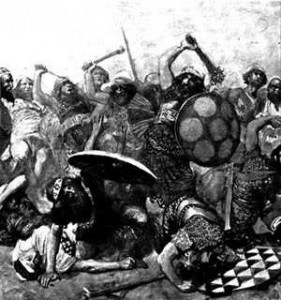
    Joshua Slaughters the Canaanites

    In a recent Conference at Notre Dame Alvin Plantinga suggested that the commands to wipe out the Canaanites, recorded in the book of Deuteronomy, might be hyperbolic; they should be understood more like how we understand a person who states, in the context of a boxing match, “knock his block off, hand him his head”, or in a football game where a person states that the team should “kill the opposition” or boasts that “we totally slaughtered them.”[1] Understood this way, the commands in Deuteronomy meant “something like attack them, defeat them, drive them out; not literally kill every man, woman, child donkey and the like”.[2]

    In two previous posts I have explored and defended Nicholas Wolterstorff’s argument for this conclusion. In God and the Genocide of the Canaanites Part I: Wolterstorff’s Argument for the Hagiographic Hyperbolic Interpretation, I elaborated on, appropriated and expanded Nicholas Wolterstorff’s case for understanding Joshua as a hagiographic, stylised and highly hyperbolic account of Israel’s early skirmishes. In Part II: Ancient Near Eastern Conquest Accounts, I argued that studies into Ancient Near Eastern historiography give considerable support to his conclusion. Joshua appears to follow the same rhetoric, literary conventions and motifs of other ancient Near East conquest accounts and one feature of such accounts is to narrate victories hyperbolically in terms of killing all people, leaving no survivors and so forth. This suggests the description of Joshua putting every inhabitant to the sword, totally destroying all and leaving no survivors, is not to be taken literally. In this last post in this series I want to look at some implications of accepting this.

    I think two implications can be drawn from this conclusion. First,

    On the assumption that Deuteronomy and Joshua are parts of the same sequence of books, this interpretation of Joshua forces a back-interpretation of Deuteronomy. If “struck down all the inhabitants with the edge of the sword” is a literary convention when used to describe Joshua’s exploits, then it is likewise a literary convention when similar words are used by Moses in his instructions to Israel in general and to Joshua in particular.[3]

    I think Wolterstorff is correct here, this interpretation of Joshua does force a back-interpretation of Deuteronomy. Deuteronomy 7:2 states “when Yahweh your God has given them up before you and you have struck them, you shall utterly destroy them”. Similarly, Deuteronomy 20:16-17 states “anything that breathes you shall not keep alive, but you shall utterly destroy them”. In Joshua 10 one sees the formulaic language of “and Yahweh gave [the city]” and they “struck it by the mouth of the sword, and its king he hath destroyed” until there were “no survivors”. The chapter is summarised with the phrase “So Joshua struck all the land, … He destroyed all that breathed”. The similar phraseology is evident.[4]

    Moreover, the book of Joshua clearly, explicitly and repeatedly identifies what Joshua did in these chapters with the command that Moses had given regarding the Canaanites in Deuteronomy.[5] If the language of “striking all the people by the sword”, “leaving no survivors”, “totally destroying”, “striking all the inhabitants with the edge of the sword”, and so on, is hyperbolic (as the evidence suggests it is) then the command cannot have been intended to be taken literally.

    This understanding of the commands in Deuteronomy also solves some other interpretative problems. Here I will mention briefly three.

    First, what God commanded regarding the Canaanites differs in various canonical books (more…)

  • God and the Genocide of the Canaanites Part II: Ancient Near Eastern Conquest Accounts

    This three-part blog series is a modified version of what I presented to the Evangelical Philosophical Society meeting in November 2010.

    Joshua stops the sun

    In my previous post, God and the Genocide of the Canaanites Part I: Wolterstorff’s Argument for the Hagiographic Hyperbolic Interpretation, I expounded and adapted Nicholas Wolterstorff’s argument for a hagiographic hyperbolic reading of the book of Joshua. Wolterstorff’s argument has, I think, considerable force. Judges and Joshua cannot both be taken literally as their accounts are at odds; given the internal evidence Wolterstorff cites it is reasonable to contend that Joshua is the one that is non-literal. Wolterstorff, however, limits his case to what I call internal evidence, evidence from within the text itself. I think there is some interesting external evidence, evidence of how particular terms and language were used in other Ancient Near Eastern histories of conquests and battles, which could be added to Wolterstorff’s argument to make it significantly more plausible. Here I will cite three lines of such evidence.

    The first is that comparisons between the book of Joshua and other Ancient Near Eastern conquest accounts from the same period demonstrate some important stylistic parallels. Various studies have documented these similarities. Commenting on the structure of the campaigns mentioned in Joshua 9-12, Kitchen notes;

    This kind of report profile is familiar to readers of ancient Near Eastern military reports, not least in the second millennium. Most striking is the example of the campaign annals of Tuthmosis III of Egypt in his years 22-42 (ca. 1458-1438). … [T]he pharaoh there gives a very full account of his initial victory at Megiddo, by contrast with the far more summary and stylized reports of the ensuing sixteen subsequent campaigns. Just like Joshua against up to seven kings in south Canaan and four-plus up north.[1] [Emphasis added]

    Kitchen adds,

    The Ten Year Annals of the Hittite king Mursil II (later fourteenth century) are also instructive. Exactly like the “prefaces” in the two Joshua war reports (10:1-4; 11:1-5), detailing hostility by a number of foreign rulers against Joshua and Israel as the reason for the wars, so in his annals Mursil II gives us a long “preface” on the hostility of neighbouring rulers and people groups that lead to his campaigns.[2] [Emphasis added]

    Kitchen adds other examples. He observes that the same formulaic style found in Joshua is also used in the Amarna letters EA 185 and EA 186.[3]Similarly, before his major campaigns (more…)

  • God and the Genocide of the Canaanites Part I: Wolterstorff’s Argument for the Hagiographic Hyperbolic Interpretation

    Around this time last year I wrote two posts Joshua and the Genocide of the Canaanites I and Joshua and the Genocide of the Canaanites II. These posts attracted a fair amount of attention and debate. I got offers to publish my ideas in several upcoming books and present them before both the Evangelical Philosophical Society (EPS) and the Society for Biblical Literature in November 2010. Since the original posts I have corresponded with various people and I have modified and refined some of the ideas. This three-part blog series is a modified version of what I presented to the EPS last month. These posts supersede and update what I wrote in a year ago.

    Joshua at AiOne of the most perplexing issues facing Christian believers is a series of jarring texts in the Old Testament. After liberating Israel from slavery in Egypt, the Israelites arrived on the edge of the Promised Land. The book of Deuteronomy records that God then commanded Israel to “destroy totally” the people occupying these regions (the Canaanites); the Israelites were to “leave alive nothing that breathes”. The book of Joshua records the carrying out of this command. In the sixth chapter it states “they devoted the city to the LORD and destroyed with the sword every living thing in it—men and women, young and old, cattle, sheep and donkeys”. In the tenth and eleventh chapters it states that Joshua “left no survivors. He totally destroyed all who breathed, just as the LORD, the God of Israel, had commanded.” The text mentions city after city where Joshua, at God’s command, puts every inhabitant “to the sword”  “totally destroyed the inhabitants” and “left no survivors.”

    If one takes these passages literally they record the divinely-authorised commission of genocide. But genocide surely is morally wrong. In the light of this, critics of Christian theism often ask a rhetorical question; how could a good and loving God command the extermination of the Canaanites?

    One response which goes back to the patristic era is to suggest that the strict, literal reading on which this rhetorical question is based is mistaken. Recently, several, protestant scholars have suggested a hyperbolic reading of the relevant passages.[1] Perhaps the most detailed is that proposed by Nicholas Wolterstorff. Wolterstorff suggests,

    “[T]hat the Book of Joshua has to be read as a theologically-oriented narration, stylized and hyperbolic at important points, of Israel’s early skirmishes in the Promised Land, with the story of these battles being framed by descriptions of two great ritualized events.  The story as a whole celebrates Joshua as the great leader of his people, faithful to Yahweh, worthy successor of Moses.  If we strip the word “hagiography” of its negative connotations, we can call it a hagiographic account of Joshua’s exploits.”[2]

    In this series I will defend Wolterstorff’s position. In this post I will sketch, adapt and defend Wolterstorff’s argument. In Part II, I will argue that external evidence from comparative studies in Ancient Near Eastern conquest accounts gives considerable support to Wolterstorff’s position. Finally in Part III I will look at two implications of this position.

    Wolterstorff’s Argument
    Wolterstorff’s contention is that “a careful reading of the text in its literary context makes it implausible to interpret it as claiming that Yahweh ordered extermination”. It is important to note what he means by context. Here, it is clear that Wolterstorff is advocating a canonical approach. He notes that,

    “Joshua as we have it today was intended as a component in the larger sequence consisting of Deuteronomy, Joshua, Judges, I and II Samuel, and I and II Kings…  I propose that we interpret the Book of Joshua as a component within this larger sequence – in particular, that we interpret it as preceded by Deuteronomy and succeeded by Judges.”[3]

    Joshua comes after Deuteronomy and before Judges. Wolterstorff points out that these books should be read as a single narrative. When one does this, however, several issues are apparent. (more…)