Category: Commentators

  • The 2009 Forum on the Family: A Review

    On Friday Madeleine and I attended the Forum on the Family and the following is our long awaited (and long) review of it.

    The Forum kicked off with an impassioned talk from Bev Adair. Bev gave a harrowing account of her own story of childhood physical and sexual abuse and subsequent encounter with God that transformed her life and character and enabled her to break the cycle in her own life, heal and bring her own experience into her work with the Family and Child Trust. She stressed that the solution to child abuse was that people stopped blaming others or their social context for what happens to them; that they must cease demanding solutions from the state and being reliant on welfare; she called for individuals and communities to take responsibility for their own actions and for an end to the silence; abuse is not invisible, people who see it must act. Bev stated that voluntary organisations that were not funded by the state were doing some of the most effective work in the community and the consensus from them was that poverty does not make people hurt their children, she pointed out that countries with real poverty don’t brutalise their children or have stats like New Zealand’s.

    What was interesting was that later in the program the children’s commissioner, Dr John Angus, gave a much drier facts and figures type talk that reinforced what Bev stated. Relying on data compiled by CYFS, Angus noted that abuse tended to be more correlated to drug and alcohol abuse than poverty and that while reports of child abuse are on the increase, the actual cases are not. Like Bev he also suggested that the solutions were at the family, individual and community levels as opposed to government. Angus noted that one of the biggest problems was that when people were worried about a friend or family member’s conduct they rang CYFS rather than actually confronting or addressing it at a family level. Angus argued that real progress is made when families and communities own the problem and openly confront the issues family members face and offer constructive help instead of just looking to the state. It was at this family/community level, that real change can be made.

    In contrast to this, Labour Leader Phil Goff gave a speech about how poverty and economic hardship were the key issues in child abuse. Goff spoke of the need for a society where no children missed out on health care, education or basic necessities due to economic deprivation. He noted the historic Christian motivation behind the original welfare policies of Labour and suggested a need for all parties to work towards helping families in need. While I am not generally a fan of Labour, it is hard to dispute Goff’s claim that we should work towards having a society where no child misses out on basic necessities due to poverty and God clearly would want Christians should to be committed to achieving such a society, that said, none of this speaks to the question as to how this should be done and what the just and appropriate means of bringing it about are (I have discussed the issue of sustenance rights in a previous post). In the Q&A when I questioned Goff further on this he made it clear that he specifically saw this support as primarily coming from the state and not from the voluntary sector on the grounds that “the state has the money.” (Ironically Goff also justified high taxes on the grounds that it was needed for the state to play this role making his position somewhat circular.) These criticisms aside, Goff is to be commended for being the first Labour leader to front up and address the Forum on the Family and for attempting to build bridges with conservative Christians instead of trying to “marginalise them out of existence.”

    One unfortunate feature of Goff’s talk was the focus in the Q&A on the smacking issue. Goff suggested this was a side issue, not as important as child abuse and that people should focus their energy and passions on more important issues. That is, of course, correct and the fixation by members of the audience on this issue did seem disproportionate. However, at the same time, as members of the audience noted, a large number of the audience were from voluntary organisations that were dealing with domestic violence and child abuse at the coal face; hence, the suggestion they were not addressing this or were not as committed to these issues is inaccurate. Moreover, opponents of the current s59 of the Crimes Act had repeatedly told Labour that laws about smacking had nothing to do with child abuse in the past. Proponents had justified the decriminalisation of reasonable force for the purposes of parental correction on the grounds that it would help to stop child abuse and some had, in fact, equated smacking with child abuse. The previous Labour government’s support of this line of argument was the reason that there was now a Bill before the house, John Boscawen’s Crimes (Reasonable Parental Control and Correction) Amendment Private Member’s Bill. So for Phil Goff to now claim now that concern around s59 was a side issue and the question of child abuse was a different, more important issue that Labour was deeply committed to was more than a tad disingenuous, which is what evoked the scathing (and justified) attack from Christine Rankin that David Farrar referred to on his Facebook page.

    Moreover, with a Bill before the house, Labour really do need to take a stance; it is fine to say s59 is not their main focus but when the bill is actually put before them they will need a position. Their opinion on the now, apparently separate and unrelated to light smacking, issue of child abuse, while commendable, is not what they will be asked to vote on. When Madeleine pressed Goff on this he stated that Labour will be voting against Boscawen’s Bill.

    Not all the speakers spoke on child abuse and s59, Greg Fleming, CEO of the Maxim Institute, gave a good talk entitled “Right Wing, Left Wing. What Does it Mean? Does it Matter?” Fleming made essentially three points; first, he noted that the terms ‘right wing’ or ‘left wing’ often function as labels that are used to pigeon hole or brand a person so as to summarily dismiss their position without actually addressing it or considering its merits. Fleming’s contention that such dismissals often reflect a kind of unjustifiable intellectual laziness is undoubtedly correct and occurs far too often.
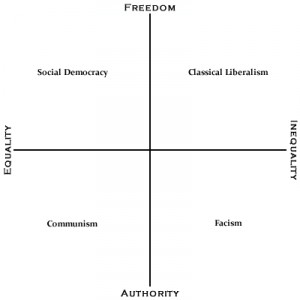
    Political SpectrumFleming’s second point was to suggest that the labels ‘left’ and ‘right,’ when understood correctly, do have a useful descriptive function in highlighting where a person sits on a particular spectrum. For Fleming, this spectrum constituted a horizontal axis whereby equality was at one end, the left and inequality at the other, the right. In addition to the horizontal left-right spectrum is a vertical spectrum with freedom at the top and authority on the bottom. These axes lead to communism being on the bottom left, totalitarian authority to maximise equality; fascism on the bottom right, totalitarian authority to maintain inequality; social democracy on the top left, limited government focused on achieving equality; finally, classical liberalism on the right, limited government for the sake of maximising individual freedom.

    One criticism I have of this is that (more…)

  • Monday Night: John Boscawen, Bob McCoskrie and Jim Evans on Amending s59

    Fresh from Facebook’s “5000 Demanding Anti Smacking Law Change” group is this invitation:

    ACT MP John Boscawen is holding a series of public debates on the smacking referendum result and how his bill to amend S59 will bring the legislation into line with public opinion.

    John Boscawen will be holding the first debate in Phil Goff’s electorate MT Roskill this Monday. He has challenged Phil Goff to front up and defend his position on ignoring the referendum result.

    The debate will be held on Monday, September 7 2009, 7.30pm, Hay Park School, 670 Richardson Road, Mt Roskill, Auckland.

    Speakers include John Boscawen, Bob McCoskrie and Professor Jim Evans from the Auckland Law School.

    If you live in the Auckland area, please do come along and learn more about John Boscawen’s bill while demanding that the politicians listen to the people and change the anti-smacking law.

    I’ll be there; Matt, sadly, will be in Tauranga.

  • Jim Evans Decisively Smacks John Roughan

    On Saturday the NZ Herald’s John Roughan demonstrated why journalists should not engage in legal interpretation in his widely criticised piece on the smacking referendum, “Sinister undertones to referendum instigator.”


    At the time I struggled to ascertain whether Roughan was being deliberately deceptive or he just didn’t get it. He essentially quoted the non-controversial, much more straight-forward, parts of the anti-smacking law, the new s59 (1),(2) and (3) of the Crimes Act, to attempt to prove that the law was not confusing and claims to the contrary were a smoke screen put up by those who desire “the right to flog children.” Aside from his slander, his article was widely criticised because he omitted to mention the most controversial and confusing clause in the new section: s59 (4).

    More than one person asked me to write a critique of this piece but was unable to due to my injuries flaring up badly this week and massive transport headaches. I also worried that my status as a law student meant anything I wrote would not carry the necessary weight (funny how that does not apply to journalists with significantly less law papers to their name than I). Not to worry, because today the Herald features a most excellent response by Jim Evans, Emeritus Professor of Law at the University of Auckland no less; see “Jim Evans: New section 59 is clearly a mess.”

    Professor Evans clearly and simply explains not only the confusion caused by the controversial sub-section (4) but also the less widely noted but equally concerning problems that sub-section (2) creates. He concludes with what we have consistently maintained,

    “This is not clear legislation. In creating this law, Parliament abandoned its constitutional responsibility to say with clarity just which conduct is criminal.


    The section results from a political fudge. Whatever other views one takes about the topic of smacking, that much at least ought to be kept clear.”

    I encourage you to read both articles, especially if you have not voted yet and you are confused by all the contradictory claims being made by both sides. I have included the piece of legislation under scrutiny as a term of reference below.


    Crimes (Substituted Section 59) Amendment Act 2007 No 18, Public Act

    New section 59 substituted
    Section 59 is repealed and the following section substituted:


    “59 Parental control
    “(1) Every parent of a child and every person in the place of a parent of the child is justified in using force if the force used is reasonable in the circumstances and is for the purpose of—

    “(a) preventing or minimising harm to the child or another person; or
    “(b) preventing the child from engaging or continuing to engage in conduct that amounts to a criminal offence; or
    “(c) preventing the child from engaging or continuing to engage in offensive or disruptive behaviour; or
    “(d) performing the normal daily tasks that are incidental to good care and parenting.


    “(2) Nothing in subsection (1) or in any rule of common law justifies the use of force for the purpose of correction.
    “(3) Subsection (2) prevails over subsection (1).
    “(4) To avoid doubt, it is affirmed that the Police have the discretion not to prosecute complaints against a parent of a child or person in the place of a parent of a child in relation to an offence involving the use of force against a child, where the offence is considered to be so inconsequential that there is no public interest in proceeding with a prosecution.”

  • (dis)Honest to God: How Not to Argue about the Smacking Referendum

    Given that yesterday we advertised Dr Glenn Peoples’ upcoming public lectures and because the smacking referendum begins on Saturday, I thought we’d share this article critiquing bad anti-smacking reasoning by Glenn.


    (dis)Honest to God: How Not to Argue about the Smacking Referendum


    smackingIan Harris tells us (“Honest to God,” Dominion Post, [Dominion Post. Saturday July 11, 2009. Page B5], reproduced at the YesVote website) that we should reject the “harsh views” on child rearing found in the Bible.

    Mr Harris, unfortunately, joins many of those who promote the criminalisation of good parents by muddying the waters. He notes, for example, that someone who defends the right to use physical discipline also believes that children (like adults) are sinners. He then announces that since “progressive” Christians (by which he seems to mean those who no longer accept Christian theology) realise that this is based on an antiquated view, we should likewise reject the right to use physical discipline and we should criminalise those who do.

    It is difficult to interact charitably with those who support the ban on smacking if this is the contorted way they are going to reason about the subject. Whether or not one thinks the theology held by some supporters of the right to use physical discipline is correct is quite a different matter from whether or not one thinks they ought to be made into criminals, surely!

    Unfortunately again, Mr Harris attempts to use his platform as a mouthpiece of liberal (what he calls “progressive) Christianity to give credence to scientific claims that are obviously subject to great dispute. He makes the sweeping claim that this nebulous thing called “modern research” (while he cites no actual studies) shows that although corporal punishment does help bring about short-term compliance, it does not help a child to “internalise positive values for the longer term.”

    I am constantly bemused by the way in which conservative religious spokespeople are ridiculed even when they do cite research, but obvious nonsense like this can be peddled by the liberal voices without so much as a single scholarly citation, and nobody is expected to bat an eyelid.

    But even if what Mr Harris says is correct, the implication is that corporal punishment in and of itself has short term benefits and no long term ill effects. Hardly something to be prosecuting people for! The reality is that the effects he cites are perfectly compatible with the good of corporal punishment. Such punishment usually is administered to children when they are not willing to reason or reflect on the long term consequences of their actions. It is for when children are being unruly and unwilling to listen. Circumstances in which they are willing to do so are the circumstances under which corporal punishment is less necessary (meaning that the older a child becomes, the less frequent a smack will become). None of this gives the careful reader any reason to think that the occasional smack is immoral, much less worthy of criminal prosecution.

    Bereft of compelling moral or scientifically grounded arguments, Mr Harris turns instead to arousing prejudice against the religious convictions of those who disagree with him about child discipline. Unable to find anything strong enough in what all Christians consider their holy book, he reaches into the book of Ecclesiasticus (part of the so-called “apocryphal” writings that did not make up part of the Hebrew canon) to find the claim that “he who loves his son will whip him often.”

    But not only has Mr Harris strayed into literature that the so-called “fundamentalists” (most of whom would identify as conservative Protestants) that he attacks do not even regard to be part of the Bible at all, he has clearly sought out the most extreme translation of the verse that he can find. He conjures up grizzly pictures of leering parents towering, horsewhip in hand, over the broken and bleeding bodies of little children with misleading language like this.

    But just a few minutes research would dispel this attempt. The New American translation reads, “He who loves his son chastises him often.” The Douay Rheims translation (the Catholic Bible, which does include this book as part of the canon) reads “He that loveth his son, frequently chastiseth him.” The old King James version, the one that “fundamentalists” are most likely to read if the read this book at all, reads “He that loveth his son causeth him oft to feel the rod.” Of course, because it’s a metaphor for physical discipline that’s probably still too much for Mr Harris, but needless to say, it robs him of his “whipping” bogeyman.

    After the rhetorical debris is stripped away, all that’s really left is a string of namecalling and fearful language. He calls the views of his opponents “repugnant.” He calls them “fundamentalists” with “antiquated” views that are opposed to “progressive” thought. But where’s the actual substance? Like much of the rhetorical fireworks that is being leveled at those who want the law changed to a common sense view that refuses to place thousands of good parents in the criminal category, Ian Harris offers more heat than light, and manifests just the sort of shallowness and bias that this debate could do without.

    RELATED POSTS: