On Friday Madeleine and I attended the Forum on the Family and the following is our long awaited (and long) review of it.
The Forum kicked off with an impassioned talk from Bev Adair. Bev gave a harrowing account of her own story of childhood physical and sexual abuse and subsequent encounter with God that transformed her life and character and enabled her to break the cycle in her own life, heal and bring her own experience into her work with the Family and Child Trust. She stressed that the solution to child abuse was that people stopped blaming others or their social context for what happens to them; that they must cease demanding solutions from the state and being reliant on welfare; she called for individuals and communities to take responsibility for their own actions and for an end to the silence; abuse is not invisible, people who see it must act. Bev stated that voluntary organisations that were not funded by the state were doing some of the most effective work in the community and the consensus from them was that poverty does not make people hurt their children, she pointed out that countries with real poverty don’t brutalise their children or have stats like New Zealand’s.
What was interesting was that later in the program the children’s commissioner, Dr John Angus, gave a much drier facts and figures type talk that reinforced what Bev stated. Relying on data compiled by CYFS, Angus noted that abuse tended to be more correlated to drug and alcohol abuse than poverty and that while reports of child abuse are on the increase, the actual cases are not. Like Bev he also suggested that the solutions were at the family, individual and community levels as opposed to government. Angus noted that one of the biggest problems was that when people were worried about a friend or family member’s conduct they rang CYFS rather than actually confronting or addressing it at a family level. Angus argued that real progress is made when families and communities own the problem and openly confront the issues family members face and offer constructive help instead of just looking to the state. It was at this family/community level, that real change can be made.
In contrast to this, Labour Leader Phil Goff gave a speech about how poverty and economic hardship were the key issues in child abuse. Goff spoke of the need for a society where no children missed out on health care, education or basic necessities due to economic deprivation. He noted the historic Christian motivation behind the original welfare policies of Labour and suggested a need for all parties to work towards helping families in need. While I am not generally a fan of Labour, it is hard to dispute Goff’s claim that we should work towards having a society where no child misses out on basic necessities due to poverty and God clearly would want Christians should to be committed to achieving such a society, that said, none of this speaks to the question as to how this should be done and what the just and appropriate means of bringing it about are (I have discussed the issue of sustenance rights in a previous post). In the Q&A when I questioned Goff further on this he made it clear that he specifically saw this support as primarily coming from the state and not from the voluntary sector on the grounds that “the state has the money.” (Ironically Goff also justified high taxes on the grounds that it was needed for the state to play this role making his position somewhat circular.) These criticisms aside, Goff is to be commended for being the first Labour leader to front up and address the Forum on the Family and for attempting to build bridges with conservative Christians instead of trying to “marginalise them out of existence.”
One unfortunate feature of Goff’s talk was the focus in the Q&A on the smacking issue. Goff suggested this was a side issue, not as important as child abuse and that people should focus their energy and passions on more important issues. That is, of course, correct and the fixation by members of the audience on this issue did seem disproportionate. However, at the same time, as members of the audience noted, a large number of the audience were from voluntary organisations that were dealing with domestic violence and child abuse at the coal face; hence, the suggestion they were not addressing this or were not as committed to these issues is inaccurate. Moreover, opponents of the current s59 of the Crimes Act had repeatedly told Labour that laws about smacking had nothing to do with child abuse in the past. Proponents had justified the decriminalisation of reasonable force for the purposes of parental correction on the grounds that it would help to stop child abuse and some had, in fact, equated smacking with child abuse. The previous Labour government’s support of this line of argument was the reason that there was now a Bill before the house, John Boscawen’s Crimes (Reasonable Parental Control and Correction) Amendment Private Member’s Bill. So for Phil Goff to now claim now that concern around s59 was a side issue and the question of child abuse was a different, more important issue that Labour was deeply committed to was more than a tad disingenuous, which is what evoked the scathing (and justified) attack from Christine Rankin that David Farrar referred to on his Facebook page.
Moreover, with a Bill before the house, Labour really do need to take a stance; it is fine to say s59 is not their main focus but when the bill is actually put before them they will need a position. Their opinion on the now, apparently separate and unrelated to light smacking, issue of child abuse, while commendable, is not what they will be asked to vote on. When Madeleine pressed Goff on this he stated that Labour will be voting against Boscawen’s Bill.
Not all the speakers spoke on child abuse and s59, Greg Fleming, CEO of the Maxim Institute, gave a good talk entitled “Right Wing, Left Wing. What Does it Mean? Does it Matter?” Fleming made essentially three points; first, he noted that the terms ‘right wing’ or ‘left wing’ often function as labels that are used to pigeon hole or brand a person so as to summarily dismiss their position without actually addressing it or considering its merits. Fleming’s contention that such dismissals often reflect a kind of unjustifiable intellectual laziness is undoubtedly correct and occurs far too often.
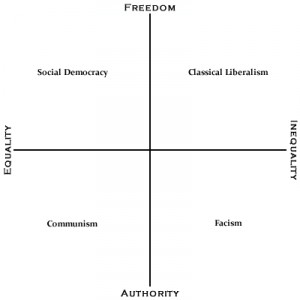 Fleming’s second point was to suggest that the labels ‘left’ and ‘right,’ when understood correctly, do have a useful descriptive function in highlighting where a person sits on a particular spectrum. For Fleming, this spectrum constituted a horizontal axis whereby equality was at one end, the left and inequality at the other, the right. In addition to the horizontal left-right spectrum is a vertical spectrum with freedom at the top and authority on the bottom. These axes lead to communism being on the bottom left, totalitarian authority to maximise equality; fascism on the bottom right, totalitarian authority to maintain inequality; social democracy on the top left, limited government focused on achieving equality; finally, classical liberalism on the right, limited government for the sake of maximising individual freedom.
One criticism I have of this is that (more…)
