Category: Social Commentary

  • Madeleine speaking to Kerre McIvor on Newstalk ZB re Flannagan v ACC

    This morning on my way to work I turned on Newstalk ZB to find that Madeleine and her recent ACC victory were the topic of Leighton Smith’s morning show – Kerre McIvor was filling in. Madeleine ended up speaking to Kerre on air – you can listen here:

    Or download here:

    NewstalkZB have also reported on the case:

    “An Auckland lawyer has won her own legal battle against the Accident Compensation Corporation.

    Madeleine Flannagan has been fighting to get ACC to overturn its decision to stop her entitlements.

    ACC claimed her injury-related pain was due to a degenerative condition.

    Ms Flannagan says the decision was based solely on a diagnosis made by its own specialist.

    “Every doctor and specialist who’d seen me at that point and subsequently, had said it was an accident.”

    ACC overturned its decision just in time to avoid being taken to the District Court.

    It claims the “consistency and rationale of two independent specialists’ opinion” is more compelling than that of its own specialist.

    However, Ms Flannagan has her doubts over ACC’s true motives.

    “They settled about two weeks after they were served my appeal papers so I am very sceptical that it was the compelling nature of my specialist’s report.” [which they’d received copies of from Madeleine’s lawyers 1-2 years prior to offering to settle]


  • Flannagan v ACC – Victory

    Long time readers of this blog will remember than 5 1/2 years ago I was in a car accident that saw me suffer a herniated cervical (neck) disc and require disc replacement surgery. Readers will also be aware that the pain I lived (live) with did not end after that surgery and that when the Accident Compensation Corporation (ACC) went on to cut my entitlements, plunging our family into poverty (NZ definition) as I was the primary earner, I instructed John Miller Law in Wellington to fight their decision.

    Matt and I were terrified at the possible $8,000 + bill we might face if we lost; trying to provide for our 4 children in Auckland on $15,000 p/a was extremely difficult as it was without a debt like that being added to the mix. We appealed on this blog for donations and with the help of those who generously gave, along with the generosity of John Miller Law, who more than once wrote off parts of my bill, we managed to keep the legal proceedings going even after we lost the Review Hearing.

    I pressed on for a number of reasons. I firmly believe that ACC deliberately set about to exit me from cover by sending me to a doctor they knew would say I had degeneration. I believe this on the basis of the Court’s previous findings on Mr Otto and on the basis of his reputation among his peers – I have previously blogged my experience of phoning Orthapaedic Surgeon’s offices and sharing what those offices had to say about him to me. I also believe this on the basis of what happened at the appointment with Mr Otto – his pronouncement of my having a degenerative condition before he’d asked me if a single medical question and shortly before he shared that he had not yet seen my MRI, X-Ray or Bone Scan films and reports. I knew my condition was not degenerative or pre-existing: I was working full-time, studying part-time, raising 4 children, running a house and was engaging in equestrian sport on the weekends immediately prior to the accident.

    The other reason I filed was for all the other people like me. I believed then, and I still do, that ACC did what they did to me (cutting me off by sending me to a specialist they know will say a condition is degenerative when other specialists would not) to many other people and that doing so was a numbers game for them – a way of cutting their bottom line. Cut x number of people off, only teeny proportion y will fight; of those who fight ignore them unless and until you are faced with a court date, then quickly settle before that court date to avoid the public damage the judgment of the Court can deliver.

    We filed my appeal earlier this year. This consisted of three expert reports written by Orthopaedic Surgeons Greg Finch and Michael Barnes. We also filed affidavits from Matt and I, which we wrote ourselves. ACC offered to settle in full shortly after they were served: legal costs, report costs and full reinstatement of my entitlement, the maximum I could have won in Court.

    More than one person said to me ‘but Madeleine, if you settle no light will be shone on ACC’s practices’. While I shared their concerns at the lack of a precedent being set if I settled, as a lawyer I know the Court’s view on people who refuse good settlement offers and press on to hearing. I took the settlement and resolved to shine light another way. I am one of the lead stories today on the New Zealand Herald’s website (and on the website of the Otago Daily Times🙂
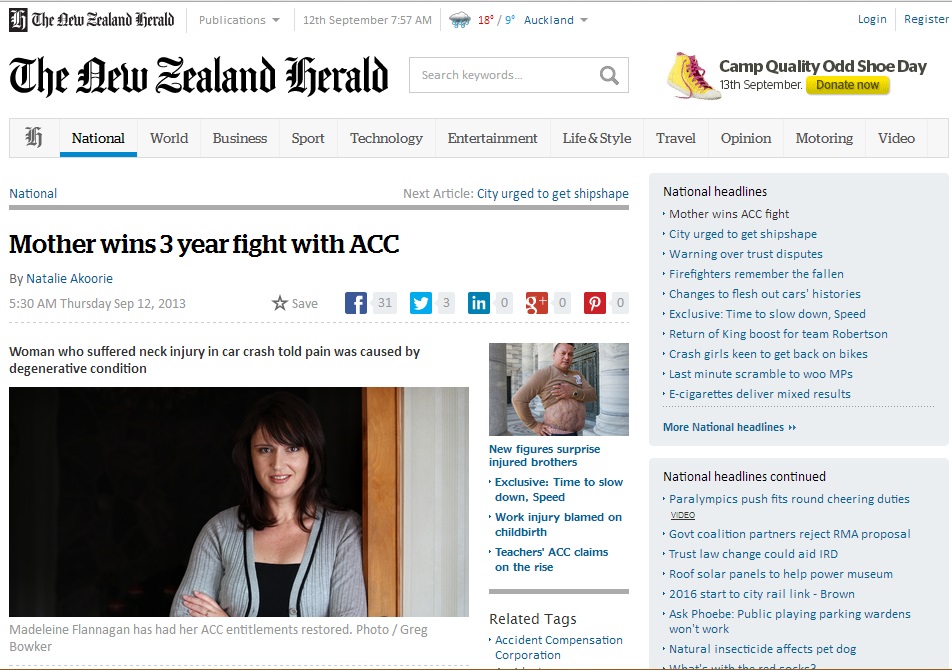
    Mother wins 3 year fight with ACC

    Click to read: Mother wins 3 year fight with ACC

    Mr Otto states in the NZ Herald article, after acknowledging he has no memory of my case, that I “would not have realised he could receive x-rays via email and that he would have seen them before diagnosing her”. I reject this. As I deposed in my affidavit:

    [40] A few minutes after making his opening statement that my condition was degenerative, Mr Otto asked me if I had brought my x-rays, MRI and bone scans. I told him that I had not been asked to and that the other specialists I had seen had all been able to log into some central record holding place and view them so it did not occur to me to bring them. He told me that his office did not have that kind of technology but he would request copies of the reports and films. I offered to send them to him but he said not to bother as ACC had only sent him a letter which didn’t say much so he was going to have to request various things from my file anyway.

    [41] In this moment it was clear that Mr Otto had made his statement about the purpose of the appointment being to discuss my “degenerative condition” in advance of asking me a single question, without having examined my x-rays and scans and on the basis of whatever ACC had communicated to him about me.

    [42] It was also clear that Mr Otto had conducted the appointment with a predetermined purpose: to determine a degenerative condition. He had decided this was my diagnosis before the examination, before being in receipt of the relevant medical evidence. I did not have confidence his diagnosis post-appointment could be objective or unbiased.

    My and Matt’s affidavits are here in full:
    13.03.22 Affidavit of Madeleine Flannagan – Flannagan v ACC
    13.03.22 Affidavit of Matthew Flannagan – Flannagan v ACC

    This is the case I refer to in my affidavit where Mr Otto was found by the Court to prefer his degeneration diagnosis in the face of evidence to the contrary: Lu-v-Accident-Compensation-Corporation-2011-NZACC-45 (A New Zealand Herald article about that case is available here)

    ACC said in the NZ Herald article “An ACC spokesman said it found the consistency and rationale of the two specialists’ opinions “more compelling” than Mr Otto’s report. “As a result ACC decided to reverse its decision.””

    I would like to stress that until ACC insisted (see affidavits) I see Mr Otto, every specialist and doctor who had seen me at that point said my issues were accident related. Mr Otto was the only one who said otherwise. Subsequant to Mr Otto’s report ACC were provided with 2 reports from Greg Finch and 1 from Michael Barnes  – these were the reports ACC found “more compelling” than Mr Otto’s – they were provided the first of these approximately 2 years before they settled, the others they received approximately 1 year before they settled. The service papers for my appeal containing these same reports they received a couple of weeks before they settled.

    Make up your own mind as to whether is was “the consistency and rationale of the two specialists’ opinions” that caused ACC to reverse its decision or whether it was the threat of a court case.

    I have to thank John Miller Law, all those who donated and encouraged me, Greg Finch, Michael Barnes, my church, my family and friends and especially my children and husband who suffered so much along side me – if it wasn’t for Matt going to my lectures and taping my classes and taking notes for me for me to attend to on the couch I would never have finished my law degree. I still live with pain today and it still impacts my life adversely but I am a lot better than I was and I continue to improve.

    Update: For those wondering how I completed a law degree when I could not work, I refer you to Matt’s post Madeleine Admitted to the Bar where he outlines just what it took and how hard it was given my injuries. It is also documented in the affidavits I have published in this post.

    NewstalkZB focussed on Madeleine’s case during the Leighton Smith show.

  • Watch Matt on the GCSB Bill on Shine TV

    On 30 July 2013 Matt was interviewed on Shine TV about the Government Communications Security Bureau and Related Legislation Amendment (“GCSB”) Bill. The discussion on the issues of civil liberties, spying in times of threats against citizens is very good. The video is here:

  • Yet Another Lawyer Agrees: Marriage Amendment Act Bill is an Affront to Freedom of Religion and Belief

    Barrister Ian Bassett has given another opinion describing the risks to freedom of religion and belief of Louisa Wall’s Marriage Amendment Act Bill if it is enacted in its presently proposed form, which would include this amendment:

    “Without limiting the generality of subsection (1), no celebrant who is a minister of religion recognised by a religious body enumerated in Schedule 1, and no celebrant who is a person nominated to solemnize marriages by an approved organisation, is obliged to solemnize a marriage if solemnizing that marriage would contravene the religious beliefs of the religious body or the religious beliefs or philosophical or humanitarian convictions of the approved organisation.”

    It is clear that any marriage celebrant exercising their public function who is not covered by the amendment risks being in breach of the New Zealand Bill of Rights Act 1990 and the Human Rights Act 1993 if they refuse to perform their public function as marriage celebrants because it is a same sex couple seeking to be married.

    Injustice

    Church ministers, marriage celebrants, court registrars, church elders, leaders, photographers and caterers and any other person or entity supplying services to the public risks being in breach of the Human Rights Act 1993 if they refuse to supply services to a couple seeking to be married because the couple are same sex. For some this could also mean risking their employment.

    Service providers to the public risk being in breach of the Human Rights Act 1993 if they refuse to supply services to a married couple because the couple are same sex.

    The New Zealand Law Society’s Law Reform Committee headed by Professor Paul Rishworth LLB (Hons) M Jur highlighted the risk to freedom of religion and belief in the Bill in its submission to Parliament:

    “The proposer of the Bill said that the Bill was not intended to compel marriage celebrants to perform marriages contrary to their religious beliefs. However, in the Law Society’s view, Professor Rishworth says it is arguable that marriage celebrants who refuse to perform same-sex marriages will be acting unlawfully under the Human Rights Act 1993, the New Zealand Bill of Rights Act 1990, or both.

    “We want to highlight arguable conclusions which seem to be at odds with the settled intentions of the Bill’s drafters. Whatever the position, the Law Society believes it makes sense to put the matter beyond doubt,” Professor Rishworth says.

    The only thing that the amended Bill puts beyond doubt is that the critics of those raising fears about the Bill’s threat to freedom of religion and belief were wrong. By recommending an amendment the Select Committee are agreeing that a risk existed, as the likes of Ian Bassett, Grant Illingworth have argued, contra to The Human Rights Commission’s claim that all “…religious officials and leaders are free to refuse to perform marriages that are not in accordance with their religious beliefs.”

    Bassett, Illingworth and Rishworth are not alone with their concerns among the legal fraternity.

    Graeme Edgeler, a Wellington Barrister has been quoted in the Herald saying:

    … if an independent celebrant declined to marry a same-sex couple, the couple could then complain to the Human Rights Commission.

    “It’s not about [celebrants] being forced, it’s about people getting in trouble afterwards if they didn’t,” he told APNZ.

    “They’re not breaking any rule in the Marriage Act, but rules in other acts. The main one would be the Human Rights Act, which says you can’t discriminate on the basis on sexual orientation or gender.”

    Auckland Barrister Rachel Wong has raised issues against the Bill.

    This blog’s Madeleine Flannagan LLB, Associate Barrister and Solicitor at Coast Legal, adds her voice:

    “The Bill, in its present form, fails to protect individual freedom of religion and belief (belief being a comprehensive viewpoint not based on religion). The proposed amendment only protects group religious rights, which is little protection at all for most religious celebrants as few denominations hold formal views on marriage, many practitioners of religion do not belong to a group and for those that do they might hold a different personal view on this topic to the group view. The amendment then fails to protect the religious freedom of most religious celebrants just as it utterly fails to protect the freedom of belief of non-religious celebrants who have no group to appeal to to protect their freedom.”

    Ian Bassett’s latest opinion thoroughly analyses the legal effects of the amended Bill, a summary as to whose freedom of religion and belief it protects and whose it does not follows: (more…)

  • Tom Wright on Hypocrisy: Catholic Church Sex Scandals, the Media and Jimmy Savile

    N T Wright, theologian and research professor at St Andrews University, tells the British media a few home truths about  hypocrisy and faux moral outrage.

    I listened in disbelief as John Humphrys interviewed Cardinal Cormac Murphy-O’Connor on Radio 4’s Today programme this week. Surely, he said, like a headmaster addressing an errant teenager, if highly placed people knew about the behaviour of Cardinal Keith O’Brien, somebody in authority should have done something rather than covering it up? I waited for the former archbishop of Westminster, who sounded weary of the whole thing, to come up with any of the phrases that might have stopped the interview in its tracks: “Jimmy Savile”; “BBC”; “people in glass houses”. Perhaps he was too polite. So Humphrys pressed on: the church claims it can tell people how to behave, so surely it has to live up to those standards itself?

    The joke here is that it is usually the media that tell people how to behave. Yes, the church sometimes “speaks out”. But if it’s moralising you want, turn on the radio. Or pick up a newspaper. And the institution the media especially love to attack is of course the church. There is a logic to this. The media want to be the guardians of public morality, but some people still see the church that way. Very well, it must be pulled down from its perch to make way for its secular successor.

    Don’t be fooled when “religious affairs correspondents” look prim and solemn and shake their heads at the latest clerical scandal. They are enjoying every minute of it. It keeps them in a job (did anyone imagine that the real “religious affairs” of this country, the prayerful and self-sacrificial work that goes on under the radar every day of every year, would ever make headlines?). More: it makes it easier to sustain the fiction that the journalists have taken over as the nation’s moral police.

    Until there’s another scandal – in the media themselves. Savile at the BBC. Phone hacking at the News of the World. Try suggesting that these were isolated, maverick one-off lapses, and listen to the hollow laughter echoing round the country. The church has rightly been attacked for hypocrisy. But is nobody else guilty? If the church is hypocritical about sex, the media are hypocritical about hypocrisy.

    The whole article in the Guardian is well worth reading. Wright goes on to  make some astute points about virtue, moral failure, morality and hypocrisy.

  • Matt on Radio: Women tells Court of Appeal being pregnant with a defective baby is an injury

    A New Zealand woman has gotten her case against the Accident Compensation Corporation (“ACC”) into the Court of Appeal. The Herald carried the story. Matt was interviewed for his view on Radio Rhema last week.

    The woman was told at her 20-week scan that "no anatomical abnormality" was detected. Photo / Getty Image

    ACC claim mother: I would have aborted

    Woman says she would have terminated pregnancy had she been told baby was disabled.

    A woman who says she would have terminated her pregnancy had doctors properly diagnosed her unborn child with spina bifida is seeking ACC cover for her disabled daughter.

    In what her lawyer says could be a landmark case if she is successful, the woman has won the right to a hearing in the Court of Appeal against the decision by the Accident Compensation Corporation not to grant her cover for her young daughter.

    The Auckland mother says her 5-year-old daughter, who walks mostly with a support frame, may miss out on crucial and costly physiotherapy as she grows older.

    “We want her to have the best possible life that we can give her and with ACC cover it makes it a lot easier for us to be able to provide everything we need to provide,” said the mother, who did not want to be named.

    She said her evidence to the court that she would have chosen to abort the pregnancy if she and her partner had been told of their daughter’s condition at 20 weeks’ pregnancy was difficult testimony to give.

    “Obviously once she’s with us we want and love her,” the mother said yesterday.

    Continues…

  • Matt on David Shearer, Gaza and Performance Pay for Teachers on “The Panel” – with Bob McCoskrie

    Radio RhemaIf you tuned in to Radio Rhema at 11:45am (NZ time) on 21 November 2012 you would have heard this blog’s Matthew Flannagan and Bob McCoskrie discuss the David Shearer and the political events from yesterday, the latest in Gaza, and whether performance pay for teachers is a good idea or not, on “The Panel” on Pat Brittenden mornings.

    You can listen online here.