Category: Social Commentary

  • 9/11

    Today in New Zealand the date is the 11th of September, this date marks the anniversary of a terrible crime, an event where planes were used to incinerate and kill thousands of innocent civilians in order to strike terror into the heart of the local population.
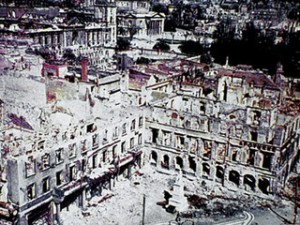
    Darmstadt, after the bombing on 9/11Those reading this will suspect that I am talking of the attack on the world trade towers in 2001. I am not. The event I refer to occurred in September 11th 1944 the bombing of Darmstadt. This was one of several bombing raids performed by the allies against German occupied Europe. What’s less well known was that Churchill under pressure from his ally Stalin, perhaps the greatest mass murderer in history, authorized the deliberate area bombing of civilian cities. Defenders of these actions argued it was necessary to destroy the morale of the German people. The raid on Darmstadt created a fire storm 1 mile high. The roaring firestorm so terrified the population that most people stayed in their bomb shelters leading to them dying of suffocation. In his fascinating monograph Humanity Jonathan Glover notes that over 12000 people died in this raid. Carolin Schaffer a survivor of the raid tells how she and her children were forced to flee through piles of corpses. She covered her children’s eyes for fear that the images would traumatize them for life.

    Darmstard was only one of many area bombings performed by the allies. A year earlier between 24 July and 3 of August the city of Hamburg was repeatedly attacked. On the night of the 27th the bombings created a firestorm with temperatures up to 800 degrees. Roads melted and fleeing civilians found their feet stuck in molten tar and asphalt while they were burnt alive. Glover’s account contains disturbing accounts from eyewitnesses, stories of charred women and children, with brains tumbling onto the ground. The firestorm of the 27th killed 40,000 people. Similar things can be said about the fire bombing of Dresden in 1945 which killed 30,000.

    Many in the west forget do not know about these events. I talk to well meaning sincere students all the time who know all about the atrocities of Hitler and have no idea that Churchill supported terrorism moreover often when this is pointed out they do not care. After all he was fighting Hitler.

    I highlight these events not to engage in the specious reasoning of anti war activists. The invalid tu quoque which states that because the west has engaged in terrorism of this sort in the past that some how means they are mistaken to condemn it now. Such arguments seem to suggest that because we did not do the right thing in the past we should not do it now. Nor do I wish to engage in the facile “Bush is a hypocrite” argument; such reasoning displays a shallow understanding of ethical argument, one that mistakes attacking against a persons character with actually offering an argument against the proposition asserted by the person. Any first year critical thinking or logic class would clear these issues up; the fact that educated University students seriously put them forward is a shame to our education system.

    I highlight to say simply this terrorism in all its forms should be condemned. The Christian Just war theory condemns deliberately targeting and killing non combatants in war. It bases this on the sixth commandment “you shall not kill” but notes, following Augustine, that when this commandment is read in it’s context it admits of two specified exceptions; killing an aggressor to defend of the innocent from his attack, and killing a person justly sentenced for a capital crime. The commandment is issued to all human beings. It does not say it’s wrong for the US to do this but Sunni Muslims who do it against America are freedom fighters. It does not say that we should condemn Israel when (and if) they deliberately attack civilians but then agree to listen and hear the complaints of Palestinians when they blow up Israeli women and children and encourage their teenagers to do so. It does not say that we should revile the CIA for dubious actions they have engaged in and yet praise terrorist organizations like Nelson Mandela’s ANC. All forms of terrorism should be condemned. All people, including all governments, are required to obey Gods law.

    The leftwing forces of “peace” and “tolerance” in our country reject Gods law and find the idea that Governments are under God as absurd. In popular discourse they replace Gods law with the most bizarre unprincipled stance on violence. They say the state should never kill when a person has been found guilty of serial murder. But they slaughter by the thousands innocent children for social, economic reasons in state hospitals at taxpayer funds. They tell us the US should not intervene in Iraq to bring down a brutal dictator and stop his slaughter of thousands of innocent people. Yet they support military intervention in the Solomon Islands to stop riots. It’s wrong to correct disobedient children with force, but they then exhort thousands of dollars of tax payer money out of adults, by threatening force and violence for any social cause they deem worthy of support. This leads to the absurd situation where Journalists on TV tell us that Bush and other American conservatives are the equivalent of Bin Laden and the Taliban. As though a country that executes serial murderers is the same as one that executes women for not wearing a Burka. As though condemning pornographic filth is the same as banning TVs and kites. Their real ethic is clear; violence is good when used by us for causes we like by regimes who oppose those we hate. It should not be used against murderers only innocent tax payers, it should not be used against dictators only against those dictators which the UN ( which is composed of dictators) like. A plane that attacks a military target illegally located within a civilian area and which inevitably but unintentionally hits a civilians ( after ringing the civilians and telling them to leave) is a terrorist because the person who did it is a Jew and supported by the US. However a terrorist who fights apartheid is a hero and Muslim Jihadists they are simply venting understandable frustration at western colonialism.

    This is one of the reasons people do not know about Darmstadt, because the Nazis were evil racists, they are the figure the left use to label any person they don’t like, so no one cares about the Germans. People confidently forget or excuse the atrocities committed upon german civilians by the allies. They also minimize the even worse social polices and massacres of Stalin our ally in the war. What is needed is not the pragmatic utilitarianism of the left. But a consistent stance grounded in the law of God. Violence is wrong when intentionally wielded against innocent people. However, to protect the innocent, governments must wield it against criminals and those who engage in aggression against the innocent. This applies domestically and internationally. I say hunt Bin Laden down kill him. Destroy terrorists everywhere and anywhere when they threaten us. Refuse to give in to them or negotiate with them until they denounce terrorism. Execute the evil people who rape and kill children here at home. Arm the police with tasers and when a criminal is threatening the innocent use them. However let those of us who are innocent, whether civilians in other countries or non criminals at home, use our life liberty and property as we please. Stop restricting our liberty appropriating our property and threatening us with incarceration us as means to achieve your social ends. Stop killing unborn children by the thousands to further the women’s revolution while selectively condemning “non violence” and prattling about peace when those who threaten the innocent us are challenged by governments doing the job God instituted them to do. Show us you actually have some moral discernment and can tell the difference between guilt and innocence, aggression and non aggression.

    Black is not white and your continual claiming it is does not make it so.

  • Fruit not Drugs?

    Today I returned from a trip to Sydney. As I exited customs and headed for my taxi I kept feeling like I had missed something, some step in security – maybe I had taken a wrong turn?

    You see when I flew to Australia I had to fill in a card answering a number of questions about what I was bringing into the country. You know the ones, you just mindlessly fill them in and get on with your trip. This time though the questions around drugs were particularly prominent for me as I had brought with me some prescription pain killers for my neck (hurt it blowdrying my hair recently – long story) and I realised I had to declare them which was a bit of a pain as I ended up getting separated from my colleagues.

    On the way home I wondered if I should just not declare them so as to not risk the separation thing again but resolved to do the right thing. Imagine my surprise on filling in the NZ entry card, as I ticked each box and came to the end having answered questions about mud and wood items and fruit only to find that there was no question about drugs at all!

    Surely they must ask me in person as I go through customs… I listened intently for my opportunity to confess to the drugs in my handbag, “No, I don’t have any fruit in my hand bag, just some eclipse mints and a biscuit I didn’t eat on the plane.” I was waived on and the next thing I knew I was outside heading for my taxi.

    The Aussies want to know about your criminal convictions and the drugs you might be carrying, the US wants to know both of the above and your Nazi party affiliations but all NZ cares about is whether you are carrying any fruit!

  • Iraq and the Just War Theory: Why I choose not to support the anti-war movement.

    I found this last night, I wrote it at the beginning of the US invasion in 2003 at that time I was opposed to the invasion of Iraq and was considering joining the anti-war movement in Dunedin. I posted it up on a newsgroup to get some answers from peace activists. I have edited it slightly and incorporated some of the responses I made to objections in the ensuing discussion into the main text.My views on permissibility the invasion have since changed. However I stand by what I said here:

    I was sitting down last night watching the News and pondering whether the doctrine of a Just War ruled out a military intervention by the US in Iraq. While I was doing this an idea came to me. I was struck by the fact that no one has asked whether the Doctrine would justify Iraq defending themselves against the US invasion. It seems odd that no one has asked this. There is after all two sides to a conflict and both sides are required to act according to Gods law. Why were people predominately concerned with the actions of only one of the belligerents? It is almost as if we people think that democratic nations have a duty to refrain from unjust belligerency, dictatorships do not. I submit that this is absurd.

    Upon reflection I came to the conclusion that the just war doctrine would not permit Iraq to engage in a defensive war against the US. Just war doctrine states that a war to be lawfully prosecuted must meet 6 requirements 1) it must be fought for a just cause with just aims 2) it must be prosecuted by someone with the lawful authority to do so 3), It must be a last resort 4) one must have a reasonable chance of success in prosecuting these aims 5) The cost one incurs by going to war must not be greater than the evil one is trying to prevent and 6) only force must be used proportionate and discriminate ( aimed only at non combatants) force should be utilized in prosecuting the war.

    I will examine each of these criteria in turn.

    1) The cause and aim is to prevent a brutal dictator, Saddam Hussein, being removed from power this is hardly a just cause.

    Some deny this, they suggest that Iraq is defending it’s oil reserves from foreign annexation. I demur for three reasons

    First, “the no blood for oil” argument is a bad one. The aim of the US is to topple the regime, of course Oil could be the motive (just as it could be the motive of Frances decision to veto). But even if it was all it shows is that the US has bad motives. It does not show their actions are unjust. Consider a person can give to charity because he wants others to be impressed by his piety, this would be a bad motive but it does not follow that giving to charity is wrong, or that he should not give to charity. It simply tells us about his character the no blood for oil argument expresses a logical fallacy, attacking a person’s character not their reasons.

    Second, Saddam’s aim is not to prevent the US getting Oil. To see this simply ask whether Saddam would settle for a situation where his regime fell, his people liberated but Iraq kept the Oil. Would he stop fighting and surrender on such terms NO. Which shows his aim is self preservation not protecting people from getting oil?

    Third even if protection of Oil reserves was Saddam’s aim (which it is not) the question could still be raised over whether this is a just cause. Is maintaining possession of Oil and money is a just cause for war, normally one does not have aright to kill to defend money. If America is not permitted to shed blood for oil why is Iraq?

    2) Holds only if one grants that a dictator who ceased power by force and stays in power largely by rigged votes is the legitimate ruler of Iraq. notice the words “if” here I was cautious because I am tempted to think that a de facto regime can be legitimate even if dictatorial, that does not mean that everything the regime did is legitimate. We recognize China’s government for example and various others.

    The standard response I get to this is that Bush rigged the election in Florida and so does not have lawful authority either. This is not an adequate response. My suggestion is that Saddam lacks lawful authority to wage war. Saying that Bush has no such authority does not address this, in fact it tends to confirm it. If Bush can’t wage war because he was not really elected then neither can Saddam why is it acceptable for dictators to engage in wars and yet not unelected leaders of free countries?

    3) Clearly does not hold, Saddam could have taken numerous reasonable non violent actions to prevent invasion. He could have stopped oppressing his people. He could have gone into exile. Saddam could have stepped down; he could have allowed his people to have free democratic elections and reformed the regime so that it upheld justice and human rights. These are all perfectly reasonable things that he had a duty to do any way and they would have averted war. Why is the US is being condemned for not exhausting all non violent solutions when Saddam did not either. You can’t have it both ways, a rule that says dictators don’t need to find peaceful alternatives but free countries do.

    4) Does not hold, it is not likely that Saddam can defeat the coalition in a war, he could not beat Iran, was beaten soundly by the US last time and has a weaker army this time.

    [note: one response I got to this point was that I was completely brainless if I thought this. I was told that Saddam’s forces would drive the US advance back, another respondent said the Arab world would unite and defeat the US as a response to the invasion. I have not put my responses to this here. I don’t think I need to…]

    5) Does not hold the “evil” being prevent is the toppling of a brutal dictatorship and so is not an evil at all. Consequently the costs incurred by the Iraqi people by fighting the coalition are not outweighed by a positive good.

    The response I get to this claim is that Saddam is no more of a dictator than George W Bush who signed Bush has signed over 200 death warrants [ Bush is the former governor of a death penalty state see here ]. Again this is beside the point I have not argued that the US or Bush are fighting a just war, I merely said Iraq is fighting an unjust one. Even if one grants that Bush’s actions are problematic it does not mean that Saddam’s are not. Taken at face value this argument confirms my claim. I take it that people who make this argument consider these actions by Bush to be wrong if so then Saddam doing the same thing is wrong and I assure you he has executed more than 200 people.

    I am surprised anyone takes this argument seriously. There is a world of difference between executing people found guilty by due process of committing first degree murder which is what happens in the US. and executing women and children without trial, often for trivial reasons, or for actions which are not crimes ( such as criticizing the government or being a Kurd).There is also a difference between a lethal injection and being tortured to death in an Iraqi torture chamber. I am at a loss to understand why some who oppose the war cannot draw such basic and obvious distinctions. Is as though any killing by the US, no matter what the circumstances, is murder but when the same action is done by Iraq it’s excusable.

    6) Saddam is does not have a track record of using force discriminately. He has a history of massacring civilians. His defenders tend also to disrespect non combatant immunity by a) housing military targets in close proximity to civilian centers and hence effectively using civilians as shields b) executing POW’s and disrespecting their rights, c) disguising troops as civilians.

    [One peace activist responded to this point by saying that my claim Saddam did these things was simply my biased opinion and hence worthless. He appeared to maintain that Saddam was a democratically elected popular leader. I kid you not]

    So Iraq fails on nearly every criterion, except perhaps 2). In fact I am inclined to think that even if the US invasion is unjust it meets more of the criteria for a just war than Iraq’s defense does, making the American invasion less morally problematic than the Iraqi’s defense . This means in fact that Saddam had a to not defend himself against the attack. If he had done this the US would not have used force and nearly every adverse effect associated with the war that people are concerned about would not have happened. Saddam therefore is as much responsible (perhaps more so) for whatever happens as the US is. His derelection of the duty to not engage in an unjust wars has lead to these things coming about

    These observations lead me to question the tactics and strategy of the Peace movement. This movement is advocating that the U.S withdraw because they are fighting an unjust war. It states that because the US are prosecuting such a war there should be demonstrations against the US. The question needs to be asked are governments allowed to prosecute unjust wars, if the answer is yes then the peace movement has no case , because Bush is not doing anything wrong, if the answer is No then it follows that Iraq also has a duty to refrain from fighting this war and that Iraq has a duty to cease fighting and withdraw its defenses from Bagdad. The peace movement should be picketing Iraq’s decision to fight, burning Iraqi flags demanding that Saddam step down, storming Iraqs embassies etc. We should see hundreds of thousands of people marching denouncing Iraq. But we do not.

    Consider it this way. The war can be stopped in two ways either by the US ceasing to invade or by Iraq ceasing to defend, It seems to me that putting pressure on Iraq to stop fighting is in fact preferable to demanding a US withdraw. For three reasons first because even if one grants the unjust nature of both wars I suspect that the US will conform to the model of a just war better than Iraq does. Second, because Iraq withdrawing and the US liberating Iraqi people from tyranny without violence is surely a better outcome than the US withdrawing and liberated people being crushed with violence, reprisals etc And Third because if it did this it would also gain support of those who support the US invasion and hence represent a broader base of people and gain more popular support.

    Why then is the peace movement most of its efforts on denouncing the coalition? If the peace movement wants to credibly pass itself of as concerned with justice for the people of Iraq rather than a simply a movement that is committed to anti Americanism while turning a blind eye to dictatorships It should focus most of its efforts protesting the actions of the Iraqi leadership. It should call for the Iraqi leadership to put down its weapons and cease fighting an unjust war. Until it does many people even those who have doubts about the justice of Americas actions will remain skeptical of its goals. If not morally appalled at its selective blindness and lack of concern for the Iraq people.

    RELATED POSTS:
    More on Iraq and the Just War Theory

  • Against Liberal Morality

    In debates over abortion, homosexual conduct, euthanasia, prostitution, drugs. Those who call themselves liberals often mount the same basic argument. A socially or morally permissive stance is necessitated towards such practices because people have a right to choose do what ever they like with their bodies. As Mill put it,

    The only part of the conduct of anyone, for which he is amenable to society, is that which concerns others. In the part which merely concerns himself, his independence is, of right, absolute. Over himself, over his own body and mind, the individual is sovereign. [1] [Emphasis added]

    Mill here draws a distinction between other-regarding actions, actions that harm other people and self-regarding actions, those that harm oneself. He argues that society, either by law or by social pressure, cannot justly regulate any action a person performs unless it is other-regarding; that is, it harms people other than the agent him/herself. As Mill’s position is typically interpreted harm is understood to be governed by the principle “volenti non fit injuria” (where there is consent there is no injury) and hence refers to things done to other people without their consent. On this interpretation, self-regarding actions are those that people consent to and that harm no non-consenting, third party. As Mill himself notes, a self-regarding action is that “which affects only himself, or affects others with their free and voluntary, and undeceived consent”.[2]

    Perhaps one of the more important counter-examples to this criterion is that of Gladiatorial Matches. Irving Kristol famously proposed this counter-example,

    [T]he plain fact is that none of us is a complete civil libertarian. We all believe that there is some point at which the public authorities ought to step in to limit the “self-expression” of an individual or group even where this might be seriously intended as a form of artistic expression, and even where the artistic transaction is between consenting adults. A playwright or theatrical director might, in this crazy world of ours, find someone willing to commit suicide on stage, as called for by the script. We would not allow that-any more than we would permit scenes of real physical torture on the stage, even if the victim were a willing masochist. And I know of no one, no matter how free in spirit, who argues that we ought to permit gladiatorial contests in Yankee stadium, similar to those once performed in the Coliseum of Rome-even if only consenting adults were involved.[3]

    Kristol notes several cases of unjust homicide, homicide that any person of common sense would condemn but where the victims all consent to be killed.

    In Harmless Wrongdoing Feinberg considers this as the most important and potentially-devastating counter-example and he spends considerable energy attempting to circumvent it. He offers three responses. Here I will argue that these responses fail.

    (a) Consent
    The first response is to question whether, in fact, such cases are really cases of consensual homicide. Feinberg suggests that Kristol is too complacent about “the problem of determining genuine ‘willingness’ and voluntary ‘consent’”.[4] He offers two lines of argument for this. Firstly, he notes that Kristol refers to such things happening in this “crazy world”. Feinberg states, “an agreement is hardly consensual if one of the parties is “crazy”. To exploit a crazy person in the way he describes is not distinguishable from murder”.[5]

    Feinberg is, of course, correct; people who are crazy in the sense of insane are not competent moral agents. However, it is doubtful that Kristol is, in fact, speaking of people who are crazy in the literal sense of the word. His reference is a colloquial comment on the kinds of depravity people will engage in if given the freedom to do so.[6]

    The second reason Feinberg offers is that if gladiatorial matches existed today one would need various mechanisms to ensure consent was actual; such licensing procedures would render the contests unobjectionable. Under the conditions necessary to discern consent, Feinberg suggests that both the contestants and the audience would agree to a set of rules that held that the contest must stop once one fighter has clearly gained his or her dominance.

    This response is inadequate. It is unclear why contestants would agree to these provisions. Why, for example, could they not agree to a free for all or a fight to the death? Arneson notes, “Feinberg has projected a bit of his own nice character onto the world at large” and correctly adds “Feinberg’s liberal principles non-tendentiously applied would hold that we ought to let the free market decide how horrific or bloody the contests should become”.[7]

    Moreover, Arneson adds that even if the contestants and audience did agree to such rules, it is hard to see why the practice would then become unobjectionable.

    Feinberg’s response contains the disturbing suggestion that a state-regulated version of Kristol’s gory spectacles would be acceptable to the liberal … so long as some analogue of the Marquis of Queensberry rules is enforced (no bludgeoning your opponent when he is down; no slashing below the belt; no disembowelling your opponent once he surrenders), commercial combat with lethal weapons should in principle be tolerated by a liberal society. Many would consider this a reductio of the liberal position.[8]

    At one point in the discussion, Feinberg appears aware that it is a stretch to suggest that such matches could not be consensual.

    There could be a presumption that such a person doesn’t fully understand what he is doing, or is not fully free of neurotic influences on his choice, but these hypotheses are rebuttable in principle, and in some cases that we can easily imagine, only with minor difficulty and expense rebuttable in fact. The liberals second and third responses then are the more pertinent ones.[9]

    It is to these I now turn.

    (b) Harm to Third Parties
    Feinberg’s second attempt to circumvent Kristol’s counter-example is to argue that this case would inevitably involve harm to non-consenting, third parties. Reflecting upon the audience in a gladiatorial match Feinberg suggests,

    We cannot hold an image of these wretches in our minds without recoiling, for each of them alone will seem threatening or dangerous, and thousands or millions of them together will be downright terrifying. … When the bloody maiming and slaughtering of a human being is considered so thrilling and enjoyable that thousands will pay dearly to witness it, it would seem to follow that thousands are already so brutalized that there is a clear and present danger that some innocent parties (identities now unknown) will suffer at their hands.[10][Emphasis original]

    Like the former, this response is inadequate. First, the claim that such an activity will lead to the deaths of innocent, third parties is an empirical one. Feinberg simply asserts that it is correct but offers no evidence to prove this. In the absence of such evidence, the claim is speculative.

    A second problem reinforces this. The people killed in gladiatorial matches consent to the fight; the innocent third parties Feinberg mentions do not. In order for enthusiasm for death and killing in a gladiatorial match to spill over into the killing of innocents, fans of such matches must be unable to distinguish between consensual and non-consensual killing so that they are unable to limit their enthusiasm for one without endorsing the other.

    This assumption is implausible. For example, permitting people to engage in and enjoy consensual sodomy does not necessarily mean that those people will engage in sodomous rape. Allowing the consensual use of drugs will not mean that all drug users will then coerce others into drug use. Allowing people to watch pornography would not result in all people forcing others to have sex. Perhaps, even closer to the issue under discussion, allowing people to watch boxing matches does not appear to lead them to inevitably engage in assault. Why then should allowing people to watch consensual homicide lead them to engage in non-consensual homicide?

    (c) Bloated Mouse
    The final response Feinberg proposes is that these counter-examples are what he calls “a bloated mouse”.[11] He concedes that in cases like these we do have a case of unjust homicide that is consensual. However, he suggests cases like this are hypothetical, “[t]here seems little likelihood that they will ever occur, at least in the foreseeable future”.[12]

    It is worth noting that Feinberg again relies upon an unsubstantiated, empirical claim. He asserts, without any reason, that gladiator matches are unlikely to occur at all in the foreseeable future but why think this? Dueling to the death was practiced for centuries. People clearly have been willing to engage in such activities and did so for many years. Moreover, it is also plausible that people would choose to watch such spectacles, even ordinary people. Public executions were popular as late as the nineteenth century, suggesting that people are willing, if allowed, to watch real death and violence. The practice of the circuses in a civilised culture such as Rome shows the appeal of watching such spectacles. There appears no reason for thinking that such an activity is unlikely to occur at all given the history of the human race.

    Interestingly, Feinberg admits this elsewhere in his monograph. In a footnote he notes that the example of gladiatorial contests is no worse and in some respects better, than some forms of commercial brawling that exist in the U.S. He then cites disapprovingly the examples of “tough guy” contests where people fight bar-room brawls with no holds barred, no rules and often on racial lines. The sources he quotes note that such contests are popular, “the newest rage in spectator entertainment”.[13] It is hard to understand then why Feinberg thinks that such things are unlikely to occur in the future.

    ***

    It seems then the Feinberg fails to escape the counter example proposed by Kristol. Liberal Morality provides no basis for condemning blood sports and Gladiator matches and as such it is inadequate.

    [1] John Stuart Mill, On Liberty (London: Penguin Classics, 1985), 69.
    [2] Ibid. 71.
    [3] Irving Kristol “Pornography, Obscenity and the Case for Censorship” New York Times Magazine March 28 1971.
    [4] Feinberg Harmless Wrong Doing: Moral Limits of the Criminal Law. Vol. 4. (New York: Oxford University Press, 1987), 127
    [5] Ibid. 130.
    [6] This highlights another feature of Feinberg’s discussion. Feinberg appears to find it difficult to accept that a sane person would ever choose to engage in the depraved activities outlined in various counter examples. However, if one believes that human beings are capable of evil then much of what he says is implausible.
    [7] Arneson “Liberalism, Freedom and Community” 373, 374.
    [8] Ibid. 374.
    [9] Feinberg Harmless Wrong Doing: 130.
    [10] Ibid. 131.
    [11] Ibid. 130.
    [12] Ibid.
    [13] Ibid. 353.

  • Violence is NOT a Disease.

    I am so sick of listening to everyone’s two cents of the causes of violence in our families, in our communities, sick of it because they are complicating the simple and putting band aids on broken legs.

    Responsibility for ones actions – that is what is missing in this ‘whats the cause of violence’ blather. Its not your skin colour, your culture, your colonisation, your government benefit – its your decision to put your fist in someone elses face that is the problem. Violence is a choice. People need to stop making excuses.

    All this talk of the root cause of violence is a crock. If violence has a cause, if it is some disease then actions are not free. No matter how crappy you feel, no matter how broke you are, how colonised you might be, no matter what your skin colour, no one makes you pick up your fist, you decide to do that.

    Plenty of poor, colonised, maoris on benefits do NOT beat their kids and plenty of rich, liberated, employed europeans do. The fact that there is more in one racial group than another is irrelevant. The demarcation lines need to be drawn down ethical lines and not skin colour or income type.

    Some people choose to beat their kids, other people wouldn’t dream of it no matter what – its a lack of character, a lack of responsibility, a lack of desire or inclination to do the right thing, to be the kind of parent that they know they should be.

    I don’t think many people who physically hurt the people they love actually think what they are doing is right, I would think most would know that it wasn’t even if they deceive themselves at times, but they just don’t care about doing the right thing enough to stop, seek help or control themselves.

    The solution to this problem is that people need to develop character. They need to commit to doing the right thing and to expressing censure on those who do not. Our government and our society has privatised morality and then fails to hold people properly to account – if everyone who beats a child to death was executed, if every parent found guilty law for beating their child had every one of their children taken off them and were thrown in jail for life, if people got that we took this seriously, that we expect a higher standard and that we value children it might start making a dent.

    Madeleine

  • Correspondence from Dr Bill Cooke

    I received the following last night:

    Dear Matthew

    Thank you telling your readers you apologised for not seeking my side of the story with regard to the Visiting Associate
    Professor imbroglio. I appreciate your honesty there.

    However, I was dismayed to read a new litany of innuendo about this. I am depressed that you should spend so much time on ad hominem attacks. Surely we can communicate in a more civil way?

    Having read your accusations I am not even sure what crime I am supposed to have committed this time. I am a philosopher in the same way you are. Your PhD is in theology, is it not? We are both philosophers in the sense of being interested in how the world works and seeking coherent answers. I have never made any other claim.

    I recognise fully that the Visiting Associate title was entirely honorary, and have never used it inappropriately. I have
    mentioned it on my CV and in publications written during the timespan of the Visiting Professorship. All this is perfectly normal use of a title like that. I have certainly never described myself as a Professor, let alone a Professor of Philosophy in the formal sense. And once the lifespan of the position expired, I stopped using it. Where is the crime in any of this?

    The way you spun the story allowed some of your readers (hiding behind pseudonyms) to jump to their own conclusions and decide beyond reasonable doubt as to my dishonesty.

    I’m not making any specific request of you beyond asking that this ad hominem campaign come to a close. Please,
    let us converse, and contest ideas if it comes to that. But this muck-raking is a waste of our time and does your cause little credit. We may not agree on how the world works, but that does not mean we have to dispute in an uncivil manner, does it?

    If you want to add this letter to your blog, feel free.

    Yours sincerely

    Bill Cooke

    I need to thank Dr Cooke for his civil and conciliatory tone in sending this. I will make only a couple of comments about this.

    First a clarification, Cooke notes that my PhD was in Theology that’s correct. As I note in my profile my area of specialisation within Theology is ethics and philosophical theology. These subjects are subfields of both Philosophy and Theology and hence areas where the two disciplines overlap. In this respect I am like a law lecturer who works in the area of philosophy of law, or a physicist who works in philosophy of science. Moreover, my master’s degree was in Philosophy and I have taught philosophy at both Waikato and Otago University and my PhD thesis was on a Philosophical topic and examined by Philosophers.

    This aside however, I agree with Cooke that dialogue between evangelical theologians (like myself) and Humanists (like him) should be civil and not a series of ad hominem arguments and muck raking. The reason I posted on the whole “professorship issue” was because I perceived the debate was not being conducted in this way. A few years ago NZARH published a newsletter, which was circulated in the media, this letter stated following “We will pass over Flanagan’s rather odd notion of the ‘law of nature;’ he is, after all, a PhD candidate in Theology, not a real subject like Law or Biology”. This was an unprovoked attack upon my academic credentials. NZARH also published attacks on Bernie Oligvy because he used the term Dr and yet only had an honorary doctorate and NZARH attacked Maxim because one of its members engaged in plagiarism. I could cite other examples.

    The point I wanted to make regarding these comments was that if this line of argument is valid (which it is not) then Cooke’s claim to being a professor and Litterick’s continual reliance on the research of Craig Young provide an argument for rejecting the position of NZARH. I was reluctant to post any more on this question and only did so because one of Cooke’s supporters stated I was “a cheap blogist who has disinterest in nor sought counter argument in defence of cheap accusations that fact would spoil his pitch” when I did not respond to Cooke’s counter argument .

    Cooke however clarifies his position, he is a religious historian with an interest in the philosophical debate regarding religion and he has received an honorary professorship and never been on faculty. Moreover, he like I, is committed to civil dialogue and is interested in discussing issues of philosophy and religion. In light of this I will take up his offer and post no more on the issue of his professorship. I hope that under Cooke’s guidance NZARH will lay off similar attacks against me and other Christians . I look forward to dialogue with NZARH on these more civil terms in the future.

  • Religion and Public Life: A Response to Russell Brown and Paul Litterick

    Paul Litterick was recently interviewed by Russell Brown on Public Address. The topic predictably is his criticism of conservative Christian groups whom Russell appears to have no time for. Here I will make to criticisms of this broadcast, first one of Russell Brown and the second of Litterick.

    Turning first to Russell Brown; Brown mentioned in detail the New Zealand Association of Rationalist Humanist’s (NZARH) exposure of Bruce Logan’s plagiarism, elaborated how this damaged Maxim’s credibility and meant they had little media respectability as a result. It was also stressed on the show that this incident showed that they were a bogus think tank.

    However, Brown seemed almost silent about NZARH’s own apparent deception that both Litterick and I have discussed. Yet it is clear from what Brown does say that he does know about it but he omits to mention it – even in contexts where it is relevant.

    For example, Brown mentions that there was an interesting story about Littericks falling out with NZARH but will not go into the details and he queried why Litterick even made the issues of the falling out public but he never ventures to state what they were.

    There seems to me to be a clear double standard here. NZARH make media comment about religion and public issues, so do Maxim. If Logan’s deception is newsworthy and calls into question Maxim’s media credibility then why is this not equally true of NZARH?

    Moreover, if Brown feels it is acceptable to make Logan’s alleged plagiarism public, which he does on his show, why then does he query the appropriateness of bringing up NZARH’s actions on air? Is privacy something that applies only to secularists perhaps?

    Turning now to Litterick; Litterick states he has no issue with private faith but is opposed to religious values guiding public policy. This is because he is concerned that the views of one group of society (those with a religious faith) are being used to restrict the freedoms of everyone else in society, many of who do not accept the religious beliefs in question and may in fact openly reject them.

    Now this is a common line of argument. However, despite its pervasiveness, this argument is erroneous. In the literature on Religion and Public Life Christian Philosophers like Nicholas Wolterstorff, Christopher Eberle and Philip Quinn have published cogent rebuttals of it. Here I can summarise the issues.

    The main problem with this criticism of using religious beliefs to guide public policy is that exactly the same thing can be said about secular, non-theological beliefs. Beliefs that Litterick and Brown hold to and would advocate public policy changes on the basis of. Phillip Quinn articulates this point,

    … if the fact that religious reasons can not be shared by all in a religiously pluralistic society suffices to warrant any exclusion of religious reasons for advocating or supporting restrictive laws or policies, then much else ought in fairness also be excluded on the same grounds.[1]

    Quinn notes correctly that secular moral theories such as Utilitarianism or Kantianism, Intuitionism, Socialism, Libertarianism, can all be reasonably rejected in a philosophically-pluralistic society.

    Indeed, it would seem that the appeal to any comprehensive ethical theory, including all known secular ethical theories, should be disallowed on the grounds that every such theory can be reasonably rejected by some citizens in a pluralistic democracy. And if justification of restrictive laws or policies can be conducted only in terms of moral considerations no citizen of a pluralistic democracy can reasonably reject, then in a pluralistic democracy such as ours very few restrictive laws or policies would be morally justified, a conclusion that would, I suspect, be welcome only to anarchists.[2]

    Quinn is substantially correct here. There is special pleading going on whereby theological beliefs are rejected on certain grounds while secular ones are not, even though the same grounds and reasons should lead to their rejection as well. If it’s unjust to restrict a person’s freedom on the basis of beliefs held by only some members of the community and which are rejected by others then all laws are unjust.

    It could be added that such arguments are frequently incoherent. After all, such beliefs propose a moral viewpoint that many reject, the view that theological beliefs are not to be appealed to in public. Given that many reject this view, some people think that they should be appealed to in public, it should not be appealed to in public debate about policy. Moreover, since this position is generally defended by appeals to normative principles about freedom or pluralism or conceptions of equality that many reject, many of the arguments for this conclusion should not be utilised in public debate either.

    Perhaps, however, I am being uncharitable here, perhaps what Litterick means to assert is not that the religious beliefs can be reasonably rejected by some people – that would, as I note above, lead to anarchism – rather, his point is that a majority of people reject them. This too, however, is problematic.

    Implicit in this argument is the claim that a necessary condition for any principle to be utilised in public debate is that the majority accepts it as true. However, this is subject to numerous counter-examples. Consider a culture where the majority believes that a husband has the right to beat his wife. Would an advocate of majoritarianism contend that in such a society criticism by a feminist minority of this practice and the advocacy of norms forbidding spousal abuse is an unacceptable imposition of a narrow, feminist perspective in a pluralistic society? Would it be true that in such a society public policy could not be based on the moral principle that it is wrong for a man to beat his wife?

    Consider an Islamic society where the majority believe that conversion to a rival, trinitarian monotheistic religion is immoral and should be a capital offence. Not to execute converts to Judaism or Christianity in such a society would, by this reasoning, be unjust. In societies where a racial majority thinks a racial minority is sub-human, it would be unjust to grant equal human rights.

    There is a further objection to this argument. Many normative positions that are currently supported by the majority or a wide section of the populace were once minority views. Over time, however, the minority has persuaded others and or converted them to its cause. If “narrow” views are to be excluded, this type of reform is not possible. A minority would never be able to propose its ideas until it was no longer a minority view. However, it cannot cease to be a minority view unless it is proposed in the first place. Consequently, this stance freezes societies in whatever popular prejudices currently exist. The reforming minority that critiques contemporary culture would be effectively silenced if we were to hold that only the views of the majority are the just ones.

    So in sum: It seems to be that Russell Brown is inconsistent in his treatment of the issue and Litterick uses common but erroneous and, I think, discredited arguments to justify his secularist stance.

    [1] Phillip Quinn, “Political Liberalism and their Exclusion of the Religious,” in Religion and Contemporary Liberalism, ed. Paul Weithman (Notre Dame, IN: University of Notre Dame Press, 1997), 144.
    [2] Ibid.