Category: Theology

  • St Matthews in the City: Progressive Irrationality

    It was a typical chilly Dunedin morning. I was standing in line at the Otago University Post Shop, about to send an important document overseas, when the student in front of me, oblivious to his audience, announced to the girl beside him “I’ve got a doll of Jesus in my car, I have tied a noose around its neck and hanged it. It’s hilarious. It really pisses those Christians off.” Laughter ensued. Now I was outwardly restrained but in my mind I contemplated a come back; it went like this, as soon as the guy had spoken I would call him an “asshole” in front of everyone in the line. When he looked bewildered and offended that a complete stranger had insulted him for no reason at all, I would respond, “What’s your problem, you just said that it was funny to insult people for no reason at all other than the fact that you find it funny to piss them off.”

    Now I did not do this, and for good reason. It is generally not a good look for a doctoral student to go around insulting other students simply because they said things about my religion that I disagreed with – people would justifiably be outraged at me and denounce me as bigoted. But, isn’t this the point?

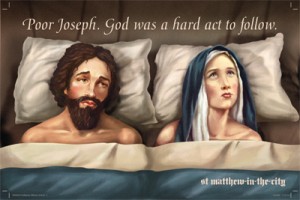
    I recalled this event this morning as I heard that the controversial Christmas billboard, put up by St Matthews in the City, has been taken down. For those outside of Auckland, St Matthews in the City is an Anglican congregation that propounds, what they like to call, “progressive Christianity.” They recently put up a billboard showing Mary and Joseph in bed, not looking too happy, with the line “poor Joseph, God was a tough act to follow.” The billboard implies quite clearly that God not only literally had sex with Mary, was a fantastic orgasmic lover but it also, by implication, entails that God committed adultery, and so did Mary.

    Mary and JosephI am glad the billboard is down (though I will not endorse the  reported method) for the obvious reason that it is insulting to other people and, prima facie, it is wrong to insult other people. Of course, there can be situations, such as where a person does something wrong, that the appropriate response is to insult them but absent such situations, charity dictates that we refrain from doing so. Millions of people world-wide worship God and millions of Roman Catholic venerate Mary, this billboard affirmed that persons they love and adore are adulterers.

    Of course some are saying that this is just a joke and we Christians should get a sense of humour. I always find this response disingenuous. Suppose I, for a joke, put a picture of the vicar of St Matthews, Glyn Cardy and his wife, outside my Church, made both of them look not so happy, and added the phrase “Glyn Cardy is as soft and floppy as his theology,” right there, in public – outside my church let’s not forget – for all to see. Would the response, ‘oh come on it’s only a joke, get a sense of humour,’ wash with anyone? I doubt it. If I were a gambler I would bet we would hear another of Cardy’s little sermons about how this is proof of the narrow-minded intolerance that non-progressive Christians like me expound. But then wouldn’t it be evident that neither Cardy nor anyone else believes that humor justifies making insulting personal comments of this nature?

    Of course in many ways this whole event shows up the intellectual shallowness that so called “progressive Christians” show towards others. Take Cardy’s justification for the billboard according to Stuff, Cardy states,

    St Matthew’s church says the aim is to provoke conversation about spiritual matters by lampooning the literal Christian conception story and inviting people to think again about what a miracle is … He said the idea behind the billboard was to move a debate that was inside the church to outside it ”and certainly people in all sorts of places are talking about it”. He didn’t doubt that some people had been offended by the billboard, but ”the literalness of a male God impregnating Mary needs to be laughed at”.

    Note two things here, first Cardy clearly caricatures the “literal conception story” yet mainstream Christendom, who believes this story, do not hold that God is literally a man and that he had sex with Mary. God in traditional theology is immaterial, he has no sex organs and the story of a virginal conception is just that, a virginal conception. Cardy, of course, being theologically trained, knows this. Second, Cardy on calling for “debate” means that people who hold orthodox Christian views “needs to be laughed at.” So Cardy’s understanding of theological debate apparently involves deliberately distorting and caricaturing the views of other people and then responding, not with reasoned argument, but ridicule.

    I might be a bit too conservative and old fashioned but in my book theological argument involves trying to understand another’s position by trying to grasp the best representative examples of it so one can articulate it accurately and then offer sound arguments or reasons for rejecting it or for showing where and why it is flawed. It also involves treating ones interlocutors with respect. Of course I do not always live up to this ideal but it is one that I think Theologians should aspire to.

    The fact that Cardy and St Matthews thinks otherwise tells us a bit about them and their “progressive Christianity.” People who think it is ok to ridicule and insult people simply because they hold a different religious perspective to them, who will dishonestly distort other’s views and responds to being challenged on this, not by reason, but by self-confident ridicule is not “progressive” and no amount of relabeling it will change this fact.

  • Does Abortion Benefit the Fetus? A Critique of Himma Part 1

    This series was developed from the paper I gave to the Auckland STAANZ Conference: Eschatology and Pneumatology.

    In Is Abortion Liberal? I suggested that one cannot simultaneously affirm the harm principle, accept that a fetus is a human being, and support permissive abortion laws. If abortion is homicide then it harms a human being, and the harm principle entails that we should prohibit harmful actions.

    Kenneth Einar Himma contests this conclusion. Himma argues that even if one grants that a fetus is a human being, feticide (the killing of a fetus) does not harm the fetus. Consider the doctrine of final punishment which is articulated in chapter 33 of The Westminster Confession of faith.

    I. God hath appointed a day, wherein he will judge the world in righteousness by Jesus Christ, to whom all power and judgment is given of the Father. … all persons, that have lived upon earth, shall appear before the tribunal of Christ, to give an account of their thoughts, words, and deeds; and to receive according to what they have done in the body, whether good or evil.

    II. The end of God’s appointing this day, is for the manifestation of the glory of his mercy in the eternal salvation of the elect; and of his justice in the damnation of the reprobate, who are wicked and disobedient. For then shall the righteous go into everlasting life, and receive that fullness of joy and refreshing which shall come from the presence of the Lord: but the wicked, who know not God, and obey not the gospel of Jesus Christ, shall be cast into eternal torments, and punished with everlasting destruction from the presence of the Lord, and from the glory of his power.

    Himma suggests that, to be plausible, this doctrine should be interpreted so that human beings who lack moral culpability, are saved directly by Gods mercy.

    Insofar as culpability presupposes moral knowledge, someone who lacks moral knowledge through no fault of her own is incapable of culpability and is hence exempt from divine punishment. Thus, for example, someone who instantiates a severe cognitive disability is saved without regard to either her behaviour or her attitude towards Christian doctrine. Such a person is saved no matter how she behaves or what she believes.

    The same is true of children before they have developed the capacity for moral reasoning. Such persons are incapable of culpability in either deed or belief and, as Abelard puts the point, “Are saved without merit of their own, as for instance, infants, and attain eternal life by grace alone.”1

    Himma is not alone in thinking this is the most plausible interpretation of this doctrine. Loraine Boettner, citing Charles Hodge, W. G. T. Shedd, and B. B. Warfield, notes “most Calvinistic theologians have held that those who die in infancy are saved,”2 these theologians, “entertained a charitable hope that since these infants have never committed any actual sin themselves, their inherited sin would be pardoned and they would be saved on wholly evangelical principles.”3

    The implication for feticide is obvious; fetuses have not yet developed the capacity for moral reasoning, hence, according to the Eschatological doctrines Himma has sketched, “fetuses that die before birth are, as a matter of moral necessity, saved without regard to personal merit”4 hence they are “as a matter of moral necessity saved without regard to personal merit.” Himma contends that abortion does not harm the fetus but, in fact, benefits it;

    It can plausibly be argued that premature death conduces maximally to the fetus’s self-interest. To see this, imagine yourself in the following situation. While in the womb, you are temporarily made fully rational and offered the choice between premature death and the opportunity to live a worldly life. The choice is expressed as follows. Should you choose a premature death, you will immediately experience a profound and eternal bliss – an ecstasy beyond any possible in this world. Should you choose an opportunity to live a worldly life, you will be judged at the end of your life for your deeds and beliefs. If you are judged favorably, you gain eternal bliss; if not, you will suffer eternal torment. You are also told there are many temptations that may lead you down a path that culminates in an unfavorable judgment so that the risk of such torment at the end of your worldly life is substantial. Finally, you are told that, after having made our choice, you will forget everything you have been told. Assume that you have no idea whatsoever of what your post-natal circumstances will be. What should you do? 5

    Himma suggest that a rational person would choose to be killed. This is because “the odds of a favourable judgment after a worldly life are probably not in [anyone’s] favor.”6 He notes that if the probability of a favourable judgment is “less than 1. The smallest chance of an unfavorable judgement”7 is multiplied by an infinite cost. Whereas any benefits one gains from a worldly life will be finite.

    Consequently, even if one grants that a fetus is a human being, traditional Christian eschatology entails that a fetus is not harmed if it is killed via an induced abortion. The harm principle, however, affirms that the state should permit, and people should have a legal right to engage in, any activity that does not harm another person; consequently, there should be a legal right to procure an induced abortion.

    Novus Actus Interveniens Objection

    Mark Murphy has argued that Himma’s argument errs by suggesting that the thesis of infant salvation entails that fetuses and infants are not harmed by being prematurely killed. He writes,

    If the fetus enjoys the beatific vision upon being aborted … the fetus’ enjoying that good is caused not by the agent’s act of aborting the fetus but by God’s graciously conferring the gift of eternal life on the child. For not every good or evil that occurs downstream from an act counts as a benefit or harm conferred by that act. This is particularly clear in those cases in which the benefit or harm would not have occurred but for some agent’s free intervention. That the causal chain from act to effect is broken by the intervention of a free agent is a standard view, both in common sense’s attribution of responsibility and in the law’s.8

    Murphy illustrates the point with an example,

    If … a traveler is beaten and left for dead by robbers, is rescued by a Samaritan, and by this transformative experience comes to have a much better life than he or she would otherwise have had, it is nevertheless incorrect to say that the robbers did not harm, or even benefited, the traveler. The robbers merely harmed the traveler; the Samaritan benefited the traveler.9

    Murphy here appeals to the common law doctrine novus actus interveniens. He notes that there is a difference between what a person causes and what one foresees will be caused by others in response to what one does. In a discussion of the doctrine of double effect, utilised in post-reformation Catholic casuistry, Donagan suggests that Catholic and Kantian ethicists,

    … and in general, all moralists who accept the freedom of the will in a non-combatibilist sense, limit an action’s effects, and a fortiori what its agent intends to bring about in doing it, to those that follow from it in course of nature and the ordinary operation of social institutions, and from the free reactions of others to it. (Thus actions in the ordinary course of business, for example, those of postal officers in delivering a letter that has been mailed, are not counted as free reactions.) The principle on which they do is that a free reaction to an action, is a ‘new action’ (‘novus actus’), the effects of which are their effects, and not those of the action to which they are reactions.10 [Emphasis added]

    Donagan does note that another person’s actions can be considered an effect of one’s actions if they follow in the ordinary operation of social institutions. For example, if I mail poison to another person and this kills him or her then I have killed him or her despite the fact that numerous other people’s actions intervened between my action of placing the poison in the mailbox and the person’s death. This is because social institutions are in place whereby the mail service acts as an agent on my behalf and such institutional rules mean that my actions can be attributed to it.11 For similar reasons, taking out a contract to kill another is culpable homicide because the institution of contract means that the killer kills on my behalf and hence I act in his or her actions. In the absence of such institutions, the free actions of others to my actions are not effects that I cause. Donagan notes that in some situations12 a person is culpable of wrongdoing if he does something which he foresees will be met with an immoral action on the part of others. However, he does not cause these actions.

    I think this is plausible. Augustine proposed the following example. Suppose a man approaches a woman and tells her that he will kill himself if she refuses to have sex with him. Does that mean that she is a murderer if she refuses?13 Her refusal would not constitute homicide even though his death is a foreseeable result of her choice. Although she foresaw his or her death, she did not cause it. It was caused by the free decision of the tempter to commit suicide. Similarly, a company knows that some people will use the roads they build to engage in reckless conduct that will kill innocent people.

    Applied to the context under discussion, a person who kills a fetus causes the evils inflicted on the fetus, such things as, damage to the fetus’s bodily integrity and deprivation of their earthly life. However, these actions do not cause the fetus to attain eternal life; this is brought about by the gracious mercy of God. Hence when a person kills a fetus they do not benefit it, they only cause it harm.

    In my next post in this series I will argue that Himma’s response to this line of argument fails.

    1Kenneth Einar Himma “No Harm, No Foul: Abortion and the Implication of Fetal Innocence” 19:2 Faith and Philosophy (2002) 179.
    2
    Loraine Boettner The Reformed Doctrine of Predestination by Loraine Boettner The Presbyterian and Reformed Publishing Company
    (Philadelphia, PA; 1963) 143.
    3
    Ibid.
    4Himma “No Harm No Foul” 179.
    5Ibid 180.
    6
    Ibid.
    7Ibid.
    8Mark Murphy “Pro-Choice and Presumption: A Reply to Kenneth Einar Himma” 20:2 Faith and Philosophy (2003) 241.
    9Ibid.
    10Alan Donagan “Moral Absolutism and the Double-Effect Exception: Reflections on Who Is Entitled to Double-Effect?” 16 Journal of Medicine and Philosophy (1991) 498.
    11This is not to say that an agent acting unknowingly, such as the mail-man, is culpable for this action only that his actions are attributable to me. If I therefore do this willingly, I am culpable for his actions on my behalf while he is not.
    12
    Theses situations are ones where one incites, induces or persuades a person to engage in wrongdoing or where in “pursuing his legitimate ends, a man finds that several effective courses of action are open to him, each legitimate in itself , but one of which will be foreseeable be met with a wrongful action by somebody else.” Alan Donagan The Theory of Morality (University of Chicago Press, Chicago; 1979) 48-50.
    13 Augustine On Lying 9.
  • Plantinga & Ruse on Methodological Naturalism & Science Definitions

    Michael Ruse (and many others) contend that science is constrained by methodological naturalism, which is the thesis that that neither the data, for a scientific investigation, nor a scientific theory nor the background beliefs, against which a theory is assessed, can properly refer to or contain supernatural beings or propositions based on revelation. In Darwinism Defended Michael Ruse seems to think science, by the very definition of science, is constrained by methodological naturalism.  He writes,

    Furthermore, even if Scientific Creationism were totally successful in making its case as science, it would not yield a scientific explanation of origins. Rather, at most, it could prove that science shows that there can be no scientific explanation of origins. The Creationists believe that the world started miraculously. But miracles lie outside of science, which by definition deals only with the natural, the repeatable, that which is governed by law.[1]

    Ruse’s specific target here are creationists who typically contend that the world was created around 6-10 thousand years ago, in 6×24 hour days and that the fossil record is the result of a world-wide flood. However, the definition he offers excludes far more than this specific position. Ruse’s definition entails that any reference to God’s activity is unacceptable in scientific theorising. Any claims such as that the universe was created (in some way or another), that God created the universe ex nihlo, that God sustains the universe, upholds laws of nature God or even theological interpretations of the big bang and the advocacy of theistic evolution would be ruled out as non scientific.

    Moreover, this ruling out is a prori. It is not that scientists have examined whether God exists, that they have gathered evidence showing he does not exist and this has become a settled, peer-reviewed, consensus; science has, in fact, done no such thing. Further, Ruse is clear that his definition would hold even if God does exist and even if there is compelling evidence for his existence. Science would not consider such facts in its theorising; the very rules governing scientific inquiry would rule it out of consideration from the outset. This is because, according to Ruse, science by definition deals only with what is:

    (i) natural;
    (ii) repeatable;
    (iii) law-governed.

    Elsewhere in the same article Ruse defines in more detail what he means by (iii). He states,

    [A]n approach to the empirical world that demands understanding in terms of unbroken law. That is to say, understanding in terms of regularities, which in some way or an other we feel are more than mere contingencies, but rather part of the necessary succession of the empirical world.[Emphasis added][2]

    Ruse contends that science only postulates and presupposes objects and properties that are natural, repeatable and governed by laws of nature. He understands these as regularities grounded in some form of necessary succession.

    Plantinga’s critique
    Alvin Plantinga argues that Ruse’s definition of science is mistaken,

    What about the Big Bang: if it turns out to be unrepeatable, must we conclude that it can’t be studied scientifically? And consider the claim that science, by definition, deals only with that which is governed by law—natural law, one supposes. Some empiricists (in particular, Bas van Fraassen) argue that there aren’t any natural laws (but only regularities): if they are right, would it follow that there is nothing at all for science to study?[3]

    Plantinga here suggests that Ruse’s conditions (ii) and (iii) are subject to straightforward counter-examples and that, as such, his definition is mistaken. In Methodological Naturalism Under Fire Ruse responds to both these criticisms. Below I will examine Ruse’s response and argue that it is unsuccessful.

    The Repeatability Requirement
    Turning to (ii), Plantinga notes that on at least one possible cosmological model the big bang is unrepeatable. Despite this studies into the first instant of the big bang are clearly parts of science and would continue to be so even if this model is true and the big bang is unrepeatable. It follows from this that science can study unrepeatable events which renders (ii) false.

    Ruse’s response is two-fold; first Ruse suggests that Plantinga is repeating a common line of argument,

    As a matter of fact, Plantinga here is raising an objection which has often been raised by critics of the claim that scientific understanding involves reference to law. His point, as was theirs, is that there are many unique events that science must surely try to cover and under stand, but that given the uniqueness of these events, in some sense this precludes lawful understanding.[4]

    Ruse then goes on to address this common line of argument,

    But, as many critics of the critics have countered, there surely has to be some thing wrong with this argument. Take for in stance the demise of the dinosaurs at the end of the Cretaceous. This was in it self a unique phenomenon and un repeat able; but, uniqueness not with standing, the demise was made up of many factors which can individually be brought beneath lawful under standing. To day, it seems most probable that an asteroid or a comet or some such thing hit the earth. This was no unique phenomenon, nor was the hit ting of the earth by the asteroid or comet such that the normal laws of nature – that is to say Galileo’s laws of motion – could not be applied.[5]

    Ruse’s response misses its target. Ruse construes Plantinga’s objection to be aimed at (iii), “the claim that scientific understanding involves reference to law.” This, however, is false. The appeal to the big bang was actually proposed as a counter example to (ii), Ruse’s contention that science deals only with repeatable events. The common line of argument Ruse responds to is not the line of argument Plantinga actually offers.

    Moreover, Ruse’s response fails to address Plantinga’s counter example completely. Plantinga’s counter example was based on big bang cosmology. Instead of showing that his definition can accommodate the big bang, Ruse instead notes that other people (not Plantinga) have offered a different counter-example, the extinction of the dinosaurs, and that this different counter example is unsuccessful. Ruse may well be correct; the extinction of the dinosaurs is not a valid counter-example to (iii) however, Plantinga never said it was. What he said was that the possibility that the big bang is unrepeatable is a counter-example to (ii) and to this line of argument Ruse says nothing.

    Requirement of Being Law-Governed
    Of course Plantinga does offer a response to (iii), the idea that science, by definition, deals only with what is governed by law but his argument against this is very different to an appeal to the extinction of the dinosaurs. Plantinga turns to the issue of being law-governed in the next paragraph and raises quite a different objection to this,

    Consider next the property of being governed by law. The first point, here, would be that the very existence of natural law is controversial; Bas van Fraassen, for example, has given an extended and formidable argument for the conclusion that there are no natural laws. There are regularities, of course, but a regularity is not yet a law; a law is what is supposed to explain and ground a regularity. Furthermore, a law is supposed to hold with some kind of necessity, typically thought to be less stringent than broadly logical necessity, but necessity nonetheless. … So suppose van Fraassen is right and there are no natural laws: would it follow by definition that there isn’t any science? That seems a bit strong.[6]

    Plantinga’s point is that some empiricists (in particular, Bas van Fraassen) argue that there are not any natural laws, there are only regularities. Regardless of whether one agrees with van Frassen or not, even if he is correct it clearly would not follow that science does not exist. This entails that the existence of science does not depend on the existence of laws of nature; hence it is a mistake to define the former in terms of the latter.

    Ruse’s response is as follows,

    Now, whilst I am the last per son to belittle the formidable philosophical powers of Bas van Fraassen – as eminent in the field of the philosophy of quantum mechanics as Plantinga is in the field of the philosophy of religion – what is being extrapolated here is far stronger than van Fraassen or any one else would want (should want) to claim. Certainly there are questions about how one might interpret the necessity of laws: I myself have al lowed that already. But neither van Fraassen, nor any one else is going to deny that there are certain sorts of regularities of some kind and that these are pre -supposed in the activity of science.[7]

    Here Ruse states the existence of science does not presuppose the existence of natural laws, it merely presupposes regularities in nature and this is compatible with the empiricist critiques of laws of nature. The problem is that this explicitly contradicts Ruse’s definition. Ruse states that science deals only with the natural, the repeatable and that which is governed by law. In elucidating this Ruse states that science is “an approach to the empirical world that demands understanding in terms of unbroken law. That is to say, understanding in terms of regularities, which in some way or another we feel are more than mere contingencies, but rather part of the necessary succession of the empirical world.” As Ruse defines science then it presupposes more than mere regularities. This position requires that these be necessary in some sense and it is precisely this understanding of laws of nature that empiricists, such as van Fraassen, do criticise.

    Ruse appears to be in a dilemma; if he accepts natural laws as necessary in some sense then his argument is subject to the objection Plantinga raises. Some empiricists reject the existence of laws so understood but even if they are correct it would be erroneous to claim that science did not exist. If Ruse contends that science need only presuppose regularities then his definition is false because his definition states science demands an understanding in terms of a necessity over and above mere regularity. It seems then that Ruse’s definition of science is problematic; if this is the case, attempts to argue for methodological naturalism on the basis of such a definition are unsound.


    [1] Michael Ruse Darwinism Defended (Reading, MA: Addison -Wesley, 1982) 322.
    [2]
    Ibid.
    [3]
    Alvin Plantinga “Religion and Science” Stanford Encyclopedia of Philosophy accessed 8 December 2009.
    [4]
    Michael Ruse “Methodological Naturalism Under Fire” South African Journal of Philosophy 24 (1) 2005 47.
    [5]
    Ibid.
    [6] Alvin Plantinga “Methodological Naturalism” Perspectives on Science and the Christian Faith 49 (September 1997).
    [7]
    Ruse, above n4, 48.

  • Contra Mundum: The Flat-Earth Myth

    A while back I made a passing comment on my blog criticising an advertisement which claimed that, prior to Columbus, the Church taught that the world was flat. In response I received the following email from a high-school student in the US,

    I’ve been studying Christopher Columbus in my history class and my history books say that prior to Columbus everyone did think the world was flat……..I don’t know if it was a mistake in the history book or your mistake…..but anyway….I guess I have some things to learn! God bless ~ Katie

    We have all heard the story behind this. Prior to Columbus, the Church and its theological scholars taught that the world was flat. For this reason they opposed Columbus’ proposed voyage in 1492 as they believed he would sail off the edge of the earth (or that he would prove them wrong and they would lose standing in society). Despite this Columbus sailed anyway and his rejection of the Church’s position was vindicated, he scored a victory for science and reason.

    My correspondent is correct. They do teach this in high school text books. I was taught it at both primary and high-school. In fact, not too long ago Prentice Hall published claims to this effect in their middle school textbook Prentice Hall Earth Science.

    At a philosophy conference at Otago University, shortly after I graduated, I recall one speaker using the example of “medieval flat-earthers” in his paper as an example of an irrational belief. Almost everyone in attendance nodded their heads in agreement; no one contested the historical assumptions implicit in the example. More recently Victoria University ran a slick television campaign stating that in the 14th century most people believed the world was flat. The ad showed a picture of a boat sailing across the sea only to fall over the side of the earth and concluded “It makes you think.”

    You might have gathered from obvious clues like the title and from the way I have set this article up that I dispute the veracity of much of these historical claims. If I state this publicly there are very few settings where this admission does not at least earn me an incredulous stare (as if I were, in fact, asserting that the earth was flat). Invariably some comment follows, “come on Matt, everyone knows this story is true, didn’t you learn this at school? Haven’t you read any history textbooks?”

    It is true that I did learn this story at school and that I have read it in more than one history textbook but because I took the time to research the history of theology when I was at university I know that this story is fiction. It is a slanderous fabrication invented by opponents of Christianity in the 19th century and has been thoroughly debunked by contemporary historians of science.

    The definitive study is undoubtedly that of Jeffrey Burton Russell in Inventing the Flat Earth: Columbus and Modern Historians. Russell summarised his findings, in a paper presented to the 1997 American Scientific Affiliation Conference, as follows,

    [W]ith extraordinary few exceptions no educated person in the history of Western Civilization from the third century B.C. onward believed that the earth was flat. A round earth appears at least as early as the sixth century BC with Pythagoras, who was followed by Aristotle, Euclid, and Aristarchus, among others in observing that the earth was a sphere. Although there were a few dissenters—Leukippos and Demokritos for example–by the time of Eratosthenes (3 c. BC), followed by Crates(2 c. BC), Strabo (3 c. BC), and Ptolemy (first c. AD), the sphericity of the earth was accepted by all educated Greeks and Romans.

    Nor did this situation change with the advent of Christianity. A few—at least two and at most five—early Christian fathers denied the spherically of earth by mistakenly taking passages such as Ps. 104:2-3 as geographical rather than metaphorical statements. On the other side tens of thousands of Christian theologians, poets, artists, and scientists took the spherical view throughout the early, medieval, and modern church. The point is that no educated person believed otherwise.

    Russell traced the story about Columbus and medieval flat-earthers back to the 19th century; it originated in a fictional novel by Washington Irving The Life and Voyages of Christopher Columbus I (1829). Later it was picked up by two influential books, John Draper’s History of the Conflict between Religion and Science (1874) and Andrew Dickson White’s book A History of The Warfare Between Science and Theology in Christendom. These books famously used the Columbus story plus many others to defend the thesis that the Church, for centuries, suppressed science and worked to prevent its flourishing; this is known as the conflict thesis.

    These books and the conflict thesis they spawned, are highly influential in popular science and media coverage of theological and scientific issues today despite most historians rejecting them as propaganda. In The Encyclopedia of the History of Science and Religion, Collin Russell notes,

    Draper takes such liberty with history, perpetuating legends as fact that he is rightly avoided today in serious historical study. The same is nearly as true of White, though his prominent apparatus of prolific footnotes may create a misleading impression of meticulous scholarship.

    Steven Shapin wrote in the same vein in The Scientific Revolution,

    In the late Victorian period it was common to write about the “warfare between science and religion” and to presume that the two bodies of culture must always have been in conflict. However, it is a very long time since these attitudes have been held by historians of science.

    Numerous other specialists in the field of the history of science and religion concur that the existence of medieval flat-earthers is a myth. Numbers and Lindberg noted in a journal article, “there was scarcely a Christian scholar of the Middle Ages who did not acknowledge [Earth’s] sphericity and even know its approximate circumference.” In his study of medieval cosmology, God and Reason in the Middle Ages, distinguished historian Edward Grant noted that,

    All medieval students who attended a university knew this. In fact any educated person in the Middle Ages knew the earth was spherical, or of a round shape. Medieval commentators on Aristotle’s “On the Heavens” or in the commentaries on a popular thirteenth century work titled “Treatise on the Sphere” by John of Sacrobosco, usually included a question in which they enquired “whether the whole earth is spherical”. Scholastics answered this question unanimously: The earth is spherical or round. No university trained author ever thought it was flat.

    Draper’s and White’s books remain widely cited despite being debunked as historically inaccurate. In fact, the kinds of textbooks Katie mentioned have been subject to scathing criticism precisely for making the aforementioned claims. Lawrence S. Lerner, a professor in the Department of Physics and Astronomy at California State University who is a member of the panel that wrote the 1990 framework for science education in California’s public schools criticised Pretence Halls history text denouncing it as “ignorant fakery.” In an article entitled “Fake ‘History’ That Is Flatly Wrong,” Lerner described the flat-earth claims as a “popular piece of pseudo historical folklore” he added that it “remains popular today among people who have had little education. These evidently include the people who produce ‘science’ books for Prentice Hall.”

    The historical facts are difficult to dispute. During the, so called, “dark ages” Boethius (480-525) cited a well known and accepted ancient Greek cosmological model that affirmed the sphericity of the earth in the Consolidation of Philosophy. Isidore of Serville (560-636) affirmed a round earth in the Etymologies. Bede (672-735) in The Reckoning of Time taught the earth was round; as did Rabanus Marcus in the ninth century.

    The late middle-ages are no different. Hemannus Contractus (1013-155) measured the circumference of the world. Hildegard of Bingen (1098-1179) taught the world was round as did John of Sacrbosco (1200-1256) and Peire d’Ailly (1350-1420). Dante’s Divine Comedy portrays the earth as a sphere. In the Summa Theologicae Thomas Aquinas wrote,

    The physicist proves the earth to be round by one means, the astronomer by another: for the latter proves this by means of mathematics, e.g. by the shapes of eclipses, or something of the sort; while the former proves it by means of physics, e.g. by the movement of heavy bodies towards the center, and so forth.

    Even medieval textbooks taught the world was round. Both the Elucidarium of Honorius Augustodunensis, a twelfth century manual for educating clergy, and On the Sphere of the World, the standard cosmological textbook of medieval universities in the 13th century, taught that the world was round.

    As I have delved into religious history further I have found that this had not been the first or only instance where I was fed false propaganda about Christianity. I could document several other false versions of history; the flat-earth story will suffice for now. As New Zealand blogger Contra Celsum wrote, “the flat earthers are those who think they existed.”

    I write a monthly column for Investigate Magazine entitled Contra Mundum. This blog post was published in the December 09 issue and is reproduced here with permission. Contra Mundum is Latin for ‘against the world;’ the phrase is usually attributed to Athanasius who was exiled for defending Christian orthodoxy.

    Letters to the editor should be sent to: editorial@investigatemagazine.DELETE.com

    RELATED POSTS:
    The “Dark Ages” and Other Propaganda
    More on the “Dark Ages” and Other Propaganda
    Things They Don’t Teach you in Public Schools…
    The Flat Earth Myth
    Guest Post: Dan Brown’s History of Science

  • Auckland STAANZ Conference: Eschatology and Pneumatology UPDATED

    The Systematic Theology Association in Aotearoa New Zealand (STAANZ ) are this week holding a conference in Auckland focusing on eschatology and pneumatology.

    What: STAANZ Conference on Eschatology and Pneumatology
    When: Thursday 19 November – Friday 20 November 9:00am-5:30 pm
    Where: Ponsonby Baptist Church, 43 Jervois Rd, Auckland
    Cost: $15

    Pre-conference prayer will be held at 8:00am at All Saints in Ponsonby, 284 Ponsonby Rd, Auckland.
    Dinner at a local restaurant will be organised for the Thursday night.

    Speakers are as follows: [UPDATED]

    Thursday
    “Holy Spirit in the theology of Walter Kasper” – Hugh Bowron
    “Backgrounding Walter Kasper’s Early Thought”- John Dunn
    “Wandering between two worlds: 19th Century Reflections on Hope and Hell” – Carolyn Kelly
    “Conscious Awareness of the Spirit in Symeon the New Theologian” – Jim McInnes
    “Searching for Embers” – Susan Adams & John Salmon

    Friday
    “Abortion, Harm and Eschatology” – Matthew Flannagan
    “Infant Salvation: Is God’s Mercy Enough?” – Myk Habets
    “Participatory Glory : The Eschatological Direction of Karl Barth’s Theology of the Cross”— Rosalene Bradbury
    “The Spirit and Longing” – Judith Brown
    “Filioque, Personhood and Ecclesiology” – Scott Kirkland

    The abstract for Matt’s topic “Abortion, Harm and Eschatology” is as follows:

    In No Harm No Foul: Abortion and the Implications of Fetal Innocence Kenneth Einar Himma offers what I shall call ‘the eschatological argument for abortion rights.’ Himma argues that because a fetus lacks the mental capacity to be culpable for any sin, a plausible Christian eschatology entails that a person who kills a fetus does not actually harm the fetus. Instead feticide benefits the fetus by sending the person killed straight to the afterlife, thus avoiding the possibility of any risk of future sin and consequent damnation. Given abortion does not harm the fetus, and as one should only legally proscribe harmful actions, it follows that abortion should be considered a woman’s right. In this paper I will criticise the eschatological argument for abortion, arguing it has absurd implications that entail infanticide and killing the disabled. Further, that even if one grants the eschatological assumptions implicit in Himma’s critique, abortion does, in fact, harm the fetus.

    Whilst Matt’s paper will find its way onto this blog, it is always nicer to hear it delivered in person so if you are free Friday morning he will be delivering it from 9:00-10:00 am.

  • “My Ways are Not Your Ways” Notre Dame Conference

    In September this year, the centre for Philosophy of Religion at the University of Notre Dame hosted a conference entitled “My Ways Are Not Your Ways”; the proceedings of the conference can be seen at the previous link and is a good resource.

    The theme of the conference, as outlined on Notre Dame’s webpage,  is as follows;

    Adherents of the Abrahamic religious traditions contend that human beings are made in the image of God and that modeling the character of God in one’s life represents the pinnacle of human flourishing and moral perfection. Defenders of this tradition commonly point to passages in the canonical texts of the Jewish and Christian faiths that portray God as loving, merciful, patient, etc. in support of such a position. Since the seventeenth century, however, numerous critics of these Abrahamic traditions have argued that God, especially in the Hebrew Bible, is often portrayed as anything but a moral role model.

    On the one hand, historical narratives in these texts describe God apparently committing, ordering, or commending genocide, slavery, and rape among other moral atrocities. On the other hand, a number of commands purportedly issued by God seem to commend bigotry, misogyny, and homophobia. In recent days, similar criticisms of the Abrahamic traditions have been raised by philosophers (Daniel Dennett), scientists (Richard Dawkins and Sam Harris), social commentators (Christopher Hitchens), and others.

    Are these apparent commendations and commands of the Hebrew Bible consistent with the claim that the Abrahamic God is perfectly good and loving? Those defending this tradition have two avenues of response open to them. The first response would be to argue that the aforementioned troubling narratives or commands should simply be rejected. Those taking this approach would have to explain how they think such passages could be rejected without placing in peril the Abrahamic religions, which have traditionally claimed that the Hebrew Bible is, represents, or contains the inspired word of God. The second response would offer explanations aiming to show that the apparently untoward consequences can be avoided without rejecting the narratives or commands. Those taking this approach must explain either why the untoward consequences do not follow, or why they are not, in the end untoward.

    However, while defenders of this tradition have both routes available to them, few of these defenders seem to have taken the challenge to heart. Despite these recent, forthright criticisms, only a handful of theologians or philosophers in these traditions have sought to respond to the criticisms.

    The present conference aims to remedy this deficiency, taking as its focus the charge that the Abrahamic tradition should be rejected because of its foundation in the Hebrew Bible, which portrays God as immoral and vicious.  The presenters and commentators include philosophers—both theistic and nontheistic—as well as Biblical scholars.

    For those who are interested, Michael Rea from Notre Dame has put the entire conference online (including the Q & A).

    Enjoy 🙂

  • Guest Post: Dan Brown’s History of Science

    This guest post was submitted by Dr James Hannam. Dr Hannam is a UK based historian with degrees in physics and history from the Universities of Oxford and London and a PhD in the history of science from the University of Cambridge. He blogs at Quodlibeta.

    The film adaptation of Dan Brown’s Angels and Demons was released this year and, on top of Brown’s new novel, appears to have done a roaring trade. Reports suggest that this is a better effort by director Ron Howard than his The Da Vinci Code, although most critics would feel that making a worse film would have been a stiffer test.

    For those lucky enough to be unfamiliar with the book, Angels and Demons is set in Rome where hunky Harvard symbologist Robert Langdon, played by Tom Hanks, is trying to prevent the Illuminati from detonating an anti-matter bomb.  According to Dan Brown’s alternative view of history, the Illuminati are a secret society of scientists (Copernicus and Galileo were, of course, members) who were persecuted by the Catholic Church.  After a great purge in the seventeenth century, we learn, the society went underground and plotted revenge. For some reason, it has taken them over three hundred years to get their act together.

    The Da Vinci Code launched the literary careers of a whole faculty previously-obscure professors of New Testament Studies. Admittedly, they had good reason for wanting to put the record straight about Brown’s distortions of early Christian history.  This time, it’s historians of science who might be upset by Brown’s misrepresentation. Because his contention that the Catholic Church has spent the last two millennia holding back the advance of science is as wrongheaded as the story that Mrs Jesus retired to the south of France with her kids.

    Of course, it’s not just Dan Brown who believes in the battle between science and religion. While few people think that the Illuminati really were a group of scientists suppressed by the Church, the perception of an eternal conflict between reason and faith is widespread. It’s true that the Church did make a single significant mistake in 1616, when it banned Copernicus’s opinion that the earth orbits the sun. But the subsequent trial of Galileo over the issue had more to do with papal self-esteem than astronomy. And even in this case, the Catholic Church was siding with the scientific consensus of the time. Still, you can’t manufacture an eternal conflict from a single example, so proponents of the hypothesis have had to resort to a different strategy – inventing the evidence.

    For example, in the book of Angels and Demons, Brown alleges that the Church had Copernicus murdered for his heliocentric model. While this is a more extreme allegation, there is a general belief that Copernicus feared persecution for his ideas. It’s widely thought that he refrained from publishing them until he was on his deathbed. In fact, he had circulated a pamphlet outlining his theory decades before he died. This was favourably received by senior churchmen and he was urged to publish by a cardinal. He even dedicated his great book, On the Revolutions of the Heavenly Spheres, to the Pope.

    Alas, as long as the likes of Dan Brown sell far more books than historians of science, this is a myth that is unlikely to go away.

    James Hannam’s book God’s Philosophers: How the Medieval World Laid the Foundations of Modern Science is published by Icon. The best price we could find for it from a New Zealand bookseller, with free delivery, was through The Nile Online Bookstore at the above link. International readers can buy it through Amazon. As I have previously stated elsewhere, it would make a good Christmas gift…

    RELATED POSTS:
    The “Dark Ages” and Other Propaganda
    More on the “Dark Ages” and Other Propaganda
    Things They Don’t Teach you in Public Schools…
    The Flat Earth Myth
    Contra Mundum: The Flat-Earth Myth