Category: Theology

  • An Interesting Comparison

    This from Occupy Democrats:
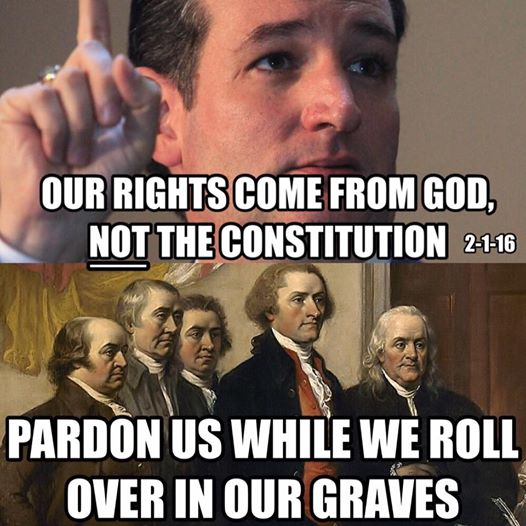
    12647129_1058653647561022_4746717199189857381_n

    This from the Unites States Founding Fathers:

    When in the Course of human events, it becomes necessary for one people to dissolve the political bands which have connected them with another, and to assume among the powers of the earth, the separate and equal station to which the Laws of Nature and of Nature’s God entitle them, a decent respect to the opinions of mankind requires that they should declare the causes which impel them to the separation.

    We hold these truths to be self-evident, that all men are created equal, that they are endowed by their Creator with certain unalienable Rights, that among these are Life, Liberty and the pursuit of Happiness.–That to secure these rights, Governments are instituted among Men, deriving their just powers from the consent of the governed, –That whenever any Form of Government becomes destructive of these ends, it is the Right of the People to alter or to abolish it, and to institute new Government, laying its foundation on such principles and organizing its powers in such form, as to them shall seem most likely to effect their Safety and Happiness. Prudence, indeed, will dictate that Governments long established should not be changed for light and transient causes; and accordingly all experience hath shewn, that mankind are more disposed to suffer, while evils are sufferable, than to right themselves by abolishing the forms to which they are accustomed. But when a long train of abuses and usurpations, pursuing invariably the same Object evinces a design to reduce them under absolute Despotism, it is their right, it is their duty, to throw off such Government, and to provide new Guards for their future security…

    We, therefore, the Representatives of the united States of America, in General Congress, Assembled, appealing to the Supreme Judge of the world for the rectitude of our intentions, do, in the Name, and by Authority of the good People of these Colonies, solemnly publish and declare, That these United Colonies are, and of Right ought to be Free and Independent States; that they are Absolved from all Allegiance to the British Crown, and that all political connection between them and the State of Great Britain, is and ought to be totally dissolved; and that as Free and Independent States, they have full Power to levy War, conclude Peace, contract Alliances, establish Commerce, and to do all other Acts and Things which Independent States may of right do. And for the support of this Declaration, with a firm reliance on the protection of divine Providence, we mutually pledge to each other our Lives, our Fortunes and our sacred Honor. (emphasis mine)

    Oceania is at war with Eastasia. Oceania has always been at war with Eastasia.
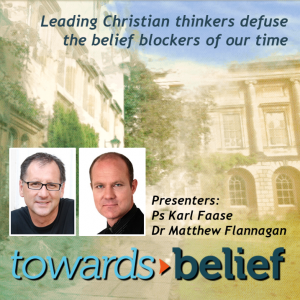
  • Towards Belief Auckland, 26 and 30 November 2015 – with Dr Matthew Flannagan

    Towards BeliefTakanini Community Church in Auckland are hosting a Towards Belief event with this blog’s Matt.

    Towards Belief follows Australian pastor and host, Karl Faase as he travels to the UK, USA and Australia to interview more than thirty leading authors, speakers and academics as they seek to defuse the top belief blockers of our time. This 10-session DVD series responds to the questions of the seeker and clarifies the answer for the Christian.

    Dr Matthew Flannagan, New Zealand theologian, apologist, author and teacher hosts the Towards Belief series for NZ churches, leadership teams, youth groups, study groups, small groups, and provides a Q&A opportunity as part of each session.

    Towards Belief

    Why Towards Belief is important – Matt’s take:

    In New Zealand today, there is a significant fall away rate of Christian youth upon attending University. A recent study by Fuller Theological Seminary in the US discovered that

    one of the most significant factors in determining whether a person who comes to the Christian faith as a teenager endures years later is whether they have been able to adequately discuss their intellectual doubts and questions with Christian leaders.

    Those who were able to explore such questions and gain some resolution were less likely to fall away whereas those who didn’t tended to leave the faith when confronted with questions at university.

    In addition to this the rise of social media, and popular books by people like Richard Dawkins or even movies like the Da Vinci code has meant that skeptical attacks on the Christian faith have become more popularised and more accessible to audiences previously who would only have been confronted with such issues in higher education. In light of this it’s crucial that the Church be willing to address the standard questions people are raising.

    The series introduction for pastors, youth leaders and key church staff involves free sessions involving Q&A and supper. Details are:

    7pm, Thu 26th/Mon 30th November
    Takanini Community Church
    160 Great South Road, Takanini, Auckland
    Register: info@takaninichurch.org.nz

    There is lots more information about this event on the event organiser’s Towards Belief page, including information as to how to book a Towards Belief course for your New Zealand church, so check it out.

    For more information in general about Towards Belief go here.

  • Hear Matt’s Three Talks on “Questions People ask”

    Recently Matt spoke at  Orewa Community Church, as part of their series on “Questions People ask”. His three talks: “How can there be just one religion?”, “How does God allow suffering?”, and “Hasn’t Science disproved Christianity?” are all available to listen online to here.

    Real Questions People Ask

  • Richard Carrier and the “Infantile” objection to God’s command’s

    In his article, “Why Traditional Theism Cannot Provide an Adequate Foundation for Morality”, Walter Sinnott-Armstrong argued that a “Divine command theory makes morality childish.”[1]

    In my response to Armstrong, “Is Ethical Naturalism more Plausible than Supernaturalism?”[2] I made two points. First, I addressed a tangential point: that Armstrong’s argument caricatures divine command theory (“DCT”) by tacitly assuming that divine command theorists believe actions are wrong because God will punish us for doing them. Second, I called into question the analogy Armstrong draws between a child following one’s parents and humans following God.Carrier

    Richard Carrier, in his reply to my article, “On the Facts as we Know them, Ethical Naturalism is all there is”,[3] objects to both these responses.

    The motivation of punishment
    Carrier dismisses my first point as “disingenuous” stating,

    (a) that he is “not aware of any DCT advocate who is actually a universalist”; and

    (b) “Every time a DCT advocate has ever threatened or warned anyone of hell (or even just the loss of heaven) in reference to their behaviour, they expose what they really think the ground of Morality is: the fear of consequences.”[4]

    Neither argument is cogent. Let us look at (a) first. The philosopher most responsible for developing and defending DCT in the last fifty years, Robert Merrithew Adams, is a universalist. Given that Adams’ discussion is definitive, and most of the literature in the last thirty years discusses his arguments, Carrier’s claim that he is “not aware of any DCT advocate who is actually a universalist” speaks only to his lack of reading and knowledge of the subject.

    Premise (b) expresses a non-sequitur. Even if, as is true, many divine command theorists are not universalists and even if some have warned people about divine punishment, then it does not follow that those people believe that fear of punishment is the ground of morality. At most it shows that those people believe in divine judgement and they see it as one reason to avoid wrongdoing.

    An analogy might illustrate the mistaken logic here. All people I know believe that prisons exist and I have known some of them warn others that if they commit a crime they will go to jail. It does not follow from this that that these people believe that jail is the only reason one should not commit crimes.

    Straw manning Armstrong and missing the real target
    Carrier’s response to my second point fares little better. He makes two objections:

    (i): “[Armstrong’s] point about infantilization is not the point Flannagan is responding to. Flannagan thinks he means something to do with children obeying parents (and therefore we can build a comparable analogy to adults obeying God that does not infantilize).”

    (ii) that Armstrong’s real point, that “Adult moral reasoning is based on actually caring about the people affected by our actions and thus wanting to do good, as opposed to actually not wanting to do good but begrudgingly doing it anyway to avoid punishment” remains untouched.[5]

    Once again, both objections fail. In respect of (i), contrary to Carrier’s protestation, Armstrong does speak of children obeying parents and does draw an analogy between adults obeying God and children obeying their parents. Here is what Armstrong says:

    “A second objection is that the divine command theory makes morality childish Compare a small boy who thinks that what makes it Morally wrong for him to hit his little sister is only that his parents told him not to hit her and will punish him if he does. As a result, this little boy thinks that if his parents leave home or die then there is nothing wrong with hitting his little sister. Perhaps some little boys think this way but surely we adults do not think that Morality is anything like this.”[6]

    This section of Armstrong’s work was directly quoted in my article.

    This brings us to (ii), even if Armstrong was making the point Carrier attributed to him in this section of his paper, it is mistaken to conclude that I never addressed this (more…)

  • Did God Really Command Genocide? Summarised at Moral Apologetics

    Over at Moral Apologetics,  David Baggett and Mark Foreman, are undertaking the task of writing chapter summaries of Paul Copan’s and my book, “Did God Really Command Genocide?” The chapter summaries are available here.

    Moral Apologetics

  • God or Natural Law: A False Dichotomy

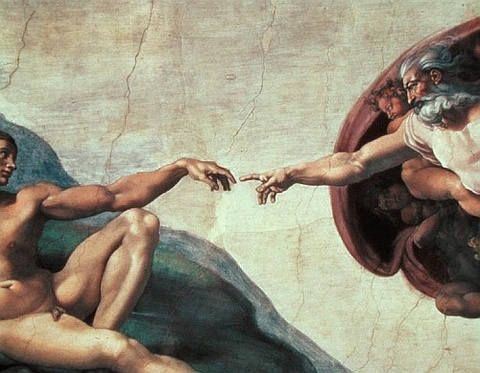
    A few weeks ago someone showed me a newspaper article entitled “New theory could prove how life began and disprove God”, which was published in the UK newspaper The Independent. Now I have, of course, heard media pronouncements of the nature published in this article frequently, reporters often seem to have a knack for making provocative pronouncements about the theological and philosophical implications of various theories (and one can usually take such prouncemants with a grain of salt), but this one caught my attention because of the unstated premise it contained. This premise is, I think, common in discussions about religion and science, which makes it worth addressing in its own right.

    Michelangelo's 'God Creates Adam

    The author’s commentary opens as follows:

    “A new theory could answer the question of how life began – and throw out the need for God. A writer on the website of Richard Dawkins’ foundation says that the theory has put God “on the ropes” and has “terrified” Christians. It proposes that life did not emerge by accident or luck from a primordial soup and a bolt of lightning. Instead, life itself came about by necessity – it follows from the laws of nature and is as inevitable as rocks rolling downhill. …”

    According to the author, the ‘new theory’ proposes that life arose from non-life by “natural necessity”, that is: according to the laws of nature. Interestingly, the author assumes the fairly standard account of ‘laws of nature’ whereby they are more than just regularities, they involve a kind of necessity that explains or grounds regularities.  The author draws the conclusion from the new theory that God does not exist.

    Now the author is not exactly clear on why this conclusion follows. One argument he seems to grope towards is that the new theory provides all sorts of problems for belief in God because someone on Richard Dawkins’ website says it does.  I suspect, however, that – apart from simple affirmations of faith in Dawkins blog – the author has something a bit more sensible in mind in his thinking.

    The premise is that: life arose from non-life, according to the laws of nature; the conclusion is that: God did not create life. The unstated assumption seems to that: if you can explain something by natural law then it follows that God did not do it.  Implicit in the reasoning is the assumption that appeals to natural law and God are rival and incompatible hypothesises; the truth of one excludes or rules out the other.

    I think anyone familiar with the history of theological thought should find this assumption odd. For (more…)

  • Hear Matt speak @ the Auckland Confident Christianity Apologetics Conference

    This ANZAC weekend make sure you check out the Thinking Matters Confident Christianity Apologetics Conference at Northcote Baptist Church. Matt will be speaking along with a number of other great speakers. Full conference schedule here.

    In brief, from the Thinking Matters’ Facebook Event page:

    Confident Christianity Conference

    Does God exist? Why is there so much suffering? Is truth relative? Are science and faith enemies?

    Can you give both intellectually and emotionally satisfying answers to these questions? Can you defend the Christian faith in a reasonable and compassionate way? Are you able to represent Christ’s message of hope, rescue and unfathomable love, even in the face of doubt and scepticism?

    Join us this Anzac weekend where a line-up of top international and local speakers will sensitively and skilfully respond to the biggest objections that Christians encounter today – and equip you to live out a confident, yet gracious faith in your everyday life.

    Speakers Include

    – Brett Kunkle – international youth speaker
    – Dr Jeff Tallon – award winning scientist
    – Dr Steve Kumar – philosopher & apologist
    – David Riddell – international speaker & counsellor
    – Mark Powell – business leader & CEO of The Warehouse
    – Dr Matthew Flannagan – philosopher & theologian

    And many others!

    Friday 24th April – 7:00PM – 9:30PM
    This is a FREE public event. No registration needed – just turn up!

    Saturday 25th April – 9:00AM – 5:00PM
    Full Day Conference. Tickets:

    ADULT:
    Early Bird Adult Registration $59 (Available until 17th April)
    Regular Adult Registration $69

    YOUTH (Under 18) & STUDENT (with ID):
    Early Bird Youth $30 (Available until 17th April)
    Regular Youth Registration $40

    Lunch included on Saturday (gluten free option available).

    ALL SATURDAY ATTENDEES ALSO RECEIVE A COMPLEMENTARY LEE STROBEL DOCUMENTARY DVD!

    For full details, a speaker lineup and to purchase tickets – check out our conference page: www.thinkingmatters.org.nz/conference