Tag: Apologetics

  • Easter Sunday: Contemplating the Resurrection Accounts

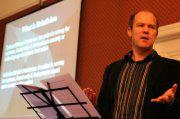
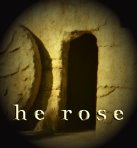
    He RoseMatt preached the Easter Sunday message at Takanini Community Church this morning. Listen to his message  “Contemplating the Resurrection Accounts” online or download it as an MP3.

    (Read Matthew 28:1-15 first.)

    Related post: Good Friday: The Ritual of Contemplating the Cross

  • Why Defend Christianity? Hear Matthew Flannagan speak on Thursday

    Matt is speaking for Thinking Matters on the topic Why Defend Christianity? This coming Thursday, from the Facebook Event:

    Matthew Flannagan“The Christian faith seems increasingly at odds with those in the world around us. From the media, to skeptical teachers and unbelieving peers, the gospel seems irrelevant and out of date. How do we talk to others about God and the Bible? Can we really argue people into the kingdom of God? Or should we just focus on compassion and loving others? Next Thursday, Thinking Matters Auckland is hosting Christian theologian Dr Matt Flannagan to speak on these questions and more. Matt will examine the Biblical and practical evidence for defending Christianity and show why it is vital to knowing and communicating our faith in the 21st Century. The event is free, so come along and bring a friend.

    Matt is a theologian and prominent New Zealand Christian commentator, debater, and blogger. He specialises in applied ethics and the interface between philosophy and theology. Currently, Matt works part-time as a teaching pastor and youth group leader for Takanini Church of Christ while he runs the popular blog MandM with his wife Madeleine.

    Thinking Matters is a New Zealand Christian ministry that exists to encourage the life of the mind in the love of God.”

    Thursday 4 April @ 7.30pm @ Auckland Chinese Presbyterian Church, 105 Vincent Street, Auckland, New Zealand

  • “Ask Dr Matt” this Sunday Night at Massey Presbyterian Church

    If you are in Auckland this Sunday evening come along to Massey Presbyterian Church and ask Matt your burning theological questions. From the Facebook Page for the event:

    Ask your questionSometimes we have unanswered questions about God, the bible and religion. Dr. Matthew Flannagan will host a questions night. He is a philosopher, theologian and apologist for the Christian faith. So dust off those questions! No questions are too silly, heretical or unworthy of attention (well almost none;p). You can either write them on the thread in the MPC fb page, or put them in the specially marked box at Church on the reception desk, or message me if you want to be anonymous. You can even ask them on the night. Dr. Matt will tackle your questions on the night (it will be recorded too if you can’t make it).

    Massey Presbyterian Church
    510 Don Buck Road, Auckland, New Zealand
    Sunday 8 July 2010 @ 7pm
    (Church cafe open from 6.15pm)

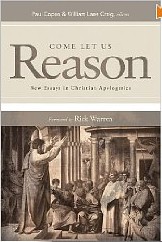
  • Come Let Us Reason: New Essays in Christian Apologetics – Available on Kindle or Pre-Order the Book, Feat. William Lane Craig, Paul Copan, JP Moreland, Gary Habermas, Matthew Flannagan et al.

    The kindle edition of Come Let Us Reason: New Essays in Christian Apologetics, published by B&H Academic, edited by William Lane Craig and Paul Copan and featuring Craig, Copan, JP Moreland, Gary Habermas, Craig Keener, Mary Jo Sharp, this blog’s Matthew Flannagan, and others, with the foreword written by Rick Warren, is now available at the link above on Amazon.

    The book version of Come Let Us Reason: New Essays in Christian Apologetics can be pre-ordered at this link on Amazon.

    Matt’s chapter is “Did God Command Canaanite Genocide?” Here is the editorial review from Amazon:

    Come Let Us Reason: New Essays in Christian ApologeticsCome Let Us Reason is the third book in a series on modern Christian apologetics that began with the popular Passionate Conviction and Contending with Christianity’s Critics. The nineteen essays here raise classical philosophical questions in fresh ways, address contemporary challenges for the church, and will deepen the thinking of the next generation of apologists. Packed with dynamic topical discussions and informed by the latest scholarship, the book’s major sections are:

    • Apologetics, Culture, and the Kingdom of God
    • The God Question
    • The Gospels and the Historical Jesus
    • Ancient Israel and Other Religions
    • Christian Uniqueness and the World’s Religions

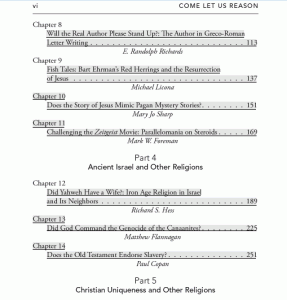
    Click to View the Table of Contents of Come Let us Reason

    Contributors include J. P. Moreland (“Four Degrees of Postmodernism”), William Lane Craig (“Objections So Bad That I Couldn’t Have Made Them Up”), Gary R. Habermas (“How to Respond When God Gives You the Silent Treatment”), Craig Keener (“Gospel Truth: The Historical Reliability of the Gospels”), and Paul Copan (“Does the Old Testament Endorse Slavery?”).

    Paul Copan is a professor and the Pledger Family Chair of Philosophy and Ethics at Palm Beach Atlantic University in West Palm Beach, Florida. He holds a Ph.D. in Philosophy from Marquette University.

    William Lane Craig is research professor of Philosophy at Talbot School of Theology in La Mirada, California. His Ph.D. in Philosophy is from the University of Birmingham in the United Kingdom.

    The Come let us Reason series is designed to bring scholarly work to the lay person so, depending on whether you prefer Kindle or book form, order or pre-order your copy now and let us know what you think.

  • Thinking Matters Youth Conference

    This Saturday is the first, of hopefully many, Thinking Matters Youth Conference, the schedule is  below.  I am leading a breakout session on Moral Relativism

    WHEN: Saturday, February 18
    WHERE: Greenlane Christian Centre, 17 Marewa Rd, Greenlane, Auckland
    COST: $10


    Schedule:
    10am Registration
    10.30am Jeff Tallon – Is Science a Threat to Faith?
    11.30am Sean McDowell – Is Faith Blind? (via Skype)
    12.15pm Lunch
    1pm Breakout Sessions 1

    • Stream 1: Is morality relative and does it matter? – Matt Flannagan
    • Stream 2: How can one religion be “right” and the others “wrong”? – Trevor Mander
    • Stream 3: Why doesn’t God do something about the evil in the world? – Ben Carswell
    • Stream 4: Does God get mad when we doubt? – Jason Kumar and Dominic Bnonn Tennant
    1.45pm Breakout Sessions 2 (repeated)
    2.30pm Tim McGrew – Is the Bible Reliable? (via Skype)
    3.30pm Q&A Panel – Jeff Tallon, Ben Carswell, Matt Flannagan, and Trevor Mander
    4.15pm Conference closes
  • Comparing the Old & New Teleological Arguments

    Robin Collins

    The “New Teleological Argument” is a theistic argument which attempts to show that theism is more probable than the postulate of an “atheistic single universe”[i]. There are number of reasons why this argument is termed the “New” teleological argument. Chief among these reasons is that its explanandum i.e. the incredible fine tuning of the laws and constants of physics have only been discovered in the past 20-30 years[ii] [iii]. By contrast, the explanandum of “Old Teleological Arguments” has long since been available to theologians and philosophers of religion. Of course the relatively recent origin of the “New” Teleological argument is not the only feature which distinguishes it from its historical counterpart. Whereas historical versions of design arguments (such as Paley’s famous watchmaker argument) rest on an argument from analogy, contemporary versions of the argument rest on what the philosopher of biology Elliot Sober calls the “Likelihood Principle”[iv] [v]. In other words, rather than relying on an analogy between the explanandum and some obviously contrived entity such as (in Paley’s case) a watch, contemporary versions of the teleological argument argue that the explanandum (the fine tuning of the laws and constants of physics) is more probable given the hypothesis of theism as opposed to the postulate of an atheistic single universe[vi].

    The Conditions of Success
    Throughout the rest of this post, I hope to argue that, on purely philosophical grounds, there is little which will allow us to say which version of the argument (be it contemporary or historical) is more or less plausible. In this respect, it seems only fair that we should assess the strength of David Hume’s critiques, since they are popularly regarded as decisive refutations of teleological arguments.[vii] [viii] It’s important to note also, that while the failure of the Humean critiques would not guarantee the conclusion that the design arguments are equally plausible, it is suggestive thereof. After all, if the joint failure of natural theological and atheological arguments should suggest that it’s impossible to arbitrate (on the evidence) between theism and atheism, then similarly, the failure of stock arguments against either of the design arguments should lead us to think that it’s impossible to arbitrate between them.  In spite of the fact that both contemporary and historical versions of the design argument are equally plausible, I will argue that the contemporary version of the argument has a number of key dialectic advantages which may warrant us in thinking that it is “dialectically speaking”, more successful than its historical counterpart. More precisely, I am saying that the relative success of the new teleological argument is a function of the fact that it does not turn on premises that are as deeply controversial as the commitments required by the historical version.

    The Contemporary Version of the Argument
    The most prolific contemporary defender of the design argument is Robin Collins who, rather than arguing from facts about biology, argues from recent discoveries in physics[ix]. As we noted earlier, this is one of the main reasons why it is termed the “New” teleological argument. Collins frames his rendition of the argument as follows:

    (1)     The existence of fine tuning is not improbable under theism[x]

    (2)     The existence of fine tuning is very improbable under the atheistic single-universe hypothesis[xi]

    Therefore, given the prime principle of confirmation[1] [xii],

    (3)     The existence of fine tuning is evidence for theism over the atheistic single-universe hypothesis[xiii]

    By “fine tuning”, I mean the very precise arrangement of the fundamental laws and constants of physics that must be met in order for our Universe to fall into the very narrow life permitting range.[xiv] [xv] According to contemporary physics, these conditions seem to be arranged in such a way that, were they to vary by even the tiniest amount, life (or more precisely, sentient life) would not be a physical possibility. For example, as P.C.W. Davies points out, a change in “the weak force”[2] by only 1 part in 100100 would make the Universe uninhabitable.[xvi] Similarly, if the cosmological constant[3] were just a fraction faster, matter would spread apart so quickly that even relatively small clumps of matter would have insufficient time to form[xvii].

    The Plausibility of the Premises
    Premise (1) amounts to the claim that if God exists, then it is entirely within His creative capability to create the universe finely tuned as it is. Hence the observation that there is a universe which exhibits teleo-functional properties is not surprising given the postulate of theism. Considering that the traditional conception of God holds that He is an omnipotent being, this is a fairly straightforward premise that we should accept.

    Premise (2) amounts to the claim that if God does not exist and if the single universe hypothesis is true, then the apparent fine tuning of the universe is a very surprising fact. After all, the fundamental laws and constants of physics seem to be arranged in such a way that their placement seems guided. But if God doesn’t exist, it doesn’t seem likely that there would be any intelligent, guiding mind such that it could plausibly account for this apparent fine tuning. Hence premise (2) seems (more…)
  • Hear Matt’s EPS Apologetics Conference Paper in Advance & Eat 3 Courses for $10 – This Weekend in Auckland

    We are going to the United States in November to, between us, give 4 talks to 4 different conferences that we have been invited to speak at (details below). We need to raise the funds to get there and so far we have raised about half of what we need thanks to the generosity of readers of this blog 🙂

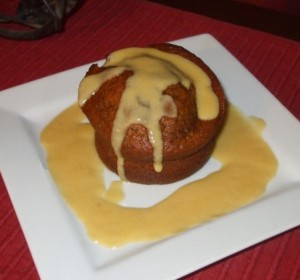
    Sticky Date Pudding with Maple Butterscotch Sauce - recipe at Mad | FoodMassey Presbyterian Church (“MPC”) has offered to help us put on a fundraising night where both of us will utilise our talents to bring you a three-course meal for $10 cooked by me (I cook see my cooking website Mad | Food) and a talk given by Matt “Can God Command Evil? The Problem of Apparently Immoral Commands” – this will be a slightly abridged version of the very same talk Matt will give to the EPS Apologetics conference in November so make sure you don’t miss it or you’ll have to fly to San Francisco to hear it!

    This event is happening this weekend at the MPC Night Church Service on Sunday 2 October. The starter and main will be served to your table before the service and the dessert will be served after. So please arrive at 6pm to be seated if you are coming for dinner; the service will start at 7pm.

    Menu

    (Diners choose 1 from each category)

    Entree:

    Creamy Tomato Soup – home made, mildly spiced (gluten free)

    MPC Bread – fresh-baked individual loaf with hummus

    Main:*
    White Chilli Chicken Enchilada – chicken, cannellini beans and mild mexican flavours in a delicious sauce wrapped and baked in a tortilla (Gluten free option: served without the tortilla on rice)

    Beef Lasagne – tasty beef mince, layered with pasta and topped with a cheese sauce

    Empanadas – mildly spiced, creamy vegetable and chickpea curry encased in flaky puff pastry topped with poppy seeds, served with chutney on the side (vegetarian) (Gluten free option: served without the pastry on rice)

    * All mains served with your choice of crunchy slaw or steamed winter vegetables

    Dessert:
    Berry Bombe with Boysenberry Coulis – Home made ice-cream with crushed meringue, marshmallows and berries topped with home made boysenberry sauce. (Gluten free)

    Chocolate Tiramisu – layers of coffee-rum flavour infused chocolate sponge and cream (alcohol free)

    Sticky Date Pudding with Maple Butterscotch Sauce – light, fluffy and so delicious!

    Non-alcoholic beverages will also be available.

    Donations towards our trip gratefully received 🙂 

    (If you can’t eat a whole three-course meal or you want two of something individual prices are: entree $2, main $5, dessert $3)  

    Please use the Facebook Page to RSVP and invite others.

    (more…)