
Tag: Ethical Naturalism

  • Debate Review: Sam Harris and William Lane Craig on Ethical Naturalism Part II

    William Lane Craig v Sam HarrisIn Part I of my review of the debate between Sam Harris and William Lane Craig on the moot “Is the Foundation of Morality Natural or Supernatural? I discussed Craig’s defence of the contention that:

    1. If God exists then we have a plausible account of (a) the nature of moral goodness and (b) the nature of moral obligation.

    I noted that Harris’s attempt to refute this conditional failed miserably. However, he did not just offer a negative case; Harris contended that:

    2. If atheism is true then we have a plausible account of (a) the nature of moral goodness and (b) the nature of moral obligation.

    Harris defended 2(a) by contending that moral goodness could be identified with human well-being, which he “in turn” identified with physical states of the brain. Harris defended 2(b) by identifying our moral obligations with the property of promoting human well-being. Harris suggested that this means that moral questions are scientific questions that can be answered by science.

    Harris’s Argument for Ethical Naturalism
    Harris’s argument for 2(a) consisted of three claims. First, he proposed a thought experiment of a world without conscious beings. Intuitively, we judge that nothing is good or bad in this world because nothing matters to anyone in such a world, since there is no one for anything to matter to. Harris concluded that the existence of goodness is dependent on conscious beings.

    Second, Harris asked us to imagine a world full of conscious creatures who live forever in excruciating pain. We intuitively judge this state of affairs to be bad and we intuitively assume a duty to avoid it.

    Third, since states of consciousness are brain states, science can develop ways of promoting these states.

    However, this argument fails to establish Harris’s conclusion. The first claim shows only that goodness depends on the existence of conscious beings. It does not show that goodness is a state of consciousness. Moreover, the second and third premises affirm that we have a duty to avoid maximising pain and that science can tell us how to fulfil this duty. It does not show that moral obligation is the property of promoting or enhancing human flourishing. Nor does the argument show that science can answer moral questions.

    The argument, in fact, relies on people determining, by moral intuition, what things are good and what obligations we have prior to scientific investigation. After this is determined science is used to ascertain how to fulfil these duties. Nothing in Harris’s argument implies that science can discover what our duties are or what is good in the first place.

    Moreover, as I noted in my previous post, this method involves accepting moral beliefs as properly basic. However, if it is the case that we can accept moral beliefs as properly basic then what is the problem with Alvin Plantinga’s contention that belief in God is properly basic? What exactly is it about religious beliefs that disqualifies them from being basic in the same way Harris contends moral beliefs are? (more…)
  • Ethical Naturalism and the Euthyphro Dilemma

    Some people argue that moral obligations can be grounded in scientifically verifiable facts about human wellbeing and flourishing. This view is a form of ethical naturalism.  For these people moral rightness is just the property of promoting or enhancing human flourishing.

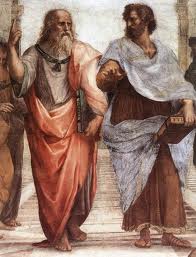
    Plato and Aristotle arguing in the School of Athens

    Plato refuted this argument over 2,000 years ago in his famous dialogue The Euthyphro. The Euthyphro argument is commonly appropriated in the form of a dilemma: “is an action right because it promotes human flourishing or does it promote human flourishing because it is right?

    If ethical naturalists take the second horn of this dilemma and claim that something promotes human flourishing because it is right then things are right prior to, and hence independently of, whether they promote human welfare; so the ethical naturalists’ position here is false.

    If the ethical naturalists take the former horn then morality is arbitrary. If rape or murder or cruelty for fun had the natural property of promoting happiness then rape and murder and cruelty for fun would be morally required but it is impossible for these things to be morally required; so ethical naturalism is clearly absurd.

    Moreover, if things are right because they have natural properties, like promoting human flourishing, then one cannot meaningfully say that human flourishing is good. To say “human flourishing”  is good is just to say that  “human flourishing is human flourishing,” which is just an empty tautology.

    So in short, Plato’s Euthyphro dilemma refuted ethical naturalism 2,000 years ago. Contemporary ethical naturalists who say otherwise just have not read Plato and have never come across this argument before.

    In any event, ethical naturalism is deeply problematic. Throughout history people have appealed to human flourishing and forms of ethical naturalism to justify atrocities. The Inquisition, for example, was often justified by Dominican Theologians on the basis that it was in accord with natural law, and natural law was understood to be grounded in human flourishing. Similarly, wars have been justified on the basis of moral theories based on human flourishing. Stalin and Lenin wanted to bring about human flourishing through a communist utopia and murdered millions in their pursuit of that. And the Americans dropped an atomic bomb on Japan because they wanted to promote the flourishing of American soldiers that were going to invade.

    Finally, it is obviously insulting to suggest that right and wrong are grounded in scientifically verifiable properties like this. There are a large number of people who live morally upright lives who do not believe in ethical naturalism. The suggestion that these people are all immoral is obviously false. Name me one moral action a person who is not an ethical naturalist cannot do? This unanswerable question shows that ethical naturalism is clearly false.

    RELATED POSTS: (more…)