Tag: Hermeneutics

  • God and the Genocide of the Canaanites Part I: Wolterstorff’s Argument for the Hagiographic Hyperbolic Interpretation

    Around this time last year I wrote two posts Joshua and the Genocide of the Canaanites I and Joshua and the Genocide of the Canaanites II. These posts attracted a fair amount of attention and debate. I got offers to publish my ideas in several upcoming books and present them before both the Evangelical Philosophical Society (EPS) and the Society for Biblical Literature in November 2010. Since the original posts I have corresponded with various people and I have modified and refined some of the ideas. This three-part blog series is a modified version of what I presented to the EPS last month. These posts supersede and update what I wrote in a year ago.

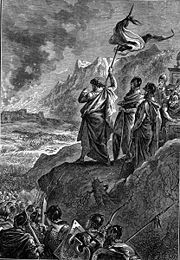
    Joshua at AiOne of the most perplexing issues facing Christian believers is a series of jarring texts in the Old Testament. After liberating Israel from slavery in Egypt, the Israelites arrived on the edge of the Promised Land. The book of Deuteronomy records that God then commanded Israel to “destroy totally” the people occupying these regions (the Canaanites); the Israelites were to “leave alive nothing that breathes”. The book of Joshua records the carrying out of this command. In the sixth chapter it states “they devoted the city to the LORD and destroyed with the sword every living thing in it—men and women, young and old, cattle, sheep and donkeys”. In the tenth and eleventh chapters it states that Joshua “left no survivors. He totally destroyed all who breathed, just as the LORD, the God of Israel, had commanded.” The text mentions city after city where Joshua, at God’s command, puts every inhabitant “to the sword”  “totally destroyed the inhabitants” and “left no survivors.”

    If one takes these passages literally they record the divinely-authorised commission of genocide. But genocide surely is morally wrong. In the light of this, critics of Christian theism often ask a rhetorical question; how could a good and loving God command the extermination of the Canaanites?

    One response which goes back to the patristic era is to suggest that the strict, literal reading on which this rhetorical question is based is mistaken. Recently, several, protestant scholars have suggested a hyperbolic reading of the relevant passages.[1] Perhaps the most detailed is that proposed by Nicholas Wolterstorff. Wolterstorff suggests,

    “[T]hat the Book of Joshua has to be read as a theologically-oriented narration, stylized and hyperbolic at important points, of Israel’s early skirmishes in the Promised Land, with the story of these battles being framed by descriptions of two great ritualized events.  The story as a whole celebrates Joshua as the great leader of his people, faithful to Yahweh, worthy successor of Moses.  If we strip the word “hagiography” of its negative connotations, we can call it a hagiographic account of Joshua’s exploits.”[2]

    In this series I will defend Wolterstorff’s position. In this post I will sketch, adapt and defend Wolterstorff’s argument. In Part II, I will argue that external evidence from comparative studies in Ancient Near Eastern conquest accounts gives considerable support to Wolterstorff’s position. Finally in Part III I will look at two implications of this position.

    Wolterstorff’s Argument
    Wolterstorff’s contention is that “a careful reading of the text in its literary context makes it implausible to interpret it as claiming that Yahweh ordered extermination”. It is important to note what he means by context. Here, it is clear that Wolterstorff is advocating a canonical approach. He notes that,

    “Joshua as we have it today was intended as a component in the larger sequence consisting of Deuteronomy, Joshua, Judges, I and II Samuel, and I and II Kings…  I propose that we interpret the Book of Joshua as a component within this larger sequence – in particular, that we interpret it as preceded by Deuteronomy and succeeded by Judges.”[3]

    Joshua comes after Deuteronomy and before Judges. Wolterstorff points out that these books should be read as a single narrative. When one does this, however, several issues are apparent. (more…)

  • Bovine Faeces and the Sexual Proclivities of Rocks: We are all Selective Literalists

    Jónathan Mark Deundian sent us the following correspondence,

    You addressed the following paragraph to a blogger named RyogaM. This one and actually the one right above it was so common sensible but so completely profound. I read it to my wife and it was as if shutters fell from her eyes. Best thing since Molinism! lol

    When I looked at the exchange Jónathan referred to I realised I had not seen it before. It was buried in a pile of comments on Matt’s post, Joshua and the Genocide of the Canaanites Part II. Anyway it made me laugh so much and it was so good that I have decided it warrants its own post.

    Context is important, of course, so here we go.

    Over at Driving the Peterbilt: Bible Critique by Ryoga M, RyogaM wrote a sarcastic rendition of the battle of Gibeon, which is found in Joshua 10. Here are some highlights of that rendition:

    [Asterisks not original]

    AT GIBEON, AGAIN

    Adoni-zedek king of Jerusalem: Well, now, let’s see. I suggest we attack…holy [****]! What’s that?!

    Hoham king of Hebron: That’s a big f[***]ing rock!

    Piram king of Jarmuth: And it’s falling on our heads!

    Japhia king of Lachish: Run away! Run away!

    Debir king of Eglon: Well, this is going to suck.

    AT THE HEBREW CAMP

    Messenger: Message for Joshua!

    Joshua: Yes?

    Messenger: God has attacked with big f[***]ing rocks, sir. He’s slain them with a great slaughter at Gibeon, and chased them along the way that goes up to Beth-horon, and smote them to Azekah, and to Makkedah. he’s killed a lot of them, sir. Squished like bugs.

    Joshua: Well it’s about time he did something useful. I guess we should kill everyone left, huh?

    Joel Watts commented that RyogaM was being excessively literalistic in his reading of the text and referred RyogaM to Matt’s Joshua and the Genocide of the Canaanites series. RyogaM was not impressed he made several points of critique on his blog, which he repeated on ours. The relevant parts are below:

    The purpose of my blog is to explore what the Bible actually SAYS, not what one wishes it to say, not what one would expect it to say if one presupposes the existence of an all-knowing, all-loving, all-power god, not what one can rationalize away because the concept of slaughtering every inhabitant of a town, including every old man, woman and child, goes against every enlightenment value we have.

    And the reason I do this is because even your average, non-fundy, modern Christian takes certain parts of the Bible literally. I assume, for example, Christians take literally the idea that Jesus Christ was the son of god, that he died and rose again. Which is as equally absurd, if not even more absurd, idea, than the idea that Joshua and his people engaged in total warfare against the country he and his people invaded at the command of god. I hope, by taking the Bible literally, and pointing out why to do so is absurd, Christians such as yourself feel free to reject the entire concept of reading any part of the Bible literally and free themselves from superstition.

    Now, looking at your blog, I think you are one of those selective literalistic, Christian. You presuppose that no god who calls himself just could ever order the slaughter of innocent old men, women and children, and you are right. So, you have to assume that god didn’t really mean what he very clearly said. Then you choose other parts of the Bible which are clearly in contradiction and think it resolves the question to say it’s all hyperbole….You refuse to accept what it says on its face and instead engage in mind-reading of the authors.

    Matt’s response to these particular comments caused me to erupt into fits of laughter (and apparently caused shutters to fall from Jónathan’s wife’s eyes),

    RyogaM, you state that I am a “selective literalist” and that not even “non-fundy, modern Christians takes certain parts of the Bible literally.”I agree. I read some parts literally and other parts non-literally. That’s a sensible approach to any form of communication.

    Another sceptic told me they thought that “the Bible was bull[****], because it was full of contradictions.” No sensible person would interpret this entire passage literally, to do so would mean it would be easily refuted. One could show that most bibles are composed of thousands of pages of ink and paper. One could note that ink and paper are different substances to bovine faeces and that the term “bull[****]” is, in English, a metaphor for falsehood. Similarly, no one would interpret this passage as entirely figurative; the reference to the Bible, for example, is not a metaphor nor is the reference to contradictions.

    The sceptic is literally referring to the Bible and literally attributing contradictions to it and metaphorically describing it as bull[****] in the same sentence. A sensible interpreter who is honestly trying to interpret the sceptics’ comments will interpret “bull[****]” figuratively and the rest literally. This is for two reasons: (a) taken literally, the comment is clearly absurd and it is unlikely an intelligent person would mean it to be taken this way; (b) the word “bull[****],” in English, is a well-attested metaphor for falsehoods in contexts like this.

    These same two reasons are precisely what we see present in Joshua: (a) taken literally, the statements are absurd (they contradict the rest of the text); (b) the language is well-attested in ANE writing of this sort as hyperbole for victory.

    Most literature and communication involves both literal and figurative language and any sensible communicator will attempt to discern both. If you disagree with me then I think your own blog post is easily refuted.

    Big Rocks

    You, after all, talk in your own post about “big f[***]ing rocks.” Now this is clearly stupid, rocks cannot engage in sexual intercourse and only a complete moron with no knowledge of the sexual proclivities of rocks would say this. On the face of it, you clearly stated that rocks “f[***].” Of course I could contend (sensibly) that the word “f[***]ing” in this context should not be taken literally, that you used the word “f[***]ing” in a hyperbolic manner to emphasise the size of the rocks and the might of God. But then you are a selective literalist, you clearly do not want me to take everything on your blog as figurative. To do so would involve me “reading your mind,” it would involve me assuming you would not intend to say something obviously stupid. Seeing you think people should not do that then I have to conclude that you are a moron.

    Please learn a bit more about sexual reproduction and its relationship to rocks before you write in future.

  • What Atheists Could Learn from Legal Interpretation 101

    At the beginning of each semester my lecturers would remind students of the fire policy, “if the alarm sounds leave the lecture theatre immediately through the nearest exit and reassemble outside the Davis law library.” Now if during class one day my lecturer had said to me, “Madeleine, do not leave class today until you have spoken with me about your brilliant essay which simply must be included in my upcoming book” [what? it is a thought experiment ok? It could’ve happened…] but then half-way through class the fire alarm rang and the smell of smoke wafted into the lecture theatre – would anyone seriously expect me to remain in my seat? Should I be paralysed with confusion by the contradictions – did my lecturer mean me to be burned alive or overwhelmed by smoke inhalation because he told me to not leave class that day until I had spoken to him or should I follow his earlier instruction to exit the classroom on hearing a fire alarm and go to the area outside the Davis Law Library? What should I do? Oh the confusion! Perhaps I should simply conclude that due to the contradictions inherent in trying to read both sets of instructions together that my lecturer, in fact, does not exist.

    Is anyone buying this? I mean, clearly what I should do is leave with the rest of the class and talk to my lecturer later. [Doh!]

    Illustrations of this sort are often used in conflict of laws or legal interpretation classes to show that what prima facie appears to be a contradiction between two pieces of legislation actually is not. This is because imperatives occur in contexts where commonly accepted qualifications, riders, priorities, idioms, etc are assumed to be understood; implicit background beliefs are in play.

    We can see this clearly in the example above. I know it is unlikely my lecturer wants his students to obey his instructions to the extent that they burn to death. I know this because I know something of his purposes and of his character. I know him to be fairly decent, humane and not one to issue arbitrary, irrational commands. I know also something of the weights involved in the issues. For example, I know the fire policy is university policy and it concerns the issue of safety – both the physical safety of students as well as its own, it does not want to be sued or prosecuted or subject to critical public scrutiny. I know that the lecturer’s authority is derived from university authority and so his instructions cannot contradict or override it. I also know that the reason he gave the instruction for me to stay behind in class was because he wanted to work with me in the future to ensure the sales of his book make the top 10 list. So from all of this I can safely conclude that he did not mean for me to follow his instructions on pain of death today.

    Of course if I already believed my lecturer to be a petty, arbitrary, narcissistic, cruel bully, capable of anything who routinely issued commands with the purpose of harming, maiming and destroying students (and if I suspected he wanted to take my essay and publish it as his own so as to keep all the book royalties for himself) I might take a different approach as to how I read his instructions together. But it would be uncharitable of me in excelsis to adopt this assumption of his character as the default one to reason from.

    Taking these contextual factors together, along with a basic grasp of the English language, its idioms and a dose of common sense it is not that hard to navigate apparently conflicting instructions.

    I raise this because a site ironically called “Common Sense Atheism” recently put up a short post entitled 6 Questions with which to Stump Conservative Christians. I was extremely underwhelmed by the questions and was left wondering if the author had actually read any Christian works above Sunday School level on Christian ethics, biblical interpretation and so on (and clearly had not read very far into this blog) but I found one of the questions stood out en stupidus maximus (that’s a legal latin maxim meaning it was so stupid it had to be taken out). Question 4 asks,

    “The Bible says to worship God (obviously) and to obey your mother and father, but what do you do if your parents tell you to worship other gods?”

    Here, the atheist is trying to establish a contradiction in the commands God issues and from this contradiction we are presumably supposed to concede that Christians are irrational or that God does not exist or some such thing (and, of course, any Christian reading it is supposed to be “stumped”).

    No Christian I know would be even momentarily stumped by this because the answer is obvious: in such a case you should disobey your parents and worship God; end of. I find it no more paralysing than the issue of whether I should leave class when the fire alarm sounds or stay to talk to my lecturer. In both cases, I understand that the command cannot sensibly be understood as an absolutely unqualified imperative. I doubt very much that God, out of allegiance to Him, wants us to give up allegiance to Him.

    Of course if one wanted to make God look silly and arbitrary one could interpret it this way, just as you could attribute silly interpretations of what my lecturer meant such as intepreting his instructions as a command to wait for him even if I get burned alive in a fire or that my lecturer does not exist, but why would you?

    If you think I am just picking on one unfortunate atheist’s example I beg to differ. When Matt was an undergrad at the University of Waikato a leader of the campus rationalist society confronted him with Isaiah 30:26,

    The moon will shine like the sun, and the sunlight will be seven times brighter, like the light of seven full days, when the LORD binds up the bruises of his people and heals the wounds he inflicted.

    The rationalist then informed Matt as to what the temperature of the sun was. He multiplied that number by seven and then noted that if it were to become that hot then world would burn to a crisp. He concluded that the Bible taught that heaven was hotter than hell. Matt’s initial inclination was to laugh and asked the guy if the exchange had “brightened up his day and warmed his heart.” It turned out that the example came from a highly regarded book by a scientist critiquing creationism, ironically entitled “Telling Lies for God: Reason vs Creationism” [scientists really really shouldn’t pontificate on theology]. The book had recieved endorsements from leading Australian Clergy. [I am reminded of Rob Muldoon’s position on Australians]

    Then there was a discussion I had on Debunking Christianity’s “Madeleine Flannagan is Happy to be Treated as Women Were in the Bible!” where John Loftus pointed to Deuteronomy,

    “Deuteronomy 22:23 If a man happens to meet in a town a virgin pledged to be married and he sleeps with her, 24 you shall take both of them to the gate of that town and stone them to death—the girl because she was in a town and did not scream for help, and the man because he violated another man’s wife. You must purge the evil from among you.

    Deuteronomy 22:28 If a man happens to meet a virgin who is not pledged to be married and rapes her and they are discovered, 29 he shall pay the girl’s father fifty shekels of silver. [c] He must marry the girl, for he has violated her. He can never divorce her as long as he lives.”

    Now Matt had written several posts on this atheist chestnut which saw me get embroiled in an exchange with both Loftus and Stephen Carr. Carr surmised that,

    “If a woman is threatened with a knife, told she will be killed if she screams out, and does not scream out, there will always be a Christian to say , and I quote ‘isn’t she a part of the problem’?”

    Apparently the non-offensive-to-God way to rape a woman is to simply render her incapable of screaming because God’s issue is with the screaming and not the raping…

    Apparently when the bible lays down case laws, it cannot simply lay down a paradigm. It must spell out every possible nuance, qualification, exception, situation, application to analogous situations and so on.

    Apparently if it does not do this then it is denying opposition to the act – now even modern case law precedents do not function like this and legislation is never drafted this way but apparently this is the way to read Biblical law.

    Seriously.

    Perhaps Carr is a too easy a target. Atheist philosopher Michael Martin makes a similar interpretation of Deuteronomy,

    “it is assumed that in all cases that a rape victim could cry for help and if she did, she would be heard and rescued. Both of these assumptions are very dubious and sensitive to the contextual aspects of rape.”

    I am at a loss to understand why atheists insist on reading these texts like a lawyer with Aspergers Syndrome in search of a convincing technicality by way to circumvent the spirit and intendment of the law? I mean why? We can all handle instructions that conflict with fire alarms going off, we don’t interpret modern laws like this, so why do atheists (and some Christians) switch to such silly anachronistic readings when the instructions are attributed to God?

    I suspect the issue is the background factors I mention above. Many atheists believe God is a petty, arbitrary, narcissistic, cruel bully, capable of anything who routinely issues commands with the purpose of harming, maiming and destroying people. They believe that the bible is obviously silly, irrational, oppressive and supports contradictory absolutism in the family, is anti-women (and so obviously supports rape) is full of scientific absurdities (and so Isaiah was talking about cosmology) and so on.

    When you have a pre-conceived notion as to what you want the text to mean – be it an uncharitable reading or what you think or have heard that the text teaches – I suppose the silly reading is congenial. What this tells us is that the reading of the text is not what leads atheists (and some Christians) to their conclusions, rather it is their conclusions lead them to read the text this way.

  • EPS Apologetics Conference: God and the Genocide of the Canaanites

    Matt has been invited to speak at the annual Evangelical Philosophical Society (EPS) Apologetics Conference in Atlanta, Georgia, USA which runs 18-20 November 2010. He will be speaking alongside some big names in contemporary Christian philosophy including Alvin Plantinga and William Lane Craig.

    Evangelical Philosophical Society Apologetics Conference

    Experience seasoned teaching by Alvin Plantinga, William Lane Craig, Gary Habermas, Greg Koukl, Randy Newman, Frank Beckwith, Craig Evans, Craig Blomberg, Mike Licona and over twenty other influencers in Christian apologetics as they equip you about the issues facing contemporary Christian witness.

    The full line up of speakers is here.

    You can register here.

    Matt’s talk is entitled “God and the Genocide of the Canaanites,”

    How could a just and loving God command Joshua to genocide the Canaanites as is apparently taught in the Old Testament? Is God really a moral monster as Christianity’s critics use these passages to claim? Matthew will re-examine these passages in light of the context they were written in showing that the skeptics’ case against God relies on a questionable reading of the Old Testament.

    This talk will be based on Matt’s blog series, Joshua and the Genocide of the Canaanites Part I and Part II, his Contra Mundum column, “Did God Command Genocide in the Old Testament?” (forthcoming August 2010) and his chapter, co-authored with Paul Copan, “Ethics of ‘Holy War’ for Christian Morality and Theology” in Old Testament ‘Holy War’ and Christian Morality: Perspectives and Prospects (forthcoming 2011).

    If you would like to donate to help Matt get to America to speak at the EPS Apologetics Conference please visit our support page.

  • Myth, Truth and Genesis 1-11

    In Naturalism Defeated, Evan Fales attacks the biblical teaching that man is made in the image of God. One reason he gives is, “How seriously, then, should one take the testimony of Genesis 1:26-27? … There is the generally mythical character of Genesis; many of the themes in the first 11 chapters are borrowed from, or influenced by, the myths of other ancient Near Eastern cultures.”[1]

    Fales’ reasoning here is not uncommon. He argues that what Genesis teaches is false because Genesis 1-11 is a myth. The latter claim he substantiates by comparing the early chapters of Genesis to various Ancient Near Eastern texts which we know to be myths. Fales contends that a comparison of the texts in question leads to the conclusion Genesis is a myth and hence what it teaches lacks authority.

    In this post I want to address one aspect of this argument. The key premise I want to contest is that if Genesis is a myth and of the same genre as Ancient Near-Eastern myths then what it teaches lacks authority. Note this is a conditional claim: I am arguing that if Genesis 1-11 is mythic in genre then this would not necessarily entail that the text lacks authority. I am not, in this post, committing myself to any claim that Genesis is mythic; I am simply asking what follows if it is.

    As a way of entering this question let me start by summarising a debate between two evangelical scholars, both of whom affirm biblical inerrancy. In Inspiration and Incarnation, Peter Enns compares the story of creation, fall, flood and Babel in Genesis 1-11 to various Ancient Near-Eastern texts such as Enuma Elish, The Gilgamesh Epic, Atrahasis Epic, the Sumerian Flood Story and the Sumerian King Lists. Enns argues that:

    (a) these writings appear to be earlier than Genesis; and,
    (b) the latter four in particular contain obvious parallels to Genesis that cannot be mere coincidence; and,
    (c) these texts are myths.

    In light of this, Enns argues that Genesis must be understood as a myth.

    When Enns says Genesis is a myth it is important to not misunderstand his meaning here. In contemporary English the word myth is often a colloquial term for a falsehood, so that calling something a myth means it is false. In Enns’ use of the term the word ‘myth’ refers to a particular kind of genre, “myth is an ancient, pre-modern, pre-scientific way of addressing ultimate meaning and origins in the form of stories: Who are we ? Where do we come from ?”[2] Hence, by saying Genesis is a myth Enns is not committing himself to the claim that the text is false.

    However, later in the same book Enns goes on to state that “the biblical account, along with its ancient Near Eastern counterparts assumes the factual nature of what it reports. They did not think, “We know this is all ‘myth’ but we will have to wait until science is invented to give us better answers.”[3] He suggests that while the text is myth, its original hearers would probably not have distinguished myth from what we would call an historical narrative.

    It is worth noting that Enns is not alone in this kind of assessment. Drawing on the same literary parallels, Gordon Wenham has argued that the author of Genesis 1-11 was retelling stories that were well known in Babylonian culture. However, the author was transforming them to make a radically different theological point. These  points, in fact, repudiate and at times ridicule, the very teachings the Babylonian myths  were trying to teach.

    Like Enns, Wenham notes several important parallels between Gen 1-11 and Ancient Near-Eastern myths and legends to substantiate this point. Wenham suggests that in retelling the Babylonian myths to make theological counter points the authors assumed or took for granted, the historicity of the folk stories in question. In The Erosion of Inerrancy in Evangelicalism, Greg Beale responds to Enns’ suggestion, “But Enns is saying more than this: the biblical writers thought they were recording history but were really recording myth … Thus one ends up with a completely inspired bible  in which the narrators recorded what they thought was history, but we know they are wrong. This is tantamount to saying the biblical writers made mistakes.”[4]

    Beale goes on to state that Enns sees Genesis as “a genre of divine accommodation,  whereby God knew better but the Israelite writers did not. They thought they were writing true history, but God knew they were not. In this respect has Enns formulated a new version of sensus plenor?”[5]

    I think Beale is correct; Enns’ position does commit him to the claim that the biblical authors made mistakes. However, I think the conclusion he tries to draw, that this claim compromises the authority of scripture is too quick. It is worth noting that Enns claimed that the biblical writers assumed the factual nature of what they reported. He explicitly states also that the genre of myth uses stories to teach answers to certain theological and existential questions.  For example, questions regarding ultimate meaning and origins, such things as, who are we? where do we come from? and so on. Hence while Enns position accords errors to what biblical writers assumed, it does not necessarily entail that what the text teaches is erroneous. This may sound like a minor technical point but I am inclined to think it is important.

    An example might help to illustrate this point. Let’s take as an example the well known story of  the boy who cried wolf. This story, on the face of it, is simply a description of a shepherd boy who was killed after giving false alarms about wolves. Taken in a straight-forward, literal fashion it appears to relay an historical event. Now most people recognise that this story is not designed to teach us an historical event, those who retell this story do so to make a moral point about the dangers and pitfalls of repeatedly lying. The story is a powerful and graphic way of teaching this point and gives the point a vividness and power that the mere claim “don’t lie” does not have.  It is also clear, I think, that no one would consider what this story teaches to be false if it was discovered the events the story described never happened (which they probably did not). This is because once the genre of the text is realised, it is evident that the text does not teach that the events happened and if it does not teach that they happened then the fact that they did not cannot render what it teaches as false.

    Now, let me provide a hypothetical situation. Suppose I was researching the origins of the story of the boy who cried wolf and I discovered that at some point in the past a person heard this story and believed it to be literally true, the person believed that the events actually happened. Suppose this person was also struck by the fact that these events provided a powerful illustration of the dangers of lying and issuing false reports so much so that this person began using this story to teach about the dangers of lying. Suppose that this person’s pedagogy caught on and the story entered into cultural consciousness and that those people who heard and retold the story also believed it actually happened. Would this discovery lead us to conclude that what the story teaches is false? Again it seems clear to me that it would not. This is because whatever the original teller believed about the story, what the story teaches remains true. The original teller may have all sorts of beliefs about what was authored but unless the story was actually used to teach each of these beliefs the story is not discredited by any finding to the effect that these beliefs are false. The story of the boy who cries wolf teaches us about lying it does not teach (nor does it purport to teach us) an historical event. As such, it is shown to be false only if someone can show us that what it says about lying is false.

    It is important to see the limitations of this illustration. I am not arguing that Genesis 1-11 should be construed as a fable in the vein of the story of the boy who cried wolf – I think Genesis  is clearly not a fable – the point I am making is that there is a distinction between what a person assumes about a story when they tell it and what the story actually teaches. Even if a person falsely assumes the factual accuracy of the events in a story or narrative as true then that does not entail that what the text teaches is untrue. The example of the boy who cries wolf shows that with some genres the truth of what is taught stands whether or not the story used to teach this truth is historically accurate. Even if we grant that Genesis is myth or folklore, it does not follow that what it teaches is false.


    [1] Evan Fales “Darwin’s Doubt, Calvin’s Calvary” in James Beilby Naturalism Defeated? Essays on Plantinga’s Evolutionary Argument Against Naturalism (Ithaca: Cornell University Press, 2000) 55.
    [2] Peter Enns  Inspiration and Incarnation: Evangelicals and the Problem of the Old Testament (Grand Rapids MI : Baker Books, 2005) 50.
    [3] Ibid 55.
    [4] Greg Beale The Erosion of Inerrancy in Evangelicalism: Responding to New Challenges to Biblical Authority (Wheaton Ill: Crossway Books, 2008) 69.
    [5] Ibid.

  • Contra Mundum: The Judgmental Jesus

    Few things are thought to be more morally pernicious than the practice of judging others. Sometimes this is given a theological spin with people citing the Sermon on the Mount “Do not judge, or you too will be judged. For in the same way you judge others, you will be judged, and with the measure you use, it will be measured to you.” (Matthew 7:1-2).

    It is common for this imperative statement to be used as a kind of rhetorical club to silence moral critique of various cultural practices. When a particular practice is subjected to such critique those who engage in the practice will complain they are being “judged.” If the alleged judgers are Christian, the claim that “judging is contrary to what Christ taught” is typically added to the charge.

    I think this is a misrepresentation of the passage and an affront to common sense. I will address the latter point first. The claim that it is wrong to judge other people is problematic; it is so problematic that it is amazing that anyone gives it credence. For example, if it is wrong to judge other people then since Hitler was another person, it is wrong to say that what he did was wrong. To claim that his actions were wrong is to make a judgment about them and if judging is wrong then it is wrong to judge Hitler. Similarly, Martin Luther King Junior was wrong to criticise racism and doing so judged the actions of racists and William Wilberforce was wrong to make moral judgments about the slave trade as in doing so he was judging slave owners. Taken consistently, the claim that “it is wrong to judge” entails that we should have no legal system, no laws and no courts as all these things involve judging others by deeming certain conduct as wrong.

    The problems with this interpretation of Matthew 7:1-2 do not stop there. A little reflection will demonstrate that the claim that it is wrong to judge other people is incoherent. To claim that it is wrong to judge others is to make a moral judgment; in making the statement one is judging that a particular action is wrong. Moreover, when a person announces this to other people he or she is implicitly making a judgment about other people’s actions. To utter that it is wrong to judge others is to engage in judging others. This kind of thinking can easily induce a kind of intellectual vertigo, it is analogous to the person who states, in English, “I can’t speak a word of English” or a person who tries to convince you of the truth of the claim “there is no truth.”

    Fortunately, one does not need to attribute to Jesus such absurd, incoherent, platitudes because it is doubtful that Jesus meant anything quite so stupid. Several factors bear this conclusion out. First, one should note that the claim, “do not judge, or you too will be judged,” occurs as part of the Sermon on the Mount. In this Sermon, Jesus regularly used hyperbole to vividly illustrate a point. One should note that interpreting these hyperboles too literalistically leads to obvious absurdities. For example, Jesus states, when referring to the act of looking at another person’s spouse with lust, “If your right eye causes you to sin, gouge it out and throw it away” (Matthew 5:9). It is evident that Jesus is not advocating self-mutilation but simply making his point about not lusting in a vivid, hyperbolic fashion. Similarly, he commands people to, “do good deeds before men,” (Matthew 5:16) but a few verses later he tells us, “not to do good deeds before men.” (Matthew 6:1). Taken in a strictly literalistic sense this is a contradiction. However, a reading of the context shows these apparently opposing statements are simply vivid illustrations of the same point; one’s good deeds should be motivated by a desire to honour God, to do the right thing and not by a desire to advance one’s own reputation. In light of such contexts the phrase, “do not judge,” should be seen for what it is, a hyperbolic statement illustrating the point elaborated in the surrounding verses.

    Second, when one seeks out this context one can see quite clearly the point being made. The phrase translated in the NIV as, “do not judge, or you too will be judged,” was originally written by Matthew in Koine (a Greek dialect). The Interlinear Bible gives the literal translation here as, “do not judge that you be judged.” In other words, do not judge others in a way that leads one to put oneself under judgement. The surrounding words support this conclusion,

    For in the same way you judge others, you will be judged, and with the measure you use, it will be measured to you. ″Why do you look at the speck of sawdust in your brother’s eye and pay no attention to the plank in your own eye? How can you say to your brother, ‘Let me take the speck out of your eye,’ when all the time there is a plank in your own eye? You hypocrite, first take the plank out of your own eye, and then you will see clearly to remove the speck from your brother’s eye.″ Do not give dogs what is sacred; do not throw your pearls to pigs. If you do, they may trample them under their feet, and then turn and tear you to pieces. (Matthew 7:2-6)

    Here the qualifications are evident. One is not to judge in a way that brings judgment on oneself. The reason for this (“for”) is that the standard one uses to judge others is the standard that one’s own behaviour will be measured by. Jesus goes on to illustrate, with a sarcastic example, precisely what he is talking about; a person who nit-picks or censures the minor faults of others (taking the speck out of their brothers eye) who ignores the serious, grave, moral faults in their own life (the log in one’s own eye). His point is that such faults actually blind the person’s ability to be able to make competent moral judgments. This suggests that Jesus is focusing on a certain type of judging and not the making of judgments per se.

    In fact, the conclusion that Jesus does not mean to condemn all judging of others is evident from the proceeding sentences in the above quote. Rather than engaging in the kind of judgment Jesus has condemned one should “first take the plank out of your own eye, and then you will see clearly to remove the speck from your brother’s eye.” In other words one should try to rectify the serious moral flaws in one’s own life precisely so one can assist others with theirs. One needs to avoid hypocrisy in order to make constructive and effective moral judgments about others. This would make no sense if Jesus meant to condemn all judging by this passage.

    The reference to “pigs and dogs” in verse 6 further bears this out. Dogs and pigs, to Jews, were unclean animals and the term was frequently used to designate people considered to be of low moral character who were “unclean” before God. In this verse Jesus is simply repeating the Old Testament teaching to “not rebuke a mocker or he will hate you: rebuke a wise man and he will love you” (Proverbs 9:8). The implication, again, is that one should try to make constructive judgments rather than simply provoking anger. Constructive judgments involve making judgments.

    Just in case I have not belaboured the point enough, my interpretation is further reinforced by what follows after these passages. While reading a passage in its context is not the strength of many popular critics of Christianity, immediately after the cited passage Jesus goes on to warn about the dangers of religious charlatans, which he, rather judgmentally, refers to as “ferocious wolves” in “sheep’s clothing” (Matthew 7:15). In the age of Osama Bin Laden, David Koresh and Jim Jones the danger of such charlatans needs little further elaboration.

    In exhorting the requisite discernment, Jesus actually instructs his disciples to make moral judgments about others. He tells his disciples to judge whether a person is a false prophet or not by their “fruit.” Anyone familiar with Old Testament prophetic literature, as Jesus’ hearers were, would know that “fruit” is a metaphor for character. Isaiah’s use of the metaphor is paradigmatic; Isaiah famously described Israel as a vineyard that did not bear fruit. In the metaphor, fruit quite clearly referred to such things as right conduct, justice, morality, etc. Paul uses the same metaphor when he states that “the fruit of the Spirit is love, joy, peace, patience, kindness, goodness, faithfulness, gentleness and self-control” (Galatians 5:22-23a). Jesus makes it clear that he is utilising this metaphor. He goes on to stress that in this context the fruit of a prophet is whether he or she “does the will of my Father” and is not an “evil doer.” It is clear then that Jesus here is exhorting his disciples to make moral judgment about other people, to critically evaluate other people’s lives, choices and actions and to make judgments about their spiritual authenticity based on this evaluation. All of this would be very odd if Jesus thought it was wrong to judge.

    Moral judgment of religious leaders, of oneself, of the organisations one is contemplating joining, of people one considers associating with, of the political leaders one supports at the ballot box and broader issues in wider culture is a task essential to both authentic spirituality and the competent navigation of everyday life.

    I write a monthly column for Investigate Magazine entitled Contra Mundum. This blog post was published in the February 10 issue and is reproduced here with permission. Contra Mundum is Latin for ‘against the world;’ the phrase is usually attributed to Athanasius who was exiled for defending Christian orthodoxy.

    Letters to the editor should be sent to: editorial@investigatemagazine.DELETE.com

    RELATED POSTS:
    Contra Mundum: What’s Wrong with Imposing your Beliefs onto Others?
    Contra Mundum: God, Proof and Faith
    Contra Mundum: “Bigoted Fundamentalist” as Orwellian Double-Speak
    Contra Mundum: The Flat-Earth Myth
    Contra Mundum: Confessions of an Anti-Choice Fanatic

  • Sunday Study: Joshua and the Genocide of the Canaanites Part I

    Critics of Christianity often claim that the book of Joshua teaches that God commanded genocide. Raymond Bradley for example states,

    In chapters 7 through 12, [the book of Joshua] treats us to a chilling chronicle of the 31 kingdoms, and all the cities therein, that fell victim to Joshua’s, and God’s, genocidal policies. Time and again we read the phrases “he utterly destroyed every person who was in it,” “he left no survivor,” and “there was no one left who breathed.”[1]

    Similarly, Walter Sinnott-Armstrong cites passages in Joshua with the same point in mind.[2]

    The objection that Bradley and Armstrong raise in highlighting these passages is that Christians are committed to an inconsistent set of propositions.

    [1] Any act that God commands is morally permissible.
    [2] The scriptures are an authoritative revelation of God’s commands.
    [3] It is morally impermissible for anyone to commit genocide.
    [4] According to the book of Joshua, God commanded Israel to commit genocide.

    If we are to rationally affirm both [1] and [2] then we must give up either [3] or [4]. So which one should we reject?

    Philip Quinn has developed a way of addressing clashes such as this. He suggests that we can draw on a principle whereby “whenever two conflicting claims differ in epistemic status, the claim with the lower epistemic status is to be rejected.”

    [3]Given this approach, if a particular interpretation of any passage conflicts with one of our moral intuitions then we should ask whether or not the case for that interpretation is as convincing as the principle that it clashes with. Now, the principle that genocide is wrong is, I think, a highly plausible one. Therefore, if one is to prefer [3] to [4] then the case for a literal reading must at least be this plausible, and preferably even more plausible. In this series of posts I will argue, perhaps surprisingly to some, that [4] is doubtful. While it is true that taken in isolation and interpreted in a strict literal fashion the book of Joshua does appear to state that God commanded Genocide, I contend that when the text is read in its literary and textual context this conclusion is far from evident and is, in fact, rather questionable.

    In the tenth chapter of the book of Joshua we read,

    They [Joshua and his troops] took the city, its king and its villages, and put them to the sword. Everyone in it they totally destroyed. They left no survivors. They did to Debir and its king as they had done to Libnah and its king and to Hebron. So Joshua subdued the whole region, including the hill country, the Negev, the western foothills and the mountain slopes, together with all their kings. He left no survivors. He totally destroyed all who breathed, just as the LORD, the God of Israel, had commanded. Joshua subdued them from Kadesh Barnea to Gaza and from the whole region of Goshen to Gibeon. (Joshua 10:39-41)

    This text summarises Joshua’s campaign in southern Canaan. The northern campaign is summarised in a similar fashion in the following chapter,

    So Joshua took this entire land: the hill country, all the Negev, the whole region of Goshen, the western foothills, the Arabah and the mountains of Israel with their foothills, from Mount Halak, which rises toward Seir, to Baal Gad in the Valley of Lebanon below Mount Hermon. He captured all their kings and struck them down, putting them to death. Joshua waged war against all these kings for a long time. Except for the Hivites living in Gibeon, not one city made a treaty of peace with the Israelites, who took them all in battle. For it was the LORD himself who hardened their hearts to wage war against Israel, so that he might destroy them totally, exterminating them without mercy, as the LORD had commanded Moses. At that time Joshua came and wiped out the Anakim from the hill country, from Hebron, from Debir, from Anab, and from all the hill country of Judah, and from all the hill country of Israel; Joshua utterly destroyed them with their towns. No Anakites were left in Israelite territory; only in Gaza, Gath and Ashdod did any survive. So Joshua took the entire land, just as the LORD had directed Moses, and he gave it as an inheritance to Israel according to their tribal divisions. Then the land had rest from war. (Joshua 11:16-23)

    If these passages are taken in a strict literal fashion and read in isolation from the proceeding narrative they record the divinely authorised commission of genocide. Taken literally these passages state three things.

    Firstly, that Joshua conquered and subdued the entire regions of southern and northern Canaan. Verse 11:23 states that “Joshua took the entire land” and then “gave it as an inheritance to Israel according to their tribal divisions.” This suggests that the region in question is the same land that is later divided between the Israelite tribes, which was the entire land of Canaan.

    Secondly, the passage repeatedly emphasises that Joshua exterminated all the Canaanites in this region. Verse 11:21 states “Joshua came and wiped out the Anakim from the hill country, from Hebron, from Debir, from Anab, and from all the hill country of Judah.” Verse 11:22 states that no Anakites were left living in Israeli territory after this campaign.  Repeatedly it states that Joshua left “no survivors” and “destroyed everything that breathed” in “the entire land.” Alongside these general claims the text goes to identifies several specific places and cities where Joshua exterminated everyone and left no survivors and killed all who breathed. These include Hebron, Debir, the hill country and the Negev.

    Thirdly, the text states that God commanded these actions. Verse 23 identifies the commands with those laid down in the Law of Moses, which refers back to passages like Deut 20:16-19 and Deut 7.1-5.

    The first thing I want to note is that the text should not be read in isolation from the narrative in which this occurs. This hermeneutical point may seem rather obvious but when it is taken seriously immediate and obvious problems occur with a strictly literal reading of the ‘genocide passages’ I mention above. The most glaringly obvious issue relates to the opening of the book of Judges. In the first chapter of Judges we read of events that occurred after the death of Joshua (and, hence, after the campaigns mentioned in Josh 10 and 11). Here it is explicitly stated that Canaanites are living in the land which had been allotted to various Israeli tribes, the land that Joshua is said to have conquered and “left no survivors” in. Note that this was not a small remnant. They existed in such numbers that each of the tribes of Israel needed to fight in order to dislodge them from the land. Several of the tribes were unable to do so and so Israel failed to dislodge them.

    Of particular interest, however, are the several cities and regions mentioned. In the first chapter we are told that the Canaanites lived Gaza (Judg 1:18), the Negev (1:9), in the hill country  (Judg 1:9) in Debir (Judg 1:11), in Hebron (Judg 1:10) and in the the western foothills (Judg 1:9). Moreover, they did so in such numbers and strength that they had to be driven out by force. These are the same cities that Joshua 10 tells us Joshua had annihilated and left no survivors in.  Moreover, the text explicitly states that Anakites are in Hebron, yet Joshua 11:22 tells us that “No Anakites were left in Israelite territory.” This seems rather odd if Joshua had exterminated everyone there and left no survivors. It is also odd given that Joshua is said, in the genocide passages, to have conquered and subdued the entire region.

    Moreover, the account of what God commanded also differs in Judges 2:1. Here no mention of genocide or annihilation is made, instead we hear of how God had promised to drive them out and has commanded the Israelites to not to make treaties with them and to destroy their shrines. Taken in a straight-forward literal manner then, Joshua’s actions are at odds with the first two chapters of Judges.

    It is not just Judges that this problem occurs in. There are numerous places within the book of Joshua itself where the same picture is presented. As noted, Joshua 11 ends by stating that “the entire land, just as the LORD had directed Moses” was given “as an inheritance to Israel according to their tribal divisions.” When the text turns to giving an account of these tribal divisions it is evident that the Israelites do not actually occupy it, but living, breathing, Canaanites do.

    The allotments begin with God telling Joshua, “You are very old, and there are still very large areas of land to be taken over” (Josh 13:1). Moreover, when one examines the allotment given to Judah we see Caleb asking permission to drive the  Anakites (Josh14: 11) from the hill countries and we also hear how Caleb has to defeat Anakites living in Hebron and, after this, marches against the people “living in Debir” (Josh 15:13-19). Similarly it is evident with several of the other allotments that the people have yet to drive Canaanites entrenched in the area and that Israelites were not always successful in doing so.

    We read, for example, that Ephraimites and Manassites “did not dislodge the Canaanites living in Gezer; to this day the Canaanites live among the people of Ephraim” (Josh 16:10). Similarly, in Chapter 17 it states “Yet the Manassites were not able to occupy these towns, for the Canaanites were determined to live in that region. However, when the Israelites grew stronger, they subjected the Canaanites to forced labor but did not drive them out completely” (Joshua 17:12-13). We hear that “Danites had difficulty taking possession of their territory, so they went up and attacked Leshem, took it, put it to the sword and occupied it. They settled in Leshem and named it Dan after their forefather” (Joshua 19:47). Here, we see the same land said to be subdued and conquered by Joshua in battles where he exterminated and left alive nothing that breathed. This land is yet to be occupied by the tribes of Israel and is occupied by Canaanites, often heavily armed and deeply entrenched (17:17-18).

    Brevard Childs notes the apparent contradiction,

    Critical scholars have long since pointed out the tension – usually it is called a contradiction – in the portrayal of the conquest of the land. On the one hand, the conquest is pictured in the main source of Josh. 1-12 as a unified assault against the inhabitants of the land under the leadership of Joshua which succeeded in conquering the entire land. On the other hand, there is a conflicting view of the conquest represented by Judges 1 and its parallels in Joshua which appears to picture the conquest as undertaken by individual tribes, extending over a long period beyond the age of Joshua, and unsuccessful in driving out the Canaanites from much of the land.[4]

    More recently Kenneth Kitchen has taken issue with Childs’ picture of Joshua 1-12. He notes that, apart from the passages cited at the beginning of this post, a careful reading of Joshua 1-12 makes it clear that Israel did not actually occupy or conquer the areas mentioned at all. Kitchen notes that after crossing the Jordan the Israelites set up camp in Gilgal “on the east border of Jericho” (Joshua 4:19). He notes that after every battle in the next six chapters the text explicitly states that they returned to Gilgal,

    The conflict with Canaanite city-state rulers in the southern part of Canaan is worth close examination. After the battle for Gibeon, we see the Hebrews advancing upon six towns in order, attacking and capturing them, killing their local kings and such inhabitants that had not gotten clear, and moving on, not holding on to those places. Twice over (10:15, 43), it is clearly stated that their strike force returned to base camp at Gilgal.  So there was no sweeping take over and occupation of this region at this point. And no total destruction of the towns attacked.[5]

    Kitchen goes on to note,

    What happened in the south was repeated up north. Hazor was both leader and famed center for the north Canaanite kinglets. Thus as in the south the Hebrew strike force defeated the opposition; captured their towns, killed rulers and less mobile inhabitants, symbolically burned Hazor and Hazor only[6] to emphasis its end to its local supremacy. Again Israel did not attempt to immediately hold on to Galilee: they remained based at Gilgal (14:6).[7]

    Kitchen notes that the first “real indication of a move in occupation beyond Gilgal comes in 18:4.” This is after the first allotment of “lands to be occupied are made” and as we saw above the Israelites did not find occupying these allotments easy. He concludes, “these campaigns were essentially disabling raids: they were not territorial conquests with instant Hebrew occupation. The text is very clear about this.”[8]

    So a straight-forward, literal, reading of the passages cited at the beginning of this post does not cohere with the rest of the narrative. The best account I have come across for explaining this apparent contradiction between a literal reading of the “genocide passages” and the rest of Joshua and Judges is one recently defended by Nicholas Wolterstorff.[9] Wolterstorff suggests that the phrases such as, “Everyone in it they totally destroyed,” “They left no survivors,” etc are not intended to be read literally but function as hyperboles. The analogy he gives is of a high school student who, after a baseball game states, “we totally slaughtered the opposition, we annihilated them just as coach told us to.”[10]

    Plantinga suggests a similar line as a possibility. That phrases such as, “put to death men women infants and cattle” are to be understood more like a person who in the context of a boxing match states, “knock his block off, hand him his head” or  in a football or baseball game where it is stated that the team should “kill the opposition” or that “we totally slaughtered them.”[11] Understood in a non-literal sense the phrases probably meant “something like, attack them, defeat them, drive them out; not literally kill every man, woman, child donkey and the like.”[12] Wolterstorff elaborates,

    When a high-school basket ball player says his team slaughtered the other team last night he’s not asserting, literally now, that they slaughter the other team. What is he asserting? Not easy to tell. That they scored a decisive victory? Maybe, but suppose they barely eked out a win? Was he lying? Maybe not. Maybe he was speaking with a wink of the eye hyperbole. High school kids do.[13]

    In the same way,

    To say Joshua struck down all the inhabitants with the edge of the sword is a way of saying something like Israel scored a decisive victory and once you recognise the presence of hyperbole it is not even clear how decisive the victories were. Joshua did not conquer all the cities in the land nor did he slaughter all the inhabitants in the cities he did conquer. The book of Joshua does not say that he did.[14]

    In my next Sunday Study, Sunday Study: Joshua and the Genocide of the Canaanites Part II,  I will attempt to defend Wolterstorff’s position.


    [1] Raymond Bradley “A moral Argument for Atheism” Presented at the University of Western Washington, May 27, 1999, and–in a revised form–at the University of Auckland, September 29, 1999.
    [2] Walter Sinnott-Armstrong “Why Traditional Theism Cannot Provide an Adequate Foundation for Morality” in Is Goodness without God Good Enough: A Debate on Faith, Secularism and Ethics eds Robert K Garcia and Nathan L King (Lanham: Rowman & Littlefield Publishers, 2008) 110.
    [3]
    Philip Quinn “Religion and Politics” in ed William Mann The Blackwell Guide to Philosophy of Religion (Malden MA: Blackwell Publishing, 2005) 316.
    [4]
    Brevard Childs An Introduction to the Old Testament as Scripture (Fortress Press Philadelphia: 1979) 247.
    [5]
    Kenneth Kitchen On the Reliability of the Old Testament (Grand Rapids and Cambridge: William B. Eerdmans Publishing Company, 2003) 162.
    [6]
    See Joshua 11:13 “But Israel burned none of the towns that stood on mounds except Hazor, which Joshua did burn.”
    [7] Kitchen, above n 5.
    [8]
    Ibid.
    [9] Nicholas Wolterstorff “Reading Joshua” a paper presented to “My Ways Are Not Your Ways: The Character of the God of the Hebrew Bible” Conference at the centre for Philosophy of Religion, University of Notre Dame, Saturday 12 September 2009
    [10] Ibid.
    [11]
    Alvin Plantinga “Comments on Evan Fales’ Satanic Versus: Moral Chaos in Holy Writ” a paper presented to “My Ways Are Not Your Ways: The Character of the God of the Hebrew Bible” Conference at the centre for Philosophy of Religion, University of Notre Dame, Friday 11 September 2009.
    [12]
    Ibid – stated by Plantinga in the Q&A session.
    [13] Nicholas Wolterstorff “Response to Louise Anthony” a paper presented to “My Ways Are Not Your Ways: The Character of the God of the Hebrew Bible” Conference at the centre for Philosophy of Religion, University of Notre Dame. Saturday 12 September 2009.
    [14]
    Wolterstorff, above n 9.


    More recently Kenneth Kitchen has taken issue with Childs’ picture of Joshua 1-12. He notes that, apart from the passages cited at the beginning of this post, a careful reading of  Joshua 1-12 makes it clear that Israel did not actually occupy or conquer the areas mentioned at all. Kitchen notes that after crossing the Jordan the Israelites set up camp in Gilgal “on the east border of Jericho” (Joshua 4:19). He notes that after every battle in the next six chapters the text explicitly states that they returned to Gilgal,

    RELATED POSTS:
    Sunday Study: Joshua and the Genocide of the Canaanites Part II