Tag: Raymond Bradley

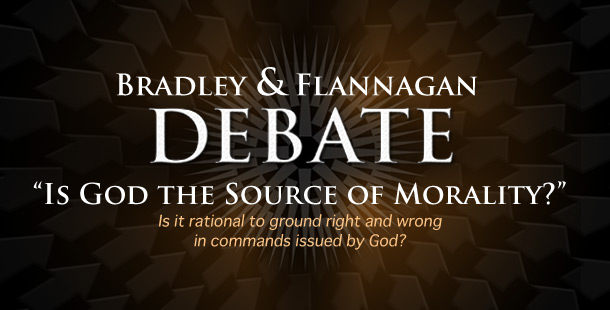
  • Bradley v Flannagan Debate @ Auckland Uni “Is God the Source of Morality?”

    Raymond Bradley and Matthew Flannagan will debate the topic “Is God the Source of Morality? Is it rational to ground right and wrong in commands issued by God?”

    The debate will be held at the University of Auckland on Monday 2 August from 7-9pm in “The Centennial” 260 – 098 OGGB (the bottom level of the Business School) on 12 Grafton Rd, Auckland City.

    Raymond Bradley v Matthew Flannagan "Is God the Source of Morality"

    If you enjoyed the 2008 debate at Auckland University between William Lane Craig and Bill Cooke, you should enjoy this debate.

    Raymond BradleyBradley is an Emeritus Professor of Philosophy with areas of specialty in Philosophical Logic, Metaphysics, Logical Atomism; he has previously debated William Lane Craig, Edward Blaiklock and many other Christian scholars and describes himself as an older generation “new atheist”.

    Matthew FlannaganFlannagan is an Auckland based Philosopher and Theologian with areas of specialty in Philosophy of Religion, Ethics and Theology; he has previously debated Bill Cooke, Zoe During and, of course, writes for this blog.

    The format of the debate will be as follows:

    Dr Bradley: Opening Comments [20 min]
    Dr Flannagan: Opening Comments [20 min]
    Dr Bradley: Reply to Dr Flannagan [10 min]
    Dr Flannagan: Reply to Dr Bradley[10 min]
    Dr Bradley: Closing Comments [7 min]
    Dr Flannagan: Closing Comments [7 min]
    Questions from the floor: [30 min]

    The moderator for the debate will be John Bishop.

    Bradley will be introduced by Robert Nola.

    Flannagan will be introduced by Chris Tucker.

    Both Bradley and Flannagan are experienced and engaging public speakers who are practiced at pitching their topics to suit their audiences. So, invite all your friends, and block out the evening of Monday 2 August from 7-9 pm now and make sure you get to the debate early to locate parking and grab a good seat.

    This debate is brought to you by the Evangelical Union and the Reason and Science Society as part of the University of Auckland’s Jesus week/Atheist week, with support from Thinking Matters.

    The event will be videoed and will be published on this blog. Entry is free and any and all are welcome.

    There is even a Facebook page you can rsvp on and use to invite your friends.

  • Sunday Study: Joshua and the Genocide of the Canaanites Part I

    Critics of Christianity often claim that the book of Joshua teaches that God commanded genocide. Raymond Bradley for example states,

    In chapters 7 through 12, [the book of Joshua] treats us to a chilling chronicle of the 31 kingdoms, and all the cities therein, that fell victim to Joshua’s, and God’s, genocidal policies. Time and again we read the phrases “he utterly destroyed every person who was in it,” “he left no survivor,” and “there was no one left who breathed.”[1]

    Similarly, Walter Sinnott-Armstrong cites passages in Joshua with the same point in mind.[2]

    The objection that Bradley and Armstrong raise in highlighting these passages is that Christians are committed to an inconsistent set of propositions.

    [1] Any act that God commands is morally permissible.
    [2] The scriptures are an authoritative revelation of God’s commands.
    [3] It is morally impermissible for anyone to commit genocide.
    [4] According to the book of Joshua, God commanded Israel to commit genocide.

    If we are to rationally affirm both [1] and [2] then we must give up either [3] or [4]. So which one should we reject?

    Philip Quinn has developed a way of addressing clashes such as this. He suggests that we can draw on a principle whereby “whenever two conflicting claims differ in epistemic status, the claim with the lower epistemic status is to be rejected.”

    [3]Given this approach, if a particular interpretation of any passage conflicts with one of our moral intuitions then we should ask whether or not the case for that interpretation is as convincing as the principle that it clashes with. Now, the principle that genocide is wrong is, I think, a highly plausible one. Therefore, if one is to prefer [3] to [4] then the case for a literal reading must at least be this plausible, and preferably even more plausible. In this series of posts I will argue, perhaps surprisingly to some, that [4] is doubtful. While it is true that taken in isolation and interpreted in a strict literal fashion the book of Joshua does appear to state that God commanded Genocide, I contend that when the text is read in its literary and textual context this conclusion is far from evident and is, in fact, rather questionable.

    In the tenth chapter of the book of Joshua we read,

    They [Joshua and his troops] took the city, its king and its villages, and put them to the sword. Everyone in it they totally destroyed. They left no survivors. They did to Debir and its king as they had done to Libnah and its king and to Hebron. So Joshua subdued the whole region, including the hill country, the Negev, the western foothills and the mountain slopes, together with all their kings. He left no survivors. He totally destroyed all who breathed, just as the LORD, the God of Israel, had commanded. Joshua subdued them from Kadesh Barnea to Gaza and from the whole region of Goshen to Gibeon. (Joshua 10:39-41)

    This text summarises Joshua’s campaign in southern Canaan. The northern campaign is summarised in a similar fashion in the following chapter,

    So Joshua took this entire land: the hill country, all the Negev, the whole region of Goshen, the western foothills, the Arabah and the mountains of Israel with their foothills, from Mount Halak, which rises toward Seir, to Baal Gad in the Valley of Lebanon below Mount Hermon. He captured all their kings and struck them down, putting them to death. Joshua waged war against all these kings for a long time. Except for the Hivites living in Gibeon, not one city made a treaty of peace with the Israelites, who took them all in battle. For it was the LORD himself who hardened their hearts to wage war against Israel, so that he might destroy them totally, exterminating them without mercy, as the LORD had commanded Moses. At that time Joshua came and wiped out the Anakim from the hill country, from Hebron, from Debir, from Anab, and from all the hill country of Judah, and from all the hill country of Israel; Joshua utterly destroyed them with their towns. No Anakites were left in Israelite territory; only in Gaza, Gath and Ashdod did any survive. So Joshua took the entire land, just as the LORD had directed Moses, and he gave it as an inheritance to Israel according to their tribal divisions. Then the land had rest from war. (Joshua 11:16-23)

    If these passages are taken in a strict literal fashion and read in isolation from the proceeding narrative they record the divinely authorised commission of genocide. Taken literally these passages state three things.

    Firstly, that Joshua conquered and subdued the entire regions of southern and northern Canaan. Verse 11:23 states that “Joshua took the entire land” and then “gave it as an inheritance to Israel according to their tribal divisions.” This suggests that the region in question is the same land that is later divided between the Israelite tribes, which was the entire land of Canaan.

    Secondly, the passage repeatedly emphasises that Joshua exterminated all the Canaanites in this region. Verse 11:21 states “Joshua came and wiped out the Anakim from the hill country, from Hebron, from Debir, from Anab, and from all the hill country of Judah.” Verse 11:22 states that no Anakites were left living in Israeli territory after this campaign.  Repeatedly it states that Joshua left “no survivors” and “destroyed everything that breathed” in “the entire land.” Alongside these general claims the text goes to identifies several specific places and cities where Joshua exterminated everyone and left no survivors and killed all who breathed. These include Hebron, Debir, the hill country and the Negev.

    Thirdly, the text states that God commanded these actions. Verse 23 identifies the commands with those laid down in the Law of Moses, which refers back to passages like Deut 20:16-19 and Deut 7.1-5.

    The first thing I want to note is that the text should not be read in isolation from the narrative in which this occurs. This hermeneutical point may seem rather obvious but when it is taken seriously immediate and obvious problems occur with a strictly literal reading of the ‘genocide passages’ I mention above. The most glaringly obvious issue relates to the opening of the book of Judges. In the first chapter of Judges we read of events that occurred after the death of Joshua (and, hence, after the campaigns mentioned in Josh 10 and 11). Here it is explicitly stated that Canaanites are living in the land which had been allotted to various Israeli tribes, the land that Joshua is said to have conquered and “left no survivors” in. Note that this was not a small remnant. They existed in such numbers that each of the tribes of Israel needed to fight in order to dislodge them from the land. Several of the tribes were unable to do so and so Israel failed to dislodge them.

    Of particular interest, however, are the several cities and regions mentioned. In the first chapter we are told that the Canaanites lived Gaza (Judg 1:18), the Negev (1:9), in the hill country  (Judg 1:9) in Debir (Judg 1:11), in Hebron (Judg 1:10) and in the the western foothills (Judg 1:9). Moreover, they did so in such numbers and strength that they had to be driven out by force. These are the same cities that Joshua 10 tells us Joshua had annihilated and left no survivors in.  Moreover, the text explicitly states that Anakites are in Hebron, yet Joshua 11:22 tells us that “No Anakites were left in Israelite territory.” This seems rather odd if Joshua had exterminated everyone there and left no survivors. It is also odd given that Joshua is said, in the genocide passages, to have conquered and subdued the entire region.

    Moreover, the account of what God commanded also differs in Judges 2:1. Here no mention of genocide or annihilation is made, instead we hear of how God had promised to drive them out and has commanded the Israelites to not to make treaties with them and to destroy their shrines. Taken in a straight-forward literal manner then, Joshua’s actions are at odds with the first two chapters of Judges.

    It is not just Judges that this problem occurs in. There are numerous places within the book of Joshua itself where the same picture is presented. As noted, Joshua 11 ends by stating that “the entire land, just as the LORD had directed Moses” was given “as an inheritance to Israel according to their tribal divisions.” When the text turns to giving an account of these tribal divisions it is evident that the Israelites do not actually occupy it, but living, breathing, Canaanites do.

    The allotments begin with God telling Joshua, “You are very old, and there are still very large areas of land to be taken over” (Josh 13:1). Moreover, when one examines the allotment given to Judah we see Caleb asking permission to drive the  Anakites (Josh14: 11) from the hill countries and we also hear how Caleb has to defeat Anakites living in Hebron and, after this, marches against the people “living in Debir” (Josh 15:13-19). Similarly it is evident with several of the other allotments that the people have yet to drive Canaanites entrenched in the area and that Israelites were not always successful in doing so.

    We read, for example, that Ephraimites and Manassites “did not dislodge the Canaanites living in Gezer; to this day the Canaanites live among the people of Ephraim” (Josh 16:10). Similarly, in Chapter 17 it states “Yet the Manassites were not able to occupy these towns, for the Canaanites were determined to live in that region. However, when the Israelites grew stronger, they subjected the Canaanites to forced labor but did not drive them out completely” (Joshua 17:12-13). We hear that “Danites had difficulty taking possession of their territory, so they went up and attacked Leshem, took it, put it to the sword and occupied it. They settled in Leshem and named it Dan after their forefather” (Joshua 19:47). Here, we see the same land said to be subdued and conquered by Joshua in battles where he exterminated and left alive nothing that breathed. This land is yet to be occupied by the tribes of Israel and is occupied by Canaanites, often heavily armed and deeply entrenched (17:17-18).

    Brevard Childs notes the apparent contradiction,

    Critical scholars have long since pointed out the tension – usually it is called a contradiction – in the portrayal of the conquest of the land. On the one hand, the conquest is pictured in the main source of Josh. 1-12 as a unified assault against the inhabitants of the land under the leadership of Joshua which succeeded in conquering the entire land. On the other hand, there is a conflicting view of the conquest represented by Judges 1 and its parallels in Joshua which appears to picture the conquest as undertaken by individual tribes, extending over a long period beyond the age of Joshua, and unsuccessful in driving out the Canaanites from much of the land.[4]

    More recently Kenneth Kitchen has taken issue with Childs’ picture of Joshua 1-12. He notes that, apart from the passages cited at the beginning of this post, a careful reading of Joshua 1-12 makes it clear that Israel did not actually occupy or conquer the areas mentioned at all. Kitchen notes that after crossing the Jordan the Israelites set up camp in Gilgal “on the east border of Jericho” (Joshua 4:19). He notes that after every battle in the next six chapters the text explicitly states that they returned to Gilgal,

    The conflict with Canaanite city-state rulers in the southern part of Canaan is worth close examination. After the battle for Gibeon, we see the Hebrews advancing upon six towns in order, attacking and capturing them, killing their local kings and such inhabitants that had not gotten clear, and moving on, not holding on to those places. Twice over (10:15, 43), it is clearly stated that their strike force returned to base camp at Gilgal.  So there was no sweeping take over and occupation of this region at this point. And no total destruction of the towns attacked.[5]

    Kitchen goes on to note,

    What happened in the south was repeated up north. Hazor was both leader and famed center for the north Canaanite kinglets. Thus as in the south the Hebrew strike force defeated the opposition; captured their towns, killed rulers and less mobile inhabitants, symbolically burned Hazor and Hazor only[6] to emphasis its end to its local supremacy. Again Israel did not attempt to immediately hold on to Galilee: they remained based at Gilgal (14:6).[7]

    Kitchen notes that the first “real indication of a move in occupation beyond Gilgal comes in 18:4.” This is after the first allotment of “lands to be occupied are made” and as we saw above the Israelites did not find occupying these allotments easy. He concludes, “these campaigns were essentially disabling raids: they were not territorial conquests with instant Hebrew occupation. The text is very clear about this.”[8]

    So a straight-forward, literal, reading of the passages cited at the beginning of this post does not cohere with the rest of the narrative. The best account I have come across for explaining this apparent contradiction between a literal reading of the “genocide passages” and the rest of Joshua and Judges is one recently defended by Nicholas Wolterstorff.[9] Wolterstorff suggests that the phrases such as, “Everyone in it they totally destroyed,” “They left no survivors,” etc are not intended to be read literally but function as hyperboles. The analogy he gives is of a high school student who, after a baseball game states, “we totally slaughtered the opposition, we annihilated them just as coach told us to.”[10]

    Plantinga suggests a similar line as a possibility. That phrases such as, “put to death men women infants and cattle” are to be understood more like a person who in the context of a boxing match states, “knock his block off, hand him his head” or  in a football or baseball game where it is stated that the team should “kill the opposition” or that “we totally slaughtered them.”[11] Understood in a non-literal sense the phrases probably meant “something like, attack them, defeat them, drive them out; not literally kill every man, woman, child donkey and the like.”[12] Wolterstorff elaborates,

    When a high-school basket ball player says his team slaughtered the other team last night he’s not asserting, literally now, that they slaughter the other team. What is he asserting? Not easy to tell. That they scored a decisive victory? Maybe, but suppose they barely eked out a win? Was he lying? Maybe not. Maybe he was speaking with a wink of the eye hyperbole. High school kids do.[13]

    In the same way,

    To say Joshua struck down all the inhabitants with the edge of the sword is a way of saying something like Israel scored a decisive victory and once you recognise the presence of hyperbole it is not even clear how decisive the victories were. Joshua did not conquer all the cities in the land nor did he slaughter all the inhabitants in the cities he did conquer. The book of Joshua does not say that he did.[14]

    In my next Sunday Study, Sunday Study: Joshua and the Genocide of the Canaanites Part II,  I will attempt to defend Wolterstorff’s position.


    [1] Raymond Bradley “A moral Argument for Atheism” Presented at the University of Western Washington, May 27, 1999, and–in a revised form–at the University of Auckland, September 29, 1999.
    [2] Walter Sinnott-Armstrong “Why Traditional Theism Cannot Provide an Adequate Foundation for Morality” in Is Goodness without God Good Enough: A Debate on Faith, Secularism and Ethics eds Robert K Garcia and Nathan L King (Lanham: Rowman & Littlefield Publishers, 2008) 110.
    [3]
    Philip Quinn “Religion and Politics” in ed William Mann The Blackwell Guide to Philosophy of Religion (Malden MA: Blackwell Publishing, 2005) 316.
    [4]
    Brevard Childs An Introduction to the Old Testament as Scripture (Fortress Press Philadelphia: 1979) 247.
    [5]
    Kenneth Kitchen On the Reliability of the Old Testament (Grand Rapids and Cambridge: William B. Eerdmans Publishing Company, 2003) 162.
    [6]
    See Joshua 11:13 “But Israel burned none of the towns that stood on mounds except Hazor, which Joshua did burn.”
    [7] Kitchen, above n 5.
    [8]
    Ibid.
    [9] Nicholas Wolterstorff “Reading Joshua” a paper presented to “My Ways Are Not Your Ways: The Character of the God of the Hebrew Bible” Conference at the centre for Philosophy of Religion, University of Notre Dame, Saturday 12 September 2009
    [10] Ibid.
    [11]
    Alvin Plantinga “Comments on Evan Fales’ Satanic Versus: Moral Chaos in Holy Writ” a paper presented to “My Ways Are Not Your Ways: The Character of the God of the Hebrew Bible” Conference at the centre for Philosophy of Religion, University of Notre Dame, Friday 11 September 2009.
    [12]
    Ibid – stated by Plantinga in the Q&A session.
    [13] Nicholas Wolterstorff “Response to Louise Anthony” a paper presented to “My Ways Are Not Your Ways: The Character of the God of the Hebrew Bible” Conference at the centre for Philosophy of Religion, University of Notre Dame. Saturday 12 September 2009.
    [14]
    Wolterstorff, above n 9.


    More recently Kenneth Kitchen has taken issue with Childs’ picture of Joshua 1-12. He notes that, apart from the passages cited at the beginning of this post, a careful reading of  Joshua 1-12 makes it clear that Israel did not actually occupy or conquer the areas mentioned at all. Kitchen notes that after crossing the Jordan the Israelites set up camp in Gilgal “on the east border of Jericho” (Joshua 4:19). He notes that after every battle in the next six chapters the text explicitly states that they returned to Gilgal,

    RELATED POSTS:
    Sunday Study: Joshua and the Genocide of the Canaanites Part II
  • William Lane Craig, Raymond Bradley and the Problem of Hell. Part Two.

    In a previous post I mentioned Professor Raymond Bradley’s (Bradley) contention that,

    [3] The bible teaches that God will torture people endlessly for their beliefs.

    In his article he cites several scriptural passages in support of this contention. I think his exegesis is problematic; I cannot go into huge detail in a blog post but I will endeavour to address the main arguments he offers.

    In essence, Bradley cites from three sections of the New Testament: Matthew, Acts and the Epistles, and Revelation. I will examine each in turn.

    Matthew
    Bradley writes:

    In the Gospel of Matthew alone he characterizes it in terms which evangelists adore: “unquenchable fire,” “fiery hell” (twice), “torment,” “burned with fire,” “furnace of fire” (twice), “weeping and gnashing of teeth” (five times), “eternal fire,” and “eternal fire which has been prepared for the devil and his angels. [Emphasis Original]

    Bradley refers to references to “fire,” “torment” and “weeping and gnashing of teeth.” He assumes, without argument, that each of these phrases refer to torturing people. However, an examination of the relevant passages shows this to be false.

    Unquenchable Fire
    The phrase “unquenchable fire” occurs Matt 5:12 and does not refer to torture.

    His winnowing fork is in his hand, and he will clear his threshing floor, gathering his wheat into the barn and burning up the chaff with unquenchable fire. [Emphasis Added]

    The phrase originates in the Old Testament. There it refers not to a fire that tortures but one that consumes what it devours, because it is never put out. (see Isa 1:311, 34:10, 11; Jer 4:4, 7:20, 17:27, 21:12; Ezek 20:47, 48; Amos 5:6). The context bears this out; Matt 5:12 states “burning up the chaff with unquenchable fire” [emphasis added]. The metaphor here is a farmer burning chaff. Now when burned, chaff is consumed and destroyed by fire and not tortured (unless Bradley is asserting that Chaff has consciousness). The picture then is of separation and annihilation, not everlasting torture.

    It is worth noting that not only does this passage not support Bradley’s contention (a), it does not support (b) either. In v 10-11 the reason people might be subject to judgement is not because of what they believe, but because of unrepentant wrongdoing. Moreover, the earlier context alludes to “lack of fruit,” an Old Testament idiom for lack of virtuous conduct.

    Fiery Hell
    The references to “hell fire” do not bear Bradley’s point out either. The Greek word for hell is Ge-Hinnom. Ge-Hinnom was a valley outside of Jerusalem. In the time of Manasseh, this valley was used for human sacrifices to the Canaanite God Molech. For this reason the area became a euphemism for disgrace, shame and contempt. Later after the Assyrian invasion, it was a place where dead bodies were piled up and cremated. Isaiah used metaphors of mass cremation as a metaphor for future judgement. This imagery became a metaphor for final judgment in Jewish Apocalyptic writings.

    The term “fiery hell” does not necessitate a picture of everlasting torture; again the references to hell in Matthew bear this out. In 5:29-30 the contrast is drawn between cutting off your hand and throwing it into hell or throwing your whole body into hell. This again is not an allusion to torture (unless severed hands have consciousness?). In Matt 10:28, the contrast is between a person who kills a body and God who kills body and soul in hell. The picture is, again, not of torture but of being discarded and destroyed. Moreover, in all these references things are thrown into hell not because of what they believe but because of what they do.

    Burned with Fire
    Again when one looks at the actual passages in context, one sees they do not say what Bradley alleges. The repeated picture is of a tree being cut down and burned due to its lack of fruit (Matt 3:11 and Matt 7:19). The imagery is again of throwing something away and destroying it and not of torture (trees are not conscious). Moreover, fruitlessness is standard apocalyptic imagery for unjust conduct, not for mistaken belief.

    Furnace of Fire
    The references to a “furnace of fire” in Matt 13 do not convey endless torture. In 13:40 the explicit metaphor is of weeds which are pulled out and burned. Moreover in v 47, the furnace stands in a Semitic parallel to fish that are already dead but are thrown away as rubbish. Moreover, in both passages it is clear that judgement is inflicted upon people because they “do evil” or are “wicked”; it is again actions not beliefs.

    Gnashing of Teeth
    Similarly Bradley appears to interpret the phrase “weeping and gnashing of teeth” as referring to the agony of torture. This again is unlikely. The phrase occurs many times in the Old Testament (Job 16:9; Ps 35:16, 36:16, 37:12; Lam. 2:16) and in the New Testament, and in almost every instance signifies hatred or rage at God or the righteous. Not the agony of pain and torture.

    Eternal Fire
    It is equally doubtful that the phrase “eternal fire” means eternal torture. Jude v7, for example, uses the term “eternal fire” to describe the judgment that befell Sodom and Gomorrah, towns that were reduced to rubble and not tortured forever.

    The passages in Matthew referred to are firstly symbolic, and secondly, do not support Bradley’s contention that they teach that God will torture people forever because of their beliefs. Its also worth noting Bradley’s citations from Matthew are selective. He cites the “fire” metaphor but ignores the metaphors for judgement of being incarcerated or of being expelled from a party which also occur in Matthew, etc and in each case it is the person’s deeds and not their beliefs, which are the basis for judgment.

    Epistles and Acts
    Bradley’s citations from Acts and the Epistles similarly do not back up his point. He notes,

    According to Luke, the reputed author of The Acts, there is salvation in no one else; for there is no other name under heaven that has been given among men, by which we must be saved.” (Acts 4:12). And St. Paul makes it clearer still when he tells us that “the Lord Jesus Christ shall be revealed from heaven with his mighty angels in flaming fire, dealing out retribution to those who do not know God [my emphasis]and to those who do not obey the Gospel of our Lord Jesus Christ. And these will pay the penalty of eternal destruction” (II Thess. 1:7-9). [Emphasis Original]

    The problem is that neither passage affirms that people are tortured for ever because of what they believe. The passage in Acts asserts that people are saved in Jesus’ name and does not state that people will be tortured because of their beliefs. Similarly, Paul does not state that people will be tortured but that they will be destroyed and the basis is not that they do not have certain beliefs but that they “do not know God” and “do not obey the Gospel of our Lord Jesus Christ.”

    Revelation
    At the Auckland Craig v Cooke debate Bradley cited a further passage from the Book of Revelation,

    If anyone worships the beast and his image and receives his mark on the forehead or on the hand, 10 he, too, will drink of the wine of God’s fury, which has been poured full strength into the cup of his wrath. He will be tormented with burning sulfur in the presence of the holy angels and of the Lamb. 11 And the smoke of their torment rises for ever and ever. There is no rest day or night for those who worship the beast and his image, or for anyone who receives the mark of his name.” 12 This calls for patient endurance on the part of the saints who obey God’s commandments and remain faithful to Jesus.

    There are several metaphors in this passage, a reference to the “wine of God’s fury” the picture of torment in burning sulphur and the picture of rising smoke. Bradley appears to have attached on to the latter two and interpreted them rather literally. The problem here is that the genre of Revelation is Apocalyptic literature. Such literature is highly metaphorical and uses stock symbols (common symbols repeatedly used in this type of literature). Careful note should be taken when reading Revelation of the metaphors in it and also the Old Testament background of these metaphors. The position is far more nuanced than Bradley appears to think.

    The picture of fire and sulphur followed by rising smoke is drawn from the account of Sodom and Gomorrah’s destruction by “burning sulphur.” Gen 19 adds,

    27 Early the next morning Abraham got up and returned to the place where he had stood before the LORD. 28 He looked down toward Sodom and Gomorrah, toward all the land of the plain, and he saw dense smoke rising from the land,

    This imagery of sulphur being poured upon people and smoke rising was later used in the Old Testament to symbolise the destruction of various nations. (Deut 29:23; Job 18:15-17; Ps 11:6; Isa 30:33). Perhaps one of the clearest uses of this imagery is seen in Isaiah 34

    9 Edom’s streams will be turned into pitch, her dust into burning sulfur; her land will become blazing pitch! 10 It will not be quenched night and day; its smoke will rise forever. From generation to generation it will lie desolate; no one will ever pass through it again.

    Now Edom did not literally burn forever in sulphur. In fact, taken literally, the differing metaphors in Isa 34 for Edom’s destruction would contradict each other. But Apocalyptic literature is not supposed to be taken this literally (just as many of the phrases we use today are not meant to be taken literally). What Apocalyptic literature does in this instance is use various differing, dramatic, visual images to describe total the destruction of Edom. Similar imagery to this passage is used thought the book of Revelation. In fact, in Rev 18 when the destruction of a city, named Babylon but probably a reference to Rome or Jerusalem, the city is said to be tormented by fire and onlookers watch the rising smoke. The message is that Babylon has been judged and destroyed.

    ***

    In essence, then, [3] is mistaken. It is based on an excessively literalistic reading of Apocalyptic literature. Bradley’s argument is not an argument for atheism. It can only succeed as an argument for atheism if one accepts both the infallibility of scripture and an excessively literalistic reading of the text, one that fails to take into account the genre of Jewish Apocalyptic writings. The correct response to this objection is not to become an atheist but to reject poor hermeneutics.

    RELATED POSTS:
    William Lane Craig, Raymond Bradley and the Problem of Hell Part Two
    The Battle of the Bill’s: A Review of the Craig – Cooke Debate

  • William Lane Craig, Raymond Bradley and the Problem of Hell Part One

    During the Q & A at the recent Auckland Cooke – Craig debate, Professor Raymond Bradley (Bradley), Emeritus Professor of Philosophy at Auckland University, offered an argument, which he has laid out in more detail in his article A Moral Argument for Atheism, as follows:

    Christians accept that:

    [1] Any act that God commits, causes, commands or condones is morally permissible;
    [2] It is morally wrong to torture people endlessly for their beliefs;
    [3] The bible teaches that God will torture people endlessly for their beliefs;

    From this he inferred that:

    [4] God does not exist.

    Dr William Lane Craig (Craig) responded that the conclusion does not follow from the premises unless one assumes that the Bible is infallible. [1] and [2] entail that God will not endlessly torture people for their beliefs. However, [3] entails the negation of this only if one adds the further premise, that whatever the bible teaches about God is true. If one does not grant this assumption, the fact that the bible records that God will do something does not entail that he actually will do this. Hence, even if Bradley’s argument is sound it is really an argument against theism conjoined with biblical infallibility, not against theism per se.

    In his article, Bradley argues that this option is unavailable to the Christian theist. He writes:

    this would be to be to abandon the chief foundation of religious and moral epistemology (ways of obtaining religious and moral knowledge) … the question arises as to how we are supposed to know of God’s existence let alone look to him for moral guidance. After all, it is a distinguishing feature of theism, as opposed to deism, to hold that God reveals himself to us and, from time to time, intervenes in human history. And the Bible, according to theists, is the principal record of his revelatory interventions. If the Bible, with its stories of Moses and Jesus, is not his revealed and presumptively true word, then how are we to know of him? If God doesn’t reveal himself through the Old Testament Moses and the New Testament Jesus, then through whom does he reveal himself? To be sure, a theist could well claim that God also reveals himself through other channels in addition to the Bible: reason, tradition, and religious experience all being cases in point. But to deny that the Bible is his main mode of communication would be to deny that the principal figures in Judaism and Christianity can really be known at all. Apart from the scriptural records, we would know little, if anything, of Moses or Jesus, it being doubtful that secular history has anything reliable to say about either. Apart from the scriptural records we would know nothing of the so-called Ten Commandments that God supposedly delivered to Moses, or of the ethical principles that Jesus supposedly delivered in his sermons and parables.

    Bradley is mistaken. He confuses the claim (i) that scripture is reliable, with the claim (ii) that scripture is infallible. In order for the Bible to give us reliable, trust-worthy information about God, (i) needs to be the case. However, (i) is compatible with admitting that on some issues scripture is mistaken.

    Therefore, Bradley’s argument does not have the bite he (and some members of the audience on Tuesday) thought it did. Nether-the-less as an evangelical, Craig is committed to some form of scriptural infallibility and I share this commitment with him. So it is best to see if another line of attack is available.

    Craig’s second point alluded to an ambiguity in [2]. [2] states it is wrong to endlessly torture people for their beliefs. However, this could be interpreted two possible ways, it could be interpreted as:

    [2a] It is wrong for human persons to endlessly torture people for their beliefs;
    [2b] It is wrong for any person including God to endlessly torture people for their beliefs.

    Now in order for Bradley’s argument to follow, [2b] needs to be the case. It needs to be the case that God is engaging in wrongdoing if he tortures people for their beliefs. However, in the article Bradley cites in support of this argument, he provides reasons only for [2a]. He argues that to deny principles such as do not torture people endlessly for their beliefs,

    … would be to ally oneself with moral monsters like Ghenghis Khan, Hitler, Stalin, and Pol Pot. It would be to abandon all pretense to a belief in objective moral values. Indeed, if it is permissible to violate the above principles, then it isn’t easy to see what sorts of acts would not be permissible. .. [It] would be tantamount to an embrace of moral nihilism. And no theist who believes in the Ten Commandments or the Sermon on the Mount could assent to that.

    What Bradley fails to appreciate is that these absurd consequences follow from the rejection of (2a) and not from the rejection of (2b). Moreover, as Craig noted there are good reasons for thinking that it is (2a) and not (2b) that is true. This is because (2b) assumes that God has duties. Both, Craig and I believe in a meta-ethical view known as the Divine Command Theory (DCT). According to this position, it is wrong for a person to perform an action, if and only if, God commands them to not perform this action. It follows from a DCT that God has duties only if he issues commands to himself. Given he does not issue commands to himself, it follows that God cannot have duties.

    God does issue commands to human beings. One command is to not torture people for their beliefs. It follows that (2a) is true and (2a) prevents us allying ourselves with moral monsters such as Pol Pot, Stalin, Hitler, etc.

    Craig’s response, then, is correct. I am inclined to think, however, that Bradley’s argument can be recast without presupposing that God has duties. It is essential to theism and to the defensibility of a divine command theory to maintain that:

    [1’] God is good (where good is referred to in terms of virtues as opposed to (duties).

    And a person, following Bradley’s lead, could argue that:

    [2’] A good person does not torture people for their beliefs.
    [3] The bible teaches that God will torture people endlessly for their beliefs.

    And [1’], [2’] and [3’], when conjoined to a commitment to biblical infallibility, entail a contradiction.

    The best response to Bradley is to attack [3]. Now note that [3] asserts at least two things; first: (a) scripture states that God will torture people forever; second, (b) God does so because of what such people believe. The crucial question then is what reasons Bradley offers for the truth of (a) and (b)? In my next post William Lane Craig, Raymond Bradley and the Problem of Hell Part Two I will examine some of these reasons and argue that they are mistaken.

    RELATED POSTS:
    William Lane Craig, Raymond Bradley and the Problem of Hell Part Two
    The Battle of the Bill’s: A Review of the Craig – Cooke Debate