Blog

  • Contra Mundum: After Birth Abortion

    “What we call ‘after-birth abortion’ (killing a newborn baby) should be permissible in all the cases where abortion is, including cases where the newborn is not disabled.” These words, published in the prestigious “Journal of Medical Ethics” by ethicists Dr Francesca Minerva and Dr Alberto Giubilini, sparked outrage around the world.

    After Birth AbortionAfter-birth abortion is, of course, a nonsensical euphemism; the term ‘abortion’ means to ‘terminate a pregnancy’, it cannot, by definition, apply post-pregnancy. The authors are talking about infanticide: the killing of infants; in essence, putting human babies down. People were shocked and perplexed that ethicists were advocating this and that a leading medical ethics journal was taking this idea seriously.

    The outrage the followed has forced the authors to back-pedal; they have since argued that there conclusion was only theoretical, it was only published for Ethicists to read and they were not engaging in political lobbying. This response is odd. The whole point of Ethics is to answer the question of how we ought to do things. If the author’s conclusion is correct then doctors should perform after-birth abortions; they should kill newborn babies on any ground that currently abortions can be performed on, which, in practice, is almost any ground at all. It is precisely this implication that is widely and correctly condemned as outrageous.

    Less widely commented on is the argument the authors gave for this conclusion. Minerva and Giubilini note that “abortion is largely accepted even for reasons that do not have anything to do with the foetus’ health.” Taking this acceptance as given they then advance three key claims. First [1], they argue that an infant, like a foetus, is only a potential person and is not an actual person. Second [2], that potential personhood confers no right to life upon a biological organism. Third [3], that the interests of actual people to not be encumbered with the care or financial burden of raising a child (or even adopting) can be significant enough to justify killing potential persons. These claims are all extremely familiar; in fact, [1], [2] and [3] are simply claims that are already widely accepted in the literature justifying legal abortion, arguments which lead to the legalisation of abortion in the west some forty years ago.

    Take [2]; if merely being a potential person confers a right to life on an organism then foetuses have a right to life because they are at least potential persons. Defenders of abortion deny that feticide is killing an actual person; hence they accept [2].

    Similarly [3] is accepted, at least implicitly, in New Zealand. Current practice allows people to destroy potential persons for a wide variety of reasons, including the burdens of care associated with child rearing and economic grounds. If one accepts this current practice then potential persons can be destroyed for the sake of relieving all manner of unpleasant economic and social burdens. There is minimal outrage over this; those who express it are generally dismissed as extremist nutters, so [2] and [3] appear to be conventionally accepted as mainstream liberal thinking.

    In the same way, whilst it may not be widely known, [1] has been implicitly accepted in pro-abortion literature for the last 40 years. The reason is this: a foetus is clearly and unequivocally a human being. Whilst people sometimes claim that a foetus is merely a clump of cells, this is, at best, only accurate at the earlier embryonic stage of development. By the foetal stage of 6-8 weeks after conception (which is, incidentally, when most pregnancies are confirmed and most abortions occur) one clearly is talking about a living, biological, physiological human animal. To justify abortion defenders of abortion had to argue that whilst a foetus is a human being this fact is insufficient to give it a right to life.

    Two reasons lead to this conclusion. Firstly, a widely held position known as secularism contends that religious reasons must be bracketed from discussions of public policy. Hence, one cannot approach the question of abortion presupposing the standard Christian view that human beings have been made in God’s image and as such have been given a special dignity not given to other animals. One can afford human beings such a dignity only if one identifies a non-theological or natural property that human beings possess and which other animals lack that plausibly grounds such a status.

    Secondly, once religious beliefs are bracketed then it is very difficult to find any such property. The fact that an animal is of a particular species is, of itself, no more relevant than the fact that someone is of a particular race. The only properties that seem remotely relevant are that mature humans typically possess higher psychological functions that other animals lack such as: sentience, self-consciousness, rationality, ability to use language, autonomy and so on. These functions are relevant because an animal with these properties can be aware of its future existence and value it, judge it valuable, and desire its preservation. In the literature, these psychological properties are referred to as ‘personhood’. Even if there is no God to confer value or dignity on human beings, persons can still have lives that are valuable to themselves.

    To defend abortion rights, a distinction was drawn between being a human being and a person. Whilst foetuses are actual human beings they are not actually persons as the psychology of a foetus is extremely primitive. Foetuses do not appear to be conscious at all until around 28 weeks, and even then the consciousness is primitive. Most mature non-human animals are far more developed psychologically than a human foetus, and even though the foetus has some minimal consciousness, it certainly is not yet self-aware or rational or so on. Hence, foetuses are only potential persons, and according to [2], have no right to life.

    There are several problems with this argument. First, it implies that only those who value their life and desire its preservation have a right to life. This is subject to some obvious counter examples. Consider the (more…)
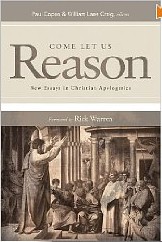
  • Come Let Us Reason: New Essays in Christian Apologetics – Available on Kindle or Pre-Order the Book, Feat. William Lane Craig, Paul Copan, JP Moreland, Gary Habermas, Matthew Flannagan et al.

    The kindle edition of Come Let Us Reason: New Essays in Christian Apologetics, published by B&H Academic, edited by William Lane Craig and Paul Copan and featuring Craig, Copan, JP Moreland, Gary Habermas, Craig Keener, Mary Jo Sharp, this blog’s Matthew Flannagan, and others, with the foreword written by Rick Warren, is now available at the link above on Amazon.

    The book version of Come Let Us Reason: New Essays in Christian Apologetics can be pre-ordered at this link on Amazon.

    Matt’s chapter is “Did God Command Canaanite Genocide?” Here is the editorial review from Amazon:

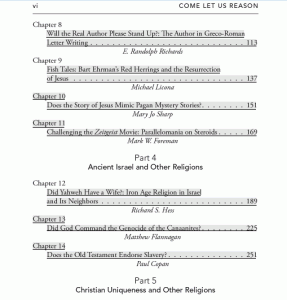
    Come Let Us Reason: New Essays in Christian ApologeticsCome Let Us Reason is the third book in a series on modern Christian apologetics that began with the popular Passionate Conviction and Contending with Christianity’s Critics. The nineteen essays here raise classical philosophical questions in fresh ways, address contemporary challenges for the church, and will deepen the thinking of the next generation of apologists. Packed with dynamic topical discussions and informed by the latest scholarship, the book’s major sections are:
    • Apologetics, Culture, and the Kingdom of God
    • The God Question
    • The Gospels and the Historical Jesus
    • Ancient Israel and Other Religions
    • Christian Uniqueness and the World’s Religions

    Click to View the Table of Contents of Come Let us Reason

    Contributors include J. P. Moreland (“Four Degrees of Postmodernism”), William Lane Craig (“Objections So Bad That I Couldn’t Have Made Them Up”), Gary R. Habermas (“How to Respond When God Gives You the Silent Treatment”), Craig Keener (“Gospel Truth: The Historical Reliability of the Gospels”), and Paul Copan (“Does the Old Testament Endorse Slavery?”).

    Paul Copan is a professor and the Pledger Family Chair of Philosophy and Ethics at Palm Beach Atlantic University in West Palm Beach, Florida. He holds a Ph.D. in Philosophy from Marquette University.

    William Lane Craig is research professor of Philosophy at Talbot School of Theology in La Mirada, California. His Ph.D. in Philosophy is from the University of Birmingham in the United Kingdom.

    The Come let us Reason series is designed to bring scholarly work to the lay person so, depending on whether you prefer Kindle or book form, order or pre-order your copy now and let us know what you think.

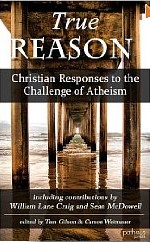
  • True Reason: Christian Responses to the Challenges of Atheism – on Kindle

    The kindle edition of new book featuring responses to the New Atheists, aimed to be readable at the popular level entitled True Reason: Christian Responses to the Challenges of Atheism is now available on Amazon. This blog’s Matthew Flannagan contributed to a chapter in it alongside William Lane Craig, Sean McDowell and others.

    Matt’s chapter is a reprint of his chapter “Did God Command Canaanite Genocide?” in the forthcoming in April B&H Academic book: Come Let Us Reason: New Essays in Christian Apologetics edited by Paul Copan and William Lane Craig.

    Here is the editorial review from Amazon:

    True Reason: Christian Responses to the Challenge of Atheism“While New Atheists like Richard Dawkins, Sam Harris, and others proclaim loudly their rationality, clear thinking, and incontrovertible scientific arguments, others are beginning to wonder how genuinely rational they are. Have they proved anything? Have they argued convincingly? Have they pinpointed any real challenges to the credibility of Christian faith?

    “True Reason,” edited by Tom Gilson and Carson Weitnauer, brings together a compendium of writers–philosophers, apologists, ethicists, theologians, historians–who look carefully at the best arguments atheism has and evaluate their validity, logic, assumptions, and naturalist conclusions.Authors include noted philosopher William Lane Craig and popular apologist Sean McDowell, along with Gilson, Weitnauer, John DePoe, Chuck Edwards, Matthew Flannagan, Peter Grice, Randy Hardman, David Marshall, Glenn Sunshine, David Wood, and Samuel Youngs. Each chapter tackles a different atheist argument and brings reason fully into the discussion.

    Which is more reasonable: atheism or Christianity? Read “True Reason” and think for yourself.”

    Get your copy now, read it, and let us know what you think both here and on Amazon 🙂

  • Francesca Minerva and Matthew Flannagan on “After-birth abortion: why should the baby live?” on Radio

    Francesca Minerva and Alberto Giubilini‘s article “After-birth abortion: why should the baby live?” published in the Journal of Law, Ethics and Medicine is creating waves the world over. In a few hours, on the morning of Thursday 1 March, around 10:00am New Zealand time, Dr Minerva will be interviewed on this article on Radio Rhema’s Pat Brittenden Mornings. Shortly after Dr Matthew Flannagan, of this blog, arguably New Zealand’s most eminent Abortion Ethicist, will be interviewed in response.

    The Abstract of “After-birth abortion: why should the baby live?” is as follows:

    After Birth AbortionAbortion is largely accepted even for reasons that do not have anything to do with the fetus’ health. By showing that (1) both fetuses and newborns do not have the same moral status as actual persons, (2) the fact that both are potential persons is morally irrelevant and (3) adoption is not always in the best interest of actual people, the authors argue that what we call ‘after-birth abortion’ (killing a newborn) should be permissible in all the cases where abortion is, including cases where the newborn is not disabled.

    Matt’s articles on abortion rebutting most of the arguments used in “After-birth abortion” (they are very similar to arguments offered by Michael Tooley and Peter Singer) can be found by using the tags below – particularly see his:

    Boonin and Sentience Criteria: A Critique Part I
    Boonin and Sentience Criteria: A Critique Part II
    (published in Ethics and Medicine: An International Journal of Bioethics vol 25, issue 2, 2009, 95-106)
    Sentience Part 1
    Sentience Part 2 

    UPDATE:
    Dr Francesca Minerva’s interview on her and Alberto Giubilini’s article “After-birth abortion: why should the baby live?” is now available to download it as an MP3.

    Dr Matthew Flannagan’s interview on Francesca Minerva and Alberto Giubilini’s article “After-birth abortion: why should the baby live?” is now available to download it as an MP3.

    FURTHER UPDATE
    In response to Dr Minerva’s comments in her interview where she states that parents of disabled children do not read academic articles and later, academics who are capable of understanding the debate would not be offended by the position she was arguing for:

    I am an academic, I am married to Matt who is also an academic.

    Matt and I are the parents of four children, two of whom have disabilities, one whose diagnosis is Severe Autistic Spectrum Disorder. The severity of this diagnosis cannot be overstated. Our son cannot go to school, cannot be cared for by most people; and when his condition is not managed, regularly does actions that endanger himself and others that are the source of considerable stress – he gets into rages where he cannot value or appreciate the risks he is taking to his own life. We shape our lives around managing his care. It is hard. His condition causes significant impact to our financial, social and professional endeavours as well as our stress levels; just on Saturday he caused four Police Patrol cars and their respective officers to leave active duty to deal with him.

    So we present a conundrum to Dr Minerva’s claims. We are academics, we are both capable of following and understanding the argument and contributing to it in a non-emotive way – in fact, both of us have contributed to this particular debate in this way. Further, we often read academic articles – most recently we have each read hers; we author them too. Contemporaneously, we are also parents of disabled children, one fairly seriously disabled child. So are we offended by her argument? Yes. The suggestion that our son, because he is a burden, could understandably and justifiably be killed provided he is of a biological state where he does not value or appreciate his life – or that had we known what we were in for we could just had killed him at birth, is offensive. An implication of this argument is that he is not as valuable as other human beings and I reject that.

    As Matt pointed out in his interview, when your reasoning brings you to a conclusion of that magnitude you need to check your premises, not bite the bullet and shoot the baby.

    Oh and by the way, abortion means termination of pregnancy it cannot, by definition, apply post-pregnancy. It is up there with talking about post-death homicide.

    HERALD UPDATE:
    The New Zealand Herald has run an article on the subject featuring Matt (only they wrongly imply he is on faculty at Auckland University): “Killing newborns: Paper stirs debate, death threats”

  • Jerry Coyne on God and Morality Revisited

    Late last year I, wrote a criticism of Jerry Coyne’s piece in USA today. Entitled, As  atheists know, you can be good without God.  My critique attracted some attention. Getting commentary from Mary Ann Spikes, Jason Thibodeau,  Jeffery Lay Lowder, and Brian Zamulinski.  Since the USA today article Coyne has written a follow up article where he purports to address the kinds of criticisms I made in this post. This article is entitled Maybe my Philosophy isn’t so Unsophisticated After All.  However, far from exonerating his poor reasoning, Coyne’s response simply further demonstrates my point.

    In this article Coyne focuses almost exclusively on criticisms I and others have made to his use of the arbitrariness objection. This is significant, for this criticism was just one of several criticisms of Coyne’s article that I raised .  Consequently, even if Coyne’s rejoinder is sound it addresses only one of my objections.  The rest remain untouched.

    As it is, his response is poor.  He begins by noting the response to the arbitrariness objection proposed by William Lane Craig. According to Coyne, Craig’s response is “whatever God orders is good and morally obligatory simply by virtue of the fact that He is God.” He cites this as a quotation but fails to provide a source. His response to this is to refer to alleged atrocities taught in the Old Testament and claim Craig’s response is “too stupid to address”

    Three things are evident, First, this is not Craig’s response to the arbitrariness objection; in his book Philosophical Foundations of  a Christian Worldview, Craig argues that Our moral duties are constituted by the commands of a just and loving God” (emphasis original)   and that

     this fact also supplies the key to the arbitrariness objection.  For our duties are determined by the commands, not merely of a supreme potentate, but of a just and loving God.  God is essentially compassionate, fair, kind, impartial, and so forth, and His commandments are reflections of His own character.  Thus, they are not arbitrary, and we need not trouble ourselves about counterfactuals with impossible antecedents like “If God were to command child abuse . . . .[1]

    So, Craig, in fact, maintains it’s impossible for God to command actions which are cruel, unjust and so on.   He does not, claim such actions can become good merely by God commanding them and Coyne appears to insinuate.

    Second, I actually addressed the Old Testament atrocity argument in my original article . However, Coyne simply repeats his argument.

    Third, calling someone “stupid” is not a rational rebuttal of their position; it commits a fallacy that logicians call the ad hominem fallacy, where one attacks the arguer instead of rebutting his argument. The distinction between attacking a person and refuting their argument is an elementary one in logic; it’s hard to believe Coyne is unaware of it.

    If Coyne thinks misrepresenting people, insulting them and then repeating an argument which has been addressed counts as competent philosophical or theological analysis he is gravely mistaken.

    After setting this tone, Coyne turns specifically to my criticisms. After suggesting that responding to on MandM is “a mugs game” he directs the reader to an article by Jason Thibodeau who Coyne calls a “real” philosopher” and cites two paragraphs which he claims “decisively” refute me.

    Now it doesn’t need saying that simply finding an article that agrees with you and maintaining the author of that article is a “real scholar” is not really a response to anything. Neither is simply asserting that someone has offered a refutation itself a refutation.

    But what’s interesting is Coyne’s selective citation. After noting my point, that a loving and just person would not command the kinds of actions he mentions, Thibodeau states

    There are a few problems with this response. The most important (and the one that I think that Coyne had in mind) is that if we are to understand the reply to mean that a moral God would not issue immoral commands… the response implies that there is a standard of morality that is independent of God against which he and his commands can be judged. But if morality is independent of God, then the DCT [divine command theory] is false.

    Coyne suggests this response “shows pretty definitively that” my argument fails and it “sets the record straight” for all thinking Christian’s

    In fact this response is mistaken. The fact that a loving and just being does not command certain actions does not entail that there is a moral standard independent of that being requiring them to not command those things. This is because it is possible for a person to be loving and just with being obligated to be loving and just. Suppose, for the sake of argument, morality was an illusion and in reality no one really was required to love their children.  Would it follow that all parents would cease to love them, or that they could not exercise love?  Not at all, I can be loving without being under an obligation to be loving. So this objection fails.

    Interestingly however, Thibodeau actually points this out in the very next line of the article which Coyne snips from his quotation. Thibodeau writes:

    In any event, as Flannagan indicated, the debate does not end here because the divine command theorist may concede the point but still insist that all he needs is that God is all-loving, and he will get the same consequence (or at least one that is close enough); namely that God will not issue commands that require us to cause horrible pain and suffering (or do anything that we all agree would be horrendous). If developed in the appropriate direction, this reply can lead to a fully developed response to the arbitrariness objection.

    So, the “real philosopher” Coyne cites actually says this argument is unsuccessful, for reasons I had already indicated in my criticisms.  Coyne’s response therefore appears to be as follows (a) find an article that agrees with his conclusions (b) assert the author (apparently unlike me) is a real philosopher (c)  quote an argument  the author actually says fails to address my point (d) Snip the context so your readers don’t know this (e) assert boldly that his comment refutes me.  Far from showing that my criticisms of Coyne are mistaken these kinds of tactics suggest I was on the mark.  Of course readers of Coyne’s work online or in USA today won’t have the original articles Coyne cites from and so will take his assertions on faith. This is effective propaganda but little else.

    After these dubious manoeuvres, Coyne then asserts that the rest of Thibodeau’s article makes devastating points against me but does not cite or summarise these arguments.

    In fact Thibodeau’s makes two arguments both of which fail.

    Thibodeau’s, first argument appeals to God’s omnipotence, which he defines as the ability to do whatever is logically possible.  If omnipotence is defined this way, then God could command the torture of children.

    Now whether omnipotence should be defined in this way is in fact a matter of dispute. However, suppose we grant Thibodeau’s definition; the argument still fails. Adams’ position is that that moral obligations are constituted by the commands of a loving and just God.  Even if God, being omnipotent could command the torture of children, he could not do so and continue to be loving and just. This is because it’s not logically possible for a loving and just being to command things like this. So this argument does nothing to show that a loving and just God could command torturing children and hence does not refute Adams’ position.

    Thibodeau’s second argument is similarly mistaken. Thibodeau argues that it’s possible that there exists an all-powerful creator that enjoys watching sentient beings suffer, he labels this being Azura. He then notes that Azura could command the torture of children.

    Now assuming that it is possible that Azura exists (which I doubt), this argument is beside the point. The fact that an evil being who is all powerful could command the torture of children, does not entail that a loving and just God could. So Adam’s contention that moral obligations are best accounted for by the commands of a loving and just God remains un-refuted.

    Both arguments fail because they misconstrue the position that Adams and those who follow him defend. These people contend that the nature of moral obligations is best explained by the commands of a loving and just God. Pointing out that they are not explained by a God who lacks these attributes does not address this contention. It ignores it.

    Interestingly,  in  some commentary on Coyne’s exchange with myself arguments philosopher and ethicist  Brian Zamulinski notes that he had pointed this out to Coyne months before he wrote the USA today article. Zamulinski  writes

    Robert Merrihew Adams contended that morality is constituted by the commands of an essentially loving God.  The Euthyphro dilemma collapses because an essentially loving God could not command just anything.  In his USA Today article, Coyne rehearses the Euthyphro dilemma but does not mention the Adams reformulation.  This is odd.  I had an e-mail correspondence with Coyne some months earlier in which I pointed out the Adams reformulation.  Coyne should have taken time to rebut the reformulation.  He did not.

    Coyne’s final riposte is to ask a question, how do you know a loving God exists? And this whole issue is “moot unless you can show that there’s a God to issue moral commands”. This however is to reason in a circle, in his USA today article Coyne was criticising the argument that morality was “strong evidence for [God’s] existence.” People like Adams argue it is because the best account of the nature of moral obligations is that moral obligations are commands issued by a loving and just God.  To contend Adams is wrong because no one has offered an argument for a loving God’s existence is to assume the very issue under dispute. One could just as easily argue Coyne’s argument is flawed on the grounds that his arguments are flawed.

    Nothing in Coyne’s follow up leads me to revisit my initial conclusion. Misrepresenting people’s views, calling people names, quoting from articles out of context, denigrating others’ scholarly qualifications and confidently asserting a position whilst reasoning in a circle, and ignoring objections, are not the same as actually addressing them.  I doubt such sophistry would pass muster in the scientific community when people write on scientific topics, and it does not pass muster when scientists comment on theology or philosophy.

    [1]William Lane Craig and J P Moreland Philosophical Foundations of a Christian WorldView (Downers Grove Il:Intervarsity Press academic), 531,

  • Matt on “The Panel” on Pat Brittenden Mornings – with David Slack

    Radio RhemaTune in to Radio Rhema at 11:40am (NZ time) today to hear this blog’s Matthew Flannagan and David Slack discuss topical issues on “The Panel” on Pat Brittenden morning.

    You can download the MP3 here or listen online here.

  • Madeleine Registered

    News that many may have missed while we were in our moving house and not blogging mode is that Madeleine has been admitted to the Register of Lawyers, this means that she may now practice law and work in the areas restricted by law for lawyers. You can even go to the New Zealand Law Society Register of Lawyers and look her up.

    The New Zealand Law Society Register of Lawyers

    I am also rather chuffed to share that after working for her firm, Coast Legal, for a relatively short time she has been offered and has accepted the position of Associate. As I understand it this was based on her performance thus far. She is currently working primarily in family law doing a number of child protection cases where her background in legal philosophy seems to really be an asset as well as the other general areas of family law. She also does a bit of criminal, traffic, estate, home schooling law and civil work and has recently been asked to first chair a High Court matter by another firm who are aware of her arguing skill; she’ll be doing that at the end of the month.