Year: 2009

  • Auckland Bloggers Drinks Feat. Pamela Anderson and John Key – This Thursday!

    Following on from the success of last week’s packed out impromptu Auckland Bloggers drinks featuring blogging celebrity David Farrar, Peter Cresswell and I have decided that we should feature celebrity guests more often.

    Anna WoolfThis week Pamela Anderson is in Auckland for Fashion Week and John Key is back from New York, fresh from his success as New Zealand’s newest comedian to appear on Letterman, so we invited them both to the Auckland Bloggers Bar Bash.

    They refused to take our calls are yet to confirm but in the unlikely event that neither will make it, and as Pamela is more woman than most, both Anna Woolf and myself will be appearing in her place and Peter Cresswell will be standing in for John Key.

    Madeleine Flannagan standing in for Pamela AndersonOpen to anyone who happens to be in Auckland. Regular blogger attendees include those from Annie Fox, Not PC, Interest.co.nz, Lolly Scramble, State Highway One and MandM. Others have been known to stop by, such as David Farrar, Whaleoil, No Minister, Roar Prawn and Fran O’Sullivan so don’t be shy.

    What: Auckland Bloggers Drinks – a social gathering of bloggers and bloupies (those who read, comment on and hang out with bloggers)
    When:
    Thursday 1 October from 6.30pm
    Where:
    Galbraiths, 2 Mt Eden Road, Mt Eden, Auckland

    Peter Cresswell standing in for John Key

  • VSM Bill off to Select Committee

    The VSM Bill has passed its first reading and is off to Select Committee. Predictably the student associations have freaked out and David Farrar has an interesting fisk of the various press releases they’ve issued in response here.

    Given that Madeleine and I were involved in the move to make student associations voluntary in the late 90’s we will follow this debate with interest.

    UPDATE:
    The Hansards debate on the VSM Bill is now online here. It makes for interesting reading, you can really see the left/right ideologies coming through. The left MP’s rubbish the concept of freedom of association and conscience as right wing inventions and talk about collective rights, rights to free education and so on.

    We also noted Labour MP Chris Hipkins revealing objection to the Bill:

    “the real driver behind this bill—which, of course, we heard already from Roger Douglas and Anne Tolley—is that it is designed to silence critics of the Government.” [Emphasis added]

    Note the assumption that all tertiary students oppose National, ACT, United Future and Maori Party [Government] policies.

    Funny, I recall some CM Research being done when I was a student at Waikato University that showed that in fact 60% of tertiary students vote right of centre, a study that NZUSA commissioned, paid for with money taken from all students, and then refused to release the study when the results didn’t come out showing all students being lefties.

  • Walter Sinnott-Armstrong and Infantile Religious Morality

    In “Why Traditional Theism Cannot Provide an Adequate Foundation for Morality” Walter Sinnott Armstrong criticises William Lane Craig’s contention that theism, if true, provides an adequate foundation for morality. Armstrong contends that Craig’s position is “incredible”[1] and subject to a “cavalcade of devastating objections.”[2] He goes on to conclude that his criticisms do not just call into question Craig’s argument for a theistic based system of ethics, he contends that his arguments are conclusive against any theistic account of ethics that is compatible with Christianity. He states, “Other theists might try to give better arguments for a religious view of morality, I don’t see how they could avoid all the problems in Craig’s account without leaving traditional Christianity far behind.”[3]

    In several posts (see the related posts below) I have criticised some of the arguments Armstrong makes in this article. In this post I want to turn to another. The claim that “divine command theory makes morality childish;” Armstrong states,

    A second objection is that the divine command theory makes morality childish. Compare a small boy who thinks that what makes it morally wrong for him to hit his little sister is only that his parents  told him not to hit her and will punish him if he hits her. As a result, this little boy thinks that, if his parents leave home or die, then there is nothing wrong with hitting his little sister. Maybe some little boys think this way, but surely we adults do not think that morality is anything like this.[4]

    Its worth noting that Armstrong’s sketch is something of a caricature; the picture is of a little boy who thinks hitting is wrong because his parents will punish him if he engages in hitting. This tacitly implies that divine command theorists believe that actions are wrong because God will issue punishments to us if we do them. No divine command theorist to my knowledge holds this view. What we typically hold is that an action is wrong for a person to perform if a perfectly good, omniscient being (identified as God) commands that person to refrain from the action in question. The fear of punishment does not come into it.

    This point, however, is largely tangential because the heart of Armstrong’s position appears to be based on three ideas.

    [1] That some children see morality as dependent on the commands of their parents.
    [2] That it is inappropriate, childish or infantile for adults to view morality as being dependent on the commands of a parent.
    [3] That the conception of morality proposed by a divine command theorist is analogous to basing morality on the commands of a parent.

    Hence, divine command morality is infantile or childish.

    In responding to this line of argument, it is worth noting Armstrong’s argument is not new. In fact, it simply summarises an early argument made by Patrick Nowell-Smith in his widely-anthologised essay Morality: Religious and Secular. In this article all three of Armstrong’s premises are defended in more detail than Armstrong provides in the short paragraph above. I think that by critically examining Smith’s argument one can see the problems with Armstrong’s.

    Like Armstrong, Nowell-Smith argued, “religious morality is infantile.”[5] Similarly, like Armstrong, it is clear that Nowell-Smith’s target was a divine command theory.[6] Nowell-Smith’s thesis is that a divine command theorist possesses an ethical consciousness that is frozen or arrested at the pre-critical stage of a child. A mature adult whose cognitive faculties are functioning properly would have outgrown it.

    In arguing for this thesis, Nowell-Smith draws upon the theories of moral development proposed by Piaget.[7] According to Piaget, children start out with a view of morality that Nowell-Smith labels deontological, heteronomous and realist. Children view morality as obedience to certain rules (deontology) which hold because an authority figure, usually the parent, has promulgated them (heteronomous) and wrongdoing is perceived as any external action that violates these rules (realism). This view of ethics is appropriate for small children; however, as they mature and become more rational their consciousness changes. They begin to see the point of certain rules and understand the reasons behind them and the function of such rules. This is the stage where ethics become in Nowell-Smith’s words “autonomous.” Instead of just accepting a parent’s word for it the child learns to figure these things out for him/herself.[8]

    Nowell-Smith goes on to argue that these same features of heteronomy, realism and deontology are present in “religious morality” or more specifically, divine command theory. Consequently, divine command theory reflects a childish way of viewing ethics, one not worthy of a grown-up, educated adult.[9]

    Nowell-Smith’s analogy between divine command theory and childish morality ignores a fundamental disanalogy between the case Piaget describes and that of the divine/human relationship. As Richard Mouw has pointed out, Piaget views the transition from heteronomy to autonomy as corresponding to the time when a child begins to be on an increasingly-equal footing with his or her parents. The infantile stage of morality is appropriate while the child is in infancy because of its limited rationality and knowledge. In this state the child is unable to make decisions as competently as the adult, hence it relies on and defers to the judgement of adults. However, as the child grows equal to the parent in these respects he or she ceases to rely on parental judgement. He or she is now just as competent to answer these questions as his or her parent is and so his or her thinking becomes autonomous.[10]

    Consequently, Piaget’s model of development applies to situations where the subordinate is temporarily in a stage of inferiority to the authority but is undergoing a process of growth towards equality. It is when this equality is reached that the authority relationship is no longer appropriate. However, the relationship between adult humans and God is fundamentally different. Adults are not growing into divinity so that when mature they will equal God in rationality and knowledge. Rather, they are permanently in a state where they are inferior to God in these respects. In this context the failure to reach a moral consciousness that is equal to God’s is not a sign of arrested development and the infantile charge loses its sting. It is inappropriate for adults to behave like children but not inappropriate for them to fail to think like God.[11]

    Nowell-Smith’s argument, therefore, is unsound. I think the same response can be attributed to Armstrong’s argument. Returning to Armstrong’s three premises,

    [1] That some children see morality as dependent on the commands of their parents.
    [2] That it is inappropriate, childish or infantile for adults to view morality as being dependent on the commands of a parent.
    [3] That the conception of morality proposed by a divine command theorist is analogous to basing morality on the commands of a parent.

    There is a subtle equivocation in this argument; turning to premise [2] that it is inappropriate, childish or infantile for adults to view morality as being dependent on the commands of a parent, as we saw, this is because an adult child has grown to a position where he or she is on par in terms of maturity, rationality, insight, knowledge, and so on, to the parent. The problem is once this is clarified [3] is false. The conception of morality proposed by the divine command theorist is not analogous to basing morality on par with the commands of a parent who is an equal as no divine command theorist thinks of adult human beings as being on par with God in terms of maturity, rationality, insight, knowledge, and so on.

    Of course there are other respects whereby the conception of morality proposed by divine command theorists is analogous to a conception that sees morality as dependent on the commands of a parent, so in this sense [3] is true. The problem is that these respects do not include the features of the relationship between an adult child and their parent that makes the conception inappropriate and so if correct then [2] would no longer be true. Either way the argument fails.


    [1] Walter Sinnott-Armstrong “Why Traditional Theism Cannot Provide an Adequate Foundation for Morality” in Is Goodness without God Good Enough: A Debate on Faith, Secularism and Ethics, eds. Robert K Garcia and Nathan L King (Lanham: Rowman & Littlefield Publishers, 2008) 106.
    [2]
    Ibid. 108.
    [3]
    Ibid. 114.
    [4]
    Ibid. 109.
    [5]
    Patrick H. Nowell-Smith “Morality: Religious and Secular,” in Christian Ethics and Contemporary Philosophy ed. Ian T. Ramsey (London: SCM Press, 1966) 95.
    [6]
    Ibid. 96. Nowell-Smith characterises the view he critiques as follows, “They have simply assumed that just as the legal propriety of an action is established by showing it to emanates from an authoritative source, so also the moral propriety of an action must be established in the same way; the legal rightness has the same form as moral rightness, and may therefore be used to shed light on it. … Morality, on this view, is an affair of being commanded to behave in certain ways by some person who has a right to issue such commands; and once this premise is granted, it is said with some reason that only God has such a right.”
    [7]
    Ibid. 100.
    [8]
    Ibid. 100-103.
    [9]
    Ibid. 103-108.
    [10]
    Richard Mouw The God Who Commands: A Study in Divine Command Ethics (Notre Dame, IN: University of Notre Dame Press, 1990) 12.
    [11]
    Ibid. 12-14.

    RELATED POSTS:
    On a Common Equivocation
    Walter Sinnott-Armstrong on God, Morality and Arbitrariness
    Walter Sinnott-Armstrong, William Lane Craig and the Argument from Harm Part I
    Walter Sinnott-Armstrong, William Lane Craig and the Argument from Harm Part II
    Tooley, The Euthyphro Objection and Divine Commands: Part I
    Tooley, The Euthyphro Objection and Divine Commands: Part II

  • MandM win M&M’s

    Over the weekend Matt entered one of those count the number of lollies in the jar competitions and won the competition. So last night he brought home his prize, a jar full of jaffa M&M’s. I couldn’t resist sharing a pic of MandM with the M&M’s especially now that we live in Auckland.

    MandM with M&Ms

    They are all gone now.

    … my tummy hurts….

  • Published – Three Strikes: Proportion and Protection

    The editor of the New Zealand Law Students Association (NZLSA) publication LEX has just advised me that she has published my article “Three Strikes: Proportion and Protection.”

    In it I argue that the objections to the The Sentencing and Parole Reform Bill (a.k.a the “Three Strikes Bill”) on the basis that it affronts the proportionality doctrine, which stems from the Bill of Rights, is flawed. I argue that criticisms of the Bill along these lines confuse appropriate force for punishment with defensive force.

    UPDATE:
    Not to be outdone, Matt just came in from the supermarket with the October edition of Investigate Magazine, which of course, features his regular Contra Mundum article – this month entitled, “God, Proof and Faith” complete with pullquote “the sceptic’s position eats its own tail … [it] is incoherent” and photo of Richard Dawkins labeled “delusional?” (you gotta love editor Ian Wishart). We’ll have a full copy of this article available on this blog at the end of the month; the editor prefers us to penalise those of you who don’t buy his magazine by making you wait.

  • The 2009 Forum on the Family: A Review

    On Friday Madeleine and I attended the Forum on the Family and the following is our long awaited (and long) review of it.

    The Forum kicked off with an impassioned talk from Bev Adair. Bev gave a harrowing account of her own story of childhood physical and sexual abuse and subsequent encounter with God that transformed her life and character and enabled her to break the cycle in her own life, heal and bring her own experience into her work with the Family and Child Trust. She stressed that the solution to child abuse was that people stopped blaming others or their social context for what happens to them; that they must cease demanding solutions from the state and being reliant on welfare; she called for individuals and communities to take responsibility for their own actions and for an end to the silence; abuse is not invisible, people who see it must act. Bev stated that voluntary organisations that were not funded by the state were doing some of the most effective work in the community and the consensus from them was that poverty does not make people hurt their children, she pointed out that countries with real poverty don’t brutalise their children or have stats like New Zealand’s.

    What was interesting was that later in the program the children’s commissioner, Dr John Angus, gave a much drier facts and figures type talk that reinforced what Bev stated. Relying on data compiled by CYFS, Angus noted that abuse tended to be more correlated to drug and alcohol abuse than poverty and that while reports of child abuse are on the increase, the actual cases are not. Like Bev he also suggested that the solutions were at the family, individual and community levels as opposed to government. Angus noted that one of the biggest problems was that when people were worried about a friend or family member’s conduct they rang CYFS rather than actually confronting or addressing it at a family level. Angus argued that real progress is made when families and communities own the problem and openly confront the issues family members face and offer constructive help instead of just looking to the state. It was at this family/community level, that real change can be made.

    In contrast to this, Labour Leader Phil Goff gave a speech about how poverty and economic hardship were the key issues in child abuse. Goff spoke of the need for a society where no children missed out on health care, education or basic necessities due to economic deprivation. He noted the historic Christian motivation behind the original welfare policies of Labour and suggested a need for all parties to work towards helping families in need. While I am not generally a fan of Labour, it is hard to dispute Goff’s claim that we should work towards having a society where no child misses out on basic necessities due to poverty and God clearly would want Christians should to be committed to achieving such a society, that said, none of this speaks to the question as to how this should be done and what the just and appropriate means of bringing it about are (I have discussed the issue of sustenance rights in a previous post). In the Q&A when I questioned Goff further on this he made it clear that he specifically saw this support as primarily coming from the state and not from the voluntary sector on the grounds that “the state has the money.” (Ironically Goff also justified high taxes on the grounds that it was needed for the state to play this role making his position somewhat circular.) These criticisms aside, Goff is to be commended for being the first Labour leader to front up and address the Forum on the Family and for attempting to build bridges with conservative Christians instead of trying to “marginalise them out of existence.”

    One unfortunate feature of Goff’s talk was the focus in the Q&A on the smacking issue. Goff suggested this was a side issue, not as important as child abuse and that people should focus their energy and passions on more important issues. That is, of course, correct and the fixation by members of the audience on this issue did seem disproportionate. However, at the same time, as members of the audience noted, a large number of the audience were from voluntary organisations that were dealing with domestic violence and child abuse at the coal face; hence, the suggestion they were not addressing this or were not as committed to these issues is inaccurate. Moreover, opponents of the current s59 of the Crimes Act had repeatedly told Labour that laws about smacking had nothing to do with child abuse in the past. Proponents had justified the decriminalisation of reasonable force for the purposes of parental correction on the grounds that it would help to stop child abuse and some had, in fact, equated smacking with child abuse. The previous Labour government’s support of this line of argument was the reason that there was now a Bill before the house, John Boscawen’s Crimes (Reasonable Parental Control and Correction) Amendment Private Member’s Bill. So for Phil Goff to now claim now that concern around s59 was a side issue and the question of child abuse was a different, more important issue that Labour was deeply committed to was more than a tad disingenuous, which is what evoked the scathing (and justified) attack from Christine Rankin that David Farrar referred to on his Facebook page.

    Moreover, with a Bill before the house, Labour really do need to take a stance; it is fine to say s59 is not their main focus but when the bill is actually put before them they will need a position. Their opinion on the now, apparently separate and unrelated to light smacking, issue of child abuse, while commendable, is not what they will be asked to vote on. When Madeleine pressed Goff on this he stated that Labour will be voting against Boscawen’s Bill.

    Not all the speakers spoke on child abuse and s59, Greg Fleming, CEO of the Maxim Institute, gave a good talk entitled “Right Wing, Left Wing. What Does it Mean? Does it Matter?” Fleming made essentially three points; first, he noted that the terms ‘right wing’ or ‘left wing’ often function as labels that are used to pigeon hole or brand a person so as to summarily dismiss their position without actually addressing it or considering its merits. Fleming’s contention that such dismissals often reflect a kind of unjustifiable intellectual laziness is undoubtedly correct and occurs far too often.

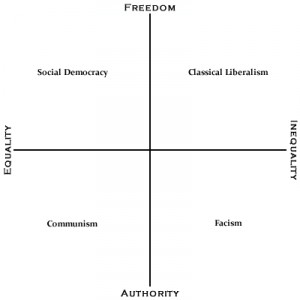
    Political SpectrumFleming’s second point was to suggest that the labels ‘left’ and ‘right,’ when understood correctly, do have a useful descriptive function in highlighting where a person sits on a particular spectrum. For Fleming, this spectrum constituted a horizontal axis whereby equality was at one end, the left and inequality at the other, the right. In addition to the horizontal left-right spectrum is a vertical spectrum with freedom at the top and authority on the bottom. These axes lead to communism being on the bottom left, totalitarian authority to maximise equality; fascism on the bottom right, totalitarian authority to maintain inequality; social democracy on the top left, limited government focused on achieving equality; finally, classical liberalism on the right, limited government for the sake of maximising individual freedom.

    One criticism I have of this is that (more…)

  • Pulse Check

    We have not fallen off the face of the earth, just too much on. Auckland Bloggers drinks was very cool, extremely packed out and seriously a who’s who of blogging – for a list of who may or may not have been present see Ryan Sproull’s write up of the night.

    We then went straight into the Family First Forum on Friday followed by dinner and drinks with a few bloggers, bloupies and others at the forum.

    Then we hung out with Andy Moore who stayed with us til last night. Then we began writing blog posts but then it was 1am and we were not finished… church now so check in later.

    If you want some Family First Forum tidbits, Big News has a few posts, Andy Moore has done a write up and if you are friends with David Farrar on Facebook he has half a dozen cryptic comments about things MP’s said on his front page, things said to MP’s that he Facebooked from the Forum (not that he conceded where he was):

    David Farrar Just met a young guy from Destiny Church. Asked him his role there and he said he was bodyguard for Brian Tamaki. Hope he is paid well!

    David Farrar Heh. Someone inro’d themself to a MP as the No 1 NZ Christian Blogger. [No idea who that might have  been…] I quipped that must make me the No 1 hedonistic blogger 🙂

    David Farrar Goff has just said he used to smack his kids

    David Farrar Rankin just attacked Goff big time. Not sure that is wise for a Families Commissioner.

    David Farrar My name twin, David Farrier, is sitting next to me. Still can’t believe people sometimes confuse us!

    David Farrar Heh John Key just said that he is happy to announce they are keeping the H in Helensville 🙂

    David Farrar Six questions so far to John Key – all on smacking so far. There are other issues!

    We’ll get our official report on the forum up later today.