Category: Speaking Engagements

  • Hear Matt speak @ the Auckland Confident Christianity Apologetics Conference

    This ANZAC weekend make sure you check out the Thinking Matters Confident Christianity Apologetics Conference at Northcote Baptist Church. Matt will be speaking along with a number of other great speakers. Full conference schedule here.

    In brief, from the Thinking Matters’ Facebook Event page:

    Confident Christianity Conference

    Does God exist? Why is there so much suffering? Is truth relative? Are science and faith enemies?

    Can you give both intellectually and emotionally satisfying answers to these questions? Can you defend the Christian faith in a reasonable and compassionate way? Are you able to represent Christ’s message of hope, rescue and unfathomable love, even in the face of doubt and scepticism?

    Join us this Anzac weekend where a line-up of top international and local speakers will sensitively and skilfully respond to the biggest objections that Christians encounter today – and equip you to live out a confident, yet gracious faith in your everyday life.

    Speakers Include

    – Brett Kunkle – international youth speaker
    – Dr Jeff Tallon – award winning scientist
    – Dr Steve Kumar – philosopher & apologist
    – David Riddell – international speaker & counsellor
    – Mark Powell – business leader & CEO of The Warehouse
    – Dr Matthew Flannagan – philosopher & theologian

    And many others!

    Friday 24th April – 7:00PM – 9:30PM
    This is a FREE public event. No registration needed – just turn up!

    Saturday 25th April – 9:00AM – 5:00PM
    Full Day Conference. Tickets:

    ADULT:
    Early Bird Adult Registration $59 (Available until 17th April)
    Regular Adult Registration $69

    YOUTH (Under 18) & STUDENT (with ID):
    Early Bird Youth $30 (Available until 17th April)
    Regular Youth Registration $40

    Lunch included on Saturday (gluten free option available).

    ALL SATURDAY ATTENDEES ALSO RECEIVE A COMPLEMENTARY LEE STROBEL DOCUMENTARY DVD!

    For full details, a speaker lineup and to purchase tickets – check out our conference page: www.thinkingmatters.org.nz/conference

  • A very belated report on my trip to San Diego

    With trips to the US, Christmas, New Years, the summer break, Madeleine’s work, my preaching and juggling the family and the launch of my book, it has been a while since I blogged. Since the last post was about me going to the US I figured I should start by giving a very belated update on the trip before I get down to more run of the mill blog posts.

    Last time Madeleine blogged it was Wednesday 19 November 2014, the day after I had flown out of Auckland. I arrived in Los Angeles at 10 am on Tuesday 18 November 2014 (love the international date line!) and I finally arrived in San Diego that afternoon where I had an enjoyable dinner with Moore College President Mark Thompson.

    The Evangelical Theological Society (ETS) and Evangelical Philosophical Society (EPS)  meetings began the next day. The first session I attended was a very good paper by Richard Davis and Paul Franks critiquing Wes Morriston’s criticisms of divine command meta-ethics (DCM). This paper was technical so I’ll try to summarise: Morriston objects that if moral requirements are identical with God’s commands, and even if it’s impossible for a perfectly good God to command the random sacrifice of 3 years olds, DCM still entails that if this impossibility were actualised and God were to command the random slaughter of 3 year olds, then such slaughter is wrong.

    This objection involves what is called a counter-possible, which is a hypothetical statement with an impossible antecedent. In this case the antecedent is that a perfectly good person could command the random sacrifice of children. According to the standard semantics for counter in modal logic all counter-possibles are  trivially true. Morriston argues this approach to standard semantics is mistaken; it is plausible that some counter possibles are false and that this counter-possible is one such example.

    Davis and Franks, give an interesting and thoughtful reply to Morriston in their forthcoming article “Counterpossibles and the ‘Terrible’ Divine Command Deity“. They argue: (a) Morristons’ own criteria  for distinguishing true from false counter-possibles entails that the counter-possible, If God commanded random sacrifice then random sacrifice is morally required, is, in fact, true and not false. Second, (b) they argue that DCM does not entail this counter-possible.

    To put their point in a nutshell: they argue that a world where God commands evil is a world where God ceases to be good; and since goodness is an essential property of God this entails that in such a world God would cease to exist. However, given God is the creator and sustainer of all that is distinct from him, a world where God does not exist is a world where nothing exists. Hence, it is false that if God commands evil, evil would be morally required. This was an excellent paper and I enjoyed some stimulating discussion with both of the authors during the Q&A and also at lunch.

    Next up was a paper by Frank Beckwith discussing Judith Jarvis Thomson’s famous article “A defence of abortion”. Thomson famously concedes for the sake of argument that a fetus is a human being and then argues, from analogy, that even if that is the case abortion is still permissible. Beckwith argued that, in fact, Thomson does not grant the personhood of the fetus in the way opponents of abortion understand it, but instead assumes a radically individualistic understanding of persons whereby people are not bound by any obligations to others which they do not willingly consent to, a picture which appears to rule out such things as parental duties to children or children’s duties to parents.

    This was followed by Micheal Rea’s interesting paper on whether God is gendered and the use of masculine and feminine language and imagery in describing God. His argument was that God is not gendered and the fact that most imagery used in scripture to describe God is masculine does not justify conceptualising God is exclusively masculine terms.

    In the break I had some very good fellowship and discussion over pizza with members of the Facebook group, Christian Apologetics Alliance.

    In the afternoon I took part in the ethics session of the ETS. The session kicked off with an interesting paper on how capital punishment is practiced in the US. The author, Ken Magnuson, made several disturbing observations about the fact that wealthy people almost always escape capital murder charges whereas the poor do not. This paper was unclear on what the nature of the core problem was: was it that innocent poor people were executed, or that the guilty escaped justice? While the fact that large numbers of innocent are executed might be a reason for opposing the death penalty, the fact that some guilty people get off does not seem to be. If the problem is that some escape capital punishment who deserve it, then ensuring everyone escapes capital punishment will increase the injustice. What was clear was that there needs to be some reforms to ensure less inequitable outcomes.

    Next was a paper by Evan Lenow where he argued that the philosophical doctrine of self-ownership, as articulated in its progenitor John Locke, does not support abortion rights. In this I thought he was right; Locke’s writing in the first treatise makes Lenow’s case even stronger.

    That afternoon I gave my paper, “Abortion as Self-Defence”. I offered a critique of Elieen Mcdonagh’s contention that even if a fetus is a human being, its presence inside a women who does not wish to be pregnant constitutes an act of unjustified aggression and so a women’s right to self-defence entitles her to kill it. My criticism was based on the fact that, in non rape cases, the fetus’ existence inside the woman is due to voluntary sexual intercourse for which her and her partner are responsible and this action confers parental obligations upon both of them. Given that parents have an obligation to provide the basic necessities of life to their children, the fetus’ appropriation of such necessities cannot be unjust aggression. This paper was well received and there was some excellent discussion about rape cases and therapeutic abortion in the Q&A. (Audio of my talk is available here.)

    Thursday was equally intense. I began the morning hearing a paper by David Wood on Paul Draper’s version of the problem of evil. This was followed by a panel discussion on Scott Smith’s recent book, In Search of Moral Knowledge. The panel consisted of Francis Beckwith, David Baggett and James Dew, all offering critique and commentary on the book and Smith offering a response.
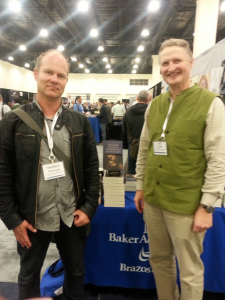
    Matthew Flannagan and Paul CopanOver lunch I met with Paul Copan and a representative from Baker Academic to discuss the launch of Copan’s and my book, Did God Really Command Genocide?: Coming to Terms with the Justice of God, the promotional events we would each be participating in, and also the prospect of further publications in the future. I was then interviewed on camera for US television about the book. (more…)

  • Matt in San Diego

    San DiegoMatt has safely arrived in San Diego and the Annual General Meetings of the Evangelical Philosophical and Theological Societies commence in a few hours.

    Matt is giving two papers this year, one at each conference: “Mackie’s Answer to the Error Theory: A Reply to Joyce″ at the EPS and “Abortion as Self Defence” at the ETS. As his book, Did God Really Command Genocide? Coming to Terms with the Justice of God, co-authored with Paul Copan, has just been released and is available for sale at the conference, I expect he will be busy promoting that too.

    If you are lucky enough to be in San Diego at the conferences please snap a pic of him for me and tag him on Facebook so we back in NZ can see what he is up to 🙂

    I want to thank those who generously donated to help get Matt there, we couldn’t have done it without you.

  • Matt to speak at the 2014 Evangelical Philosophical Society in San Deigo

    Evangelical Philosophical SocietyThis blog’s Matthew Flannagan has had his paper “Mackie’s Answer to the Error Theory: A Reply to Joyce″ accepted for the National Annual Meeting of the Evangelical Philosophical Society (“EPS”) in San Diego, USA, from 19-21 November 2014. The abstract for Matt’s paper is as follows:

    Abstract
    Richard Joyce has argued that the “real problem” with divine command theories of ethics is not the euthyphro dilemma, but rather that such theories cannot account for the platitude that moral obligations have inescapable moral authority. In this paper I reply to Joyce’s contention.

    First, I look at Joyce’s objection in the context of Joyce’s own defence of John Mackie’s error theory. Joyce interprets Mackie as arguing that moral obligations are queer precisely because, if they existed, they would have inescapable authority and no sense can be made of such authority.

    Then I note that Mackie himself argued that a divine command theory was an exception to his thesis. Mackie contended that naturalistic theories face this challenge but a divine command theory does not. I argue that Joyce’s own reconstruction of Mackie’s argument confirms this conclusion.

    Finally, I examine some objections that Joyce raises to this kind of response. I argue they fail. Mackie and Joyce’s error theory, if sound, is an objection to naturalistic or secular accounts of moral obligations and not to divine command theories.”

    This year’s conference theme will be “Ecclesiology”. The Plenary Speaker is Paul Helm of Regent College, Vancouver Canada. The draft copy of the ETS-EPS program is available here.

    (Matt has also had a paper accepted for the Evangelical Theological Society’s Annual Meeting, which is also in San Diego around the same time.)

    As with previous years, we will need to fundraise to raise the $2,500 NZD shortfall in our budget needed to get him there. Family life on one modest, full-time income with a special needs child, who is unable to go to school, makes it very hard. Almost all of Matt’s philosophical and theological work on this blog is the result of his unpaid commitment to the field. Donations, no matter how modest, are greatly appreciated.

  • Matt to speak at the 2014 Evangelical Theological Society in San Deigo

    ETS ProgramThis blog’s Matthew Flannagan has had his paper “Abortion as Self Defence” accepted for the 66th Annual Meeting of the Evangelical Theological Society (“ETS”) in San Diego, USA, from 19-21 November 2014. The abstract for Matt’s paper is as follows:

    Abstract
    Eileen McDonagh has proposed an ingenious argument for abortion rights; she concedes, for the sake of argument, that a fetus is a human being but argues that a fetus’ presence inside the womb of a woman who does not consent to pregnancy constitutes unjust aggression. Consequently, the woman has a right to expel and kill the fetus in self-defence.

    In this paper I will sketch a critique of this line of argument suggested decades ago by Alan Donagan. Donagan argues that, in cases where a woman has not been raped, the woman is has acquired parental obligations to the fetus. Parental obligations are acquired through the act of begetting. If  a person brings a child into existence through voluntary sexual intercourse then he or she has a duty to provide the necessities of life for that child. The fetus is, therefore, not an unjust aggressor.

    I will defend this argument against two influential objections. First, the objection that a woman who does not consent to getting pregnant cannot have parental obligations to her offspring. Second, the objection that, even if  a woman does have parental obligations to her offspring, these obligations do not include a duty to provide bodily life support. I will argue that both objections fail.

    This year’s Annual Meeting theme is “Ecclesiology”. Plenary speakers for this year’s meeting are  Gregg R. Allison (Professor of Christian Theology, Southern Baptist Theological Seminary), Joseph H. Hellerman (Professor of New Testament Language and Literature, Talbot School of Theology, Biola University) and Miroslav Volf (Henry B. Wright Professor of Systematic Theology, Founding Director of Yale Center for Faith and Culture, Yale Divinity School).

    (Matt has also had a paper accepted for the Evangelical Philosophical Society’s Annual Meeting, which is also in San Diego around the same time.)

    As with previous years, we will need to fundraise to raise the $2,500 NZD shortfall in our budget needed to get him there. Family life on one modest, full-time income with a special needs child, who is unable to go to school, makes it very hard. Almost all of Matt’s philosophical and theological work on this blog is the result of his unpaid commitment to the field. Donations, no matter how modest, are greatly appreciated.

  • Dialogue with Randal Rauser

    When I was in Baltimore last November I caught up with fellow theologian and blogger Randal Rauser. Randal is professor of Theology at Taylor Seminary in Edmonton Canada.

    Randal and I have had some spirited but cordial exchanges in the past, including a panel discussion at the Society of Biblical Literature in 2010.While we do not always agree I find him to be a very astute critic of my work.

    Randal Rauser and Matthew Flannagan

    Randal asked to interview me in Baltimore on the topic “Matthew Flannagan on God, ethics, and divine commands” so the readers of his blog could get a take on the positions I have staked out. The interview is now available at the link above.

  • Back from Baltimore

    The following is a belated report of my recent trip to Baltimore. I began writing the post in December, but Christmas, New Year, the holidays, and various other things got in the way of me finally completing it.

    On Tuesday 26 November 2013 I flew back to New Zealand having attended the annual conference of the Evangelical Theological Society (ETS), Evangelical Philosophical Society (EPS), and Evangelical Philosophical Society Apologetics (Apologetics) conferences in Baltimore. My trip year was shorter than my month long tour the previous year and a lot more intense, but it was still very rewarding.

    The first session I attended was a panel involving Micheal Bird, Al Mohler and Peter Enns and Van Hoozer on inerrancy. There were no surprises here. Al Mohler took the line that inerrancy, as defined by the Chicago statement, must be retained and that denying it was a kind of slippery slope to all sorts of doctrinal error. Peter Enns asserted a whole lot of alleged problems with inerrancy; he assumed that the issues he raised were a fait accompli, ignored any critical responses to them and dismissed theological arguments as a priori without engaging the premises. Van Hoozer spelt out his own position in terms of speech act theory.

    Michael Bird was perhaps the exception in terms of stating the expected; he pointed out correctly, in my view, that the debate on inerrancy tended to presuppose a North American context. He argued that the kinds of cultural battles which contributed to the American debate had not played out the same way in evangelicalism outside the USA. This, I think, is entirely correct. Unfortunately there was little engagement between speakers. I would have liked to heard how each responded to the premises and arguments of their opponents.

    The next session of note was David Baggett speaking on “the vices of virtue theory”. Baggett is working on a sequel to the book Good God: The Theistic Foundations of Morality which he co-wrote with Jerry Walls. In this paper Baggett raised some trenchant criticisms of Philippa Foot’s book Natural Goodness. Foot defends a naturalistic account of goodness in terms of the natural flourishing of a species. The gist of Baggett’s criticism was that Foot is unable to really rise above amoral accounts of goodness, such as when we say that a good tiger tears apart its prey well.

    In the afternoon I attended an interesting paper by Christian Milhut about whether resentment can be a virtue. Milhut was critical of the idea that our feelings of resentment and anger at perceived injustices are reliable. This paper elicited an interesting discussion about when such emotions are and are not appropriate in morality.

    The evening saw the EPS reception, where Gary DeWeese gave a thoughtful address on the role of fellowship in Christian philosophy. This was followed by nibbles, socialising and mingling.

    On the Wednesday I began at 8:30 am by attending a paper by Peter Payne on “Objectivity in debates over whether Ethics needs God”. This was followed by a paper by Harry Bunting entitled “Divine Authority A Kantian Perspective”. Bunting’s paper was excellent. He noted that while Immanuel Kant viewed morality’s content as dependent on reason, but maintained Kant believed the moral law was only obligatory on humans because God held human beings accountable to the standards reason laid down. Bunting brought this perspective of God’s authority being linked to him holding humans accountable into dialogue with Mark Murphy’s celebrated position on divine authority in “an essay on divine authority”. Bunting’s paper was extremely interesting and I hope to get a copy of this paper in the future as (more…)