Category: Studies

  • Religious Restraint and Public Policy: Part I

    In this series I set out the doctrine of religious restraint, the idea that in a pluralistic, liberal, society religious beliefs should not be utilised in the formation of public policy. I note that this doctrine entails an asymmetrical treatment of religious and secular beliefs, which appears to conflict with the central notion of liberal democracy that all people are equal and that the state should be neutral in respect to different conceptions of the good. I examine several key arguments in support of the doctrine and some defences of this asymmetry. I argue these arguments are subject to numerous difficulties and the asymmetry appears arbitrary and unjustified.

    As far back as the birth of liberal democracy commentators have proposed various forms of epistemological restraint on the nature and extent of the justifications offered for coercive laws. Justification is important because central to the concept of liberal democracy is the notion that all people are free and equal. Broadly speaking, the state must accord equal protection to all who come within its territory. Public policy must allow people equal freedom to live their lives as they see fit. Every adult must have an equal voice in the governance of society through the democratic process. Charles Larmore sums this up,[1]

    The familiar constitutional rights of free-expression, property, and political participation, though no doubt serving to promote the goal of democratic self-rule, also have an independent rationale. They draw upon that most fundamental of individual rights, which is the right [of every person] to equal respect.

    A diversity of beliefs, views and religions flourishes as people avail themselves of these liberties and come to different understandings about life, the world they live in, the meanings and purposes thereof. The fact of this plurality invites an important corollary to the concept of liberal democracy, typically formulated as the idea that the state must remain neutral with respect to the different religions and comprehensive viewpoints present within society.

    This is not to say that the state must hold that all views are equally true, just or good. Likewise, it is not a requirement that the state must adopt the incoherent stance of affirming (as a truth) that there is no such thing as truth. Nor that it should not concern itself with injustice or deleterious conduct. What is meant by this requirement is that, as a body that exists to serve the people, it is not the state’s role to rule on what is or is not the correct philosophy, worldview or religion; each person must be free to determine this. The state being neutral in this way shows equal respect for the freedom of all people.

    When state neutrality is conjoined with the concepts of all people being free, equal and worthy of respect, it follows that coercive legislation needs justification. If people are worthy of respect then there exists a prima facie presumption against state coercion. A commitment to state neutrality entails that justification must be drawn from neutral grounds. I will refer to this view of liberal democracy as “the standard view.”

    Common to almost all versions of the standard view is some form of restraint on religious reasons being offered as a form of justification. Richard Rorty, alluding to Jefferson’s famous reference to a wall of separation, describes this as [2]

    the happy, Jeffersonian compromise that the Enlightenment reached with the religious. This compromise consists in privatizing religion — keeping it out of … “the public square,” making it seem bad taste to bring religion into discussions of public policy.

    The doctrine is more than just a restraint on religious reasons; Nicholas Wolterstorff expounds further;[3]

    Definitive of the position is a negation at this point: citizens (and officials) are not to base their decisions and/or debates concerning political issues on their religious convictions. When it comes to such activities, they are to allow their religious convictions to idle. They are to base their political decisions and their political debate in the public space on the principles yielded by some source independent of any and all of the religious perspectives to be found in society. … The source must be such that it is fair to insist that everybody base his or her political decisions, as well as public political debates, on the principles yielded by that source.

    Paul Rishworth writes, “some have contended that the nature of religious belief is such that, while it may be integral to individual autonomy and development, it has no proper role in public policy debates and that these ought to be conducted exclusively in secular terms that are equally accessible to all.”[4]

    Christopher Eberle and Terence Cuneo refer to this position as the doctrine of religious restraint (DRR) that they define canonically as[5]

    The DRR: a citizen of a liberal democracy may support the implementation of a coercive law L just in case he reasonably believes himself to have a plausible secular justification for L, which he is prepared to offer in political discussion. [Emphasis original]

    Eberle and Cuneo explain the implications of the DRR, “if a citizen is trying to determine whether or not she should support some coercive law, and if she believes that there is no plausible secular rationale for that law, then she may not support it.”[6]

    I           The Doctrine of Religious Restraint

    As Wolterstorff identifies in the quotes above, the restraint is negative; justifications for coercive laws must not be religious. The extent and nature of the independent source that acceptable justifications may be drawn from varies depending on which advocate one reads; all agree that a coercive law must be able to be justified by a plausible secular justification if it is to be neutral.

    Defenders of the DRR claim that it need not be codified. It is a moral requirement upon people regardless of their role within society; some form of censure rather than legal stricture is what is suggested. Rorty reflects this when he refers to it being “bad taste” to bring religion into the public square. Stephen Carter puts it clearly;[7]

    One good way to end a conversation – or start an argument – is to tell a group of well educated professionals that you hold a political position (preferably a controversial one such as being against abortion or pornography) because it is required by your understanding of God’s will. In the unlikely event that anyone hangs around to talk with you about it, chances are that you will be challenged on the ground that you are intent on imposing your religious beliefs on other people. And in contemporary political and legal culture, nothing is worse.

    There is an asymmetry present in most versions of the DRR; state coercion can be justified by some secular justifications but it can never be justified by religious justifications. In reviewing a definitive defence of the DRR advanced by Robert Audi, Philip Quinn observes;[8]

    These principles impose burdens on religious people that Audi nowhere suggests imposing on nonreligious people. … Audi does not propose that nonreligious people must be sufficiently motivated by adequate religious reason for their advocacy or support of restrictive laws or politicise. The lack of symmetry is striking.

    Eberle and Cuneo, in their discussion of the DRR, note the same asymmetry;[9]

    There is an important asymmetry between religious and secular reasons in the following respect: some secular reasons can themselves justify state coercion but no religious reason can. This asymmetry between the justificatory potential of religious and secular reasons, it is further claimed, should shape the political practice of religious believers. According to advocates of the standard view, citizens should not support coercive laws for which they believe there is no plausible secular rationale, although they may support coercive laws for which they believe there is only a secular rationale.

    Not surprisingly, the DRR is controversial despite its current orthodoxy. Religious believers are required to omit beliefs they understand to be true or hold as important when they grapple with public policy. Stephen Carter captures the sentiment well when he labels this “the separation of church and self.”[10] Yet defenders of the DRR maintain that some form of religious restraint is not only in accord with the notion of liberal democracy but essential to it, as Rorty puts it, “we shall not be able to keep a democratic political community going unless the religious believers remain willing to trade privatization for a guarantee of religious liberty.”[11]

    For the DRR to be as pervasively held in the literature, in society generally and within religious-freedom jurisprudence there must exist good reasons as to how the DRR does uphold the concepts of equal protection, freedom, voice and neutrality in spite of the charges critics level against it.

    In my next posts in this series, Religious Restraint and Public Policy: Part II, I will look at some of the arguments for the doctrine of religious restraint. These are mostly variants of appeals to respect (such as the golden rule, epistemic inaccessibility) or arguments around the dangers of religion.


    [1] Charles Larmore quoted in Michael J Perry Under God? Religious Faith and Liberal Democracy (Cambridge University Press, New York, 2003) 36.
    [2] Richard Rorty “Religion as a Conversation-Stopper” (1994) 3:1 Common Knowledge 1, 2.
    [3] Nicholas Wolterstorff “The Role of Religion in Decision and Discussion of Political Issues” in Nicholas Wolterstorff & Robert Audi (eds) Religion in the Public Square: The Place of Religious Convictions in Political Debate (Rowman and Littlefield Publishers Inc, Lanham Md, 1997) 67-120, 73.
    [4] Paul Rishworth “Freedom of Thought, Conscience, and Religion” in Paul Rishworth, Grant Hushcroft, Scott Optican and Richard Mahoney (eds) The New Zealand Bill of Rights (Oxford University Press, Melbourne, 2003) 277-307, 279.
    [5]
    Christopher J. Eberle and Terence Cuneo “Religion and Political Theory” (2008) Stanford Encyclopedia of Philosophy (at 9 August 2009).
    [6]
    Ibid.
    [7]
    Stephen Carter The Culture of Disbelief: How American Law and Politics Trivialise Religious Devotion (Basic Books, New York, 1993) 23-24.
    [8]
    Philip Quinn “Religion in the Public Square: The Place of Religious Convictions in Political Debate” (2000) 60:2 Philosophy and Phenomenological Research 486, 487 (book review).
    [9]
    Eberle and Cuneo, above n 5.
    [10]
    Carter, above n 7, 1.
    [11]
    Rorty, above n 2, 3.

    This series was written as a supervised research paper in pursuit of my LLB. I am very grateful to a number of people who personally encouraged me, gave feedback, recommended  resources  or were good enough to supply me with their own – particularly my supervisor, Paul Rishworth; philosophers: Glenn Peoples, Lydia McGrew, Alexander Pruss, Francis J Beckwith, Nicholas Wolterstorff and my husband, Matthew Flannagan.

    RELATED POSTS:
    Religious Restraint and Public Policy: Part II
    Religious Restraint and Public Policy: Part III
    Religious Restraint and Public Policy: Part IV
    Religious Restraint and Public Policy: Part V
    Religious Restraint and Public Policy: Part VI
  • My Supervised Research Paper Grade….

    Remember when I posted that I’d finally submitted my supervised research project and I wrote, “it is not allowed to come back with anything other an an A written on it and preferably not an A-”?

    I logged into the University results page just now and it came back with a (more…)

  • Of Papers, Jobs, Weddings and TV Shows

    We have had, and are in for, an interesting few weeks.

    Last week I finished my studies for 2009 with my Legal Ethics exam and enrolled to complete the final two papers of my LLB (bachelor of law) in 2010. This week Matt handed in his final piece of assessment for his post graduate diploma in teaching and I re-entered the workforce! … Kinda.

    My pre-car-accident (neck injury) employer phoned me out of the blue last week to offer me a small job. They have a project that needs doing, they don’t have anyone spare who can do it and so they thought of me.

    So cool!

    🙂

    They have set it up so there is no need for me to do the drive into work (which can be a good hour or more at the wrong time of the day) I can work from home. They have supplied me with a lap-top so I can work in my bean bag. Its all flexi-hours to get around the bad pain days/parts of the day. It basically works that as long as I finish the project by the specified date I can break the hours down into manageable chunks.

    So I have been thoroughly enjoying myself this week working! The whole thing will be over by Dec 10 but hey it beats sitting around being unproductive!

    In other news I am apparently appearing on a TV panel tonight to discuss parental notification/consent on abortion with Dr Paul Hutchison – MP for Hunua, Bev Adair – Spoke person for Family First, the Principal of either Tangaroa College or Kelston High and the Rev. Tavale Mataia. The show will apparently air on Triangle TV on Tuesday night at 7.30pm also on Wednesday nights at 8pm on Sky Digital channel 89 and on Freeview channel 21.

    Then of course tomorrow Matt will give his paper “Abortion, Harm and Eschatology” to the STAANZ conference. On Sunday I am not only attending Filia Day‘s wedding but I am doing the makeup for her 4 bridesmaids and then the weekend after that Matt and I are flying to wellington to attend the Wellington Bloggers Drinks and to speak at the All for Life Conference.

  • Power Cuts and Deadlines

    At 12pm today I handed my supervised research project “Religious Restraint and Public Policy” across the counter at the University of Auckland Law School. It felt like quite a moment and it had been quite a morning.

    Last night I was feeling quietly confident about heading to bed at a sane hour. Matt had given the draft his approval and by 8pm I had emailed it off to both my external editors for feedback on the argument and content (my father who holds a Masters in English for grammar, punctuation and typo checking and Glenn Peoples whose doctorate in philosophy was on religion in public life).  I then went through the footnotes and got them all compliant with the law school style guide. I created the bibliography (4.5 pages single spaced comprising 42 books, 14 articles!) I felt quietly confident about going to bed at a sensible hour and worrying about sorting out the title, writing one small paragraph in the morning and adding in the feedback from Dad and Glenn.

    All was going to plan in the morning. By about 9.30am I had incorporated Glenn’s emailed feedback, was halfway through a coffee and Dad was running me through the things he’d found over the phone (he doesn’t do email) and all of a sudden, just as we’d finished the first page everything switched off. Power cut. Crap. Our laptop died a while ago so no battery, I was staring blankly at a blank screen while Dad was saying in my ear “on line 4 of page 2 you need to add…”

    Visions of handing my hard drive over the law school counter at 12pm ran through my mind. I’d already had a week’s extension. I didn’t want to ask for another one. Argh!

    I phoned the power company and they couldn’t tell me much beyond they thought there was a fault, it seemed big given the number of calls they were getting and they had no idea how long it would be off for or how much of Auckland was affected. I got on the phone to our friends. Most of them did not answer as they all have modern phones that use electricity. Those I got hold of said their power was out. I even rang friends on the other side of Auckland contemplating driving half an hour, or more with traffic lights out all over the city, with the computer so I could get the essay off it. No one had power.

    Just as I was starting to really panic, and just as I finally found a friend with power who lived in the inner city – there is no way the power company would let the CBD go down if it could help it, though I should have thought of that sooner – it finally came back on. I got Dad back on the phone, got the final proof sorted, abandoned the extra paragraph and then wasted about 15 minutes trying to name the thing before I could print it!

    I’m pleased to report I managed to drive fairly lawfully to the law school (I didn’t speed but I did do a lane change to avoid a lengthy queue that technically only buses are allowed to do). I managed to walk sedately to the counter (once I ran and was in horrific pain for days). I got the submission forms filled out, handed it over to be stapled (my stapler at home said “yeah right” to stapling 40 pages) and submitted it with 30 seconds spare. Phew!

    I know for those readers of this blog with PhD’s and books available on Amazon.com, a 10,000 word research project at undergraduate level probably does not seem that much but the first time you actually write something bigger than the standard University essay on the set topic using the set readings, the first time where you choose the topic and the resources and you take the argument where you want to go, you suddenly see that achieving things like books on Amazon.com and PhD’s are really within reach.

    I put a lot of work into this piece. I really wanted to produce something publishable in something other than a law student journal, which is why it sucked so much time off me and saw us neglect the blog (something that if you know me, should tell you a lot about what this meant to me). As I have said previously, I am hoping that this work will atone for my somewhat patchy academic transcript and open the doors for me into a masters of jurisprudence. With my transcript as it is, a full house of grades, no honours (there are reasons for why my record does not reflect my ability, see the link above) a poor grade in this supervised research could be the nail in the coffin of the masters dream; so, as I have said to Matt ad nauseum over recent weeks, “it is not allowed to come back with anything other an an A written on it and preferably not an A-.” Anyway, time will tell if I have achieved any of these things!

    I should probably wait until it is graded before I publish it as a series on this blog (frustrating as that means I have to come up with fresh material to blog with and I still have an exam to pass yet on the 11th) but I don’t want to mess anything up inadvertently.

  • In Pursuit of an LLB – Some News!

    I have some news!!! Official as of this morning: this semester, instead of doing one of the elective papers on offer to 4th year law students, I will be undertaking Supervised Research on freedom of religion with the Academic Dean, Professor Paul Rishworth, described on the Law School’s faculty page as “the country’s leading legal academic expert on the New Zealand Bill of Rights,” as my supervisor.

    🙂

    I am very excited about this as it says in the student handbook that “only students who have already shown research capability will be given permission to do a supervised research paper.” It also says that applications will be approved on a case by case basis and you have to have a very good grade point average to apply. I had always wanted to undertake supervised research but I never thought of applying until the Dean of Students suggested it a couple of weeks ago; I never thought of applying as I never thought I would get approval to do it.

    When I began my degree back in 1993 it was very difficult. I enrolled as a 19 year old single mother. I wanted to study because I had at that point screwed up my life and I was determined to set a better example for my daughter. We were on our own. I would not just sit on welfare, I would better myself and ensure that I could provide for us.

    I was living in Hamilton, my family were in Auckland so I had little support. I did not have a computer at home but back then nothing relevant was online anyway; nowadays I can sit at home and log into NexisLexis, Brookers, Westlaw, Justis and so on, back then I had to hire a babysitter and go into the law library and find the relevant volumes on the shelves. It was the same with typing assignments, I would write them in one all-nighter stint as it was cheaper to pay for one overnight babysitting session than several. As hiring babysitters cost money, I was juggling a job as well. On top of all that, I was trying to escape a violent, abusive and controlling relationship – my ex would routinely sabotage my studies – tearing up my assignments, trying to make me miss lectures and exams – it wasn’t until my second child to this man that I managed to break away from whatever was holding me there and regain my life.

    In order to balance my priorities as a studying, working, single mother I made a decision early on that A’s were for students who did not have my circumstances and as B’s and C’s get degrees that was that. It was very hard for me to decide this as I am a very driven personality who really likes to achieve but study was not the only area in my life that was important to me to achieve in, being a good parent was more important – especially given the violence my older two children had already been exposed to in their infancy.

    Later when I met and married Matt things got easier. I could leave him with the kids, we had a computer, things were increasingly coming online, I cut back to part-time study and I finally allowed myself the luxury of chasing A’s. But that early period cost me the grade point average necessary to even contemplate applying for areas of study such as the honours program, supervised research, masters program, etc.

    On paper I did not and do not look like one of the above average students and certainly not post-graduate material. Last year when I applied to Auckland Law School (arguably the best law school in New Zealand) having had an 8 year break from Waikato Law School (arguably the worst law school in the country) with the aforementioned very average transcript I was not surprised when Auckland only reluctantly accepted me and I received a sternly worded letter at the beginning of 2008 indicating that I was in by the skin of my teeth; I was on probation, they would only accept me as a Waikato Certificate of Proficiency student and that I would have to prove myself before they would even accept me as an Auckland LLB student. Then just a month after I began study there was the car accident which as you know rendered me permanently injured, and back then, unable to attend lectures and with a sitting tolerance of 30 minutes, unable to sit through exams or do big stints at the computer.

    So, to be holding in my hand today the approval to undertake the type of study that only the best law students are permitted to engage in at the best law school in the country under one of the best legal minds in the field is somewhat giddying when you consider where I have come from and the battle I have faced and overcome to get here.

    I am scared stupid I have bitten off more than I can chew! Still I am very happy.

    RELATED POSTS:
    My Supervised Research Paper Grade….
    Religious Restraint and Public Policy: Part I

  • Exams Over – Back Again!

    Not that I completely stayed away…

    My last exam was Wednesday. Studies over for the year! The exams were awful from a sitting them with an injury perspective but good from a content perspective as the questions were not scary and on reading them I immediately began formulating the answers which is how you want that 10 minutes reading time at the beginning to feel.

    But…

    Injury wise though I did not get through either of them without severe pain and drug side effects as I was forced to take the heavier duty drugs that screw with my mind to cope with the pain. In the longer exam, the 4 hour one, the last hour saw me grappling with moving lines on my answer book and difficulties with perspective – I kept having to think really hard as to whether my pen was in fact touching the paper even though it felt too me like I had pushed it through the desk. I don’t recall what I wrote for the answer to the last problem question but I do recall crossing a lot of things out – I HATE Tramol.

    Due to this, even though I am certain I passed both papers, I still went to the med centre and applied for an aegrotat as with essay marks reaching as high as 97.5% (I can write an essay in short bursts at home without causing myself pain or needing to write it under the influence of pain drugs) I am not going to take coming out of the course with a lousy C without a fight because I cannot sit for one hour (let alone 3 or 4). There is no guarantee that my application will succeed, they may take the view that “you’ve passed, what’s your problem?” but they have been known to on occasion take a more sympathetic view and look at your work over the year so it is worth paying the $50 to ask.

    I am on a high though, that after years of wondering if I would ever pick up the degree I began back in 1993 and try to finish it, and if I did, would I still be able to do it, and then when I tried to do it I was in a car accident and couldn’t attend class so Matt and one of my law school friends taped my lectures for me yet I finished it and I pulled some of my best ever marks for assessment during the year despite being injured.

    It feels good.

    It is also cool that my job, which I can only do part-time as I wait for surgery is now all about my legal role, they have hired a temp to do my PA and HR roles so I do nothing but legal work when I go into work which I LOVE! Yesterday, after sitting the exam and being exhausted the night before, I had to get up at the crack of dawn and head for Shieff Angland’s Queen St office for a breakfast appointment – so cool!

    I now have to suss what I am studying next year. Given my HR role at work I figure Employment Law at summer school, then knock off the last 2 compulsory papers Legal Ethics for Semester A, Legal Research 2 for the whole year and due to the massive quantity of work I do in the area of Trade Marks for work, Intellectual Property for Semester B. I am tempted to add 1 more to each A and B semester as then with 1 more summer school paper after that I would be completely finished but I am not sure if that will be too much of a juggle with work and kids and recovering from surgery.

  • Exams Loom: Signing Out for Now

    My last lecture of the year was taped yesterday, my first final exam in 8 years is on Thursday (whatever happened to study week?) so I am signing out of the blogosphere until my last exam on 5 November. My Labour weekend will be nothing but intense study.

    I am not stressed though as I got my final essay grade yesterday and it was the highest mark I have pulled since studying at University: 97.5%!!!!! – yay! totally made my day ! With all my grades in I now know I am going into exams sitting higher than the class average in both subjects (not bad given I have had an 8 year break from study, have completed the year pretty much absent from class due to my injury, have battled said injury and have 4 kids, a job, a blog, etc). Anyway, I would have to bomb in a spectacularly bad way to pull a fail overall – which I know I won’t.

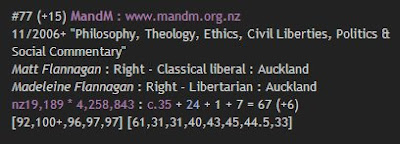
    Speaking of things that made my day yesterday, we climbed 15 spots on the NZ blog rankings for September.

    If Tim had had our correct uniques for September we would have officially climbed 26 spots to the number 69 spot (conservatively) but I recently upgraded our stats counter, so I could not provide him the data in the correct form; hence, we got guestimated – such are the rules. Tim does a great job so I won’t complain. The new position moves us to the number 4 spot of blogs formally identifed as Christian.

    So, I will leave the blog to Matt to manage, try to avoid the news, the computer and generally talking to people so I can focus purely on the books!