Category: Atheists

  • Raymond Bradley’s Opening Statement: Bradley v Flannagan Debate

    On Monday 2 August at the University of Auckland Emeritus Professor of Philosophy Dr Raymond Bradley and Dr Matthew Flannagan (of this blog) debated the topic “Is God the Source of Morality? Is it rational to ground right and wrong in commands issued by God?” For the benefit of those who could not be there, who are awaiting the editing and uploading of the video of the debate, we will be running a blog series where we bring you some of the debate in written form.

    PROFESSOR ROBERT NOLA’S INTRODUCTION

    Published here with permission

    It gives me great pleasure to introduce Ray Bradley to you.

    Ray was a student of philosophy at this university in the early 1950s. He also attended the Auckland Teachers’ Training College and become a school teacher.  But then he won scholarship to the ANU to do advanced research in Philosophy where he wrote a PhD thesis entitled ‘Free Will and Logic’.  One of his papers that emerges from this research is on fatalism ‘Must the Future be what it is going to be?”. This paper has been anthologised and it is a pretty good read about what is wrong with fatalism.

    After the ANU Ray spent a year at Oxford and then returned to teach philosophy in Australia.  He was appointed to the Chair of Philosophy at This University in 1964 at the very young age of 33 – he is most likely the youngest professorial appointment at this university. It was at this time that I first met Ray as a student in the Dept.   He was an energetic shaker of a number matters from the organisation of the dept and its courses to protesting against the Viet Nam war. And also debating about religion; he took on the professors of Botany and Classics in a series of about 20 debates.

    Unfortunately he left Auckland at the end of 1969 for a professorship at Simon Fraser University. There he produced many papers and two books: the co-authored ‘Possible Worlds’ and ‘The Nature of all Being’. When Ray retired from Simon Fraser he returned to NZ to live in Northland by the sea.

    Living in Canada gave Ray his chance to realise one of his great passions – skiing. He has won over 60 medals in National and International events, including three World Championships in the speed event known as Super G. You can read about this in the recent Sunday Times article on Ray: they devoted more space to Ray as a skier than Ray as a philosopher.

    One of Ray’s other abiding passions has been to combat religion. In his youth he was a believer but he gave this up in his teens. As a professional philosopher he entered into debates with a range of people from local advocates of religion in Auckland and those elsewhere such as William Lane Craig and Anthony Flew who had a late life conversion from atheism to religion. There are many of Ray’s papers on religion around, – you can find some of them on the web. One of the finest is Ray’s exposition of the claim by David Hume that the rivalry between religions discredit them all, that is, their rivalry shows that each is highly improbable. – see Ray’s paper ‘The rivalry of religions’.

    Tonight Ray is on one of his favourite themes – the connection, more strictly the lack of a connection, between God and morality.

    As I have indicated, Ray has debated issues about God at this University for over 50 years – tonight is yet another stage in Ray’s long engagement with the atheism and his presentation of it.

    Welcome to Ray Bradley.

    PROFESSOR RAYMOND BRADLEY’S OPENING STATEMENT

    Published here with permission

    I come not to praise God but to bury him along with the dead gods of now forgotten religions. Not to praise him as the source of all that’s good in the world, and hence the ultimate guide to human morals, but to indict him as the self-confessed source of all that’s wrong with it. When the Christian God says in his Holy Scriptures, that he is the creator of evil, I am prepared to take him at his word.

    I will assume the role of prosecutor in providing grounds for agreeing with God’s self-indictment. And having conducted God’s trial in accord with the principles of morality and logic, I will hope to see him put, first, into a straightjacket, and then forever in his grave, no longer to command the belief of men.

    Matt will act on God’s behalf as counsel for God’s defence, what theologians call an “apologist”.

    THE DEITY IN THE DOCK

    I’m going to indict God on four categories of charges. Each category has scores, if not hundreds or thousands of instances. If God is guilty of even one of these instances, that alone would be grounds for his conviction. Drawing upon evidence provided by God himself in his so-called Holy Scriptures, I hold that he’s guilty of them all.

    A. Crimes against Humanity

    The pagan religions typically invoked various gods as supernatural causes of natural phenomena: earthquakes, volcanic eruptions, floods, lightning, plagues, famines, and so on. The biblical god takes over the same sort of role, only he claims to be responsible for the lot. He boasts of repeatedly using natural events such as these to injure, maim, starve, drown, and in other ways kill off millions upon millions of people. Disease and disaster are God’s weapons of mass destruction.

    B. War Crimes

    This god is guilty of the crime of genocide. According to the story of Noah and the flood he wipes out “every living thing on the face of the earth”. In his role as Commander-in-Chief of his chosen people, God is guilty of ethnic cleansing. He orders the slaughter, without compassion, of hundreds of thousands of women, children, and suckling babes. He condones the taking of orphaned virgins for use as sex slaves by his conquering soldiers. He threatens, too, to have unborn children ripped out of their mothers’ wombs; and seems to relish the prospect.

    C. Licensing Moral Mayhem and Murder

    This God prescribes the death penalty for at least 15 alleged offences. These include being a stubborn and rebellious son (Deuteronomy 21:18-21), hitting or cursing one’s father and mother (Exodus 21:17, Leviticus 20:8), desecrating the Sabbath (Exodus 31:14), being a woman who cannot prove she was a virgin prior to marriage (Deuteronomy 22:20-21), being a woman who did not protest loudly enough when she was being raped (Deuteronomy 22:23-24), being a blasphemer (Leviticus 24:16), being an adulterer (Leviticus 20:10-12), worshipping some other gods (Deuteronomy 13:6-9), and being a homosexual (Leviticus 20:13). God’s recommended penalty? Stoning, usually.

    God tells us unambiguously that he’s committed all these crimes and countless more. And he never says sorry for any of them or even shows a trace of regret.

    But all of these crimes pale into insignificance compared with that for which I’m now about to indict him. For all of these are finite in duration, whereas the next is supposed to go on and on for all eternity.

    D. Crimes of Torture

    This god, in the person of his son, Jesus, commits the vilest of all crimes: torture of infinite duration in the fires of hell. For whom and why? The majority of the human race for the simple alleged offence of not having the right religious beliefs.

    There are at least thirteen passages in Matthew alone in which Jesus talks about the fate of those who will go to hell—a fate that he describes as “eternal”, as “fiery”, as a place of “unquenchable fire”, as a place where there will be “weeping and gnashing of teeth”. The apostle Paul (2 Thessalonians 1:8-9) looks forward to the time when, in his words, “the Lord Jesus Christ shall be revealed from heaven with his mighty angels, in flaming fire taking vengeance on them that know not God.” And the author of Revelation paints a picture of hell in all its voyeuristic obscenity when he reports that all whose names were not written in the book of life would be “cast into the lake of fire” (Revelation 20:15), a place where all non-believers will, in his words, “be tormented with burning sulphur in the presence of the holy angels and of the Lamb, and the smoke of their torment ascendeth for ever and ever” (Revelation 14:10-11). The expression “the Lamb”, scholars and theologians agree, refers to Jesus. Nice to know that Jesus will watch the eternal tortures of the damned, i.e., of many like me, and hosts of unbelievers like some of you.

    Is it any wonder that Christians who take God at his word have tortured themselves with fear about their own eternal prospects, have burned heretics at the stake so as to save their souls from eternal perdition, or have dashed infants’ brains out on the stones so they wouldn’t have a chance of becoming non-believers? Yet God, by virtue of his omniscience, knew all this.

    Is it any wonder that televangelists are able to use the fear of hellfire to bring money into their coffers?

    Who today, you may ask, would take this sort of moral primitivism seriously? Well, many Muslim fundamentalists certainly do: the Taliban, for instance. Arguably, the moral laws they and other Islamic fundamentalists seek to enforce are little more than the Islamic versions of the Old Testament, which Mohammed drew upon freely.

    Ditto with many Christian fundamentalists—the Christian Reconstructionists, for instance. Comprising a sizable and increasingly influential proportion of the Southern Baptist Convention—itself the most potent force for evangelical Christianity—the extreme Christian Right, like their Muslim brethren, demand their country become a theocracy and unflinchingly acknowledge that implementing God’s commands would inevitably result in the death of tens of millions of their fellow citizens: over 45 million, on one estimate. Welcome to a replica of Sharia Law.

    It’s not just the ultra-fundamentalists of theistic religions that take God’s precepts seriously. Even the relatively liberal branch of the Christian church–as represented by the Church of England and its Episcopalian offshoot–are troubled enough by God’s word to agonise over some of them, what he has to say about homosexuals in particular: that they are an “abomination” who should be killed in this world and spend the next in hell. Hence the prospect of another great schism in Christianity, and the pathetic excuse by gay bishop, Bishop Gene Robinson that the church is “still trying to figure out God’s will” on the subject. Robinson and Archbishop Rowan Williams (who’s on the other side of the debate), should read the Bible. It reported God’s will long ago.

    Has God changed his mind about any of his moral dictates? If so, he has kept it to himself. Yet acclaimed Christian philosopher and apologist, William Alston, claims God still communicates with sincere Christians. Could it be that all those sincere Christians who–for about two thousand years–have gone on crusades with God’s word on their lips, are listening to themselves, not God.

    Why don’t any ever report having heard God say clearly “Stop! You’ve got me wrong.”

    The biblical god is not what Saint Anselm thought he was: that than which no greater, no more morally perfect, can be conceived. Out of his own mouth God condemns himself as that than which no viler, no more evil, can be conceived.

    “God is love” is a sick joke. The pleasantry, “Do unto others as you would have others do unto you”, is little more than propaganda to cover up God’s true nature. The Golden Rule we might applaud, as a rough rule of thumb. But it’s a bit rich, don’t you think, coming from the mouth of someone, Jesus, who would send most of us to hell? No moral reciprocity there!

    How do God’s depictions of his own behaviour square with the belief that he’s perfectly good? Or that he’s the source of what some call “The Moral Law”? They don’t.

    Putting God and his Defenders in a Logical Straight-Jacket

    The fact that God himself chronicles all his crimes–often in graphic and gruesome detail–falsifies the belief that he is omnipotent, omniscient, and perfectly good. His self-revelation places both God and his followers, such as Matt, in a logical straightjacket. For there is no way of escaping from the following set of five mutually inconsistent propositions:

    1. What God proposes for our belief–including beliefs about what we ought to do–is what we ought to believe or do.

    2. In his holy scripture God proposes for our belief that he has caused, committed, condoned, or laid down commands for us to obey, every one of the four types of crimes of types A, B, C, and D.

    3. It is morally wrong to cause, commit, condone, or command any of the crimes of types A, B, C, D.

    4. God is omnipotent, omniscient, and morally perfect.

    5. A morally perfect being would not do anything that is morally wrong.

    Theists believe in all five. The trouble is that these five statements form an inconsistent set such that from any four one can validly infer the falsity of the remaining one. Thus, one can coherently assert (1), (2), (3) and (4) only at the cost of giving up (5); coherently assert (2), (3), (4), and (5) only at the cost of giving up (1); and so on.

    The problem is to decide which of these five statements to give up in order to avoid contradiction.

    To deny (1) would be to deny that we ought to do what he says we should believe as to matters of morals, or matters of fact. It would be to deny, for instance, that we ought to obey God’s commandments, such as those instanced in category C. It would be to deny that God is the ultimate authority on what is true or false, right or wrong.

    To deny (2) would be to deny the authority of scripture. It would be to say either (a) that God didn’t know how to say what he meant or (b) that he really meant what he so clearly said. But the first alternative would entail denying his linguistic competence and hence his omniscience. On the other hand, the second alternative would entail that we have to rely on human interpreters to tell us what he really did mean. That’s where the art of apologetics comes in. But in that case, the so-called Word of God becomes the word of man subject to rival, subjective, interpretations. All pretence of objective moral truth is then abandoned. We would then place ourselves in the same sort of position as primitives who wait on witch doctors to tell them what the chicken entrails really mean.

    To deny (3) would be to assert that it is morally permissible to cause, commit, condone, or command some of the vilest crimes imaginable. It would be to ally oneself with moral monsters like Ghenghis Khan, Hitler, Stalin, and Pol Pot.

    To deny (4) would be to deny that the god we are talking about has the properties that theologians regard as the defining, and distinguishing, properties of the Christian God. In short it would be to deny the core belief of theism.

    Finally, to deny (5) would be to deny a virtual truism. To deny it would to license the use of the word “good” so as to mean the equivalent of “evil”. It would be to play word games, like Humpty Dumpty who thought he could make words mean whatever he wanted them to mean–including their opposites.

    Which, I wonder, will Matt deny so as to avoid contradiction?

    Let’s wait and see.

    I’ll also challenge him to discuss the false scientific presuppositions of the story of God’s genocide by means of Noah’s Flood, and the dubious historical presuppositions to the stories about Jesus condemning unbelievers to eternal torment in Hell.

    Please note that this series is not a transcript of the debate. Each post in this series is effectively a very close approximation of what was said on the night and has been put together from the papers and notes each speaker prepared and spoke from plus any additions each recalled making.

    RELATED POSTS:
    Video: Bradley v Flannagan “Is God the Source of Morality?
    The Podcast: Bradley v Flannagan
    Joint Communique: Bradley v Flannagan Debate
    Matthew Flannagan’s Opening Statement: Bradley v Flannagan Debate
    Bradley’s Reply to Matt: Bradley v Flannagan Debate
    Flannagan’s Reply to Ray: Bradley v Flannagan Debate
    Glenn Peoples’ Review: Bradley v Flannagan Debate
  • Joint Communique: Bradley v Flannagan Debate

    On Monday 2 August at the University of Auckland Emeritus Professor of Philosophy Dr Raymond Bradley and Dr Matthew Flannagan (of this blog) debated the topic “Is God the Source of Morality? Is it rational to ground right and wrong in commands issued by God?” With a turnout of 400-500 people, this debate was the largest Christian event to occur on Auckland University’s campus since the 2008 debate between Dr William Lane Craig and Dr Bill Cooke. For the benefit of those who could not be there, who are awaiting the editing and uploading of the video of the debate, we will be running a blog series where we bring you some of the debate in written form. This will include:

    JOINT COMMUNIQUE
    Read by moderator Professor John Bishop

    1. Matt and Ray wish this to be a genuine debate in which they, so to speak, ‘lock horns’ on the issues, not — as so often happens — ‘talk past each other.’ They therefore agreed to exchange in writing their opening remarks so as to make it possibly for each to engage each other, not some caricature of what the other was saying.

    2. They also agreed, right from the beginning, that they did not wish the organisers or supporters of either so-called ‘side’ to conduct a final poll as to which of Matt or Ray, if either, had ‘won’ the debate. Such polls, they both believe, encourage shallow thinking and an unfortunate disposition for supporters of one side or the other to go away crowing ‘our side won’ and thereafter put it out of their minds.

    3. Matt and Ray are both philosophers who like to encourage people to reflect at length and seriously about the issues raised and to weigh carefully the evidence and the arguments for each of the opposing viewpoints.

  • Dissecting the Bradley v Flannagan Debate

    We’re just in from the debate at Auckland University where Raymond Bradley and Matt debated  “Is God the Source of Morality? Is it rational to ground right and wrong in commands issued by God?” and we see the discussion from those there has started in more than one place on the net – including here. We don’t plan to write much on our own thoughts just yet – we need to wind down first! But for those of you keen to start/keep sharing your thoughts go ahead – the discussion is off to a great start!

    • Glenn Peoples, a Dunedin based Philosopher of Religion who many regulars will know as the author of Say Hello to my Little Friend: The Beretta Blog and Podcast, watched a live video feed of the debate via Skype and will be writing a review of his thoughts which we hope to have online in the next few days.
    • We plan to publish Matt’s opening statement and Ray’s (if he is agreeable) tomorrow.
    • The video will be online in a few weeks once it is edited and uploaded.

    [I’ve moved the comments people have already left on the sticky post (which I have now unstickied so it is further down the page) to this thread in case you were wondering how your comment got here.

  • Bradley v Flannagan Debate @ Auckland Uni “Is God the Source of Morality?”

    Raymond Bradley and Matthew Flannagan will debate the topic “Is God the Source of Morality? Is it rational to ground right and wrong in commands issued by God?”

    The debate will be held at the University of Auckland on Monday 2 August from 7-9pm in “The Centennial” 260 – 098 OGGB (the bottom level of the Business School) on 12 Grafton Rd, Auckland City.

    Raymond Bradley v Matthew Flannagan "Is God the Source of Morality"

    If you enjoyed the 2008 debate at Auckland University between William Lane Craig and Bill Cooke, you should enjoy this debate.

    Raymond BradleyBradley is an Emeritus Professor of Philosophy with areas of specialty in Philosophical Logic, Metaphysics, Logical Atomism; he has previously debated William Lane Craig, Edward Blaiklock and many other Christian scholars and describes himself as an older generation “new atheist”.

    Matthew FlannaganFlannagan is an Auckland based Philosopher and Theologian with areas of specialty in Philosophy of Religion, Ethics and Theology; he has previously debated Bill Cooke, Zoe During and, of course, writes for this blog.

    The format of the debate will be as follows:

    Dr Bradley: Opening Comments [20 min]
    Dr Flannagan: Opening Comments [20 min]
    Dr Bradley: Reply to Dr Flannagan [10 min]
    Dr Flannagan: Reply to Dr Bradley[10 min]
    Dr Bradley: Closing Comments [7 min]
    Dr Flannagan: Closing Comments [7 min]
    Questions from the floor: [30 min]

    The moderator for the debate will be John Bishop.

    Bradley will be introduced by Robert Nola.

    Flannagan will be introduced by Chris Tucker.

    Both Bradley and Flannagan are experienced and engaging public speakers who are practiced at pitching their topics to suit their audiences. So, invite all your friends, and block out the evening of Monday 2 August from 7-9 pm now and make sure you get to the debate early to locate parking and grab a good seat.

    This debate is brought to you by the Evangelical Union and the Reason and Science Society as part of the University of Auckland’s Jesus week/Atheist week, with support from Thinking Matters.

    The event will be videoed and will be published on this blog. Entry is free and any and all are welcome.

    There is even a Facebook page you can rsvp on and use to invite your friends.

  • There’s Probably No God? Fisking Atheist Billboards

    On the way back from Bloggers drinks we drove past one of the controversial atheist advertising billboards, put up by NZ Atheist Campaign, The Humanist Society and NZARH, which have appeared around Auckland. This appears to have come on the back of the Richard Dawkins inspired bus advertising that made headlines earlier this year. It is worth fisking them a bit.

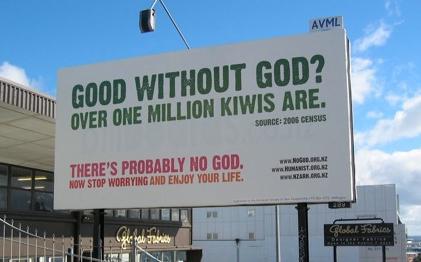
    Here is a pic of the first one.

    Good Without God? Over One Million Kiwis Are.

    Here we are told one million kiwis are good without God because the census says so. This, however, is fallacious. What the census shows is not that one million kiwis are good without God, it shows that one million kiwis are good (although this is granting a lot for the sake of argument) without believing in the existence God. But to say one can be good without believing in God is not the same as saying one can be good without God. Many people throughout history have been able to live and breath without believing in the existence of hydrogen and oxygen atoms, it does not follow that they could live without water.

    Moreover, it is hard to tell what the point of this sociological fact is anyway. Why does the fact that people do not need to believe in something to do good deeds mean that the belief is false? For centuries people have done good deeds and lived good lives without believing in evolutionary theory or quantum mechanics, should we conclude that these theories are therefore ‘probably false’? Surely these atheists are not suggesting that our beliefs should be based on what is useful or helpful as opposed to what is true or false?

    Perhaps the atheists here mean to convey something else. Some Christian thinkers such as William Lane Craig, Robert Adams, Stephen Layman, Alvin Plantinga, John Hare, Philip Quinn have argued that moral properties such as right and wrong depend on God for their existence. Atheist writers such as Paul Kurtz and Christopher Hitchens retort that this claim is falsified by the existence of morally upright atheists. I suspect something like this is behind the slogan on the billboard, it repeats Hitchens and Kurtz’s retorts as though they said something insightful or clever.

    The problem is, as any one familiar with this discussion should know, this retort misses the point (as I pointed out in On a Common Equivocation). Craig, Adams, et al are not claiming that one needs to believe in God to be good (a point made several times in the literature and particularly made so many times to Kurtz that it beggars belief that he keeps repeating it) rather their claim is that moral properties, such as right and wrong, depend on God for their existence.

    This is a fairly basic and elementary distinction in the literature. How exactly expressing a common philosophical confusion counts as reason for thinking “there probably is no God” is hard to see.

    Let’s look at the next one.

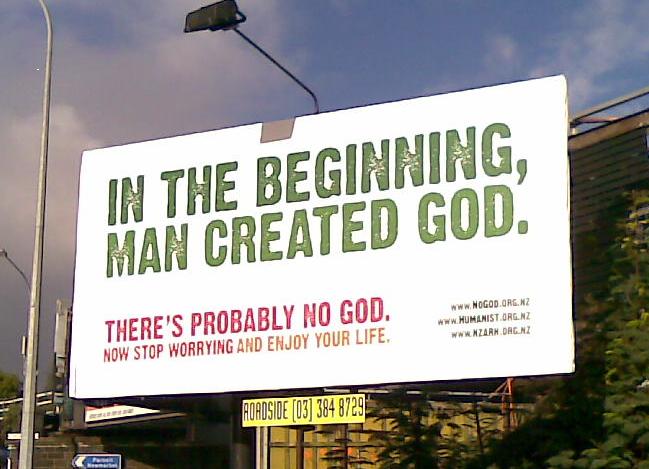
    In the Beginning, Man Created God.

    What is asserted here? That man created God. This, however, is clearly absurd. God is typically defined as an all-powerful, all-knowing, immaterial, necessarily-existent being who created the world. Now if one is going to claim that humans actually created an all-powerful, all-knowing, immaterial, necessarily-existent who created the world, then they are contradicting themselves.

    Humans are part of the world and therefore cannot have created the being that created the world – otherwise humans would have to exist prior to their own existence.

    Similarly, one cannot create a necessary being, this would entail it is possible for a necessary being to not exist, in which case it would not be a necessary being. Taken in a straight-forward, literal manner (the way freethinkers are so fond of taking every passage in the Bible) this billboard simply asserts contradictions.

    Of course, the authors of this billboard probably do not mean to say humans actually created God, they do not think he exists after all. Their claim is that humans created the idea or concept of God and developed it. This is undoubtedly true. Of course, humans also invented the idea or concept of atoms as well, ancient Greek philosophers came up the basics of this concept millennium ago. This trivial fact tells us nothing about whether or not the idea or concept humans developed actually corresponds to anything in reality. To assume that it tells us something about whether the idea or concept is true or false is a fairly obvious case of the genetic fallacy.

    So the second billboard either asserts a contradiction or it is a clear case of a logical fallacy.

    The last one is my favourite.

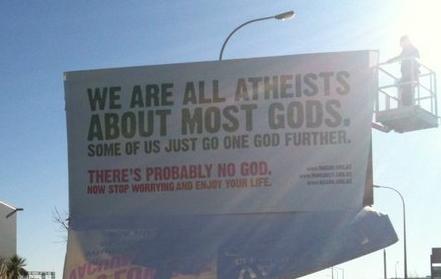
    We are all atheists about most gods. Some of us just go one god further.

    I am inclined to think the argument on this sign is invalid. To see why let’s take out the term “God” in the sign and replace it with some other term such as “non-Christian perspective.” When we do this we get: “We all reject most non-Christian perspectives, some of us just reject one more.” This argument has true premises, do we now have, a knock-down argument for Christianity?

    Similarly, an analogous argument form with true premises gives us an argument for nihilism, the total denial of the existence of morality. “We are all nihilists about some conceptions of morality, some of us are just nihilistic about one more.”

    The same argument for also furnishes a refutation of secularism, “we all reject some secular perspectives on reality, some of us just reject one more.” I could go on.

    Taking a stand on any issue of philosophical substance, whether by affirming, denying or simply being sceptical of it, is to put oneself in opposition to any number of other people and groups who take a contrary stance. That is life. Such pluralism hardly provides a reason for thinking “there probably is no God” any more than it gives us a reason to doubt any other perspective on the world.

    So what do the atheist billboards do? Well the first one tells us that some atheist groups conflate basic philosophical distinctions and don’t really understand the debate they are contributing to. The second shows us that these groups think contradictions and obvious fallacies are some how savvy and smart. The last shows us that they think that invalid argument forms, forms from which you could infer the denial of anything and everything by substituting one true premise with another, are avant-garde.

    All in all, pretty accurate advertising for these groups.

    Hat tip: MCAS

  • Contra Mundum: Fairies, Leprechauns, Golden Tea Cups & Spaghetti Monsters

    That belief in God is on par with belief in fairy tales is a fairly common charge levelled at Christianity. Highly regarded atheist Philosopher Michael Tooley argues,

    If there is no evidence in support of the existence of God, then it is reasonable to believe that God does not exist. The essential line of thought which I would hope to develop later on is that if you consider other things like fairies, leprechauns, golden teacups orbiting around Venus, and so on, I would suggest that we have no evidence against the existence of those sorts of things, but if I asked you whether you were agnostic I think the answer would be “no.” You would believe there are no fairies, no leprechauns, no golden teacups orbiting around Venus. That illustrates the general principle in regard to God’s existence that the burden of proof must fall upon the person who is arguing in support of God’s existence. If there’s no positive support for it, then the other side wins by default.

    Something like Tooley’s argument regularly features in popular discussions of religion where fairies, leprechauns and golden tea-cups are substituted for flying spaghetti monsters. The basic idea remains the same, to believe in God without providing compelling arguments or evidence for his existence is on par with believing in fairy tales and this is something no sensible, educated, intelligent person can take seriously.

    To address this argument it is first necessary to unpack it. Three separate claims are being made; first, it is assumed that the rational stance to take towards the existence of fairies, leprechauns, orbiting golden tea-cups and spaghetti monsters is not a stance of agnosticism but one of certain denial. Second, it is contended that the reason why this stance is correct is not because we have reasons for believing such things do not exist, but rather that we lack any positive evidence for the existence of these things. Third, the objector assumes that a person who advocates or defends belief in God, in the absence of compelling evidence for God’s existence, has no principled way of distinguishing the case for God from the case for the existence of fairies, leprechauns, et al. Now I grant the first of these claims, it is obviously silly and irrational to believe in things like fairies, leprechauns, orbiting golden tea-cups and spaghetti monsters. The real issue is whether the second and third claims are correct; I will argue that they are not.

    Turning to the second claim that the reason it is irrational to believe in fairies, leprechauns, et al is solely because we lack evidence for their existence and not because we have reasons for thinking that they do not exist. I am inclined to think this claim is false. Consider another claim for which we also lack evidence for thinking is true, that intelligent extra-terrestrial life (ET’s) exists somewhere in the universe. We lack compelling reasons for thinking this claim is true yet it seems mistaken to infer from this that such beings absolutely do not exist, at best all that we can say is that we do not know. Moreover, even in face of agnosticism, many scientists take the existence of ET’s quite seriously; for example, the SETI research site in California spends millions of dollars sending messages into outer space and searching the universe for signs of intelligent life. I note that they do not do the same in pursuit of the search for signs of fairies, leprechauns, orbiting tea-cups or spaghetti monsters and I cannot find any evidence of an agency anywhere in the world that does.

    This example suggests that the reason it is rational to deny the existence of the stuff of fairy tales cannot be simply the lack of positive evidence for these things, if it was we would take the same stance towards ET’s yet we do not. This is because there are important differences between ET’s and fairies, leprechauns, et al over and above the mere lack of evidence we have for their existence. ET’s are the sort of things that could exist even if we lack evidence that they do. ET’s fit with the picture of the world we hold, we know that intelligent life can evolve on planets. This is not the case with fairies, leprechauns, orbiting tea-cups, spaghetti monsters and so on.

    Leprechaun’s first appeared in fairy tales and folklore; in such tales they store their wealth in pots of gold at the end of rainbows. We know that the genre of fairy tales is fantasy. We know rainbows do not have ends in the way this picture envisages. Similarly tea-cups we know are artefacts made by human beings, seeing humans have not been to Venus it is unlikely that such things orbit Venus – even if they are made of gold. It is not just that we lack evidence for the existence of such things but that we have evidence against their existence. What we do know about the world provides us with reasons for doubting they can exist. With ET’s, on the other hand, we have no such reasons for doubting they can exist. Hence, in the latter case agnosticism is justified whereas denial is required in the former case.

    The insinuation that belief in God is on par with belief in fairies, leprechauns, et al is equally questionable. In the case of these things we have no evidence for their existence. With God, however, the situation is different. It is not that no evidence exists; on the contrary, sophisticated and rigorous arguments for God’s existence have been offered and are still being offered in the literature today, it is that experts in the field are divided on the cogency of these arguments. The best that sceptics can suggest is that the evidence is inconclusive. However, even if we grant this, those who defend belief in God can and have offered principled distinctions between God and things like flying spaghetti monsters.

    Two examples will suffice. The first stems from a tradition going back to William James and Blaise Pascal is that when one cannot avoid making a choice, one can act in hope or faith that a belief is true, even if there is no evidence for it, if the expected benefits of the thing hoped for outweigh the benefits of the alternatives. James Jordan provides an example,

    A castaway builds a bonfire hoping to catch the attention of any ship or plane that might be passing nearby. Even with no evidence that a plane or ship is nearby, he still gathers driftwood and lights a fire, enhancing the possibility of rescue. The castaway’s reasoning is pragmatic. The benefit associated with fire building exceeds that of not building, and, clearly, no one questions the wisdom of the action.

    Pascal argued that if one acts on the assumption that God exists and that assumption turns out to be incorrect then one has lost little but if one acts on the assumption that God does not exist and that assumption turns out to be incorrect the one has lost everything. Modified versions of this line of argument are still defended by philosophers today.

    A second reason is that even if one has insufficient evidence for the truth of some proposition, one can be rational in believing it if it is grounded directly in one’s experience. There are plenty of things we believe which are not based on evidence, our belief in the existence in the past or our belief that it is wrong to rape women, our belief that other people exist or that basic axioms of logic are true are not based on arguments or proofs. These things are true because we experience or see them to be true, for example, I remember the existence of a past event, I intuitively conclude that rape is wrong, I observe that other people exist, I see that basic axioms of logic are self-evident. Philosophers such as Alvin Plantinga argue that belief in God is like these beliefs; it is something a person directly sees as true via direct experience or intuition of some sort as opposed to the conclusion of an evidentiary proof.

    I am not in a short article like this going to be able to develop and defend these lines of argument further. I mention them only to show that according to two standard ways of defending belief in God in the face of inconclusive evidence a principled distinction between belief in God and the stuff of fairy tales can be made. People tend to not directly experience or perceive the existence of these things nor does one risk losing everything by acting on the assumption they do not exist. Moreover, if belief in fairies, leprechauns, orbiting tea-cups and spaghetti monsters did possess these features then it is no longer obvious that belief in such beings is irrational. Suppose that instead of there being no evidence for the existence of leprechauns there was in fact some evidence but it was not compelling, perhaps experts were in disagreement. Suppose also that if I failed to act on the assumption that leprechauns existed and it turned out that they did then I would lose everything but if it turned out that they did not I would gain little. In addition, suppose that I directly perceived a leprechaun in front of me or I remembered clearly seeing one a few days ago and I had no reason for thinking my perception or memory was unreliable. If these conditions were satisfied then it would cease to be obvious that belief in leprechauns was obviously irrational. The claim that believing in God is on par with believing in “fairies, leprechauns, golden teacups orbiting around Venus” and flying spaghetti monsters is then unjustified.

    I write a monthly column for Investigate Magazine entitled Contra Mundum. This blog post was published in the July 10 issue and is reproduced here with permission. Contra Mundum is Latin for ‘against the world;’ the phrase is usually attributed to Athanasius who was exiled for defending Christian orthodoxy.

    Letters to the editor should be sent to:
    editorial@investigatemagazine.DELETE.com

    RELATED POSTS:
    Contra Mundum: Secularism and Public Life
    Contra Mundum: Richard Dawkins and Open Mindedness
    Contra Mundum: Slavery and the Old Testament

    Contra Mundum: Secular Smoke Screens and Plato’s Euthyphro

    Contra Mundum: What’s Wrong with Imposing your Beliefs onto Others?
    Contra Mundum: God, Proof and Faith
    Contra Mundum: “Bigoted Fundamentalist” as Orwellian Double-Speak
    Contra Mundum: The Flat-Earth Myth
    Contra Mundum: Confessions of an Anti-Choice Fanatic
    Contra Mundum: The Judgmental Jesus

  • Contra Mundum: Richard Dawkins and Open Mindedness

    The bold statement “Richard Dawkins opens minds” leaped out at me from the newsletter sitting on the University of Auckland’s Law Library counter. The article went on to sing the praises of Richard Dawkins and mentioned his book The God Delusion. On reading the piece one could be forgiven for concluding that Dawkins’ works are a paragon of the open minded assessment of ideas.

    Now Dawkins is a Zoologist and I, not being a Zoologist, would not presume to assess his work on Zoology. What is interesting, however, is that much of Dawkins’ most famous work is not on Zoology; it is on Theology and specifically Philosophy of Religion. That field of Philosophy which critically analyses religious questions, such as, the veracity of arguments for and against God’s existence. Having some background in these fields I find it a little surprising that an Auckland University publication would contend that his work is open minded because it is evidently not.

    In The God Delusion Dawkins’ main argument against the existence of God alludes to Fred Hoyle’s famous claim that the probability of something as complex as life evolving by blind chance was less likely than a fully-functional Boeing 747 being created by a hurricane blowing parts around in a junk yard. Dawkins writes, “However statistically improbable the entity you seek to explain by invoking a designer, the designer himself has got to be at least as improbable. God is the Ultimate Boeing 747.” Dawkins has made the same line of argument elsewhere “God, or any intelligent, decision-making calculating agent, is complex, which is another way of saying improbable.” In The Blind Watchmaker he argues,

    Once we are allowed simply to postulate organized complexity, if only the organized complexity of the DNA/protein replicating machine, it is relatively easy to invoke it as a generator of yet more organized complexity”. But of course any God capable of intelligently designing something as complex as the DNA/protein machine must have been at least as complex and organized as that machine itself.

    This argument contains three premises. First, that theism (belief in God) is justified by “postulating” God to explain the existence of organised complexity. Second that the God appealed to by theists is complex. Third, that the existence of complex beings are highly improbable. These lead to the conclusion that “God is the Ultimate Boeing 747” and hence “almost certainly does not exist”. The problem with this argument is that all three premises rest on caricatures and misunderstandings of contemporary theology and ignorance of contemporary philosophy of religion. I will explain.

    Dawkins contends that God is postulated to explain organised complexity. There are two problems with this contention. First, Dawkins assumes that God is rationally believed only if his existence is inferred by some kind of argument for the best explanation of a given phenomenon. However, not all beliefs are justified on the basis of some kind of argument of this sort. Our belief in the existence of the past, our belief that it is wrong to rape, our belief that other people exist or that basic axioms of logic are true are not based on inferences to the best explanation. It is not that they are rationally believed because they explain some phenomena better than all alternatives, it is rather that these beliefs are part of the background data that we use to assess proposed explanations against. These things are true because we immediately experience them as true. I have the experience of remembering the existence of a past event. I intuitively perceive that rape is wrong. I experience the basic axioms of logic as self-evident and so on. Such beliefs are called properly-basic beliefs.

    Since the late 1970’s an extremely important movement within Philosophy of Religion, known as the reformed epistemology movement, has offered detailed and rigorous defences of the contention that, for theists, belief in God can be properly-basic. This position has been defended by leading philosophers of religion such Alvin Plantinga, William Alston, Nicholas Wolterstorff, Peter Van Inwagen and others. Now, of course, it is possible that this movement is mistaken but Dawkins surely owes us an argument to this end as opposed to his simply assuming it and ignoring the counter evidence.

    Second, among those theists who do defend God’s existence on the basis of some argument for the best explanation, very few do so on the basis that God explains “organized complexity”. Richard Swinburne, the leading proponent of such arguments, argues that God explains the existence of laws of nature, religious experience, the origin of the universe and the continued existence of the universe. Swinburne does not postulate God to explain “organised complexity”. Similarly, William Lane Craig, a leading defender of theism, suggests that God explains the origin of the universe, the existence of morality and the fine tuning of the laws of nature. Again, Craig makes no appeal to “organized complexity”. In 2009 The Blackwell Companion to Natural Theology was published which contains the most up to date versions of the 11 most definitive arguments used to defend the existence of God in the literature today. Not one of them involves an appeal to “organised complexity”. While the cogency of arguments for the existence of God that do not involve “organized complexity” remains open to substantive debate, it is undisputed that these arguments exist. Dawkins’ picture of God as a postulate to explain organised complexity is a crude caricature of theistic scholarship.

    To be fair Dawkins attempts to address some of these other arguments elsewhere in the book. However, here again much of his writing consists of caricature. He attacks five arguments proposed 800 years ago by Thomas Aquinas as being representative of the current case for theism and completely ignores the vastly more sophisticated and vigorous versions being defended in the literature today. Ironically, Dawkins quite severely misunderstands Aquinas’ arguments and attributes to him a position no Aquinas scholar would accept as accurate. However, even if his account were accurate, critiquing theism by attacking the arguments of one 12th century theologian is a bit like me attacking evolution on the basis of the evidence for it gathered in the 12th century and ignoring any of the scientific developments of the last 800 years. Such ineptitude would not be tolerated in the scientific world and should not be seen as de rigueur just because the topic is religion.

    Dawkins’ second contention fares little better. Dawkins states that “A God capable of continuously monitoring and controlling the individual status of every particle in the universe cannot be simple” this seems to be because,

    The corners of God’s giant consciousness are simultaneously preoccupied with the doings and emotions and prayers of every single human being—and whatever intelligent aliens there might be on other planets in this and 100 billion other galaxies.

    There are several problems here. First, as Craig has noted, this confuses whether what God thinks about is complex with whether God himself is complex. Second, as Plantinga has noted, in The Blind Watchmaker Dawkins states that something is complex if it has parts that are “arranged in a way that is unlikely to have arisen by chance alone.” However, the concept of God employed by most theists is of an immaterial being that does not have material parts so by Dawkins’ own definition God is not complex (unless one assumes that God is a material being but theists almost unanimously maintain that God is an immaterial being).

    This misrepresentation is made all the more pertinent by the fact that for centuries theists have been offering rigorous and sophisticated arguments that God is not in fact complex but is simple. While these arguments may not be successful, Dawkins still needs to actually provide reasons for rejecting them. To simply assert that God is to be conceived in a way that no one conceives Him and to ignore the numerous arguments to the contrary seem more like a child who asserts his position and then puts his hands over his ears and repeats “I am not listening” than it does a serious critical evaluation of another’s position.

    Dawkins’ final contention, that the existence of complex beings is improbable, is similarly confused. Suppose one grants that God is “the Ultimate Boeing 747” and that God’s existence is as statically improbable as the complexity it is invoked to explain. Little in fact follows from this. This is because what is improbable in the Boeing 747 analogy is that the plane came into existence by chance. If God is “the Ultimate Boeing 747” then the conclusion to be drawn is only that it is improbable that God came into existence by chance. This, however, provides us with no reason for thinking that God does not exist. No theist holds that God came into existence by chance, theists hold that God is eternal. Here, again, Dawkins attacks a concept of God nobody holds to and hence is caught jousting with a straw-man.

    On examining Dawkins’ central argument what one discovers is not an open-minded, informed, careful examination of the contemporary debate over the existence of God. Nor does one find a carefully researched assessment of theism. Instead one finds Dawkins simply ignoring what theists mean by God. He ignores how they conceptualise God and ignores the arguments and discussions they have actually made. The theism Dawkins dismisses apparently assumes that God is a material being with parts, that He came into existence by chance and is postulated merely to explain organized complexity. The actual arguments proposed in defence of theism that have been put forward in the literature are not addressed at all.

    Some Auckland University academics might consider such tactics to count as open-minded but I do not. In my view an open-minded honest assessment of religion requires accurately representing what theologians say and teach. It means endeavouring to read and understand their position and offer informed and critical responses to these positions. Ignorance and caricature is not open-minded scholarship.

    I write a monthly column for Investigate Magazine entitled Contra Mundum. This blog post was published in the May 10 issue and is reproduced here with permission. Contra Mundum is Latin for ‘against the world;’ the phrase is usually attributed to Athanasius who was exiled for defending Christian orthodoxy.

    Letters to the editor should be sent to: editorial@investigatemagazine.DELETE.com

    RELATED POSTS:
    Contra Mundum: Slavery and the Old Testament

    Contra Mundum: Secular Smoke Screens and Plato’s Euthyphro

    Contra Mundum: What’s Wrong with Imposing your Beliefs onto Others?
    Contra Mundum: God, Proof and Faith
    Contra Mundum: “Bigoted Fundamentalist” as Orwellian Double-Speak
    Contra Mundum: The Flat-Earth Myth
    Contra Mundum: Confessions of an Anti-Choice Fanatic
    Contra Mundum: The Judgmental Jesus