In a previous post, I observed that Walter Sinnott-Armstrong concedes that secular accounts of moral obligation cannot vindicate the thesis that agents always have decisive (all-things-considered) reasons to avoid wrongdoing. To mitigate this problem, he argues: Is this limitation a problem for secular accounts of morality? I doubt that, too. If we demand this extreme […]
Entries Tagged as 'Atheists'
Sinnott-Armstrong on God, Secularism and “reasons” to be moral. Part Three: Can Religious theories answer the question, “Why be moral?”
September 13th, 2025 1 Comment
Tags: Divine Command Theory · Dualism of Practical Reason · God and Morality · Walter Sinnott-Armstrong · Why be Moral?
Sinnott-Armstrong on God, Secularism and “reasons” to be moral. Part two: Do unselfish reasons answer the question, “Why be moral?”
September 8th, 2025 Comments Off on Sinnott-Armstrong on God, Secularism and “reasons” to be moral. Part two: Do unselfish reasons answer the question, “Why be moral?”
*** Walter Sinnott-Armstrong discusses the following objection: “Harming others is sometimes in some people’s best interest, even considering probable costs. In those cases, some theists say that only a divine threat of Hell provides a reason to be moral. Since atheists and agnostics do not believe in God, they do not believe in divine retribution […]
Tags: Dualism of Practical Reason · Hell · Mark Murphy · Walter Sinnott-Armstrong · Why be Moral?
Divine Command Theory and the Euthyphro Dilemma: Part IV
May 20th, 2021 Comments Off on Divine Command Theory and the Euthyphro Dilemma: Part IV
This is a talk I gave to the Philosophy Club at Glendale Community College in Phoenix, Arizona, this weekend. The talk was followed by a long discussion with some faculty, students at the college, and others who zoomed in. In this talk, I introduced and defended a divine command theory of ethics. I divided the talk into three […]
Tags: Divine Command Theory · Euthyphro Dilemma · Graham Oppy · James Rachels
Problems in Value Theory An Introduction to Contemporary Debates: My Chapter with Graham Oppy is finally published
February 10th, 2020 Comments Off on Problems in Value Theory An Introduction to Contemporary Debates: My Chapter with Graham Oppy is finally published
Yesterday, I was informed that the book Problems in Value Theory An Introduction to Contemporary Debates has finally been published. The book is now available both on amazon on Bloomsbury’s website. Chapter 3 of this book “Does Morality Depend on God?” is co-authored by myself and Graham Oppy (Monash University). Both Graham and I each wrote […]
Tags: Divine Command Theory · God and Morality · Graham Oppy
The Psychopath Objection to Divine Command Theory: Another Response to Erik Wielenberg (Part two)
September 11th, 2019 Comments Off on The Psychopath Objection to Divine Command Theory: Another Response to Erik Wielenberg (Part two)
In my last post, I expounded the Psychopath objection to divine command meta-ethics (DCM) that has recently been defended by Erik Wielenberg. To recap. Wielenberg suggests that my response to his earlier “reasonable unbeliever’s objection” relies on the following principle: R) God commands person S to do act A only if S is capable of […]
Tags: C Stephen Evans · Divine Command Theory · Erik Wielenberg · God and Morality · Wes Morriston
The Psychopath Objection to Divine Command Theory: Another Response to Erik Wielenberg (part one)
September 3rd, 2019 Comments Off on The Psychopath Objection to Divine Command Theory: Another Response to Erik Wielenberg (part one)
www.youtube.com/watch?v=6iVyVJAMiOY.
Recently, Erik Wielenberg has developed a novel objection to divine command meta-ethics (DCM). DCM “has the implausible implication that psychopaths have no moral obligations and hence their evil acts, no matter how evil, are morally permissible” (Wielenberg (2008), 1). Wielenberg develops this argument in response to some criticisms of his earlier work. One of the […]
Tags: C Stephen Evans · Divine Command Theory · Erik Wielenberg · God and Morality · Psychopathy · Robert Adams · William Lane Craig
Is Naturalism simpler than Theism? Some reflections on Graham Oppy’s “Best argument against God”
October 30th, 2018 2 Comments
In Best Argument Against God (BAAG) Graham Oppy sketches a sophisticated argument for atheism. Oppy’s conclusion is the result of applying a particular method to the question of God’s existence. He contends that question of Gods existence should not be determined by examining the arguments for and against the existence of God. Instead philosophy of […]
Tags:

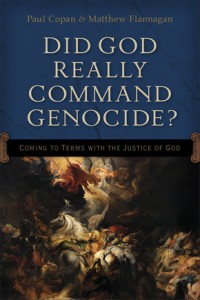 A common objection to belief in the God of the Bible is that a good, kind, and loving deity would never command the wholesale slaughter of nations. In the tradition of his popular Is God a Moral Monster?, Paul Copan teams up with Matthew Flannagan to tackle some of the most confusing and uncomfortable passages of Scripture. Together they help the Christian and nonbeliever alike understand the biblical, theological, philosophical, and ethical implications of Old Testament warfare passages.