Category: Current Events

  • Goodbye NCEA, Farewell, Get lost, Good Riddance

    Some readers of this blog will know that I work as a secondary school teacher. Recently, several people have asked my opinion on the government’s decision to ditch the National Certificate of Educational Achievement (NCEA). My thoughts follow.

    When I was at teachers’ college, we were taught that New Zealand had the best curriculum in the world. Unlike other curricula, which focused on subject content, New Zealand’s curriculum focused on certain kinds of skills—analysis, critical thinking, research, etc.

    A comparison between the NCEA standards for Religious Studies (my specialist subject) and Cambridge illustrates the contrast. For IGCSE World Religions, students study two major religions over the course of a year. The syllabus requires them to learn a huge amount of content—about the religion’s history, doctrines, modes of worship, and so on. The assessment is an examination in which any of these topics could be assessed.

    By contrast, Level 1 NCEA has standards such as: Demonstrate understanding of the development of a community that shares religious or spiritual beliefs. This is flexible—teachers can choose any religion. One gets an Achieved if they show understanding of the development of the religious community, a Merit if they can explain it, and an Excellence if they examine it. The focus is on analytical skills. Prima facie, this is a good idea. Education should not be about regurgitating facts; it should develop skills of understanding, explaining, and examining.

    This appearance, however, has not withstood my experience at the coalface, teaching Religious Studies to Year 11–13 boys.

    My first practical experience with NCEA was during my practicum in 2009. I was placed at a low-decile school in South Auckland. The school was almost entirely in Pasifika in its demographic. Despite being in a poor area and having a demographic that statistically underachieves, the school was getting good results—large numbers of students were getting Achieved. Here was the method I encountered:

    • Period 1: Tell the students the questions they will be assessed on. Get them to copy them down.
    • Period 2: Tell them the answer to Question 1. Write it down.
    • Period 3: Tell them the answer to Question 2. Write it down.
    • Rinse and repeat
    • Then the assessment: Take the sheet of paper you’ve copied the answers onto into an exam where you will be asked the memorised questions.

    I am not joking. What was interesting was that even under these conditions, students would talk during the assessment and not finish. So extensions were given until the students all passed. Or they were held in till they finished.

    Here I discovered the perverse incentive structures of NCEA. Because there were certain prescribed skills (such as “explain” and “describe”) which were internally assessed by the school, and because the school’s reputation was tied to how well it got traditionally low-achieving groups to pass, tactics like this actually made the school “successful.” Students who struggled with basic skills and academic discipline would pass at high rates.

    My experience in the teaching sector has suggested to me that this sort of thing is not an aberration. I have seen many NCEA programmes where students who lack basic skills pass because they are spoon-fed the answers. I have seen, for example, courses where students copy notes into a workbook in each class, then have a week of classes to copy those notes into a resource, and are then given a structured worksheet on how to write an essay. They fill in the worksheet with the material from the resource. Despite the apparent ease of this, I have witnessed teachers offer several weeks of classes—including lunchtime and after-school sessions—to get students to complete the task. If all else fails, threaten a detention until they fill out the sheet. Instant, Achieved. In a short time, this student who can’t write an essay or hand one in on time gets University Entrance. A school has managed to get large numbers of students known for lack of academic ability to university level. It looks impressive—but of course, in the long term, it is fraudulent. These students haven’t achieved the “skills”; they’ve ticked boxes and been micromanaged on how to tick them.

    My next experience was doing professional development on NCEA marking. At a best-practice workshop, I was given a model answer for the standard Describe the beliefs of a religious community. It stated: “According to Christianity, Jesus was a good moral teacher.” Achieved or Not Achieved?

    I said Not Achieved. My reason: this is not an accurate description of what Christianity teaches. Muslims believe Isa (Jesus) was a prophet, so they would consent to this statement. An agnostic could—and many do—accept that Jesus was a good moral teacher. Christianity teaches Jesus is the Messiah and God incarnate.

    I was told I was being too precise. To meet the standard, they only need the most generic answer. The student should get an Achieved simply for writing that down.

    We went on to look at exemplars of Merit and Excellence. To get an Excellence, a student needs to “evaluate.” I pointed out that the evaluation provided was extremely poor. I was told that the standard didn’t say “evaluate well”—it simply said “evaluate.” That meant the student used words like therefore and in conclusion. If they used such words, they were using evaluative language and hence got an Excellence.

    On another occasion, I was learning the ropes of moderation. The course was on the Reformation. To get an Achieved, the student had to describe the key facts. To get a Merit, they had to show the implications of the facts. I  was told that because the word “facts” is plural, NZQA required that a student get two facts correct. Facts were things like names, places, and dates. This meant that if a student, after studying the Reformation for several weeks, wrote only: “Martin Luther, Wittenberg 1517,” they got an Achieved.

    Here I learned how words like “describe,” “evaluate,” “discuss,” and “analyse” did not mean what they appeared to. Due to bureaucratic requirements and moderation procedures, they had highly specific meanings which reduced them to a checklist. A student could know in advance what the checklist was and tick the boxes. They didn’t need to understand, analyse, or evaluate in the ordinary sense of those terms. Or at least not in terms of what would be expected by the canons of the discipline.  

    Students were often aware of this. I’ve had several classes where I assigned an essay and got the response: “Sir, if I don’t write an intro and a conclusion, but just write X, Y, Z, will I still get an Achieved?” The honest answer, according to the requirements I had been told, was yes. What do the students do? They don’t bother learning to write an essay. They can Google the basic “facts” they need to meet the minimum standard. Do it, pass. They haven’t learned to write an essay, or research, or think critically. They’ve learned that they don’t have to. The most efficient path to success is to not do these things. They know the game.

    This was exacerbated by a third feature of NCEA. When I was teaching it, a student could pass an entire course by doing two or three internal assessments early in the year. Once they had ticked the box and got an Achieved, they could tune out for the rest of the course. They could fail to show up for the exam and still get an Achieved. I had many students ask me: “Sir, if I don’t hand in X and Y or do the exam, I’ll still get an Achieved, right?” They were right. I saw large numbers of students pass subjects without ever successfully sitting an exam. They left with University Entrance.

    The school I currently teach at has a dual pathway: NCEA and Cambridge. A few years ago, the leadership began assigning me fewer NCEA classes and more Cambridge ones. Here’s what I noticed.

    First, students were much more concerned about learning the content. They knew that anything they learned might be in the examination—and they didn’t know which topics would be. Second, they were keenly aware of risk. They understood that if they failed the exam, that was it—they failed the year. They also knew I couldn’t give them a break; I wasn’t the examiner—Cambridge was. A re-sit might mean they would repeat another six months of work. It couldn’t be done for two days during my lunch hour.

    Third, I discovered that appearances can be deceiving. While Cambridge had a huge amount of content, when it asked questions in the exam, it used terms like “discuss,” “describe,” and “explain.” These terms were not redefined in non-standard ways. The people marking the exams were subject specialists who knew what these terms meant, and the marking schedule reflected that. Students were assessed on things like “used relevant information,” “took into account various views,” and “some inaccurate information.” “detailed evidence” “technical precision”. They also had to write answers in essay form. Through the process of doing practice exams, students learned those skills. To prepare, they had to research a massive body of content and ask how they could put it into essay form—how to analyse and draw on relevant information. They weren’t just regurgitating facts; they were developing the requisite skills.

    Fourth—and most disturbing—I noticed that every year I taught bright students with potential who told me they were going to transfer to NCEA because it was easier. They could get into university without doing an exam and could, with minimal stress, get an Excellence in every subject—often in the first half of the year. Even more pernicious, I encountered Māori and Pasifika students who told me that because of their race, they are “too dumb” for Cambridge. These students—often bright and full of potential—lack self-belief. Because of this, they doubt themselves, and they know they can get academic success without the risk, effort, or fear of failure. Every year, I try to talk students out of dropping out and switching to NCEA because “it’s easier to pass.”

    Here I reflect on the irony of my first experience with NCEA. People were concerned about Māori and Pasifika fail rates. They were using NCEA to fix the problem. Large numbers were passing. The problem is—they were not being educated. We were defrauding society and the students themselves by declaring they were educated and certifying them as having skills they didn’t have. Academic skills are acquired through work, practice, and the risk of failure. Making errors is part of the process. It requires students to take ownership and responsibility for their learning. It cannot just be given for free by a teacher or from the ministry. These students were learning that they didn’t need any of that to pass. Someone else would just give them the results if they checked a box.  

    So, when I heard the government was scrapping NCEA, my initial response was this: Goodbye NCEA. Farewell, get lost. Good riddance.

    Cross-posted at kiwiblog


  • When bigots call out “bigots”

    Albert Giubilini and I would not agree on a lot. Giubilini has defended not only abortion rights but what he calls “after-birth abortion”( which of course is a reference to infanticide). He also opposes religious conscientious objection in medicine. I disagree with him on both topics and disagree strongly. I find his conclusions repugnant. 

    However,  it is the nature of moral philosophy that people will debate controversial moral opinions, opinions both sides feel strongly about. When the issue is a serious one, such as the ethics of war, abortion, or capital punishment, where you are literally discussing who can and cannot be killed people will find the views of their opponents repugnant and sincerely believe their views are harmful. This does not mean I attempt to harangue and shut down any lectures he does, or lobby for journals to not publish his work. It means I do the best I can to critique his views, as well as defend and sketch an alternative ethic which better accounts for our considered moral judgements. 

    Studying moral philosophy has also taught me that often people you disagree with on one topic will say insightful and interesting things on another. In fact, they often say insightful things on the topic you disagree with them on. Those you disagree with are almost never always wrong and those in your camp are almost never always right. You can learn a lot reading people whose worldviews are very different to your own. 

    To this end. I recently found an interesting piece Gulibani wrote on the. Practical Ethics blog at Oxford  University. 

    One thing that stands out from the article is this, which reflects ideas I have myself expressed on occasion. 

    The problem I am talking about is that on university campuses there is today a tendency towards bigotry. Being offended by certain topics to the point of wanting to shut down discussions can, in certain circumstances, turn political correctness into a kind of bigotry. Following the dictionary, we can define bigotry as “intolerance towards those who hold different opinions from oneself.” In this dictionary sense, bigotry does not describe the content of one’s moral beliefs, but rather the extent to which someone is prepared to expose her ideas to counter-arguments and evidence. Also, a more philosophical definition of “bigotry” – such as the one provided by John Corvino – does not tie bigotry to any particular political or moral view, whether “conservative” or “liberal.” According to Corvino, bigotry is “stubborn and unjustified contempt toward groups of people, typically in the context of a larger system of subordination.

    Giubilini points out that bigotry, or “being a bigot” is not determined by the fact a person holds a particular opinion on race, gender, abortion, religion, political policy or economics to you. According to both the normal dictionary meanings of the word[1], and also more detailed philosophical analyses such as that of John Corvino. Bigotry is a function of *how* the opinion is held, and how one responds to those who disagree with that opinion.

    Two aspects of what constitutes bigotry are noteworthy. Bigotry involves not just strongly held opinions, but *stubbornly* held opinions. If one holds an opinion strongly but is prepared to listen to counterarguments and revise your opinion in the face of new information and argument rather than just stubbornly affirm it no matter what, then you are not a bigot. You might be mistaken, but you aren’t a bigot. 

    Similarly, bigotry involves intolerance towards those who hold rival ideas. Intolerance is not “disagreement”. If I said to you, “I tolerate my wife’s cooking” you would assume my wife was a bad cook and her cooking was something I had to endure dispute not liking it. You are not tolerant if you agree with certain views. Tolerance is determined by how one responds to views one disagrees with or finds distasteful, mistaken and so on.  

     So if you try and ban and shut down, or express hatred towards people who disagree with you, demeaning them banning them, trying to have them removed from the country, intimidating them insulting and shaming them and so forth then you are intolerant. It doesn’t matter what those views are and what views you hold. If you do those things you are not tolerating those who disagree with you. 

    To his credit, Gulibani realizes this: 

    “The aforementioned reactions of some pro-life (and, to a smaller extent, of some pro-choice) people to the after-birth abortion paper are a clear example of bigotry. But it would be a mistake to think that in academia bigotry is a prerogative of the pro-life or conservative camp. Actually, as the feminists’ disruption of the OSFL’s event demonstrates, pro-lifers and conservatives in academia are often victims of bigotry on the part of (some) feminists, pro-choice supporters, and liberals more generally. This is because bigotry is a function of the (un)ease with which someone is offended by other people’s opinions or even by scientific hypotheses, and there is no reason to think that feminists, so-called liberals or pro-choice advocates are less susceptible to being easily offended than conservatives. One can hold the most progressive or liberal ethical and political views and still be a bigot in the sense of I have defined. As Teresa Bejan recently wrote in an article in The Atlantic, today, “[w]hile conservative students defend the importance of inviting controversial speakers to campus and giving offense, many self-identified liberals are engaged in increasingly disruptive, even violent, efforts to shut them down.” As a self-identified liberal, I have to say that, sadly, this claim finds confirmation in my experience.” 

    The irony is that today, many people who confidently pride themselves on “calling out bigotry” are actually bigots. 

    If you turn up to angry protests demanding that people who express certain views be silenced, shut down. You are doing two things, first, you are showing, that will not consider rival views, listen to them or consider them, instead, you will just angrily shut those views down, refuse to listen and make sure no one else can. You will not examine any counterarguments, in fact you are demanding such arguments not be made. If you do this have not just strong views, but stubborn views, views immune to counter-evidence. Second, you are also exercising intolerance towards those with whom you disagree. So, you are a bigot. 

    Saying “ I am calling out bigotry” doesn’t make you, not a bigot just as the claim by the characters in Orwell’s 1984 claiming they worked for the Ministry of Truth, didn’t change the fact they were publishing lies. Stating a claim over and over doesn’t make it true. Nor does chanting slogans about how much you hate bigotry make you, not a bigot. Words have meanings and we know what a bigot is. If you hold your opinion stubbornly and use it to act intolerantly against others you meet the core criteria of a bigot.

    So, when I am confronted with a young first-year university student, straight out of high school, who tells me some view I hold “makes me a bigot” and concludes am to be shunned or insulted, or silenced, because of this. My reaction is to roll my eyes. 

    I have spent years studying questions in moral philosophy and in theology, reading and exposing myself to people on all sides of the issue. I have engaged in public debates and panel discussions with people I disagree. I read the works of the best opponents of the views I hold and I have published responses to some of them in the literature. On some occasions, I have discussed and debated issues with them. I have learnt a lot from this, on several occasions my views have shifted, or I have revised what I thought. It is, of course, possible that I am holding my views stubbornly and if you have some reasons or arguments, you want me to consider I am happy to listen. 

    However, if you are just going to assert without argument, I am a bigot, refuse to listen and then demand I be shunned, hated, fired, muzzled etc. etc. I am afraid that your claim to be calling out bigotry is self-deceived bull shit. It is true I might be a bigot. However, your behaviour makes it abundantly clear that you are.  

    Your claim to be calling out bigotry is on par with someone standing in a room shouting, in English, “I don’t speak a word of English”. That’s funny, it is something one might see an epic Monty Python skit on. But don’t expect me to take your conclusions remotely seriously. When you grow up and can have a rational discussion rather than throw a tantrum let me know. In the meantime, stop the bullshit you’re a bigot. If you want to call out bigotry, try the mirror.


    [1] Some examples:

     Webster’s Ninth New Collegiate Dictionary defines a bigot as: someone who is ‘obstinately or intolerantly devoted to his own opinions and prejudices’,

    The American Heritage Dictionary of the English Language says a bigot is:‘one who is strongly partial to one’s own group, religion, race, or politics and is intolerant of those who differ’.

    Miriam Webster defines a bigot as “a person who is obstinately or intolerantly devoted to his or her own opinions and prejudices especially : one who regards or treats the members of a group (such as a racial or ethnic group) with hatred and intolerance

    The Oxford Dictionary of English defines bigotry as: ‘obstinate and unenlightened attachment to a particular creed, opinion system or party’.

    Oxford Languages defines a bigot as “a person who is obstinately or unreasonably attached to a belief, opinion, or faction, especially one who is prejudiced against or antagonistic towards a person or people on the basis of their membership of a particular group.

  • IS A FETUS A HUMAN BEING? Part one: Viability

    This is one of a series of posts based on a class I teach for level 3 NCEA Religious Studies.

    In the last few posts we saw that most of the Christian religious tradition sketched the following argument against feticide;

    Premise [1] Killing a human being without justification violates the law of God.

    Premise [2] A formed conceptus (i.e. a fetus) is a human being.

    Premise [3] In the case of feticide (at least in the majority of cases) insufficient or no justification is forthcoming.

    In this next series of posts, we will look at [2], the claim that a fetus, is a human being.

    Viability

    A very common position put forward today is that a foetus doesn’t become a human being until the point of viability. Viability refers to the point in pre-natal development where a foetus can live outside the mother’s womb. The idea is that fetus is not a human being until it is capable of surviving independently of another individual, before this period, it does not have an independent existence from its mother.

    Philosopher Susan Sherwin expresses this idea when she states that a fetus “is wholly dependent on her [the mother’s] unique contribution to its maintenance, while a newborn is physically separate, though still in need of a lot of care”[1]. Current medical technology means that viability occurs around 22-24 weeks after conception. At this point in time an infant that is born prematurely survive and be placed in an incubator.

    Objections to viability

    Obviously, the claim that a fetus is not a human being until viability is controversial. Several important objections have been raised to this position. We will look at the main ones below.

    A. The problem of differing technology

    The Philosopher Peter Singer contends that just because a fetus cannot survive independently of its mother that does not mean it is not a human being. This is because whether a fetus is viable or not depends more on the medical technology of a particular culture than any feature of the fetus itself. A fetus that is not viable in a more impoverished country like Chad is viable in a city like Los Angeles. If viability is necessary for something to be a human, then a woman pregnant with a viable fetus in Los Angeles who flies from Los Angeles to Chad carries a human being when she leaves, but this human being ceases to exist when she arrives in India and yet becomes human again when she returns.

    2. The problem of conjoined twins

    The Philosopher Michael Tooley offers a different criticism of people who claim that viability is the point where a human comes into existence. Tooley argues this claim has the strange implications that conjoined (Siamese) twins are not humans either[2]. Consider conjoined twins Bob and Scott. If Bob is a human being, then since Scott cannot live independently of Bob, Scott must not be a human person. However, it is difficult to see what property Bob has that Scott lacks which would justify considering one a human and the other not. It appears then that one would be forced to conclude that they both are, and are not, human. However, both Bob and Scott are humans and killing one or both of them would be homicide despite this entailing that they are both human beings even though one cannot live independently of the other.

     C. Does Dependence end at Birth

    Above we quoted the philosopher Susan Sherwin, Sherwin argued that the difference between a fetus and a newborn infant is that a fetus is dependent on the mothers care and cannot live independently of her. Some Philosophers have argued this is false, they claim that when you reflect on the facts carefully, it is clear that dependence doesn’t end at birth. Philosopher David Oderberg is an example:

    A born baby is also totally dependent on its mother, only instead of being fed and sheltered by the mother’s automatic internal processes, it is fed and sheltered by the mother’s consciously controlled external, behaviour. How can that make a difference to whether or not a foetus is a human being?[3]

    Peter Singer points out that a new-born is entirely dependent on its mother if it happens to be born in an isolated area where there are no other lactating women or the means of bottle-feeding. An elderly woman may be entirely dependent on her children looking after her. A hiker who breaks her leg a week’s walk from a road will die if her companions do not bring help. Yet in these situations. Yet the hiker, the elderly women or the baby are still t human beings.  He concludes it is not plausible to suggest that the dependence of the non-viable fetus upon its mother makes it non-human.


    [1] Susan Sherwin, “Abortion a Feminist Perspective,” in Ethical Issues in Modern Medicine, 5th ed., ed.

    Bonnie Steinbock & John D. Arras (Mountain View CA: Mayfield Publishing Co, 1999), 364.

    [2] Michael Tooley, “Abortion and Infanticide” Philosophy and Public Affairs, Vol. 2, No. 1 (Autumn, 1972), 51

    [3] David Oderberg, Applied Ethics: A Non-Consequentialist Approach (Oxford: Blackwell Publishers Co, 2000), 5.


  • An Interesting Comparison

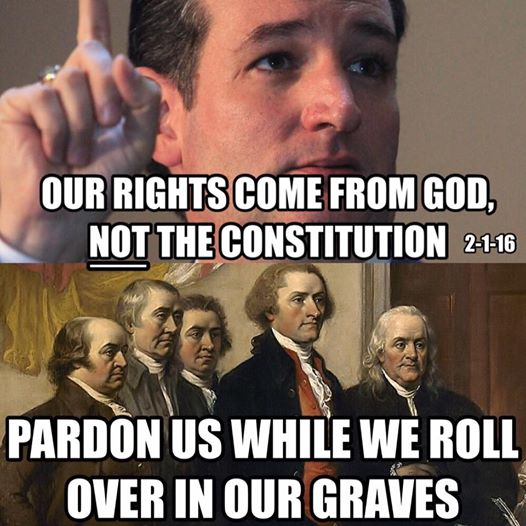
    This from Occupy Democrats:

    12647129_1058653647561022_4746717199189857381_n

    This from the Unites States Founding Fathers:

    When in the Course of human events, it becomes necessary for one people to dissolve the political bands which have connected them with another, and to assume among the powers of the earth, the separate and equal station to which the Laws of Nature and of Nature’s God entitle them, a decent respect to the opinions of mankind requires that they should declare the causes which impel them to the separation.

    We hold these truths to be self-evident, that all men are created equal, that they are endowed by their Creator with certain unalienable Rights, that among these are Life, Liberty and the pursuit of Happiness.–That to secure these rights, Governments are instituted among Men, deriving their just powers from the consent of the governed, –That whenever any Form of Government becomes destructive of these ends, it is the Right of the People to alter or to abolish it, and to institute new Government, laying its foundation on such principles and organizing its powers in such form, as to them shall seem most likely to effect their Safety and Happiness. Prudence, indeed, will dictate that Governments long established should not be changed for light and transient causes; and accordingly all experience hath shewn, that mankind are more disposed to suffer, while evils are sufferable, than to right themselves by abolishing the forms to which they are accustomed. But when a long train of abuses and usurpations, pursuing invariably the same Object evinces a design to reduce them under absolute Despotism, it is their right, it is their duty, to throw off such Government, and to provide new Guards for their future security…

    We, therefore, the Representatives of the united States of America, in General Congress, Assembled, appealing to the Supreme Judge of the world for the rectitude of our intentions, do, in the Name, and by Authority of the good People of these Colonies, solemnly publish and declare, That these United Colonies are, and of Right ought to be Free and Independent States; that they are Absolved from all Allegiance to the British Crown, and that all political connection between them and the State of Great Britain, is and ought to be totally dissolved; and that as Free and Independent States, they have full Power to levy War, conclude Peace, contract Alliances, establish Commerce, and to do all other Acts and Things which Independent States may of right do. And for the support of this Declaration, with a firm reliance on the protection of divine Providence, we mutually pledge to each other our Lives, our Fortunes and our sacred Honor. (emphasis mine)

    Oceania is at war with Eastasia. Oceania has always been at war with Eastasia.

  • A Message from Northern Iraq

    This message was apparently received by Auckland Salvation Army. It has been published in the Western Leader and Rodney Times:

    “A friend just got a text message from her brother asking her to shower him and his parish in prayer.
    “He is part of a mission and ISIS has taken over the town they are in.
    Nazarene“He said ISIS is systematically going house to house to all the Christians and asking the children to denounce Jesus.
    “He said so far not one child has. And so far all have consequently been killed.
    “But not the parents.
    “The UN has withdrawn and the missionaries are on their own.
    “They are determined to stick it out for the sake of the families – even if it means their own deaths.
    “He is very afraid, has no idea how to even begin ministering to these families who have seen their children martyred.
    “Yet he says he knows God has called him for some reason to be his voice and hands at this place at this time.
    “Even so, he is begging prayers for his courage to live out his vocation in such dire circumstances.
    “And, like the children, accept martyrdom if he is called to do so.
    “The missionary’s sister asks everyone we know to please pray for them.
    “These brave parents instilled such a fervent faith in their children that they chose martyrdom. Please surround them in their loss with your prayers for hope and perseverance.
    “She was able to talk to her brother briefly by phone. She didn’t say, but I feel she believes it will be their last conversation.
    “Pray for her too. She said he just kept asking her to help him know what to do and do it.
    “She told him to tell the families we are praying for them and they are not alone or forgotten – no matter what.
    “Her mail broke my heart. Please keep all in your prayers. Thank you.
    “Just a few minutes ago I received a message on my phone from Sean Malone who leads Crisis Relief International (CRI).
    “We spoke briefly and I assured him that we would share this urgent prayer need with all of our contacts.
    “This was that caller’s message:
    “We have lost the city of Queragosh (Qaraqosh).
    “It fell to ISIS and they are beheading children systematically. This is the city we have been smuggling food too.
    “ISIS has pushed back Peshmerga (Kurdish forces) and is within 10 minutes of where our CRI team is working.
    “Thousands more fled into the city of Erbil last night. The UN has evacuated its staff in Erbil. Our team is unmoved and will stay. Prayer cover needed!
    “Please pray sincerely for the deliverance of the people of Northern Iraq from the terrible advancement of ISIS and its extreme Islamic goals for mass conversion or death for Christians across this region.
    “I plead with you not to ignore his email.
    “Send it to as many people as possible – especially your friends.”

  • Ad Homonym: MandM are not suing the National Party

    For the record MandM are not suing the New Zealand National Party over their election advertisement. Rumours to the contrary we hereby reject as an ad homonym.

    National Party Ad