Category: Media

  • Rangiora New Life College, Religion and Discrimination

    On Wednesday I flew to Christchurch for an interview regarding a religious education (RE) teaching position in a Catholic School. On having the interview and receiving the subsequent rejection email, it was clear what the reason I did not get the position was: I am a protestant, the school has a particular Catholic ethos that it was trying to instill in the students; this ethos involved such things as Marian devotions, praying the rosary, prayers for the dead and regular involvement in the Eucharist. As a leader in the school I would be expected to, by my teaching and life, encourage and model this ethos. Given I am an evangelical protestant I could not do this. I could, of course, explain to students what the Catholic teaching was on these issues and respect the special character of the school but due to my religious convictions, I could not truly fit with the ethos of the school because I could not model it, as fact, in my own example.

    Now in no way do I think I was treated unfairly, it was afterall a Catholic School and this was something that was  obvious both from the name on the advertisement in the education gazette and from the website linked to from the same ad. The function of this school was not simply to impart information; it was to imbibe a particular religious way of life, some of it involving what Nicholas Wolterstorff calls “educating for responsible action,”

    The ultimate goal of all education, as Christians see it, is that those who are taught shall live in such a way as to carry out their responsibilities to God and find joy and delight in so doing. … But if responsible action is to ensue, more is necessary than for the students to have knowledge of the relevant matters and the ability to perform the relevant actions. Knowledge and ability are not yet performance. It is also necessary that the students’ tendencies, ranging all the way from their unreflective habits to highly self-conscious commitments, be those of acting in accord with the normative laws for right action. Education, accordingly, must have among its goals to secure–always in morally defensible ways–the formation of right tendencies.[1] [Emphasis original]

    Wolterstorff argues that modelling plays an important role in cultivating tendencies. He notes that a series of studies show that students who view other people resisting the temptation to act in an immoral or inappropriate way fortify their own resistance to temptation.[2] Wolterstorff states, “The evidence seems to be that not only do a model’s low standards influence the student to lower the standards which otherwise he or she would adopt, but also a model’s high standards influence the child to raise his or hers.”[3] [Emphasis original]. An important caveat of this is that studies show “the self-denial induced by a stringent model gives way rather readily when the subject is confronted by another model with lower standards.”[4] Because the school was seeking to train students to internalise a Catholic ethos, and an important part of the pedagogy of internalising such an ethos is modelling, it follows that leaders within communities committed to this goal must themselves follow and be committed to the basic moral teachings of the community. I was not. I am a protestant and so would buck (internally) against many of the tendencies the RE department were trying to teach.

    This does not seem terribly controversial to me. Schools dedicated to inculculating a religious way of life into their students have the right to demand that the leaders in their schools be committed to and reflect this way of life. It is perfectly reasonable for Jewish schools to expect people in positions of leadership to be faithful followers of the Torah. It is perfectly reasonable for Muslim schools to expect leaders in their community to be faithful Muslims; for atheist schools devoted to promoting atheism to expect their leaders to be atheists.

    I reflect on this because of the recent outcry in response to a Campbell Live story that a Christian school in Rangiora, Rangiora New Life School, expelled a student for getting pregnant and subsequently revoked the deputy head-boy status given to her fiancé, the father of her child. Now, in light of what the media has reported, I will say I am not in agreement with everything the school did (I should qualify this by stating that I have very little faith that the media to report events like this terribly accurately – so take that concession with a grain of salt).

    For example, Ollie Sterrit the deputy head-boy and his fiancé Sara Etherington stated that “if we decided not to keep her [abort their daughter] they didn’t support it, and they still didn’t support us if we did keep it. So we were stuck in the middle and couldn’t do anything to please them.” The media reports that the teen couple “are engaged and determined to stay together.” Now, I am inclined to think that if a teenage couple respond to getting pregnant unmarried by taking their responsibilities seriously by refusing to kill their child, getting engaged, making a commitment to stay together and to continue their education they should be supported and commended for doing the right thing. They are of course not yet “legally married” but given their age, in this country, that is impossible; hence it is not clear cut to me that this couple’s choice should not be supported. In fact, I think that a scriptural case could be made that people in this situation can, in certain circumstances, be viewed as being in a constituted kind of common law marriage and that, in fact, it is the duty of the father to marry the woman he has impregnated and to take his responsibilities to her and the child seriously (which is what appears to be happening in this situation).  However, Sara’s parents tell a different story (see the second comment on the Campbell Live link) “We have consistently tried to encourage Ollie and Sara to see the bigger picture (others affected by there decisions) all along, their choice of course. Sara has had every love and support from RNLS  [the school] and her family.“

    Whatever the truth is on the matter of the school supporting the couple, stripping someone of a position of leadership is not the same thing as not supporting them –  though not permitting Sara to finish her education (she was apparently asked to leave the school) might be. Also giving someone a position of leadership, knowing about the pregnancy and then removing it from them, perhaps demonstrated a lack of wisdom in the first place on the part of the school or some dud processes (or bad media reporting).

    However, these issues are not the focus of my concern in this blog post. First, Dave Crampton at Big News seems to suggest that the school had no policy on sex outside of marriage and as such they could not claim that this was part of the ethos they were trying to impart, meaning the school had no right to suddenly make an issue of the sexual conduct of its students, “The schools handbook has no mention of policies on sex, although swearing and alcohol are forbidden in school grounds, as are piercings for males.” If you visit Rangiora New Life’s website a very different picture emerges. First of all, the name of the school  “New Life” immediately suggests it is evangelical or pentecostal. On the front page the school mission states “Providing quality Christian education that equips and inspires all students to reach their life’s potential in order to serve God’s purposes.” There is a clear indication by the use of words such as “their life’s potential” and “serve God’s purpose” that the type of education they are seeking to inculculate is holistic, they hope that it will impact all aspects of the students’ lives. Click through to their Mission, Vision and Values page and you’ll find under the heading “Vision,”

    GODLINESS – Building character in the students that will enable them to lead by example.

    LIFE SKILLS – Equipping students with skills in relationships, home-life and vocation.

    EVANGELISM – Taking every opportunity to share the life changing message of the gospel.

    SERVICE – Impacting our region and beyond through sacrificial service and giving. [Emphasis added]

    Here we see concern with character, leading by example, reference to relationship skills, home-life and vocation tell us they mean more than relationships with their school peers and teachers. Evangelism and reference impacting the region and beyond show, again, the broader ethos of the school. The “guiding values” on this page continue these motifs and among these we find “Ensuring school relationships, procedures and policies reflect Biblical principles and the highest Christian conduct” and “Promoting personal responsibility in learning and conduct, and community responsibility by way of service and leadership skill.” Does anyone really think, on reading these, that banging your fellow teenage school peer and knocking her up is compatible with Rangiora New Life’s understanding of these terms and is the sort of example in leadership or high biblical standard that the school is seeking to promote by example and that this sort of conduct is what the other parents with kids in the school want modelled to their kids?

    Now, as Madeleine points out, when contracts are formed (I’m getting at here Dave Crampton’s contractual suggestion) all aspects of the communication between the parties, the information freely offered about the parties states of mind, intent, etc as well as the surrounding documentation speak to how the minutae of the handbooks and policies should be read and interpreted. The school is clearly a conservative, pentecostal/evangelical bible believing Christian school. Did anyone miss the memo that people with such beliefs tend to frown on pre-marital sex and that such people have high expectations of the example of their leaders – that’s why church leaders being hypocrites is such a big deal.

    Second, what is my concern is the widespread belief of some commentators that a religious school cannot demand that leaders in their community abide by the moral teachings of the religious ethos the school seeks to inculculate. Idiot/Savant of No Right Turn’s comments are typical,

    This is clearly unlawful discrimination on the basis of marital status and family status, in violation of sections 21(1)(b) and s21(1)(l) of the Human Rights Act 1993. It may also constitute discrimination on the basis of religious belief in violation of s21(1)(c). Rangiora New Life School is a religious school, so it has an exemption for the latter – but not for the former. It can not legally exclude or punish students who have children or are in de facto relationships, any more than it can exclude or punish them for being divorced (or the children of people who are divorced).

    Regardless of the merits (or lack thereof as Madeleine insists) of Idiot/Savant’s legal analysis here there is a moral point here worth addressing. Idiot/Savant seems to think that religious schools can discriminate on the grounds of religious belief but not on grounds of sexual behaviour. It is hard to see the sense in this because in many circumstances, and certainly in this case, a person’s religious beliefs include a set of beliefs about sexual morality. If we are to take this line of argument seriously a religious school can discriminate against people who believe that sex outside of marriage is wrong but they cannot discriminate against people who refuse to practice this belief. It is hard to see how such a view could be taken seriously; surely the whole point of these teachings is that they be followed.

    Idiot/Savant continues,

    But there’s another aspect to this: Rangiora New Life School is a state integrated school, and therefore effectively part of the state education system. The New Zealand Bill of Rights Act therefore clearly applies. By discriminating against its students and denying them any involvement in the decisions about them, the school has violated the right to be free from discrimination and the right to justice. And that is something we should not be tolerating from any part of our government. Rangiora New Life School’s board must be told to obey the law, cease its discrimination, and reinstate the student it has excluded. And if they do not, they should be replaced.

    Idiot/Savant here makes heavy weather over the fact that Rangiora New Life is an integrated school. While this is true, it is also a religious school which aims to inculculate a particular religious way of life. Integrated religious schools, with special characters allowing them to promote a particular religion, are extremely common. If Idiot/Savant’s, position is correct none of these schools should be allowed to require leaders in the school or students who attend the schools to uphold a certain religious ethos. This would of course make a mockery out of their mission to promote such a way of life.

    Lurking behind this complaint is, I think, a mindset that schools that promote a particular religious ethos (or at least take the ethos seriously) should not get public funds; only secular schools should get such funds. In practice this means that a school that promotes a secular perspective antithetical to a particular religion will get state funds whereas a school that inculculates certain religious beliefs will not. It’s odd that people like Idiot/Savant who maintain the right to be free from discrimination on the part of the state would support such a policy that clearly discriminates against tax paying parents with religious views.

    Wolterstorff notes a deeper problem,

    there are parents within society for whom it is a matter of religious conviction that their children receive a religiously integrated education. … If those parents are forbidden by law to establish and patronize schools that teach in accord with their religious convictions, then the discrimination is embodied in law. If they not legally forbidden to establish and patronize such schools then the discrimination is embodied in economics. Were those parents to establish and patronize schools that teach in accord with their convictions, they would have to pay for those schools out of their own pockets, while still contributing to the general tax fund for the other schools, obviously there free exercise of religion is thereby infringed upon in a way in which that of others is not. They do not enjoy equal freedom to live their lives as they see fit.[5]

    To insist that schools either forgo public funds or compromise the religious ethos they seek to inculculate is itself discrimination. Wolterstorff notes the only escape from this dilemma apart from privatising education entirely is to “fund equitably all schools that meet minimum educational requirements” and this means allowing schools to take public funding that will require strict standards of sexual morality from student leaders. Of course one could always admit that one does not actually support the right of all to be free from religious discrimination…


    [1] Nicholas Wolterstorff Educating for Responsible Action (Grand Rapids MI: Eerdmans Publishing Co) 14-15.
    [2]
    Ibid 51-55.
    [3]
    Ibid 55.
    [4] Ibid.
    [5]
    Nicholas Wolterstorff “The Role of Religion in Political Issues” Religion in the Public Square

    RECOMMENDED READING:
    Religious Restraint and Public Policy

    While it is not central to my point I cannot ignore the fact that in two places now (see the second comment on the Campbell Live link for one) I have seen the parents express anger at Campbell Live’s intrusion into their home without their consent. They had apparently categorically told the producers that they did not give permission for their property to be used for the interview but Campbell Live ignored their wishes and waited til they were not home to film the piece. Appalling.

  • Hadouken Punch

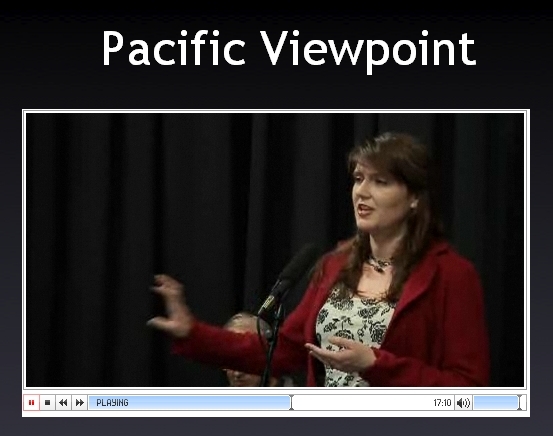
    Online Sid had some fun with my Pacific Viewpoint TV screen-shot. Apparently my question to MP Paul Hutchison on Pacific Viewpoint was so powerful you could see the hadouken punch I hurled at him (or chi blast as my kids tell me the correct term is) when you freeze-framed the video.

    Classic!

    Hat Tip: Online Sid

  • View Pacific Viewpoint TV Panel on Abortion & Parental Consent Here (Feat. Madeleine)

    Episode one of the television panel discussion Madeleine participated in on parental consent/notification for abortion is now available for viewing online here at Pacific Viewpoint TV.

    The show runs for 30 minutes; in this episode Madeleine features as an audience member  (panelists are Bev Adair, Paul Hutchison, Reverend Tavale Matai’a) and she goes a round with the Member of Parliament for Hunua, Dr Paul Hutchison. (Originally she went two rounds with him but her second spiel, where she dealt to his inadequate response to her question, only got as far as the editing room.)

    Madeleine on Pacific Viewpoint

    In the next episode, Madeleine actually is a panel member and she gets a lot more speaking time. The second episode will air Tuesday 15 December at 7:30pm on Triangle TV also on Stratos (Freeview 21 & Sky Digital 89) on Wednesday 16 December at 8pm or you can catch it here next Wednesday.

    Anyway, enjoy and feel free to make use of the button that permits you to make a comment to the show.

  • Madeleine on Pacific Viewpoint TV on Abortion & Parental Consent

    Part one of the panel discussion I participated in on parental consent/notification for abortion airs on Pacific Viewpoint tonight (Tuesday 8 December) on Triangle TV at 7:30pm. Part two will air Tuesday 15 December at 7:30pm.

    The episodes will also be aired on Stratos (Freeview 21 & Sky Digital 89) tomorrow (Wednesday 9 December) at 8pm and the following Wednesday at the same time.

    The panel features Dr Paul Hutchison, MP for Hunua and former member of the Abortion Supervisory Committee; Bev Adair, spokesperson for Family First, Reverend Tavale Matai’a, a couple of other women and me! In tonight’s episode I feature as an audience member and go a round with Dr Hutchison. Next week, I am a panel member.

    I have no idea how it will run. Panel discussions are frustrating because you cannot hit everything and you have to manage to get everything you want to say out cohesively in the little snippets of time you do get but nevertheless is was fun filming it!

    Recommended Reading:
    During, Sherwin & Hutchison on Backstreet Abortion

  • Contra Mundum: The Flat-Earth Myth

    A while back I made a passing comment on my blog criticising an advertisement which claimed that, prior to Columbus, the Church taught that the world was flat. In response I received the following email from a high-school student in the US,

    I’ve been studying Christopher Columbus in my history class and my history books say that prior to Columbus everyone did think the world was flat……..I don’t know if it was a mistake in the history book or your mistake…..but anyway….I guess I have some things to learn! God bless ~ Katie

    We have all heard the story behind this. Prior to Columbus, the Church and its theological scholars taught that the world was flat. For this reason they opposed Columbus’ proposed voyage in 1492 as they believed he would sail off the edge of the earth (or that he would prove them wrong and they would lose standing in society). Despite this Columbus sailed anyway and his rejection of the Church’s position was vindicated, he scored a victory for science and reason.

    My correspondent is correct. They do teach this in high school text books. I was taught it at both primary and high-school. In fact, not too long ago Prentice Hall published claims to this effect in their middle school textbook Prentice Hall Earth Science.

    At a philosophy conference at Otago University, shortly after I graduated, I recall one speaker using the example of “medieval flat-earthers” in his paper as an example of an irrational belief. Almost everyone in attendance nodded their heads in agreement; no one contested the historical assumptions implicit in the example. More recently Victoria University ran a slick television campaign stating that in the 14th century most people believed the world was flat. The ad showed a picture of a boat sailing across the sea only to fall over the side of the earth and concluded “It makes you think.”

    You might have gathered from obvious clues like the title and from the way I have set this article up that I dispute the veracity of much of these historical claims. If I state this publicly there are very few settings where this admission does not at least earn me an incredulous stare (as if I were, in fact, asserting that the earth was flat). Invariably some comment follows, “come on Matt, everyone knows this story is true, didn’t you learn this at school? Haven’t you read any history textbooks?”

    It is true that I did learn this story at school and that I have read it in more than one history textbook but because I took the time to research the history of theology when I was at university I know that this story is fiction. It is a slanderous fabrication invented by opponents of Christianity in the 19th century and has been thoroughly debunked by contemporary historians of science.

    The definitive study is undoubtedly that of Jeffrey Burton Russell in Inventing the Flat Earth: Columbus and Modern Historians. Russell summarised his findings, in a paper presented to the 1997 American Scientific Affiliation Conference, as follows,

    [W]ith extraordinary few exceptions no educated person in the history of Western Civilization from the third century B.C. onward believed that the earth was flat. A round earth appears at least as early as the sixth century BC with Pythagoras, who was followed by Aristotle, Euclid, and Aristarchus, among others in observing that the earth was a sphere. Although there were a few dissenters—Leukippos and Demokritos for example–by the time of Eratosthenes (3 c. BC), followed by Crates(2 c. BC), Strabo (3 c. BC), and Ptolemy (first c. AD), the sphericity of the earth was accepted by all educated Greeks and Romans.

    Nor did this situation change with the advent of Christianity. A few—at least two and at most five—early Christian fathers denied the spherically of earth by mistakenly taking passages such as Ps. 104:2-3 as geographical rather than metaphorical statements. On the other side tens of thousands of Christian theologians, poets, artists, and scientists took the spherical view throughout the early, medieval, and modern church. The point is that no educated person believed otherwise.

    Russell traced the story about Columbus and medieval flat-earthers back to the 19th century; it originated in a fictional novel by Washington Irving The Life and Voyages of Christopher Columbus I (1829). Later it was picked up by two influential books, John Draper’s History of the Conflict between Religion and Science (1874) and Andrew Dickson White’s book A History of The Warfare Between Science and Theology in Christendom. These books famously used the Columbus story plus many others to defend the thesis that the Church, for centuries, suppressed science and worked to prevent its flourishing; this is known as the conflict thesis.

    These books and the conflict thesis they spawned, are highly influential in popular science and media coverage of theological and scientific issues today despite most historians rejecting them as propaganda. In The Encyclopedia of the History of Science and Religion, Collin Russell notes,

    Draper takes such liberty with history, perpetuating legends as fact that he is rightly avoided today in serious historical study. The same is nearly as true of White, though his prominent apparatus of prolific footnotes may create a misleading impression of meticulous scholarship.

    Steven Shapin wrote in the same vein in The Scientific Revolution,

    In the late Victorian period it was common to write about the “warfare between science and religion” and to presume that the two bodies of culture must always have been in conflict. However, it is a very long time since these attitudes have been held by historians of science.

    Numerous other specialists in the field of the history of science and religion concur that the existence of medieval flat-earthers is a myth. Numbers and Lindberg noted in a journal article, “there was scarcely a Christian scholar of the Middle Ages who did not acknowledge [Earth’s] sphericity and even know its approximate circumference.” In his study of medieval cosmology, God and Reason in the Middle Ages, distinguished historian Edward Grant noted that,

    All medieval students who attended a university knew this. In fact any educated person in the Middle Ages knew the earth was spherical, or of a round shape. Medieval commentators on Aristotle’s “On the Heavens” or in the commentaries on a popular thirteenth century work titled “Treatise on the Sphere” by John of Sacrobosco, usually included a question in which they enquired “whether the whole earth is spherical”. Scholastics answered this question unanimously: The earth is spherical or round. No university trained author ever thought it was flat.

    Draper’s and White’s books remain widely cited despite being debunked as historically inaccurate. In fact, the kinds of textbooks Katie mentioned have been subject to scathing criticism precisely for making the aforementioned claims. Lawrence S. Lerner, a professor in the Department of Physics and Astronomy at California State University who is a member of the panel that wrote the 1990 framework for science education in California’s public schools criticised Pretence Halls history text denouncing it as “ignorant fakery.” In an article entitled “Fake ‘History’ That Is Flatly Wrong,” Lerner described the flat-earth claims as a “popular piece of pseudo historical folklore” he added that it “remains popular today among people who have had little education. These evidently include the people who produce ‘science’ books for Prentice Hall.”

    The historical facts are difficult to dispute. During the, so called, “dark ages” Boethius (480-525) cited a well known and accepted ancient Greek cosmological model that affirmed the sphericity of the earth in the Consolidation of Philosophy. Isidore of Serville (560-636) affirmed a round earth in the Etymologies. Bede (672-735) in The Reckoning of Time taught the earth was round; as did Rabanus Marcus in the ninth century.

    The late middle-ages are no different. Hemannus Contractus (1013-155) measured the circumference of the world. Hildegard of Bingen (1098-1179) taught the world was round as did John of Sacrbosco (1200-1256) and Peire d’Ailly (1350-1420). Dante’s Divine Comedy portrays the earth as a sphere. In the Summa Theologicae Thomas Aquinas wrote,

    The physicist proves the earth to be round by one means, the astronomer by another: for the latter proves this by means of mathematics, e.g. by the shapes of eclipses, or something of the sort; while the former proves it by means of physics, e.g. by the movement of heavy bodies towards the center, and so forth.

    Even medieval textbooks taught the world was round. Both the Elucidarium of Honorius Augustodunensis, a twelfth century manual for educating clergy, and On the Sphere of the World, the standard cosmological textbook of medieval universities in the 13th century, taught that the world was round.

    As I have delved into religious history further I have found that this had not been the first or only instance where I was fed false propaganda about Christianity. I could document several other false versions of history; the flat-earth story will suffice for now. As New Zealand blogger Contra Celsum wrote, “the flat earthers are those who think they existed.”

    I write a monthly column for Investigate Magazine entitled Contra Mundum. This blog post was published in the December 09 issue and is reproduced here with permission. Contra Mundum is Latin for ‘against the world;’ the phrase is usually attributed to Athanasius who was exiled for defending Christian orthodoxy.

    Letters to the editor should be sent to: editorial@investigatemagazine.DELETE.com

    RELATED POSTS:
    The “Dark Ages” and Other Propaganda
    More on the “Dark Ages” and Other Propaganda
    Things They Don’t Teach you in Public Schools…
    The Flat Earth Myth
    Guest Post: Dan Brown’s History of Science

  • During, Sherwin & Hutchison on Backstreet Abortion

    Recently Madeleine was on a TV panel discussion regarding the issue of abortion and parental notification/consent which will go to air in the next week. During the ensuing dialogue Dr Paul Hutchinson, National Party Member of Parliament for Hunua, specialist in Obstetrics and Gynaecology and former member of the Abortion Supervisory Committee, raised the famous backstreet abortion argument for abortion rights. In many respects this is hardly surprising. In almost any media discussion of the issue of abortion the back-street abortion argument comes out. In Abortion: A Feminist Perspective, Susan Sherwin states, “Feminists recognise that women have abortions for a wide variety of compelling reasons.”[1] One reason she immediately cites is,

    No one denies that if abortion is not made legal, safe, and accessible in our society, women will seek out illegal and life-threatening abortions to terminate pregnancies they cannot accept. Antiabortion activists appear willing to accept this cost, although liberals definitely are not; feminists, who explicitly value women, judge the inevitable loss of women’s lives that results from restrictive abortion laws to be of fundamental concern.[2]

    In similar vein Dr Zoe During, former President of the Abortion Law Reform Association of New Zealand (ALRANZ), in a debate with the me, gave a paper entitled “Is Abortion Justifiable: An Examination of the Evidence”, in which she argued,

    But the majority of women, poor women, have had to go to backstreet practitioners or swallow dubious potions or use knitting needles on themselves. Attempting illegal abortion by such means has always been dreadful and dangerous and greatly increased maternal mortality.

    The World Health Organisation estimates that worldwide there are 20 million abortions each year, half or more being illegal, these causing up to 78,000 maternal deaths and hundreds of thousands of disabilities. A New York statistic is illuminating. For the three years before abortion became legal in that state, the maternal death ratio averaged 51 per 100,000 live births. For each of the three years immediately following legalisation it dropped to a mere 38, and there was the additional bonus of a 5% reduction in the neo-natal mortality rate. Thus not having access to legal abortion unjustifiably kills mothers and babies, while legalising abortion saves lives.[3]

    During’s argument rests upon three contentions:

    (a) That prohibiting feticide results in the death of women.
    (b) That (a) entails that prohibiting feticide kills women.
    (c) That killing of thousands of women in these circumstances is unjustifiable.

    Firstly, this is an argument not to the conclusion that feticide is permissible but rather that it should not be a criminal action. The fact (if it is a fact) that there are reasons why an act should not be a criminal offence does not entail that the act is morally permissible. Strictly speaking, this argument is compatible with the position that feticide is morally wrong. However, even as an argument for decriminalisation it is unsound.

    Many debates swirl around (a). As the citation shows During bases her conclusion on statistics from the World Health Organisation (WHO) and an un-referenced study about mortality in New York. These statistical claims are vigorously debated in the literature,[4] however, for our purposes this debate can be set aside. More interesting, I think, are the normative premises encapsulated in (b) and (c). If these are mistaken, the argument as a whole is unjust regardless of any merits of (a).

    Regarding premise (b) During appears to think that if passing a law results in the death of large numbers of women then to pass such a law is to kill these women. This is false. It is an empirical fact that building motorways results in innocent people dying, yet it does not follow that a person who builds a road kills innocent people. It is also a fact that by allowing people to swim at beaches some people will drown yet in permitting people to swim at beaches the government cannot be said to have drowned these people. Even if it could be demonstrated that restricting feticide results in women dying it does not follow that such restrictions kill women.

    During fails to distinguish between an action that foreseeably results in a person’s death and an action that causes that person’s death. Suppose that Parliament were to criminalise feticide and this led to a chain of events one of which was the death of a woman due to septic abortion. Somewhere in this chain, between the act of the legislature and the death of the woman, are the free actions of various people who choose to ignore or breach these laws. Parliament does not perform these actions; in fact they are done in defiance of Parliament’s will and hence without Parliament’s consent. Such actions include the choice of a woman to violate the law and procure an abortion and the choice of an abortionist to perform an abortion and to violate hygiene and safety standards. The death and injury that occurs is caused by these actions. It is the abortionist’s decision, acting as an agent of the woman, to perform unsafe surgery that causes the injury to occur. These facts make it evident that Parliament does not cause such deaths. The actions of the woman and abortionist are un-coerced. They are free, voluntary actions and as such not caused by someone else. It follows immediately that they were not caused by the state. If they were not caused by the state, then the effects that follow from them were not caused by the state either. The suggestion that one causes the free (and hence uncaused) reactions of others to decisions one makes is far fetched.

    The failure to distinguish caused and foreseen effects is illustrated well by Augustine. In contending with the consequentialists of his day, Augustine proposed the following example. Suppose a man approaches a woman and tells her that he will kill himself if she refuses to have sex with him. Does that mean that she is a murderer if she refuses?[5]

    One response to this kind of rejoinder is to claim that a woman’s choice is not free; rather it is made out of desperation and anguish. She feels compelled to abort given the psychological and economic pressures she faces. Three responses can be given to this argument.

    Firstly, even if it is granted, the same cannot be said to be true of the abortionist and given that it is the abortionist’s actions that kill the woman, the fact that these are uncaused entails that Parliament cannot have caused them either.

    Secondly, even if the woman’s actions were not free but caused in some way it does not follow that Parliament caused them. In some circumstances other people, such as the man’s decision to have intercourse and then to not support her or the family’s refusal to help, caused this desperation. Given that these actions are free, then Parliament cannot be held to have caused these either.

    Thirdly, making the claim that a woman was not free to refuse an abortion makes this argument less plausible. Abortion is often trumpeted as a woman’s free choice. If this claim is correct then how can women be coerced into such an operation against their consent? Further, it seems odd to claim that we should legalise forced abortions.

    Turning to (c), this claim is plausible only if it is true that feticide is not homicide. If feticide is homicide then to permit feticide is to permit homicide. Not only will the failure to permit feticide result in human beings dying, permitting it will also result in human beings being killed. If, as During contends, endorsing a rule that results in deaths is wrong then it will also be wrong to permit feticide.

    It is worthwhile noting that the numbers of fetuses killed by legal abortion is significantly higher than the number of women killed by illegal ones. At its highest, the number of women who died from illegal abortion in New Zealand in any one year was 37.[6] The number of fetuses destroyed by legal abortion in New Zealand annually is approximately 18,000.[7] Moreover, according to the stats During cited from WHO, there are around 10 million legal abortions per year and 78,000 deaths resulting from illegal ones.[8] If we follow the argument During offers, then we are permitting the killing of 10,000,000 human beings per year to avoid killing 78,000 human beings.

    During’s argument in favour of feticide is sound only if feticide is not homicide. However, if feticide is homicide she is arguing that in order to prevent thousands of people from harming themselves we should kill millions of people; a claim that on the face of it is absurd.

    This absurdity is not unique to During; the same thing can be said about the arguments offered by Sherwin and Hutchinson.


    [1] Susan Sherwin “Abortion a Feminist Perspective” in Ethical Issues in Modern Medicine ed Bonnie Steinbock & John D. Arras (Mountain View CA: Mayfield Publishing Co, 1999) 361.
    [2]
    Ibid.
    [3]
    Zoe During “Is Abortion Justifiable?” New Zealand Rationalist Humanist Spring (1999) 10-11.
    [4]
    The debates on this issue are documented in Francis Beckwith Politically Correct Death: Answering the Arguments for Abortion Rights (Grand Rapids MI: Baker Books, 1993) 54-59.
    [5] Augustine On Lying 9.
    [6]
    Wayne Facer Criminal Abortion in New Zealand: Public Health Consequences; this study was distributed by the Abortion Law Reform Association of New Zealand in the 1970’s. Facer was an outspoken proponent of decriminalising abortion.
    [7]
    New Zealand Abortion Supervisory Committee Report 2008.
    [8]
    These figures are not current.

    RELATED POSTS:
    Is Abortion Liberal? Part 1
    Is Abortion Liberal? Part 2
    Sentience Part 1
    Sentience Part 2
    Viability
    Abortion and Child Abuse
    Abortion and Brain Death: A Response to Farrar
    Abortion and Capital Punishment: No Contradiction
    Imposing Your Beliefs onto Others: A Defence
    Boonin’s Defense of the Sentience Criterion: A Critique Part I
    Boonin’s Defense of the Sentience Criterion: A Critique Part II

  • The NZ Herald on Cactus Kate and Priorities in Journalism Ethics

    There is an interesting story unfolding in the blogosphere. Cactus Kate published extracts of APN News and Media’s guidelines for publication on her blog in, APN Chicken Out, and inserted her own commentary and spin on them based on email correspondence from staff members working for APN’s publications. Where it gets really interesting is that the New Zealand Herald ran this piece Herald tells blogger: You’re Wrong. Anyone familiar with Cactus Kate (and probably bloggers generally) will not be surprised to hear that Cactus has published a cutting response, with the rather brilliant title, Herald Clucks On Spin Cycle.

    The whole thing is worth a read for two reasons. One it demonstrates the rise of the blog, the increasing position of the blog as a source of information and as a force to not be ignored (which is a phenomena, as a blogger, that I find very interesting). The second reason is that some aspects of the guidelines for publication that Cactus cites are alarming.

    While the Herald takes issues with some of the points in Cactus’ initial blog post, it calls them a “heavily truncated mish-mash” (I think that’s journo speak for cut and pasted extracts) and says they have been in play for a long time “Nothing secret about them and nothing new”, it does not deny that these guidelines are, in fact, in play.

    “[The guidelines] are not new (same general thoughts have been included in the training document for years) … the basic points are entirely matter-of-fact for anyone seeking to get things right and avoid legal pitfalls the media have encountered before.

    There is no new ‘conservative’ approach, no recent guidelines discussed, received or implemented, no change.”

    So the Herald says they are not new, Cactus’ sources say they are but that is not why I called your attention to them. It is that the content of the guidelines are what is revealing. Now I don’t share every aspect of Cactus’ take on what precisely is wrong with the guidelines but I do agree she is right when she says some of them are pretty awful. For example, consider this guideline:

    d. There are categories of people who are more inclined to sue if they are the subject of adverse publications, so particular care should be taken in reporting allegations of misconduct against lawyers, doctors, judges, other professionals, politicians, critics and wealthy businessmen/women.

    Cactus takes issue with this and describes it as “the worst affront to investigative journalism” contained in the document.  I too think that it is the most concerning of all of them but not as an affront to investigative journalism. My issue with clause d is the suggestion that publications only bother to take care in reporting damning allegations against people who are likely to sue them – so don’t bother being as careful writing damning allegations about people who are not likely to sue?

    I’m sorry, but I thought that the reason one should take care to not publish false, private and damning allegations about people (you tend to not be able to succeed in legal action if what is written is true and in the public interest) was something vaguely to do with respect for truth, morality, ethics, integrity, respect for other people, a desire to not misinform the public and so on. When I think of the reasons why I try to not publish anything false, damning and private on our blog, the odds of my success in the courtroom do not figure very high. I’m more concerned that I get it right simply for the sake of getting it right because that is important to me.

    Nice to have what we all thought about journalism ethics set out in black and white I guess.