Category: Media

  • Contra Mundum: Secular Smoke Screens and Plato’s Euthyphro

    In “Religion: A Barrier to Clear Thinking,” the final article in the award winning series of lay philosophy articles published in the Christchurch Press, Canterbury based Philosopher Simon Clarke addressed the question, “what is the biggest obstacle to thinking clearly about social and political issues?” Predictably he answered “Several answers suggested themselves but time and again I came back to the same thing: religion.” Clarke explained that “the fallacy of grounding morality upon religion was pointed out by Plato over two thousand years ago.” [1]

    Clarke was appealing to a famous argument that purports to show that ethics (what is right and wrong) is independent of religion. This argument is known by professional ethicists as “The Euthyphro Dilemma” or “Plato’s Euthyphro” and is named after a dialogue Plato wrote. The current version used against mono-theistic religions, such as Christianity, Islam and Judaism, is an adaptation (the original applied to poly-theistic religions, those religions that believe in many gods).

    The argument is usually framed in terms of a rhetorical question ‘are actions wrong because God prohibits them or does God prohibit them because they are wrong?’ As the question is framed, there are only two possible answers a person can offer.

    The first is to contend that actions are wrong because God prohibits them. This answer is said to suffer a debilitating problem, it makes morality arbitrary – anything at all could be deemed ‘right’ as long as God commanded it. Philosopher Michael Tooley has suggested this, “if God had commanded mankind to torture one another as much as possible, then it would follow that that action was obligatory. … many people, including many religious thinkers, are very unhappy with that consequence.” Therefore, the critics conclude, actions are not wrong just because God issues commands against them.

    The failure of the first answer means that the only possible way out is to claim that God prohibits actions because they are wrong; they are not wrong just because he prohibits them. This answer does not have the problems of the former. However, as Clarke points out, it entails that “there are independent standards for what we should do, independent that is of the dictates of religion.” Actions are wrong before God prohibits them. His commands simply tell us what is already wrong, quite independently of what he prohibits.

    This argument is something of a cliché in contemporary secular ethics and is found in almost every secular text book I have read (and will undoubtedly make its way into the Ethics section of the new NCEA Philosophy course). Typically “religious ethics” is mentioned and then dismissed with a short rendition of Plato’s Euthyphro. When I studied Philosophy Plato’s Euthyphro was one of the first things I was taught in first year Ethics. The lecturer spelled out the argument, contended that it showed “religious ethics” was mistaken/confused/ muddle-headed/whatever and from there would went on with the serious business of offering secular perspectives on topics such as abortion, affirmative action, euthanasia, homosexual rights and so on.

    Philosopher Peter Geach noted “In modern ethical treatises we find hardly any mention of God; and the idea that if there really is a God, his commandments might be morally relevant is wont to be dismissed by a short and simple argument that is generally regarded as irrefutable.” The short, simple argument he mentioned was, of course, Plato’s Euthyphro.

    Given this backdrop it is perhaps not so surprising that Clarke, after mentioning Plato’s argument, stated “… Plato’s pretty convincing demonstration has been ignored by the vast majority of people in the intervening millennia. Why are appeals to religion so common?”

    Despite the popularity of making claims like this, I still find them somewhat puzzling. Perhaps secular ethicists assume that theological ethicists have never read Plato or that, if they have, they have ignored him. In fact, the opposite is true. The last 40 years, in fact, has seen sustained defences of theological ethics including thorough refutations of Plato’s Euthyphro. These have been published in the philosophical literature at the highest levels – off the top of my head I can rattle off over 22 different articles and monographs which have offered rebuttals to Plato’s Euthyphro – yet secular ethicists and many textbooks blithely continue as though these answers had never been offered.

    I maintain that there is an answer to the Euthyphro dilemma, one that many have pointed out; it is to adopt the first of the answers I mentioned above, to contend that an action is wrong because God prohibits it. Contrary to popular claims, this option can succeed. The objections raised against it are not as debilitating as they are made out to be.

    The primary objection is that morality is made arbitrary; anything at all could be deemed ‘right’ as long as God commanded it – even atrocious commands. What is important to note here is that the objector assumes that it is possible that God could command atrocious things like ‘torturing people as much as possible.’ This assumption, however, seems very dubious. We need to remember that we are not taking about right or wrong as being based on the commands of just anyone, we are talking about these things being based on the commands of God. In the mono-theistic tradition that this line of argument seeks to criticise, God is typically defined as a being who is all knowing, all powerful, and is morally perfect.

    So, as the terms are defined, the claim that it is possible for God to command people to “torture one another as much as possible” is true only if it is possible for a morally perfect person to command such an atrocious thing. But this is unlikely. The very reason critics cite examples such as “torturing others as much as possible,” is because these actions are paradigms of conduct that no morally good person could ever entertain or endorse. The situation the critic envisages then is a situation which is impossible.

    Of course the critic could contend that he or she does not accept the existence of a being who is all knowing, all powerful, and is morally perfect. However, because those the critic is criticising do believe in such a being and also if the dismissal of theological ethics is to be based on an accurate understanding of what the various theological traditions actually believe and teach, and is not based on a caricature, then the sceptic must address what these traditions actually affirm.

    This answer typically generates a rejoinder. If some action is right or wrong because God permits or prohibits it then God cannot be said to be good in any meaningful sense. This answer renders the claim ‘God is good’ into no more than the claim that God obeys his own commands, if this is so, can God be said to have any duties at all?

    Philosopher William Lane Craig argues that “[duties] are not independent of God nor, plausibly, is God bound by moral duties, since He does not issue commands to Himself.” William Alston drew the same conclusion, “we can hardly suppose that God is obliged to love his creatures because he commands himself to do so!” William Wainwright suggests “the notion of commanding oneself to do something … is incoherent.”

    The rejoinder that, if God has no duties then he cannot be said to be good in any meaningful sense, has a grain of truth to it. If we are going to understand God’s goodness in terms of God having duties or obligations that he consistently fulfils then theological ethics, of the sort envisaged, has problems. However, it is not clear to me why the phrase ‘God is good’ should be explicated in terms of God having duties that He follows.

    Many theologians have suggested that one should not understand God’s goodness in this way. When God’s goodness is explicated in sacred texts like the Psalms or in official creedal statements such as the Westminster Confession of Faith it is often explicated in terms of God having certain character traits. To claim God is good is to claim that He is truthful, benevolent, loving, gracious, merciful, that He is opposed to certain actions such as adultery, murder and rape and so on. Now, even if God does not have duties, it does not follow that he cannot have character traits such as these. It is true that God may not be under any obligation to love others or to tell the truth or what have you, but that does not mean that He cannot love others or tell the truth. God does not have to have a duty to do something in order to do it.

    So there seems, on the face of it, nothing incoherent about contending that God is good, that he has certain attributes like being truthful, benevolent, loving and so on. It is not that theological ethicists have never read Plato or that they have ignored him – they have read him, found his arguments wanting and published responses explaining why – it is that some sceptics have never read the responses or they have chosen to ignore them.

    Perhaps these rebuttals do not work (though I think that they do) but even if I am wrong the onus is surely on the sceptic to demonstrate why. Simply ignoring them, misrepresenting the situation and then dismissing religion “as a barrier to clear thinking” is simply not good enough.


    [1] Clarke’s series “Clear Thinking” was awarded the Australasian Association of Philosophy Media prize in 2006.

    I write a monthly column for Investigate Magazine entitled Contra Mundum. This blog post was published in the March 10 issue and is reproduced here with permission. Contra Mundum is Latin for ‘against the world;’ the phrase is usually attributed to Athanasius who was exiled for defending Christian orthodoxy.

    Letters to the editor should be sent to: editorial@investigatemagazine.DELETE.com

    RELATED POSTS:
    Contra Mundum: What’s Wrong with Imposing your Beliefs onto Others?
    Contra Mundum: God, Proof and Faith
    Contra Mundum: “Bigoted Fundamentalist” as Orwellian Double-Speak
    Contra Mundum: The Flat-Earth Myth
    Contra Mundum: Confessions of an Anti-Choice Fanatic
    Contra Mundum: The Judgmental Jesus

  • Contra Mundum: The Judgmental Jesus
    Few things are thought to be more morally pernicious than the practice of judging others. Sometimes this is given a theological spin with people citing the Sermon on the Mount “Do not judge, or you too will be judged. For in the same way you judge others, you will be judged, and with the measure you use, it will be measured to you.” (Matthew 7:1-2).

    It is common for this imperative statement to be used as a kind of rhetorical club to silence moral critique of various cultural practices. When a particular practice is subjected to such critique those who engage in the practice will complain they are being “judged.” If the alleged judgers are Christian, the claim that “judging is contrary to what Christ taught” is typically added to the charge.

    I think this is a misrepresentation of the passage and an affront to common sense. I will address the latter point first. The claim that it is wrong to judge other people is problematic; it is so problematic that it is amazing that anyone gives it credence. For example, if it is wrong to judge other people then since Hitler was another person, it is wrong to say that what he did was wrong. To claim that his actions were wrong is to make a judgment about them and if judging is wrong then it is wrong to judge Hitler. Similarly, Martin Luther King Junior was wrong to criticise racism and doing so judged the actions of racists and William Wilberforce was wrong to make moral judgments about the slave trade as in doing so he was judging slave owners. Taken consistently, the claim that “it is wrong to judge” entails that we should have no legal system, no laws and no courts as all these things involve judging others by deeming certain conduct as wrong.

    The problems with this interpretation of Matthew 7:1-2 do not stop there. A little reflection will demonstrate that the claim that it is wrong to judge other people is incoherent. To claim that it is wrong to judge others is to make a moral judgment; in making the statement one is judging that a particular action is wrong. Moreover, when a person announces this to other people he or she is implicitly making a judgment about other people’s actions. To utter that it is wrong to judge others is to engage in judging others. This kind of thinking can easily induce a kind of intellectual vertigo, it is analogous to the person who states, in English, “I can’t speak a word of English” or a person who tries to convince you of the truth of the claim “there is no truth.”

    Fortunately, one does not need to attribute to Jesus such absurd, incoherent, platitudes because it is doubtful that Jesus meant anything quite so stupid. Several factors bear this conclusion out. First, one should note that the claim, “do not judge, or you too will be judged,” occurs as part of the Sermon on the Mount. In this Sermon, Jesus regularly used hyperbole to vividly illustrate a point. One should note that interpreting these hyperboles too literalistically leads to obvious absurdities. For example, Jesus states, when referring to the act of looking at another person’s spouse with lust, “If your right eye causes you to sin, gouge it out and throw it away” (Matthew 5:9). It is evident that Jesus is not advocating self-mutilation but simply making his point about not lusting in a vivid, hyperbolic fashion. Similarly, he commands people to, “do good deeds before men,” (Matthew 5:16) but a few verses later he tells us, “not to do good deeds before men.” (Matthew 6:1). Taken in a strictly literalistic sense this is a contradiction. However, a reading of the context shows these apparently opposing statements are simply vivid illustrations of the same point; one’s good deeds should be motivated by a desire to honour God, to do the right thing and not by a desire to advance one’s own reputation. In light of such contexts the phrase, “do not judge,” should be seen for what it is, a hyperbolic statement illustrating the point elaborated in the surrounding verses.

    Second, when one seeks out this context one can see quite clearly the point being made. The phrase translated in the NIV as, “do not judge, or you too will be judged,” was originally written by Matthew in Koine (a Greek dialect). The Interlinear Bible gives the literal translation here as, “do not judge that you be judged.” In other words, do not judge others in a way that leads one to put oneself under judgement. The surrounding words support this conclusion,

    For in the same way you judge others, you will be judged, and with the measure you use, it will be measured to you. ″Why do you look at the speck of sawdust in your brother’s eye and pay no attention to the plank in your own eye? How can you say to your brother, ‘Let me take the speck out of your eye,’ when all the time there is a plank in your own eye? You hypocrite, first take the plank out of your own eye, and then you will see clearly to remove the speck from your brother’s eye.″ Do not give dogs what is sacred; do not throw your pearls to pigs. If you do, they may trample them under their feet, and then turn and tear you to pieces. (Matthew 7:2-6)

    Here the qualifications are evident. One is not to judge in a way that brings judgment on oneself. The reason for this (“for”) is that the standard one uses to judge others is the standard that one’s own behaviour will be measured by. Jesus goes on to illustrate, with a sarcastic example, precisely what he is talking about; a person who nit-picks or censures the minor faults of others (taking the speck out of their brothers eye) who ignores the serious, grave, moral faults in their own life (the log in one’s own eye). His point is that such faults actually blind the person’s ability to be able to make competent moral judgments. This suggests that Jesus is focusing on a certain type of judging and not the making of judgments per se.

    In fact, the conclusion that Jesus does not mean to condemn all judging of others is evident from the proceeding sentences in the above quote. Rather than engaging in the kind of judgment Jesus has condemned one should “first take the plank out of your own eye, and then you will see clearly to remove the speck from your brother’s eye.” In other words one should try to rectify the serious moral flaws in one’s own life precisely so one can assist others with theirs. One needs to avoid hypocrisy in order to make constructive and effective moral judgments about others. This would make no sense if Jesus meant to condemn all judging by this passage.

    The reference to “pigs and dogs” in verse 6 further bears this out. Dogs and pigs, to Jews, were unclean animals and the term was frequently used to designate people considered to be of low moral character who were “unclean” before God. In this verse Jesus is simply repeating the Old Testament teaching to “not rebuke a mocker or he will hate you: rebuke a wise man and he will love you” (Proverbs 9:8). The implication, again, is that one should try to make constructive judgments rather than simply provoking anger. Constructive judgments involve making judgments.

    Just in case I have not belaboured the point enough, my interpretation is further reinforced by what follows after these passages. While reading a passage in its context is not the strength of many popular critics of Christianity, immediately after the cited passage Jesus goes on to warn about the dangers of religious charlatans, which he, rather judgmentally, refers to as “ferocious wolves” in “sheep’s clothing” (Matthew 7:15). In the age of Osama Bin Laden, David Koresh and Jim Jones the danger of such charlatans needs little further elaboration.

    In exhorting the requisite discernment, Jesus actually instructs his disciples to make moral judgments about others. He tells his disciples to judge whether a person is a false prophet or not by their “fruit.” Anyone familiar with Old Testament prophetic literature, as Jesus’ hearers were, would know that “fruit” is a metaphor for character. Isaiah’s use of the metaphor is paradigmatic; Isaiah famously described Israel as a vineyard that did not bear fruit. In the metaphor, fruit quite clearly referred to such things as right conduct, justice, morality, etc. Paul uses the same metaphor when he states that “the fruit of the Spirit is love, joy, peace, patience, kindness, goodness, faithfulness, gentleness and self-control” (Galatians 5:22-23a). Jesus makes it clear that he is utilising this metaphor. He goes on to stress that in this context the fruit of a prophet is whether he or she “does the will of my Father” and is not an “evil doer.” It is clear then that Jesus here is exhorting his disciples to make moral judgment about other people, to critically evaluate other people’s lives, choices and actions and to make judgments about their spiritual authenticity based on this evaluation. All of this would be very odd if Jesus thought it was wrong to judge.

    Moral judgment of religious leaders, of oneself, of the organisations one is contemplating joining, of people one considers associating with, of the political leaders one supports at the ballot box and broader issues in wider culture is a task essential to both authentic spirituality and the competent navigation of everyday life.

    I write a monthly column for Investigate Magazine entitled Contra Mundum. This blog post was published in the February 10 issue and is reproduced here with permission. Contra Mundum is Latin for ‘against the world;’ the phrase is usually attributed to Athanasius who was exiled for defending Christian orthodoxy.

    Letters to the editor should be sent to: editorial@investigatemagazine.DELETE.com

    RELATED POSTS:
    Contra Mundum: What’s Wrong with Imposing your Beliefs onto Others?
    Contra Mundum: God, Proof and Faith
    Contra Mundum: “Bigoted Fundamentalist” as Orwellian Double-Speak
    Contra Mundum: The Flat-Earth Myth
    Contra Mundum: Confessions of an Anti-Choice Fanatic

  • Contra Mundum: Confessions of an Anti-Choice Fanatic

    If current media is to be believed opposition to legal abortion comes from misogynist fundamentalist fanatics who want to impose their religious mores onto others. This string of pejorative terms is amusing; however, it does not actually address the more crucial question of whether laws against feticide (the killing of a fetus) are just. I maintain they are and, unlike most media commentators and politicians who pontificate on the topic, I will argue three points for this thesis.

    The first is that the typical arguments in favour of abortion succeed only if it is assumed from the outset that feticide is not a form of homicide. A couple of examples will illustrate this. It is frequently asserted that women have a right to do whatever they like with their own bodies. This assertion is false. Women do not have a right to do whatever they like with their bodies; no one has such a right. Women cannot use their bodies to rape or commit homicide or set fires. The right to do as we please is limited by the morality of our actions, thus whether abortion falls into the category of an action we are free to choose depends on whether feticide is homicide. If it is, then this argument fails but as currently used it is just assumed that it is not.

    Some might object that such an interpretation is an uncharitable reading of this contention. What is important from this perspective is that all people have a right to control what happens inside or to their own bodies. I have a right to control what happens to mine and you have a right to control what happens to yours. Hence, provided the decision I make does not involve me using your body in a way that you do not consent to then I have a right to do it. However, implicit in this argument is the claim that a fetus, at least until born, is part of a woman’s body, that it is not a separate, bodily-living, human being on its own. However, this claim is erroneous. To suggest that a fetus is part of a woman’s body entails that the mother of a male fetus has two heads, four arms and a penis. Once again this argument is successful only if one assumes a fetus is not a human being from the outset because if the fetus is human then it too has a right to not have its body harmed.

    The infamous illegal “back-street” abortion argument fares no better. The allegation that “hundreds” (I put this in scare-quotes because actually the figures show it was significantly a lot less than this) of women died from illegal abortions can justify legalisation only if feticide is not homicide. If it is homicide then this argument reduces to the bizarre assertion that we should kill eighteen thousand children each year in order to prevent “hundreds” of women from harming themselves by breaking the law.

    Typical consequentialist arguments also fail. Abortion prevents unwanted children who are likely to be poor, abused or engage in crime. It is hailed as a solution to over-population and the existence of more handicapped people. It prevents adult and teenage women from falling into economic hardship and stress. It enables them to complete their education, pursue their careers. However, all this is equally true of infanticide. Infanticide prevents the existence of unwanted children and their associated social costs, lowers the population, prevents the handicapped existing and saves women and teenagers from the economic and emotional stresses of parenthood. Yet infanticide, as convenient as it is, is condemned because it is homicide. Again, all these arguments assume that the fetus is not human without actually arguing for it.

    This is not to say feticide can never be unjustified. Utilising the justification of self-defence, I think a case can be made for feticide where pregnancy constitutes a threat to a woman’s life or perhaps in cases of rape (space prevents me elaborating the casuistry here). Such cases are extremely rare and make up less than 0.5% of all cases (according to figures compiled by the Abortion Supervisory Committee). So, if feticide is homicide, the vast majority of abortions lack justification. To defend permissive abortion laws on these grounds is a bit like allowing people to murder on demand on the grounds that there exist rare cases of justifiable killing in self-defence.

    My second point is the claim that feticide is homicide has considerable prima facie plausibility. Consider this scenario. A hunter is in the woods and notices some rustling in the bushes. Looking through his scope he sees a six-foot high, bi-pedal being with brown hair, blue eyes, wearing a swann-dri. He refrains from shooting. Here, the hunter makes the sensible and reasonable judgment that in firing he would risk engaging in homicide. He bases this on what the target looked like. In the absence of reasons for thinking otherwise he has good grounds for this claim. However, “[there is] a general consensus that the fetus is recognisably human after six weeks, and certainly after eight” (D Boonin A Defense of Abortion (2003) 95). This fact, conjoined with the above illustration, entails that, in the absence of good reasons to the contrary, there are good grounds for thinking that feticide is homicide.

    My final point is that good reasons to the contrary are not forthcoming. Here I will focus on three common examples starting with the fetus not being viable.

    The fact that a fetus cannot survive independently of its mother does not mean it is not a human being. Fetal viability is contingent upon the medical technology of a given culture. A fetus that is not viable in Chad is viable in Los Angeles. If viability is necessary for something to be a human then a woman pregnant with a viable fetus in Los Angeles who flies from Los Angeles to Chad carries a human being when she leaves but this human being ceases to exist when she arrives in India and yet becomes human again when she returns (Peter Singer Writings on an Ethical Life (2000) 148).

    Similarly, while the fetus lacks consciousness, lack of consciousness does not make a being non-human. If it did, then a human being ceases to exist when asleep or unconscious and then pops back into existence upon awakening. Shooting someone would cease to be homicide provided we render him or her unconscious first.

    Appeals to fetal consciousness face other problems. David Boonin notes that those who attempt to ground humanity in the amount of brain development an organism has undergone face a dilemma. “Any appeal to what a brain can do at various stages of development would seem to have to appeal to what the brain can already do. Or to what the brain has the potential to do in the future.” (David Boonin A Defence of Abortion (2002) 125). Either option leads to problems for a defender of the permissibility of feticide who does not also want to endorse infanticide. This is because “by any plausible measure dogs, and cats, cows and pigs, chickens and ducks are more intellectually developed than a new born infant”.(Boonin, 121)

    Suppose, then, that one takes the first horn of the dilemma and appeals to what the brain can already do. However, unless one wishes to affirm that “dogs, and cats, cows and pigs, chickens and ducks” are human beings then “appeals to what the brain can already do” will “be unable to account for the presumed wrongness of killing toddlers or infants.”

    Suppose, then, one takes up the second horn and appeals to “what the brain has the potential to do in the future.” Boonin notes that this will entail that feticide is homicide. “If [such an account] allows appeals to what the brain has the potential to do in the future, then it will have to include fetuses as soon as their brains begin to emerge, during the first few weeks of gestation.”(Boonin, 121)

    Finally, while it’s true that fetuses are not ‘persons,’ where person is defined as “a thinking, intelligent being that has reason and reflection and can consider itself as itself, the same thinking being, in different times and places,” (J Locke Essay Concerning Human Understanding) neither are newborn infants. In fact, a newborn cow is more person-like than an infant is. The price of a cogent pro-abortion argument is the reduction of newborn infants to the ethical level of cows. It is difficult to understand, on this view, why killing a newborn infant is any more problematic than killing a calf.

    In summation, except for a few rare cases, abortion is justified only if feticide is not homicide. However, there are good prima facie grounds for thinking feticide is homicide and these prima facie grounds are not overridden by reasons to the contrary. Jointly, these contentions demonstrate that feticide constitutes unjustified homicide, and, hence, should not be a practice that is tolerated or sanctioned by the state.

    I write a monthly column for Investigate Magazine entitled Contra Mundum. This blog post was published in the January 10 issue and is reproduced here with permission. Contra Mundum is Latin for ‘against the world;’ the phrase is usually attributed to Athanasius who was exiled for defending Christian orthodoxy.

    Letters to the editor should be sent to: editorial@investigatemagazine.DELETE.com

    RELATED POSTS:
    Is Abortion Liberal? Part 1
    Is Abortion Liberal? Part 2
    Sentience Part 1
    Sentience Part 2
    Viability
    Abortion and Child Abuse: Another Response to Farrar
    Abortion and Brain Death: A Response to Farrar
    Abortion and Capital Punishment: No Contradiction
    During, Sherwin & Hutchison on Backstreet Abortion
    Imposing Your Beliefs onto Others: A Defence
    Boonin’s Defense of the Sentience Criterion: A Critique Part I
    Boonin’s Defense of the Sentience Criterion: A Critique Part II

  • New Years Eve Antics: MandM – One News Anchors

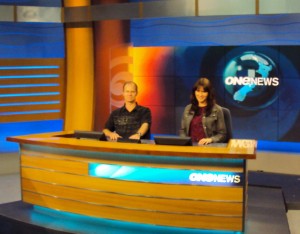
    Last night a friend took us behind the scenes at TVNZ to watch live broadcasts of One News and Channel 7 News. As everyone was too busy partying they threw us in to anchor at the last minute. No one noticed – I mean who watches the 6-o’clock news on New Years Eve  anyway right?

    One News

    One News

    Not really…

    Our friend’s sister works at TVNZ; we were just playing on the set after it went to air.

    We finished up the night with a BBQ with friends, drank wine, margaritas and shots of some stuff that tasted like cough syrup (but wasn’t). We conversed, listened to music and then we wandered up the road to watch the Sky Tower’s 3 minute firework display at midnight. How was your New Years eve?

  • View Episode 2 Pacific Viewpoint TV Panel on Abortion & Parental Consent Here (Feat. Madeleine)

    Episode two of the television panel discussion I participated in on parental consent/notification for abortion is now available for viewing online here at Pacific Viewpoint TV. (Episode one can be viewed here).

    Madeleine on Pacific Viewpoint

    The show runs for 30 minutes; in this episode I appear as a panel member (last time I was an audience member). Panelists are host, Setita Millar, Family First’s Bev Adair, National Party MP Paul Hutchison, Reverend Tavale Matai’a, Ula Sangyum, Cushla McNabb and moi!

    Pacific Viewpoint Panel

    A lot of the dialogue made the editing room floor, some of which was frustrating, and the conversation did stray more onto sex education – state v home – but it was still all good.

    NOTE:
    In this footage I make a comment stating I used the pill as a form of contraception. I wish to make it clear that on learning of the pill’s abortifacient properties (this applies to both the mini and combined pills) I ceased using it some years ago.

    As a protestant I have no issue preventing conception. However, the pill permits conception but prevents implantation (often sneakily worded on your pill packet or by your doctor as “preventing pregnancy” where pregnancy is re-defined as beginning at implantation and not conception).  I reject the common protestant argument that because plenty of conceptuses fail to implant anyway it is ok to actually cause that to happen by taking the pill – if you view life beginning at conception this is like saying it is ok to shoot children in 3rd world countries because plenty will die of hunger and disease anyway.