Category: Media

  • Contra Mundum: The Number of the Beast

    The OmenRecently TV3 screened The Omen. This classic horror is a about a boy called Damian who is the predicted anti-Christ and appropriately has the number 666 on his head. This film epitomises how the book of Revelation is understood in contemporary culture; apparently it predicts a future person, the beast or the anti-Christ who will take over the world. Associated with this is the number 666 which is literally inscribed into people’s heads or hands.  I think this pop-theology is mistaken.

    The relevant section in Revelation says:

    And the dragon stood on the shore of the sea. And I saw a beast coming out of the sea. He had ten horns and seven heads, with ten crowns on his horns, and on each head a blasphemous name. The beast I saw resembled a leopard, but had feet like those of a bear and a mouth like that of a lion. The dragon gave the beast his power and his throne and great authority… The whole world was astonished and followed the beast. Men worshiped the dragon because he had given authority to the beast, and they also worshiped the beast and asked, “Who is like the beast? Who can make war against him?” (Rev 13:1-2, 3b-4)

    The text proceeds:

    Then I saw another beast, coming out of the earth. He had two horns like a lamb, but he spoke like a dragon. He exercised all the authority of the first beast on his behalf, and made the earth and its inhabitants worship the first beast … He also forced everyone, small and great, rich and poor, free and slave, to receive a mark on his right hand or on his forehead, so that no one could buy or sell unless he had the mark, which is the name of the beast or the number of his name. This calls for wisdom. If anyone has insight, let him calculate the number of the beast, for it is man’s number. His number is 666. (Rev 13:11,16-18)

    Most English translations mention the number 666, (more…)

  • Christchurch Earthquake

    Matt and I have been getting a lot of emails, facebook messages, etc from our overseas friends in the wake of what appears to be international news that there has been a large 7.1 magnitude (it has been downgraded from the earlier score of 7.4) earthquake in New Zealand – 40 km west of Christchurch to be precise – that has seen a state of emergency declared.

    Map of Christchurch Earthquake EpicentreBeing in Auckland, over 1000 km or 670 miles away from the epicentre, we slept right through it and did not notice a thing. We woke up to full power and everything functioning as normal. It was only the banner stripped across the Saturday morning kids TV program that alerted us to there being anything different about this Saturday.

    We have now heard from most of our friends in Christchurch and everyone seems to be ok, if a little shaken – power outages and water restrictions seem about the worst any of them have personally suffered. Fellow blogger and friend Andy Moore reported on Facebook that his brother’s house collapsed but that his brother is ok. News reports so far report two serious injuries, no fatalities.

    Good sites for up to date news reports:
    NZ Herald
    TVNZ – in addition to news reports, The Herald has a page dedicated to showing photos of the earthquake damage
    TV3
    Stuff
    NewstalkZB

    GeoNet is worth a look too – they have all the specs of the Christchurch earthquake and its aftershocks on their recent earthquakes page.

    We are praying for the people of Christchurch and those working to help them.

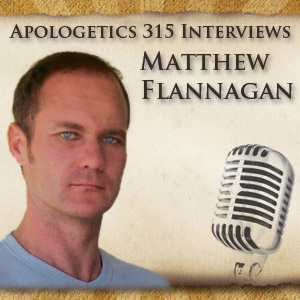
  • Apologetics 315 Interviews Matthew Flannagan on his Contribution to Apologetics

    Apologetics 315, which brings together a variety of apologetics resources including audio, debates, podcasts, book reviews and articles profiling the works of the best apologists in the world, has interviewed Matt as part of their series.

    Apologetics 315 Interviews Matthew Flannagan

    Matt is the first kiwi apologist to be featured in this series and stands alongside

    such contemporary greats as William Lane Craig, Michael Licona, Gary Habermas, Paul Copan, Greg Koukl, Doug Groothius, Doug Geivett, Craig Hazen, Peter Williams, Kenneth Samples, Chris Shannon to name a few.

    The interview is in the form of a half-hour podcast entitled Apologist Interview: Matthew Flannagan. It covers how Matt got into philosophy of religion, the international attention some of his work has received, his upcoming research projects, his upcoming US speaking engagements, his recent debate with Raymond Bradley, his thoughts on the benefit of public debate, the need for reasoned faith and more.

    We’d like to thank our generous supporters who donated the necessary equipment for us to be able to do interviews via Skype.

  • Contra Mundum: Fairies, Leprechauns, Golden Tea Cups & Spaghetti Monsters

    That belief in God is on par with belief in fairy tales is a fairly common charge levelled at Christianity. Highly regarded atheist Philosopher Michael Tooley argues,

    If there is no evidence in support of the existence of God, then it is reasonable to believe that God does not exist. The essential line of thought which I would hope to develop later on is that if you consider other things like fairies, leprechauns, golden teacups orbiting around Venus, and so on, I would suggest that we have no evidence against the existence of those sorts of things, but if I asked you whether you were agnostic I think the answer would be “no.” You would believe there are no fairies, no leprechauns, no golden teacups orbiting around Venus. That illustrates the general principle in regard to God’s existence that the burden of proof must fall upon the person who is arguing in support of God’s existence. If there’s no positive support for it, then the other side wins by default.

    Something like Tooley’s argument regularly features in popular discussions of religion where fairies, leprechauns and golden tea-cups are substituted for flying spaghetti monsters. The basic idea remains the same, to believe in God without providing compelling arguments or evidence for his existence is on par with believing in fairy tales and this is something no sensible, educated, intelligent person can take seriously.

    To address this argument it is first necessary to unpack it. Three separate claims are being made; first, it is assumed that the rational stance to take towards the existence of fairies, leprechauns, orbiting golden tea-cups and spaghetti monsters is not a stance of agnosticism but one of certain denial. Second, it is contended that the reason why this stance is correct is not because we have reasons for believing such things do not exist, but rather that we lack any positive evidence for the existence of these things. Third, the objector assumes that a person who advocates or defends belief in God, in the absence of compelling evidence for God’s existence, has no principled way of distinguishing the case for God from the case for the existence of fairies, leprechauns, et al. Now I grant the first of these claims, it is obviously silly and irrational to believe in things like fairies, leprechauns, orbiting golden tea-cups and spaghetti monsters. The real issue is whether the second and third claims are correct; I will argue that they are not.

    Turning to the second claim that the reason it is irrational to believe in fairies, leprechauns, et al is solely because we lack evidence for their existence and not because we have reasons for thinking that they do not exist. I am inclined to think this claim is false. Consider another claim for which we also lack evidence for thinking is true, that intelligent extra-terrestrial life (ET’s) exists somewhere in the universe. We lack compelling reasons for thinking this claim is true yet it seems mistaken to infer from this that such beings absolutely do not exist, at best all that we can say is that we do not know. Moreover, even in face of agnosticism, many scientists take the existence of ET’s quite seriously; for example, the SETI research site in California spends millions of dollars sending messages into outer space and searching the universe for signs of intelligent life. I note that they do not do the same in pursuit of the search for signs of fairies, leprechauns, orbiting tea-cups or spaghetti monsters and I cannot find any evidence of an agency anywhere in the world that does.

    This example suggests that the reason it is rational to deny the existence of the stuff of fairy tales cannot be simply the lack of positive evidence for these things, if it was we would take the same stance towards ET’s yet we do not. This is because there are important differences between ET’s and fairies, leprechauns, et al over and above the mere lack of evidence we have for their existence. ET’s are the sort of things that could exist even if we lack evidence that they do. ET’s fit with the picture of the world we hold, we know that intelligent life can evolve on planets. This is not the case with fairies, leprechauns, orbiting tea-cups, spaghetti monsters and so on.

    Leprechaun’s first appeared in fairy tales and folklore; in such tales they store their wealth in pots of gold at the end of rainbows. We know that the genre of fairy tales is fantasy. We know rainbows do not have ends in the way this picture envisages. Similarly tea-cups we know are artefacts made by human beings, seeing humans have not been to Venus it is unlikely that such things orbit Venus – even if they are made of gold. It is not just that we lack evidence for the existence of such things but that we have evidence against their existence. What we do know about the world provides us with reasons for doubting they can exist. With ET’s, on the other hand, we have no such reasons for doubting they can exist. Hence, in the latter case agnosticism is justified whereas denial is required in the former case.

    The insinuation that belief in God is on par with belief in fairies, leprechauns, et al is equally questionable. In the case of these things we have no evidence for their existence. With God, however, the situation is different. It is not that no evidence exists; on the contrary, sophisticated and rigorous arguments for God’s existence have been offered and are still being offered in the literature today, it is that experts in the field are divided on the cogency of these arguments. The best that sceptics can suggest is that the evidence is inconclusive. However, even if we grant this, those who defend belief in God can and have offered principled distinctions between God and things like flying spaghetti monsters.

    Two examples will suffice. The first stems from a tradition going back to William James and Blaise Pascal is that when one cannot avoid making a choice, one can act in hope or faith that a belief is true, even if there is no evidence for it, if the expected benefits of the thing hoped for outweigh the benefits of the alternatives. James Jordan provides an example,

    A castaway builds a bonfire hoping to catch the attention of any ship or plane that might be passing nearby. Even with no evidence that a plane or ship is nearby, he still gathers driftwood and lights a fire, enhancing the possibility of rescue. The castaway’s reasoning is pragmatic. The benefit associated with fire building exceeds that of not building, and, clearly, no one questions the wisdom of the action.

    Pascal argued that if one acts on the assumption that God exists and that assumption turns out to be incorrect then one has lost little but if one acts on the assumption that God does not exist and that assumption turns out to be incorrect the one has lost everything. Modified versions of this line of argument are still defended by philosophers today.

    A second reason is that even if one has insufficient evidence for the truth of some proposition, one can be rational in believing it if it is grounded directly in one’s experience. There are plenty of things we believe which are not based on evidence, our belief in the existence in the past or our belief that it is wrong to rape women, our belief that other people exist or that basic axioms of logic are true are not based on arguments or proofs. These things are true because we experience or see them to be true, for example, I remember the existence of a past event, I intuitively conclude that rape is wrong, I observe that other people exist, I see that basic axioms of logic are self-evident. Philosophers such as Alvin Plantinga argue that belief in God is like these beliefs; it is something a person directly sees as true via direct experience or intuition of some sort as opposed to the conclusion of an evidentiary proof.

    I am not in a short article like this going to be able to develop and defend these lines of argument further. I mention them only to show that according to two standard ways of defending belief in God in the face of inconclusive evidence a principled distinction between belief in God and the stuff of fairy tales can be made. People tend to not directly experience or perceive the existence of these things nor does one risk losing everything by acting on the assumption they do not exist. Moreover, if belief in fairies, leprechauns, orbiting tea-cups and spaghetti monsters did possess these features then it is no longer obvious that belief in such beings is irrational. Suppose that instead of there being no evidence for the existence of leprechauns there was in fact some evidence but it was not compelling, perhaps experts were in disagreement. Suppose also that if I failed to act on the assumption that leprechauns existed and it turned out that they did then I would lose everything but if it turned out that they did not I would gain little. In addition, suppose that I directly perceived a leprechaun in front of me or I remembered clearly seeing one a few days ago and I had no reason for thinking my perception or memory was unreliable. If these conditions were satisfied then it would cease to be obvious that belief in leprechauns was obviously irrational. The claim that believing in God is on par with believing in “fairies, leprechauns, golden teacups orbiting around Venus” and flying spaghetti monsters is then unjustified.

    I write a monthly column for Investigate Magazine entitled Contra Mundum. This blog post was published in the July 10 issue and is reproduced here with permission. Contra Mundum is Latin for ‘against the world;’ the phrase is usually attributed to Athanasius who was exiled for defending Christian orthodoxy.

    Letters to the editor should be sent to:
    editorial@investigatemagazine.DELETE.com

    RELATED POSTS:
    Contra Mundum: Secularism and Public Life
    Contra Mundum: Richard Dawkins and Open Mindedness
    Contra Mundum: Slavery and the Old Testament

    Contra Mundum: Secular Smoke Screens and Plato’s Euthyphro

    Contra Mundum: What’s Wrong with Imposing your Beliefs onto Others?
    Contra Mundum: God, Proof and Faith
    Contra Mundum: “Bigoted Fundamentalist” as Orwellian Double-Speak
    Contra Mundum: The Flat-Earth Myth
    Contra Mundum: Confessions of an Anti-Choice Fanatic
    Contra Mundum: The Judgmental Jesus

  • Contra Mundum: Secularism and Public Life

    Legal scholar Stephen Carter stated,

    One good way to end a conversation – or start an argument – is to tell a group of well educated professionals that you hold a political position (preferably a controversial one such as being against abortion or pornography) because it is required by your understanding of God’s will. In the unlikely event that anyone hangs around to talk with you about it, chances are that you will be challenged on the ground that you are intent on imposing your religious beliefs on other people. And in contemporary political and legal culture, nothing is worse.

    Carter puts his finger on an important perspective which is pervasive in contemporary liberal societies. This is the view that citizens of liberal democracies may justly support the implementation of a law only if they reasonably believe themselves to have a plausible secular justification for that law. Further, they must be willing to appeal to secular justifications alone in political discussion. The upshot of this perspective is that it is perceived to be unjust to support or advocate for laws for theological or religious reasons.

    I will refer to this position as secularism, the commitment to the position that the public square should be secular. The secularisation of political culture is, of course, an implication of accepting this position.  Richard Rorty described it as,

    The happy, Jeffersonian compromise that the Enlightenment reached with the religious. This compromise consists in privatizing religion — keeping it out of … “the public square,” making it seem bad taste to bring religion into discussions of public policy.

    My experience as a New Zealand citizen is that secularism is widely held and taken for granted in our culture by media, politicians and popular culture. I also think, perhaps predictably, that secularism of this sort is questionable.

    Let me begin by pointing out that several writers have observed that prima facie there is something unfair or discriminatory about secularism. Contemporary critics of secularism, Christopher Eberle and Terence Cuneo, note that it entails “There is an important asymmetry between religious and secular reasons in the following respect: some secular reasons can themselves justify state coercion but no religious reason can.”

    Another critic, Philip Quinn, observes that secularists impose “burdens on religious people” that they nowhere suggest “imposing on nonreligious people.” Secularists do “not propose that nonreligious people must be sufficiently motivated by adequate religious reason for their advocacy or support of restrictive laws or policies. The lack of symmetry is striking.”

    This raises an obvious question, why the asymmetry? On the face of it secularism appears to privilege secular ideologies and doctrines in public debate whilst relegating religious or theological perspectives to the private sphere.  What is the basis for this? Two reasons are typically offered and neither is terribly compelling.

    The first is that it is dangerous to allow theological or religious concerns into public debate. Defenders of secularism raise the specter of the wars of religion that tore Europe apart during the 17th century or they mention episodes such as the Inquisition and Crusades, which are said to be consequences of allowing religious reasons to influence public and political life. It is argued that the only way to keep social peace and prevent the kind of violence that Europe witnessed is to ensure religious reasons do not influence public life and that all political discussions take place on secular terms.

    This argument assumes that appeal to religious reasons is the cause of religious wars and appeals to secular reasons protect us against such wars. Writing in the Stanford Encyclopedia of Philosophy, Eberle and Cuneo note that the religious wars of the 17th century were caused not by the appeal to religious reasons per se but rather by the violation of religious freedom. Moreover, they note that even in the 17th century, religious persecution was typically justified on secular grounds. They go on to observe that religious freedom is not necessarily safeguarded by secularising public debate. They note that many “secularists have a long history of hostility to the right to religious freedom and, presumably, that hostility isn’t at all grounded in religious considerations” In addition, they note correctly that some of the most important defences of religious persecution and defences of religious tolerance, such as those proposed by John Locke and Pierre Bayle, appealed to explicitly theological grounds.

    Yale philosopher Nicholas Wolterstorff makes a similar point, he notes that much of “the slaughter, torture, and generalised brutality of our century has mainly been conducted in the name of one or another secular cause–nationalism of many sorts, communism, fascism, patriotisms of various kinds, economic hegemony.” He also stated that “many of the social movements in the modern world that have moved societies in the direction of liberal democracy have been deeply and explicitly religious in their orientation.” Wolterstorff cites examples such as the abolitionist, civil rights and various other resistance movements as examples.

    The assumption that secular reasoning is always tolerant and religious reasoning is always intolerant does not survive scrutiny. Particular types of religious reasons in particular political contexts can lead to wars and abuse, whereas appealing to other types of religious reasons in other contexts can be beneficent. The same is equally true of secular reasons. Certain types of secular reasons can be dangerous in particular contexts and other types of secular reasons are not. To single religious reasons out as being ‘too dangerous to be aired in public’ and insisting on a default to secular reasons seems ad hoc and unjustified.

    The fear of religious wars is not the only argument typically offered for the secular public square. The main reason offered for secularism is that religious reasons are not accessible to all people. Auckland Law Professor Paul Rishworth observes, “some have contended that the nature of religious belief is such that, while it may be integral to individual autonomy and development, it has no proper role in public policy debates and that these ought to be conducted exclusively in secular terms that are equally accessible to all.” [Emphasis added]

    Something like this is also evident in defences of secularism. Leading secular Philosopher Michael Tooley states, “For it is surely true that it is inappropriate, at least in a pluralistic society, to appeal to specific theological beliefs of a non moral sort… in support of legislation that will be binding upon everyone.” Robert Audi, one of the leading defenders of secularism, states “as advocates for laws and public policies, then, and especially for those that are coercive, virtuous citizens will seek grounds of a kind that any rational adult citizen can endorse as sufficient for the purpose.” [Emphasis added]  In essence, because not everyone in society accepts the existence of God or some theological perspective on life then it is unjust to base laws governing their conduct on theological or religious grounds.

    This argument is deeply flawed. If taken consistently it would require not just the exclusion of religious reasons but the exclusion of any reasons that were controversial and not accepted by all people. The problem is that many secular justifications and ideologies are also controversial in the same way. Quinn makes the point,

    If the fact that religious reasons cannot be shared by all in a religiously pluralistic society suffices to warrant any exclusion of religious reasons for advocating or supporting restrictive laws or policies, then much else ought in fairness also to be excluded on the same grounds.

    He goes on to note,

    Indeed, it would seem that the appeal to any comprehensive ethical theory, including all known secular ethical theories, should be disallowed on the grounds that every such theory can be reasonably rejected by some citizens of a pluralistic democracy. And if justification of restrictive laws or policies can be conducted only in terms of moral considerations no citizen of a pluralistic democracy can reasonably reject, then in a pluralistic democracy such as ours very few restrictive laws or policies can be morally justified, a conclusion that would, I suspect, be welcomed only by anarchists. [Emphasis added]

    I agree with Quinn. There is special pleading going on whereby theological beliefs are rejected on certain grounds, while secular ones are not, even though the same grounds and reasons, consistently applied, should lead to the rejection of secular beliefs.

    On examining secularism and the main arguments for it, it certainly is not evident that a just or fair society will have a secularised public square. To insist this is the case prima facie seems to favour secular views of the world for no adequate reason. Contrary to what some maintain, secular reasons, like religious reasons, can be used to justify atrocities and human rights abuses. Further, like religious reasons, secular reasons are frequently controversial and not shared by all intelligent people. Of course, secularists might consider religious views of the world to be false but then, of course, religious people consider secular views of the world to be false and given the diversity of secular moral theories on offer they cannot all be true (some are at odds with each other) so why single out religious views? The question remains as to why morality requires that public discussions privilege secular perspectives by requiring that all such discussions are engaged in on secular terms.  I suspect we will be waiting a long time for an answer.

    [In this article I acknowledge being influenced by my wife Madeleine Flannagan’s supervised research paper “Religious Restraint and Public Policy” which she wrote under the supervision of Professor Rishworth, the Dean of the University of Auckland’s School of Law.]

    I write a monthly column for Investigate Magazine entitled Contra Mundum. This blog post was published in the June 10 issue and is reproduced here with permission. Contra Mundum is Latin for ‘against the world;’ the phrase is usually attributed to Athanasius who was exiled for defending Christian orthodoxy.

    Letters to the editor should be sent to: editorial@investigatemagazine.DELETE.com

    RELATED POSTS:
    Contra Mundum: Richard Dawkins and Open Mindedness
    Contra Mundum: Slavery and the Old Testament

    Contra Mundum: Secular Smoke Screens and Plato’s Euthyphro

    Contra Mundum: What’s Wrong with Imposing your Beliefs onto Others?
    Contra Mundum: God, Proof and Faith
    Contra Mundum: “Bigoted Fundamentalist” as Orwellian Double-Speak
    Contra Mundum: The Flat-Earth Myth
    Contra Mundum: Confessions of an Anti-Choice Fanatic
    Contra Mundum: The Judgmental Jesus

  • Contra Mundum: Richard Dawkins and Open Mindedness

    The bold statement “Richard Dawkins opens minds” leaped out at me from the newsletter sitting on the University of Auckland’s Law Library counter. The article went on to sing the praises of Richard Dawkins and mentioned his book The God Delusion. On reading the piece one could be forgiven for concluding that Dawkins’ works are a paragon of the open minded assessment of ideas.

    Now Dawkins is a Zoologist and I, not being a Zoologist, would not presume to assess his work on Zoology. What is interesting, however, is that much of Dawkins’ most famous work is not on Zoology; it is on Theology and specifically Philosophy of Religion. That field of Philosophy which critically analyses religious questions, such as, the veracity of arguments for and against God’s existence. Having some background in these fields I find it a little surprising that an Auckland University publication would contend that his work is open minded because it is evidently not.

    In The God Delusion Dawkins’ main argument against the existence of God alludes to Fred Hoyle’s famous claim that the probability of something as complex as life evolving by blind chance was less likely than a fully-functional Boeing 747 being created by a hurricane blowing parts around in a junk yard. Dawkins writes, “However statistically improbable the entity you seek to explain by invoking a designer, the designer himself has got to be at least as improbable. God is the Ultimate Boeing 747.” Dawkins has made the same line of argument elsewhere “God, or any intelligent, decision-making calculating agent, is complex, which is another way of saying improbable.” In The Blind Watchmaker he argues,

    Once we are allowed simply to postulate organized complexity, if only the organized complexity of the DNA/protein replicating machine, it is relatively easy to invoke it as a generator of yet more organized complexity”. But of course any God capable of intelligently designing something as complex as the DNA/protein machine must have been at least as complex and organized as that machine itself.

    This argument contains three premises. First, that theism (belief in God) is justified by “postulating” God to explain the existence of organised complexity. Second that the God appealed to by theists is complex. Third, that the existence of complex beings are highly improbable. These lead to the conclusion that “God is the Ultimate Boeing 747” and hence “almost certainly does not exist”. The problem with this argument is that all three premises rest on caricatures and misunderstandings of contemporary theology and ignorance of contemporary philosophy of religion. I will explain.

    Dawkins contends that God is postulated to explain organised complexity. There are two problems with this contention. First, Dawkins assumes that God is rationally believed only if his existence is inferred by some kind of argument for the best explanation of a given phenomenon. However, not all beliefs are justified on the basis of some kind of argument of this sort. Our belief in the existence of the past, our belief that it is wrong to rape, our belief that other people exist or that basic axioms of logic are true are not based on inferences to the best explanation. It is not that they are rationally believed because they explain some phenomena better than all alternatives, it is rather that these beliefs are part of the background data that we use to assess proposed explanations against. These things are true because we immediately experience them as true. I have the experience of remembering the existence of a past event. I intuitively perceive that rape is wrong. I experience the basic axioms of logic as self-evident and so on. Such beliefs are called properly-basic beliefs.

    Since the late 1970’s an extremely important movement within Philosophy of Religion, known as the reformed epistemology movement, has offered detailed and rigorous defences of the contention that, for theists, belief in God can be properly-basic. This position has been defended by leading philosophers of religion such Alvin Plantinga, William Alston, Nicholas Wolterstorff, Peter Van Inwagen and others. Now, of course, it is possible that this movement is mistaken but Dawkins surely owes us an argument to this end as opposed to his simply assuming it and ignoring the counter evidence.

    Second, among those theists who do defend God’s existence on the basis of some argument for the best explanation, very few do so on the basis that God explains “organized complexity”. Richard Swinburne, the leading proponent of such arguments, argues that God explains the existence of laws of nature, religious experience, the origin of the universe and the continued existence of the universe. Swinburne does not postulate God to explain “organised complexity”. Similarly, William Lane Craig, a leading defender of theism, suggests that God explains the origin of the universe, the existence of morality and the fine tuning of the laws of nature. Again, Craig makes no appeal to “organized complexity”. In 2009 The Blackwell Companion to Natural Theology was published which contains the most up to date versions of the 11 most definitive arguments used to defend the existence of God in the literature today. Not one of them involves an appeal to “organised complexity”. While the cogency of arguments for the existence of God that do not involve “organized complexity” remains open to substantive debate, it is undisputed that these arguments exist. Dawkins’ picture of God as a postulate to explain organised complexity is a crude caricature of theistic scholarship.

    To be fair Dawkins attempts to address some of these other arguments elsewhere in the book. However, here again much of his writing consists of caricature. He attacks five arguments proposed 800 years ago by Thomas Aquinas as being representative of the current case for theism and completely ignores the vastly more sophisticated and vigorous versions being defended in the literature today. Ironically, Dawkins quite severely misunderstands Aquinas’ arguments and attributes to him a position no Aquinas scholar would accept as accurate. However, even if his account were accurate, critiquing theism by attacking the arguments of one 12th century theologian is a bit like me attacking evolution on the basis of the evidence for it gathered in the 12th century and ignoring any of the scientific developments of the last 800 years. Such ineptitude would not be tolerated in the scientific world and should not be seen as de rigueur just because the topic is religion.

    Dawkins’ second contention fares little better. Dawkins states that “A God capable of continuously monitoring and controlling the individual status of every particle in the universe cannot be simple” this seems to be because,

    The corners of God’s giant consciousness are simultaneously preoccupied with the doings and emotions and prayers of every single human being—and whatever intelligent aliens there might be on other planets in this and 100 billion other galaxies.

    There are several problems here. First, as Craig has noted, this confuses whether what God thinks about is complex with whether God himself is complex. Second, as Plantinga has noted, in The Blind Watchmaker Dawkins states that something is complex if it has parts that are “arranged in a way that is unlikely to have arisen by chance alone.” However, the concept of God employed by most theists is of an immaterial being that does not have material parts so by Dawkins’ own definition God is not complex (unless one assumes that God is a material being but theists almost unanimously maintain that God is an immaterial being).

    This misrepresentation is made all the more pertinent by the fact that for centuries theists have been offering rigorous and sophisticated arguments that God is not in fact complex but is simple. While these arguments may not be successful, Dawkins still needs to actually provide reasons for rejecting them. To simply assert that God is to be conceived in a way that no one conceives Him and to ignore the numerous arguments to the contrary seem more like a child who asserts his position and then puts his hands over his ears and repeats “I am not listening” than it does a serious critical evaluation of another’s position.

    Dawkins’ final contention, that the existence of complex beings is improbable, is similarly confused. Suppose one grants that God is “the Ultimate Boeing 747” and that God’s existence is as statically improbable as the complexity it is invoked to explain. Little in fact follows from this. This is because what is improbable in the Boeing 747 analogy is that the plane came into existence by chance. If God is “the Ultimate Boeing 747” then the conclusion to be drawn is only that it is improbable that God came into existence by chance. This, however, provides us with no reason for thinking that God does not exist. No theist holds that God came into existence by chance, theists hold that God is eternal. Here, again, Dawkins attacks a concept of God nobody holds to and hence is caught jousting with a straw-man.

    On examining Dawkins’ central argument what one discovers is not an open-minded, informed, careful examination of the contemporary debate over the existence of God. Nor does one find a carefully researched assessment of theism. Instead one finds Dawkins simply ignoring what theists mean by God. He ignores how they conceptualise God and ignores the arguments and discussions they have actually made. The theism Dawkins dismisses apparently assumes that God is a material being with parts, that He came into existence by chance and is postulated merely to explain organized complexity. The actual arguments proposed in defence of theism that have been put forward in the literature are not addressed at all.

    Some Auckland University academics might consider such tactics to count as open-minded but I do not. In my view an open-minded honest assessment of religion requires accurately representing what theologians say and teach. It means endeavouring to read and understand their position and offer informed and critical responses to these positions. Ignorance and caricature is not open-minded scholarship.

    I write a monthly column for Investigate Magazine entitled Contra Mundum. This blog post was published in the May 10 issue and is reproduced here with permission. Contra Mundum is Latin for ‘against the world;’ the phrase is usually attributed to Athanasius who was exiled for defending Christian orthodoxy.

    Letters to the editor should be sent to: editorial@investigatemagazine.DELETE.com

    RELATED POSTS:
    Contra Mundum: Slavery and the Old Testament

    Contra Mundum: Secular Smoke Screens and Plato’s Euthyphro

    Contra Mundum: What’s Wrong with Imposing your Beliefs onto Others?
    Contra Mundum: God, Proof and Faith
    Contra Mundum: “Bigoted Fundamentalist” as Orwellian Double-Speak
    Contra Mundum: The Flat-Earth Myth
    Contra Mundum: Confessions of an Anti-Choice Fanatic
    Contra Mundum: The Judgmental Jesus

  • Contra Mundum: Slavery and the Old Testament

    “Why didn’t the Christian God ever explicitly and clearly condemn slavery?” This was John Loftus’ question in his book, Why I Became an Atheist: A Former Preacher Rejects Christianity. He posed it after sharing the following chilling account of slavery as practiced in the antebellum American south,

    He took her into the kitchen, and stripped her from neck to waist. He made her get upon the stool, and he tied her hands to a hook in the joist. After rolling up his sleeves, he commenced to lay on the heavy cow skin, and soon the warm, red blood came dripping to the floor … No words, no tears, no prayers, from his gory victim, seemed to move his iron heart from its bloody purpose. The louder she screamed, the harder he whipped; and where the blood ran fastest, there he whipped longest. He would whip her to make her scream, and whip her to make her hush; and not until overcome by fatigue, would he cease to swing the blood clotted cowskin.

    Loftus is not alone, it is often affirmed as an incontestable and obvious truth that the Bible supports slavery. Atheist philosopher Walter Armstrong substantiated this accusation with a citation from the book of Leviticus, “as for your male and female slaves whom you may have: you may buy male and female slaves from among the nations around you” (Lev 25:44 ESV).

    The ESV here uses the English word ‘slave’ to translate the Hebrew word ebed. The problem is that it is not at all clear that these two terms are analogous. In 1690 philosopher John Locke argued that an examination of the Old Testament’s references to an ebed shows that it is not the equivalent what we think of when we hear the term ‘slave.’ Locke is only one of many scholars who have come to the same conclusion.

    The Oxford Dictionary defines a slave as a “person who is the legal property of another or others and is bound to absolute obedience, human chattel.” Rodney Stark utilises a similar definition, “A slave is a human being who, in the eyes of the law and custom, is the possession, or chattel, of another human being or of a small group of human beings. Ownership of slaves entails absolute control, including the right to punish (often including the right to kill), to direct behavior, and to transfer ownership.” Timothy Keller astutely observes that the English term ‘slave’ carries connotations of new-world slavery as it was practiced in the British Empire and made infamous in the antebellum southern states of the US.

    In the British Empire and in many US states, slavery was governed under the Code of Barbados. This code was explicitly racist and described Africans as “heathenish, brutish, and an uncertaine, dangerous kinde of people.” It allowed owners to use, “unlimited force to compel labor without penalty even if this resulted in maiming or death.” It denied slaves due process rights and permitted owners to, in effect, kill their slave for any cause. It forbade slaves from marrying. It effectively prevented owners from setting their slaves free. Keller writes that, “The African slave trade was begun and resourced through kidnapping.” Stark notes that “20 to 40 percent of slaves died while being transported to the coast, another 3-10 percent died while waiting on the coast, and about 12 to 16 percent boarded on ships died during the voyage.”

    However, what the Old Testament refers to differs from slavery, so understood, in several important respects.

    First, an ebed was not acquired by kidnapping. Kidnapping a human being and selling that person as a slave was a capital offence in the Old Testament (Ex 21:16). Moreover, slave trading is implicitly condemned in the book of Revelation (Rev 18:13) and explicitly condemned by Paul as contrary to the law and sound doctrine (1 Tim 1:9-10).

    In the Old Testament an ebed was usually person who offered to work for another, free of charge, in exchange for a debt being cancelled. It resembled a form of indentured servitude.

    Second, the institution was not based on notions that ebed were of an inferior race. In fact, the opposite is affirmed. In the book of Job we read,

    If I have rejected the cause of my male or female slaves [Hebrew: ebed amah] when they brought a complaint against me; what then shall I do when God rises up? When he makes inquiry, what shall I answer him? Did not he who made me in the womb make them? And did not one fashion us in the womb? (Job 31:13-15)

    Here Job refers to an ebed as having a right to go to court and sue his or her “owner” in pursuit of his or her rights. Job bases this on the idea that both he and his ebed are equal, both are created by God.

    Third, as Locke noted, an ebed was not the property of another and could not be disposed of. To deliberately kill an ebed was a capital offence (Ex 21:20-21). Similarly, it was illegal to strike an ebed (Ex 21:26-27).

    However, some dispute this latter point on the basis of Exodus 21:20-21,

    If a man beats his male or female slave with a rod and the slave dies as a direct result, he must be punished, but he is not to be punished if the slave gets up after a day or two, since the slave is his property.

    Some interpret this passage to mean that because a “slave” is the property of another they can severely beat the slave and providing the beating is not fatal, there is no legal punishment. However, this fails to deal adequately with the context and the Hebrew text, the word translated as ‘property’ here is actually ‘silver’ (a reference to money) and the word translated ‘punishment’ here is not the usual word for punishment.

    Old Testament scholar Christopher Wright notes that the word implies “the shedding of the blood of the master of the slave” and so refers to capital punishment. It is used in direct contrast with the same word in the previous verse where it is stated that deliberately killing an ebed is to be avenged. Therefore, it does not say the person will not be punished for beating a slave, it says he will not be executed for it unless he kills the slave. For further evidence that the passage is not a license to beat, a couple of verses later even causing a minor injury on an ebed, such as a bruise, is explicitly condemned. The same contrast occurs in the passage immediately preceding where a free man who struck and killed another was to be “held responsible” but not if the person survived. It is clear, however, that the person was in fact to be legally punished as v 19 states he had to compensate his victim for the injury. Hence, in context the ‘held responsible’ is referring only to being held responsible for murder and is not speaking to the lesser charges of assault. What Ex 21:20-21 says then, is that if a person deliberately kills his or her ebed then that person is to be held responsible for murder and executed. If the slave “gets up after a day or two,” then the person is not to be held responsible for murder because the ebed is his or her “silver.”

    This makes sense as a few verses later, in Ex 21:26-27, striking a slave is explicitly prohibited and the legal punishment is for the ebed to go free. In The Old Testament, the penalty for assault was for the assailant to provide monetary compensation to the victim. This would create a quandary in this case as an ebed is in a position of servitude because he or she is in debt to the person he or she works for. In such a case the assailant would owe money to a person who owes him or her money. The Old Testament resolves the issue by declaring that even a trivial strike, such as causing a bruise (v21:25) should result in an immediate cancelation of the ebed’s entire debt, which would often result in a financial loss to the assailant. The New Testament similarly concurs, prohibiting “masters’ from even threatening their “slaves” (Eph 6:9) and to treat their “slaves” the way the “slave” is required to treat them.

    Further, unlike new-world slavery which was life long and where, under the Barbados Code, emancipation was effectively prohibited, an ebed could not be held in service for more than six years (Ex 21:2). Upon release, their employer was morally required to give them sufficient resources for them to be set up on their own feet (Deut 15:12-18) and the community left resources for them to live on for a year (Ex 23:10-11, Lev 25:2-7).

    These passages are often thought to refer only to Hebrew and hence Jewish slaves. Wright, however, argues that that in its original context the key word ibri designated a social class, not an ethnic group. This was the class of people who did not own land and in an agrarian economy survived by hiring themselves out to land owners.

    In fact, in the passage immediately before the verse Armstrong cites the Old Testament forbids any Israelite taking another Israelite as a ebed on the grounds that they are a “ebed of God” whom God has redeemed. Paul applies the same teaching to Christians prohibiting Christians from being sold as ‘slaves’ (1 Cor 7:23). Similarly, the Old Testament commanded people to prevent family members from becoming an ebed by paying their debts for them (Lev 25:48). Further, Paul, after writing to the Corinthians and encouraging them to “retain the place in life that the Lord assigned,” encourages slaves to purchase their freedom and to not remain in this position if it was possible to do so (1 Cor 7:21-22).

    Finally, if an ebed fled from an oppressive employer it was illegal to return him or her to “his master.” Instead, he or she was to live “wherever he likes and in whatever town he chooses” (Deut 23:15-16). It was forbidden to send an ebed back to his or her owner; contrast this with the practice in the antebellum south, the Fugitive Slave Act 1850 required the return of run-away slaves at penalty of law.

    Contrary to what some contend, the Old Testament does not permit slavery. It is more accurate to say it tolerates indentured servitude under certain situations; the paradigm being where the servitude is voluntary, temporary, is done in exchange for payment of a debt where the alternative is starvation and destitution and only in situations where the servant is given the same basic legal rights as everyone else and is protected from abusive treatment. To suggest this picture fits with the opening quote above is a stretch to say the least.

    I write a monthly column for Investigate Magazine entitled Contra Mundum. This blog post was published in the April 10 issue and is reproduced here with permission. Contra Mundum is Latin for ‘against the world;’ the phrase is usually attributed to Athanasius who was exiled for defending Christian orthodoxy.

    Letters to the editor should be sent to: editorial@investigatemagazine.DELETE.com

    RELATED POSTS:
    Contra Mundum: Secular Smoke Screens and Plato’s Euthyphro

    Contra Mundum: What’s Wrong with Imposing your Beliefs onto Others?
    Contra Mundum: God, Proof and Faith
    Contra Mundum: “Bigoted Fundamentalist” as Orwellian Double-Speak
    Contra Mundum: The Flat-Earth Myth
    Contra Mundum: Confessions of an Anti-Choice Fanatic
    Contra Mundum: The Judgmental Jesus