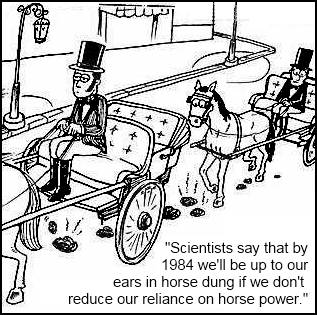
 One of the most destructive carnards concreted into the mind of greenism and environmentalism is the proposition that natural resources are fixed, finite, and limited. Once gone, they are gone forever. Therefore, conservation of said resources is a moral imperative.
Statists warm to this proposition reflexively, that is, without thinking. To conserve on a grand scale requires big government: to regulate, limit, control, restrict, order, prescribe, proscribe, and ban. Without such a big intrusion into the lives and endeavours of citizens, disaster will fall upon the entire race. Therefore, statists join the moral crusade. Advocating for big-brother government suddenly makes one morally good. Saving the planet and saving humanity has a nice moral ring to it, making big government itself a moral imperative.
Socialists likewise find the proposition of limited resources needing to be conserved a convenient doctrine. It justifies pre-emptive property rights of the state over private citizens. It also gives moral cover to advocating for more government taxation and expropriation to fund things like “green industries” and “green energy”. You just have to take a glance at President Obama’s “new” energy strategy. Instead of “drill, baby drill” it is “spin, baby, spin”, referring of course to the windmills he is spending billions of dollars worth of citizen’s property to manufacture and deploy.
So, we have the ideological Grand Coalition of our times: greenists, environmentalists, statists, and socialists. Ladies and gentlemen put your hands together for “the Left”.
There is one small problem. This monumental intellectual and political construction is built upon a simple fallacy, known as the fallacy of composition. It beggars belief that in a world self-proclaimed to be so smart and so rational that the very same wise-in-their-own-estimation are actually operating with a grand intellectual and political edifice built on more swamps than Christchurch, or more volcanoes than Auckland.
The fallacy of composition assumes or asserts that the attributes of the parts must sum to the attribute of the whole. In this case, since each specific natural resource is clearly finite, natural resources as a whole must, therefore, be finite. Once you explode this childish error (more…)