Category: Political Philosophy

  • Religious Restraint and Public Policy: Part I

    In this series I set out the doctrine of religious restraint, the idea that in a pluralistic, liberal, society religious beliefs should not be utilised in the formation of public policy. I note that this doctrine entails an asymmetrical treatment of religious and secular beliefs, which appears to conflict with the central notion of liberal democracy that all people are equal and that the state should be neutral in respect to different conceptions of the good. I examine several key arguments in support of the doctrine and some defences of this asymmetry. I argue these arguments are subject to numerous difficulties and the asymmetry appears arbitrary and unjustified.

    As far back as the birth of liberal democracy commentators have proposed various forms of epistemological restraint on the nature and extent of the justifications offered for coercive laws. Justification is important because central to the concept of liberal democracy is the notion that all people are free and equal. Broadly speaking, the state must accord equal protection to all who come within its territory. Public policy must allow people equal freedom to live their lives as they see fit. Every adult must have an equal voice in the governance of society through the democratic process. Charles Larmore sums this up,[1]

    The familiar constitutional rights of free-expression, property, and political participation, though no doubt serving to promote the goal of democratic self-rule, also have an independent rationale. They draw upon that most fundamental of individual rights, which is the right [of every person] to equal respect.

    A diversity of beliefs, views and religions flourishes as people avail themselves of these liberties and come to different understandings about life, the world they live in, the meanings and purposes thereof. The fact of this plurality invites an important corollary to the concept of liberal democracy, typically formulated as the idea that the state must remain neutral with respect to the different religions and comprehensive viewpoints present within society.

    This is not to say that the state must hold that all views are equally true, just or good. Likewise, it is not a requirement that the state must adopt the incoherent stance of affirming (as a truth) that there is no such thing as truth. Nor that it should not concern itself with injustice or deleterious conduct. What is meant by this requirement is that, as a body that exists to serve the people, it is not the state’s role to rule on what is or is not the correct philosophy, worldview or religion; each person must be free to determine this. The state being neutral in this way shows equal respect for the freedom of all people.

    When state neutrality is conjoined with the concepts of all people being free, equal and worthy of respect, it follows that coercive legislation needs justification. If people are worthy of respect then there exists a prima facie presumption against state coercion. A commitment to state neutrality entails that justification must be drawn from neutral grounds. I will refer to this view of liberal democracy as “the standard view.”

    Common to almost all versions of the standard view is some form of restraint on religious reasons being offered as a form of justification. Richard Rorty, alluding to Jefferson’s famous reference to a wall of separation, describes this as [2]

    the happy, Jeffersonian compromise that the Enlightenment reached with the religious. This compromise consists in privatizing religion — keeping it out of … “the public square,” making it seem bad taste to bring religion into discussions of public policy.

    The doctrine is more than just a restraint on religious reasons; Nicholas Wolterstorff expounds further;[3]

    Definitive of the position is a negation at this point: citizens (and officials) are not to base their decisions and/or debates concerning political issues on their religious convictions. When it comes to such activities, they are to allow their religious convictions to idle. They are to base their political decisions and their political debate in the public space on the principles yielded by some source independent of any and all of the religious perspectives to be found in society. … The source must be such that it is fair to insist that everybody base his or her political decisions, as well as public political debates, on the principles yielded by that source.

    Paul Rishworth writes, “some have contended that the nature of religious belief is such that, while it may be integral to individual autonomy and development, it has no proper role in public policy debates and that these ought to be conducted exclusively in secular terms that are equally accessible to all.”[4]

    Christopher Eberle and Terence Cuneo refer to this position as the doctrine of religious restraint (DRR) that they define canonically as[5]

    The DRR: a citizen of a liberal democracy may support the implementation of a coercive law L just in case he reasonably believes himself to have a plausible secular justification for L, which he is prepared to offer in political discussion. [Emphasis original]

    Eberle and Cuneo explain the implications of the DRR, “if a citizen is trying to determine whether or not she should support some coercive law, and if she believes that there is no plausible secular rationale for that law, then she may not support it.”[6]

    I           The Doctrine of Religious Restraint

    As Wolterstorff identifies in the quotes above, the restraint is negative; justifications for coercive laws must not be religious. The extent and nature of the independent source that acceptable justifications may be drawn from varies depending on which advocate one reads; all agree that a coercive law must be able to be justified by a plausible secular justification if it is to be neutral.

    Defenders of the DRR claim that it need not be codified. It is a moral requirement upon people regardless of their role within society; some form of censure rather than legal stricture is what is suggested. Rorty reflects this when he refers to it being “bad taste” to bring religion into the public square. Stephen Carter puts it clearly;[7]

    One good way to end a conversation – or start an argument – is to tell a group of well educated professionals that you hold a political position (preferably a controversial one such as being against abortion or pornography) because it is required by your understanding of God’s will. In the unlikely event that anyone hangs around to talk with you about it, chances are that you will be challenged on the ground that you are intent on imposing your religious beliefs on other people. And in contemporary political and legal culture, nothing is worse.

    There is an asymmetry present in most versions of the DRR; state coercion can be justified by some secular justifications but it can never be justified by religious justifications. In reviewing a definitive defence of the DRR advanced by Robert Audi, Philip Quinn observes;[8]

    These principles impose burdens on religious people that Audi nowhere suggests imposing on nonreligious people. … Audi does not propose that nonreligious people must be sufficiently motivated by adequate religious reason for their advocacy or support of restrictive laws or politicise. The lack of symmetry is striking.

    Eberle and Cuneo, in their discussion of the DRR, note the same asymmetry;[9]

    There is an important asymmetry between religious and secular reasons in the following respect: some secular reasons can themselves justify state coercion but no religious reason can. This asymmetry between the justificatory potential of religious and secular reasons, it is further claimed, should shape the political practice of religious believers. According to advocates of the standard view, citizens should not support coercive laws for which they believe there is no plausible secular rationale, although they may support coercive laws for which they believe there is only a secular rationale.

    Not surprisingly, the DRR is controversial despite its current orthodoxy. Religious believers are required to omit beliefs they understand to be true or hold as important when they grapple with public policy. Stephen Carter captures the sentiment well when he labels this “the separation of church and self.”[10] Yet defenders of the DRR maintain that some form of religious restraint is not only in accord with the notion of liberal democracy but essential to it, as Rorty puts it, “we shall not be able to keep a democratic political community going unless the religious believers remain willing to trade privatization for a guarantee of religious liberty.”[11]

    For the DRR to be as pervasively held in the literature, in society generally and within religious-freedom jurisprudence there must exist good reasons as to how the DRR does uphold the concepts of equal protection, freedom, voice and neutrality in spite of the charges critics level against it.

    In my next posts in this series, Religious Restraint and Public Policy: Part II, I will look at some of the arguments for the doctrine of religious restraint. These are mostly variants of appeals to respect (such as the golden rule, epistemic inaccessibility) or arguments around the dangers of religion.


    [1] Charles Larmore quoted in Michael J Perry Under God? Religious Faith and Liberal Democracy (Cambridge University Press, New York, 2003) 36.
    [2] Richard Rorty “Religion as a Conversation-Stopper” (1994) 3:1 Common Knowledge 1, 2.
    [3] Nicholas Wolterstorff “The Role of Religion in Decision and Discussion of Political Issues” in Nicholas Wolterstorff & Robert Audi (eds) Religion in the Public Square: The Place of Religious Convictions in Political Debate (Rowman and Littlefield Publishers Inc, Lanham Md, 1997) 67-120, 73.
    [4] Paul Rishworth “Freedom of Thought, Conscience, and Religion” in Paul Rishworth, Grant Hushcroft, Scott Optican and Richard Mahoney (eds) The New Zealand Bill of Rights (Oxford University Press, Melbourne, 2003) 277-307, 279.
    [5]
    Christopher J. Eberle and Terence Cuneo “Religion and Political Theory” (2008) Stanford Encyclopedia of Philosophy (at 9 August 2009).
    [6]
    Ibid.
    [7]
    Stephen Carter The Culture of Disbelief: How American Law and Politics Trivialise Religious Devotion (Basic Books, New York, 1993) 23-24.
    [8]
    Philip Quinn “Religion in the Public Square: The Place of Religious Convictions in Political Debate” (2000) 60:2 Philosophy and Phenomenological Research 486, 487 (book review).
    [9]
    Eberle and Cuneo, above n 5.
    [10]
    Carter, above n 7, 1.
    [11]
    Rorty, above n 2, 3.

    This series was written as a supervised research paper in pursuit of my LLB. I am very grateful to a number of people who personally encouraged me, gave feedback, recommended  resources  or were good enough to supply me with their own – particularly my supervisor, Paul Rishworth; philosophers: Glenn Peoples, Lydia McGrew, Alexander Pruss, Francis J Beckwith, Nicholas Wolterstorff and my husband, Matthew Flannagan.

    RELATED POSTS:
    Religious Restraint and Public Policy: Part II
    Religious Restraint and Public Policy: Part III
    Religious Restraint and Public Policy: Part IV
    Religious Restraint and Public Policy: Part V
    Religious Restraint and Public Policy: Part VI
  • The 2009 Forum on the Family: A Review

    On Friday Madeleine and I attended the Forum on the Family and the following is our long awaited (and long) review of it.

    The Forum kicked off with an impassioned talk from Bev Adair. Bev gave a harrowing account of her own story of childhood physical and sexual abuse and subsequent encounter with God that transformed her life and character and enabled her to break the cycle in her own life, heal and bring her own experience into her work with the Family and Child Trust. She stressed that the solution to child abuse was that people stopped blaming others or their social context for what happens to them; that they must cease demanding solutions from the state and being reliant on welfare; she called for individuals and communities to take responsibility for their own actions and for an end to the silence; abuse is not invisible, people who see it must act. Bev stated that voluntary organisations that were not funded by the state were doing some of the most effective work in the community and the consensus from them was that poverty does not make people hurt their children, she pointed out that countries with real poverty don’t brutalise their children or have stats like New Zealand’s.

    What was interesting was that later in the program the children’s commissioner, Dr John Angus, gave a much drier facts and figures type talk that reinforced what Bev stated. Relying on data compiled by CYFS, Angus noted that abuse tended to be more correlated to drug and alcohol abuse than poverty and that while reports of child abuse are on the increase, the actual cases are not. Like Bev he also suggested that the solutions were at the family, individual and community levels as opposed to government. Angus noted that one of the biggest problems was that when people were worried about a friend or family member’s conduct they rang CYFS rather than actually confronting or addressing it at a family level. Angus argued that real progress is made when families and communities own the problem and openly confront the issues family members face and offer constructive help instead of just looking to the state. It was at this family/community level, that real change can be made.

    In contrast to this, Labour Leader Phil Goff gave a speech about how poverty and economic hardship were the key issues in child abuse. Goff spoke of the need for a society where no children missed out on health care, education or basic necessities due to economic deprivation. He noted the historic Christian motivation behind the original welfare policies of Labour and suggested a need for all parties to work towards helping families in need. While I am not generally a fan of Labour, it is hard to dispute Goff’s claim that we should work towards having a society where no child misses out on basic necessities due to poverty and God clearly would want Christians should to be committed to achieving such a society, that said, none of this speaks to the question as to how this should be done and what the just and appropriate means of bringing it about are (I have discussed the issue of sustenance rights in a previous post). In the Q&A when I questioned Goff further on this he made it clear that he specifically saw this support as primarily coming from the state and not from the voluntary sector on the grounds that “the state has the money.” (Ironically Goff also justified high taxes on the grounds that it was needed for the state to play this role making his position somewhat circular.) These criticisms aside, Goff is to be commended for being the first Labour leader to front up and address the Forum on the Family and for attempting to build bridges with conservative Christians instead of trying to “marginalise them out of existence.”

    One unfortunate feature of Goff’s talk was the focus in the Q&A on the smacking issue. Goff suggested this was a side issue, not as important as child abuse and that people should focus their energy and passions on more important issues. That is, of course, correct and the fixation by members of the audience on this issue did seem disproportionate. However, at the same time, as members of the audience noted, a large number of the audience were from voluntary organisations that were dealing with domestic violence and child abuse at the coal face; hence, the suggestion they were not addressing this or were not as committed to these issues is inaccurate. Moreover, opponents of the current s59 of the Crimes Act had repeatedly told Labour that laws about smacking had nothing to do with child abuse in the past. Proponents had justified the decriminalisation of reasonable force for the purposes of parental correction on the grounds that it would help to stop child abuse and some had, in fact, equated smacking with child abuse. The previous Labour government’s support of this line of argument was the reason that there was now a Bill before the house, John Boscawen’s Crimes (Reasonable Parental Control and Correction) Amendment Private Member’s Bill. So for Phil Goff to now claim now that concern around s59 was a side issue and the question of child abuse was a different, more important issue that Labour was deeply committed to was more than a tad disingenuous, which is what evoked the scathing (and justified) attack from Christine Rankin that David Farrar referred to on his Facebook page.

    Moreover, with a Bill before the house, Labour really do need to take a stance; it is fine to say s59 is not their main focus but when the bill is actually put before them they will need a position. Their opinion on the now, apparently separate and unrelated to light smacking, issue of child abuse, while commendable, is not what they will be asked to vote on. When Madeleine pressed Goff on this he stated that Labour will be voting against Boscawen’s Bill.

    Not all the speakers spoke on child abuse and s59, Greg Fleming, CEO of the Maxim Institute, gave a good talk entitled “Right Wing, Left Wing. What Does it Mean? Does it Matter?” Fleming made essentially three points; first, he noted that the terms ‘right wing’ or ‘left wing’ often function as labels that are used to pigeon hole or brand a person so as to summarily dismiss their position without actually addressing it or considering its merits. Fleming’s contention that such dismissals often reflect a kind of unjustifiable intellectual laziness is undoubtedly correct and occurs far too often.

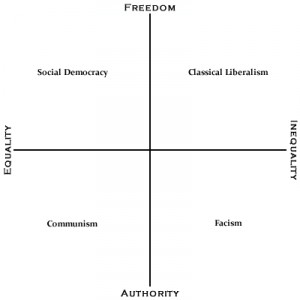
    Political SpectrumFleming’s second point was to suggest that the labels ‘left’ and ‘right,’ when understood correctly, do have a useful descriptive function in highlighting where a person sits on a particular spectrum. For Fleming, this spectrum constituted a horizontal axis whereby equality was at one end, the left and inequality at the other, the right. In addition to the horizontal left-right spectrum is a vertical spectrum with freedom at the top and authority on the bottom. These axes lead to communism being on the bottom left, totalitarian authority to maximise equality; fascism on the bottom right, totalitarian authority to maintain inequality; social democracy on the top left, limited government focused on achieving equality; finally, classical liberalism on the right, limited government for the sake of maximising individual freedom.

    One criticism I have of this is that (more…)

  • A Review of Last Night’s Boscawen, McCoskrie, Evans, Baldock Meeting UPDATED

    Last night’s meeting with John Boscawen, Bob McCoskrie, Jim Evans and Larry Baldock on amending s59 of the Crimes Act to decriminalise the use of reasonable force for the purposes of parental correction was encouraging. The main themes I came away with from each speaker were:

    John Boscawen – ACT Party MP
    John Boscawen has not given up on his Bill and will use the time between now and 15 October 09, the date he expects his Bill to go to first reading, to rally support for it. He needs us to keep the issue live. So commenters, keep commenting; bloggers keep blogging. Everyone keep the pressure on the MP’s, especially the Nats  and everyone keep an eye out for public meetings as John travels around and turn up to them with friends – we want the media to be able to report that there are bums on seats everywhere he goes in support of this Bill.

    Despite John Key’s refusal to act, keep in mind that MP’s feel political pressure, they are human beings, they are not immune to it.

    Jim Evans – Emeritus Professor of Law at the University of Auckland
    Professor Evans confirmed that the dominant purpose of any act of force in the course of parenting cannot be correction. He spoke of his concern for the danger to the rule of law caused by reliance on police discretion for acts that are clearly criminal. He said it might be one thing for the police to exercise discretion over issuing a traffic fine but when it comes to criminal acts it is not an adequate solution. If you have a situation where conduct that should not be criminal in fact is then the solution is not to just not prosecute but to change the law.

    Highlighting Fitzgerald v Muldoon [1976] 2 NZLR 615 (NZSC) he spoke of the legal principle that required this contained in the Bill of Rights Act 1689, Article 1, which provides:

    “That the pretended power of suspending of laws or the execution of laws by regal authority without consent of Parliament is illegal.”

    Essentially this means that only parliament can change the law and it must make a statute to do so. Professor Evans pointed out that being governed by discretion, as opposed to law, makes it impossible for one to stand on the law.

    Bob McCoskrie – Family First
    Bob spoke on research on the real causes of child abuse and called for more action on that.  Not one, even those done by the likes of UNICEF, CYFS and the Children’s Commissioner, cited smacking as a cause.  I support this research and action being done but not by government.

    He also put up some excellent quotes:

    John’s Key speaking on Radio Live on 4 Sept 09 at 11:40 am to Michael Laws:

    “It’s a complete and utter dog’s breakfast – let’s acknowledge that”, that it’s badly drafted, “extremely vague”, and “we believe the Borrows amendment was the right place to settle.”

    Hat tip: S59Blog, Voxy

    [I won a chocolate bar at the meeting for knowing who said that – it was very nice]

    Sue Bradford’s contradictory and confusing statements on the law;

    Will ban smacking: “Greens draw up their own anti-smacking bill”

    Won’t ban smacking:
    Sue Bradford: “It won’t be legal but that won’t mean…
    Barry Soper (interviewer): “So it’s banning smacking.”
    Bradford: “No it’s not”

    Smacking is banned: “Ms Bradford says parents need to accept that it is no longer legal to hit children.”

    Smacking isn’t banned: “Smacking has never been a criminal offence, and still isn’t”

    Smacking already banned: “it is already illegal to smack children but her bill removes a defence of reasonable force for the purpose of correction.” (March 2007)

    There is no such law:
    “There is no specific law relating to smacking on New Zealand’s statute books. People like Mr McCoskrie have fostered a myth that what has happened is that a new law has been created that specifically outlaws smacking. This is simply not true.”

    Smacking bill won’t help: “The epidemic of child abuse and child violence in this country continues – sadly. My bill was never intended to solve that problem.” (National Radio – 21 Dec 07)

    Sue Bradford attempts to explain the effect of the anti-smacking law to National Radio’s Sean Plunket (18 June 2009) – click here to listen [or read Dave Crampton’s summary of the interview.]

    Sue Bradford says it’s not a decision that should be left to the people – watch her on YouTube.

    Hat tip: Vote No

    A great one by former Labour Prime Minister Michael Moore (not the faux-documentary maker) in the Herald,

    The expensive, puerile, futile controversy over the ill-considered anti-smacking legislation is a monument to political cowardice and opportunism.

    Hat tip: Big News, Contra Celsum

    [Many thanks to the readers who sent these quotes to me; I have had a very bad run with pain lately and sitting through the meeting on hard plastic chairs was really difficult and I was paying for it yesterday which is why I did not hunt them down myself.]

    Larry Baldock – Kiwi Party
    Larry spoke of his plans to promote another referendum; a non-binding referendum to ask the question “should Citizens Initiated Referenda seeking to amend or repeal a law be binding?’ He asked for people to sign up to help promote it, once it is approved by the Clerk of the House.

    I did not sign up and will not help to promote it.

    Direct democracy is a flawed concept. Legislating is a skill, it is not something that every person is capable of. This is why we must take care to elect skilled and capable and ethical people to parliament when we vote. We elect them to consider the issues, all of them and wisely legislate on our behalf. They should listen to the people but democracy is not mob rule, it is not and should not constitute bowing to the will of the majority. The majority can and have and continued to jump on the wrong bandwagons; the majority once supported slavery, circuses in Rome, they elected Hitler to power and in New Zealand if we held binding referenda today abortion on demand and the removal of the defence of provocation would fly through – positions that are wrong (see here and here respectively) that are held on the basis of knee-jerk emotionalism instead of reason.

    Much philosophical literature has been written over the centuries against direct democracy.  If I have not convinced you, read some before you sign your name to Larry’s petition or agree to help promote it.

    I agree with Larry’s frustrations, I agree there is a massive problem with our political system in New Zealand but the solution is that we need an upper house. An upper house vets legislation sent up by the lower house. It is typically elected by a different system so you get quite a different makeup. Essentially it means that all legislation gets a second look by skilled, knowledgeable eyes, gets re-debated, amended and tweaked before it becomes law. This is a far better safeguard that the option to call a binding referendum where only a vague conception can be communicated to parliament in the form of the referenda question to which one can only offer a yes or a no. A bill still has to be drafted in response to a binding referendum and who gets to write that or determine how much it is in line with the referenda question?

    If Larry’s petition was a clearly worded call for an upper house I would be behind him completely.

    UPDATE:
    You Tube videos of the speakers are here.

  • Maori and Pakeha are Not Partners to the Treaty of Waitangi

    [For the benefit of our international readership: Maori are the indigenous people of New Zealand; Pakeha is a term used to describe Caucasian New Zealanders; The Treaty of Waitangi is a significant founding document of our nation over which many historical and current differences have arisen around its role, interpretation and application.]

    Recently I read a document that stated, “This institution seeks to honour the partnership between Pakeha and Maori that is laid down in The Treaty of Waitangi.” I have seen this type of statement numerous times before in the mission statements of many different kinds of New Zealand institutions. I think this claim is nonsense. Below I will argue why.

    At the heart of this kind of statement is the notion that The Treaty of Waitangi (The Treaty) constitutes a partnership between Maori and Pakeha; Maori and Pakeha apparently entered into an agreement which contains mutual obligations.

    The problem with this claim is that only persons can enter into contracts. Persons are either rational self-conscious agents, such as adult human beings or legal persons which are an organisation of rational agents into an institutional structure of some sort. One cannot enter into a contract with concrete objects that are not persons such as rocks or trees; nor can one enter into contracts with abstract objects such as the colour blue. One would have thought this was an obvious point which did not need pointing out.

    ‘Maori’ and ‘Pakeha,’ however, are not persons. Individual Maori people and individual Pakeha people are persons, and individuals of either race can organise themselves into an institution which will have a legal personhood separate from their own individual personhood, but the racial groups ‘Maori’ and ‘Pakeha are not persons.

    The term Pakeha is an abstraction, it is simply a reference to an aggregate of individuals who share a particular genetic trait. It is false that everyone who has these genetic traits signed The Treaty. In fact, as The Treaty was signed in 1840, no individual alive today signed The Treaty. It is equally false that simply because someone with the same genetic traits as me at some point in history signed a treaty that it follows that all members of my race signed a treaty.

    What is accurate is to say is that two institutions entered into an agreement, the Crown and various Maori tribes. No Pakeha individual can be identified as the crown and no Maori individual can be identified as a tribal group unless the individuals are acting in an official capacity as the agent of these institutions. Hence, no Maori or Pakeha individual is bound by The Treaty; no individual is responsible or culpable for breeches of The Treaty.

    Someone might object that the Crown being the head of a representative government acts on behalf of all Pakeha and hence, Pakeha can be said to have entered into a partnership via The Treaty. I think this claim is mistaken. It assumes that whenever a government performs an action one can attribute the actions of the government to any and all private citizens of that government.

    This error is precisely the error we condemn when terrorists target a civilian population. When terrorists target non-combatants they assume that because a government has unjustifiably committed aggression against them that it follows that the citizens of that government can be attacked. The principles of non-combatant immunity, however, deny this. If a state engages in aggression then the military personal who act as the state’s agents can be attacked but citizens who are not acting as agents for the state cannot be. They are innocent third parties.

    Maori and Pakeha, therefore, did not enter into a partnership at the time of The Treaty was signed, and private individuals from either race have no obligations to each other under The Treaty. To suggest they do is to commit the error of attributing personhood to racial groups as opposed to individual members of that group. It suggests that the actions of one person who has a particular genetic trait can be attributed to everyone who has that trait. The implication of this is that whenever a Maori gang member commits a crime one could justly claim that ‘Maori’ committed the crime. This is of course racist and would justifiably be condemned in any other context. It should equally be condemned in the context of discussions over The Treaty of Waitangi.

    Of course this is not to say that Pakeha and Maori individuals do not have duties to each other. The normal duties to not steal from each other or vandalise each others property, to refrain from rape and assault, etc still apply. These apply because these are general duties laid down by God. I am not bound to fulfil them because some other person signed a contract with a third party. Moreover these have nothing to do with race. I have a duty to not steal from a Maori individual because I have a duty to not steal from any human being. The duty would hold whether the person in question was Maori, Chinese, Persian or Tongan. The duty has nothing to do with a historical event in 1840.

    Nor are my comments meant to deny that one party to The Treaty was treated unjustly and unfairly by the other. There is probably good historical evidence that they were. My comments simply point out who the parties in question are. They are not Maori and Pakeha. They were the Crown and certain Maori groups.

    By all means let’s have a discussion about what the Crown should do to honour its obligations under The Treaty. I have no problem with the idea that a state should keep its obligations to other states and parties. I have no problem with the idea that government should both protect and respect the property rights of its citizens regardless of their race. I also have no problem with courts demanding the state compensate its victims if it can be proven in a court of law that the state has not done these things – one of the insidious features of the former government was its continual rejection of these principles. But stop suggesting that Maori and Pakeha are “partners” under The Treaty and that they and private individuals have obligations under it. They do not. As Dr Martin Luther King said, individuals should be judged by the content of their character not the colour of their skin.

  • Moral Issues and Direct Democracy

    I have been involved in a discussion over at MacDoctor Moments on various aspects of the abortion debate, though in this post I don’t want to talk about that issue. In the course of this discussion Chuck advocated for a policy of direct democracy to decide moral issues and it is this that I want to explore.

    Before addressing direct democracy I want to look at the term “moral issue.” Which issues are moral issues and which are not? What do people mean when they say this? Every piece of legislation is a moral issue to some extent. When legislators pass laws they have the power to restrict people’s freedoms or impose obligations and they have the state to back up these expectations with force for non-compliance. The question as to whether or not they should pass such laws is always a moral one because prima facie it is wrong to coerce others by force. Of course there may be instances were the state is justified in making a particular legislative move but to say that the state is justified is to make a moral claim.

    Those who refer to some issues as moral ones and others not, tacitly assume that unless one is talking about sex or something typically associated with moral conservatism the legislation the state passes is not moral. This is a very truncated view of what a person’s moral obligations are.

    Parliament has a standing practice of not using whips and allowing conscience votes on matters of “moral legislation.” There is something almost machiavellian about this because it suggests that governing is an a-moral exercise; that on most issues either an MP’s conscience has nothing to say or that an MP has no duty to do what is right but is rather obligatied to follow their peers. Proof positive that MP’s have a lot in common with teenagers.

    The arbitrary nature of this distinction can be seen in Chuck’s examples, he cites the “anti-smacking bill” and “abortion” as moral issues. However, why is smacking a moral issue and assault not? Why is abortion a moral issue and not homicide (or appendectomies if you are pro-abortion)?

    Consider taxation, surely one of the most fundamental issues of government. How is taxation not a moral issue? It involves appropriating other people’s property, oft obtained by hours and hours of work, by force. Moreover, taxation is often used to support the poor. Surely the method and means of supporting the poor is a moral question.

    Chucks reasoning in advocating for direct democracy involves a conflation between what is popular and what is just.

    I think it is outrageous that any militant group can force legislation that is opposed by 80% of the people whether it is to do with smacking or abortion.
    …
    If we had direct democracy on moral issues instead of allowing these issues to be determined by fanatical pressure groups we would have better law.

    …

    If they [MP’s] had a conscience they would support direct democracy and not be so arrogant.

    Note the assumption that if the majority support something then it is unjust for any government to pass a law contrary to it. This is clearly false. If the majority supported looting Asian stores on Thursdays the legislature would have an obligation to refuse to legalise this. The government owes a duty to protect the property and liberty of Asian store owners, even if they are a minority, even if the majority demand it. However, Chuck says that it is arrogant for people to suggest that the majority might be wrong.

    Now Chuck may seem like a colourful example who takes the whole concept slightly further than most but I think he is a good example of the inherent flaws in the binding referendum movement and his reasoning follows from their basic line of argument. Those who support binding referenda believe that if 51% of the population vote for something then the state is obligated to pass that directive into law. Further, the fact they want it binding is evidence that they think that any legislator who does not do what the majority wants is arrogant and above the people, they just don’t phrase it like Chuck but the assumption remains.

    However, the whole point of having a legislature is to ensure that justice prevails, not popularity or mob rule. The state has an obligation to protect the rights of all citizens, even unpopular minorities.

    Democracy has its problems but it remains the best option. As Wolff argued in his adaptation of Plato’s Republic (Plato was much more familiar with direct democracy than any of us are) if you had a medical problem you would consult someone with a degree of expertise in medicine, a doctor; you would not organise a vote on what the public think the appropriate diagnosis is. Likewise, why should those without a degree of expertise, the general populace, vote on matters of state when they are as ill informed about them as they are about medicine?

    Of course power corrupts and anyone in a position of power must be subject to checks and balances. The doctor has to answer to the medical council and is ultimately answerable to the Minister of Health. In the same way the MP has to answer to the public and the public has the power to vote them out of office. However, one must be careful to not confuse the right to participate in choosing who will govern with a right to choose which specific acts of government will be passed.

  • A Voting Guide

    How to choose who to vote for tomorrow, from Glenn (once again – what can we say? he is brilliant and we ran out of time *ahem*)

    Extract from: So who AM I voting for? (the election blog, part 3)

    Basic Human rights/freedoms
    There are some bottom line human rights and liberties that should always be protected. They’re sometimes called “first generation” human rights. Whatever you call them, here are the big basic things that no government anywhere should neglect, and which no state has any right to diminish. These are the non-negotiables, the rejection of which means that you’re simply morally deficient and unfit to be in power.

    Right to life
    Christians believe that human life is sacred. Humanity is made in the image of God, and as such taking life is a serious matter. Prima facie, we have a duty to not kill. That is to say, if there are no other factors to consider, then killing human beings is always wrong. Some times, of course, there are other factors to consider. Sometimes people are attacked (or their families, friends etc), and in the course of defending themselves they kill the attacker. This is rare, since self defense usually does not require killing anyone, but sometimes it happens. Sometimes this happens not merely on a personal level, but a national one, where your country is attacked by another. Here too, most of us recognise that although we may not want to kill anyone, that may be an unavoidable outcome of defending our country.

    Even in the controversial case of abortion, many conservative Christians accept that – although it is a terrible thing to have to do – there are cases where the very existence of the unborn child poses a clear and imminent threat to the life of the woman carrying the child, and removing the child at an early stage of gestation involves ending the life of that child. It’s the doctrine of double effect – you save life and prevent both mother and child from dying, but a consequence of this is that one of them dies. A more controversial example still for some Christians is the issue of capital punishment. Here, while we have a prima facie duty not to kill people, a person is deemed to have done something so terrible that they give up their right to life itself, and they are put to death.

    None of these scenarios, of course, involves rejecting the right to life, since the right to life imposes only a prima facie duty. But it is still a duty, and the fact that there are a few rare cases where we can take life should not allow us to trivialise this right or duty. For that reason, abortion should be regarded as prima facie wrong (even if there could conceivably be isolated cases where it is permissible), and not merely wrong but such an abridgment of human rights that it ought not be permitted.

    Similarly, because of the value of human life, most forms of euthanasia are likewise not permissible. I say “most forms” because there are some forms of euthanasia that are arguably not killing, or which are sufficiently indirect that they are not morally on par with killing (such as withdrawal of extraordinary means, or death as a double effect resulting from pain relief). Firstly then, I think that any party that has a permissive policy on abortion or euthanasia has a big black mark against it when it comes to being a party worth voting for. I know of only two parties in the election race who pass this hurdle, namely the two Christian parties: The Kiwi party and the Family Party.

    [Support for Abortion is illiberal; any liberal who supports it is inconsistent. Don’t agree? Then read our series and post a reasoned rebuttal.]

    Free speech
    The right to freedom of speech means that if I want to say it, and if I am able to say it, then I must be free to say it and the state should not prevent me from doing so. As with the right to life, this is a prima facie right, and there are limits on what I can and cannot say. Sellers are not allowed to mislead people about products and services they sell, for example. I am not allowed to defame somebody: Say things that are not true or reasonable to believe and which damage another person (for example, I cannot spread rumours that a local retailer is a paedophile in order to get people to come to my store instead). But the right to free speech means that it is wrong for the state to censor or inhibit the propagation of any point of view in society.

    If I want to print and distribute fliers telling people who I think they should vote for, or if I want to rent billboard space to do the same thing – no strings attached, it is something I have a right to do. Of course, nobody has a duty to promote or protect my views, so another person can refuse to use her private property to promote my views (e.g. if I leave comments on her blog she may delete them, because it’s her blog), but that’s an issue of that person’s private property rights, and it doesn’t mean I no longer have a right to free speech. What’s more, free speech doesn’t come with extra conditions.

    For example, the state can’t say “sure, you can voice your political opinion and attack our policies, but if you do then you must wear this big bullseye so that people can identify you in public,” or “OK, so tell people that you’re opposed to our regime, but you’ll have to attach this big yellow star to the front door of your house so that our goons know where to look for you.” That’s not free speech because it’s not free. All it would do is discourage people from expressing themselves via intimidation or fear of reprisal.

    Generally speaking, free speech exists in New Zealand, and few parties pose any sort of threat to it. As far as I know, none of the parties listed in this blog entry would threaten free speech. I haven’t listed the Labour Party or the minor parties on the far left, as they tend to fail just about every single criterion I present here. Free speech is no exception for Labour, who are responsible for the “electoral finance act” that I discussed recently. The act in effect does the same thing as would a law that says you can have free speech as long as you paint a bulls-eye on the door of your family home. Check out my earlier blog entry to see why.

    Property rights
    People have certain rights over their own property. What they earn belongs to them, and it cannot be taken from them without due process and given to others. The government cannot commandeer land that you own for its own projects, and if it requires land you own, you must be compensated at market value. This has implications for taxation as well. Prima facie, the government cannot tax you at all. Only after good grounds have been given for obliging you to pay tax can the government take money from you, and it must be transparently accountable to you for what it does with that money, and continually justify the level of tax taken. Remember, “thou shalt not steal.”

    In addition to what we might think of as basic human rights and freedoms, there are a few other important principles of government that have in common the pursuit of justice and/or the reduction of corruption by state interference.

    Separation of powers / due process
    By “separation of powers” I mean that Parliament, while it has the authority to make laws, has absolutely no authority to enforce those laws, and no role whatsoever in the judicial process. It will respect the decision of the courts, it will not commandeer the police to do its bidding, and it will not influence the likelihood of a person facing (or not facing) charges, among other things. The Labour government and its ministers have blatantly violated each of these principles as I have noted elsewhere.

    Small government / non intervention
    This is really the broad principle underlying many of the rights and principles I’ve outlined here. In a pluralistic society, we all have our own agendas. Some will get married, others will not, some are happy with one type of school or educational method, some prefer others, some people might like one insurance company, some prefer others, some people take fewer risks, and so end up having fewer accidents and less accident related expense, some people make foolish choices and end up disadvantaging themselves and so forth. You get the idea. Small government means that the government does not intrude into private life, and it lets people make their own choices and bear responsibility for the consequences of those choices. People will save money or waste money depending on the options they choose, they will have more or fewer accidents, they will spend more or less on education, and so forth. Likewise, the government might not like the values that parents instill in their children, but it is not the job of government to raise children, that is the role of parents. Likewise again, the government might not like the fact that a court reaches a certain decision, but it is not the job of the government to settle cases, that is the role of the courts.

    In the political tradition that I am partial to, namely the Christian classical liberal tradition, the role of the state is limited by the law of nature. It should only do what the basic precepts of the law of nature (that is, minimal standards of justice and upright living) require of it, and beyond this, it usurps the role of the private sector.

    Safety net for the poor
    Why am I listing this last? Doesn’t the Bible say more about caring for the poor than it does about free trade or property rights? Yes it does. It also says more about worshipping God in song than it does about free speech, but that doesn’t mean we should only vote for a party that promises to create taxpayer funded hymn singing squads. The fact that something is encouraged in the Bible does not automatically mean that we are justified in saying that the Bible advocates it as a duty of the government. Just about every time the Bible says anything at all about caring for the poor, it is clearly speaking about the duty that we as people have, rather than describing government spending programmes. I’m also listing it last to deliberately contrast myself from some Christians who (as far as I can tell) seriously believe that social justice just is wealth redistribution to the poor. Those who think this are somewhat selective in their reading of the Bible. For some reason none of them ever seem to quote 2 Thessalonians 3:10-12:

    For even when we were with you, we would give you this command: If anyone is not willing to work, let him not eat. For we hear that some among you walk in idleness, not busy at work, but busybodies. Now such persons we command and encourage in the Lord Jesus Christ to do their work quietly and to earn their own living.

    That being said, there does need to be a safety net for those who fall into genuine hardship. People who are genuinely unable to earn a living (or who are demonstrably doing all that they can to obtain work) and who have no other means of support should be assisted for as long as is necessary. Although by no means a desirable state of affairs, it’s like the Proverb says, “people do not despise a thief if he steals to satisfy his appetite when he is hungry.”

    Far from being some sort of socialism, this has always been a part of a conservative or classical liberal outlook. John Locke gives his rationale for limited welfare in his treatise on government, book 1, paragraph 42:

    But we know God hath not left one man so to the mercy of another, that he may starve him if he please: God, the Lord and Father of all, has given no one of his children such a property in his peculiar portion of the things of this world, but that he has given his needy brother a right to the surplusage of his goods; so that it cannot justly be denied him, when his pressing wants call for it: and therefore no man could ever have a just power over the life of another by right of property in land or possessions; since it would always be a sin, in any man of estate, to let his brother perish for want of affording him relief out of his plenty. As justice gives every man a title to the product of his honest industry, and the fair acquisitions of his ancestors descended to him; so charity gives every man a title to so much out of another’s plenty as will keep him from extreme want, where he has no means to subsist otherwise.

    Likewise in biblical law, allowance was made for those in genuine need to receive something from the surplus of those with plenty. See Leviticus 19:9-10 – “When you reap the harvest of your land, you shall not reap your field right up to its edge, neither shall you gather the gleanings after your harvest. And you shall not strip your vineyard bare, neither shall you gather the fallen grapes of your vineyard. You shall leave them for the poor and for the sojourner: I am the Lord your God.”

    This has particular relevance here because it is not simply moral instruction but law, and therefore enforceable by the authorities.

    What should be pretty obvious in all this is that having basic safety nets for those in genuine need has little (if anything) to do with enormous wealth redistribution programmes to equalise all middle class families and give them advantages over people with no children. One other reason for listing this criteria last is that it really serves no value as a means of distinguishing between political parties in this election. There is no party that stands any chance of being in Parliament that does not meet this criterion in some way. Most parties go well beyond a safety net, and end up pursuing admirable ends by immoral means.

    So how do these parties measure up?

    National
    I won’t say much about National, other than to say that they have painted themselves into a political corner. In order to attract Labour voters, they have become as much like Labour as its own supporters will let it, which is quite a lot unfortunately. Think enormous government, duplicating Labour’s massive welfare programmes, shaving tiny amounts off tax for most people, and calling it a change. There’s no principled stance on matters of human life that I can see, and little to redeem the party apart from the fact that they could be worse (e.g. they could be Labour). It does, however, have two redeeming features (I said there’s little to redeem them, not nothing). One, they aren’t Labour, and two, Stephen Franks (one of the finest politicians in this country, and a former ACT MP).

    United Future
    Ditto for United Future, but add to the mix a leader (Peter Dunne) who will literally support any other party no matter how bad, as long as it gets him leverage as a minister and coalition power broker. This is the man who was happy to prop up the minority Labour Government in exchange for a ministerial portfolio.

    The Kiwi Party
    The Kiwi party presents a strong Christian image, opposing abortion and the legal manufacturing of same sex marriage, but they are a bit of a political Frankenstein – sometimes appearing to favour a socialist state (when it comes to, for example, spending taxpayer funds on pre-marriage counselling), sometimes appearing to favour a more limited state (opposing the so-called “anti-smacking bill” as a government intrusion into the home).

    There’s a statist approach to employment (and effectively job cuts), advocating raising the minimum wage to $15 an hour, which is a big nod to leftist voters, and then they’re back in the lower tax camp by advocating income splitting for couples. On the whole they certainly seem to advocate more of a limited government/personal responsibility stance than the current government (additional policies like tax rebates for private health insurance bear this out). So while I like them when it comes to a few specific issues, on the whole I just don’t see them as having a particular political vision or unifying set of principles, and they fail quite badly in some cases when it comes to the scope and power of the government. An improvement? Sure. Will I vote for them? No.

    ACT
    On the whole, the ACT party score very well in regard to the principles that I look for in government, as outlined here. It’s such a shame that they do so abysmally poor when it comes to issues of human life. As a party perceived as being fairly extreme (only because most New Zealand parties contain so many socialistic elements that any party that lacks them appears very different and therefore extreme), it attracts extreme supporters, and like Labour it has managed to capture the affections of some young voters very hostile to Christianity. There’s great potential in what the party quite self-consciously stands for; individual rights and responsibilities, personal liberty, strong policies on justice and other things, but the fly in the ointment – terrible policies that lack regard for the sanctity of life and a support base that contains some crazies – is pretty distracting.

    The Family Party
    Lastly there’s the youngest of the parties that have my interest, the Family Party. OK, least important things first: I hate their party name. It gives the unfortunate and misleading impression that they want to benefit families and forget everyone else. There are people who wouldn’t vote for a party with a name like that. Their policy statements reveal that their concern is much broader than this, so they should have a different name. But that aside, I like what I see.

    They’re the second explicitly Christian party. They have what I think are some great policies on taxation. They advocate removing sales tax on necessities like food and gasoline. Freedom of choice in education is a priority, a welfare policy designed to get people away from welfare, a clearly pro-life stance on abortion, and policies across the board that as far as I can tell line up very well with the values that I outlined at the start of this post. So what’s the drawback? Why am I not coming out in full force telling everyone that this is who I will vote for? The answer lies in a fairly embarrassing pragmatism. In order for a party to get into parliament at all in New Zealand’s electoral system, they must either have one candidate who wins an electorate seat, or they must win at least 5% of the party vote, and I’m not sure that the Family party will do this. If I knew that the party I vote for would definitely get into parliament, I would vote for them in a second. As it is, I still might do so, but my mind hasn’t been made up.

    Ask me who I’m not going to vote for, however, and I’m as clear as day (they aren’t listed here).