Tag: Guest Post

  • Guest Post: The Rise and Fall of the New Zealand Christian Blogosphere

    ScrubOne has gone back through the  New Zealand blog rankings over the past year and documented the rise and fall of the Christan blogs to see if the launch of the MandM Top 10 NZ Christian Blog rankings has had observable impact. (This guest post is part of open mic week(s))

    A lot of people have noticed that the top 10 Christian blogs here on MandM are ranking higher in the general rankings over time. It’s been suggested that the rankings themselves might be responsible themselves for this phenomenon, by making more people aware of the Christian blogs out there.

    So I thought I’d put that hypothesis to the test.

    I used Tumeke! Ranking data to trace blogs over the past year. I noted the rank of the blogs included in the MandM rankings, from the time they were first used in those rankings, not when they first appeared on Tumeke!.

    I used Tumeke! for several reasons.

    1. It’s more respected
    2. It’s been operating longer
    3. Halfdone rankings have tended to favour Christian blogs for some unknown reason. Thus the Tumeke! Rank becomes a “tougher” test of popularity
    4. Basically, I’m too lazy to do both!

    The first issue we have is that the data is problematic. New blogs come on the scene, old blogs fall off. So I tweaked the data a bit.

    1. Removed MacDoctor – he scored very highly before being placed on the “Christian” list. I think most people would agree that him being a Christian isn’t the primary reason why people read his blog. So he’s not really
    2. Removed Backchat Café and NZ Debate, both of whom started and ended within the survey period.

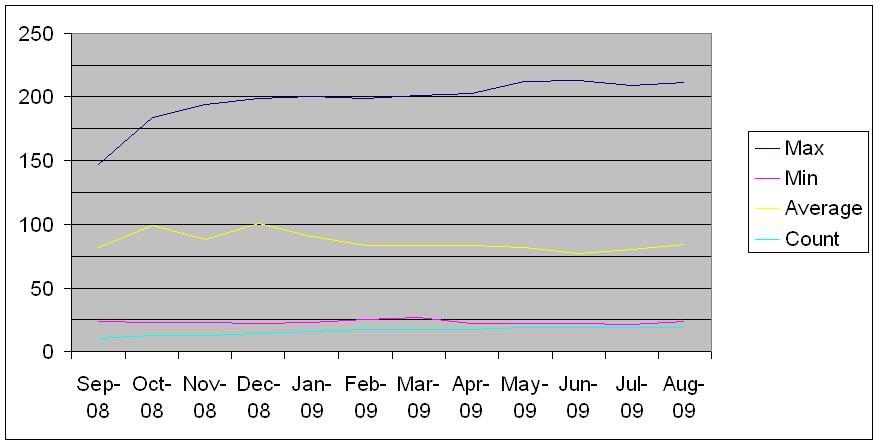
    Charting what’s left, we come up with this (I’ve divided the Max score by 10 to keep it in the scale).

    Total Christian Blogs

    So the number of Christian blogs has increased. Also, as the blog rankings have grown the lowest ranked blog has pushed out lower and lower – i.e. if 300 blogs are ranked, clearly the lowest ranked Christian blog is likely to be in the 200s. No surprises with either of those. The average looks interesting, but we need to dig further.

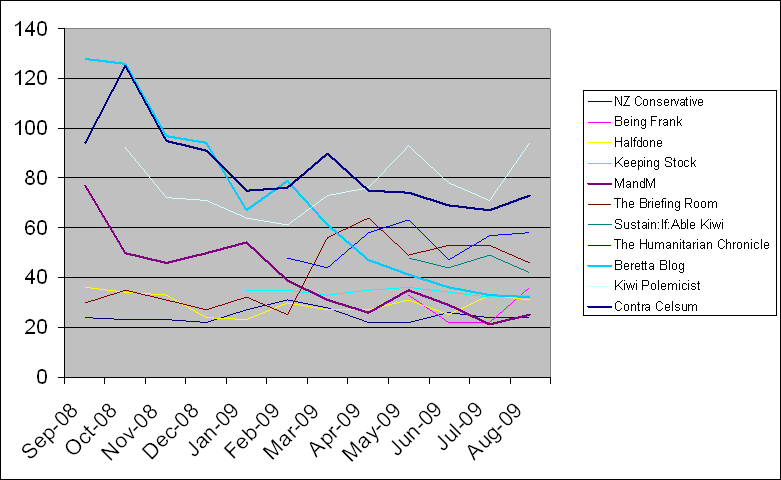
    Here’s the 11 blogs that averaged the highest score.

    Note the highest score in a Christian blog that didn’t make it onto this chart is 62. That was by Samuel Dennis back in November, so our method didn’t eliminate any good starters thus making the trend look better.

    Improvements Over the Year

    The most impressive improvements over the year have been MandM and the Beretta blog. Both have come from very uninspiring rankings to sweep into the top 40.

    Contra Celsum also made some good gains. I’ve highlighted these blogs to make their movement easier to see.

    Not all blogs gained during the year. Kiwi Polemicist slipped after almost making it to 60. The Briefing room dropped right off after February.

    But what has really gotten the attention of those watching the Christian rankings is the number of blogs that are now in the top 50/60. This can be clearly seen in this chart, with a mere 3 in the top 40 at the beginning. Now however, there are 8, 5 of those being in the top 40. That’s all in spite of TBR’s dropping off the pace.

    Some of us have suspected that this is due to improving scores. That’s partially true, with Beretta and MandM improving drastically, but mostly it’s been due to already good Christian blogs getting included in the stats, and other blogs such as MacDoctor and Keeping Stock identifying or being identified as Christian.

    Speaking of MacDoctor, in spite of his exclusion from the analysis, he is the only one who consistently makes it into the Tumeke! top 20.

    Something for us all to work on, eh?

  • Guest Post: Dan Brown’s History of Science

    This guest post was submitted by Dr James Hannam. Dr Hannam is a UK based historian with degrees in physics and history from the Universities of Oxford and London and a PhD in the history of science from the University of Cambridge. He blogs at Quodlibeta.

    The film adaptation of Dan Brown’s Angels and Demons was released this year and, on top of Brown’s new novel, appears to have done a roaring trade. Reports suggest that this is a better effort by director Ron Howard than his The Da Vinci Code, although most critics would feel that making a worse film would have been a stiffer test.

    For those lucky enough to be unfamiliar with the book, Angels and Demons is set in Rome where hunky Harvard symbologist Robert Langdon, played by Tom Hanks, is trying to prevent the Illuminati from detonating an anti-matter bomb.  According to Dan Brown’s alternative view of history, the Illuminati are a secret society of scientists (Copernicus and Galileo were, of course, members) who were persecuted by the Catholic Church.  After a great purge in the seventeenth century, we learn, the society went underground and plotted revenge. For some reason, it has taken them over three hundred years to get their act together.

    The Da Vinci Code launched the literary careers of a whole faculty previously-obscure professors of New Testament Studies. Admittedly, they had good reason for wanting to put the record straight about Brown’s distortions of early Christian history.  This time, it’s historians of science who might be upset by Brown’s misrepresentation. Because his contention that the Catholic Church has spent the last two millennia holding back the advance of science is as wrongheaded as the story that Mrs Jesus retired to the south of France with her kids.

    Of course, it’s not just Dan Brown who believes in the battle between science and religion. While few people think that the Illuminati really were a group of scientists suppressed by the Church, the perception of an eternal conflict between reason and faith is widespread. It’s true that the Church did make a single significant mistake in 1616, when it banned Copernicus’s opinion that the earth orbits the sun. But the subsequent trial of Galileo over the issue had more to do with papal self-esteem than astronomy. And even in this case, the Catholic Church was siding with the scientific consensus of the time. Still, you can’t manufacture an eternal conflict from a single example, so proponents of the hypothesis have had to resort to a different strategy – inventing the evidence.

    For example, in the book of Angels and Demons, Brown alleges that the Church had Copernicus murdered for his heliocentric model. While this is a more extreme allegation, there is a general belief that Copernicus feared persecution for his ideas. It’s widely thought that he refrained from publishing them until he was on his deathbed. In fact, he had circulated a pamphlet outlining his theory decades before he died. This was favourably received by senior churchmen and he was urged to publish by a cardinal. He even dedicated his great book, On the Revolutions of the Heavenly Spheres, to the Pope.

    Alas, as long as the likes of Dan Brown sell far more books than historians of science, this is a myth that is unlikely to go away.

    James Hannam’s book God’s Philosophers: How the Medieval World Laid the Foundations of Modern Science is published by Icon. The best price we could find for it from a New Zealand bookseller, with free delivery, was through The Nile Online Bookstore at the above link. International readers can buy it through Amazon. As I have previously stated elsewhere, it would make a good Christmas gift…

    RELATED POSTS:
    The “Dark Ages” and Other Propaganda
    More on the “Dark Ages” and Other Propaganda
    Things They Don’t Teach you in Public Schools…
    The Flat Earth Myth
    Contra Mundum: The Flat-Earth Myth

  • Guest Post: Having a Beer… for the Glory of God!

    As it is still open mic (blog?!) week(s) here are MandM; here is another guest post from Jonny King who, if you have not visited his blog before, you’ll find has a rather distinctive style; he threatened to burn effigies of our blog if we didn’t publish him LOL!

    Having a Beer… for the Glory of God!

    What?… I did put it in the singular… “a beer,”… lest we also forget 1 Cor. 10:31, unless you are planning other excursions for the liquid refreshment?!

    No, I don’t believe that this will be a candidate for the next issue in the Tui billboards dotting themselves over various parts of the Islands of NZ [for all you unfortunate individuals who are not so domiciled, these are somewhat tongue-in-cheek, culturally relevant statements, attached to the phrase “Yeah Right.”].

    … and No, I haven’t had one, let alone a few, quiet ones, before I sat my repository of blogging thoughts down before my little friend, the computer… I can talk to it for days and it will listen to every word, unlike some other people I know… Yes, I am referring to my fixer.

    I am Jonny King is not a big fan of the amber ale as a drink of choice.  Maybe, it is an acquired taste, but surely such shows that I have probably not inculcated myself to such a reality.  Or, maybe, I need to pay for the privilege.  Therefore, whatever you think of my liquidity, I am not pushing my barrow in the pursuit of guilt-free cravings.

    I, in fact, prefer something even darker… (more…)

  • Guest Post: VUWSA’s VSM Violations

    When ScrubOne sent us this offering as a guest post we couldn’t resist. This sort of thing has been happening for years and we saw it a lot back at Waikato University but that was pre-You Tube…gotta love the internet.

    DPF links to some videos of a student meeting held at the University of Wellington where some students decided to show up and demand their association (VUWSA) support compulsory membership.

    The association insiders try to shut it down by

    • breaking rules
    • announcing lack of quorum in a packed room (wait till the camera turns around – it’s absurd)
    • ignoring the result of votes

    In other words, they employed every trick in the book legal and illegal to try and stop students having their say.

    Watch it for yourself (you may need to hunt down parts 2 and 3 as it doesn’t seem to have been set into a playlist)

    DPF reports that they’re now using similar tactics to overturn the result by scheduling a meeting…

    So an illegal meeting, in breach of their own constitution, held in a bar at 11 am on a Friday (when all good students are hungover) is the first response of the compulsion lovers.

    But it gets even better. After forceful representations about the illegality of the proposed Friday meeting (not that the forces of compulsion did the same thing at WSU – hold a vote with only a day or two’s notice) including a potential injunction, the compulsionaters have come up with an even better plan.

    They have simply declared the Wednesday meeting void  on the grounds two VUWSA people declare a quorum count of 45, less than the required 50. Now note the resolution was passed with 80 people voting and a later quorum count (with one independent person) found there to be over 60 people present, and this count was done within the 30 minutes allowed in the constitution.

    The chances of the VUWSA putting in a submission in support of VSM are roughly those of a snowball’s chance in hell. Even if they accept the legality of this vote (which they won’t) and the illegality of the new meeting (which they won’t) they will simply ignore the motion or spin it away somehow.

    But that’s the point – the more VUWSA refuse to obey their own rules, and ignore their own members, the more they demonstrate the need for students to be allowed to remove their support from the association.

  • Snowed

    Matt and I are really snowed this week (as alluded to recently). If anyone wishes to submit a guest post please do. If we like it enough to use it we’ll link to your blog so you’ll get some traffic, a link… the satisfaction of being a good samaritan… We have no issue with  cross-posting the same item on your own blog so there is no extra effort involved, just send us what you are about to post on your own…

    Guest posts do not have to agree completely with what Matt and I think but they do have to be within our niche,  whether it is something deep and meaningful or commentary on current events and it should be well argued and supported.

    Email submissions to m_flannagan at clear dot net dot nz

  • Guest Post: Why doesn’t the Bible address X?

    The following is authored by Bethyada of True Paradigm, it is particularly apt given recent comments left on this blog. Bethyada writes:

    A not infrequent complaint raised by theism sceptics is that the Bible does not address many issues the sceptics think it should address; if indeed the Bible is a divine book and not merely a human one.

    There are several problems with this demand

    1. It assumes the critic’s concerns are the same as God’s
    2. It assumes the Bible is written for the sceptical
    3. It assumes that God should dictate Scripture rather than use his servants to author it
    4. It ignores that Scripture was written into a culture
    5. It ignores what is contained within Scripture
    6. It ignores that the issues may be addressed indirectly
    7. It places an unreasonable burden on the size of the resultant text
    8. It suggests that if such was included the sceptic would be convinced of the truth of the Bible
    Whose concern is important?
    To ask that the Bible address X, Y, or Z assumes that these are the things God is most interested in recording for his people. The Bible is diverse, though there are several common themes. A major theme is right relationship with God. There is a large amount of material discussing individuals and nations in right and wrong relationship with God and the consequences of such. God is forever calling people to himself and rebuking them for going their own way. The Bible suggests that the biggest problem in men following God is not evidential, rather wilful. All Jericho were in fear of Yahweh after reports of his exploits, yet only Rahab submitted to him.

    Related to this theme is reconciliation, especially the focus on God coming to earth as a man to teach us God’s way, to receive our punishment and to establish a kingdom. Thus, much of Scripture builds up to this event, describes this event and discusses the consequences of this event.

    Who was the Bible written for?
    The Bible has information that can be used to defend the truth of God and to rebuke the mocker; that is, it does have apologetic value. However the intended audience includes and is probably predominantly, those who belong to God’s kingdom. At the time of the Old Testament that was Israel (though admittedly this included apostate Israel). In the New Testament the gospel of Luke (and Acts) are addressed to Theophilus (Friend of God). The letters are all addressed to individual Christians or churches. The biblical “inadequacies” as claimed by the sceptical may be of less concern to believers.

    The Bible was written by God’s servants
    Scripture, in the main, is not dictated by God. Thus there is freedom for the authors to write in their own style. Christians believe God had the authors include what God wanted recorded. Many also claim that God prevented them from writing error. This at least allows for difficulties in reconciling parallel passages, none of which contain exhaustive information.

    The Bible was written into specific cultures
    This fact has been misused to limit the scope biblical injunctions. Nevertheless, the authors were writing to the people who lived and thought a common culture. They addressed issues that were pertinent to the people around them. This includes who they perceived as their friends and enemies at the time. Laws related (in part) to their way of life, the types of houses they lived in, the foods they ate. The Israelites were an agrarian society. Many of the specific issues we face in the 21st century were non-existent in ancient Israel and some of them would have been barely comprehensible. However, most issues faced by diverse nationalities have some degree of commonality. Truly new concepts, such as intellectual property, are not that common. To request the Bible address specifically, issues that post-date its completion is anachronistic. The Bible may do so if God wishes but to complain of these types of deficiencies is unreasonable.

    What does the Bible discuss?
    The fact is, the Bible does discuss a wide range of issues. There may be questions we have that it is difficult to clearly answer from biblical considerations but what of that which the Bible does tell us? It tells us a lot about God, a lot about us. It tells us we are broken. It tells us our relationship with God is broken and better, how to fix it. It tells us how to treat others. It teaches about relationships with one’s spouse and with one’s children. It tells us about honesty in business relationships. It tells us to concern ourselves with the less fortunate.

    There is much we are shown about in the Bible. Is the concern about what is lacking actually about us not liking what is not lacking?

    The indirect teaching of Scripture
    It is not that difficult to apply what the Bible says within an ancient culture to our modern one. Is it really that hard? to go from “build a parapet around the edge of your [flat] roof” to “build a fence around your swimming pool.” Does one really think that if God opposes getting intoxicated with wine that he approves of getting intoxicated with marijuana? Many of the questions we have in our modern technological age are addressed indirectly through Scripture.

    How big do we want our Bible?
    It is difficult for a finite text to cover all the questions that man is capable of asking. The amount of information now known to man is vast, too much for any one person to know. Yet there are questions I can ask (that are intrinsically answerable) and not one man on earth currently knows the answer. If the Bible addressed in detail the specific answer, along with an underlying explanation of the assumptions of the questioner, of every question raised by a bibliosceptic its size would be enormous, not to mention unsustainable for the ancient scribes. For a hand-written book, the Bible is already pretty large. And even many Christians have not read it thru. How does one gain the overall themes of a book that would take a lifetime to read thru once?

    Would a different text alter the sceptic’s position?
    My considered view is that the complaint of biblical deficiencies is an empty one. Inclusion of specific issues would only mean that different deficiencies would be raised.

    As mentioned above, the problem, as the Bible sees it, is not one of knowledge; rather it is one of the will. Rahab chose to worship Yahweh. Many of those who would be willing to submit to Christ have enough information to evaluate him. If someone has a real stumbling block then it is worth addressing it with him. But there is enough clarity in Scripture for those whose hearts are good soil and there is enough concealment for the mocker to remain sceptical.

  • Guest Post: Understanding The Needs of the Hour

    The following is authored by John Tertullian of Contra Celsum; a blog worth visiting. JT writes:

    The Kingdom of God is gradualist in nature. By this we mean that it comes bit by bit. Whilst in principle and in essence it is utterly revolutionary, in practice and human service it is not. The completely revolutionary nature of the Kingdom is of course alluded to in expressions such as, “if anyone is in Christ he is a new creation. The old has passed away. Behold all things have become new.” (II Corinthians 5:17). However, the gradual nature of the Kingdom is illustrated in God’s appointment of a lifetime process of incremental growth for Christian believers.

    This “radical, yet gradual” nature of the Kingdom needs to be understood in two ways. Firstly, when a person is converted out of darkness into the light of Christ, profound and totally radical change occurs, both in heaven and upon earth. His name is indelibly written in the Book of Life. He is born again by the Spirit of God. He is united into Christ. These realities mean that in time he will be transformed totally and made perfectly conformed to the Son of Man. He will end up being like Jesus (I John 3:2).

    Yet existential reality is somewhat different. The believer continues to sin; he lives in weakness; he is subject to many temptations; his life is full of ups and downs. He is afflicted with sicknesses. He struggles and suffers. Eventually he dies. Through this process of weakness, struggle and suffering he becomes sanctified. He grows in grace. He is changed from one degree of glory to another until he becomes like Christ. In other words the actualisation of Christlikeness is gradual. This is what theologians call the grace of sanctification. It is a gradual, slow, bit-by-bit transforming into greater holiness.

    The Westminster Shorter Catechism defines sanctification as follows:

    Sanctification is the work of God’s free grace, whereby we are renewed in the whole man after the image of God, and are enabled more and more to die unto sin, and live unto righteousness.
    Shorter Catechism, Question 35

    A good analogy is that of a child growing to maturity. Upon birth, all the potential of the adult is present, nascent within the child. As the child grows and matures, more and more of the potential is realised. But the process is gradual.

    The Kingdom of God, similarly, comes upon the earth gradually. It has to be this way, because the Kingdom is not divorced from the elect—their number, degree of understanding of the Word of God, levels of sanctification and obedience, and influence throughout the culture. Even as the Kingdom comes within and upon them gradually, so the Kingdom comes in nations and cultures slowly and gradually, even as the Church and the elect come to greater and greater maturity.

    This also implies that sanctification should be to an extent intergenerational. A person brought up in a godly Christian home, instructed and trained by sanctified parents, ordinarily starts off on the process of sanctification well ahead of someone who has just been converted out of the extremes of a dissolute, violent, and drug-enslaved family. (This, of course, does not imply that the one is less intrinsically sinful than the other, for the Scriptures declare that whoever observes the whole Law but slips in one point, is guilty in every respect. However, it does mean that to whom much has been given, much is expected.)

    As we seek to extend the Kingdom of God, we are concerned to apply God’s Word not only to our own individual lives and responsibilities, but also to corporate and institutional life. We wish to develop sound, biblical Christian schools. We want to see hospitals, voluntary institutions, and businesses acting consistently with biblical precepts and directions. We want to see the rules and constitutions of these structures conformed to Christ’s law and commands. We wish to see civil law reflect biblical ethical standards. Part of service in His Kingdom is working to bring these things about in an appropriate fashion. It will only occur as those ruling and working in each respective institution covenant together to serve the Lord in holiness.

    We also want to see the government conformed to Christ as His servant, restricted to His mandate, and acting appropriately as His minister. This means that we need to work to see that progressively the law of the land conforms to the commands and directions of the risen Lord.

    It is at this point that many Christians become confused. Imbued with a deep conviction of the absolute nature of God’s commands, they find themselves unable to accept anything less than complete conformity to God’s commands in the public sphere. They think that to work for anything less than the absolute would be to compromise the faith and disobey the Lord.

    Take abortion for example. So convicted are many Christians that any and all positive efforts to kill an unborn child is an act of murder, they cannot bring themselves to support measures which would only make abortion relatively more difficult or more restricted. A mere step forward is not just insufficient, it is seen as permissively supporting something that is wicked. The only thing they would be able to support is a total proscription of all abortion, at all times, in all conditions and places. Anything less they would regard as an ungodly compromise.

    But this denies the gradualist nature of the Kingdom. It also denies how God deals with them in their own process of sanctification.

    John Quincy Adams, a staunch Christian, was for many seventeen years a US Congressman, after having served as President. For all that time he, year after year, sought leave to introduce a Bill into the House to restrict slavery. He was refused year after year. But he kept at it. His Bill was a gradualist measure. It called firstly for the outlawing of all slavery in Washington DC. Secondly, it called for all the children of slaves born in the United States to be freemen. Adams argued that in time (since slave ships were already illegal) these measures would mean that slavery would die out in all the States of the Union.

    But his biggest opponents were the Abolitionists who were so committed to opposing slavery as an absolute evil that they could not support any measure that did not immediately and totally end the practice. Adams was a gradualist. The Abolitionists were radicals and revolutionaries. Adams understood the gradualist nature of the Kingdom of God; the Abolitionists did not. Their intransigence indirectly led to the death of 620,000 soldiers, and untold civilians a few years later as a result of the Civil War.

    It is an irony that amongst the strongest opponents to gradualist measures introducing partial restrictions upon abortion in our day are Christians. They have not understood the gradualist nature of the Kingdom. They have not understood that supporting of gradual measures is not ungodly compromise. It is rather a programme that is not only entirely consistent with the gradualist nature of the Kingdom of God, but in fact a service demanded by the King Himself.

    When Israel went into the land of Palestine, the destruction of the pagan tribes in the land was to be complete. There was to be no compromise. There was to be no mingling of paganism and idolatry with the true and pure worship of God. But, at the same time, the process of taking over the promised land was to be gradual.

    I will not drive them out before you in a single year, that the land may not become desolate and the beasts of the field become too numerous for you. I will drive them out before you little by little, until you become fruitful and take possession of the land.
    Exodus 24: 29,30

    This meant that Israel was to put up with a lot of rubbish in the “hood” until the pagan cultures were finally overcome. “Little by little” is the rubric. Christians are to be radicals in principle, but gradualists in practice. That is the way God deals with every one of His children. It is the way, we, as God’s called servants, are to deal with the culture and community around us.