Tag: Guest Post

  • Jesus: The Cold Case a Guest Post by Glenn Peoples

    Glenn Peoples shares his thoughts on TV One’s recent episode Jesus: The Cold Case.

    Jesus: The Cold Case

    Like a number of others tonight I have just watched Jesus: The Cold Case on TV One, presented by Bryan Bruce. Here are my thoughts on what I have seen. First off, who is Bryan Bruce?

    Bryan Bruce

    Bryan Bruce is an award winning producer, writer & director who lives in Wellington, New Zealand. He has a MA in Sociology, Psychology & philosophy from Canterbury University. A former musician and schoolteacher, he began his television career in 1984 as front person and writer for a TVNZ arts show. Since then has won awards for Best Director and Best Factual Writer and his work has made the finals of several international festivals, including the New York Television Festival and the prestigious Banff Awards.

    The overarching message that Bryan Bruce is gravitating towards in this documentary is that the biblical and subsequent Christian message on who killed Jesus, namely, “the Jews” in some broad sense, is false, and what’s more it is responsible for centuries of great evil.

    Something that strikes the viewer quite early on is that Bruce quite simply doesn’t believe that the Gospels accounts are true in general terms. “Many,” he says, “now believe that the Gospels contain more fiction than fact.” Throughout the documentary we hear from a number of academics who lend their credibility to the various claims Bruce makes.

    One of the immediate worries about the presentation is that although we’re led to believe that the presenter is applying rigorous criminal investigation methods to the case, to those familiar with the world of biblical scholarship, his list of authorities suggests otherwise:

    • Emeritus Prof. Geza Vermes (Oxford)
    • Emeritus Prof John Dominic Crossan ( St Pauls)
    • Prof. Elaine Paigels (Princeton)
    • Bishop John Shelby Spong (USA)
    • Prof. Lloyd Geering (New Zealand)
    • Dr Helen Bond ( Edinburgh)
    • Prof . Israel Hershkovitz (Tel Aviv)
    • Dr Shimon Gibson (London)

    Does this read like the list a careful investigator consults if he wants a decent shot at getting to the unvarnished truth, rather than a somewhat partisan perspective?

    According to Vermes, Jesus was resurrected in the hearts of his followers, but not literally from the dead.

    Crossan claims that Jesus’ followers had a kind of spiritual visionary experience
    Paigels writes that early Christians didn’t believe in physical resurrection at all, seeking instead a state of spiritual knowledge and enlightenment Spong says that Jesus’ resurrection had nothing to do with him coming back to life, but with the subjective – but real – experiences in the hearts of his followers.

    Lloyd Geering, who himself does not believe in any such being as God, claims that the body of Jesus remained buried and that the story of his resurrection was a later story concocted on the basis of a re-reading of the Old Testament.

    Now of course this isn’t a documentary on the resurrection, but the pattern is somewhat striking. It looks fairly clearly as though the presenter has intentionally stacked the witness stand with those hostile to the Christian story. It will hardly come as a surprise that, given such a uniform and narrow sample, the testimony will (rather gleefully!) point away from the traditional version of events surrounding the death of Christ. We might just as easily consult the faculty of Dallas Theological Seminary and claim that using rigorous scrutiny, we have reached the conclusion that the biblical portrait of Jesus’ death is, well, inerrant! Given that those consulted would be placed at one extreme of the spectrum on whether or not we can generally trust the Gospel accounts or the teaching of the early Christian movement, the interests of balance would surely call for less radical voices, the likes of Craig Evans, James Dunn, Luke Timothy Johnson or N. T Wright. One example – Lloyd Geering is quoted as assuring viewers – completely unchallenged – that the details of the crucifixion was no more than what people “imagined” had probably taken place. When it comes to the story of the resurrection, Geering is explicit – Jesus was probably buried by the Romans and that was that. No tomb, no stone rolled away, and no angels. Geering laughs, “the very fact that you’ve got angels [in the story] shows that we’re dealing with myth, not history.” There was not a single challenge raised. Not even an innuendo that Geering’s view isn’t the scholarly consensus. This was said just minutes after the narrator told us that the Gospel was more fiction than fact.

    This type of concern rears its head among a more sceptical audience when the evangelical likes of Lee Strobel seeks to do just what Bryan Bruce is doing: Apply critical scrutiny to the facts concerning the life of Christ. And yet we frequently hear the complaint that Strobel consults only committed and usually conservative Christians, people who are unlikely to disagree strongly with each other – or with Strobel. I would hope, then, that this same type of sceptical, professedly critical audience will likewise regard Bruce’s offering as a biased, selective survey of a very thin slice of the scholarly community. For example (more…)

  • Guest Post: One Less God

    Bethyada from True Paradigm writes:

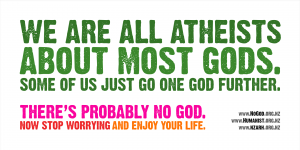
    I have read a few posts on the ‘one less god’ proposition. Stephen F Roberts originally put it,

    “I contend we are both atheists, I just believe in one fewer god than you do. When you understand why you dismiss all the other possible gods, you will understand why I dismiss yours.”

    elsewhere he says,

    “We are all atheists, some of us just believe in fewer gods than others.”

    I have read a few responses against this illogical claim.

    Some of us just go one god further

    One retort is to state that Christians do believe in several gods, it is just that the lesser gods are demons and Christians claim allegiance to the true God. Yahweh is not just a local deity (1Ki 20:23) but the true God, creator heaven and earth

    And Hezekiah prayed before the LORD and said: “O LORD, the God of Israel, enthroned above the cherubim, you are the God, you alone, of all the kingdoms of the earth; you have made heaven and earth. (2 Kings 19:15)

    the most high God,

    Abram said to the king of Sodom, “I have lifted my hand to the LORD, God Most High, Possessor of heaven and earth,…” (Genesis 14:22)

    Though there is truth to this, depending a little on how one defines God, I do not think this rebutal gets to the crux of the problem.

    Another response is to state that polytheists believe in gods for different reasons than monotheists believe in God. Polytheists believe X and monotheists believe Y, thus the monotheist’s refutation of X does not refute Y, which the atheist is claiming. In other words, the reason Christians reject other gods is not the same as the reason they accept the Christian God. This is logically true, and hints at the atheist error, but does not get to the heart of it. It is inadequate though because it is not immediately obvious that polytheists and monotheists have significantly different reasons for theism. Romans 1 suggests that there are some basic reasons why all people are theists, but our fallen nature means this may be distorted such that theism becomes polytheism or, as per Romans, animism and pantheism.

    A related response is to state that Christians see polytheism is a distortion of monotheism. As such, removal of the distortion does not remove the argument. The dismissal of the wrong elements of theism is not an argument against theism. This gets closer to the problem.

    The primary problem with the atheist position is that it makes a category error. The following analogy demonstrates this central issue. As such the analogy is useful, but for several reasons I think it is inadequate and could be improved upon. Nevertheless, if it illustrates the problem it is helpful.

    “Let’s say that people are debating the best colour for stop signs. One person may prefer red for stop signs. Another green. Still others think that any colour can be used and no standardisation is necessary, and others promote the use of all colours on every sign.

    The atheist response is like saying you can’t agree on what colour to use because there are in fact no colours. Colours do not exist.”

    Debating colour preference is not the same as debating the existence of colours. Dropping from one god to no gods is not a continuation of the number-of-gods argument, it is a completely different argument.

    Consider the deity set. It is either empty: atheism; or not empty: theism. The argument over the number of members in a non-empty theism set is unrelated to argument about whether or not the set is in fact empty.

    Douglas Wilson put it well in his response to Sam Harris,

    “You say, “Understand that the way you view Islam is precisely the way devote Muslims view Christianity. And it is the way I view all religions.” Well, no, not exactly. And well, actually, no, not at all.

    Suppose we are considering a phenomenon that is, by most accounts, inexplicable by an unsupervised occurrence—three of us attend a sophisticated party uptown, and halfway through the evening at the party we find a trout in the punch bowl. At this point, the three of us divide into three schools of thought. I think that Smith, a practical joker, put it there; our friend Murphy thinks that Jones, the avant-garde performance artist, put it there; and you think that it has simply shown up as the result of natural forces. My central point is not to interact with the truth or falsity of your naturalistic position—except perhaps through the use of this absurd example of the punchbowl—but rather to show that you are arguing for something completely different from what Murphy and I are arguing. We all have an explanation but your explanation is of a different kind altogether.

    The differences between two of us (between Murphy and me) concern who put the trout in the punchbowl. The difference between the both of us together and you iswhether someone put a trout in the punchbowl. And who and whether represent different questions entirely. Quite apart from who is right and who is wrong about this, it is important to note that we are not disagreeing in the same way or over the same kind of issue at all. Murphy and I are disagreeing over the relative behaviours of Smith and Jones, but not over whether the trout calls for an explanation. Maybe I am more hostile to Smith than I ought to be, and maybe Murphy is deeply prejudiced against Jones. Maybe we are both wrong about who put it there. But thinking someone’s explanation is inadequate (when we agree the phenomenon must be explained) is quite different from arguing with someone who says it calls for no outside explanation whatever.” (Letter from a Christian Citizen)

    RELATED POST:
    Selling Atheism

  • Guest Post: Tim McGrew defends “The Argument from Miracles: A Cumulative Case for the Resurrection of Jesus of Nazareth”

    Tim McGrewA little while back we published a post linking to some talks by Tim McGrew on Undesigned Coincidences in the Gospels. For some bizarre reason this post of ours prompted fellow kiwi blogger Deane Galbraith to write a post on the Bulletin for the Study of Religion, linking to our post, on the separate topic of Tim and his wife Lydia McGrew’s article “The Argument from Miracles: A Cumulative Case for the Resurrection of Jesus of Nazareth” which was published in the The Blackwell Companion to Natural Theology.

    Here is a snippet of Galbraith’s post from the beginning:

    There are quite a few academic and quasi-academic studies in which statistical analysis seems to be employed as a substitute for thinking. It is, perhaps, fairly understandable why some people are tempted by the allure of numbers. Those mysteriously complex formulae, mindnumblingly boring statistics and obscure mathematical notations lend a magical aura of scientific objectivity and plausibility to even the most patently absurd claims.

    What gets me talking about this at this moment is my dumbfounded reading last night of an article published by Timothy McGrew and Lydia McGrew, entitled“The Argument from Miracles: A Cumulative Case for the Resurrection of Jesus of Nazareth” (2009). In this article, the McGrews utilize Bayesian probability in order to argue to the “scientific” conclusion that the probability of the resurrection of Jesus is a “staggering” 100,000,000,000,000,000,000,000,000,000,
    000,000,000,000,000 to 1.

    Are you staggered? overwhelmed? swooning? Were you previously skeptical about the Christian claim that Jesus was resurrected, but now you’re feeling pretty silly? Perhaps not.

    The post goes on in the same vein to accuse the McGrews of trying to trick people into belief in the resurrection. It is littered with terms like “flimsy basis”, “populist apologetics”, “fanciful” and “deeply and unavoidably farcical” and is illustrated complete with a giant white-robed Caucasian Jesus wistfully looking heavenward as he steps out of the tomb. It finishes with Galbraith laying out his understanding of their mathematical reasoning, the tone at this point is dripping with lashings of smug, self-congratulation at how easily he, PhD student from Otago whose research area is giants in the Old Testament narrative, had dispatched two of the top philosophers of religion working in this field, both specialists in probability theory.

    Not being qualified remotely in Bayesian probability theory myself, and therefore not wanting to presume anything beyond assessing the tone as exceedingly arrogant, I passed on Galbraith’s criticisms to the McGrews on Facebook. Well it turns out that Galbraith isn’t the only non-qualified liberal/atheist to take a punt at their reasoning on this piece. Tim McGrew explains that straw men have been popping up all over.

    Straw Men Burning: Misinterpretations of our Article on the Resurrection

    One of the hazards of writing technical philosophy is the risk that someone who lacks the appropriate expertise will attempt to critique it. In the case of the article on the resurrection that Lydia and I wrote for The Blackwell Companion to Natural Theology, this has already happened. It is hard enough to correct misimpressions of this sort on a relatively neutral topic; when the subject rouses passions of the sort that, as Hume reminds us, religious disputes are apt to generate, then the difficulties are redoubled.

    But one thing that we did not anticipate is that (more…)

  • Guest Post: No Official Religion in God’s Own?

    David Simpkin is a Hamilton based lawyer with an interest in church-state issues. He studied law at the University of Auckland and holds a BA majoring in history and political studies. David is married to Susan and has a infant son, Caleb. He attends Whitiora Bible Church in Hamilton. David writes:

    As a holiday weekend that coincides with the most significant festival on the Christian calendar, Easter, concludes we should reflect on the freedom of religion we have in this nation. The Human Rights Commission is calling for submissions on a draft statement on freedom of religion and belief that includes the statement:

    ‘New Zealand has no official or established religion.’

    Race relations conciliator Joris de Bres has publicly said that New Zealand’s absence of a state religion is a statement of fact[1]. Former Prime Minister Helen Clark was also quoted as saying there is no state religion, there will be no state religion[2]. These comments may be a surprise to those Kiwis who thought rugby has the role of a national religion!

    Given the above comments by influential New Zealanders and the tax payer supported Human Rights Commission it must be clearly correct legally to say that New Zealand has no official religion.

    Well, actually, no, it is not.

    Does New Zealand Have an Official Religion?
    An important distinction needs to be made at the outset. A state with an established religion is one in which a particular religion or church is effectively an arm of the state, and the state identifies with a particular religion. A state with an official religion gives special recognition or privileges to a religion. While an established religion and an official religion are usually found together, that is not always the case.

    One of the most (if not the most) important offices in New Zealand is that of our head of state. New Zealand is a constitutional monarchy and the head of state in New Zealand is our monarch, currently Queen Elizabeth II.

    The Accession Declaration Act 1910 provides New Zealand’s head of state’s oath of office’ This accession declaration states:

    “I … do solemnly and sincerely in the presence of God profess, testify, and declare that I am a faithful Protestant, and that I will, according to the true intent of the enactments which secure the Protestant succession to the Throne of my Realm, uphold and maintain the said enactments to the best of my powers according to law.”

    The accession declaration provides that the Queen must claim to be a Protestant. This is inconsistent with the notion that New Zealand has no official religion. It also refers to other laws which “secure the Protestant succession.” These other laws are the Bill of Rights 1688[3] and The Act of Settlement 1700[4]. All these acts of parliament were re-affirmed as part of the law of New Zealand by our parliament as recently as 1988 in the Imperial Laws Application Act (which, curiously given her comments above, Helen Clark voted in favour of passing[5]). The other laws that secure the Protestant succession are intended to ensure that the King or Queen of New Zealand is always a Protestant Christian. These laws are, incidentally, identical to the current law in the now multi-religious United Kingdom. Where New Zealand differs from the United Kingdom is that neither the Anglican nor Presbyterian churches are established.

    The legal requirement that New Zealand’s head of state must be a Protestant Christian means that in our constitutional form at least we are a Christian nation. Technically our official religion is Anglicanism[6]. Having an official religion of course in no way requires New Zealanders to profess a particular religion. But does an Official Religion pose a threat to Religious Minorities? To answer this question lets refer to some overseas examples.

    Having no official religion and a secular state has been no guarantee that freedom of religion and human rights generally will be respected in North Korea, Cuba and the People’s Republic of China, all of which have woeful human rights records.

    By contrast the Lutheran church is the established church in Norway (there is even a minister of church affairs). It would be fair to say that Norway is not known for its suppression of freedom of religion or for having a poor human rights record.

    Likewise, the established Anglican Church in England and the Presbyterian Church in Scotland has not led to a lack of freedom of religion. Indeed the tolerant Anglican Church is preferable for religious minorities to intolerant secularism.

    It may come as a surprise to learn that there are leading Muslim and Jewish scholars who are actually against disestablishing the Anglican Church in the United Kingdom. To paraphrase their argument, an established but tolerant Anglican Church is preferable to a nation where all reference to the religious or sacred is ruthlessly excluded from the public domain[7].

    The intolerant secularism rightly feared by religious minorities has been evident in France recently. France has already banned the Islamic headscarf and outward wearing of the crucifix, and other religious symbols, in state schools[8] and is considering banning the wearing of a burqa altogether, moves which are causing public discord in France[9].

    Having an official religion is not necessarily any threat to freedom of religion, and may actually be more beneficial to religious minorities than aggressive secularism. The advancement of the rights of religious minorities and multi-culturalism should not be mis-used as a Trojan horse to advance intolerant secularism.

    Conclusion
    As a nation we should celebrate our tolerant Christian tradition, not attempt to falsely deny the legal fact that Christianity is a part of our national constitution. Ironically denials that Christianity is our official religion are playing down the Christian religious tradition that bought about the very religious freedom and tolerance the Human Rights Commission is attempting to promote.

    We have nothing to fear and will gain by having a National Statement on Religious Diversity in New Zealand and a Draft Statement on Freedom of Religion and Belief that acknowledge the existence of New Zealand’s official religion rather than willfully ignore it.


    [1] “There’s No State Religion –De Bres” New Zealand Herald 19 February 2007.
    [2]
    As above.
    [3]
    The relevant section of Bill of Rights 1688 provides:

    And whereas it hath beene found by experience that it is inconsistent with the safety and welfaire of this Protestant Kingdome to be governed by a Popish Prince or by and King or Queene marrying a Papist the said Lords Spirituall and Temporall and Commons doe further pray that it may be enacted that all and every person and persons that is are or shall be reconciled to or shall hold communion with the See or Church of Rome or shall professe the Popish religion or shall marry a Papist shall be excluded and be for ever uncapeable to inherit possesse or enjoy the Crowne and Government of this Realme.

    [4] Section 3 of the Act of Settlement 1700 states (inter alia) “that whosoever shall hereafter come to the possession of this Crown shall joyn in Communion with the Church of England.”
    [5]
    Hansard, 1988 (4th Labour government 1984-1990).
    [6] The Head of State is required to be an Anglican – refer to footnote 4.
    [7]
    Tariq Modood “(Muslim) Establishment, Multiculturalism and British Citizenship,” Political Quarterly 65 (1994) pp.53-73; Rabbi Jonathan Sacks, Ibid at 63-64; also Jonathan Sacks, The Persistence of Faith: Morality and Society in a Secular Age, London, 1991, cited in R Ahdar and J Stenhous et al God and Government The New Zealand Experience, University of Otago Press 2000.
    [8] “Party Pushes Burqa Law Despite Public Discord” New Zealand Herald 10 January 2010.
    [9] Ibid.

    [Wikipedia have a chart showing which countries Queen Elizabeth II is currently head of state of.]

  • Guest Post: Tim Wikiriwhi Reviews The Great Waitangi Debate (Uncut)

    On Waitangi Day, Saturday 6 Feb, TV One aired “The Great Waitangi Debate” on their Marae Program in which Matt and I were audience members. Panelist Tim Wikiriwhi (who won the MandM award for being the most inflammatory speaker of the day) has submitted his review as a guest post. Other blogs have published bits of it, we are the first to publish it in its entirety. Neither Matt or I concur completely with Tim’s assessment of Matthew Hooten’s criticisms of Stephen Franks’ position (which Stephen documents here) nevertheless we back his call for racial equality and he alludes to some fascinating historical arguments around land confiscations which we both intend to read more on. Tim Wikiriwhi was the Maori Spokesperson for the Libertarianz Party for 10 years and is himself Maori. Tim writes:

    It was with great pleasure that I accepted TVNZs invitation to participate in this debate, and agree with Steve Franks who said it was truly a great thing for tvnz to open up this discussion in the public arena as a lack of serious debate plays a large part in perpetuating the troubles surrounding race relations and the treaty.

    I completely agreed with his argument that the real treaty was not holding us back but that the bogus treaty separatist interpretations and sexed up versions were the trouble. I did not agree with his position that it was ok for the state to treat different peoples differently or that some of the favoritism was pragmatic common sense. This was in fact picked up by Matthew Hooten when he slammed Franks for claiming the favoritism that worked was not treatyism but that the rest was!

    Hana Oreagan was nice enough in person, but the politics she espoused can only be described as flakey and hypocritical. For example she could not see that when she slammed the NZ government for being discriminatory against Maori in the 1920s ( Lower pensions for Maori was one example she used) that she her self was advocating the same type of discrimination be imposed today …favoring Maori…this completely escaped her just as she did not recognize that some of the favoritism in the 1920s was actually in favour of Maori such as exemption from rates.

    Off air I did my best to show her this error and that what was needed was one equal law for all. Her claim the treaty can mean whatever we want it to mean just shows how flakey her ideas really are.

    When the time came for me to present my arguments, I attempted to give as broad a range of the troubles as I could in two minutes, hoping to fill in the details later when interviewed. Yet Shane decided it was better to attack my views on taxation instead! This worked in my favour as it gave me opportunity to slam socialist rapaciousness.

    I do want to add in here a couple of historic references to support my speech which I was unable to include in the debate. The first is Governor Grays declaration to the Waikato Chiefs about respecting the sovereignty of the queen and keeping the peace dated 11 July 1863 (as can be found in Richard Stowers book The Forest Rangers pg6) Governor Grey asked them to stop the evil acts against peaceable settlers…Grey asked for the free passage of Europeans in the Waikato district, in particular movement on the Waikato river. He also stated:

    Those who remain peaceably at their own villages in the Waikato , or move into such districts as may be pointed out by the government, will be protected in their persons, property and land.

    Those who wage war against her majesty, or remain in arms, threatening the lives of her peaceable subjects, must take the consequences of their acts and they must understand that they forfeit the right of possession of their lands guaranteed them by the treaty of Waitangi; which lands will be occupied by a population capable of protecting for the future the quiet and un-offending from violence with which they are now so constantly threatened.

    A second reference is to Sir Apirana Ngata who stated in his ‘The Treaty of Waitangi, An Explanation’ that…

    Some have said that these confiscations were wrong and they contravened the articles of the treaty of Waitangi, but the chiefs placed in the hands of the Queen of England, the Sovereignty and authority to make Laws. Some sections of the Maori people violated that authority, war arose and blood was spilled. The Law came into operation and land was taken in payment. This in itself is Maori Custom-revenge-plunder to avenge a wrong. It was their chiefs who ceded that right to the Queen. The Confiscations can not therefore be objected to in the light of the treaty…

    Finally I am happy I got a plug in against the anti freedom Nannyism and anti colonialism of Minto regarding Crime and health statistics that are used as vindication for socialist favoritism and ongoing regulation.

    “Why are we trying to manipulate fat people I said?”

    “That is not a duty of government but a matter of self responsibility!”

    (Socialists believe its their right/duty to force you to be the politically correct weight)

    I liked Matt Hootens smug grin…very amusing, but he said little worthy of note except that people will continue to use the current system to gain filthy lucre which more supported us and not them!

    I think even Hana O Regan thought she had been paired up with a wally.

    Valuable contributions from the audience came from:

    • Martin Doutre, New Zealand’s foremost expert on the history of the treaty documents when he verified Steve Franks assertion that the modern treaty used by the separatists and current government is a fraud.
    • Matt and Madeleine Flannagan both questioned the interpretations of the separatists … “How did they get their idea that the treaty obliged the state to teach and propagate Te Reo?” … “Why do they think a legal document like the treaty can be interpreted without applying the usual rules of law?”
    • Prof David Round criticised the ongoing and deepening riff caused by the separatist treaty industry.

    Most of the rest from the likes of Minto, Dalamere and co were the usual socialist rubbish that denies any responsibility of the Maori people to stand on their own two feet lumping the taxpayer with the burden of carrying them like babies.

    It was difficult to follow much of the commentary as it was so muddled up with some truth and a hell of a lot of false assumptions/propaganda.

    I was even dis-owned by my tribe for supporting equality before the Law! (Oh well, I shall continue to walk on alone if I must)

    I was happy that in the last segment I got to slam our racially divided electoral system and parliament adding that what made the election of Barack Obama great is that he was elected in a proper non-racist election competing with white men and woman, unlike our current shameful apartheid system in NZ.

    In closing I want to state for the record that…Just as the state education system is a propaganda machine of the theory of evolution…so too it propagates the lies of treaty separatism.

    This exposes the travesty of having a democracy with state control of our schools and the urgent need to divest the state of its evil encroachments and control over our children’s minds. Privatize education!

    The battle goes on…

    RELATED POSTS:
    View “Marae: The Great Waitangi Debate” Here

    Sovereignty and The Treaty of Waitangi
    Maori and Pakeha are Not Partners to the Treaty of Waitangi
    (Our Review of the Debate)

  • Guest Post: The Common Good – An Emergent Phenomenon

    This guest post comes from Nyokodo of And All These Things…. Catholic social teaching stresses that civil government should seek the common good. This post contains some critical commentary as to how to understand and apply the common good.

    The documents of the Church and the writings of most socially minded scholars are replete with exhortations for public figures to work towards the common good in all secular affairs. In response grand public works are begun, optimistic programmes launched, and a great many resources are shifted from one sector to another to achieve this lofty goal. However, it soon becomes clear that these programmes introduce further imbalances, insecurities and evils. Entire strata of society become addicted to welfare, economic protectionism make prices soar, unjust monopolies are established, and regulations are always too little too late. Some of these problems can be explained by ordinary political corruption and the general imperfection of man, however there is an even larger problem with all these methods: it’s literally impossible for them to work.

    The problem is information:

    • how to collect it;
    • how to interpret it once you have it;
    • and the time frame in which all this is done.

    Governments simply cannot aggregate enough information in a timely enough fashion, and even if they could social and economic data are largely subjective and impossible to interpret correctly when distanced from the specific situation and the particular people involved.

    Readers will be familiar with government economic data only coming out after the fact, often sometime after. This is because it takes time for sectors of the economy to report how they’re doing, there is always a delay requisite with the time it takes for individuals and businesses to aggregate their own data and to government requirements. Even then the data is often manipulated to make government policies look better so the reliability of the data is questionable.

    The data are also very much subjective as the needs, wants, aspirations and acceptable outcomes of economic and social activities differs per person, business, city and region. The sheer immensity of this subjective information is too vast for any government to sufficiently aggregate and essentially impossible to even attempt to collect.

    Governments who attempt this central planning of our social and economic lives are simply driving blind because they cannot have the information they would need to direct us effectively. This is why government programmes always encourage the wrong behaviour, leave certain groups and issues behind, grow stale and unresponsive, and generally spring leaks from every orifice.

    The only way for the Common Good to be achieved is to unleash the power of individuals, families and groups to work towards their own benefit. The Common Good emerges out of this chaos with the most efficient use of resources, the most timely actions taken and no interpretation being necessary. The only people who have the necessary information to achieve their good, and in chorus the common good, are the individuals directly involved. Governments need to get out of the way and enable this process to occur instead of their futile attempts to conjure the common good from the top down.

  • Guest Sunday Study: Moral Perspectives on Lying

    Bethyada explores the morality of lying. (This guest post is part of open mic week(s))

    There are a range of Christian theories on the moral acceptability of lying.

    The issues around lying seem difficult to fully categorise in English. The problem is a lack of simple words to express subtle differences in meaning. To illustrate this note that the concept of lying can be considered analogous to killing. With killing we have sub-terms such as murder, manslaughter, and capital punishment. We also recognise killing in a variety of situations such as warfare and self-defence. The debate about the morality of types of killing is more transparent because we agree on meaning, even if we disagree or the moral acceptability of them.

    Whereas “lying” merely means distorting the truth irrespective of the circumstances. There are terms such as deception, falsification, untruthfulness, but these are basically synonymous. There are situational terms though, such as perjury.

    So is falsehood a single conceptual category? I have long thought it meaningful that the 9th commandment is not, “You shall not lie,” but rather, “You shall not bear false witness against your neighbour.” I have previously distinguished between reality and what one perceives as reality stating that affirming a false belief is not lying. I have also made the distinction between voluntary and forced disclosure of information which I wish to expand on here.

    The moral debate is that either:

    • lying (or specific types or lying) is objectively wrong, that is, various forms of absolutism; or
    • lying is not intrinsically wrong (for all people), (though it may be preferable to avoid in certain situations for other reasons), that is, forms of subjectivism.

    Christianity claims that morality has its source in the moral law giver, thus it views the morality of truth telling as objective: the same rules for all people at all times. Here are particular forms of such absolutism.

    1. Unqualified Absolutism

    Lying is always wrong. People should never lie ever. No matter what the situation or consequences.

    Doug Beaumont explains such unqualified absolutism.

    Unqualified Absolutism is based on the idea that most moral actions are intrinsically right or wrong, and because sin is always avoidable there can be no actual moral conflict. Given a choice between telling the truth or lying to avoid a murder, for example, one must choose telling the truth for in that instance it is not the one speaking, but the murderer who is sinning. In that case it is better to permit sin than to commit it. This view states that moral “oughts” are viable regardless of their consequences, for any moral philosophy that has exceptions results in relativism. Moral law is based on God’s unchanging nature, therefore moral law itself is unchanging. Logically, if an act is intrinsically evil, it cannot become good because of a changing situation. Finally, God can always provide a third alternative to sinful actions.

    This is how many people view lying. It is a somewhat reasonable but it lacks depth. Exceptions to rules don’t intrinsically mean relativism. True, exceptions can be special pleading or hypocrisy, but they may be legitimate (eg. age based rules). And as I note below, unqualified absolutism may conflate intrinsically different actions.

    2. Conflicting Absolutism

    Lying is wrong, but it needs to be considered within the situation. If lying conflicts with another moral commandment then one must do obey the higher moral. But lying, while required, is still sinful.

    Such a position acknowledges that we have moral conflict (at least in this age). I think this is an improvement as it notes that as bad as lying may be, it may not be the greatest evil (though lying is a bigger evil than many acknowledge). This position encourages people to do good and love their neighbour.

    It fails in that it suggests at times all options a man may have involve sin. However if we wish to do right, Scripture suggests we are able to do so (thru God). Further, how much less are we to blame when others have placed us in a dilemma, rather than our own prior choices.

    3. Graded Absolutism

    Lying is wrong unless it conflicts with a higher moral commandment. Obeying the higher moral by lying is not wrong or sinful.

    This resolves the dilemma or not being able to make a right choice. It affirms moral conflict, but it claims that the choice to do the better is good. And not sinful if a greater good is being done. There may be some support from Jesus’ words to the Pharisees. It discussing tithing garden herbs Jesus states

    “But woe to you Pharisees! For you tithe mint and rue and every herb, and neglect justice and the love of God. These you ought to have done, without neglecting the others.”

    While one could claim that tithing herbs and doing justice are morally equal—Jesus does say not to neglect the former—the context would suggest that doing justice is a higher moral command. Apologists for unqualified absolutism could argue Jesus commands they do both, but there is no conflict between moral obligations set up here, so unqualified absolutism cannot be proven from the passage. I am merely illustrating that moral commands are graded.

    It is important to note that this is not arguing that the end justifies the means. Yes, the end is considered, but for the sake of doing good, not for preferred result. Doing good may have unpleasant consequences.

    4. Libertarian Absolutism

    Lying is wrong if one is voluntarily giving information. One need not tell the truth if one is being compelled to divulge information. I am responsible for my actions, not yours.

    This has the advantage over graded absolutism in that it recognises that voluntary information and compelled information are categorically different. It is somewhat analogous to saying that predatory killing is sinful but self-defensive killing is not.

    Interestingly Jesus’ words may shed some light on our understanding here.

    After this Jesus went about in Galilee. He would not go about in Judea, because the Jews were seeking to kill him. Now the Jews’ Feast of Booths was at hand. So his brothers said to him, “Leave here and go to Judea, that your disciples also may see the works you are doing. For no one works in secret if he seeks to be known openly. If you do these things, show yourself to the world.” For not even his brothers believed in him. Jesus said to them, “My time has not yet come, but your time is always here. The world cannot hate you, but it hates me because I testify about it that its works are evil. You go up to the feast. I am not going up to this feast, for my time has not yet fully come.” After saying this, he remained in Galilee.

    But after his brothers had gone up to the feast, then he also went up, not publicly but in private. The Jews were looking for him at the feast, and saying, “Where is he?” And there was much muttering about him among the people. While some said, “He is a good man,” others said, “No, he is leading the people astray.” Yet for fear of the Jews no one spoke openly of him.

    About the middle of the feast Jesus went up into the temple and began teaching. (John 7, emphasis added)

    Jesus said he wasn’t going but then he did. This implies that Jesus’ answer was not true. In fact some manuscripts say, “I am not yet going up to this feast.” Which would seem to make Jesus’ answer more honest. Looking at the passage it is clear Jesus wished to go without others initially knowing he was there. He is asked if he is going, however Jesus does not wish to tell this person. Being evasive may be construed as a yes. Jesus says that he is not going to this feast. Within the libertarian absolutism view a request is made of Jesus to divulge information he does not wish to give and he is at liberty to answer in a way that does not divulge same information.

    This position is distinct from graded absolutism in that one is not weighing up morality in conflict. The distinction is in will for informing.

    Although one could think nothing one hears in conversation is reliable, the solution is listen to what people wish to tell you.

    5. Authoritative Absolutism

    Non aggressive version

    • Lying is wrong in non-aggressive situations. Self-defence against an aggressor allows for lying. Authorities are owed the truth.

    Libertarian version

    • One need not tell the truth if one is being compelled to divulge information unless being compelled by a legitimate authority.

    Authoritative absolutism states the voluntary information must be true as per libertarian absolutism, or that all information must be true unless facing an aggressor. It states that, in general, compelled information does not need to be true though there can be variation on what is meant by compulsion.

    But this position does allow an appropriate authority to force information (whereas strict libertarian absolutism would not). A person following libertarian absolutism would allow one to lie in court if he did not wish to divulge the truth. Non-aggressive absolutism would mean that it is eumoral (morally good) to tell the truth in legitimate courts and immoral to withhold it. Note the caveat: obeying a lesser authority is not required if that means disobeying a higher one. Obeying a policeman, a ruler, or a court is necessary even unjust ones, or in unpleasant circumstances; unless doing so compromises a higher earthly ruler or God.

    Conclusion

    People may argue for the legitimacy of any of these options within Christian theology. Unless one recognises that the concept of lying may include more than one category, graded absolutism is as far as one can advance and this seems to be the best approach. However the knowledge of a permissible sub-categorisation based on the distinction between voluntary and involuntary knowledge sharing allows for more nuanced views.

    Moral perspectives on lying


    There are a range of Christian theories on the moral acceptability of lying.

    The issues around lying seem difficult to fully categorise in English. The problem is a lack of simple words to express subtle differences in meaning. To illustrate this note that the concept of lying can be considered analogous to killing. With killing we have sub-terms such as murder, manslaughter, and capital punishment. We also recognise killing in a variety of situations such as warfare and self-defence. The debate about the morality of types of killing is more transparent because we agree on meaning, even if we disagree or the moral acceptability of them.

    Whereas “lying” merely means distorting the truth irrespective of the circumstances. There are terms such as deception, falsification, untruthfulness, but these are basically synonymous. There are situational terms though, such as perjury.

    So is falsehood a single conceptual category? I have long thought it meaningful that the 9th commandment is not, “You shall not lie,” but rather, “You shall not bear false witness against your neighbour.” I have previously distinguished between reality and what one perceives as reality stating that affirming a false belief is not lying. I have also made the distinction between voluntary and forced disclosure of information which I wish to expand on here.

    The moral debate is that either:

    • lying (or specific types or lying) is objectively wrong, that is, various forms of absolutism; or
    • lying is not intrinsically wrong (for all people), (though it may be preferable to avoid in certain situations for other reasons), that is, forms of subjectivism.

    Christianity claims that morality has its source in the moral law giver, thus it views the morality of truth telling as objective: the same rules for all people at all times. Here are particular forms of such absolutism.

    1. Unqualified Absolutism

    Lying is always wrong. People should never lie ever. No matter what the situation or consequences.

    Doug Beaumont explains such unqualified absolutism.

    Unqualified Absolutism is based on the idea that most moral actions are intrinsically right or wrong, and because sin is always avoidable there can be no actual moral conflict. Given a choice between telling the truth or lying to avoid a murder, for example, one must choose telling the truth for in that instance it is not the one speaking, but the murderer who is sinning. In that case it is better to permit sin than to commit it. This view states that moral “oughts” are viable regardless of their consequences, for any moral philosophy that has exceptions results in relativism. Moral law is based on God’s unchanging nature, therefore moral law itself is unchanging. Logically, if an act is intrinsically evil, it cannot become good because of a changing situation. Finally, God can always provide a third alternative to sinful actions.

    This is how many people view lying. It is a somewhat reasonable but it lacks depth. Exceptions to rules don’t intrinsically mean relativism. True, exceptions can be special pleading or hypocrisy, but they may be legitimate (eg. age based rules). And as I note below, unqualified absolutism may conflate intrinsically different actions.

    2. Conflicting absolutism

    Lying is wrong, but it needs to be considered within the situation. If lying conflicts with another moral commandment then one must do obey the higher moral. But lying, while required, is still sinful.

    Such a position acknowledges that we have moral conflict (at least in this age). I think this is an improvement as it notes that as bad as lying may be, it may not be the greatest evil (though lying is a bigger evil than many acknowledge). This position encourages people to do good and love their neighbour.

    It fails in that it suggests at times all options a man may have involve sin. However if we wish to do right, Scripture suggests we are able to do so (thru God). Further, how much less are we to blame when others have placed us in a dilemma, rather than our own prior choices.

    3. Graded absolutism

    Lying is wrong unless it conflicts with a higher moral commandment. Obeying the higher moral by lying is not wrong or sinful.

    This resolves the dilemma or not being able to make a right choice. It affirms moral conflict, but it claims that the choice to do the better is good. And not sinful if a greater good is being done. There may be some support from Jesus’ words to the Pharisees. It discussing tithing garden herbs Jesus states

    “But woe to you Pharisees! For you tithe mint and rue and every herb, and neglect justice and the love of God. These you ought to have done, without neglecting the others.”

    While one could claim that tithing herbs and doing justice are morally equal—Jesus does say not to neglect the former—the context would suggest that doing justice is a higher moral command. Apologists for unqualified absolutism could argue Jesus commands they do both, but there is no conflict between moral obligations set up here, so unqualified absolutism cannot be proven from the passage. I am merely illustrating that moral commands are graded.

    It is important to note that this is not arguing that the end justifies the means. Yes, the end is considered, but for the sake of doing good, not for preferred result. Doing good may have unpleasant consequences.

    4. Libertarian absolutism

    Lying is wrong if one is voluntarily giving information. One need not tell the truth if one is being compelled to divulge information. I am responsible for my actions, not yours.

    This has the advantage over graded absolutism in that it recognises that voluntary information and compelled information are categorically different. It is somewhat analogous to saying that predatory killing is sinful but self-defensive killing is not.

    Interestingly Jesus’ words may shed some light on our understanding here.

    After this Jesus went about in Galilee. He would not go about in Judea, because the Jews were seeking to kill him. Now the Jews’ Feast of Booths was at hand. So his brothers said to him, “Leave here and go to Judea, that your disciples also may see the works you are doing. For no one works in secret if he seeks to be known openly. If you do these things, show yourself to the world.” For not even his brothers believed in him. Jesus said to them, “My time has not yet come, but your time is always here. The world cannot hate you, but it hates me because I testify about it that its works are evil. You go up to the feast. I am not going up to this feast, for my time has not yet fully come.” After saying this, he remained in Galilee.

    But after his brothers had gone up to the feast, then he also went up, not publicly but in private. The Jews were looking for him at the feast, and saying, “Where is he?” And there was much muttering about him among the people. While some said, “He is a good man,” others said, “No, he is leading the people astray.” Yet for fear of the Jews no one spoke openly of him.

    About the middle of the feast Jesus went up into the temple and began teaching. (John 7, emphasis added)

    Jesus said he wasn’t going but then he did. This implies that Jesus’ answer was not true. In fact some manuscripts say, “I am not yet going up to this feast.” Which would seem to make Jesus’ answer more honest. Looking at the passage it is clear Jesus wished to go without others initially knowing he was there. He is asked if he is going, however Jesus does not wish to tell this person. Being evasive may be construed as a yes. Jesus says that he is not going to this feast. Within the libertarian absolutism view a request is made of Jesus to divulge information he does not wish to give and he is at liberty to answer in a way that does not divulge same information.

    This position is distinct from graded absolutism in that one is not weighing up morality in conflict. The distinction is in will for informing.

    Although one could think nothing one hears in conversation is reliable, the solution is listen to what people wish to tell you.

    5. Authoritative absolutism

    Non aggressive version

    • Lying is wrong in non-aggressive situations. Self-defence against an aggressor allows for lying. Authorities are owed the truth.

    Libertarian version

    • One need not tell the truth if one is being compelled to divulge information unless being compelled by a legitimate authority.

    Authoritative absolutism states the voluntary information must be true as per libertarian absolutism, or that all information must be true unless facing an aggressor. It states that, in general, compelled information does not need to be true though there can be variation on what is meant by compulsion.

    But this position does allow an appropriate authority to force information (whereas strict libertarian absolutism would not). A person following libertarian absolutism would allow one to lie in court if he did not wish to divulge the truth. Non-aggressive absolutism would mean that it is eumoral (morally good) to tell the truth in legitimate courts and immoral to withhold it. Note the caveat: obeying a lesser authority is not required if that means disobeying a higher one. Obeying a policeman, a ruler, or a court is necessary even unjust ones, or in unpleasant circumstances; unless doing so compromises a higher earthly ruler or God.

    Conclusion

    People may argue for the legitimacy of any of these options within Christian theology. Unless one recognises that the concept of lying may include more than one category, graded absolutism is as far as one can advance and this seems to be the best approach. However the knowledge of a permissible sub-categorisation based on the distinction between voluntary and involuntary knowledge sharing allows for more nuanced views.