Tag: Paul Copan

  • Madeleine on Unbelievable?

    Recently we posted a link to an episode from Justin Brierly’s Unbelievable? show on the UK station Premier Christian Radio which featured a podcast of Paul Copan and Norman Bacrac discussing Is God a Moral Monster? Yesterday we were alerted to the fact that at the end of the Unbelievable? episode of 23 Apr 2011, “Rob Bell defends ‘Love Wins’“, Brierly had a  follow-up feedback session where he played calls and read out emails from listeners commenting on the issues raised in the Copan and Bacrac show. Several people were clearly confused by Copan’s argument and we were pleasantly surprised to hear Brierly positively offer a short hermeneutical piece written by Madeleine on the Unbelievable? forums as a response to the concerns of his listeners.

    To listen to the whole follow-up feedback session on the Copan Bacrac podcast click on Rob Bell defends ‘Love Wins’ and skip forward – just drag the slider forward – to 1:06:21 and play from there. (The section relating to Madeleine starts at 1:11:43.)

    We have had several requests for the text of what Madeleine wrote that Brierly read out, so here it is below:

    It does not follow that just because there is good textural and cultural evidence to read specific passages this way that all passages must now be read that way.

    Chocolate Cake

    If I wrote a book of memoirs of my life that included a poem I wrote to be read out at my wedding, my favourite recipe for chocolate cake and my first hand experience of surviving an earthquake do you read the part of my memoirs recording my experience and observations of the earthquake as a poem? Do you take the chocolate cake recipe as historical narrative of a natural disaster? Do you assume I am an idiot for mixing my genres in a single text? Of course not! you can recognise the different genres as you read your way through the book and strike them – doing this is easy when we are reading texts from our own culture and time but when we talking about another culture and time written in another language, it is a lot harder but it does not mean that the we stop looking for genre and context clues and we start saying if we are to interpret passage x as rhetorical flourish then we have to interpret everything as rhetorical flourish.

    It never ceases to amaze me that people fail to get this point which Madeleine makes in a far more pithy way than I could.

  • Moving Beyond Sunday School

    On this blog we often rail against new-atheist readings of Biblical texts. Our pages are littered with expositions as to what a text is really saying when you consider the context, genre and textual evidence, all of which demonstrates that the new-atheist readings of the texts are at best wanting and at worst down-right stupid or dishonest. But, of course, it is not just atheists who sometimes fail to read Biblical texts properly.

    Joshua Fit the Battle of Jericho

    I was reminded of this recently in an exchange with someone who on considering Paul Copan’s work in Is God a Moral Monster? and Matt’s blog series God and the Genocide of the Canaanites Part I, Part II and Part III, asked me:

    “If these Biblical battles are so clearly exaggerated, why aren’t they taught to be so in churches? When I learnt in Sunday School about how “Joshua fit the battle of Jericho”, should the Sunday-School teacher have added “Of course, it didn’t really happen!”

    Aside from the fact that I thought it was an interesting observation on his part that he had never really sought to take his own understanding of those passages beyond Sunday School level, I think there is something in his question but before I go on I should make a brief qualification. Neither Copan or Matt have argued that the Battle of Jericho never happened; they have argued that the ‘genocide language’ in the earlier parts of the Book of Joshua should be read as hyperbolic hagiographic accounts of Israel’s early skirmishes in Canaan and that this language and the accounts of those battles should not be read in isolation from the rest of the Book of Joshua and the surrounding texts – especially Judges. This more Canonical approach shows that the Bible does not teach that the Canaanites were genocided by the Israelites.

    As to why Sunday School teachers don’t get into how to interpret the ‘genocide passages’ in Joshua, I expect it has something to do with the same reason the dove with the olive branch is generally not depicted flying over any floating, swollen corpses in the pictures of the happy pairs of animals floating on an ark with a rainbow in the background that dot the Sunday School walls. A Sunday School teacher should focus on the message or point of these stories and leave the realities of floods and wars and their effect on the people who don’t survive them for when a child is older.

    But this I guess is my correspondent’s point. The church seems to have produced Christians en masse whose understanding of these passages has not really moved beyond the Sunday School glossing of the story – their understanding now appears to be the Sunday School version plus, now they have lived a bit and get that floods and wars kill people, X number of dead people. If you scan the comments on the half or dozen posts Matt has published on the ‘genocide passages’ on this blog you will find Christians struggling to get their heads around the idea that perhaps instead of reading only Joshua 6-11 and forming a conclusion that is only fractionally more in touch with reality as the Sunday School stories they should instead read all 24 chapters plus a fair decent way through Judges.

    Now I am not trying to say that my fellow Christians are all stupid (or even that new atheists are) (more…)

  • Unbelievable? Is God a Moral Monster? Paul Copan & Norman Bacrac

    Paul Copan recently debated Norman Bacrac on the topic “Is God a Moral Monster?” on a recent episode of Unbelievable? on the UK station Premier Christian Radio.

    Matt and I just listened to it and we both thought it was worth sharing as Copan really handled himself well and very clearly articulated his position on the hyperbolic reading of the Canaanites (a position he has co-authored with Matt on). The interaction between Copan, Bacrac and the show’s host Justin Brierly was very good too.

    Unbelievable?Listen here: Unbelievable? 9 Apr 2011 – Is God a Moral Monster? Paul Copan & Norman Bacrac
    [If the link will not load the Copan v Bacrac debate directly go to the Unbelievable? page then locate the 9 April 2011 episode ]

    The blurb from the show is:

    Richard Dawkins describes the Old Testament God as “a vindictive, bloodthirsty ethnic cleanser” (among other things).  Paul Copan is a Christian apologist and has written a book, “Is God a Moral Monster?” aiming to show why God’s actions in the Old Testament are not immoral when taken in context.

    Norman Bacrac is an atheist humanist and part ot the South place Ethical Society. He believes that Old Testament morality was barbaric and we don’t need a God to tell us how to behave.  He holds that God’s morality is called into question if we take the Old Testament literally.

    So how do we interpret passages where the Israelites were commanded to wipe out whole towns including women and children?

    “The blog of Matthew and Madeleine Flannagan in New Zealand” rates a mention from the host, Justin Brierly, about 38 mins in 😉

  • Is God a Moral Monster? A Review of Paul Copan’s Book

    On 11 September 2001 Islamic terrorists flew two planes into the World Trade Centre, killing thousands of innocent people. Ostensibly they did this because they believed God commanded them to do so. This event has reinvigorated a fear that has been latent in Western psyche since the 17th century when religious wars tore Europe apart. The fear of religious fanaticism, of people willing to murder hundreds in the name of God, has been whipped up by the new atheists–Richard Dawkins, Sam Harris, Christopher Hitchens, et al.

    The phenomenon is not just limited to the popular atheological literature. These fears went centre stage recently at a conference entitled “My Ways Are Not Your Ways” which was put on by the Centre for Philosophy of Religion at the University of Notre Dame. Sceptics presenting at the conference argued passionately that the God of the Bible issues commands which are at odds with modern understandings of morality; adultery is punished with death, God is portrayed as commanding the killing of non-combatants in “holy wars” against the Canaanites, God commanded Abraham to sacrifice his son, the Bible appears to approve of slavery and polygamy, and so forth.

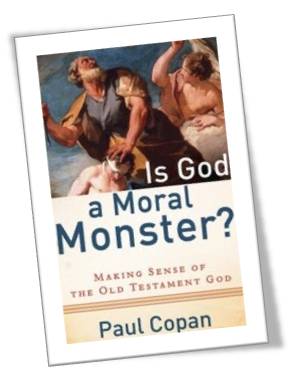
    Is God a Moral Monster?In Is God a Moral Monster? Paul Copan attempts to address some of these concerns. What’s novel about Copan’s approach is that, unlike many standard philosophical responses to the above problems, Copan draws on recent conservative Old Testament scholarship by people like Gordon Wenham, Tremper Longman, Christopher Wright, Walter Kaiser, Richard Hess and numerous others. This is novel as much of what has been going on in evangelical discussions of Old Testament ethics for decades has been done almost in isolation from contemporary philosophy of religion and vice versa. Copan, who has degrees both in Philosophy and in Biblical Studies, brings this material together in an accessible manner.

    There is no point in hiding the fact that I am a fan of Copan’s book. In a few places Copan cites my own writings as sources of ideas and in other places the overlap with my own thoughts on these issues is considerable. I have recommended it to my son who intends to read it as soon as he has finished William Lane Craig’s On Guard. However, this review will not simply be an exercise in cheer-leading; I will attempt to both summarise Copan’s work and add critical comments.

    The Review
    Is God a Moral Monster? opens with a discussion on the new atheism in general. In chapters 3 and 4 Copan addresses the charge that God in the Old-Testament is both jealous and egocentrically demands worship. Then in chapter 5 he turns to the binding of Isaac. I will touch briefly on this (more…)

  • Religion, Science, 9/11 and the Moon: Dawkins’ Response to Copan

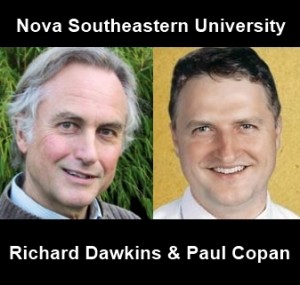
    Richard Dawkins and Paul CopanParchment and Pen, has an audio of a brief exchange between Paul Copan and Richard Dawkins who was speaking in Ft. Lauderdale at Nova Southeastern University on “The Fact of Evolution.” (The following week, Paul Copan spoke on “The Fact of God” at Nova Southeastern and gave a direct response to Dawkins.) This MP3 of Paul Copan and Richard Dawkins’ exchange is from the Q&A of Dawkins’ talk.

    In it Paul alludes to an argument advanced by C S Lewis, Alvin Plantinga, Michael Rea, Victor Reppert and also alluded to by Patrica Churchland, Thomas Nagel, William Whewell and Friedrich Nietzche. The argument is that if our cognitive faculties evolved by natural selection, unguided by God, then our cognitive faculties cannot be rationally relied on to give us truth. The literature on this argument is interesting but I won’t comment on that here.

    What interests me is the comment Dawkins made in the MP3 which got the applause of the audience. Dawkins appears to not grasp the point of the argument and takes it to be asking for a reason why he supports “scientific rationalism”. He said he believes in scientific rationalism because it “works”. He then provided an example of how it “works”, it is that “science flies us to the moon, while religion flies planes into buildings.”

    Much could be said here but I want to limit myself to a single point, the evidence Dawkins cites that science works and religion does not. Dawkins offers that science has done good things such as getting us to the moon; religion has done bad things like destroying the World Trade Centre on 9/11. In other words, the positive things science does commends it as a something we should trust whereas the negative things religious does commends it as some thing which we should not trust.

    So let’s look at the claim Dawkins made that “science” got us to the moon. Now how does a subject, get us to the moon? Presumably what he means is that it was through science that we developed the rocket propulsion technology which enabled us to get to the moon.

    But here is the problem. If the fact that science developed the propulsion technology that got us to the moon means that science is responsible for the flight to the moon, and can take credit for it, then science must be responsible for the flight into the World Trade Centre; science developed the propulsion technology of aeroplanes, hence, it should be science not religion that is blamed.

    Moreover, rockets are used for other things apart from space and air travel (more…)

  • Abraham, Isaac, Virginity, Rape and Child Killing (Another Old Testament Ethics Post)

    Randal Rauser has published a blog post touching on Old Testament ethics called “An update in the wake of Atlanta (plus a bit on rape and child killing)“. His post gives an update on his thoughts following his interaction with Paul Copan, Richard Hess and myself in the Evangelical Philosophical Society’s break-out panel discussion “Is Yahweh a Moral Monster” at the Society for Biblical Literature (“SBL”) in Atlanta in November. While there was considerable overlap between his position and mine, there was one particular issue on which he and I disagreed quite sharply on the night that he alludes to in his post. Let me contextualise this disagreement and then put my response to his comments.

    Back in 2009 I wrote “Abraham and Isaac – Did God Command the Killing of an Innocent?” This post addressed a dilemma several philosophers have raised for those Christians who take the patriarchal narratives in Genesis in literal manner. It seems plausible that Christians who do this are committed to an inconsistent triad,

    1. If God commands an action x then x is morally required;
    2. It is wrong to kill innocent human beings;
    3. God commanded Abraham to kill an innocent human being.

    These three propositions are inconsistent; 1 and 3 entail the denial of 2.

    To respond to this triad, I appropriated a thought experiment provided by John Hare; I wrote:

    One example Hare notes, is particularly interesting, “Perhaps (to get more bizarre) God could have willed that we kill each other at the age of 18, at which point God would bring us immediately back to life.” Hare asks us to imagine a world, in which, when people of a certain age are killed they immediately come back to life. He opines, quite plausibly, that if this were to be the case then killing people at this age would not be wrong or at least, not seriously wrong. One of the reasons that killing people is wrong in the world we live in is because people stay dead. If they were only unconscious for a split second and came back to life in full health then arguably killing a person would not be the serious wrong we believe it is.

    I suggested that, a careful examination of the text reveals that Abraham’s actions occurred in a context where he knew his son would not stay dead but would come down the mountain with him and live on to adulthood to father children of his own. I argued this fact resolves the dilemma,

    Once this is realised, I think it is evident that [1], [2] and [3] are consistent. If one assumes, for the sake of argument, that the Patriarchal Narratives are literally true then it follows that [3] is true only if a certain context is assumed. God commanded Abraham to kill his son in the highly unusual context where Abraham knew that his son would not stay dead but would come down the mountain afterwards and live on to adulthood to father children of his own. Proposition [2] is defensible only in a context where people do not know these sorts of things; the rule to not kill the innocent applies to a world where people do not come back to life after they have been killed. Hence, the story of Abraham and Isaac, if taken literally, does not entail that God commanded something immoral or contradictory.

    What I later discovered is that Paul Copan sometimes reads this blog and he, on reading my post, summarised my argument and appropriated it (with acknowledgements)  in chapter 5 of his latest book Is God a Moral Monster: Making Sense of the Old Testament God.

    The EPS Session at the SBL: Richard Hess, Randal Rauser, Paul Copan,  Matthew Flannagan, Michael ReaEnter Randal Rauser. In the paper he presented for the SBL panel, Rauser made a remark on the Abraham and Isaac issue. Copan responded by summarising his argument, which was an appropriation of my argument. Rauser responded with an analogy, which he has since (more…)

  • God and the Genocide of the Canaanites Part III: Two Implications of the Hagiographic Hyperbolic Account

    This three-part blog series is a modified version of what I presented to the Evangelical Philosophical Society meeting in November 2010.

    Joshua Slaughters the Canaanites

    In a recent Conference at Notre Dame Alvin Plantinga suggested that the commands to wipe out the Canaanites, recorded in the book of Deuteronomy, might be hyperbolic; they should be understood more like how we understand a person who states, in the context of a boxing match, “knock his block off, hand him his head”, or in a football game where a person states that the team should “kill the opposition” or boasts that “we totally slaughtered them.”[1] Understood this way, the commands in Deuteronomy meant “something like attack them, defeat them, drive them out; not literally kill every man, woman, child donkey and the like”.[2]

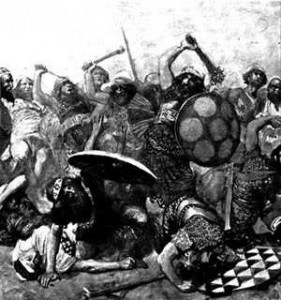
    In two previous posts I have explored and defended Nicholas Wolterstorff’s argument for this conclusion. In God and the Genocide of the Canaanites Part I: Wolterstorff’s Argument for the Hagiographic Hyperbolic Interpretation, I elaborated on, appropriated and expanded Nicholas Wolterstorff’s case for understanding Joshua as a hagiographic, stylised and highly hyperbolic account of Israel’s early skirmishes. In Part II: Ancient Near Eastern Conquest Accounts, I argued that studies into Ancient Near Eastern historiography give considerable support to his conclusion. Joshua appears to follow the same rhetoric, literary conventions and motifs of other ancient Near East conquest accounts and one feature of such accounts is to narrate victories hyperbolically in terms of killing all people, leaving no survivors and so forth. This suggests the description of Joshua putting every inhabitant to the sword, totally destroying all and leaving no survivors, is not to be taken literally. In this last post in this series I want to look at some implications of accepting this.

    I think two implications can be drawn from this conclusion. First,

    On the assumption that Deuteronomy and Joshua are parts of the same sequence of books, this interpretation of Joshua forces a back-interpretation of Deuteronomy. If “struck down all the inhabitants with the edge of the sword” is a literary convention when used to describe Joshua’s exploits, then it is likewise a literary convention when similar words are used by Moses in his instructions to Israel in general and to Joshua in particular.[3]

    I think Wolterstorff is correct here, this interpretation of Joshua does force a back-interpretation of Deuteronomy. Deuteronomy 7:2 states “when Yahweh your God has given them up before you and you have struck them, you shall utterly destroy them”. Similarly, Deuteronomy 20:16-17 states “anything that breathes you shall not keep alive, but you shall utterly destroy them”. In Joshua 10 one sees the formulaic language of “and Yahweh gave [the city]” and they “struck it by the mouth of the sword, and its king he hath destroyed” until there were “no survivors”. The chapter is summarised with the phrase “So Joshua struck all the land, … He destroyed all that breathed”. The similar phraseology is evident.[4]

    Moreover, the book of Joshua clearly, explicitly and repeatedly identifies what Joshua did in these chapters with the command that Moses had given regarding the Canaanites in Deuteronomy.[5] If the language of “striking all the people by the sword”, “leaving no survivors”, “totally destroying”, “striking all the inhabitants with the edge of the sword”, and so on, is hyperbolic (as the evidence suggests it is) then the command cannot have been intended to be taken literally.

    This understanding of the commands in Deuteronomy also solves some other interpretative problems. Here I will mention briefly three.

    First, what God commanded regarding the Canaanites differs in various canonical books (more…)