A common slogan in western liberal societies is that religion is a private matter; it has no place in public discussions of law, economics, public policy, education, social ethics, culture and so on. This “separationist” view is often attributed to US Founding Father, Thomas Jefferson “Wall of Separation Letter” and has become the orthodox view in liberal thought receiving important advocacy by philosophers such as John Rawls.
This idea is often enforced in the courts with public displays or manifestations of religion being challenged on freedom of religion grounds. This has recently been seen in European countries; recent laws and cases have seen bans on religious emblems being worn in schools, employment situations and in public generally. The UK courts recently ruled that Christians could not foster children out of fear their private beliefs about homosexual conduct might be taught to the children.
In the US, a confusing, and often contradictory, array of cases on everything from public displays of the ten commandments, home-schooling, school vouchers and so on has rendered the position in the position more and more hostile towards religion being exercised in public and the law has become more and more difficult to comply with because of increasing lack of clarity as to how it works.
Increasingly in the West we are seeing the idea of religion being something private being accepted by Christian believers who feel that while they personally believe something it is inappropriate for them to apply or utilise these beliefs when thinking about or going about issues that may affect others.
An increasing body of theological, philosophical and legal scholarship has called this orthodox view into question. These scholars have argued that the orthodox view is unjust, contradictory and arbitrary. It is unjust in that it places moral and social restraints on religious advocacy that are not imposed on non-religious views. It is arbitrary and contradictory in that the reasons typically offered for this view, if sound, seem to apply with equal force to any controversial view whether religious or secular and, in fact, to many doctrines central to liberal thought itself. Moreover, it suggests that even if religious beliefs are true and relevant to public issues, believers are to conduct themselves in public in a manner which ignores these beliefs or treats them as if they are not true if they cannot be justified from a secular viewpoint; in private they are free to believe what they want.
Critics of orthodoxy contend this separation of faith and self in public is unrealistic at a psychological level and that it fails to understand how religions function in the lives of believers who believe their religion to be true and not merely just a personal private preference.
New Zealand jurisprudence has not seen the litigation on this subject that the United States and Europe has so it is largely untested. The practice of being influenced by international precedent from the commonwealth and US jurisdictions coupled with our secular society which contains strong factions in favour of the liberal view – secular humanist groups, some politicians, scholars, media, bloggers – suggests that it will fall the way of the rest of the western world unless a robust counter-view is developed and advanced in the New Zealand across disciplines.
Further to the issue of justice, the tendency to view religious beliefs as a merely private preference that is isolated from one’s public actions, decisions and choices is pervasive in the New Zealand evangelical church and it leads to a view of religion that ignores questions of truth and focuses instead on private benefit and piety of religious belief.
For these reasons it is important this conversation be had across disciplines; particularly the three disciplines of theology, philosophy and law need to understand and hear each other so we can work together on this problem.
With this backdrop in mind, Thinking Matters and Evangelical Union bring you, as part of Jesus Week, the following event:
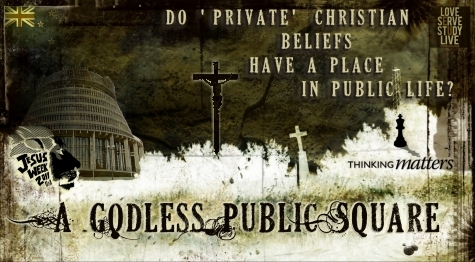
A Godless Public Square:
Do ‘Private’ Christian Beliefs Have a Place in Public Life?
A Jesus Week Dialogue between Theology, Philosophy and Law
7pm Wednesday 3 August
Lib B28 (Library Basement, 5 Alfred St) University of Auckland
Organised by: Thinking Matters and Evangelical Union
Format: Panel Discussion followed by Q&A
Moderated by: Patt Brittenden
Speakers: listed in the order they will speak in: (more…)
 As part of AUSA’s Human Rights week at the University of Auckland, and in association with Thinking Matters, Matt and I will be giving a free public lecture with Q&A on the topic “Freedom of Religion in a Secular Society” on Monday 12 September from 7-8.30pm in Clock Tower Lecture Room 032.