Author: Matt

  • Religion, Science, 9/11 and the Moon: Dawkins’ Response to Copan

    Richard Dawkins and Paul CopanParchment and Pen, has an audio of a brief exchange between Paul Copan and Richard Dawkins who was speaking in Ft. Lauderdale at Nova Southeastern University on “The Fact of Evolution.” (The following week, Paul Copan spoke on “The Fact of God” at Nova Southeastern and gave a direct response to Dawkins.) This MP3 of Paul Copan and Richard Dawkins’ exchange is from the Q&A of Dawkins’ talk.

    In it Paul alludes to an argument advanced by C S Lewis, Alvin Plantinga, Michael Rea, Victor Reppert and also alluded to by Patrica Churchland, Thomas Nagel, William Whewell and Friedrich Nietzche. The argument is that if our cognitive faculties evolved by natural selection, unguided by God, then our cognitive faculties cannot be rationally relied on to give us truth. The literature on this argument is interesting but I won’t comment on that here.

    What interests me is the comment Dawkins made in the MP3 which got the applause of the audience. Dawkins appears to not grasp the point of the argument and takes it to be asking for a reason why he supports “scientific rationalism”. He said he believes in scientific rationalism because it “works”. He then provided an example of how it “works”, it is that “science flies us to the moon, while religion flies planes into buildings.”

    Much could be said here but I want to limit myself to a single point, the evidence Dawkins cites that science works and religion does not. Dawkins offers that science has done good things such as getting us to the moon; religion has done bad things like destroying the World Trade Centre on 9/11. In other words, the positive things science does commends it as a something we should trust whereas the negative things religious does commends it as some thing which we should not trust.

    So let’s look at the claim Dawkins made that “science” got us to the moon. Now how does a subject, get us to the moon? Presumably what he means is that it was through science that we developed the rocket propulsion technology which enabled us to get to the moon.

    But here is the problem. If the fact that science developed the propulsion technology that got us to the moon means that science is responsible for the flight to the moon, and can take credit for it, then science must be responsible for the flight into the World Trade Centre; science developed the propulsion technology of aeroplanes, hence, it should be science not religion that is blamed.

    Moreover, rockets are used for other things apart from space and air travel (more…)

  • Fallacy Friday: Division and Composition

    Today I want to look at two fallacies, the fallacy of composition and the fallacy of division. These two fallacies are related in that they both mistakenly confuse what is true of the parts with what is true of the whole.

    The Fallacy of Composition
    M&MsThe fallacy of composition involves mistakenly reasoning that what is true of all the parts of something is therefore true of the whole of that thing. Some obvious examples would be reasoning that because every track on a CD is 10 minutes long the whole CD is ten minutes long; or arguing that because atoms are colourless, and m&ms are made up of atoms, it follows m&ms are colourless. These are examples are fairly obviously cases of invalid inferences.

    However, some examples are less obvious. In some versions of the Cosmological Argument for God’s existence, or at least in some apocryphal versions of the argument, it is mistakenly argued that because every item in the universe has a prior cause, the universe as a whole has a prior cause. This is mistaken. If the universe is infinite in time, i.e. it has no beginning, then it is possible for the whole universe to be uncaused while every part is caused by a prior part. Hence, what is true of each individual part of the universe will not be true of the whole. Of course, not all forms of the cosmological argument make this mistake but those that do commit the fallacy of composition.

    The Fallacy of Division
    Just as the fallacy of composition mistakenly infers what is true of the parts is true of the whole, the fallacy of division mistakenly reasons that what is true of the whole is true of the parts. This would occur, for example, if someone reasoned that because the All Blacks score multiple tries in a game, it follows that every member of the All Blacks scores multiple tries in a game; or that because a particular wall is fragile and breakable, every single brick that makes up the wall is fragile and breakable.

    Our Schist Flagstone FireplaceThe problem with both these fallacies is that they mistakenly assume that the whole and the parts that make up the whole have the same properties. Madeleine and I have a beautiful flagstone fire-place in our lounge. It is made up of a series of different sized, shaped and coloured pieces of schist rock, plastered together in flagstone formation to make a single rectangle panel. Merely looking at the fire-place gives a visual illustration that the parts can have different properties to the whole. The individual flagstones are a variety of shapes and not very rectangular yet the whole fire-place is rectangular. Some of these rocks are grey, others are brown,  some have amethyst and teal tones to them but the whole panel is not grey, nor is the whole panel brown, amethyst or teal. This visual picture shows, quite nicely, that what is true of the parts is not always true of the whole and vice-versa.

    Conflating Collective & Distributive uses of General Terms
    Apart from the straight-forward mistake of confusing what is true of a part with what is true of the whole, there are more subtle versions of this kind of fallacy. The most common is where a person conflates what is true of a group distributively and what is true of it collectively. This is less technical than it sounds; consider the following two propositions which can be sensibly said to be true:

    1) Cats have roamed the earth longer than humans.

    2) Cats have a natural life span of around 15-20 years.

    1) is a statement about cats collectively; it is a statement about cats as a group. This type of animal has been roaming the earth since before humans came on the scene. On the other hand 2) is true of cats distributively; it is a  about a property possessed by every individual cat.

    Felis takes a break from all the earth roamingIf a person does not pay attention to the differences between distributive and collective uses of general terms one can make fallacious inferences that may sound correct but which are not. An example will illustrate, our children have a cat called Felis who  is around 5 years old. Suppose, however, that I were to reason:

    1) Cats have roamed the earth longer than humans;

    2) Felis is a cat;

    Therefore: (more…)

  • Contra Mundum: “Till Death do us Part” Christ’s Teachings on Abuse, Divorce and Remarriage

    Anne was clearly angry. She relayed how her former husband had been abusive, had beaten her and sexually violated her. Despite this, however, he had never – as far as she knew – had an affair. Did this mean she had sinned before God for leaving her marriage? Was she now required to remain celibate for the rest of her life? Anne recited Jesus’ words with palpable sarcasm, “whoever divorces his wife, except for adultery, and marries another woman commits adultery.”

    Christian MarriageAnne’s story was the real life face of an intellectual journey and struggle I had faced some years earlier during my theology studies. How should I understand the bibles teaching on divorce? When I was at Bible College I remember two approaches vividly.

    The first was from a marriage counsellor who, when I asked him if we should counsel battered spouses to leave their marriages, responded “no, until death do we part”. He refused to take with any seriousness my suggestion that in some cases the death of one spouse might be a realistic outcome if the battered spouse does not leave.

    The second was a lecturer who argued that the New Testament did not speak unequivocally on this topic. While Matthew’s gospel allowed an exception for adultery, Mark’s gospel seemed to condemn divorce outright with no exceptions. On the other hand Paul, in his epistle to the Corinthians, contended that a person abandoned by their spouse “is not bound”. The Greek in this epistle alluded to the wording of a Jewish divorce certificate, which stated that the person in question had a right to remarry. The lecturer, quite correctly, concluded that Paul allowed divorce and remarriage for abandonment. The lecturer then suggested that because Paul added to Jesus’ teaching so could we.

    Both approaches seemed to me to be evidently problematic. My questions remained equally unsolved by the Pastor who told me that he accepted Jesus’ teaching as correct but did not follow it because it was “impractical” in the real world and in his experience. I was underwhelmed by the author who suggested that because Mark, Paul and Matthew disagreed, we should just choose the one we find the most congenial.

    Then I discovered a study, which to my mind answered my questions and addressed Anne’s concerns. The book was Divorce and Re-Marriage in the Bible: The Social and Literary Context by David Instone-Brewer. Brewer is a scholar of first century rabbinical writings. In his book he places Christ’s teaching within the cultural context of first century Judaism; the results are interesting and enlightening.

    The passage Anne cited comes from Matthew 19. This passage begins with a question from the Pharisees – the Jewish religious scholars at that time – which asked, “Is it lawful for a man to divorce his wife for any reason?” In the dialogue the (more…)

  • Fallacy Friday: Tu Quoque (But you did it too!)

    Last week I looked at the Straw Man Fallacy, today I want to explore the tu quoque fallacy. In latin tu quoque (too kwo-kwee) means “you too”;  in fact, the phrase “you did it too” is a good, succinct account of this fallacy. A tu quoque occurs when one rebuts a particular criticism of one’s own position by showing one’s opponent’s position is subject to the same criticism; this is done instead of showing that one’s own position is not susceptible to the criticism.

    A good example is the following segment of a CNN Interview with Osama Bin Laden,

    Q: Now, the United States government says that you are still funding military training camps here in Afghanistan for militant, Islamic fighters and that you’re a sponsor of international terrorism. … Are these accusations true? …

    Osama Bin LadenOsama Bin Laden: … At the time that they condemn any Muslim who calls for his right, they receive the highest top official of the Irish Republican Army at the White House as a political leader, while woe, all woe is the Muslims if they cry out for their rights. Wherever we look, we find the US as the leader of terrorism and crime in the world. The US does not consider it a terrorist act to throw atomic bombs at nations thousands of miles away, when it would not be possible for those bombs to hit military troops only. These bombs were rather thrown at entire nations, including women, children and elderly people and up to this day the traces of those bombs remain in Japan. The US does not consider it terrorism when hundreds of thousands of our sons and brothers in Iraq died for lack of food or medicine. So, there is no base for what the US says and this saying does not affect us.[1]

    Here Bin Laden was asked to respond to the claim that he has been sponsoring terrorism and training Islamic militants. Bin Laden argued that there is no basis for this claim because the United States supports terrorism and has itself engaged in activities which can justifiably be labelled ‘terrorist’. Bin Laden’s comments about the United States may or may not be true but either way it would not answer the questions as to whether Bin Laden has been sponsoring terrorism. It is possible, after all, that both Bin Laden and the United States sponsor and engage in terrorism.

    The Difference Between a Tu Quoque and Internal Criticism
    It is important to distinguish this argument from another similar argument, which I will call internal criticism. Internal criticism occurs when one argues against an opponent’s position by noting that one proposition the opponent holds conflicts with another proposition he holds.

    An example is Alvin Plantinga’s famous argument in God and other Minds. In this book Plantinga looks at the question of whether belief in the existence of God is irrational because it cannot be proven to be true with a non-circular argument (more…)

  • Hoist with one’s own petard

    Hoist with one's own petard

    When a Christian says that all other religions are false, he is deemed narrow minded.

    When an atheist says that all religions are false, she is deemed open minded.


  • The Sceptic and the Scientist: Ed Feser on Richard Dawkins and PZ Myers

    String TheoryHe is not one to pull punches and true to form, in To a Louse, Ed Feser holds a mirror up to the kind of reasoning that is all too common amongst Dawkins and Myers fans with this fictional dialogue between a scientist and a science sceptic;

    Skeptic: Science is BS. Physicists believe in these things called “quarks,” which are little flavored particles that spin around and work like magic charms. Their evidence is that they read about them in a James Joyce novel. Some of them think the universe is made up of tiny shoelaces tied together, though they admit that they have no evidence for this and have to take it on faith. Einstein said morality is all relative – which is why he stole his ideas from this guy who worked in a patent office, and why Richard Feynman stole atomic secrets during WWII. Meanwhile, the chemists contradict the physicists and believe instead in little colored balls held together by sticks. Biologists believe monkeys can give birth to human beings. What a bunch of crap! It’s child abuse to teach kids about this stuff in schools.

    Scientist: Are you joking? If not, I suggest that you actually read some science before criticizing it.

    Skeptic: I’ve already read a lot about it, in blog comboxes like this one. And why should I waste my time reading anything else? I already know it’s all BS! Didn’t you hear the examples I just gave?

    Scientist: No, you’re missing my point. You’ve completely distorted what scientists actually say. It’s not remotely as silly as you think it is. In fact it’s not silly at all. But you need to actually read the stuff to see that.

    Skeptic: So you deny that physicists believe in quarks? What flavor are your quarks, chocolate or vanilla? Do you deny that they think we came from monkeys? Which monkey was your mother?

    Scientist: No one says that monkeys gave birth to humans. That’s a ridiculous caricature. And of course I don’t deny that physicists believe in quarks, but you’re badly misunderstanding what they mean when they attribute “flavor” to them. They don’t mean that literally…

    Skeptic: Oh so it’s just empty verbiage, then. See, you’re just proving my point for me.

    Scientist: No, it’s not empty verbiage. It’s technical terminology.

    Skeptic: I see, like magic spells. That’s why (more…)

  • Fallacy Friday: The Straw Man

    In my last Fallacy Friday I covered the The Genetic Fallacy, the error of arguing that an idea is false on the basis of where it originated from. Today I want to look at what’s known as the “straw man” fallacy.

    Origins of the Name
    This fallacy takes its name from a practice common in the middle ages. A knight would practice jousting by putting a straw man on a horse and attempting to knock it off. This practice provides a vivid image of how the fallacy works, anyone who knocks a straw man off a horse has not defeated a jousting opponent; he has only knocked down a dummy or effigy of his opponent. A real opponent was not so easy to knock down.

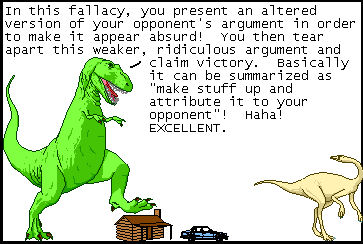
    Straw Man

    www.qwantz.com

    Similarly, the straw man fallacy occurs when a person attempts to refute an argument or conclusion, not by showing that that argument is unsound or that the conclusion is false, but instead by falsely attributing a different argument or conclusion to their opponent and refute that. Usually the position attributed to the opponent is similar to their actual position so that it looks to other people like it has actually been refuted. Like the straw man the jouster trains with, the falsely attributed position is typically easier to rebut. Unfortunately rebutting an argument or conclusion which is like your opponent’s, is not the same as refuting the argument or conclusion your opponent actually holds.

    Structure
    Straw man reasoning typically proceeds in the following fashion, let’s say John and Sally are having a discussion:

    1. John affirms P.
    2. Sally then attributes Q to John (Q is a distorted version of P although superficially similar to it).
    3. Sally then offers a refutation of Q
    4. Sally concludes she has refuted P.

    In this exchange Sally does not respond to P. Instead she misrepresents John’s position as being Q.

    There are several ways this kind of misrepresentation is (more…)