Author: Matt

  • Fallacy Friday: Assessing Arguments

    In last week’s post, Fallacy Friday: What is an Argument?, we established that an argument is a set of reasons (or premises) offered in support of a conclusion. We noted that arguments always have  two components: premises and conclusions. We also observed that premises sometimes can be implicit or unstated.

    Is your argument a success or a failure?Of course knowing what an argument is, in and of itself, does not help us much to ascertain whether the argument in front of us is a good one or a bad one. When we are faced with conflicting arguments we want to know how to evaluate them; that is what logic and analytical philosophy is all about.  Here I will say a couple of things about how one goes about assessing an argument.

    First, note that in assessing arguments we are interested in truth. It should not need saying but arguments are not good arguments because the arguer makes us feel good or looks good or what they say sounds nice or like the easy option or like what all our peers think and so on.

    The exact definition of what truth is remains a matter of philosophical debate. Aristotle described the intuitive idea several thousand years ago when he stated,

    “To say of what is that it is not, or of what is not that it is, is false; while to say of what is that it is, and of what is not that it is not, is true.”

    A proposition or assertion is true when what it affirms is, in fact, the case and it is false when what it affirms is, in fact, not the case.

    However, merely having a true conclusion as part of our argument is not enough. As I noted last week, we can believe a true conclusion for really bad reasons, so we should not just aim at our argument having a true conclusion -we want to hold to true conclusions for good reasons. In working out whether an argument has good reasons and a true conclusion, two features are crucially important: these are validity and soundness.

    Validity
    In logic the word ‘valid’ has a technical and precise meaning; it means an argument is structured in such a way that it is impossible for the premises to be true and the conclusion false. An example would be as follows:

    Premise: All men are under 10 feet tall;

    Premise: John is a man;

    Conclusion: John is under 10 feet tall.

    This argument is valid because the premises cannot both be true and the conclusion false. If it is true that all men are under 10 feet tall and if it is true that John is a man then John cannot be over 10 feet tall. If it were possible for John to be over 10 feet tall then the first premise would mean he could not be a man, which, of course, would contradict the second premise.

    Note in this technical sense of ‘valid’, validity is a feature of an argument. In common colloquial language people talk of someone having a “valid point” but in logic we do not do this (more…)

  • Abraham, Isaac, Virginity, Rape and Child Killing (Another Old Testament Ethics Post)

    Randal Rauser has published a blog post touching on Old Testament ethics called “An update in the wake of Atlanta (plus a bit on rape and child killing)“. His post gives an update on his thoughts following his interaction with Paul Copan, Richard Hess and myself in the Evangelical Philosophical Society’s break-out panel discussion “Is Yahweh a Moral Monster” at the Society for Biblical Literature (“SBL”) in Atlanta in November. While there was considerable overlap between his position and mine, there was one particular issue on which he and I disagreed quite sharply on the night that he alludes to in his post. Let me contextualise this disagreement and then put my response to his comments.

    Back in 2009 I wrote “Abraham and Isaac – Did God Command the Killing of an Innocent?” This post addressed a dilemma several philosophers have raised for those Christians who take the patriarchal narratives in Genesis in literal manner. It seems plausible that Christians who do this are committed to an inconsistent triad,

    1. If God commands an action x then x is morally required;
    2. It is wrong to kill innocent human beings;
    3. God commanded Abraham to kill an innocent human being.

    These three propositions are inconsistent; 1 and 3 entail the denial of 2.

    To respond to this triad, I appropriated a thought experiment provided by John Hare; I wrote:

    One example Hare notes, is particularly interesting, “Perhaps (to get more bizarre) God could have willed that we kill each other at the age of 18, at which point God would bring us immediately back to life.” Hare asks us to imagine a world, in which, when people of a certain age are killed they immediately come back to life. He opines, quite plausibly, that if this were to be the case then killing people at this age would not be wrong or at least, not seriously wrong. One of the reasons that killing people is wrong in the world we live in is because people stay dead. If they were only unconscious for a split second and came back to life in full health then arguably killing a person would not be the serious wrong we believe it is.

    I suggested that, a careful examination of the text reveals that Abraham’s actions occurred in a context where he knew his son would not stay dead but would come down the mountain with him and live on to adulthood to father children of his own. I argued this fact resolves the dilemma,

    Once this is realised, I think it is evident that [1], [2] and [3] are consistent. If one assumes, for the sake of argument, that the Patriarchal Narratives are literally true then it follows that [3] is true only if a certain context is assumed. God commanded Abraham to kill his son in the highly unusual context where Abraham knew that his son would not stay dead but would come down the mountain afterwards and live on to adulthood to father children of his own. Proposition [2] is defensible only in a context where people do not know these sorts of things; the rule to not kill the innocent applies to a world where people do not come back to life after they have been killed. Hence, the story of Abraham and Isaac, if taken literally, does not entail that God commanded something immoral or contradictory.

    What I later discovered is that Paul Copan sometimes reads this blog and he, on reading my post, summarised my argument and appropriated it (with acknowledgements)  in chapter 5 of his latest book Is God a Moral Monster: Making Sense of the Old Testament God.

    The EPS Session at the SBL: Richard Hess, Randal Rauser, Paul Copan,  Matthew Flannagan, Michael ReaEnter Randal Rauser. In the paper he presented for the SBL panel, Rauser made a remark on the Abraham and Isaac issue. Copan responded by summarising his argument, which was an appropriation of my argument. Rauser responded with an analogy, which he has since (more…)

  • Fallacy Friday: What is an Argument?

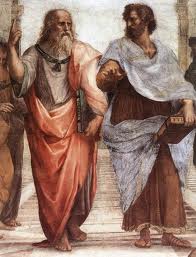
    Plato and Aristotle arguing in the School of AthensWhen I was doing my PhD at the University of Otago, Madeleine and I would try to save up for a “date night” once a fortnight.  Often we would go to the movies. On more than one occasion we would stand in the theatre and look at various options. Madeleine would suggest we see one movie and give some reasons, I would suggest another. After a few minutes we would settle on a movie and then buy a ticket.

    In the technical sense, in amicably settling on which movie we would see Madeleine and I had ‘had an argument.’ Now, in everyday language when we say a husband and wife have ‘had an argument’ we mean they have quarrelled, had a fight, come into conflict with each other and so forth. In logic, however, the phrase is more precise. An argument is defined as a set of reasons in support of a conclusion.

    This definition suggests an argument has two features:

    A Conclusion: the claim being proposed as true; and,

    Premises: a set of propositions or statements being made in support of a conclusion.

    It is important to note that these features are not the same thing. Simply asserting your conclusion is not an argument, it is a statement. Asserting random facts does not constitute an argument either, unless these facts are offered in support of some conclusion. Grasping the distinction between a premise and a conclusion is important because it is possible, and in many cases likely, that you will come across an argument which has a conclusion you agree with and yet the premises offered for it are either false or do not support this conclusion. Consider the following:

    Premise [1] The sun is divine;

    Premise [2] Whatever is divine would exist in the centre of the solar system and have all other planets orbiting it;

    Therefore:

    Conclusion [3] The sun is at the centre of the solar system and all the other planets orbit it.

    Pretty much all of us would accept the conclusion of this argument. However, few of us would accept the premises. It is important to note this because one real problem that exists in our current society is that people fail to draw the distinction between (more…)

  • Fallacy Fridays

    Over the past few years I have occasionally been asked by para-church, church and home-schooling groups to put together a critical thinking or “mini logic” course, with a focus on fallacy spotting, and teach it to their youth. I have done this from time to time and have often found as many adults in attendance as youth; the demand for this sort of thing seems to be fairly high if the turnouts of these events are anything to go by.

    Invalid ArgumentCourses of this sort are common in a first year university philosophy programs but there are not many that are accessible to younger students of high school age or those not enrolled in such programs. It also seems that there are not many resources out there for self-teaching that are lay friendly in general. Madeleine and I subscribe to the email lists of a few home schooling groups and it is not uncommon for us to see people asking where they can find resources of this nature to use in their small groups and within their families. Those resources that get recommended are not always so user friendly and sometimes their quality is deficient.

    So, given that Thinking Matters Tauranga have been particularly keen for some time now for me to formally put together what I have been doing ad hoc (along with a few other other groups) I have decided to do a short piece on this every Friday on MandM entitled “Fallacy Friday”. This should enable me to both actually get on with sorting through the rough notes I normally work from into tidier form and get critical feedback on the material itself – some understanding of how others will understand what is said and so on would be very useful before I turn this into a course I offer to small groups.

    The first few Fallacy Friday posts will cover some basics then I will move into common fallacies proper with examples and application. To navigate the series as we go on, use the tag.

    Apologetics 315 are producing an audio version of this series, also released every Friday. Subscribe to the Fallacy Friday Podcast using:
    • RSS Feed, or
    • Via iTunes, or
    • one-click to your feed-reader

  • God and the Genocide of the Canaanites Part III: Two Implications of the Hagiographic Hyperbolic Account

    This three-part blog series is a modified version of what I presented to the Evangelical Philosophical Society meeting in November 2010.

    Joshua Slaughters the Canaanites

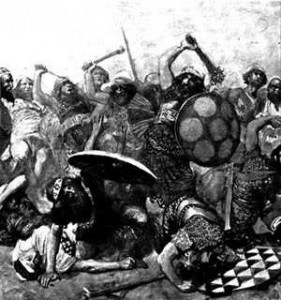
    In a recent Conference at Notre Dame Alvin Plantinga suggested that the commands to wipe out the Canaanites, recorded in the book of Deuteronomy, might be hyperbolic; they should be understood more like how we understand a person who states, in the context of a boxing match, “knock his block off, hand him his head”, or in a football game where a person states that the team should “kill the opposition” or boasts that “we totally slaughtered them.”[1] Understood this way, the commands in Deuteronomy meant “something like attack them, defeat them, drive them out; not literally kill every man, woman, child donkey and the like”.[2]

    In two previous posts I have explored and defended Nicholas Wolterstorff’s argument for this conclusion. In God and the Genocide of the Canaanites Part I: Wolterstorff’s Argument for the Hagiographic Hyperbolic Interpretation, I elaborated on, appropriated and expanded Nicholas Wolterstorff’s case for understanding Joshua as a hagiographic, stylised and highly hyperbolic account of Israel’s early skirmishes. In Part II: Ancient Near Eastern Conquest Accounts, I argued that studies into Ancient Near Eastern historiography give considerable support to his conclusion. Joshua appears to follow the same rhetoric, literary conventions and motifs of other ancient Near East conquest accounts and one feature of such accounts is to narrate victories hyperbolically in terms of killing all people, leaving no survivors and so forth. This suggests the description of Joshua putting every inhabitant to the sword, totally destroying all and leaving no survivors, is not to be taken literally. In this last post in this series I want to look at some implications of accepting this.

    I think two implications can be drawn from this conclusion. First,

    On the assumption that Deuteronomy and Joshua are parts of the same sequence of books, this interpretation of Joshua forces a back-interpretation of Deuteronomy. If “struck down all the inhabitants with the edge of the sword” is a literary convention when used to describe Joshua’s exploits, then it is likewise a literary convention when similar words are used by Moses in his instructions to Israel in general and to Joshua in particular.[3]

    I think Wolterstorff is correct here, this interpretation of Joshua does force a back-interpretation of Deuteronomy. Deuteronomy 7:2 states “when Yahweh your God has given them up before you and you have struck them, you shall utterly destroy them”. Similarly, Deuteronomy 20:16-17 states “anything that breathes you shall not keep alive, but you shall utterly destroy them”. In Joshua 10 one sees the formulaic language of “and Yahweh gave [the city]” and they “struck it by the mouth of the sword, and its king he hath destroyed” until there were “no survivors”. The chapter is summarised with the phrase “So Joshua struck all the land, … He destroyed all that breathed”. The similar phraseology is evident.[4]

    Moreover, the book of Joshua clearly, explicitly and repeatedly identifies what Joshua did in these chapters with the command that Moses had given regarding the Canaanites in Deuteronomy.[5] If the language of “striking all the people by the sword”, “leaving no survivors”, “totally destroying”, “striking all the inhabitants with the edge of the sword”, and so on, is hyperbolic (as the evidence suggests it is) then the command cannot have been intended to be taken literally.

    This understanding of the commands in Deuteronomy also solves some other interpretative problems. Here I will mention briefly three.

    First, what God commanded regarding the Canaanites differs in various canonical books (more…)

  • Did Hannibal of Carthage Exist?

    HannibalHistorian James Hannam has written an entertaining article called “Satirising the Christ Myth.” The piece uses similar methods employed by those seeking to make the case for the claim that Jesus never existed to show that Hannibal of Carthage did not exist either. It is written in Hannam’s classicly witty yet accurate style;

    Did Hannibal Really Exist?

    To ask whether or not the great Carthaginian general Hannibal ever actually existed might seem rather pointless. It might be an exercise for a student learning about the nature of historical evidence, but not something any serious scholar would waste time on. But maybe we should not be too hasty in acquiescing with the opinion of establishment historians (in other words, there’s a plot by academics stifling debate).

    In fact, although there is plenty of writing about Hannibal, none of it is contemporary and there is no archaeological evidence for him at all (not surprising given the Romans razed the city from whence he came). Furthermore he is not mentioned in any Carthaginian sources, which is incredible, given he was supposed to be their greatest leader (there are no Carthaginian sources as the Romans burnt their city down)! We find when we actually try to pin him down he tends to recede further into the mists of time. His exploits, such as leading elephants over the Alps, are clearly legendary (the skeptic pretends to be incredulous but seems happy to buy his own amazing theory) and it is not hard to find a motive for the creation of this colorful character by Roman writers (as long we can invent a motive for fabrication we can assume that fabrication exists).

    Rome and Carthage were great trading rivals in the Western Mediterranean and it did not take them long to come to blows. Rome signed a peace treaty but, under the leadership of the elder Cato, desperately wanted to rid itself permanently of the competition (this is actually true and so helps to conceal the moment when we slip into fantasy). The Romans needed an excuse and the idea they developed was brilliant. Like many ancient civilizations, the Romans rewrote history as it suited them to exhibit their own prowess (a useful and exaggerated generalization). Consequently we should not be surprised to find that they invented a great enemy from Carthage to demonstrate the threat still existed and justify a further war to wipe them out.

    The author of the fiction was Cato himself (we need someone to point the finger at; note also how there is no distinction made between the background material above and theorizing here), as Cato wrote the earliest Roman History (true as well, as it happens). But it was intended simply as a justification for a further war with Carthage. It contained the details of Hannibal’s alleged campaigns against the Romans, including his victories on Italian soil (Cato’s history has conveniently not survived so we can speculate freely about what it contained). Cato brilliantly combined the truth with his own anti-Carthaginian propaganda with the intention of goading Rome into another wholly unjustified war with the old enemy (give the fabricator lots of credit for his invention). Once the war was over and Carthage was razed to the ground, the Romans were able to ensure that only their version of history survived (this is important as it enables all other sources to be declared forgeries).

    Therefore the myth of the great Carthaginian war leader became an accepted fact. Later Roman historians like the notoriously unreliable Livy (we have to denigrate counter sources) simply assumed Cato’s fabrications were true (because the ancients were stupid and simply could not do any research themselves).

    Conclusion

    The earlier parts set out in “The Christ Myth won’t die“ are also worth reading.

    RELATED POSTS:
    Guest Post: James Hannam on Dan Brown’s History of Science
    The “Dark Ages” and Other Propaganda
    More on the “Dark Ages” and Other Propaganda

  • God and the Genocide of the Canaanites Part II: Ancient Near Eastern Conquest Accounts

    This three-part blog series is a modified version of what I presented to the Evangelical Philosophical Society meeting in November 2010.

    Joshua stops the sun

    In my previous post, God and the Genocide of the Canaanites Part I: Wolterstorff’s Argument for the Hagiographic Hyperbolic Interpretation, I expounded and adapted Nicholas Wolterstorff’s argument for a hagiographic hyperbolic reading of the book of Joshua. Wolterstorff’s argument has, I think, considerable force. Judges and Joshua cannot both be taken literally as their accounts are at odds; given the internal evidence Wolterstorff cites it is reasonable to contend that Joshua is the one that is non-literal. Wolterstorff, however, limits his case to what I call internal evidence, evidence from within the text itself. I think there is some interesting external evidence, evidence of how particular terms and language were used in other Ancient Near Eastern histories of conquests and battles, which could be added to Wolterstorff’s argument to make it significantly more plausible. Here I will cite three lines of such evidence.

    The first is that comparisons between the book of Joshua and other Ancient Near Eastern conquest accounts from the same period demonstrate some important stylistic parallels. Various studies have documented these similarities. Commenting on the structure of the campaigns mentioned in Joshua 9-12, Kitchen notes;

    This kind of report profile is familiar to readers of ancient Near Eastern military reports, not least in the second millennium. Most striking is the example of the campaign annals of Tuthmosis III of Egypt in his years 22-42 (ca. 1458-1438). … [T]he pharaoh there gives a very full account of his initial victory at Megiddo, by contrast with the far more summary and stylized reports of the ensuing sixteen subsequent campaigns. Just like Joshua against up to seven kings in south Canaan and four-plus up north.[1] [Emphasis added]

    Kitchen adds,

    The Ten Year Annals of the Hittite king Mursil II (later fourteenth century) are also instructive. Exactly like the “prefaces” in the two Joshua war reports (10:1-4; 11:1-5), detailing hostility by a number of foreign rulers against Joshua and Israel as the reason for the wars, so in his annals Mursil II gives us a long “preface” on the hostility of neighbouring rulers and people groups that lead to his campaigns.[2] [Emphasis added]

    Kitchen adds other examples. He observes that the same formulaic style found in Joshua is also used in the Amarna letters EA 185 and EA 186.[3]Similarly, before his major campaigns (more…)