Author: Matt

  • God and the Genocide of the Canaanites Part I: Wolterstorff’s Argument for the Hagiographic Hyperbolic Interpretation

    Around this time last year I wrote two posts Joshua and the Genocide of the Canaanites I and Joshua and the Genocide of the Canaanites II. These posts attracted a fair amount of attention and debate. I got offers to publish my ideas in several upcoming books and present them before both the Evangelical Philosophical Society (EPS) and the Society for Biblical Literature in November 2010. Since the original posts I have corresponded with various people and I have modified and refined some of the ideas. This three-part blog series is a modified version of what I presented to the EPS last month. These posts supersede and update what I wrote in a year ago.
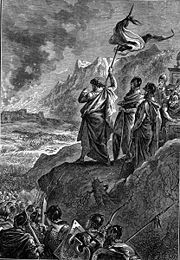
    Joshua at AiOne of the most perplexing issues facing Christian believers is a series of jarring texts in the Old Testament. After liberating Israel from slavery in Egypt, the Israelites arrived on the edge of the Promised Land. The book of Deuteronomy records that God then commanded Israel to “destroy totally” the people occupying these regions (the Canaanites); the Israelites were to “leave alive nothing that breathes”. The book of Joshua records the carrying out of this command. In the sixth chapter it states “they devoted the city to the LORD and destroyed with the sword every living thing in it—men and women, young and old, cattle, sheep and donkeys”. In the tenth and eleventh chapters it states that Joshua “left no survivors. He totally destroyed all who breathed, just as the LORD, the God of Israel, had commanded.” The text mentions city after city where Joshua, at God’s command, puts every inhabitant “to the sword”  “totally destroyed the inhabitants” and “left no survivors.”

    If one takes these passages literally they record the divinely-authorised commission of genocide. But genocide surely is morally wrong. In the light of this, critics of Christian theism often ask a rhetorical question; how could a good and loving God command the extermination of the Canaanites?

    One response which goes back to the patristic era is to suggest that the strict, literal reading on which this rhetorical question is based is mistaken. Recently, several, protestant scholars have suggested a hyperbolic reading of the relevant passages.[1] Perhaps the most detailed is that proposed by Nicholas Wolterstorff. Wolterstorff suggests,

    “[T]hat the Book of Joshua has to be read as a theologically-oriented narration, stylized and hyperbolic at important points, of Israel’s early skirmishes in the Promised Land, with the story of these battles being framed by descriptions of two great ritualized events.  The story as a whole celebrates Joshua as the great leader of his people, faithful to Yahweh, worthy successor of Moses.  If we strip the word “hagiography” of its negative connotations, we can call it a hagiographic account of Joshua’s exploits.”[2]

    In this series I will defend Wolterstorff’s position. In this post I will sketch, adapt and defend Wolterstorff’s argument. In Part II, I will argue that external evidence from comparative studies in Ancient Near Eastern conquest accounts gives considerable support to Wolterstorff’s position. Finally in Part III I will look at two implications of this position.

    Wolterstorff’s Argument
    Wolterstorff’s contention is that “a careful reading of the text in its literary context makes it implausible to interpret it as claiming that Yahweh ordered extermination”. It is important to note what he means by context. Here, it is clear that Wolterstorff is advocating a canonical approach. He notes that,

    “Joshua as we have it today was intended as a component in the larger sequence consisting of Deuteronomy, Joshua, Judges, I and II Samuel, and I and II Kings…  I propose that we interpret the Book of Joshua as a component within this larger sequence – in particular, that we interpret it as preceded by Deuteronomy and succeeded by Judges.”[3]

    Joshua comes after Deuteronomy and before Judges. Wolterstorff points out that these books should be read as a single narrative. When one does this, however, several issues are apparent. (more…)


  • An Atheist and a Christian walk into a Bar… Original Sin & the Existential Paradox

    My previous post, William Lane Craig, Original Sin and Original Guilt, touched on the doctrine of original sin. According to the standard western articulation of this doctrine it has three components. First that human beings have a propensity towards doing wrong. Second, this propensity is inherited from our ancestors, it is not that we come into the world perfect and then later abandon perfection. In Edward Oakes’ words in “Original Sin: A Disputation”, “sin after Adam always takes the form of acquiescence and not of origination. We are born, that is, into a world where rebellion against God has already taken place, and the drift of it sweeps us along.” Finally, despite this we are responsible for this propensity in some way.

    As both theologians and philosophers have noted for centuries this doctrine appears paradoxical. How can we be responsible for something we inherit? I agree that there is something of a paradox in the notion of original sin and it is hard to find a coherent way of making sense of it. In this post I will take a different tack; I want to suggest that denying theological doctrines of original sin will not resolve this paradox. The reason: the paradox is in fact a paradox which is part of human existence and human moral experience. Hence, even without a doctrine of original sin, the paradox is still apparent to anyone who reflects on their experience.

    Original Sin

    This was made clear to me in a conversation I had in a bar with an atheist friend. My interlocutor, who had had a staunch Calvinist upbringing, was railing against the Calvinist doctrine of original sin and the apparent contradictions in it. His observations were fairly astute. He noted that on the one hand Calvinist parents instilled personal responsibility in their children and brought them up to accept responsibility and accountability for their actions. This he commended as morally good. At the same time he noted that these same parents believe in original sin. They believed human nature, as it exists today, is corrupt. Humans come into the world with a propensity to evil; their view is that from birth onwards it is inevitable that we will sin, that our hearts are inclined towards evil and so on. He proceeded to argue that if the latter view was correct then the former must be false. The doctrine of original sin undercuts the idea of personal responsibility.

    I listened carefully to my friend’s argument, when he had finished I asked him a question:

    Did he consider himself a moral agent who was responsible for his actions?

    Unsurprisingly, given his recent praise for personal responsibility, he immediately answered yes.

    Then came my second question:

    Have you ever lied? (more…)

  • What Sex is Not

    Recreational ActivityChildren cannot, either by themselves or by proxy, give valid consent to sexual intercourse.

    Children can give consent, by themselves or by proxy, to casual recreational activities.

    Therefore, sex is not merely a casual recreational activity.

  • Contra Mundum: In Defence of Santa

    I grasped the sponge, water dripped down my wrist as I took aim. The man from the McGillicuddy Serious Party raised his voice and said “now throw!” The sponge flew through the air from my hand and struck Santa solidly on the chest soaking his red costume. Santa laughed and said “throw another one!”

    It was my second year at university and the McGillicuddies were running their annual “throw a sponge at Santa” event. This was done ostensibly to protest materialistic consumerism of which they saw Santa as a modern icon. I was simply sick of the whole hypocritical façade that was Christmas. An event that for many, myself included, has deeply religious significance was being trivialised by a fat man in a red suit from the north-pole. It really irked me.

    Years have passed since this event and with age comes (I hope) more reserve and wisdom. I have learned more about the cultural icon known as Santa and I have come to appreciate, at least from an historical perspective, why this icon exists. I agree that today the historical meaning of this icon has been forgotten. However I think that the solution to this forgetfulness is to re-awaken our cultural memory by addressing the theological and historical ignorance prevalent in our culture; attempts to cut ourselves off from the past even further are not the right approach.

    Nicholas of Myra

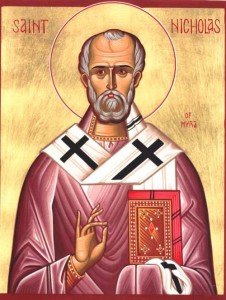
    The reference to Santa as an icon is apt because the original Santa, Nicholas of Myra, became an icon in religious art. In earlier times there was no printing press and illiteracy was widespread so vivid art became an important way of communicating a message. Characters had to be readily recognisable, in religious art Nicholas was represented by the figure of a man with a large white beard. Given that he was a Catholic bishop, he was portrayed in red robes. The figure of a white-bearded man in red robes became a symbol for an historical person, and the story of Nicholas was kept alive because of its immediate relevance for the present.

    Nicholas of Myra was probably (more…)

  • Oprah Winfrey, Religious Pluralism and Woolly Thinking

    Oprah WinfreyI once caught 5 minutes of Oprah discussing religion. She made the comment, in a very sage-sounding tone, that she believed all religions are true. The audience immediately interrupted her with resounding applause; camera shots caught audience members nodding in approval, clearly impressed with the wisdom of the claim just made.

    This commonly heard platitude may sound clever, wise and sensible but let’s unpack it:

    • All religions are true;
    • Christianity is a religion;
    • Christianity claims to be the only true religion;

    Therefore:

    • If all religions are true, Christianity is the only true religion.

    [The same line of argument works with any religion which rejects the first premise.]

  • Contra Mundum: The Number of the Beast

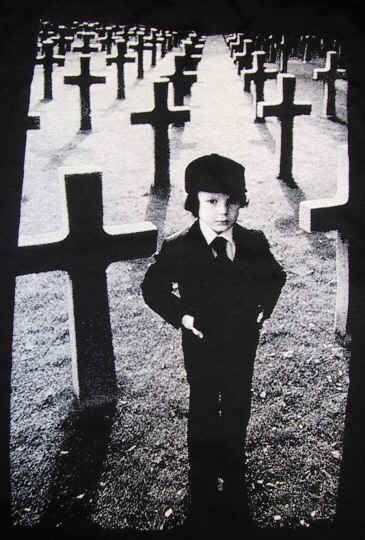
    The OmenRecently TV3 screened The Omen. This classic horror is a about a boy called Damian who is the predicted anti-Christ and appropriately has the number 666 on his head. This film epitomises how the book of Revelation is understood in contemporary culture; apparently it predicts a future person, the beast or the anti-Christ who will take over the world. Associated with this is the number 666 which is literally inscribed into people’s heads or hands.  I think this pop-theology is mistaken.

    The relevant section in Revelation says:

    And the dragon stood on the shore of the sea. And I saw a beast coming out of the sea. He had ten horns and seven heads, with ten crowns on his horns, and on each head a blasphemous name. The beast I saw resembled a leopard, but had feet like those of a bear and a mouth like that of a lion. The dragon gave the beast his power and his throne and great authority… The whole world was astonished and followed the beast. Men worshiped the dragon because he had given authority to the beast, and they also worshiped the beast and asked, “Who is like the beast? Who can make war against him?” (Rev 13:1-2, 3b-4)

    The text proceeds:

    Then I saw another beast, coming out of the earth. He had two horns like a lamb, but he spoke like a dragon. He exercised all the authority of the first beast on his behalf, and made the earth and its inhabitants worship the first beast … He also forced everyone, small and great, rich and poor, free and slave, to receive a mark on his right hand or on his forehead, so that no one could buy or sell unless he had the mark, which is the name of the beast or the number of his name. This calls for wisdom. If anyone has insight, let him calculate the number of the beast, for it is man’s number. His number is 666. (Rev 13:11,16-18)

    Most English translations mention the number 666, (more…)

  • God, Morality and Abhorrent Commands: Part III Philip Quinn

    In this three-part series I look at some different ways of adjudicating conflicts between apparent divine commands and moral beliefs. I started with Immanuel Kant, I then looked at Robert Adams’ defence of Kant’s position. Now I will complete the series by exploring Philip Quinn’s alternative view.

    In “God, Morality and Abhorrent Commands: Part II Robert Adams” I mentioned Phillip Quinn’s observation that theists can face a particular dilemma,

    “[I]t seems possible that a theist should have both good reasons for believing that God has commanded him to perform a certain action and good reasons for believing that it would be morally wrong for him to perform that action. Thus a theist can be confronted with moral dilemmas of a peculiar sort.”

    Quinn’s point is that a theist might find himself believing all three of the following propositions:

    [1] Whatever God commands is morally permissible;

    [2] God commands X;

    [3] It is wrong to do X.

    Adams and Kant argued that one should resolve dilemmas of this sort by affirming [3] and denying [2].  I argued in Part I Kant and Part II Robert Adams that this conclusion is unjustified. What Adams does show is that one cannot “accept a theological ethics that ascribes to God a set of commands that is too much at variance with the ethical outlook that we bring to our theological thinking.” [Emphasis added] His position, in fact, suggests that in many cases we should accept divine commands at variance with our moral beliefs. Hence, there may well be times when it is rational to reject [3] and embrace [2].

    In this last post I will elaborate Quinn’s answer to this question. Quinn’s position can be seen by contrasting two approaches he takes to specific examples of the kind of dilemma he cites.

    The first is Quinn’s response to the dilemma posed by “the sins of the patriarchs” (more…)